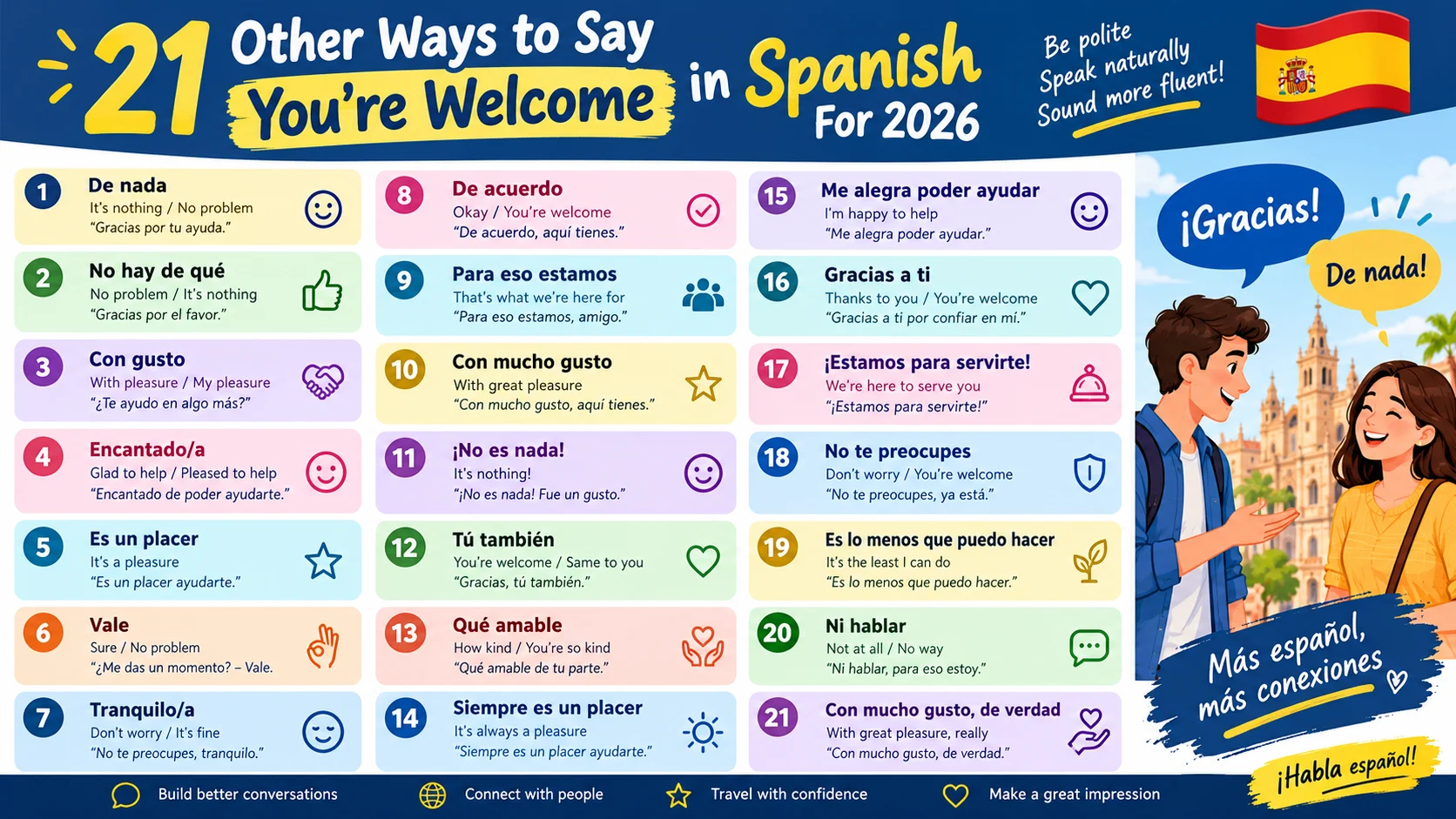
De nada is the standard way to say “you’re welcome” in Spanish, but no hay de qué, con gusto, un placer, and a la orden offer more warmth, formality, or regional flavor. Choose based on the situation and relationship.
“De nada” is the first phrase most learners memorize when responding to “gracias.” It’s reliable, universally understood, and perfectly polite. But relying on it exclusively makes your Spanish sound textbook-flat. Native speakers constantly rotate through expressions that carry different warmth, formality, and regional identity.
This guide covers 15 other ways to say you’re welcome in Spanish, from casual replies among friends to polished phrases for professional settings. Each alternative includes tone, formality level, and real examples so you can pick the right phrase with confidence.
Whether you’re chatting with a host family, emailing a client in Mexico City, or simply want to sound less repetitive, these alternatives to “you’re welcome” in Spanish will sharpen your fluency and cultural awareness.
Quick Categories
Formal Alternatives
- No hay de qué “There’s no reason for thanks.” Slightly more elegant than de nada.
- Es un placer “It’s a pleasure.” Warm yet professional.
- A su servicio “At your service.” Highly deferential.
- Con mucho gusto “With much pleasure.” Formal but genuinely warm.
- Para servirle “To serve you.” Traditional and respectful.
Pro Tip
These phrases work beautifully in business emails, customer service, and interactions with elders or superiors. The extra formality signals respect without sounding cold.
Professional Alternatives
- Con gusto “With pleasure.” The go-to in Latin American service contexts.
- No hay de qué “Don’t mention it.” Gracious and composed.
- Un placer “A pleasure.” Concise and polished.
- A la orden “At your command.” Standard in Colombia and Venezuela.
- Estamos para servirle “We’re here to serve you.” Ideal for client-facing roles.
Pro Tip
In professional Spanish, “con gusto” and “no hay de qué” hit the sweet spot respectful, natural, and never stiff.
Business Email Alternatives
- No hay de qué Clean, professional, and universally appropriate.
- Es un placer Adds warmth to transactional emails.
- Con gusto Friendly but still workplace-safe.
- Quedo a su disposición “I remain at your disposal.” Formal email closer.
- A la orden Regional favorite in Andean business culture.
Pro Tip
For written business communication, avoid overly casual options like “no pasa nada.” Stick with phrases that project competence and courtesy.
Academic Alternatives
- No hay de qué Respectful and appropriate for professors or colleagues.
- Es un placer Suitable for academic correspondence.
- Con mucho gusto Warm but maintains scholarly decorum.
- Un placer Brief and professional.
- No es nada “It’s nothing.” Humble and understated.
Pro Tip
In academic Spanish, err on the side of formality. “No hay de qué” never feels out of place in university settings.
Casual Alternatives
- No pasa nada “No worries.” Relaxed and modern.
- No te preocupes “Don’t worry about it.” Friendly reassurance.
- Cuando quieras “Whenever you want.” Signals ongoing availability.
- No es nada “It’s nothing.” Quick and humble.
- Con gusto Works in casual contexts too, especially in Latin America.
Pro Tip
Casual alternatives work best with friends, peers, and people you already know. Using them with strangers can sound overly familiar.
Informal Expressions
- No hay problema “No problem.” Direct English influence, widely understood.
- Por nada A shorter, softer “de nada”.
- Nada, nada Repetition for emphasis, common in Spain.
- Claro “Of course!” Upbeat and friendly.
- Faltaba más “That was the least I could do!” Emphatic and distinctly Spanish.
Pro Tip
These are for spoken, everyday Spanish. They add personality and make you sound like you actually live in the language.
“The right phrase at the right moment shows you understand more than words you understand people.”
Common Mistakes
Mistake 1: Using “por favor” as a reply to “gracias”
- Why it’s wrong: “Por favor” means “please.” It responds to requests, not thanks.
- Correct version: De nada / No hay de qué
- Example: “Gracias por tu ayuda.” → “No hay de qué.”
Mistake 2: Saying “bienvenido” as “you’re welcome”
- Why it’s wrong: “Bienvenido” means “welcome” as in greeting someone to a place.
- Correct version: De nada / Con gusto
- Example: “Gracias por venir.” → “Con gusto.”
Mistake 3: Using “gracias” back reflexively
- Why it’s wrong: Simply replying “gracias” to “gracias” sounds confused. Use “gracias a ti” or “a ti.”
- Correct version: Gracias a ti / A ti
- Example: “Gracias por todo.” → “Gracias a ti.”
Mistake 4: Overusing “de nada” in every situation
- Why it’s wrong: It works everywhere, but constant repetition sounds mechanical.
- Correct version: Rotate with con gusto, no hay de qué, or un placer.
- Example: In a restaurant, “Con gusto” sounds warmer than “De nada.”
Mistake 5: Using “no problema” instead of “no hay problema”
- Why it’s wrong: “No problema” is grammatically incomplete in Spanish.
- Correct version: No hay problema
- Example: “Gracias por esperar.” → “No hay problema.”
What Does “You’re Welcome” Mean in Spanish?
Definition: A polite response to “gracias” (thank you), acknowledging gratitude and signaling that the favor was given willingly.
Grammar note: “De nada” literally means “of nothing” the favor was nothing. The phrase is invariable; you don’t change it based on gender or number.
Simple explanation: It’s the Spanish equivalent of “you’re welcome,” “no problem,” or “my pleasure” depending on which variant you choose.
Natural example: “Gracias por el café.” → “De nada, hombre.”
When to Use “You’re Welcome” in Spanish
Business & Professional
- Responding to client gratitude in emails or meetings
- Acknowledging a colleague’s thanks after collaboration
- Customer service interactions
Academic Settings
- Replying to a professor or classmate’s thanks
- Written correspondence with university staff
Emails
- Short replies to thank-you messages
- Professional sign-offs: “Quedo a su disposición”
Meetings
- Verbal acknowledgment during presentations or discussions
- Quick, polite responses to team gratitude
Daily Conversation
- Responding to a friend’s thanks
- Casual exchanges with neighbors or service workers
Formal vs. Informal
- Formal: No hay de qué, A su servicio, Es un placer
- Informal: No pasa nada, Claro, Nada, nada
Is It Professional or Polite?
Understanding the difference between polite, professional, formal, and natural matters in Spanish.
| Quality | Best Examples | When to Use |
|---|---|---|
| Polite | De nada, Por nada | Everyday courtesy, any setting |
| Professional | Con gusto, No hay de qué | Workplace, clients, emails |
| Formal | A su servicio, Para servirle | Elders, superiors, hospitality |
| Natural | Nada, nada, Claro, Faltaba más | Friends, casual chat |
Business-style example: “Gracias por su tiempo, licenciado.” → “No hay de qué, para eso estamos.”
Polite? ✔ Yes “No hay de qué” is always polite.
Professional? ✔ Yes Appropriate for workplace contexts.
Formal? Somewhat More formal than “de nada,” but not stiff.
Natural? ✔ Yes Native speakers use it comfortably.
Pros and Cons of Learning Multiple Alternatives
Pros
- Sound more fluent: Variety prevents robotic repetition.
- Navigate regional differences: “A la orden” in Colombia, “con gusto” in Mexico.
- Match formality to context: Professional emails need different phrasing than casual texts.
- Show cultural awareness: Using local expressions signals respect.
- Express genuine warmth: “Faltaba más” carries emotional weight that “de nada” lacks.
Cons
- Risk of over-formality: “A su servicio” can sound excessive in casual settings.
- Regional confusion: Some phrases are less understood outside their home country.
- Learner anxiety: Too many options can freeze you in conversation.
- Tonal missteps: Using informal expressions with strangers can offend.
Your Path to Natural Spanish
Ready to move beyond textbook responses? The alternatives ahead give you options for every situation from a quick “no pasa nada” to a heartfelt “faltaba más.”
Learn them gradually. Pick three that match your most common interactions and practice them until they’re automatic. Then add more.
“Fluency isn’t knowing one word for everything. It’s knowing the right word for this moment.”
Expert Tip
Native speakers choose their response based on three things: who they’re talking to, where they are, and what kind of gratitude they’re receiving. A quick “gracias” from a barista gets a different reply than heartfelt thanks from a friend who just helped you move.
Other Ways to Say “You’re Welcome” in Spanish (With Examples)
These 15 alternatives will help you sound more fluent, improve professional Spanish, and communicate naturally across every Spanish-speaking region. Each phrase carries its own tone and best-use scenario.
1. No hay de qué
Meaning: “There’s no reason for thanks.” A slightly more elegant alternative to de nada.
Explanation: This phrase works in nearly every context formal or informal but carries a touch more grace than the standard “de nada.” Native speakers in Spain use it frequently, and it’s universally understood across Latin America.
Example Sentence: “Gracias por explicarme el proceso tan claramente.” → “No hay de qué, fue un gusto.”
Best Use: Business Email, Formal Settings
Avoid Using In: Casual Text (sounds slightly stiff)
Tone: Polite, Gracious
Formality Level: ⭐⭐⭐⭐ Formal
Usage Frequency: Very Common
CEFR Level: B1
Common Collocations:
- No hay de qué
- No hay de qué preocuparse
- No hay de qué, señor
Context Variability:
- Spoken English: “Gracias por el aventón.” → “No hay de qué.”
- Professional English: “Thank you for the detailed report.” → “No hay de qué.”
- Casual Conversation: “Gracias por traer los snacks.” → “No hay de qué, hombre.”
2. Con gusto
Meaning: “With pleasure.” One of the warmest standard replies.
Explanation: This is the dominant response in much of Latin America, especially Mexico, Colombia, and Central America. It signals that you genuinely enjoyed helping. The full form “con mucho gusto” adds emphasis.
Example Sentence: “Gracias por ayudarme con la mudanza.” → “Con gusto, para eso están los amigos.”
Best Use: Daily Conversation, Service Settings
Avoid Using In: Ultra-Formal Ceremonies
Tone: Warm, Friendly
Formality Level: ⭐⭐⭐ Neutral
Usage Frequency: Very Common
CEFR Level: A2
Common Collocations:
- Con mucho gusto
- Con gusto, señor
- Fue con gusto
Context Variability:
- Spoken English: “Gracias por la recomendación.” → “Con gusto.”
- Professional English: “Thank you for accommodating our request.” → “Con gusto.”
- Casual Conversation: “Gracias por el café.” → “Con gusto, amigo.”
3. Un placer
Meaning: “A pleasure.” Concise and polished.
Explanation: This short phrase conveys genuine satisfaction in having helped. It’s common in professional and service contexts, especially when closing an interaction. Think of it as the Spanish equivalent of “my pleasure”.
Example Sentence: “Gracias por su atención durante la reunión.” → “Un placer.”
Best Use: Business Meetings, Client Interactions
Avoid Using In: Casual Text with Close Friends
Tone: Professional, Warm
Formality Level: ⭐⭐⭐⭐ Formal
Usage Frequency: Common
CEFR Level: B1
Common Collocations:
- Un placer ayudarle
- Un placer, señora
- Es un placer
Context Variability:
- Spoken English: “Gracias por venir.” → “Un placer.”
- Professional English: “Thank you for your time.” → “Un placer.
- Casual Conversation: “Gracias por escucharme.” → “Un placer.”
4. A la orden
Meaning: “At your command” or “at your service.”
Explanation: This phrase is the standard reply in Colombia and Venezuela, used from taxi drivers to shopkeepers to neighbors. It expresses ongoing willingness to help again. Using it outside these regions is fine but may sound slightly old-fashioned.
Example Sentence: “Gracias por indicarme el camino.” → “A la orden, vecino.”
Best Use: Regional (Colombia/Venezuela), Service Settings
Avoid Using In: Spain, Southern Cone (sounds dated)
Tone: Respectful, Available
Formality Level: ⭐⭐⭐ Neutral
Usage Frequency: Business Only (in specific regions)
CEFR Level: B2
Common Collocations:
- A la orden
- Quedo a la orden
- Estoy a la orden
Context Variability:
- Spoken English: “Gracias por la información.” → “A la orden.”
- Professional English: “Thank you for your business.” → “A la orden.”
- Casual Conversation: “Gracias por el favor.” → “A la orden.”
5. No pasa nada
Meaning: “Nothing happened” or “no worries.”
Explanation: This is a relaxed, modern response that downplays the favor entirely. It’s common in Spain and increasingly across Latin America. Use it when you want to signal that the person shouldn’t feel indebted.
Example Sentence: “Perdón por llegar tarde, gracias por esperarme.” → “No pasa nada, tranquilo.”
Best Use: Daily Conversation, Casual Settings
Avoid Using In: Formal Business Email
Tone: Friendly, Relaxed
Formality Level: ⭐⭐ Casual
Usage Frequency: Common
CEFR Level: B1
Common Collocations:
- No pasa nada
- No pasa nada, hombre
- Tranquilo, no pasa nada
Context Variability:
- Spoken English: “Gracias por no enojarte.” → “No pasa nada.”
- Professional English: Not recommended.
- Casual Conversation: “Gracias por cubrirme.” → “No pasa nada.”
Native Speaker Tip
Among these five, “no hay de qué” is the safest choice for formal situations across all Spanish-speaking countries. “Con gusto” sounds most natural in everyday Latin American interactions. “A la orden” is regional use it in Colombia or Venezuela, but it may sound outdated in Spain.
“The best phrase isn’t the most impressive one. It’s the one that fits the moment.”
6. No te preocupes
Meaning: “Don’t worry about it.”
Explanation: This phrase works when someone thanks you for something minor or when you want to reassure them that no debt exists. It’s warm, direct, and common in both Spain and Latin America.
Example Sentence: “Gracias por ayudarme con eso, sé que estás ocupado.” → “No te preocupes, no fue molestia.”
Best Use: Daily Conversation, Reassurance
Avoid Using In: Client-Facing Professional Email
Tone: Warm, Reassuring
Formality Level: ⭐⭐ Casual
Usage Frequency: Common
CEFR Level: B1
Common Collocations:
- No te preocupes
- No se preocupe (formal)
- No te preocupes por eso
Context Variability:
- Spoken English: “Gracias por el detalle.” → “No te preocupes.”
- Professional English: “Thank you for handling that.” → “No se preocupe.”
- Casual Conversation: “Gracias por la molestia.” → “No te preocupes.”
7. No es nada
Meaning: “It’s nothing.”
Explanation: Direct and humble, this phrase minimizes the favor. It’s similar to “no pasa nada” but slightly more neutral. Works in both casual and semi-formal contexts.
Example Sentence: “Gracias por traerme el archivo.” → “No es nada, estaba por aquí.”
Best Use: Workplace, Daily Conversation
Avoid Using In: Formal Correspondence (slightly too casual)
Tone: Humble, Neutral
Formality Level: ⭐⭐⭐ Neutral
Usage Frequency: Common
CEFR Level: B1
Common Collocations:
- No es nada
- No es nada, de verdad
- No es nada importante
Context Variability:
- Spoken English: “Gracias por avisarme.” → “No es nada.”
- Professional English: “Thank you for the reminder.” → “No es nada.”
- Casual Conversation: “Gracias por el favor.” → “No es nada.”
8. Cuando quieras
Meaning: “Whenever you want.”
Explanation: This phrase signals ongoing availability. It’s especially appropriate when someone thanks you for a favor and you want them to know they can ask again. Common in Spain and Latin America.
Example Sentence: “Gracias por cubrir mi turno.” → “Cuando quieras, sin problema.”
Best Use: Team Collaboration, Friendships
Avoid Using In: Formal Business Email (too familiar)
Tone: Friendly, Available
Formality Level: ⭐⭐ Casual
Usage Frequency: Occasional
CEFR Level: B2
Common Collocations:
- Cuando quieras
- Cuando gustes
- Estoy cuando quieras
Context Variability:
- Spoken English: “Gracias por la ayuda.” → “Cuando quieras.”
- Professional English: “Thank you for your support.” → “Cuando gustes.”
- Casual Conversation: “Gracias por todo.” → “Cuando quieras.”
9. Claro
Meaning: “Of course!” or “Sure!”
Explanation: This one-word reply is upbeat and friendly. It works best when someone thanks you for something obvious or easy. It’s casual but never rude.
Example Sentence: “Gracias por prestarme tu bolígrafo.” → “Claro, no hay problema.”
Best Use: Daily Conversation, Quick Replies
Avoid Using In: Formal Writing
Tone: Friendly, Upbeat
Formality Level: ⭐ Very Casual
Usage Frequency: Very Common
CEFR Level: A2
Common Collocations:
- Claro que sí
- Claro, hombre
- Claro, para eso estamos
Context Variability:
- Spoken English: “Gracias por el dato.” → “Claro.”
- Professional English: “Thank you for clarifying.” → “Claro que sí.”
- Casual Conversation: “Gracias por avisar.” → “Claro.”
10. Faltaba más
Meaning: “That was the least I could do!” or “It goes without saying!”
Explanation: This phrase is distinctly from Spain and carries an emphatic, almost indignant energy as if NOT helping would have been unthinkable. It’s warm, characterful, and shows genuine investment.
Example Sentence: “Gracias por acompañarme al aeropuerto.” → “¡Faltaba más! No iba a dejarte ir solo.”
Best Use: Close Relationships, Spain
Avoid Using In: Latin America (less understood)
Tone: Emphatic, Warm
Formality Level: ⭐⭐ Casual
Usage Frequency: Occasional (Spain)
CEFR Level: C1
Common Collocations:
- Faltaba más
- ¡Faltaba más!
- Faltaba más, hombre
Context Variability:
- Spoken English: “Gracias por defenderme.” → “¡Faltaba más!”
- Professional English: Not recommended.
- Casual Conversation: “Gracias por el apoyo.” → “¡Faltaba más!”
Expert Insight
In workplace communication, “no hay de qué” and “con gusto” are your safest bets across all Spanish-speaking regions. They’re professional without being stiff and warm without being overly familiar. Save “faltaba más” for Spain and close relationships it’s charming but regionally specific.
“Learn the phrase, learn the culture. Spanish politeness lives in the details.”
11. Para servirle
Meaning: “To serve you.”
Explanation: This phrase is traditional, respectful, and common in Mexico and Central America, especially in customer service and with older generations. It positions the speaker as genuinely available to help.
Example Sentence: “Gracias por todo, don Roberto.” → “Para servirle, siempre que necesite algo.”
Best Use: Customer Service, Formal Respect
Avoid Using In: Casual Peer Conversations
Tone: Respectful, Traditional
Formality Level: ⭐⭐⭐⭐⭐ Very Formal
Usage Frequency: Business Only
CEFR Level: B2
Common Collocations:
- Para servirle
- Estoy para servirle
- Para eso estamos
Context Variability:
- Spoken English: “Gracias por la ayuda.” → “Para servirle.”
- Professional English: “Thank you for your assistance.” → “Para servirle.”
- Casual Conversation: Not recommended.
12. Por nada
Meaning: “For nothing” or “it’s nothing.”
Explanation: This is a softer, shorter alternative to de nada. It’s slightly less common but perfectly understood. Use it when you want a quick, humble reply.
Example Sentence: “Gracias por el aventón.” → “Por nada, hombre.”
Best Use: Daily Conversation, Quick Replies
Avoid Using In: Highly Formal Settings
Tone: Humble, Casual
Formality Level: ⭐⭐⭐ Neutral
Usage Frequency: Occasional
CEFR Level: B1
Common Collocations:
- Por nada
- Por nada, de verdad
- No es por nada
Context Variability:
- Spoken English: “Gracias por el favor.” → “Por nada.”
- Professional English: “Thank you for your help.” → “Por nada.”
- Casual Conversation: “Gracias por todo.” → “Por nada.”
13. Nada, nada
Meaning: “Nothing, nothing.” Repeated for emphasis.
Explanation: This is very common in Spain as a quick, friendly way to dismiss thanks. The repetition adds warmth and a slightly playful tone. It’s casual but not rude.
Example Sentence: “Gracias por el café.” → “Nada, nada, hombre.”
Best Use: Spain, Daily Conversation
Avoid Using In: Latin America (less common)
Tone: Friendly, Dismissive (in a good way)
Formality Level: ⭐ Very Casual
Usage Frequency: Common (Spain)
CEFR Level: B1
Common Collocations:
- Nada, nada
- Nada, hombre
- Nada, no hay problema
Context Variability:
- Spoken English: “Gracias por el detalle.” → “Nada, nada.”
- Professional English: Not recommended.
- Casual Conversation: “Gracias por avisar.” → “Nada, nada.”
14. A su servicio
Meaning: “At your service.”
Explanation: This is the most formal option on the list. It’s common in hospitality, high-end customer service, and traditional professional settings. The formal “su” signals deep respect.
Example Sentence: “Muchas gracias por resolver el problema tan rápido.” → “A su servicio, señora.”
Best Use: Hospitality, Formal Business
Avoid Using In: Casual Conversation
Tone: Deferential, Professional
Formality Level: ⭐⭐⭐⭐⭐ Very Formal
Usage Frequency: Business Only
CEFR Level: C1
Common Collocations:
- A su servicio
- Estoy a su servicio
- Para servirle
Context Variability:
- Spoken English: “Gracias por su ayuda.” → “A su servicio.”
- Professional English: “Thank you for your time.” → “A su servicio.”
- Casual Conversation: Not recommended.
15. No hay problema
Meaning: “No problem.”
Explanation: This phrase is widely understood due to English influence, but it’s fully integrated into Spanish. It’s casual, friendly, and works in most informal contexts.
Example Sentence: “Gracias por cambiarme la cita.” → “No hay problema, para eso estamos.”
Best Use: Daily Conversation, Service Interactions
Avoid Using In: Formal Written Correspondence
Tone: Friendly, Relaxed
Formality Level: ⭐⭐ Casual
Usage Frequency: Very Common
CEFR Level: A2
Common Collocations:
- No hay problema
- No hay ningún problema
- Sin problema
Context Variability:
- Spoken English: “Gracias por la espera.” → “No hay problema.”
- Professional English: “Thank you for your patience.” → “No hay problema.”
- Casual Conversation: “Gracias por el favor.” → “No hay problema.”
Native Speaker Tip
Among alternatives 11–15, “no hay problema” is the most versatile for everyday conversation. “Para servirle” and “a su servicio” are excellent in formal service settings but would sound excessive among friends. “Nada, nada” is charming in Spain but less common in Latin America.
“Every ‘thank you’ deserves a response that matches its weight.”
Top 10 Alternatives Compared
| Phrase | Tone | Formality | Best Use | Frequency |
|---|---|---|---|---|
| No hay de qué | Polite, Gracious | ⭐⭐⭐⭐ | Business Email | Very Common |
| Con gusto | Warm, Friendly | ⭐⭐⭐ | Daily Conversation | Very Common |
| Un placer | Professional, Warm | ⭐⭐⭐⭐ | Client Meetings | Common |
| A la orden | Respectful, Available | ⭐⭐⭐ | Regional Service | Business Only |
| No pasa nada | Friendly, Relaxed | ⭐⭐ | Casual Chat | Common |
| No te preocupes | Warm, Reassuring | ⭐⭐ | Friendships | Common |
| No es nada | Humble, Neutral | ⭐⭐⭐ | Workplace | Common |
| Cuando quieras | Friendly, Available | ⭐⭐ | Team Collaboration | Occasional |
| Claro | Friendly, Upbeat | ⭐ | Quick Replies | Very Common |
| Faltaba más | Emphatic, Warm | ⭐⭐ | Close Relationships | Occasional |
Which One Should You Use?
Best Overall: No hay de qué Works in every Spanish-speaking country, every formality level, every context.
Best Professional: Con gusto Warm but workplace-appropriate, especially in Latin America.
Best Academic: No hay de qué Respectful and never out of place in university settings.
Best Business Email: Un placer Concise, polished, and professional.
Best Everyday Conversation: No pasa nada Relaxed and natural among friends.
Most Natural: Con gusto The phrase you’ll hear most often in real Latin American conversations.
Most Polite: No hay de qué Gracious without being excessive.
Commonly Confused Phrases
“De nada” vs. “No hay de qué”
“De nada” is the default. “No hay de qué” is slightly more formal and elegant. Both work everywhere.
“Con gusto” vs. “Con mucho gusto”
“Con gusto” is standard. “Con mucho gusto” adds emphasis and warmth use it when the favor was significant.
“No pasa nada” vs. “No es nada”
“No pasa nada” means “no worries” and focuses on the situation. “No es nada” means “it’s nothing” and minimizes the favor itself.
“Gracias a ti” vs. “A ti”
Both turn the thanks back. “Gracias a ti” is warmer and more complete. “A ti” is shorter and casual.
Scenario Practice
1. A client emails to thank you for resolving their issue quickly.
Which phrase would you choose?
Answer: “No hay de qué” or “Un placer.” Both are professional, warm, and appropriate for client communication.
2. A friend thanks you for covering their shift at work.
Which phrase would you choose?
Answer: “Con gusto” or “No pasa nada.” These are casual, friendly, and match the relationship.
3. A professor thanks you for staying after class to ask a question.
Which phrase would you choose?
Answer: “No hay de qué.” It’s respectful and academically appropriate without being stiff.
4. A taxi driver in Bogotá thanks you for the tip.
Which phrase would you choose?
Answer: “A la orden.” This is the standard response in Colombia and signals local awareness.
5. A close friend in Madrid thanks you for helping them move.
Which phrase would you choose?
Answer: “¡Faltaba más!” This emphatic phrase shows genuine investment and is distinctly Spanish.
Mini Quiz
1. Which phrase is most appropriate for a formal business email?
A) No pasa nada
B) No hay de qué
C) Claro
D) Nada, nada
2. Which phrase is most common in Colombia and Venezuela?
A) Con gusto
B) A la orden
C) Faltaba más
D) No te preocupes
3. “Con gusto” is most commonly used in:
A) Spain
B) Latin America
C) Both equally
D) Only in formal settings
4. Which phrase means “That was the least I could do”?
A) No hay problema
B) Faltaba más
C) Un placer
D) Cuando quieras
5. Which is the safest choice across all Spanish-speaking regions?
A) Faltaba más
B) A la orden
C) De nada
D) Nada, nada
Answer Key
- B “No hay de qué” is professional and universally appropriate.
- B “A la orden” is the regional standard in Colombia and Venezuela.
- B “Con gusto” dominates in Latin America, especially Mexico and Central America.
- B “Faltaba más” carries this emphatic meaning in Spain.
- C “De nada” is understood and accepted everywhere.
FAQs
What is the most formal way to say “you’re welcome” in Spanish?
“A su servicio” is the most formal option, used in hospitality and high-end customer service. “No hay de qué” is slightly less formal but appropriate for nearly all professional situations, including business emails and client meetings.
Which phrase is best for professional emails in Spanish?
“No hay de qué” is the safest choice for professional correspondence. It’s polite, universally understood, and never sounds out of place. “Un placer” also works well for shorter email replies.
What is the difference between “de nada” and “no hay de qué”?
“De nada” is the everyday default simple and universally appropriate. “No hay de qué” is slightly more elegant and formal. Both mean essentially the same thing, but “no hay de qué” carries a touch more grace.
Which alternative sounds most natural in Latin America?
“Con gusto” is the most natural and common reply in most Latin American countries, especially Mexico, Colombia, and Central America. It’s warm, friendly, and used in both casual and professional settings.
Can I use these expressions in business meetings?
Yes. “No hay de qué” and “con gusto” are both appropriate for business meetings. Avoid overly casual options like “no pasa nada” or “claro” in formal professional contexts.
Conclusion
Learning multiple ways to say “you’re welcome” in Spanish isn’t just about vocabulary it’s about understanding tone, context, and culture. Each phrase carries its own personality, from the humble “de nada” to the emphatic “faltaba más.” Choosing the right one shows you understand more than words; you understand people.
Start by practicing “no hay de qué” and “con gusto” until they feel automatic. Then add regional phrases that match the Spanish you hear most often. With time, you’ll respond to “gracias” with the same natural ease as a native speaker.
Your Spanish is growing. Every phrase you learn brings you closer to fluency. Keep practicing, keep listening, and keep responding with confidence.

3 thoughts on “21 Other Ways to Say You’re Welcome in Spanish For 2026”