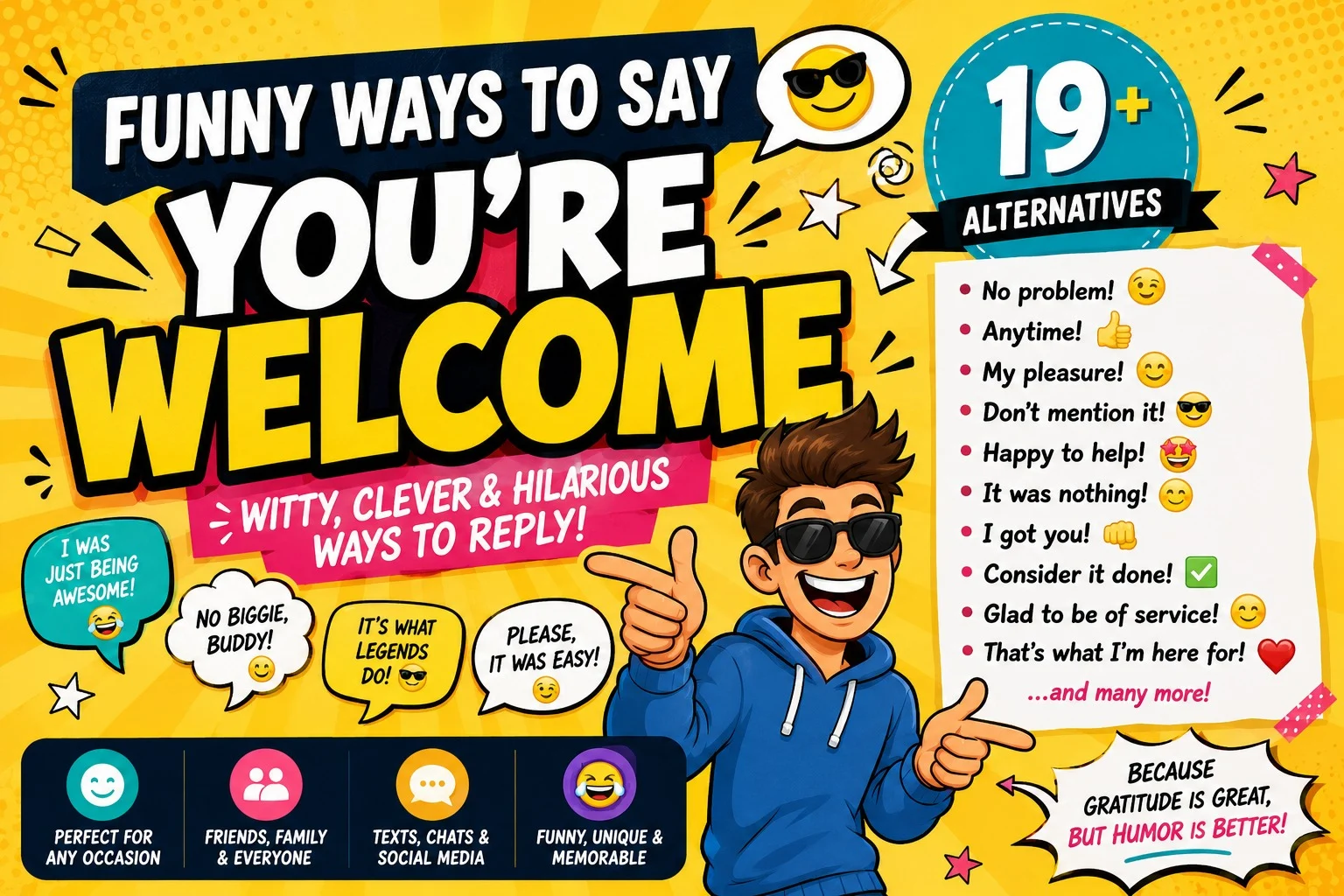
Saying “you’re welcome” doesn’t have to be boring. Adding humor to your response can make conversations more engaging and memorable. Whether you’re chatting with friends, texting colleagues, or want to lighten the mood, these 15 funny alternatives will help you respond with personality and wit.
Top 5 funny alternatives: “No problem at all,” “Anytime,” “My pleasure,” “Happy to help,” and “Don’t mention it.
Most English learners learn “you’re welcome” as the standard response to “thank you.” And it works. It’s polite, clear, and gets the job done. But native English speakers rarely use it in casual conversation. Instead, they choose responses that match their personality, the situation, and their relationship with the other person.
Funny alternatives to “you’re welcome” do more than just acknowledge gratitude. They build rapport, show personality, and make interactions feel warmer. Whether you’re in a relaxed workplace, chatting with friends, or responding to a compliment, the right humorous response can turn a simple exchange into a memorable moment.
Quick Categories
Funny Yet Professional Alternatives
- Happy to help
- My pleasure
- Glad I could assist
- Always happy to help
Casual and Playful Alternatives
- No problem at all
- Anytime
- Don’t mention it
- Sure thing
Witty and Sarcastic Alternatives
- I accept payment in cookies
- What are friends for?
- You owe me one (just kidding)
Texting and Digital Alternatives
- No worries
- Of course
- Absolutely
What Does “You’re Welcome” Mean?
Definition: A polite response to someone who has thanked you for a favor, gift, or assistance.
Grammar: This phrase functions as a response expression. It’s a complete utterance that acknowledges gratitude.
Example Sentence:
“Thanks for helping me with my presentation!”
“Anytime. Happy to help.”
When to Use “You’re Welcome” and Its Alternatives
- Casual Conversations: Friends, family, and close colleagues
- Workplace Settings: Team meetings, casual office interactions
- Text Messages and Digital Communication: Quick replies via chat or email
- Everyday Situations: Coffee shops, stores, and informal gatherings
- Professional Contexts: When maintaining a friendly yet polished tone
Is It Professional or Polite?
| Polite? | ✔ Yes |
| Professional? | Depends on the phrase and context |
| Formal? | Sometimes, but mostly casual |
| Natural? | Yes, when used appropriately |
Business Example:
“Thanks for your help with the quarterly report.”
“My pleasure. Happy to assist anytime.”
Pros and Cons of Using Funny Alternatives
Pros
- Makes conversations more memorable
- Builds stronger relationships
- Shows personality
- Sounds more natural and fluent
Cons
- Can sound unprofessional in formal settings
- May be misunderstood if the humor doesn’t land
- Not appropriate for serious situations
- Can seem insincere if overused
15 Funny Ways to Say “You’re Welcome”
[1]. My Pleasure
Meaning: I genuinely enjoyed helping you.
Explanation: This phrase adds warmth and sincerity. It’s commonly used in customer service and professional settings but works beautifully in casual conversations too. It sounds polished without being stiff.
Example Sentence:
“Thanks for covering my shift yesterday!”
“My pleasure. Happy I could help.”
Best Use: Customer service, workplace, friendly interactions
Avoid Using In: Sarcastic or overly casual contexts
Tone: Warm, Professional
Formality Level: ⭐⭐⭐⭐ Formal
Usage Frequency: Very Common
CEFR Level: B1
Common Collocations:
- My absolute pleasure
- It was my pleasure
- My pleasure entirely
- A genuine pleasure
Context Variability:
- Spoken English: “My pleasure! Glad I could help.”
- Professional English: “It was my pleasure to assist with your project.”
- Casual Conversation: “My pleasure. Anytime!”
[2]. Happy to Help
Meaning: I was glad to assist you.
Explanation: This phrase strikes a perfect balance between professional and friendly. It shows enthusiasm without being overly formal. Native speakers use it frequently in both workplace and casual settings.
Example Sentence:
“Thanks for explaining that concept to me.”
“Happy to help. Let me know if anything else comes up.”
Best Use: Workplace, email, teaching, everyday conversation
Avoid Using In: Very formal documents or serious situations
Tone: Friendly, Professional
Formality Level: ⭐⭐⭐ Neutral
Usage Frequency: Very Common
CEFR Level: A2
Common Collocations:
- Always happy to help
- Happy to help anytime
- Truly happy to help
Context Variability:
- Spoken English: “Happy to help! That’s what I’m here for.”
- Professional English: “I’m always happy to help the team succeed.”
- Casual Conversation: “Happy to help, no worries at all.”
[3]. Anytime
Meaning: I’m available to help whenever you need me.
Explanation: This casual, friendly response emphasizes availability. It suggests you’re not just helping this one time but are open to future requests. It’s warm and approachable.
Example Sentence:
“Thanks for picking up my package!”
“Anytime. Just give me a heads-up next time.”
Best Use: Friends, close colleagues, casual interactions
Avoid Using In: Formal business emails, official communication
Tone: Friendly, Casual
Formality Level: ⭐⭐ Casual
Usage Frequency: Very Common
CEFR Level: A2
Common Collocations:
- Anytime at all
- Absolutely anytime
- Anytime you need
Context Variability:
- Spoken English: “Anytime! You know I’ve got your back.”
- Professional English: “Anytime you need assistance, just ask.”
- Casual Conversation: “Anytime, dude. No problem.”
[4]. No Problem at All
Meaning: The favor wasn’t any trouble.
Explanation: This friendly reassurance is popular in casual American English. It downplays the effort involved, making the other person feel they didn’t impose. It’s one of the most common alternatives to “you’re welcome.”
Example Sentence:
“I’m so sorry for all the questions.”
“No problem at all. I enjoy helping people learn.”
Best Use: Everyday conversation, casual workplace
Avoid Using In: Formal written communication
Tone: Relaxed, Friendly
Formality Level: ⭐⭐ Casual
Usage Frequency: Very Common
CEFR Level: A2
Common Collocations:
- No problem whatsoever
- Absolutely no problem
- No problem at all, really
Context Variability:
- Spoken English: “No problem at all. Don’t even worry about it.”
- Professional English: “No problem at all. I’m happy to support the team.”
- Casual Conversation: “No problem at all, seriously.”
“Choosing the right humorous response can turn a routine exchange into a moment of genuine connection.”
[5]. Don’t Mention It
Meaning: You don’t need to thank me.
Explanation: This modest phrase tells the other person their thanks aren’t necessary. It’s polite and friendly, though slightly old-fashioned. Native speakers still use it commonly in casual and semi-formal settings.
Example Sentence:
“I really appreciate your advice on my resume.”
“Don’t mention it. I was happy to help.”
Best Use: Small favors, modest responses
Avoid Using In: Professional emails, formal writing
Tone: Modest, Friendly
Formality Level: ⭐⭐⭐ Neutral
Usage Frequency: Common
CEFR Level: B1
Common Collocations:
- Please don’t mention it
- Don’t even mention it
- Really, don’t mention it
Context Variability:
- Spoken English: “Don’t mention it. It was nothing.”
- Professional English: “Please don’t mention it. Happy to assist.”
- Casual Conversation: “Don’t mention it, seriously.”
[6]. I Accept Payment in Cookies
Meaning: I’m joking that your thanks aren’t enough, and I want a treat instead.
Explanation: This playful response is perfect for friends and family. It’s clearly a joke, and it adds warmth to the exchange. Native speakers use this kind of humor to keep conversations light and fun.
Example Sentence:
“Thank you so much for helping me move!”
“I accept payment in cookies. Preferably chocolate chip.”
Best Use: Friends, family, close colleagues
Avoid Using In: Professional contexts, with strangers
Tone: Playful, Warm
Formality Level: ⭐ Very Casual
Usage Frequency: Occasional
CEFR Level: B2
Context Variability:
- Spoken English: “I accept payment in cookies, if you’re offering!”
- Casual Conversation: “Cookies are my preferred currency.”
[7]. It Was Nothing
Meaning: The favor was trivial and not worth mentioning.
Explanation: This humble response minimizes your contribution. It shows modesty and is common among native speakers, especially when the favor was indeed small .
Example Sentence:
“I can’t thank you enough for finding my keys.”
“It was nothing. I’m just glad I spotted them.”
Best Use: Small favors, friendly situations
Avoid Using In: Professional contexts where you want to appear competent
Tone: Humble, Casual
Formality Level: ⭐⭐ Casual
Usage Frequency: Common
CEFR Level: A2
Context Variability:
- Spoken English: “It was nothing. Happy I could find them.”
- Casual Conversation: “It was nothing, seriously.”
[8]. Not at All
Meaning: It wasn’t any trouble.
Explanation: This polite, warm response works in both formal and informal contexts. It reassures the person they didn’t bother you. It’s slightly more formal than “no problem” but still sounds natural.
Example Sentence:
“I hope I wasn’t interrupting your work.”
“Not at all. I’m always happy to chat.”
Best Use: Professional settings, polite conversations
Avoid Using In: Very casual texts with friends
Tone: Polite, Warm
Formality Level: ⭐⭐⭐⭐ Formal
Usage Frequency: Common
CEFR Level: B1
Context Variability:
- Spoken English: “Not at all. I had a free moment.”
- Professional English: “Not at all. Please feel free to reach out anytime.”
- Casual Conversation: “Not at all, don’t worry.”
“The best response often depends more on your relationship with the person than the situation itself.”
[9]. What Are Friends For?
Meaning: Friends help each other, so you don’t need to thank me.
Explanation: This response emphasizes the relationship itself. It’s warm and affectionate, perfect for friends and close colleagues. It implies that helping is natural because of your bond.
Example Sentence:
“Thanks for always being there for me.”
“What are friends for? You’d do the same for me.”
Best Use: Friends, family, close colleagues
Avoid Using In: Professional settings, with acquaintances
Tone: Warm, Affectionate
Formality Level: ⭐⭐ Casual
Usage Frequency: Common
CEFR Level: B1
Context Variability:
- Spoken English: “What are friends for? Anytime you need me.”
- Casual Conversation: “What are friends for? No thanks needed.”
[10]. You Got It
Meaning: Sure, I was happy to do that for you.
Explanation: This enthusiastic, affirmative response is common in casual American English. It’s friendly, energetic, and makes the other person feel like their request was no trouble at all .
Example Sentence:
“Thanks for sending that document over!”
“You got it. Let me know if you need anything else.”
Best Use: Casual workplace, friends, quick replies
Avoid Using In: Formal emails, serious professional settings
Tone: Enthusiastic, Casual
Formality Level: ⭐⭐ Casual
Usage Frequency: Common
CEFR Level: B1
Context Variability:
- Spoken English: “You got it. No problem at all.”
- Casual Conversation: “You got it, my friend.”
[11]. I’ve Got You
Meaning: I’ll take care of it and you can rely on me.
Explanation: This reassuring phrase emphasizes support and dependability. It’s common in casual conversations and implies ongoing availability. It sounds warm and supportive.
Example Sentence:
“Thank you for covering my shift!”
“I’ve got you. We help each other out here.”
Best Use: Supportive situations, friends, casual workplace
Avoid Using In: Formal professional contexts
Tone: Supportive, Casual
Formality Level: ⭐⭐ Casual
Usage Frequency: Common
CEFR Level: B1
Context Variability:
- Spoken English: “I’ve got you, don’t worry.”
- Professional English: “I’ve got you covered. We’re a team.”
- Casual Conversation: “I’ve got you, always.”
[12]. No Worries
Meaning: There’s no need to be concerned about it.
Explanation: This phrase is hugely popular in casual English. It’s relaxing and makes the other person feel at ease. It’s particularly common in Australian and British English but has spread worldwide .
Example Sentence:
“I’m sorry for the late notice on this request.”
“No worries. I’ll get it done.”
Best Use: Everyday conversation, casual workplace
Avoid Using In: Formal professional communication
Tone: Relaxed, Casual
Formality Level: ⭐⭐ Casual
Usage Frequency: Very Common
CEFR Level: A2
Context Variability:
- Spoken English: “No worries, seriously.”
- Professional English: “No worries. I’m glad I could assist.”
- Casual Conversation: “No worries, mate.”
“Humor in a response shows confidence and makes you sound more like a native speaker.”
[13]. Sure Thing
Meaning: Definitely, I was happy to do that.
Explanation: This casual, upbeat response is common in everyday speech. It suggests willingness and enthusiasm. It’s short, simple, and sounds natural.
Example Sentence:
“Thanks for grabbing coffee for me!”
“Sure thing. Next time, you’re paying though.”
Best Use: Friends, casual workplace, quick replies
Avoid Using In: Formal emails, professional documents
Tone: Upbeat, Casual
Formality Level: ⭐⭐ Casual
Usage Frequency: Common
CEFR Level: B1
Context Variability:
- Spoken English: “Sure thing! Anytime.”
- Casual Conversation: “Sure thing, no problem.”
[14]. I’m Happy I Could Help
Meaning: I feel good about being able to assist you.
Explanation: This warm response is sincere and specific. It shares a positive emotion while acknowledging the other person’s gratitude. It sounds natural in both casual and professional settings.
Example Sentence:
“Thank you for guiding me through the process.”
“I’m happy I could help. You did great work.”
Best Use: Teaching, mentoring, professional settings
Avoid Using In: Very casual texts, overly familiar situations
Tone: Sincere, Professional
Formality Level: ⭐⭐⭐ Neutral
Usage Frequency: Very Common
CEFR Level: B1
Context Variability:
- Spoken English: “I’m happy I could help.”
- Professional English: “I’m happy I could help. Let me know if you need further assistance.”
- Casual Conversation: “Happy I could help, truly.”
[15]. Absolutely
Meaning: Yes, certainly, I was happy to help.
Explanation: This confident, enthusiastic response shows eagerness and positivity. It’s short and impactful. It works well in both casual and semi-professional contexts.
Example Sentence:
“Thank you for reviewing my proposal!”
“Absolutely. You did excellent work.”
Best Use: Quick responses, enthusiastic acknowledgment
Avoid Using In: Formal documents, serious professional settings
Tone: Confident, Enthusiastic
Formality Level: ⭐⭐⭐ Neutral
Usage Frequency: Common
CEFR Level: A2
Context Variability:
- Spoken English: “Absolutely! It was my pleasure.”
- Professional English: “Absolutely, I’m happy to assist.”
- Casual Conversation: “Absolutely, anytime.”
Native Speaker Tips
Native Speaker Tip #1
Phrases like “no worries,” “no problem,” and “anytime” are extremely common in casual English. “No worries” is especially popular in Australian, British, and American English. These alternatives sound much more natural in everyday conversation than the formal “you’re welcome .
Native Speaker Tip #2
“You’re welcome” can sound stiff or overly formal in casual contexts. Native speakers often reserve it for professional situations or when they want to be extra polite. In everyday conversation, “no problem” or “anytime” are typically preferred .
Native Speaker Tip #3
Humor in responses should match your relationship with the person. A joke that works with close friends might seem unprofessional in a workplace setting. Pay attention to context and relationship dynamics.
Common Mistakes
Mistake 1: Using Slang in Formal Emails
Mistake: “No worries, sir.”
Why it’s incorrect: Too casual for professional communication.
Correct version: “You’re most welcome. Please let me know if you need any further assistance.”
Example: Use professional language when responding to superiors or clients in formal contexts.
Mistake 2: Overusing the Same Phrase
Mistake: Saying “You’re welcome” to every single “thank you.
Why it’s incorrect: It sounds repetitive and robotic.
Correct version: Vary your responses based on context “anytime,” “my pleasure,” or “happy to help.”
Example: Alternate between different responses to sound more natural.
Mistake 3: Sounding Sarcastic Unintentionally
Mistake: “Yeah, sure.” (said in a flat tone)
Why it’s incorrect: Can sound dismissive or sarcastic.
Correct version: “Sure thing!” (with enthusiasm)
Example: Tone and delivery matter as much as the words themselves.
Mistake 4: Responding Too Casually to Superiors
Mistake: “Anytime, boss.”
Why it’s incorrect: Can seem disrespectful or overly familiar.
Correct version: “Happy to help, [Name]. Let me know if you need anything else.”
Example: Match your level of formality to the person you’re speaking with.
Mistake 5: Using Jokes in Serious Contexts
Mistake: “I accept payment in cookies” after a serious favor.
Why it’s incorrect: It undermines the sincerity of the situation.
Correct version: “I was happy to help. Please don’t hesitate to ask again.”
Example: Save humor for appropriate, light-hearted situations.
Avoid These in Formal Situations
| Phrase to Avoid | Why to Avoid It | Better Alternative |
| No worries | Too casual for professional communication | My pleasure |
| No biggie | Slang, not appropriate for workplace | Happy to help |
| You got it | Too informal for client interactions | Certainly, happy to assist |
| Sure thing | Too casual for formal emails | You’re most welcome |
| No problem | Can sound dismissive in formal settings | I’m glad I could help |
Best Phrases by Situation
| Situation | Best Phrase | Why It Works |
| Business Email | “My pleasure” | Professional and warm |
| Client Meeting | “Happy to help” | Confident and service-oriented |
| Academic Setting | “I’m happy I could help” | Sincere and professional |
| Team Collaboration | “Anytime” | Supportive and available |
| Job Interview | “Absolutely” | Confident and enthusiastic |
| Daily Conversation | “No worries” | Relaxed and natural |
| Text Message | “Sure thing” | Short and friendly |
Which One Should You Use?
Best Overall
“Happy to help” It works in almost every context and sounds natural .
Best Professional
“My pleasure” Professional, warm, and widely used in business settings .
Best Casual
“No worries” Extremely common among native speakers in everyday conversation .
Best Digital
“Anytime” Short, friendly, and perfect for text messages and quick replies .
Most Humorous
“I accept payment in cookies” Playful and fun for friends and family.
Most Natural
“No problem at all” One of the most common casual responses in American English .
Scenario Practice
Scenario 1: Workplace Email
Your colleague thanks you for helping with a project report.
Which phrase would you choose?
“My pleasure. Happy I could contribute.”
Scenario 2: Coffee with a Friend
Your friend thanks you for treating them to coffee.
Which phrase would you choose?
“Anytime! Next one’s on you though.”
Scenario 3: Customer Service
A client thanks you for resolving their issue.
Which phrase would you choose?
“I’m happy I could help. Let me know if anything else comes up.”
Scenario 4: Job Interview Follow-up
The interviewer thanks you for attending the interview.
Which phrase would you choose?
“Absolutely. Thank you for your time today.
Scenario 5: Texting a Close Friend
Your friend thanks you for a small favor via text.
Which phrase would you choose?
“Sure thing! No worries at all.”
Mini Quiz
1. Which response is most appropriate for a formal business email?
A) No worries
B) My pleasure
C) You got it
D) Sure thing
Answer: B
2. Which phrase is too casual for a job interview?
A) Absolutely
B) Happy to help
C) No biggie
D) My pleasure
Answer: C
3. Which response is best for a close friend?
A) It was my pleasure to assist
B) You’re welcome
C) Anytime
D) I’m happy I could contribute
Answer: C
4. Which phrase means “the favor was no trouble at all”?
A) Not at all
B) I’ve got you
C) What are friends for?
D) I accept payment in cookies
Answer: A
5. Which response is most natural in casual American English?
A) No problem at all
B) You’re welcome
C) It was my pleasure
D) You’re most welcome
Answer: A
FAQs
What is the most formal way to say “you’re welcome”?
The most formal alternatives include “You’re most welcome,” “It was my pleasure,” and “I’m happy I could be of assistance.” These phrases work best in professional emails, formal letters, and official communications .
Which phrase is best for professional emails?
“My pleasure” and “Happy to help” are excellent choices for professional emails. They sound polished, friendly, and show genuine willingness to assist. For more formal emails, “You’re most welcome” is also appropriate .
What is the difference between “no problem” and “no worries”?
Both phrases mean the same thing and are commonly used in casual conversation. “No worries” is slightly more common in British, Australian, and New Zealand English, while “no problem” is widely used in American English. Both are informal and suggest the favor was no trouble .
Which alternative sounds most natural in casual conversation?
“No problem,” “anytime,” and “no worries” are the most natural-sounding options in casual conversation. Native speakers use these regularly instead of “you’re welcome.” They’re short, friendly, and don’t sound overly formal .
Can I use these expressions in business meetings?
Yes, but choose carefully. “My pleasure” and “Happy to help” are appropriate in business meetings. Avoid very casual phrases like “no worries” or “sure thing” in formal meetings, though they might be fine in a relaxed team environment .
Conclusion
Learning alternative ways to respond to “thank you” is a key step toward sounding more natural and fluent in English. These 15 funny, professional, and casual alternatives give you the flexibility to match your response to any situation.
Practice using different phrases in your daily conversations. Notice how native speakers respond to “thank you” and try similar approaches. With time, choosing the right response will feel automatic.
Remember, the goal isn’t just to be correct it’s to be natural, engaging, and appropriate. Whether you choose “my pleasure” in a meeting or “no worries” with friends, your response should reflect your personality and the situation. Confidence comes from practice, so start using these alternatives today.

7 thoughts on “Funny ways to say you’re welcome| 19 Funny Alternatives”