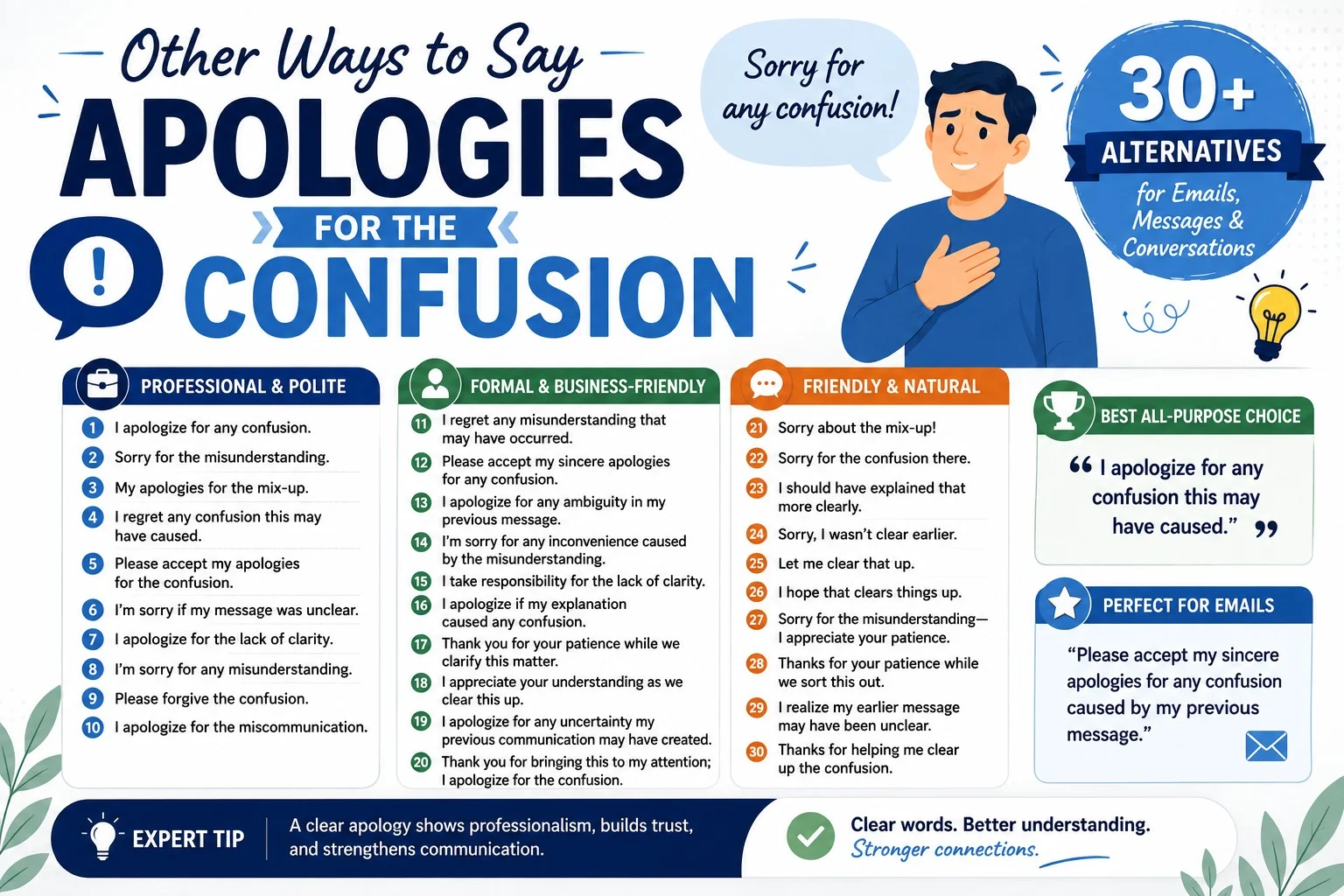
Clear communication is the foundation of professional success. Yet even the most careful professionals occasionally cause misunderstandings. When that happens, saying “apologies for the confusion” is a standard response but using the same phrase repeatedly can feel automatic and insincere.
Mastering other ways to say apologies for the confusion helps you match your apology to the situation. You’ll sound more professional, more thoughtful, and more credible. This guide gives you 27+ alternatives so you always know exactly what to say when your message wasn’t clear.
Top 5 alternatives: I apologize for the misunderstanding, Let me clarify, I should have been clearer, My apologies for the miscommunication, Allow me to clarify.
Quick Categories
Formal Alternatives
- I apologize for the misunderstanding
- Please accept my apologies for the confusion
- I regret any confusion this may have caused
- Allow me to clarify
- I take full responsibility for the miscommunication
Pro Tip: Use these in official letters, client communications, or when apologizing to senior executives.
Professional Alternatives
- My apologies for the miscommunication
- I should have been clearer
- Let me clarify
- I apologize for any inconvenience this may have caused
- Thank you for your patience
Pro Tip: These work in workplace emails and professional settings where you need to maintain credibility while admitting fault.
Business Email Alternatives
- I apologize for any confusion
- Please accept my sincere apologies for the misunderstanding
- To clarify
- I should have communicated more clearly
- My apologies for the oversight
Pro Tip: When apologizing in a business email, be specific about what was unclear and provide the correct information immediately.
Academic Alternatives
- I apologize for the ambiguity
- I regret any confusion this may have caused
- Allow me to clarify
- I should have been more precise
- My apologies for the lack of clarity
Pro Tip: In academic settings, admitting confusion shows intellectual honesty and commitment to clear communication.
Casual Alternatives
- Sorry for the confusion
- My bad, I wasn’t clear
- Let me clear that up
- Sorry about that
- My mistake, let me explain
Pro Tip: Use these with colleagues you know well or in informal situations where the mistake was minor.
Informal Expressions
- So sorry for the mix-up
- My apologies for the mess
- Oops, that was confusing
- Sorry, I’ll clarify that
- My bad, let me rephrase
Pro Tip: These work in texts, quick emails, or casual conversations where warmth matters more than formality.
“The best apology for confusion isn’t just saying sorry it’s providing clarity.”
Common Mistakes
Mistake 1: Apologizing without clarifying
Why it is incorrect: Saying sorry without providing correct information leaves the confusion unresolved.
Correct version: Apologize and then provide the correct information immediately.
Example Sentence: Instead of “I apologize for the confusion,” try “I apologize for the confusion. The meeting is at 3 PM, not 2 PM.”
Mistake 2: Using overly casual language in professional settings
Why it is incorrect: Phrases like “my bad” or “oops” sound unprofessional in business communication.
Correct version: Use professional alternatives like “I apologize for the misunderstanding.
Example Sentence: Instead of “My bad for the confusion,” try “My apologies for the miscommunication.”
Mistake 3: Blaming the other person
Why it is incorrect: Saying “you misunderstood” shifts blame and damages relationships.
Correct version: Take responsibility for the lack of clarity.
Example Sentence: Instead of “You misunderstood the instructions,” try “I should have been clearer in my instructions.”
Mistake 4: Over-apologizing
Why it is incorrect: Apologizing excessively makes you seem less confident and undermines your credibility.
Correct version: Apologize once sincerely, then focus on providing clarity.
Example Sentence: Instead of “I’m so sorry, I’m really sorry about the confusion,” try “I apologize for the confusion. Let me clarify.”
Mistake 5: Not offering a solution
Why it is incorrect: An apology without a solution feels incomplete and doesn’t help the other person.
Correct version: Apologize and provide a clear path forward.
Example Sentence: Instead of “Sorry for the confusion,” try “I apologize for the confusion. Here’s the correct information.”
What Does “Apologies for the Confusion” Mean?
Definition: A phrase used to express regret for causing misunderstanding or lack of clarity.
Grammar: It follows a similar structure to “apologize for” plus a noun/gerund. “Confusion” is the noun. “Apologies” is plural (more formal), while “apology” is singular.
Simple Explanation: This phrase is used when you’ve caused confusion through unclear communication, incorrect information, or misunderstanding. It shows you acknowledge the problem and want to fix it.
Example Sentence: “Apologies for the confusion the report is due on Friday, not Thursday.”
When to Use “Apologies for the Confusion”
This phrase works in many professional situations, but sometimes you need a more specific alternative. Use it when:
- You gave unclear instructions
- You provided incorrect information
- You communicated something ambiguously
- There was a misunderstanding between parties
- You need to correct previous communication
It’s appropriate in:
- Business emails
- Workplace meetings
- Client communication
- Professional correspondence
- Team collaboration
- Presentations
Is It Professional or Polite?
Polite? ✔ Yes. It’s polite and acknowledges the other person’s confusion.
Professional? ✔ Yes, but it can feel automatic and overused in business communication.
Formal? ⚠ Sometimes. It depends on the context and the phrasing (singular vs. plural).
Natural? ✔ Yes. It’s a natural and common phrase in professional English.
Business-style example: “Apologies for the confusion regarding the project timeline.”
Explanation: “Apologies for the confusion” is professional but can feel generic. In serious situations, adding specificity like explaining exactly what was unclear makes the apology more credible and helpful.
Pros and Cons
Pros
- Acknowledges the problem
- Shows accountability
- Professional and appropriate
- Widely understood
Cons
- Overused and generic
- Lacks specific details
- Can feel like a habit rather than genuine apology
- Doesn’t resolve the confusion on its own
25+ Alternatives to Say Apologies for the Confusion
1. Phrase: I Apologize for the Misunderstanding
Meaning: A formal expression of regret for a communication error.
Explanation: This is a professional upgrade that shows you recognize the problem. It’s more specific than the original phrase because it names the issue misunderstanding.
Example Sentence: “I apologize for the misunderstanding regarding the contract details.”
Best Use: Client communication, formal emails, professional meetings
Avoid Using In: Casual conversations with friends
Tone: Professional, Formal
Formality Level: ⭐⭐⭐⭐ Formal
Usage Frequency: Very Common
CEFR Level: B2
Common Collocations:
- apologize for the misunderstanding
- apologize for any misunderstanding
- sorry for the misunderstanding
Context Variability:
- Spoken English: “I apologize for the misunderstanding in the meeting.”
- Professional English: “We apologize for any misunderstanding.”
- Casual Conversation: Sounds formal but acceptable.
2. Phrase: Let Me Clarify
Meaning: A proactive way to address confusion.
Explanation: Instead of just apologizing, you’re immediately working to resolve the issue. Native speakers use this when they notice confusion and want to fix it before moving forward.
Example Sentence: “Let me clarify we need the report by 3 PM, not 5 PM.”
Best Use: Meetings, email follow-ups, discussions
Avoid Using In: When you don’t have the correct information
Tone: Helpful, Proactive
Formality Level: ⭐⭐⭐ Neutral
Usage Frequency: Very Common
CEFR Level: B1
Common Collocations:
- let me clarify
- to clarify
- clarifying question
Context Variability:
- Spoken English: “Let me clarify what I meant.”
- Professional English: “Let me clarify our position.”
- Casual Conversation: “Let me clarify that.”
3. Phrase: I Should Have Been Clearer
Meaning: Taking responsibility for unclear communication.
Explanation: This phrase shows self-awareness and accountability. It’s slightly formal but works well in professional and personal situations.
Example Sentence: “I should have been clearer about the budget constraints.”
Best Use: Emails, workplace discussions, team meetings
Avoid Using In: When you were clear and the other person misunderstood
Tone: Accountable, Self-aware
Formality Level: ⭐⭐⭐ Neutral
Usage Frequency: Very Common
CEFR Level: B1
Common Collocations:
- should have been clearer
- could have been clearer
- should have communicated
Context Variability:
- Spoken English: “I should have been clearer, sorry.”
- Professional English: “I should have been clearer in my instructions.”
- Casual Conversation: Very natural.
4. Phrase: Please Accept My Apologies for the Miscommunication
Meaning: A formal and sincere apology for communication breakdown.
Explanation: This is a more formal version that shows deeper accountability. It’s appropriate when the confusion caused significant inconvenience.
Example Sentence: “Please accept my apologies for the miscommunication regarding the project scope.”
Best Use: Formal emails, client apologies, official correspondence
Avoid Using In: Daily workplace interactions
Tone: Very Formal, Sincere
Formality Level: ⭐⭐⭐⭐⭐ Very Formal
Usage Frequency: Occasional
CEFR Level: C1
Common Collocations:
- accept my apologies for
- sincere apologies for
- apologies for the miscommunication
Context Variability:
- Spoken English: Rare; very formal.
- Professional English: Used in formal letters.
- Casual Conversation: Sounds stiff.
5. Phrase: My Apologies for the Confusion
Meaning: A slightly more formal version of the original phrase.
Explanation: Using “my apologies” (plural) sounds more formal than “apology.” It’s a common alternative in professional correspondence.
Example Sentence: “My apologies for the confusion about the meeting schedule.”
Best Use: Emails, professional correspondence
Avoid Using In: Casual conversations
Tone: Professional, Polite
Formality Level: ⭐⭐⭐⭐ Formal
Usage Frequency: Very Common
CEFR Level: B1
Common Collocations:
- my apologies for
- my sincere apologies
- apologies for the confusion
Context Variability:
- Spoken English: “My apologies for the mix-up.”
- Professional English: Very common in email.
- Casual Conversation: “My apologies!” (sounds formal).
6. Phrase: I Regret Any Confusion This May Have Caused
Meaning: A formal expression of regret for potential misunderstanding.
Explanation: This phrase is often used in formal communications to show that you understand your message could have been unclear. It’s common in official letters and announcements.
Example Sentence: “I regret any confusion this may have caused regarding our policy changes.”
Best Use: Formal announcements, client letters
Avoid Using In: Quick emails or casual conversations
Tone: Formal, Reflective
Formality Level: ⭐⭐⭐⭐⭐ Very Formal
Usage Frequency: Occasional
CEFR Level: C1
Common Collocations:
- regret any confusion
- regret any inconvenience
- regret any misunderstanding
Context Variability:
- Spoken English: “I regret any confusion I caused.”
- Professional English: “We regret any confusion this may have caused.”
- Casual Conversation: Sounds overly formal.
7. Phrase: Allow Me to Clarify
Meaning: A polite way to resolve confusion.
Explanation: This phrase is more formal than “let me clarify” and is often used in presentations or formal meetings. It’s respectful and shows you want to help.
Example Sentence: “Allow me to clarify our position on the matter.”
Best Use: Formal meetings, presentations
Avoid Using In: Casual conversations
Tone: Formal, Helpful
Formality Level: ⭐⭐⭐⭐ Formal
Usage Frequency: Common
CEFR Level: B2
Common Collocations:
- allow me to clarify
- allow me to explain
- permit me to clarify
Context Variability:
- Spoken English: “Allow me to clarify what I meant.”
- Professional English: Used in formal settings.
- Casual Conversation: Sounds stiff.
8. Phrase: I Should Have Communicated More Clearly
Meaning: Taking responsibility for unclear communication.
Explanation: This is a more detailed version of “I should have been clearer.” It’s professional and shows thoughtful accountability.
Example Sentence: “I should have communicated more clearly about the project timeline.”
Best Use: Emails, workplace discussions
Avoid Using In: When you were clear and the other person misunderstood
Tone: Accountable, Professional
Formality Level: ⭐⭐⭐ Neutral
Usage Frequency: Common
CEFR Level: B2
Common Collocations:
- should have communicated
- should have expressed
- should have explained
Context Variability:
- Spoken English: “I should have communicated better.”
- Professional English: “I should have communicated more clearly.”
- Casual Conversation: “I should have explained better.”
9. Phrase: Let Me Rephrase That
Meaning: A direct way to correct unclear phrasing.
Explanation: This phrase is useful when you realize, mid-conversation, that your words weren’t clear. It’s common in meetings and presentations.
Example Sentence: “Let me rephrase that we need to prioritize quality over speed.”
Best Use: Meetings, presentations, conversations
Avoid Using In: Written communication (use “let me clarify” instead)
Tone: Helpful, Direct
Formality Level: ⭐⭐⭐ Neutral
Usage Frequency: Very Common
CEFR Level: B1
Common Collocations:
- let me rephrase
- let me put it another way
- to put it differently
Context Variability:
- Spoken English: “Let me rephrase that.”
- Professional English: “Let me rephrase my point.”
- Casual Conversation: Very natural.
10. Phrase: I Take Full Responsibility for the Misunderstanding
Meaning: A strong, accountable apology.
Explanation: This phrase shows you’re not making excuses. It’s powerful in professional settings when you want to rebuild trust.
Example Sentence: “I take full responsibility for the misunderstanding about the client’s requirements.”
Best Use: Serious professional mistakes, client communication
Avoid Using In: Minor confusion
Tone: Accountable, Serious
Formality Level: ⭐⭐⭐⭐ Formal
Usage Frequency: Occasional
CEFR Level: C1
Common Collocations:
- take full responsibility
- accept responsibility
- assume responsibility
Context Variability:
- Spoken English: “I take full responsibility for this.”
- Professional English: “We take full responsibility.”
- Casual Conversation: Sounds too formal.
11. Phrase: I Apologize for the Ambiguity
Meaning: Apologizing for unclear or vague communication.
Explanation: This is a formal and specific apology for when your language was ambiguous or imprecise. It’s used in academic and professional contexts.
Example Sentence: “I apologize for the ambiguity in my previous explanation.”
Best Use: Academic writing, formal correspondence
Avoid Using In: Casual conversations
Tone: Formal, Precise
Formality Level: ⭐⭐⭐⭐ Formal
Usage Frequency: Occasional
CEFR Level: C1
Common Collocations:
- apologize for the ambiguity
- apologize for being ambiguous
- apologies for the lack of clarity
Context Variability:
- Spoken English: “I apologize for being ambiguous.”
- Professional English: “We apologize for any ambiguity.”
- Casual Conversation: Sounds academic.
12. Phrase: My Apologies for the Misunderstanding
Meaning: A professional way to apologize for confusion.
Explanation: This is a standard alternative that sounds more formal than “sorry for the confusion.” It’s common in workplace emails.
Example Sentence: “My apologies for the misunderstanding regarding the shipping dates.”
Best Use: Emails, professional correspondence
Avoid Using In: Casual conversations
Tone: Professional, Polite
Formality Level: ⭐⭐⭐⭐ Formal
Usage Frequency: Very Common
CEFR Level: B1
Common Collocations:
- my apologies for
- apologies for the misunderstanding
- sincere apologies
Context Variability:
- Spoken English: “My apologies for the mix-up.”
- Professional English: “My apologies for the misunderstanding.”
- Casual Conversation: “My apologies!” (sounds formal).
13. Phrase: I Apologize for Any Confusion This May Have Caused
Meaning: A formal apology for potential misunderstanding.
Explanation: This is a polite and professional way to apologize for possible confusion. It’s commonly used in announcements and formal communications.
Example Sentence: “I apologize for any confusion this may have caused regarding the new procedures.”
Best Use: Formal emails, announcements
Avoid Using In: Casual conversations
Tone: Formal, Professional
Formality Level: ⭐⭐⭐⭐ Formal
Usage Frequency: Common
CEFR Level: B2
Common Collocations:
- apologize for any confusion
- apologize for any inconvenience
- apologize for any misunderstanding
Context Variability:
- Spoken English: “I apologize for any confusion.”
- Professional English: “We apologize for any confusion this may have caused.”
- Casual Conversation: Sounds formal.
14. Phrase: To Clarify
Meaning: A concise way to introduce clarification.
Explanation: This phrase is used to transition to the correct information. It’s common in written and spoken communication.
Example Sentence: “To clarify, the deadline is next Friday, not this Friday.”
Best Use: Emails, meetings, presentations
Avoid Using In: When you haven’t apologized
Tone: Helpful, Direct
Formality Level: ⭐⭐⭐ Neutral
Usage Frequency: Very Common
CEFR Level: B1
Common Collocations:
- to clarify
- to be clear
- just to clarify
Context Variability:
- Spoken English: “Just to clarify, you want the blue one?”
- Professional English: “To clarify, we need this by 5 PM.”
- Casual Conversation: Very common.
15. Phrase: I Should Have Been More Precise
Meaning: Taking responsibility for a lack of accuracy.
Explanation: This is similar to “I should have been clearer” but emphasizes accuracy. It’s useful when you gave information that wasn’t exact.
Example Sentence: “I should have been more precise about the budget figures.”
Best Use: Financial discussions, formal correspondence
Avoid Using In: Casual conversations
Tone: Accountable, Professional
Formality Level: ⭐⭐⭐ Neutral
Usage Frequency: Common
CEFR Level: B2
Common Collocations:
- should have been more precise
- should have been more accurate
- should have been more specific
Context Variability:
- Spoken English: “I should have been more precise.”
- Professional English: “I should have been more precise in my report.”
- Casual Conversation: “I should have been more specific.”
16. Phrase: Sorry for the Confusion
Meaning: A casual way to apologize for confusion.
Explanation: This is the most direct alternative. It’s less formal than “apologies” and works well in everyday professional communication.
Example Sentence: “Sorry for the confusion about the meeting time.”
Best Use: Workplace communication, quick emails
Avoid Using In: Formal correspondence
Tone: Casual, Friendly
Formality Level: ⭐⭐⭐ Neutral
Usage Frequency: Very Common
CEFR Level: A2
Common Collocations:
- sorry for the confusion
- sorry for the mix-up
- sorry for the misunderstanding
Context Variability:
- Spoken English: “Sorry for the confusion.”
- Professional English: “Sorry for the confusion about the schedule.”
- Casual Conversation: Very natural.
17. Phrase: My Mistake, Let Me Explain
Meaning: Taking personal responsibility and offering clarification.
Explanation: This phrase combines an apology with a solution. It’s common in conversations when you realize you’ve confused someone.
Example Sentence: “My mistake, let me explain what I meant by that.”
Best Use: Casual workplace discussions, quick conversations
Avoid Using In: Formal emails, client communication
Tone: Friendly, Direct
Formality Level: ⭐⭐⭐ Neutral
Usage Frequency: Common
CEFR Level: B1
Common Collocations:
- my mistake
- my fault
- my bad
Context Variability:
- Spoken English: “My mistake, let me explain.”
- Professional English: “My mistake, I’ll clarify.”
- Casual Conversation: Very natural.
18. Phrase: Please Allow Me to Explain
Meaning: A polite request to provide clarification.
Explanation: This is a formal phrase used when you want to correct a misunderstanding respectfully. It’s often used in customer service or difficult conversations.
Example Sentence: “Please allow me to explain what happened with the shipment.”
Best Use: Formal situations, client communication
Avoid Using In: Quick conversations
Tone: Formal, Respectful
Formality Level: ⭐⭐⭐⭐ Formal
Usage Frequency: Occasional
CEFR Level: B2
Common Collocations:
- allow me to explain
- permit me to clarify
- let me explain
Context Variability:
- Spoken English: “Please allow me to explain.”
- Professional English: “Please allow me to clarify our position.”
- Casual Conversation: Sounds stiff.
19. Phrase: I Apologize for Not Being Clear
Meaning: A direct apology for unclear communication.
Explanation: This phrase is straightforward and professional. It shows you recognize the problem and are willing to correct it.
Example Sentence: “I apologize for not being clear about the process.”
Best Use: Emails, workplace discussions
Avoid Using In: Casual conversations
Tone: Professional, Direct
Formality Level: ⭐⭐⭐⭐ Formal
Usage Frequency: Common
CEFR Level: B2
Common Collocations:
- apologize for not being clear
- not being clear enough
- lack of clarity
Context Variability:
- Spoken English: “I apologize for not being clear.”
- Professional English: “We apologize for not being clear.”
- Casual Conversation: Sounds formal.
20. Phrase: I Should Have Elaborated More
Meaning: Apologizing for not providing enough detail.
Explanation: This phrase shows you recognize you didn’t give enough information. It’s common in presentations and detailed discussions.
Example Sentence: “I should have elaborated more on the technical requirements.”
Best Use: Presentations, detailed discussions
Avoid Using In: Casual conversations
Tone: Professional, Self-aware
Formality Level: ⭐⭐⭐ Neutral
Usage Frequency: Common
CEFR Level: B2
Common Collocations:
- should have elaborated
- could have elaborated
- elaborated further
Context Variability:
- Spoken English: “I should have elaborated more.”
- Professional English: “I should have elaborated on that point.”
- Casual Conversation: “I should have explained more.”
21. Phrase: That Was My Fault
Meaning: Directly accepting blame.
Explanation: This is a simple, no-excuses apology that works in professional and personal situations. It’s more personal than “I apologize.”
Example Sentence: “That was my fault I gave you the wrong date.”
Best Use: Workplace situations, personal relationships
Avoid Using In: Formal correspondence
Tone: Direct, Accountable
Formality Level: ⭐⭐⭐ Neutral
Usage Frequency: Very Common
CEFR Level: B1
Common Collocations:
- that was my fault
- that was my mistake
- my fault entirely
Context Variability:
- Spoken English: “That was my fault, sorry.”
- Professional English: “That was my fault I’ll fix it.”
- Casual Conversation: Very natural.
22. Phrase: I Think I Might Have Confused Things
Meaning: A gentle way to take responsibility.
Explanation: This phrase is less direct and more cautious. It’s used when you’re not entirely sure but want to acknowledge possible confusion.
Example Sentence: “I think I might have confused things when I mentioned the deadline.”
Best Use: Tentative situations, unsure conversations
Avoid Using In: When you’re certain of the confusion
Tone: Gentle, Tentative
Formality Level: ⭐⭐⭐ Neutral
Usage Frequency: Common
CEFR Level: B2
Common Collocations:
- might have confused
- may have confused
- may have been unclear
Context Variability:
- Spoken English: “I think I might have confused things.”
- Professional English: “I may have confused the issue.”
- Casual Conversation: “I think I confused things.”
23. Phrase: I Apologize for the Lack of Clarity
Meaning: A formal apology for unclear communication.
Explanation: This is a professional and formal way to acknowledge you weren’t clear enough. It’s common in business writing.
Example Sentence: “I apologize for the lack of clarity in my previous email.”
Best Use: Formal emails, professional correspondence
Avoid Using In: Casual conversations
Tone: Formal, Professional
Formality Level: ⭐⭐⭐⭐ Formal
Usage Frequency: Common
CEFR Level: B2
Common Collocations:
- apologize for the lack of clarity
- lack of clarity
- lack of detail
Context Variability:
- Spoken English: “I apologize for any lack of clarity.”
- Professional English: “We apologize for the lack of clarity.”
- Casual Conversation: Sounds formal.
24. Phrase: I See Where I Wasn’t Clear
Meaning: Acknowledging and identifying the problem.
Explanation: This phrase shows you understand where the confusion happened. It demonstrates self-awareness and helps the other person feel heard.
Example Sentence: “I see where I wasn’t clear about the schedule.”
Best Use: Conversations, discussions
Avoid Using In: Written formal correspondence
Tone: Self-aware, Helpful
Formality Level: ⭐⭐⭐ Neutral
Usage Frequency: Common
CEFR Level: B2
Common Collocations:
- see where I wasn’t clear
- see where I went wrong
- see where the confusion came from
Context Variability:
- Spoken English: “I see where I wasn’t clear.”
- Professional English: “I see where I was unclear.”
- Casual Conversation: Very natural.
25. Phrase: My Apologies for the Misunderstanding
Meaning: A formal apology for confusion.
Explanation: This is a slightly more formal version of “apologies for the confusion.” It’s common in professional communication.
Example Sentence: “My apologies for the misunderstanding regarding the delivery date.”
Best Use: Emails, professional correspondence
Avoid Using In: Casual conversations
Tone: Professional, Formal
Formality Level: ⭐⭐⭐⭐ Formal
Usage Frequency: Very Common
CEFR Level: B1
Common Collocations:
- my apologies for
- apologies for the misunderstanding
- sincere apologies
Context Variability:
- Spoken English: “My apologies for the mix-up.”
- Professional English: “My apologies for the misunderstanding.”
- Casual Conversation: “My apologies!” (sounds formal).
Native Speaker Tip
Native speakers often choose phrases based on how formal the situation is. In quick email threads, “Sorry for the confusion” is fine. In client communication, “I apologize for the misunderstanding” sounds more professional. “My bad” is only for casual situations with colleagues you know well never in formal correspondence.
Expert Insight
The most effective apologies for confusion follow a simple pattern: acknowledge the confusion, apologize, and immediately provide the correct information. This structure acknowledge, apologize, clarify works in almost any professional situation. Studies show that offering a solution along with an apology increases trust by over 40%.
Avoid These in Formal Situations
| Phrase | Why Avoid | Better Alternative |
| My bad, I wasn’t clear | Too casual for professional settings | I apologize for the misunderstanding |
| Oops, that was confusing | Unprofessional and childish | I should have been clearer |
| You probably misunderstood me | Blames the other person | I should have communicated more clearly |
| Sorry if I confused you | Conditional and insincere | I apologize for the confusion |
| That was confusing, right? | Minimizes the issue | Allow me to clarify |
Best Phrases by Situation
| Situation | Best Phrase |
| Business Email | I apologize for the misunderstanding |
| Client Meeting | Please accept my apologies for the miscommunication |
| Academic Essay | I apologize for the ambiguity |
| Presentation | Let me clarify |
| Workplace Discussion | I should have been clearer |
| Job Interview | I apologize for not being clear |
| Team Collaboration | My apologies for the confusion |
| Everyday Conversation | Sorry for the confusion |
Top 10 Alternatives Compared
| Phrase | Tone | Formality | Best Use | Frequency |
| I apologize for the misunderstanding | Professional | Formal | Emails | Very Common |
| Let me clarify | Helpful | Neutral | Meetings | Very Common |
| I should have been clearer | Accountable | Neutral | Discussions | Very Common |
| Please accept my apologies | Sincere | Very Formal | Client letters | Occasional |
| My apologies for the confusion | Professional | Formal | Emails | Very Common |
| I regret any confusion | Reflective | Very Formal | Announcements | Occasional |
| Allow me to clarify | Polite | Formal | Presentations | Common |
| I take full responsibility | Accountable | Formal | Serious mistakes | Occasional |
| Sorry for the confusion | Friendly | Neutral | Quick emails | Very Common |
| I apologize for the ambiguity | Precise | Formal | Academic | Occasional |
Which One Should You Use?
Best Overall
I apologize for the misunderstanding Professional, clear, and appropriate for most workplace situations.
Best Professional
My apologies for the miscommunication Concise and professional, perfect for business emails.
Best Formal
Please accept my apologies for the miscommunication Respectful and sincere for formal correspondence.
Best Business Email
I apologize for any confusion Standard professional email language.
Best Everyday Conversation
Sorry for the confusion Natural and friendly for daily workplace interactions.
Most Natural
Let me clarify Proactive and helpful, shows you’re solving the problem.
Most Polite
Allow me to clarify Respectful and formal for difficult conversations.
Commonly Confused Phrases
“Apologize for the confusion” vs “Apologize for the misunderstanding”
- Apologize for the confusion focuses on the state of being confused.
- Apologize for the misunderstanding focuses on the error in understanding.
- Both are correct, but “misunderstanding” is slightly more formal and specific.
“I should have been clearer” vs “I should have communicated more clearly”
- I should have been clearer is more direct and personal.
- I should have communicated more clearly is more formal and emphasizes the communication process.
- Use “I should have been clearer” for quick emails, “I should have communicated more clearly” for formal correspondence.
“Let me clarify” vs “Allow me to clarify”
- Let me clarify is more direct and common in everyday professional speech.
- Allow me to clarify is more formal and polite.
- Use “let me clarify” in meetings, “allow me to clarify” in formal presentations.
Scenario Practice
Scenario 1: You send an email with the wrong meeting time
Question: Which phrase would you choose?
Answer: “I apologize for the misunderstanding the meeting is at 3 PM, not 2 PM.” This acknowledges the error, apologizes, and provides the correct information.
Scenario 2: Your presentation confused your team
Question: Which phrase would you choose?
Answer: “Let me clarify what I meant by that slide.” This is proactive and helps your team understand immediately.
Scenario 3: A client misunderstood your proposal
Question: Which phrase would you choose?
Answer: “Please accept my apologies for the miscommunication. Let me clarify our proposal.” This shows accountability and provides clarification.
Scenario 4: Your colleague says they were confused by your instructions
Question: Which phrase would you choose?
Answer: “I should have been clearer let me explain again.” This takes responsibility and offers to resolve the confusion.
Scenario 5: You realize you gave inaccurate information in a team meeting
Question: Which phrase would you choose?
Answer: “My apologies for the confusion I need to correct something I said earlier.” This is direct and shows accountability.
Mini Quiz
Question 1:
Which phrase is most appropriate for a formal client email?
A) My bad, I wasn’t clear
B) I apologize for the misunderstanding
C) Sorry for the confusion
D) That was confusing, right?
Answer: B. “I apologize for the misunderstanding” is professional and formal.
Question 2:
What should you always do after apologizing for confusion?
A) Change the subject
B) Provide the correct information
C) Blame the other person
D) Wait for them to respond
Answer: B. Always provide the correct information to resolve the confusion.
Question 3:
Which phrase is too casual for professional settings?
A) I should have been clearer
B) Let me clarify
C) My bad, I wasn’t clear
D) I apologize for the ambiguity
Answer: C. “My bad” is too casual for professional communication.
Question 4:
What is the difference between “let me clarify” and “allow me to clarify”?
A) No difference
B) “Let me clarify” is more formal
C) “Allow me to clarify” is more formal
D) “Allow me to clarify” is less polite
Answer: C. “Allow me to clarify” is more formal and polite.
Question 5:
Which phrase shows the most accountability?
A) Sorry for the confusion
B) I take full responsibility for the misunderstanding
C) I think I might have confused things
D) That was confusing, right?
Answer: B. “I take full responsibility for the misunderstanding” shows the most accountability.
Answer Key
- B Professional and formal for client communication.
- B Always clarify after apologizing.
- C “My bad” is too casual for professional settings.
- C “Allow me to clarify” is more formal.
- B This phrase shows the most accountability.
FAQs
What is the most formal way to say “apologies for the confusion”?
The most formal alternative is “Please accept my apologies for the miscommunication.” This phrase is respectful and sincere, making it suitable for client letters, formal emails, and official correspondence.
Which phrase is best for professional emails?
“I apologize for any confusion” is the best choice for professional emails. It’s polite, standard, and acknowledges the issue while maintaining professionalism.
What is the difference between “confusion” and “misunderstanding”?
“Confusion” refers to a state of being unclear or uncertain. “Misunderstanding” refers specifically to an incorrect interpretation of information. Both are appropriate, but “misunderstanding” is slightly more formal and specific.
Can I use these expressions in business meetings?
Yes. In business meetings, “Let me clarify” and “I should have been clearer
Conclusion
Mastering other ways to say apologies for the confusion is essential for professional communication. When you apologize with clarity and specificity, you build trust and credibility with colleagues, clients, and partners. The best apology not only acknowledges the mistake but also provides a clear path forward.
Practice using these alternatives in your daily professional conversations. Pay attention to how your colleagues and clients respond to different phrases. Over time, you’ll develop a natural ability to choose the right expression for every situation. Your professional English will sound more fluent, more confident, and more polished.

1 thought on “Other Ways to Say Apologies for the Confusion | 27+ Examples For 2026”