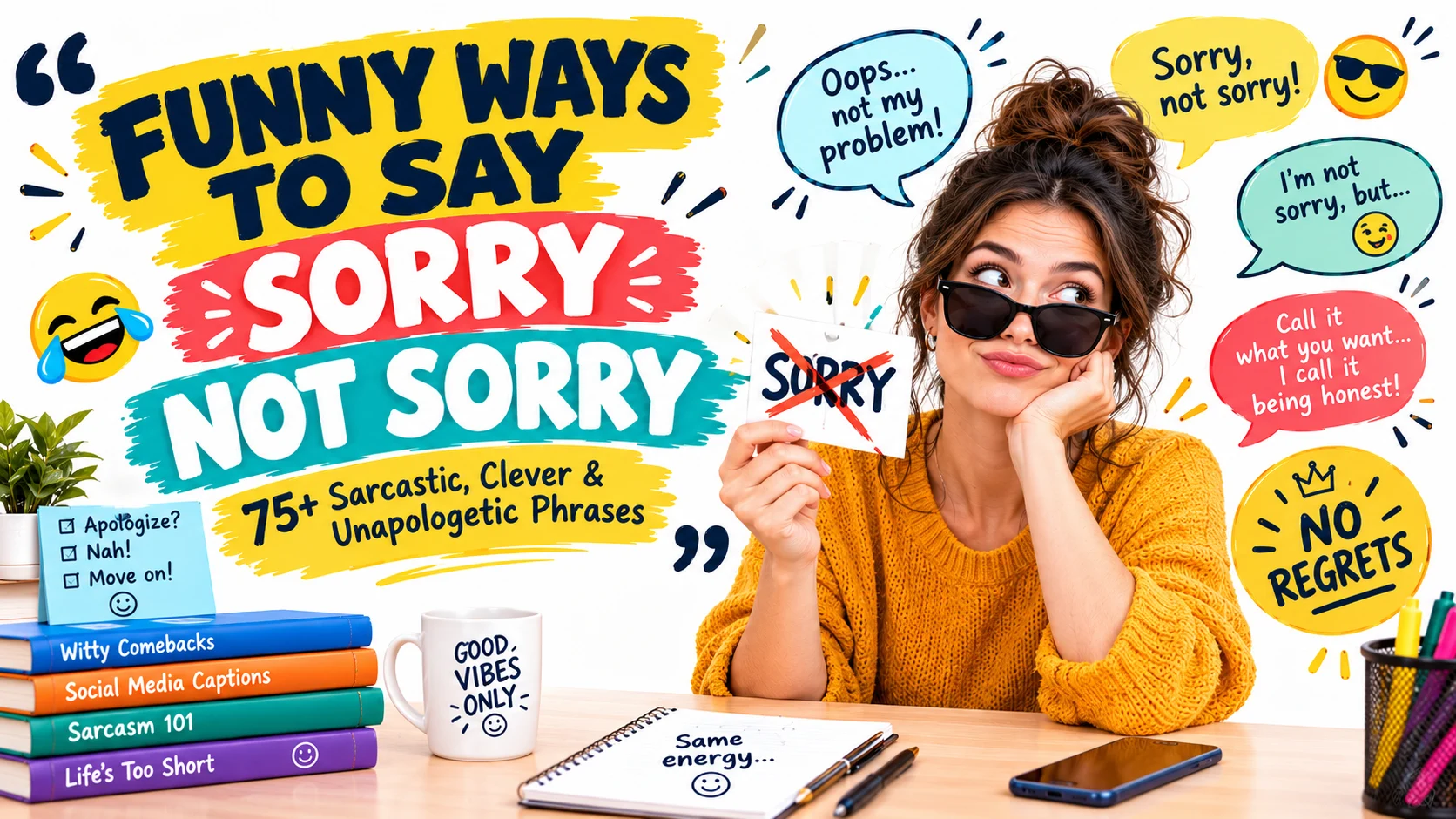
Sorry not sorry is the ultimate unapologetic phrase. It’s the perfect way to say, “I’m not actually sorry, and I’m not going to pretend I am.” But using it repeatedly can make you sound like a broken record.
The English language is full of clever, witty, and humorous alternatives to express the same sentiment. Mastering funny ways to say “sorry not sorry” helps you sound more like a native speaker, adds personality to your conversations, and lets you confidently stand your ground with style. This guide provides over 35 alternatives, ranging from playful to professionally bold, so you always have the perfect unapologetic response ready.
Top 5 alternatives: I’m not sorry, No regrets, I regret nothing, I’d do it again, Can’t say I’m sorry.
Quick Categories
Confident & Direct Alternatives
- I’m not sorry
- No regrets
- I regret nothing
- I’d do it again
- Can’t say I’m sorry
Pro Tip: These are direct and bold. Use them when you want to make your position crystal clear without any humor or sugar-coating.
Playful & Humorous Alternatives
- Sorry you feel that way
- Sorry, but not really sorry
- My apologies (I’m not sorry)
- Regretfully unapologetic
- You’re welcome
Pro Tip: Use these in lighthearted conversations with friends. They add humor and make the situation feel less confrontational.
Witty & Clever Alternatives
- I’m unapologetically myself
- If I hurt your feelings, that’s on you
- Sorry, not my problem
- I’m not here to make everyone happy
- Facts don’t care about your feelings
Pro Tip: These are for when you want to sound smart and confident. Perfect for social media, witty comebacks, or dealing with people who need a reality check.
Professional & Polite Alternatives (for work!)
- I appreciate your perspective, but I stand by my decision
- I understand your concern, however, I believe my approach is correct
- I respect your opinion, but I disagree
- I’m confident in my choice
- Thank you for your feedback, but I’m comfortable with my decision
Pro Tip: These are essential for workplace communication. They express confidence in your decisions while maintaining professionalism and respect.
Sarcastic & Bold Alternatives
- Cry about it
- Deal with it
- Suck it up
- Live with it
- Not my circus, not my monkeys
Pro Tip: Use these with caution. They work well with close friends or in humorous contexts but can come across as rude in professional settings.
“Confidence is knowing you’re right. Unapologetic confidence is knowing you don’t need to apologize for it.”
Common Mistakes
Mistake 1: Using “sorry not sorry” in professional settings
Why it is incorrect: This phrase is too casual and can sound immature or dismissive in the workplace.
Correct version: Use “I appreciate your perspective, but I stand by my decision.”
Example Sentence: Instead of “Sorry not sorry I disagreed with you,” say “I understand your concern, but I believe my approach is correct.
Mistake 2: Using overly aggressive alternatives
Why it is incorrect: Phrases like “Cry about it” can sound aggressive and damage relationships.
Correct version: Use a more neutral or humorous alternative.
Example Sentence: Instead of “Cry about it,” try “I’d do it again.”
Mistake 3: Overusing the phrase
Why it is incorrect: Using the same expression repeatedly makes you sound repetitive and less interesting.
Correct version: Vary your responses based on the situation.
Example Sentence: Instead of always saying “I’m not sorry,” alternate with “No regrets” and “I regret nothing.
Mistake 4: Not reading the room
Why it is incorrect: Some alternatives are too harsh for sensitive situations.
Correct version: Choose a phrase that matches the relationship and context.
Example Sentence: Instead of “Sorry you feel that way” to a friend who is genuinely hurt, say “I’m sorry you’re upset, but I stand by what I did.”
Mistake 5: Using sarcasm in written communication
Why it is incorrect: Sarcasm doesn’t translate well in text and can be misinterpreted.
Correct version: Avoid sarcastic phrases in emails or messages.
Example Sentence: Instead of “Not my circus, not my monkeys” in an email, say “I’m confident in my decision.”
What Does “Sorry Not Sorry” Mean?
Definition: An informal expression used to say that you are not actually sorry for something you’ve done.
Grammar: It’s a phrase that contrasts “sorry” with “not sorry” to emphasize the lack of regret.
Simple Explanation: When someone says “sorry not sorry,” they are acknowledging that they might have done something controversial but they don’t regret it and aren’t going to apologize.
Example Sentence: “I ate the last piece of cake. Sorry not sorry!”
When to Use “Sorry Not Sorry”
“Sorry not sorry” is a very modern, casual phrase. Use it when:
- You’ve done something controversial but don’t regret it
- You want to be playful about your choices
- You’re standing your ground against criticism
- You’re making a joke about your behavior
- You want to be unapologetic
“The best unapologetic phrase reflects your confidence without being disrespectful.”
Is It Professional or Polite?
Polite? ❌ No, it can come across as rude or dismissive.
Professional? ❌ No, it’s too casual and immature for professional settings.
Formal? ❌ No, it’s very informal.
Natural? ✔ Yes, it’s very common and natural among younger speakers.
Business-style example: Instead of “Sorry not sorry,” use “I appreciate your perspective, but I stand by my decision.”
Explanation: “Sorry not sorry” is a casual, often humorous phrase for friends and social media. In professional contexts, use more measured, respectful language to maintain credibility and relationships.
Pros and Cons
Pros
- Shows confidence
- Expresses your position clearly
- Humorous and playful
- Modern and relatable
Cons
- Can sound rude or dismissive
- Too casual for professional settings
- Overused
- May damage relationships
35+ Funny Alternatives to Say “Sorry Not Sorry”
1. Phrase: I’m Not Sorry
Meaning: A direct, unapologetic statement.
Explanation: This is the most straightforward alternative. It leaves no room for doubt—you are not sorry, and you mean it.
Example Sentence: “I told her the truth about the project. I’m not sorry.”
Best Use: Friends, family, casual settings
Avoid Using In: Professional contexts
Tone: Direct, Confident
Formality Level: ⭐⭐⭐ Neutral
Usage Frequency: Very Common
CEFR Level: A2
Common Collocations:
- I’m not sorry
- not sorry at all
- absolutely not sorry
Context Variability:
- Spoken English: “I’m not sorry.”
- Professional English: Avoid.
- Casual Conversation: Very natural.
2. Phrase: No Regrets
Meaning: You don’t regret your action at all.
Explanation: This is a short, confident statement that you stand by your choice. It’s a classic and widely understood expression.
Example Sentence: “I quit that toxic job. No regrets.”
Best Use: Friends, family, personal decisions
Avoid Using In: Professional settings
Tone: Confident, Bold
Formality Level: ⭐⭐⭐ Neutral
Usage Frequency: Very Common
CEFR Level: B1
Common Collocations:
- no regrets
- zero regrets
- absolutely no regrets
Context Variability:
- Spoken English: “No regrets, man.”
- Professional English: Acceptable but bold.
- Casual Conversation: Very natural.
3. Phrase: I Regret Nothing
Meaning: A stronger, more emphatic version of “no regrets.”
Explanation: This phrase leaves no room for doubt. It says you are completely comfortable with your actions and would make the same choice again.
Example Sentence: “I dyed my hair pink. I regret nothing!”
Best Use: Friends, social media, personal decisions
Avoid Using In: Professional contexts
Tone: Emphatic, Confident
Formality Level: ⭐⭐⭐ Neutral
Usage Frequency: Common
CEFR Level: B1
Common Collocations:
- regret nothing
- regret nothing at all
Context Variability:
- Spoken English: “I regret nothing!”
- Professional English: Avoid.
- Casual Conversation: Very common.
4. Phrase: I’d Do It Again
Meaning: You would make the same choice if given the chance.
Explanation: This is a bold statement that shows you are unapologetic. It implies that not only do you not regret it, but you would repeat the action.
Example Sentence: “I ate the last slice of pizza. I’d do it again.”
Best Use: Friends, humorous situations
Avoid Using In: Professional settings
Tone: Bold, Playful
Formality Level: ⭐⭐ Casual
Usage Frequency: Very Common
CEFR Level: B1
Common Collocations:
- I’d do it again
- I would do it again
- would do it again in a heartbeat
Context Variability:
- Spoken English: “I’d do it again, no question.”
- Professional English: Avoid.
- Casual Conversation: Very common.
5. Phrase: Can’t Say I’m Sorry
Meaning: A playful way to say you’re not sorry.
Explanation: This is a casual alternative that sounds more conversational. It’s like saying “I can’t honestly say I’m sorry” without sounding too confrontational.
Example Sentence: “I took the day off to go hiking. Can’t say I’m sorry.”
Best Use: Friends, colleagues, casual settings
Avoid Using In: Formal situations
Tone: Playful, Honest
Formality Level: ⭐⭐ Casual
Usage Frequency: Common
CEFR Level: B2
Common Collocations:
- can’t say I’m sorry
- can’t say I regret it
Context Variability:
- Spoken English: “Can’t say I’m sorry.”
- Professional English: Avoid.
- Casual Conversation: Very natural.
6. Phrase: Sorry You Feel That Way
Meaning: A dismissive but polite-sounding alternative.
Explanation: This phrase apologizes for the other person’s feelings, not for your actions. It’s a classic passive-aggressive way to be unapologetic.
Example Sentence: “I’m sorry you feel that way, but I stand by what I said.”
Best Use: Friends, social situations
Avoid Using In: Professional contexts
Tone: Passive-Aggressive, Dismissive
Formality Level: ⭐⭐⭐ Neutral
Usage Frequency: Very Common
CEFR Level: B1
Common Collocations:
- sorry you feel that way
- sorry you think that
- sorry you’re upset
Context Variability:
- Spoken English: “Sorry you feel that way.”
- Professional English: Avoid.
- Casual Conversation: Very common and slightly sarcastic.
7. Phrase: Sorry, But Not Really Sorry
Meaning: A direct, playful alternative.
Explanation: This phrase is almost identical to “sorry not sorry” but sounds slightly different. It’s clear, casual, and leaves no doubt about your position.
Example Sentence: “I didn’t invite him to the party. Sorry, but not really sorry.”
Best Use: Friends, humorous situations
Avoid Using In: Professional settings
Tone: Playful, Direct
Formality Level: ⭐⭐ Casual
Usage Frequency: Common
CEFR Level: B1
Common Collocations:
- not really sorry
- but not sorry
- not actually sorry
Context Variability:
- Spoken English: “Sorry but not really.”
- Professional English: Avoid.
- Casual Conversation: Very natural.
8. Phrase: My Apologies (I’m Not Sorry)
Meaning: A sarcastic, formal-sounding version.
Explanation: This phrase uses formal language (“my apologies”) but immediately contradicts it with “I’m not sorry.” It’s a funny, sophisticated way to be unapologetic.
Example Sentence: “My apologies if you were offended, but I’m not sorry.”
Best Use: Friends, sarcastic humor
Avoid Using In: Professional settings
Tone: Sarcastic, Clever
Formality Level: ⭐⭐⭐ Neutral
Usage Frequency: Occasional
CEFR Level: B2
Common Collocations:
- my apologies
- apologies
- I apologize
Context Variability:
- Spoken English: “My apologies. I’m not sorry.”
- Professional English: Avoid.
- Casual Conversation: Very witty.
9. Phrase: I’m Unapologetically Myself
Meaning: A positive way to say you won’t apologize for who you are.
Explanation: This is a confident, modern phrase. It frames being unapologetic as a positive trait—you’re proud of who you are and won’t change for anyone.
Example Sentence: “I may be loud and opinionated, but I’m unapologetically myself.”
Best Use: Social media, personal branding, self-confidence
Avoid Using In: Situations where you might be coming across as arrogant
Tone: Confident, Empowering
Formality Level: ⭐⭐⭐ Neutral
Usage Frequency: Common
CEFR Level: B2
Common Collocations:
- unapologetically myself
- unapologetically authentic
- unapologetically confident
Context Variability:
- Spoken English: “I’m unapologetically myself.”
- Professional English: Acceptable.
- Casual Conversation: Very empowering.
10. Phrase: If I Hurt Your Feelings, That’s on You
Meaning: A harsh, unapologetic statement blaming the other person.
Explanation: This phrase is direct and places responsibility on the listener. It can come across as harsh or defensive but is undeniably clear.
Example Sentence: “I said what I said. If I hurt your feelings, that’s on you.”
Best Use: Confrontational situations, close friends
Avoid Using In: Professional contexts, with sensitive people
Tone: Harsh, Direct
Formality Level: ⭐⭐ Casual
Usage Frequency: Common
CEFR Level: B2
Common Collocations:
- that’s on you
- not my problem
- your problem
Context Variability:
- Spoken English: “That’s on you, not me.”
- Professional English: Avoid.
- Casual Conversation: Very direct.
11. Phrase: Sorry, Not My Problem
Meaning: A dismissive way to refuse responsibility.
Explanation: This phrase acknowledges that someone might expect an apology but makes it clear you don’t feel responsible. It’s a common way to establish boundaries.
Example Sentence: “You’re upset about my decision? Sorry, not my problem.”
Best Use: Friends, casual settings
Avoid Using In: Professional contexts
Tone: Dismissive, Clear
Formality Level: ⭐⭐ Casual
Usage Frequency: Common
CEFR Level: B1
Common Collocations:
- not my problem
- not my concern
- not my issue
Context Variability:
- Spoken English: “Sorry, not my problem.”
- Professional English: Avoid.
- Casual Conversation: Very natural.
12. Phrase: I’m Not Here to Make Everyone Happy
Meaning: A confident statement that you can’t please everyone.
Explanation: This phrase is a mature, confident way to be unapologetic. It acknowledges that you might disappoint some people but you’re okay with that.
Example Sentence: “I know some people disagree, but I’m not here to make everyone happy.”
Best Use: Professional settings, personal decisions
Avoid Using In: Situations where teamwork is essential
Tone: Confident, Mature
Formality Level: ⭐⭐⭐ Neutral
Usage Frequency: Very Common
CEFR Level: B2
Common Collocations:
- not here to make everyone happy
- can’t please everyone
- not everyone will be happy
Context Variability:
- Spoken English: “I’m not here to make everyone happy.”
- Professional English: Acceptable but bold.
- Casual Conversation: Very natural.
13. Phrase: You’re Welcome
Meaning: A sarcastic alternative to “sorry.”
Explanation: This is a classic witty response. When someone expects an apology, saying “you’re welcome” turns the tables and implies they should be grateful instead.
Example Sentence: “Thanks for nothing.” “You’re welcome!”
Best Use: Friends, humorous comebacks
Avoid Using In: Professional settings
Tone: Sarcastic, Witty
Formality Level: ⭐⭐ Casual
Usage Frequency: Very Common
CEFR Level: A2
Common Collocations:
- you’re welcome
- you’re very welcome
- anytime
Context Variability:
- Spoken English: “You’re welcome!” (sarcastic)
- Professional English: Avoid.
- Casual Conversation: Very witty.
14. Phrase: Cry About It
Meaning: A very dismissive, harsh alternative.
Explanation: This is a challenge to the other person’s feelings. It’s aggressive and should only be used with people you have a very close relationship with.
Example Sentence: “I ate the last cookie.” “But I wanted it!” “Cry about it.”
Best Use: Close friends, siblings, humorous banter
Avoid Using In: Professional contexts, with sensitive people
Tone: Dismissive, Aggressive
Formality Level: ⭐ Very Casual
Usage Frequency: Common
CEFR Level: B1
Common Collocations:
- cry about it
- cry me a river
Context Variability:
- Spoken English: “Cry about it.”
- Professional English: Avoid.
- Casual Conversation: Very direct.
15. Phrase: Deal with It
Meaning: A direct, unapologetic statement.
Explanation: This phrase tells the other person to accept the situation. It’s clear and leaves no room for argument.
Example Sentence: “I’m going to wear what I want. Deal with it.”
Best Use: Friends, casual settings
Avoid Using In: Professional settings
Tone: Direct, Confident
Formality Level: ⭐⭐ Casual
Usage Frequency: Very Common
CEFR Level: B1
Common Collocations:
- deal with it
- get over it
- accept it
Context Variability:
- Spoken English: “Deal with it.”
- Professional English: Avoid.
- Casual Conversation: Very natural.
16. Phrase: Suck It Up
Meaning: A harsh way to say the other person should accept the situation.
Explanation: This phrase is dismissive and can come across as unsympathetic. Use it only in very casual settings with people you know well.
Example Sentence: “I can’t believe you said that!” “Well, I did. Suck it up.”
Best Use: Close friends, siblings, humorous banter
Avoid Using In: Professional contexts, with sensitive people
Tone: Harsh, Dismissive
Formality Level: ⭐ Very Casual
Usage Frequency: Common
CEFR Level: B2
Common Collocations:
- suck it up
- suck it up buttercup
Context Variability:
- Spoken English: “Suck it up.”
- Professional English: Avoid.
- Casual Conversation: Very direct.
17. Phrase: Live with It
Meaning: A calm but unapologetic alternative.
Explanation: This phrase is less aggressive than “deal with it.” It simply says the other person needs to accept the situation.
Example Sentence: “I’ve made my choice. You’ll have to live with it.”
Best Use: Friends, personal decisions
Avoid Using In: Professional settings
Tone: Calm, Unapologetic
Formality Level: ⭐⭐⭐ Neutral
Usage Frequency: Common
CEFR Level: B1
Common Collocations:
- live with it
- learn to live with it
Context Variability:
- Spoken English: “Live with it.”
- Professional English: Avoid.
- Casual Conversation: Very natural.
18. Phrase: Not My Circus, Not My Monkeys
Meaning: A humorous way to say it’s not your problem.
Explanation: This is a classic, funny Polish proverb. It means “that’s someone else’s problem.” It’s a playful way to be unapologetic.
Example Sentence: “I heard there’s drama between Sarah and John.” “Not my circus, not my monkeys.”
Best Use: Friends, humorous situations
Avoid Using In: Professional contexts
Tone: Playful, Humorous
Formality Level: ⭐⭐ Casual
Usage Frequency: Common
CEFR Level: B2
Common Collocations:
- not my circus
- not my monkeys
- not my problem
Context Variability:
- Spoken English: “Not my circus, not my monkeys.”
- Professional English: Avoid.
- Casual Conversation: Very funny.
19. Phrase: Sorry, I’m Not Actually Sorry
Meaning: A clear, unapologetic statement.
Explanation: This phrase makes your position crystal clear. It leaves no room for misunderstanding.
Example Sentence: “I ate your leftovers. Sorry, I’m not actually sorry.”
Best Use: Friends, casual settings
Avoid Using In: Professional settings
Tone: Clear, Playful
Formality Level: ⭐⭐ Casual
Usage Frequency: Common
CEFR Level: B1
Common Collocations:
- actually sorry
- not actually sorry
Context Variability:
- Spoken English: “Sorry, I’m not actually sorry.”
- Professional English: Avoid.
- Casual Conversation: Very natural.
20. Phrase: I’m Sorry You Think I Should Apologize
Meaning: A passive-aggressive, clever alternative.
Explanation: This phrase apologizes for the other person’s expectation of an apology, not for your actions. It’s a very clever way to be unapologetic.
Example Sentence: “I’m sorry you think I should apologize, but I stand by what I did.”
Best Use: Friends, witty comebacks
Avoid Using In: Professional settings
Tone: Passive-Aggressive, Clever
Formality Level: ⭐⭐ Casual
Usage Frequency: Occasional
CEFR Level: B2
Common Collocations:
- sorry you think
- sorry you feel
Context Variability:
- Spoken English: “I’m sorry you think I should apologize.”
- Professional English: Avoid.
- Casual Conversation: Very witty.
21. Phrase: And I’d Do It Again
Meaning: An emphatic way to say you stand by your actions.
Explanation: This is a stronger version of “I’d do it again.” It shows you are completely unapologetic and would repeat the action.
Example Sentence: “I told everyone the truth. And I’d do it again.”
Best Use: Friends, personal decisions
Avoid Using In: Professional settings
Tone: Emphatic, Bold
Formality Level: ⭐⭐⭐ Neutral
Usage Frequency: Common
CEFR Level: B1
Common Collocations:
- and I’d do it again
- and I’d do it again in a heartbeat
Context Variability:
- Spoken English: “And I’d do it again.”
- Professional English: Avoid.
- Casual Conversation: Very bold.
22. Phrase: I Appreciate Your Perspective, but I Stand by My Decision
Meaning: A professional, unapologetic response.
Explanation: This is the perfect workplace alternative. It acknowledges the other person’s opinion but clearly states you are standing firm.
Example Sentence: “I appreciate your perspective, but I stand by my decision to decline the offer.”
Best Use: Professional emails, meetings, workplace discussions
Avoid Using In: Casual conversations with friends
Tone: Professional, Respectful
Formality Level: ⭐⭐⭐⭐ Formal
Usage Frequency: Very Common
CEFR Level: B2
Common Collocations:
- stand by my decision
- appreciate your perspective
- respect your opinion
Context Variability:
- Spoken English: “I stand by my decision.”
- Professional English: “I appreciate your perspective, but I stand by my decision.”
- Casual Conversation: Sounds formal.
23. Phrase: I Understand Your Concern, However, I Believe My Approach Is Correct
Meaning: A respectful, professional alternative.
Explanation: This phrase validates the other person’s feelings while firmly stating your position. It’s the gold standard for professional disagreement.
Example Sentence: “I understand your concern, however, I believe my approach is correct based on the data.”
Best Use: Professional settings, workplace disagreements
Avoid Using In: Casual conversations
Tone: Professional, Respectful
Formality Level: ⭐⭐⭐⭐ Formal
Usage Frequency: Very Common
CEFR Level: B2
Common Collocations:
- understand your concern
- believe my approach is correct
- based on the data
Context Variability:
- Spoken English: “I understand, but I believe I’m right.”
- Professional English: “I understand your concern, however…”
- Casual Conversation: Sounds formal.
24. Phrase: I’m Confident in My Choice
Meaning: A calm, professional way to be unapologetic.
Explanation: This phrase expresses confidence without arrogance. It’s perfect for professional settings where you need to stand your ground.
Example Sentence: “I’ve reviewed all the options and I’m confident in my choice.”
Best Use: Professional settings, business decisions
Avoid Using In: Casual arguments with friends
Tone: Professional, Confident
Formality Level: ⭐⭐⭐⭐ Formal
Usage Frequency: Very Common
CEFR Level: B2
Common Collocations:
- confident in my choice
- confident in my decision
- confident in my approach
Context Variability:
- Spoken English: “I’m confident in my choice.”
- Professional English: “I’m confident in my decision.”
- Casual Conversation: Sounds formal.
25. Phrase: Thank You for Your Feedback, but I’m Comfortable with My Decision
Meaning: A polite, professional way to say you’re not changing your mind.
Explanation: This phrase acknowledges feedback but firmly states you are satisfied with your choice. It’s gracious and confident.
Example Sentence: “Thank you for your feedback, but I’m comfortable with my decision.”
Best Use: Professional settings, feedback situations
Avoid Using In: Casual conversations
Tone: Professional, Gracious
Formality Level: ⭐⭐⭐⭐ Formal
Usage Frequency: Common
CEFR Level: B2
Common Collocations:
- comfortable with my decision
- comfortable with my choice
- satisfied with my decision
Context Variability:
- Spoken English: “I’m comfortable with my decision.”
- Professional English: “Thank you for your feedback…”
- Casual Conversation: Sounds formal.
26. Phrase: I Respect Your Opinion, but I Disagree
Meaning: A respectful, professional way to disagree.
Explanation: This phrase shows you value the other person’s perspective while clearly stating your different position.
Example Sentence: “I respect your opinion, but I disagree with your assessment.”
Best Use: Professional settings, respectful disagreements
Avoid Using In: Situations where you want to be playful
Tone: Respectful, Professional
Formality Level: ⭐⭐⭐⭐ Formal
Usage Frequency: Very Common
CEFR Level: B1
Common Collocations:
- respect your opinion
- disagree
- respectfully disagree
Context Variability:
- Spoken English: “I respect that, but I disagree.”
- Professional English: “I respect your opinion, but I disagree.”
- Casual Conversation: Sounds formal.
27. Phrase: Regretfully Unapologetic
Meaning: A clever, ironic phrase.
Explanation: This is a funny, sophisticated way to say you’re not sorry. “Regretfully” suggests you should be sorry, but “unapologetic” says you’re not.
Example Sentence: “I declined the invitation without guilt. I’m regretfully unapologetic.”
Best Use: Friends, witty humor
Avoid Using In: Professional settings
Tone: Ironic, Clever
Formality Level: ⭐⭐⭐ Neutral
Usage Frequency: Occasional
CEFR Level: C1
Common Collocations:
- regretfully unapologetic
- unapologetically myself
Context Variability:
- Spoken English: “I’m regretfully unapologetic.”
- Professional English: Avoid.
- Casual Conversation: Very clever.
28. Phrase: Not My Finest Moment, but I’m Not Sorry
Meaning: A humorous, self-aware alternative.
Explanation: This phrase acknowledges the situation wasn’t perfect but still refuses to apologize. It’s a funny way to be unapologetic while admitting you might have been a bit much.
Example Sentence: “I ate all the cookies. Not my finest moment, but I’m not sorry.”
Best Use: Friends, humorous situations
Avoid Using In: Professional settings
Tone: Humorous, Self-Aware
Formality Level: ⭐⭐ Casual
Usage Frequency: Common
CEFR Level: B2
Common Collocations:
- not my finest moment
- not my proudest moment
Context Variability:
- Spoken English: “Not my finest moment, but not sorry.”
- Professional English: Avoid.
- Casual Conversation: Very relatable.
29. Phrase: I’m Not Apologizing for Being Right
Meaning: A bold, confident alternative.
Explanation: This phrase assumes you are correct and refuses to apologize for it. It’s direct and unapologetic.
Example Sentence: “I told you this would happen. I’m not apologizing for being right.”
Best Use: Friends, arguments, confident moments
Avoid Using In: Professional settings
Tone: Bold, Confident
Formality Level: ⭐⭐⭐ Neutral
Usage Frequency: Common
CEFR Level: B2
Common Collocations:
- apologizing for being right
- for being right
- not apologizing
Context Variability:
- Spoken English: “I’m not apologizing for being right.”
- Professional English: Avoid.
- Casual Conversation: Very bold.
30. Phrase: Sorry, but I Have No Regrets
Meaning: A clear, confident alternative.
Explanation: This phrase acknowledges a possible expectation of an apology while stating you don’t have any regrets.
Example Sentence: “I left the company. Sorry, but I have no regrets.”
Best Use: Friends, personal decisions
Avoid Using In: Professional settings
Tone: Confident, Clear
Formality Level: ⭐⭐⭐ Neutral
Usage Frequency: Common
CEFR Level: B1
Common Collocations:
- no regrets
- have no regrets
- zero regrets
Context Variability:
- Spoken English: “Sorry, I have no regrets.”
- Professional English: Acceptable but bold.
- Casual Conversation: Very natural.
31. Phrase: I’m Sorry if the Truth Hurt
Meaning: A passive-aggressive, blunt alternative.
Explanation: This phrase apologizes for the “truth” hurting, not for the action itself. It implies the other person is too sensitive.
Example Sentence: “I’m sorry if the truth hurt, but it needed to be said.”
Best Use: Friends, confrontational situations
Avoid Using In: Professional settings
Tone: Passive-Aggressive, Blunt
Formality Level: ⭐⭐⭐ Neutral
Usage Frequency: Common
CEFR Level: B2
Common Collocations:
- if the truth hurt
- sorry if you were offended
- truth hurts
Context Variability:
- Spoken English: “I’m sorry if the truth hurt.”
- Professional English: Avoid.
- Casual Conversation: Very direct.
32. Phrase: I’m Not Sorry, and I’m Not Going to Be
Meaning: A firm, unapologetic statement.
Explanation: This phrase leaves no room for negotiation. It says you are not sorry now and will not become sorry in the future.
Example Sentence: “I made my decision. I’m not sorry, and I’m not going to be.”
Best Use: Friends, personal decisions
Avoid Using In: Professional settings
Tone: Firm, Unapologetic
Formality Level: ⭐⭐⭐ Neutral
Usage Frequency: Common
CEFR Level: B1
Common Collocations:
- not going to be sorry
- won’t be sorry
Context Variability:
- Spoken English: “I’m not sorry and I won’t be.”
- Professional English: Avoid.
- Casual Conversation: Very firm.
33. Phrase: Facts Don’t Care About Your Feelings
Meaning: A harsh, unapologetic response.
Explanation: This is a controversial phrase often used in political or heated debates. It prioritizes facts over emotions and is completely unapologetic.
Example Sentence: “I know you’re upset, but facts don’t care about your feelings.”
Best Use: Debates, confrontational situations
Avoid Using In: Professional settings, with sensitive people
Tone: Harsh, Unapologetic
Formality Level: ⭐⭐ Casual
Usage Frequency: Common
CEFR Level: B2
Common Collocations:
- facts don’t care
- facts over feelings
Context Variability:
- Spoken English: “Facts don’t care about your feelings.”
- Professional English: Avoid.
- Casual Conversation: Very direct.
34. Phrase: You’re Entitled to Your Opinion, but It’s Wrong
Meaning: A blunt, unapologetic way to disagree.
Explanation: This phrase acknowledges the other person’s right to an opinion but immediately dismisses that opinion as wrong. It’s direct and unapologetic.
Example Sentence: “You’re entitled to your opinion, but it’s wrong.”
Best Use: Friends, debates
Avoid Using In: Professional settings
Tone: Blunt, Unapologetic
Formality Level: ⭐⭐⭐ Neutral
Usage Frequency: Common
CEFR Level: B2
Common Collocations:
- entitled to your opinion
- but it’s wrong
- but you’re wrong
Context Variability:
- Spoken English: “You’re entitled to your opinion, but it’s wrong.”
- Professional English: Avoid.
- Casual Conversation: Very direct.
35. Phrase: I’m Not Apologizing for Being Awesome
Meaning: A playful, confident statement.
Explanation: This is a humorous, self-confident phrase. It suggests that any action you’ve taken is because you’re awesome, and you won’t apologize for that.
Example Sentence: “I took the lead on the project. I’m not apologizing for being awesome.”
Best Use: Friends, humorous moments
Avoid Using In: Professional settings
Tone: Playful, Confident
Formality Level: ⭐⭐ Casual
Usage Frequency: Occasional
CEFR Level: B2
Common Collocations:
- apologizing for being awesome
- being awesome
Context Variability:
- Spoken English: “I’m not apologizing for being awesome.”
- Professional English: Avoid.
- Casual Conversation: Very playful.
Top 10 Alternatives Compared
| Phrase | Tone | Formality | Best Use | Frequency |
| I’m not sorry | Direct, Confident | Neutral | Friends, casual | Very Common |
| No regrets | Bold, Confident | Neutral | Personal decisions | Very Common |
| I regret nothing | Emphatic, Confident | Neutral | Friends, social media | Common |
| I’d do it again | Bold, Playful | Casual | Friends, humor | Very Common |
Frequently Asked Questions
1. What does “sorry not sorry” mean?
“Sorry not sorry” is a playful way to apologize without actually feeling guilty. It usually means you know someone might disagree with what you did, but you have no real regrets.
2. What are some funny ways to say “sorry not sorry”?
Funny alternatives include “Oops, I’d do it again,” “My bad, but absolutely worth it,” “Apologies with zero regrets,” and “I’m sorry you feel that way.”
3. Is “sorry not sorry” rude?
It can be. Among friends, it is usually humorous and sarcastic, but in professional or sensitive situations, it may sound dismissive or disrespectful.
4. How can I say “sorry not sorry” in a playful way?
Try something lighthearted such as, “Oops… no regrets,” “Forgive me, but I stand by it,” or “My apologies, but I regret nothing.”
5. What is a sarcastic way to say sorry?
You could say, “Please accept my completely unnecessary apology,” “I’m deeply sorry… that you didn’t enjoy it,” or “My sincerest regrets, which are currently unavailable.”
6. What are funny “sorry not sorry” captions?
Short captions such as “Oops. Zero regrets,” “Sorry-ish,” “My bad, not my problem,” and “Regret? Never heard of her” work well for social media.
7. Can I use “sorry not sorry” with friends?
Yes. It works especially well when joking with people who understand your sense of humor and know you are being playful.
8. What is a cute way to say “sorry not sorry”?
Try “Oopsie, but I’d do it again,” “Tiny apology, huge confidence,” or “Sorry, but my heart says absolutely not.”
9. What is a funny way to apologize without admitting fault?
You can say, “I apologize for nothing,” “My mistake was assuming you’d understand,” or “I’m sorry for the inconvenience caused by my excellent decision.”
10. Is “sorry not sorry” good for Instagram captions?
Yes. Its short, sarcastic style makes it useful for Instagram captions, selfies, funny posts, memes, and situations where you want to show confidence without sounding too serious.
Conclusion
Sometimes an apology is sincere, sometimes it is sarcastic, and sometimes you simply have zero regrets. That is exactly where funny “sorry not sorry” phrases come in handy.
Whether you want a clever comeback, a playful text, a sarcastic caption, or a funny response to a friend, these alternatives let you say what you mean without sounding overly serious. From “Oops, I’d do it again” to “My apologies, but I regret nothing,” there is a phrase for almost every unapologetic moment.
So the next time you make a questionable decision, steal the last slice of pizza, or post something your friends definitely did not expect, skip the boring apology. Pick a funny line, own the moment, and deliver your sorry-not-sorry energy with confidence.

4 thoughts on “Funny Ways to Say “Sorry Not Sorry” |75+ Alternatives for 2026”