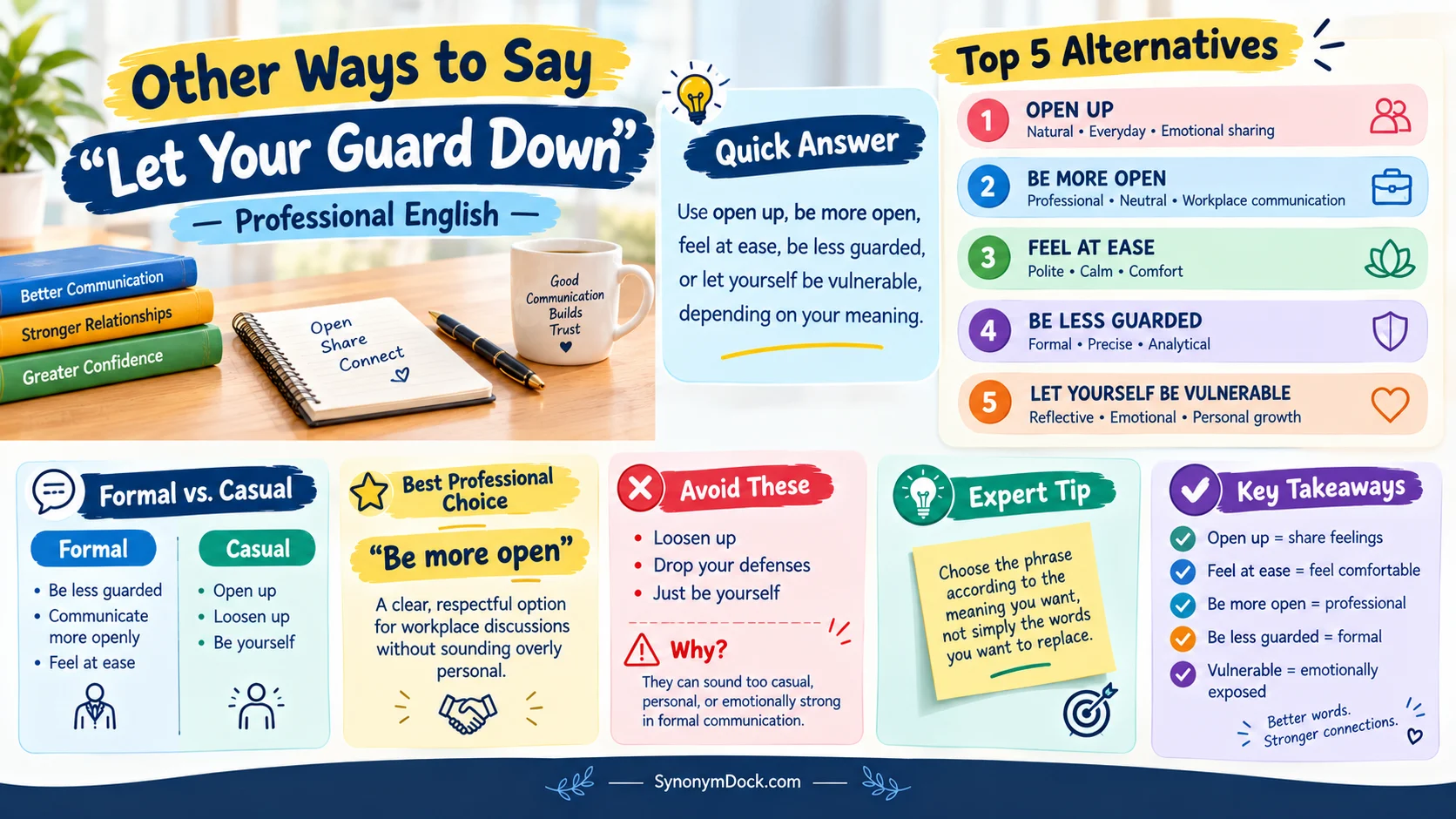
Other ways to say let your guard down include open up, relax around someone, lower your defenses, be less guarded, and let yourself be vulnerable. The best choice depends on whether you mean trust, emotional openness, or simply feeling relaxed.
Top alternatives: Open up, relax around someone, lower your defenses, be less guarded, let yourself be vulnerable
“Let your guard down” means becoming less cautious, defensive, or emotionally reserved, especially around people you trust. It can describe relaxing, sharing personal feelings, or allowing someone to see your genuine personality.
People often search for alternatives to “let your guard down” because repeating the same expression can make spoken and written English feel limited. Learning other ways to say “let your guard down” gives you more control over tone and meaning.
Some alternatives work well in personal conversations, while others fit workplace communication, academic writing, professional emails, or presentations. The key is choosing a phrase that matches what you actually mean.
“Natural English is not about using bigger words; it is about choosing the right words for the situation.”
Formal Alternatives
- Lower your defenses
- Be less guarded
- Allow yourself to be vulnerable
- Reveal your true feelings
- Open yourself up
Pro Tip
Formal alternatives usually focus on emotional openness or reducing defensiveness. “Lower your defenses” and “be less guarded” work particularly well when discussing relationships, communication, or behavior.
Professional Alternatives
- Be more open
- Share your perspective openly
- Become more comfortable
- Build trust
- Communicate more openly
Pro Tip
In professional English, direct emotional language can sometimes sound too personal. Phrases such as “be more open” and “communicate more openly” are safer in workplace discussions.
Business Email Alternatives
- I appreciate your openness
- Thank you for sharing this
- I’m glad you felt comfortable sharing
- I appreciate your honesty
- I value your openness
Pro Tip
Business emails rarely need the exact phrase “let your guard down.” When someone shares something personal or sensitive, acknowledging their openness sounds more professional.
Academic Alternatives
- Become less defensive
- Remain open to discussion
- Express personal perspectives
- Show greater openness
- Allow greater emotional openness
Pro Tip
Academic writing usually benefits from precise, objective language. Avoid overly conversational expressions unless you are analyzing dialogue, literature, psychology, or communication.
Casual Alternatives
- Open up
- Relax around someone
- Loosen up
- Be yourself
- Feel at ease
Pro Tip
These are common in everyday conversation. “Open up” usually suggests emotional sharing, while “relax around someone” emphasizes comfort.
Informal Expressions
- Drop your defenses
- Let your guard down
- Let yourself be seen
- Stop holding back
- Show your real self
Pro Tip
Informal expressions are useful with friends and people you know well. Some, such as “drop your defenses,” can sound emotionally stronger than the original phrase.
“The closest synonym is not always the best choice; the intended meaning matters.”
What Does “Let Your Guard Down” Mean?
Let your guard down means to stop being so cautious, defensive, private, or emotionally protected.
The expression is an idiomatic phrasal expression. It is often used when someone normally protects their feelings or remains cautious but becomes more relaxed or open.
Simple meaning
If someone lets their guard down, they allow other people to see more of their genuine thoughts, feelings, personality, or vulnerability.
Example:
After several weeks of working together, Maya finally let her guard down and started talking openly about her goals.
The phrase does not always mean revealing something deeply personal. Sometimes it simply means feeling comfortable enough to relax.
When to Use “Let Your Guard Down”
You can use the expression in several situations:
- Daily conversation: talking about becoming comfortable with someone.
- Friendships: describing emotional openness.
- Relationships: discussing trust and vulnerability.
- Workplace communication: possible in informal workplace conversations.
- Meetings: useful when discussing trust or team relationships, but often replaced by more professional wording.
- Emails: acceptable in friendly or personal emails, but less suitable for formal business writing.
- Academic writing: usually replaced with more precise terms such as become less guarded.
- Spoken English: very natural.
- Written English: natural in personal, journalistic, or conversational writing.
- Formal English: understandable, but alternatives may sound more precise.
Is “Let Your Guard Down” Professional or Polite?
Polite? ✔ Yes
Professional? ✔ Sometimes
Formal? △ Depends on context
Natural? ✔ Very natural
The expression itself is not rude. However, it can imply that someone has emotional defenses or is hiding something.
Business-style example
Instead of:
You need to let your guard down with the team.
A softer workplace version is:
You may feel more comfortable sharing your ideas with the team over time.
The second sentence avoids suggesting that the person is unnecessarily defensive.
Pros and Cons
Pros
- Easy for native speakers to understand.
- Common in everyday English.
- Works naturally in spoken English.
- Can describe emotional or social comfort.
- Expresses trust without requiring a long explanation.
Cons
- Can sound personal in professional situations.
- May imply defensiveness.
- Does not always mean simply “relax.”
- Can be too informal for academic writing.
- The meaning can change depending on context.
Other Ways to Say “Let Your Guard Down” With Examples
These alternatives are not identical in every situation. Each one highlights a slightly different idea, such as trust, relaxation, vulnerability, or openness.
1. Phrase: Open Up
Meaning:
To become more willing to share your thoughts, feelings, or personal experiences.
Explanation:
“Open up” is probably the most natural everyday alternative when emotional sharing is involved. Native speakers commonly use it when someone who is usually private begins talking honestly.
It sounds neutral, natural, and conversational rather than formal.
Example Sentence:
It took Daniel a while to open up, but eventually he told us what had been bothering him.
Best Use:
Personal Conversations
Avoid Using In:
Formal Reports
Tone:
Warm, Natural
Formality Level:
⭐⭐⭐ Neutral
Usage Frequency:
Very Common
CEFR Level:
B1
Common Collocations:
- open up to someone
- open up about something
- slowly open up
- finally open up
- encourage someone to open up
Context Variability:
- Spoken: She rarely opens up about her worries.
- Professional: Employees may open up more when they feel respected.
- Casual: Come on, open up. You can tell me.
2. Phrase: Relax Around Someone
Meaning:
To feel comfortable and less tense in another person’s presence.
Explanation:
This phrase focuses more on comfort and ease than emotional vulnerability. Someone can relax around you without telling you personal secrets.
It is highly natural in everyday English.
Example Sentence:
I knew we had become good friends when I could finally relax around her.
Best Use:
Friendship
Avoid Using In:
Academic Essay
Tone:
Friendly, Natural
Formality Level:
⭐⭐ Casual
Usage Frequency:
Very Common
CEFR Level:
B1
Common Collocations:
- relax around someone
- feel relaxed around
- completely relax
- relax in someone’s company
Context Variability:
- Spoken: I can really relax around you.
- Professional: New employees often need time to relax around their colleagues.
- Casual: He finally relaxed around everyone at the party.
3. Phrase: Lower Your Defenses
Meaning:
To become less defensive or cautious toward another person.
Explanation:
This expression is close to “let your guard down” but can sound slightly stronger. It often suggests that someone has been protecting themselves emotionally or psychologically.
It works in serious conversations, relationship discussions, and reflective writing.
Example Sentence:
Once she realized that nobody was judging her, she began to lower her defenses.
Best Use:
Serious Discussions
Avoid Using In:
Casual Texts
Tone:
Reflective, Serious
Formality Level:
⭐⭐⭐⭐ Formal
Usage Frequency:
Common
CEFR Level:
B2
Common Collocations:
- lower your defenses
- slowly lower defenses
- lower emotional defenses
- encourage someone to lower defenses
Context Variability:
- Spoken: He needs time before he lowers his defenses.
- Professional: Trust can help employees lower their defenses during difficult discussions.
- Casual: She finally lowered her defenses and trusted us.
4. Phrase: Be Less Guarded
Meaning:
To behave in a less cautious, private, or defensive way.
Explanation:
“Be less guarded” is useful when you want to describe someone’s behavior without sounding overly emotional. It is especially helpful in professional, academic, and analytical contexts.
It is more formal than “open up.”
Example Sentence:
During the second interview, the candidate seemed less guarded and spoke more freely.
Best Use:
Professional Writing
Avoid Using In:
Very Casual Chat
Tone:
Neutral, Professional
Formality Level:
⭐⭐⭐⭐ Formal
Usage Frequency:
Common
CEFR Level:
B2
Common Collocations:
- seem less guarded
- become less guarded
- appear less guarded
- be emotionally guarded
Context Variability:
- Spoken: She became less guarded after we talked.
- Professional: The employee appeared less guarded during the follow-up meeting.
- Casual: He’s much less guarded with his close friends.
5. Phrase: Let Yourself Be Vulnerable
Meaning:
To allow yourself to show genuine feelings, weaknesses, or personal concerns.
Explanation:
This phrase is more specific than “let your guard down.” It emphasizes emotional vulnerability rather than simply relaxing.
It is common in discussions about relationships, personal growth, leadership, and communication.
Example Sentence:
Strong relationships often require both people to let themselves be vulnerable.
Best Use:
Personal Growth
Avoid Using In:
Routine Emails
Tone:
Reflective, Emotional
Formality Level:
⭐⭐⭐ Neutral
Usage Frequency:
Common
CEFR Level:
B2
Common Collocations:
- allow yourself to be vulnerable
- feel vulnerable
- emotional vulnerability
- embrace vulnerability
Context Variability:
- Spoken: Sometimes you have to let yourself be vulnerable.
- Professional: Effective leadership can involve allowing appropriate vulnerability.
- Casual: It’s hard for me to let myself be vulnerable.
Native Speaker Tip
Among these first five options, “open up” is usually the most natural everyday choice. “Be less guarded” sounds more analytical, while “let yourself be vulnerable” carries a deeper emotional meaning.
“Use ‘open up’ for sharing; use ‘relax’ for comfort; use ‘vulnerable’ for emotional exposure.”
6. Phrase: Be More Open
Meaning:
To become more willing to share ideas, feelings, information, or opinions.
Explanation:
This is one of the safest alternatives for professional communication because it does not automatically suggest emotional weakness.
It works well in workplaces, meetings, classrooms, and everyday conversations.
Example Sentence:
The manager encouraged everyone to be more open about their concerns.
Best Use:
Workplace Communication
Avoid Using In:
Legal Statements
Tone:
Professional, Neutral
Formality Level:
⭐⭐⭐⭐ Formal
Usage Frequency:
Very Common
CEFR Level:
B1
Common Collocations:
- be more open
- remain open
- open communication
- open discussion
- open about concerns
Context Variability:
- Spoken: Try to be more open with your family.
- Professional: We encourage team members to be more open about challenges.
- Casual: You can be more open with me.
7. Phrase: Feel at Ease
Meaning:
To feel comfortable, calm, and free from tension.
Explanation:
“Feel at ease” does not necessarily mean revealing personal information. It focuses on comfort.
It is a useful choice when describing someone’s emotional state without implying that they have lowered their defenses.
Example Sentence:
The welcoming atmosphere helped the new students feel at ease.
Best Use:
Formal Communication
Avoid Using In:
Very Informal Speech
Tone:
Polite, Calm
Formality Level:
⭐⭐⭐⭐ Formal
Usage Frequency:
Common
CEFR Level:
B2
Common Collocations:
- feel at ease
- put someone at ease
- completely at ease
- make someone feel at ease
Context Variability:
- Spoken: She made me feel at ease immediately.
- Professional: The interviewer put the candidate at ease.
- Casual: I always feel at ease when I’m with them.
8. Phrase: Loosen Up
Meaning:
To become more relaxed and less serious or tense.
Explanation:
This is a distinctly informal expression. It usually refers to relaxing socially rather than sharing deep emotions.
Be careful with it at work because telling someone to “loosen up” can sound critical or dismissive.
Example Sentence:
After the presentation was over, everyone loosened up and started joking.
Best Use:
Casual Conversation
Avoid Using In:
Formal Meetings
Tone:
Casual, Friendly
Formality Level:
⭐⭐ Casual
Usage Frequency:
Common
CEFR Level:
B1
Common Collocations:
- loosen up
- help someone loosen up
- start to loosen up
- loosen up a little
Context Variability:
- Spoken: You need to loosen up a little.
- Professional: The team loosened up after the formal presentation.
- Casual: Come on, loosen up and have some fun.
9. Phrase: Stop Holding Back
Meaning:
To stop restraining your feelings, opinions, abilities, or reactions.
Explanation:
This phrase is broader than “let your guard down.” It can refer to emotional expression, creativity, participation, or personal opinions.
That flexibility makes it useful in both personal and professional contexts.
Example Sentence:
Once the discussion became more relaxed, the students stopped holding back.
Best Use:
Group Discussion
Avoid Using In:
Formal Instructions
Tone:
Encouraging, Direct
Formality Level:
⭐⭐⭐ Neutral
Usage Frequency:
Common
CEFR Level:
B1
Common Collocations:
- stop holding back
- hold back feelings
- hold back opinions
- stop holding yourself back
Context Variability:
- Spoken: Don’t hold back tell me what you really think.
- Professional: Employees should feel comfortable sharing ideas rather than holding back.
- Casual: She stopped holding back and told us everything.
10. Phrase: Drop Your Defenses
Meaning:
To stop protecting yourself emotionally or mentally from other people.
Explanation:
This phrase is very close to “let your guard down.” However, “drop your defenses” can sound more dramatic and deliberate.
It is useful in personal conversations and reflective writing but may feel too strong in business English.
Example Sentence:
He gradually dropped his defenses and started trusting the people around him.
Best Use:
Personal Relationships
Avoid Using In:
Business Emails
Tone:
Emotional, Strong
Formality Level:
⭐⭐⭐ Neutral
Usage Frequency:
Occasional
CEFR Level:
B2
Common Collocations:
- drop your defenses
- slowly drop defenses
- emotional defenses
- lower and drop defenses
Context Variability:
- Spoken: She finally dropped her defenses.
- Professional: The discussion became more productive once participants stopped being defensive.
- Casual: He dropped his defenses after realizing we trusted him.
Expert Insight
In workplace English, “be more open” is generally more practical than “drop your defenses.” The first encourages communication without suggesting that someone is emotionally protected or difficult.
Quick Recap
Best Professional Choice: Be more open
Best Casual Choice: Open up
Best Formal Choice: Be less guarded
Most Natural Choice: Open up
Most Polite Choice: Feel at ease
11. Phrase: Communicate More Openly
Meaning:
To share thoughts, concerns, or information more honestly and directly.
Explanation:
This is a strong professional alternative when “let your guard down” means becoming more communicative.
It fits meetings, workplace discussions, leadership conversations, and professional development.
Example Sentence:
The new feedback system gives employees more opportunities to communicate openly.
Best Use:
Workplace Communication
Avoid Using In:
Casual Texts
Tone:
Professional, Clear
Formality Level:
⭐⭐⭐⭐ Formal
Usage Frequency:
Common
CEFR Level:
B2
Common Collocations:
- communicate openly
- communicate more openly
- open communication
- communicate concerns
- communicate honestly
Context Variability:
- Spoken: We need to communicate more openly.
- Professional: Managers should create opportunities for staff to communicate openly.
- Casual: I wish you’d communicate more openly with me.
12. Phrase: Show Your True Self
Meaning:
To allow other people to see your genuine personality rather than a carefully controlled version of yourself.
Explanation:
This expression focuses on authenticity. It is especially useful when someone stops pretending, hiding, or trying to impress others.
It sounds natural but somewhat more reflective than “open up.”
Example Sentence:
Once she felt accepted, she stopped worrying about impressing everyone and showed her true self.
Best Use:
Personal Writing
Avoid Using In:
Technical Reports
Tone:
Warm, Reflective
Formality Level:
⭐⭐⭐ Neutral
Usage Frequency:
Common
CEFR Level:
B2
Common Collocations:
- show your true self
- reveal your true self
- be your true self
- true self
Context Variability:
- Spoken: You can show your true self around good friends.
- Professional: A supportive workplace can help people express their authentic selves.
- Casual: It took months before he showed his true self.
13. Phrase: Put Your Defenses Aside
Meaning:
To temporarily stop being defensive and approach someone or something with greater openness.
Explanation:
This phrase sounds deliberate and slightly formal. It is useful when discussing conflict resolution, communication, negotiation, or relationships.
Example Sentence:
If we put our defenses aside, we may be able to understand each other’s concerns.
Best Use:
Conflict Resolution
Avoid Using In:
Casual Messages
Tone:
Respectful, Serious
Formality Level:
⭐⭐⭐⭐ Formal
Usage Frequency:
Occasional
CEFR Level:
C1
Common Collocations:
- put defenses aside
- put differences aside
- set defenses aside
- approach openly
Context Variability:
- Spoken: Let’s put our defenses aside and talk.
- Professional: Both sides need to put their defenses aside during negotiations.
- Casual: Just put your defenses aside for a minute.
14. Phrase: Reveal Your True Feelings
Meaning:
To openly express emotions that you have previously kept private.
Explanation:
This phrase is more specific than “let your guard down.” Use it when the main idea is emotional disclosure rather than relaxation.
It is natural in personal conversations and literary or reflective writing.
Example Sentence:
After years of silence, he finally revealed his true feelings.
Best Use:
Emotional Conversations
Avoid Using In:
Routine Emails
Tone:
Emotional, Direct
Formality Level:
⭐⭐⭐ Neutral
Usage Frequency:
Common
CEFR Level:
B2
Common Collocations:
- reveal your feelings
- reveal true feelings
- openly reveal
- express hidden feelings
Context Variability:
- Spoken: She finally revealed her true feelings.
- Professional: The survey allowed participants to express concerns more openly.
- Casual: He revealed his true feelings after the conversation.
15. Phrase: Be Yourself
Meaning:
To behave naturally instead of hiding your personality or trying to appear different.
Explanation:
“Be yourself” is not a direct synonym in every context, but it often communicates the same result when “let your guard down” means becoming comfortable and authentic.
It is highly common and encouraging.
Example Sentence:
You don’t need to impress anyone; just be yourself.
Best Use:
Everyday Conversation
Avoid Using In:
Formal Reports
Tone:
Friendly, Encouraging
Formality Level:
⭐⭐ Casual
Usage Frequency:
Very Common
CEFR Level:
A2
Common Collocations:
- be yourself
- simply be yourself
- feel free to be yourself
- encourage someone to be themselves
Context Variability:
- Spoken: Just be yourself during the interview.
- Professional: Employees perform well when they feel comfortable being themselves.
- Casual: You can always be yourself around me.
Native Speaker Tip
“Open up” remains the most natural choice when emotional sharing is the main idea. “Feel at ease” is better when the meaning is comfort, while “be yourself” emphasizes authenticity.
“Think about the meaning behind the expression, not just the words you want to replace.”
Best Phrases by Situation
| Situation | Best Phrase |
| Business Email | I appreciate your openness |
| Client Meeting | Communicate more openly |
| Academic Essay | Be less guarded |
| Presentation | Be more open |
| Workplace Discussion | Communicate more openly |
| Job Interview | Be yourself |
| Team Collaboration | Be more open |
| Everyday Conversation | Open up |
Top 10 Alternatives Compared
| Phrase | Tone | Formality | Best Use | Frequency |
| Open up | Warm | Neutral | Personal conversation | Very Common |
| Be more open | Professional | Formal | Workplace | Very Common |
| Relax around someone | Friendly | Casual | Relationships | Very Common |
| Be less guarded | Professional | Formal | Analysis | Common |
| Lower your defenses | Serious | Formal | Relationships | Common |
| Feel at ease | Polite | Formal | Professional settings | Common |
| Let yourself be vulnerable | Reflective | Neutral | Personal growth | Common |
| Stop holding back | Direct | Neutral | Discussions | Common |
| Loosen up | Casual | Casual | Social situations | Common |
| Drop your defenses | Emotional | Neutral | Relationships | Occasional |
Which One Should You Use?
Best Overall
Open up is the most versatile everyday alternative when you mean sharing thoughts or feelings.
Best Professional
Be more open works well because it encourages communication without sounding overly personal.
Best Academic
Be less guarded is useful when analyzing behavior, communication, or interpersonal relationships.
Best Business Email
I appreciate your openness is a polished way to acknowledge someone’s willingness to share information.
Best Everyday Conversation
Open up sounds natural and familiar in ordinary conversation.
Most Natural
Open up is the phrase most likely to sound effortless when emotional sharing is involved.
Most Polite
Feel at ease is a gentle option when you want to emphasize comfort rather than vulnerability.
Commonly Confused Phrases
“I agree” vs. “I completely agree”
I agree simply expresses agreement.
I completely agree adds stronger emphasis.
“Open up” vs. “Let your guard down”
Open up usually means sharing feelings or personal information.
Let your guard down can mean opening up, relaxing, or becoming less defensive.
“I concur” vs. “I agree”
I concur is formal and is more common in formal discussions or writing. I agree is much more natural in everyday English.
“I support your view” vs. “I agree”
I support your view can sound professional and deliberate. It emphasizes support for an opinion or position rather than simply sharing the same opinion.
“Small differences in meaning are what make vocabulary choices sound natural.”
Scenario Practice
1. Business Meeting
Situation: Your colleague has been quiet during meetings and you want to encourage more communication.
Which phrase would you choose?
Answer: Be more open.
Why: It sounds supportive and professional without implying that your colleague is emotionally defensive.
2. Job Interview
Situation: A friend is nervous about an interview and is trying too hard to sound perfect.
Which phrase would you choose?
Answer: Be yourself.
Why: It is friendly, natural, and encouraging.
3. Presentation
Situation: A presenter wants the audience to feel comfortable asking questions.
Which phrase would you choose?
Answer: Feel at ease.
Why: It focuses on comfort and reduces the sense of tension.
4. Class Discussion
Situation: Students are hesitant to express their opinions.
Which phrase would you choose?
Answer: Stop holding back.
Why: It encourages participation and sharing without necessarily implying emotional vulnerability.
5. Personal Conversation
Situation: A friend has finally started talking honestly about a difficult experience.
Which phrase would you choose?
Answer: Open up.
Why: This is the most natural everyday expression for emotional sharing.
Mini Quiz
1. Which phrase best fits a professional meeting?
A. Loosen up
B. Be more open
C. Drop your defenses
D. Just be yourself
2. Which phrase specifically emphasizes emotional vulnerability?
A. Feel at ease
B. Be yourself
C. Let yourself be vulnerable
D. Loosen up
3. Which expression is most natural for everyday emotional sharing?
A. Open up
B. Communicate more openly
C. Put your defenses aside
D. Be less guarded
4. Which phrase mainly means becoming comfortable?
A. Reveal your true feelings
B. Feel at ease
C. Stop holding back
D. Lower your defenses
5. Which expression can sound too casual or critical in a workplace?
A. Be more open
B. Communicate more openly
C. Loosen up
D. Feel at ease
Answer Key
1. B Be more open: It fits workplace communication naturally.
2. C Let yourself be vulnerable: It directly emphasizes emotional exposure.
3. A Open up: It is highly common in personal conversations.
4. B Feel at ease: The expression focuses on comfort and calmness.
5. C Loosen up: It can sound overly casual or judgmental in professional settings.
FAQs
What is the most formal way to say “let your guard down”?
“Be less guarded” is one of the more formal alternatives. It works well when discussing behavior, communication, or emotional openness in professional or academic contexts. “Lower your defenses” is another option, although it can sound more psychological or emotionally intense depending on the situation.
Which phrase is best for professional emails?
For professional emails, avoid directly telling someone to “let their guard down.” Instead, use phrases such as “I appreciate your openness,” “thank you for sharing this,” or “I value your honesty.” These expressions acknowledge openness without making the communication sound overly personal or informal.
What is the difference between “open up” and “let your guard down”?
“Open up” usually means becoming willing to share personal thoughts or feelings. “Let your guard down” is broader: it can mean opening up, becoming less defensive, or simply relaxing around someone. Choose “open up” when emotional sharing is the main idea.
Which alternative sounds most natural?
“Open up” is generally the most natural everyday alternative when you mean that someone has started sharing personal thoughts or feelings. If you simply mean that someone has become comfortable, “relax around someone” or “feel at ease” may be more accurate.
Can I use these expressions in business meetings?
Yes, but context matters. “Be more open,” “communicate more openly,” and “feel at ease” are generally suitable for professional settings. Expressions such as “loosen up” or “drop your defenses” can sound too casual or emotionally strong, so more neutral wording is often preferable.
Conclusion
Learning other ways to say “let your guard down” helps you express subtle differences between emotional openness, trust, relaxation, vulnerability, and authenticity. “Open up” is a natural everyday choice, while “be more open,” “communicate more openly,” and “be less guarded” can work better in professional or formal contexts. The best expression depends on what you actually mean.
Try using these alternatives in conversations, emails, meetings, classroom discussions, and professional writing. Notice how changing one phrase can change the tone of your message. With regular practice, choosing natural English expressions becomes easier and your vocabulary becomes more precise, flexible, and confident.

5 thoughts on “Other Ways to Say Let Your Guard Down 35+ Examples”