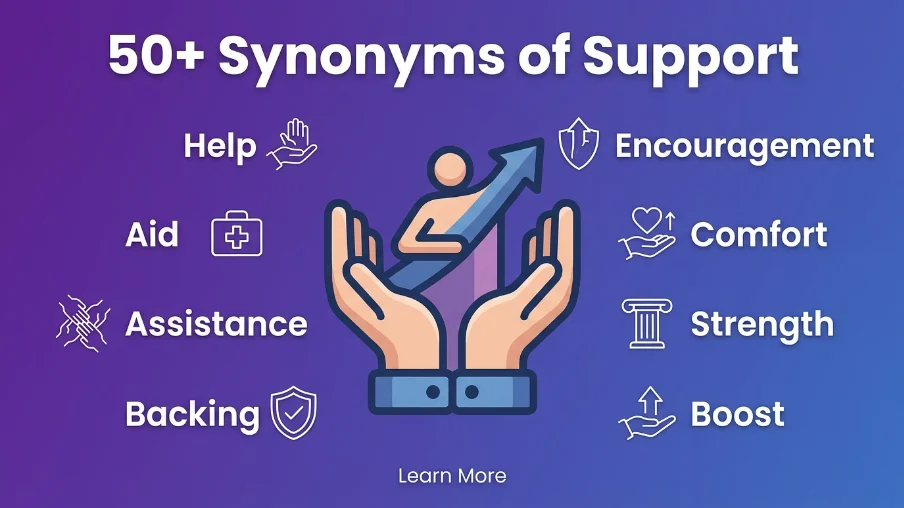
Support means to hold up, help, or agree with someone or something. The best synonyms include help, aid, assistance, backing, encouragement, comfort, strength, reinforcement, boost, and relief. But every synonym has a slightly different meaning, tone, or context, so choosing the right one depends on your situation.
Have you ever needed a better word for support? Perhaps you’re writing a thank-you note, a school essay, or a business report. The word support is useful, but using it too often can make your writing sound boring.
That’s exactly why learning synonyms is so helpful. Finding alternative words for support will help you speak and write more like a native speaker. In this guide, you’ll discover 30 powerful synonyms for support, complete with meanings, examples, and practical advice. By the end, you’ll know exactly which word to use whether you’re giving encouragement to a friend, writing a professional email, or working on an academic project.
What Does “Support” Mean?
Definition
In simple terms, support means to hold something up, give help to someone, or agree with an idea. It can describe physical support, like a pillar holding up a building. It can also describe emotional support, like comforting a friend who is sad. And it can describe logical support, like providing evidence for an argument. Essentially, whenever you help, strengthen, or back someone or something, you are giving support.
Pronunciation
| Feature | Value |
|---|---|
| US IPA | /səˈpɔrt/ |
| UK IPA | /səˈpɔːt/ |
| Syllables | 2 |
| Tip | Stress the second syllable: suh-PORT |
Grammar
| Grammar Feature | Information |
|---|---|
| Part of Speech | Noun and Verb |
| Common Position (Noun) | Subject or object |
| Common Position (Verb) | Before an object |
| Typical Pattern (Verb) | support someone/something |
| Typical Pattern (Noun) | support for someone/something |
Example Sentences:
- My family always supports me. (Verb)
- The government provides financial support for students. (Noun)
- She gave me a lot of support during the difficult time. (Noun)
Grammar Note: As a verb, support is transitive it always needs an object. You support someone or support something. As a noun, it’s often uncountable, but you can say a support when referring to a physical object that holds something up.
Word Family
| Word | Part of Speech | Meaning |
|---|---|---|
| Support | Verb/Noun | To help or hold up; help given |
| Supporter | Noun | A person who supports someone or something |
| Supportive | Adjective | Giving help or encouragement |
| Supporting | Adjective | That supports or backs something |
| Supported | Adjective | Backed or held up by something |
| Supportable | Adjective | Able to be supported or justified |
| Unsupportive | Adjective | Not giving help or encouragement |
30 Synonyms of “Support”
1. Help
Meaning: To make it easier for someone to do something; to give assistance.
Best Used For: Daily conversation, writing, and general situations.
Formality: Neutral
Tone: Positive, helpful
Frequency: ⭐⭐⭐⭐⭐ Very Common
CEFR Level: A1
Example Sentence 1: Can you help me with this heavy box?
Example Sentence 2: The charity helps families in need.
Usage Tip: Help is the most common and versatile synonym for support. Use it in almost any situation it’s simple, clear, and natural. It works for physical help (help carry something), emotional help (help someone feel better), and practical help (help with homework). It’s less formal than assist or aid.
2. Aid
Meaning: Help or support given to someone in need, often in a formal or organized way.
Best Used For: Professional writing, news reports, and formal contexts.
Formality: Formal
Tone: Professional, serious
Frequency: ⭐⭐⭐⭐ Common
CEFR Level: B1
Example Sentence 1: The organization provides aid to disaster victims.
Example Sentence 2: Financial aid is available for students.
Usage Tip: Aid is more formal than help and often suggests official or organized support. It’s commonly used for humanitarian efforts (foreign aid), financial assistance (student aid), and medical help (first aid). Avoid using it in casual conversation it sounds too serious.
Common Confusion: Aid vs Aide Aid is help or support. An aide is a person who helps, often an assistant.
3. Assistance
Meaning: The act of helping or supporting someone.
Best Used For: Business, professional, and formal writing.
Formality: Formal
Tone: Professional, helpful
Frequency: ⭐⭐⭐⭐ Common
CEFR Level: B1
Example Sentence 1: Please call if you need any assistance.
Example Sentence 2: The company offers technical assistance to its customers.
Usage Tip: Assistance is a formal way to say help. It’s very common in customer service, business emails, and professional settings. You’ll hear it in phrases like “Do you need any assistance?” It’s polite and respectful. In casual conversation, help sounds more natural.
4. Backing
Meaning: Support, especially financial or political support.
Best Used For: Business, politics, and describing support for ideas or projects.
Formality: Neutral to formal
Tone: Professional, confident
Frequency: ⭐⭐⭐ Moderate
CEFR Level: B2
Example Sentence 1: The project has strong financial backing from investors.
Example Sentence 2: She has the backing of her entire team.
Usage Tip: Backing often implies support that involves money or influence. It’s commonly used in business and politics. It suggests that someone is “behind” an idea or person, giving them strength. Use it when you want to emphasize that support makes something possible.
5. Encouragement
Meaning: Words or actions that give someone confidence, hope, or motivation.
Best Used For: Personal relationships, teaching, and coaching.
Formality: Neutral
Tone: Warm, positive, motivating
Frequency: ⭐⭐⭐⭐ Common
CEFR Level: B1
Example Sentence 1: Her words of encouragement gave me the confidence to try again.
Example Sentence 2: Children need encouragement to keep learning.
Usage Tip: Encouragement is specifically about emotional support that motivates someone. It’s what you give when you say “You can do it!” It’s different from practical help. Use it when you want to highlight the emotional, confidence-building side of support.
6. Comfort
Meaning: Support that makes someone feel less sad, worried, or in pain.
Best Used For: Emotional situations, caregiving, and personal relationships.
Formality: Neutral
Tone: Warm, caring, soothing
Frequency: ⭐⭐⭐⭐ Common
CEFR Level: B1
Example Sentence 1: She comforted her friend after the bad news.
Example Sentence 2: The soft music provided comfort during the difficult time.
Usage Tip: Comfort is about emotional and physical soothing. It’s what you offer when someone is upset or in pain. It can be emotional (kind words) or physical (a warm blanket). Use it when support is about easing distress, not solving practical problems.
7. Strength
Meaning: The ability to support or endure; a source of emotional or physical support.
Best Used For: Personal relationships, motivational contexts, and describing resilience.
Formality: Neutral
Tone: Positive, powerful, inspiring
Frequency: ⭐⭐⭐⭐ Common
CEFR Level: B1
Example Sentence 1: My friends give me strength when I feel down.
Example Sentence 2: She was a source of strength for her family.
Usage Tip: Strength is a powerful word for support that comes from within or from others. It suggests that support gives you the power to keep going. It’s often used in emotional and motivational contexts. Use it when you want to emphasize that support makes someone stronger.
8. Reinforcement
Meaning: Additional support to make something stronger.
Best Used For: Military, construction, psychology, and describing additional support.
Formality: Formal
Tone: Professional, structural
Frequency: ⭐⭐⭐ Moderate
CEFR Level: B2
Example Sentence 1: The building needs steel reinforcement to withstand earthquakes.
Example Sentence 2: Positive reinforcement encourages good behavior in children.
Usage Tip: Reinforcement is about making something stronger by adding extra support. It can be physical (building reinforcement), psychological (behavioral reinforcement), or military (troop reinforcement). It’s more technical than support. Use it when you mean support that strengthens or fortifies.
9. Boost
Meaning: A lift or increase in support, confidence, or energy.
Best Used For: Motivation, business, and describing increased support.
Formality: Informal to neutral
Tone: Positive, energetic
Frequency: ⭐⭐⭐⭐ Common
CEFR Level: B1
Example Sentence 1: Her kind words gave my confidence a big boost.
Example Sentence 2: The new policy gave a boost to the economy.
Usage Tip: Boost is a lively word for support that lifts something up. It’s commonly used for confidence (confidence boost), energy (energy boost), and business (sales boost). It’s informal and positive. Use it when you want to emphasize that support creates improvement or momentum.
10. Relief
Meaning: Support that reduces or removes pain, stress, or difficulty.
Best Used For: Medical, emotional, and practical contexts.
Formality: Neutral
Tone: Positive, relieving
Frequency: ⭐⭐⭐⭐ Common
CEFR Level: B1
Example Sentence 1: The medicine provides relief from the pain.
Example Sentence 2: The new law offers relief for small business owners.
Usage Tip: Relief is support that takes away discomfort or difficulty. It’s common in healthcare (pain relief), finance (debt relief), and emotional contexts (sense of relief). Use it when support is about reducing something negative, not just adding something positive.
11. Backup
Meaning: Support or help that is available if needed; a reserve.
Best Used For: Casual conversation, business, technology, and emergency planning.
Formality: Informal
Tone: Practical, reassuring
Frequency: ⭐⭐⭐⭐ Common
CEFR Level: B1
Example Sentence 1: I have backup if the plan fails.
Example Sentence 2: Always back up your computer files.
Usage Tip: Backup is support that’s held in reserve for when it’s needed. It’s commonly used in technology (data backup), security (police backup), and everyday planning (backup plan). It’s informal and practical. Use it when you want to emphasize that support is available just in case.
12. Advocacy
Meaning: Active support for a cause, idea, or person.
Best Used For: Social causes, politics, and professional contexts.
Formality: Formal
Tone: Passionate, committed
Frequency: ⭐⭐⭐ Moderate
CEFR Level: B2
Example Sentence 1: Her advocacy for human rights has inspired many people.
Example Sentence 2: The group’s advocacy helped change the law.
Usage Tip: Advocacy is support that involves speaking up and fighting for something. It’s not passive support it’s active and public. It’s common in social justice, politics, and professional fields. Use it when you mean support that involves campaigning or defending a cause.
13. Sustenance
Meaning: Support that maintains or keeps something alive.
Best Used For: Physical needs, survival, and metaphorical contexts.
Formality: Formal
Tone: Serious, essential
Frequency: ⭐⭐ Rare
CEFR Level: C1
Example Sentence 1: The community relies on farming for sustenance.
Example Sentence 2: Art provided emotional sustenance during the difficult years.
Usage Tip: Sustenance is support that keeps things going. Originally, it meant food and drink that keep you alive. Now, it’s also used metaphorically for emotional or spiritual support. It’s quite formal and literary. Use it when you want to emphasize that support is essential for survival.
14. Underpinning
Meaning: The foundation or basis that supports something.
Best Used For: Academic writing, business, and describing theoretical foundations.
Formality: Formal
Tone: Analytical, structural
Frequency: ⭐⭐ Rare
CEFR Level: C1
Example Sentence 1: A solid education is the underpinning of a successful career.
Example Sentence 2: The theory’s underpinnings are based on decades of research.
Usage Tip: Underpinning is a metaphorical word for the support that holds up an idea, system, or structure. It’s like the foundations of a building. Use it in formal, analytical writing when you want to describe the underlying support that makes something possible.
15. Reinforcement
Meaning: Additional support to strengthen something.
Best Used For: Technical, military, and psychological contexts.
Formality: Formal
Tone: Professional, structural
Frequency: ⭐⭐⭐ Moderate
CEFR Level: B2
Example Sentence 1: The bridge needs reinforcement to hold more weight.
Example Sentence 2: Positive reinforcement is an effective teaching method.
Usage Tip: Reinforcement is about adding strength to something that already exists. It’s commonly used in construction, psychology, and military contexts. It’s more technical than support. Use it when you want to emphasize that support makes something stronger or more resilient.
16. Sponsorship
Meaning: Financial or practical support given to a person, event, or organization.
Best Used For: Business, events, and charitable contexts.
Formality: Formal
Tone: Professional, commercial
Frequency: ⭐⭐⭐ Moderate
CEFR Level: B2
Example Sentence 1: The company provides sponsorship for local sports teams.
Example Sentence 2: Her education was funded by a sponsorship from a local business.
Usage Tip: Sponsorship is support that usually involves money. A sponsor provides funds or resources in exchange for recognition or promotion. It’s common in sports, events, and charity. Use it when support is part of a business or promotional arrangement.
17. Subsidization
Meaning: Financial support given by a government or organization to help something continue.
Best Used For: Economics, government, and business.
Formality: Formal
Tone: Official, economic
Frequency: ⭐ Rare
CEFR Level: C1
Example Sentence 1: The government’s subsidization of agriculture helps farmers stay in business.
Example Sentence 2: Subsidization of public transport reduces costs for passengers.
Usage Tip: Subsidization is a formal economic term for financial support from governments or organizations. It’s used to keep prices low or support industries. It’s quite technical and specific. Use it only in formal, economic, or policy contexts.
18. Maintenance
Meaning: Support that keeps something in good condition.
Best Used For: Technical, property, and business contexts.
Formality: Neutral to formal
Tone: Practical, ongoing
Frequency: ⭐⭐⭐ Moderate
CEFR Level: B2
Example Sentence 1: Regular maintenance keeps the car running smoothly.
Example Sentence 2: The building requires ongoing maintenance.
Usage Tip: Maintenance is support that involves keeping things in working order. It’s common for machinery, buildings, and systems. It implies ongoing, practical support rather than one-time help. Use it when support is about preservation and upkeep.
19. Endorsement
Meaning: Support shown by publicly approving or recommending something.
Best Used For: Business, politics, and marketing.
Formality: Formal
Tone: Professional, public
Frequency: ⭐⭐⭐ Moderate
CEFR Level: B2
Example Sentence 1: The celebrity endorsement boosted sales significantly.
Example Sentence 2: The union gave its endorsement to the candidate.
Usage Tip: Endorsement is public support where someone officially recommends or approves something. It’s common in marketing (celebrity endorsements), politics (endorsing a candidate), and business. Use it when support is about giving public approval that influences others.
20. Prop
Meaning: A physical object that supports something; to support or sustain.
Best Used For: Physical contexts, theater, and metaphorical use.
Formality: Neutral
Tone: Practical, physical
Frequency: ⭐⭐⭐ Moderate
CEFR Level: B1
Example Sentence 1: Use a prop to hold up the collapsing ceiling.
Example Sentence 2: His faith was a prop during the hard times.
Usage Tip: Prop can be a noun (the thing that supports) or a verb (to support). It’s often used physically, like a prop supporting a shelf. Metaphorically, it can mean emotional support. It’s more specific and concrete than support. Use it for physical holding up or for vivid metaphorical writing.
21. Buttress
Meaning: A structure that supports a building; to strengthen or support an argument.
Best Used For: Architecture and formal, persuasive writing.
Formality: Formal
Tone: Professional, structural
Frequency: ⭐ Rare
CEFR Level: C1
Example Sentence 1: Flying buttresses support the cathedral’s walls.
Example Sentence 2: The lawyer buttressed his argument with strong evidence.
Usage Tip: Buttress is both a noun (a stone support) and a verb (to support). It’s a sophisticated word for formal writing. Use it literally for architecture or metaphorically for supporting arguments. It’s more impressive and precise than support in formal writing.
22. Advocacy
Meaning: Active support for a cause or idea.
Best Used For: Social and political contexts.
Formality: Formal
Tone: Passionate, committed
Frequency: ⭐⭐⭐ Moderate
CEFR Level: B2
Example Sentence 1: Her advocacy for equal rights made a real difference.
Example Sentence 2: The organization focuses on advocacy for mental health.
Usage Tip: Advocacy is active, public support. It often involves speaking out and campaigning. It’s different from quiet or private support. Use it when you want to emphasize that support involves action and public commitment.
23. Favor
Meaning: Support or approval for a person, plan, or idea.
Best Used For: Personal and professional contexts.
Formality: Neutral
Tone: Positive, approving
Frequency: ⭐⭐⭐⭐ Common
CEFR Level: B1
Example Sentence 1: He looked favorably on her proposal.
Example Sentence 2: The court ruled in favor of the defendant.
Usage Tip: Favor is support based on approval or preference. When you favor something, you choose it or approve of it. It’s common in decision-making contexts. Use it when support is about approval rather than active help.
24. Championing
Meaning: Active support and advocacy for a cause or idea.
Best Used For: Social causes, business innovation, and leadership.
Formality: Neutral to formal
Tone: Passionate, leadership
Frequency: ⭐⭐⭐ Moderate
CEFR Level: B2
Example Sentence 1: She is championing the cause of renewable energy.
Example Sentence 2: The CEO is championing a new company initiative.
Usage Tip: Championing is enthusiastic, public support. A champion fights for a cause. It’s more active and passionate than regular support. Use it when you want to emphasize passionate advocacy and leadership.
25. Upholding
Meaning: Supporting and maintaining something, often principles or standards.
Best Used For: Legal, professional, and ethical contexts.
Formality: Formal
Tone: Professional, principled
Frequency: ⭐⭐⭐ Moderate
CEFR Level: B2
Example Sentence 1: The judge is responsible for upholding the law.
Example Sentence 2: She is upholding the values of the organization.
Usage Tip: Upholding is support that involves maintaining standards, principles, or laws. It’s about keeping things at a high level. It’s formal and often used in legal and professional contexts. Use it when support is about maintaining quality or integrity.
26. Sustaining
Meaning: Support that keeps something continuing or alive.
Best Used For: Environmental, economic, and personal contexts.
Formality: Formal
Tone: Serious, essential
Frequency: ⭐⭐⭐ Moderate
CEFR Level: B2
Example Sentence 1: The land is sustaining the community through agriculture.
Example Sentence 2: Her faith is sustaining her through the illness.
Usage Tip: Sustaining is support that keeps things going over time. It’s about long-term maintenance. It’s more formal than support and suggests endurance. Use it when you want to emphasize that support provides ongoing life or continuity.
27. Guarding
Meaning: Protecting or supporting by keeping safe.
Best Used For: Security, safety, and protective contexts.
Formality: Neutral
Tone: Protective, vigilant
Frequency: ⭐⭐⭐ Moderate
CEFR Level: B1
Example Sentence 1: The soldiers are guarding the border.
Example Sentence 2: She guards her privacy carefully.
Usage Tip: Guarding is support that involves protection from danger. It’s more specific than general support. Use it when support is about keeping someone or something safe. It implies vigilance and protection.
28. Aegis
Meaning: Support, sponsorship, or protection provided by a person or organization.
Best Used For: Formal and academic contexts.
Formality: Formal
Tone: Official, protective
Frequency: ⭐ Rare
CEFR Level: C1
Example Sentence 1: The research was conducted under the aegis of the university.
Example Sentence 2: The project operates under the aegis of the United Nations.
Usage Tip: Aegis is a formal, sophisticated word for support or protection from an authoritative source. It’s often used in academic and official contexts. It suggests that support comes from a respected organization. Use it sparingly in formal writing.
29. Morale Support
Meaning: Emotional and psychological support that boosts confidence.
Best Used For: Team contexts, military, and personal relationships.
Formality: Neutral
Tone: Uplifting, emotional
Frequency: ⭐⭐⭐ Moderate
CEFR Level: B2
Example Sentence 1: The team needed morale support after the loss.
Example Sentence 2: Good leadership provides morale support to employees.
Usage Tip: Morale support (often spelled moral support) is about emotional encouragement, not practical help. It’s what you give when you say “I’m here for you.” Use it when you mean psychological support that boosts spirits.
30. Tithing
Meaning: Financial support given regularly to a religious organization.
Best Used For: Religious contexts.
Formality: Neutral
Tone: Religious, committed
Frequency: ⭐ Rare
CEFR Level: B2
Example Sentence 1: He gives 10% of his income as tithing to his church.
Example Sentence 2: Tithing supports the work of the local parish.
Usage Tip: Tithing is a specific type of financial support, usually one-tenth of income given to a church. It’s only used in religious contexts. Avoid it in general or business situations support or donation works better.
Synonyms Comparison Table
| Synonym | Best Context | Formality | Tone | Frequency |
|---|---|---|---|---|
| Help | General, everyday | Neutral | Helpful | ⭐⭐⭐⭐⭐ |
| Aid | Formal, organized | Formal | Serious | ⭐⭐⭐⭐ |
| Assistance | Professional, business | Formal | Professional | ⭐⭐⭐⭐ |
| Backing | Financial, political | Neutral | Confident | ⭐⭐⭐ |
| Encouragement | Emotional, motivational | Neutral | Warm | ⭐⭐⭐⭐ |
| Comfort | Emotional, caregiving | Neutral | Caring | ⭐⭐⭐⭐ |
| Strength | Resilience, personal | Neutral | Powerful | ⭐⭐⭐⭐ |
| Boost | Motivation, energy | Informal | Energetic | ⭐⭐⭐⭐ |
| Relief | Pain, stress reduction | Neutral | Relieving | ⭐⭐⭐⭐ |
| Backup | Technology, planning | Informal | Practical | ⭐⭐⭐⭐ |
| Advocacy | Causes, politics | Formal | Passionate | ⭐⭐⭐ |
| Sponsorship | Business, events | Formal | Commercial | ⭐⭐⭐ |
| Endorsement | Marketing, politics | Formal | Public | ⭐⭐⭐ |
Best Synonyms by Situation
| Situation | Best Synonym | Why It Works |
|---|---|---|
| Daily Conversation | Help or Support | Natural and easy |
| Business Email | Assistance or Support | Professional and polite |
| Academic Writing | Advocacy or Underpinning | Formal and precise |
| School Assignment | Help or Support | Clear and appropriate |
| Professional Meeting | Backing or Endorsement | Confident and business-like |
| Presentation | Boost or Reinforcement | Engaging and clear |
| Creative Writing | Comfort or Sustenance | Imagery-rich and emotional |
| Social Media | Support or Boost | Modern and relatable |
| Personal Letter | Encouragement or Comfort | Warm and caring |
| Job Interview | Support or Endorsement | Professional and confident |
Formal vs Informal Synonyms
Formal Alternatives
| Synonym | Best Used For |
|---|---|
| Aid | Official help, humanitarian |
| Assistance | Business, professional contexts |
| Advocacy | Social causes, politics |
| Sponsorship | Business arrangements |
| Endorsement | Public approval, recommendations |
| Underpinning | Academic, theoretical foundations |
| Reinforcement | Technical, military contexts |
Neutral Alternatives
| Synonym | Best Used For |
|---|---|
| Help | Almost any context |
| Support | Almost any context |
| Comfort | Emotional situations |
| Strength | Personal resilience |
Informal Alternatives
| Synonym | Best Used For |
|---|---|
| Backup | Planning, technology |
| Boost | Motivation, energy |
| Prop | Physical or metaphorical support |
When to Choose Each Level of Formality: Use formal synonyms in academic papers, business reports, and official communications. Use neutral synonyms in everyday conversation, emails, and general writing. Use informal synonyms with friends, on social media, and in casual settings. Always match your word to your audience.
Strong vs Mild Synonyms
Mild
- Help — Basic support
- Aid — Organized support
- Support — General support
- Favor — Approval-based support
These words are suitable for everyday situations. They don’t carry strong emotional weight.
Moderate
- Assistance — Professional help
- Backing — Support with influence
- Encouragement — Motivational support
- Comfort — Emotional soothing
- Boost — Support that lifts
These words are more expressive and suggest meaningful support.
Strong
- Strength — Powerful, emotional support
- Advocacy — Active, passionate support
- Reinforcement — Strengthening support
- Sustenance — Essential, life-sustaining support
- Underpinning — Foundational support
Use these words carefully. They convey intensity and should be reserved for situations where strong support truly exists. Overusing them can make your writing sound exaggerated.
Real-Life Examples
In the Workplace:
- “My manager gave me a lot of support during the project.”
- “The team needs more assistance to meet the deadline.”
- “I have the full backing of the executive committee.”
In Academic Writing:
- “The study provides strong support for the hypothesis.”
- “The theoretical underpinning of this argument is sound.”
- “Her advocacy for social justice has been widely recognized.”
In Everyday Conversation:
- “Thanks for your help with the move!”
- “Your encouragement means the world to me.”
- “I need a boost to get through the week.”
In Personal Relationships:
- “She gave me comfort when I was feeling down.”
- “His strength gave me the courage to keep going.”
- “My friends are my biggest supporters.”
In Business Emails:
- “We offer full technical assistance to all customers.”
- “Thank you for your continued support of our organization.”
- “We need your backing to move this project forward.”
In Social Media:
- “Thank you to everyone for your support!”
- “Your encouragement keeps me going!”
Common Collocations
| Common Phrase | Better Alternative |
|---|---|
| Strong support | Strong backing, firm support |
| Financial support | Financial aid, sponsorship |
| Emotional support | Emotional comfort, moral support |
| Technical support | Technical assistance |
| Political support | Political backing, endorsement |
| Public support | Public backing, popular approval |
| Full support | Full backing, complete support |
| Continued support | Ongoing support, sustained support |
| Direct support | Direct help, direct assistance |
| Mutual support | Mutual aid, reciprocity |
Common Phrases
| Phrase | Meaning | Stronger Alternative |
|---|---|---|
| Give support | To help or back someone | Offer backing |
| Show support | To demonstrate support | Show solidarity |
| Lean on someone for support | To rely on someone emotionally | Find strength in someone |
| Support system | A network of people who help you | Support network |
| Support group | A group that provides emotional support | Peer support group |
| Supportive environment | A place where help is available | Nurturing environment |
| Supportive evidence | Evidence that backs a claim | Corroborating evidence |
Context Guide
| Situation | Best Synonym | Reason |
|---|---|---|
| Essay | Support or Advocacy | Academic and clear |
| Speech | Strength or Encouragement | Inspiring and emotional |
| Business Email | Assistance or Support | Professional and polite |
| Novel | Comfort or Sustenance | Imagery-rich and warm |
| Presentation | Boost or Reinforcement | Energetic and clear |
| Conversation | Help or Support | Natural and friendly |
| Academic Writing | Underpinning or Advocacy | Formal and precise |
| Marketing Copy | Support or Boost | Positive and engaging |
Related Words
Near Synonyms
- Help — Basic assistance
- Aid — Organized support
- Assistance — Professional help
- Backing — Support with influence
- Encouragement — Motivational support
Antonyms
- Opposition — Being against something
- Obstruction — Blocking support
- Discouragement — Reducing confidence
- Abandonment — Withdrawing support
- Neglect — Failing to support
Related Adjectives
- Supportive — Giving help or encouragement
- Helpful — Giving useful assistance
- Encouraging — Giving hope or confidence
- Comforting — Providing relief from distress
- Reinforcing — Strengthening
Related Nouns
- Supporter — A person who supports
- Advocate — A person who supports a cause
- Patron — A financial supporter
- Backer — A person who provides backing
Related Verbs
- Support — To help or hold up
- Help — To make something easier
- Aid — To provide formal help
- Encourage — To give confidence
- Comfort — To soothe distress
- Reinforce — To strengthen
Frequently Asked Questions
What is another word for support?
The most common synonyms for support are help, aid, and assistance. The best choice depends on your context. For everyday situations, use help. For formal or professional contexts, use assistance or aid. For emotional support, use encouragement or comfort.
Which synonym sounds the most professional?
Assistance and aid sound the most professional. Use assistance in business emails and customer service contexts. Use aid in formal reports and humanitarian contexts. Both are respectful, clear, and widely accepted in professional writing.
What is the strongest synonym for support?
Advocacy, reinforcement, and sustenance are strong synonyms. Advocacy suggests active, passionate support. Reinforcement suggests support that strengthens. Sustenance suggests support that keeps something alive. Choose based on what kind of strength you want to emphasize.
Which synonym is best for essays?
Support, advocacy, and underpinning work best in essays. Support is versatile and clear. Advocacy works for social and political topics. Underpinning is excellent for describing theoretical foundations. They’re all formal enough for academic writing.
What’s the difference between support and help?
Support is broader it can mean physical, emotional, or practical backing. Help is more direct and often implies practical assistance. You can support someone emotionally, but you usually help someone with a task. Support often suggests ongoing backing, while help suggests immediate assistance.
Which synonym is most common in everyday English?
Help is the most common, followed by support. Native speakers use help daily in countless situations. Support is also very common but is slightly more formal. For everyday speech, use help. For writing and professional contexts, support is excellent.
What is the opposite of support?
The main opposites are opposition, obstruction, and discouragement. Opposition means being against something. Obstruction means blocking or hindering. Discouragement means undermining confidence. Choose based on what kind of “lack of support” you mean.
Is support a verb or noun?
Support is both a verb and a noun. As a verb, it means to help or hold up (I support my team). As a noun, it means the help given (I need support). This makes it very versatile. Many synonyms, like help and aid, are also both verbs and nouns.
Conclusion
Support is one of the most important words in English. It describes everything from physical help to emotional comfort to professional backing. But using the same word repeatedly can make your writing feel flat.
Now you have 30 powerful synonyms to choose from. Remember:
- Use help for everyday, practical assistance
- Use aid or assistance for formal, professional support
- Use encouragement or comfort for emotional support
- Use backing or endorsement for public or financial support
- Use advocacy for active, passionate support
- Use strength or sustenance for support that keeps you going
The key to choosing the right synonym is understanding your context, tone, and audience. A word that works perfectly in a business email might sound strange in a personal conversation. Practice using these synonyms in your daily life, and soon they’ll feel completely natural.
Start small replace support with help or encouragement in your next conversation. Then experiment with more sophisticated words like advocacy or reinforcement when the situation is right. Your vocabulary will grow, and your English will sound more fluent and natural.

2 thoughts on “50+ Synonyms of Support | Meaning, Examples & Usage For 2026”