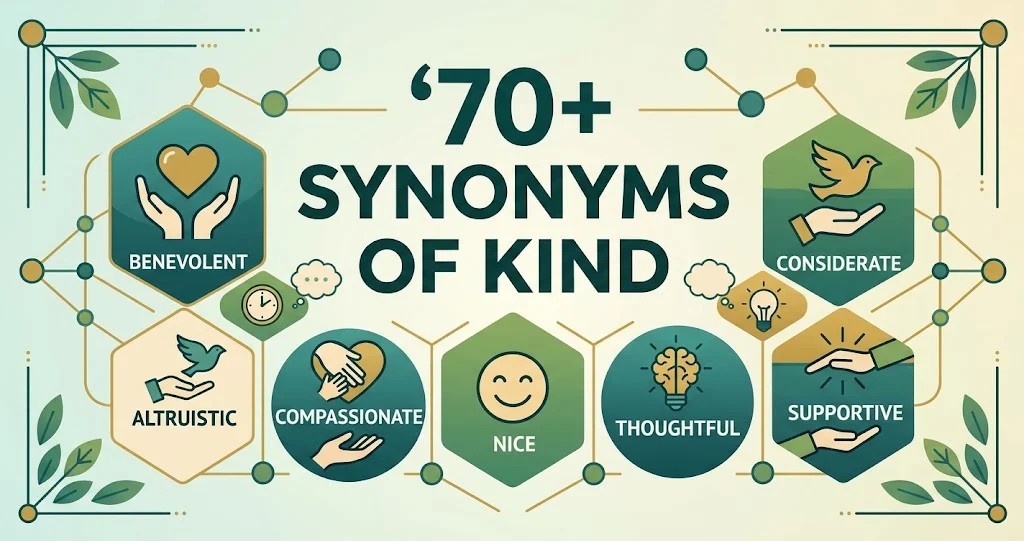
The word “kind” means having a friendly, generous, or considerate nature. The best formal synonyms include benevolent, compassionate, and considerate. For casual conversations, use nice, warm, or thoughtful. Academic writing calls for altruistic or empathetic. Professional settings benefit from courteous or personable. Choose your synonym based on tone, audience, and emotional intensity.
Have you ever caught yourself using the word “kind” over and over again in an email, a school essay, or a social media caption? You are not alone. Many writers struggle to find fresh ways to describe someone’s generous nature or gentle actions. Whether you are writing a recommendation letter, describing a friend, or crafting a professional message, having a strong vocabulary makes your communication more precise and engaging. Understanding the synonym of kind that fits each situation will elevate your writing and help you express exactly what you mean. This guide will walk you through the most accurate alternatives for every context you might encounter.
Meaning, Tone, and Context
Simple Definition
Kind describes a person who shows concern for others and acts with generosity, gentleness, and consideration. It refers to both a personality trait and specific actions that benefit other people.
Part of Speech
Adjective. It can also function as a noun meaning a category or type, though this guide focuses on the adjective form.
Overall Tone
Kind carries a positive and warm tone. It suggests goodness without being overly emotional or dramatic. The word feels approachable and sincere.
Formality Level
Kind is neutral in formality. It works well in almost any situation, from casual conversations to professional emails. This flexibility makes it one of the most commonly used positive adjectives in English.
Common Uses
Native English speakers use kind to describe people, actions, words, and gestures. You will hear it in everyday conversations, workplace evaluations, thank-you notes, and character descriptions. It often appears when someone wants to acknowledge another person’s good heart or helpful behavior.
Word Forms
- Kind (adjective): She is a kind person.
- Kindness (noun): Her kindness made a difference.
- Kindly (adverb): He kindly offered his seat.
- Kindhearted (adjective): A kindhearted neighbor helped us.
When and How to Use “Kind”
Choosing kind is appropriate when you want to describe someone’s basic goodness without adding strong emotional weight. It is a safe, reliable word that almost everyone understands. However, kind can feel vague when you need to communicate specific qualities.
Here are seven realistic examples showing how to use kind in different contexts.
Professional
“Thank you for your kind consideration of my application.”
Academic
“The study suggests that kind behavior in early childhood predicts positive social outcomes.”
Workplace
“My manager is always kind when providing feedback on my work.”
Personal
“She is the kind of friend who remembers everyone’s birthday.”
“I appreciate your kind words about my presentation.”
Resume
“Recognized for kind and patient interactions with older residents.”
Social Media
“Grateful for all the kind messages on my birthday.”
Best Synonyms of “Kind”
No synonym perfectly matches kind in every situation. Each alternative carries its own shade of meaning, emotional weight, and appropriate context. Here are the strongest recommendations for specific writing situations.
Professional Writing
Considerate is the best professional synonym. It implies thoughtfulness and attention to others’ needs. It sounds polished without being overly formal.
Academic Writing
Altruistic works well in academic contexts. It refers to selfless concern for others and carries a precise, research-friendly meaning.
Business Communication
Courteous is ideal for business settings. It emphasizes politeness and good manners while maintaining a professional tone.
Casual Conversation
Nice is the most natural choice for everyday speech. It is simple, friendly, and widely understood by all English speakers.
Emotional Writing
Compassionate adds depth and emotional resonance. It suggests deep empathy and genuine care for others’ suffering.
Creative Writing
Tender works beautifully in creative writing. It suggests gentleness and delicate care in a way that feels poetic.
Resume Writing
Personable is excellent for resumes. It indicates someone is easy to get along with and interacts well with others.
Workplace Communication
Supportive fits workplace conversations well. It emphasizes helping colleagues and creating a positive environment.
Stronger Meaning
Benevolent is stronger than kind. It implies active generosity and a desire to do good for others.
Softer Meaning
Gentle is softer than kind. It emphasizes a mild, tender approach without the generosity aspect.
When Not to Use “Kind”
When the Word Sounds Too General
Kind often fails to communicate specific qualities. Saying someone is kind does not tell your reader whether they are generous, patient, empathetic, or polite. The word becomes a catch-all that lacks precision.
Better synonym: Considerate or compassionate.
Original: “She is a kind person.”
Improved: “She is a considerate person who always thinks about how her actions affect others.”
When the Word Sounds Too Vague
In performance reviews or recommendation letters, kind does not provide concrete information. It lacks the specificity employers and evaluators need to understand someone’s actual behavior.
Better synonym: Supportive or empathetic.
Original: “He is kind to his coworkers.”
Improved: “He is consistently supportive of his coworkers and helps them meet tight deadlines.”
When the Word Sounds Too Weak
Kind can feel understated when describing extraordinary goodness or heroic actions. It does not convey the depth of someone’s generosity or selflessness.
Better synonym: Benevolent or altruistic.
Original: “Her kind donation helped the organization.”
Improved: “Her benevolent donation transformed the organization’s ability to serve the community.”
When the Word Sounds Too Informal
In formal academic writing or legal documents, kind may seem too casual. More precise vocabulary adds authority and seriousness.
Better synonym: Altruistic or magnanimous.
Original: “The kind actions of volunteers made a difference.”
Improved: “The altruistic actions of volunteers significantly improved outcomes.”
When the Word Sounds Too Formal
In text messages or casual conversations, kind can feel stiff. Using it between close friends may sound awkward or overly proper.
Better synonym: Nice or sweet.
Original: “That was kind of you.”
Improved: “That was sweet of you.”
When the Word Sounds Outdated
Kind remains current and widely used. However, phrases like “kind of” to mean “somewhat” can sound dated or informal in professional writing.
Avoid: “The project was kind of difficult.”
Use instead: “The project was somewhat difficult” or “The project was challenging.”
Words Commonly Confused With “Kind”
Kind vs Nice
Main Difference: Kind implies genuine concern for others’ wellbeing. Nice often refers to pleasantness or agreeableness.
When to Use It: Use kind when describing true generosity. Use nice when describing surface-level pleasantness.
Example (Kind): “She gave her lunch to a hungry stranger.”
Example (Nice): “She has a nice smile.”
Kind vs Good
Main Difference: Good is broader and can refer to moral character, quality, or skill. Kind specifically describes care for others.
When to Use It: Use good for general moral character. Use kind for specific acts of consideration.
Example (Kind): “He helped the woman carry her groceries.”
Example (Good): “He is a good man who lives by strong principles.”
Kind vs Gentle
Main Difference: Gentle emphasizes softness and mildness. Kind focuses more on generosity and consideration.
When to Use It: Use gentle when describing physical touch or soft speech. Use kind when describing helpful actions.
Example (Kind): “She volunteers at the animal shelter every weekend.”
Example (Gentle): “He spoke to the frightened child in a gentle voice.”
Kind vs Compassionate
Main Difference: Compassionate involves deeper empathy for others’ suffering. Kind can describe smaller, everyday gestures.
When to Use It: Use compassionate when describing someone who truly feels others’ pain. Use kind for everyday thoughtfulness.
Example (Kind): “He held the door open for the person behind him.”
Example (Compassionate): “She dedicated her career to helping refugees.”
Kind vs Courteous
Main Difference: Courteous focuses on politeness and good manners. Kind focuses on genuine care and generosity.
When to Use It: Use courteous in professional or formal situations. Use kind in personal or emotional contexts.
Example (Kind): “She cooked dinner for her sick neighbor.”
Example (Courteous): “He sent a handwritten thank-you note after the interview.”
Kind vs Benevolent
Main Difference: Benevolent suggests active, generous goodwill, often toward those less fortunate. Kind is more general.
When to Use It: Use benevolent for significant acts of generosity or organizational charity.
Example (Kind): “She always listens to her friends’ problems.”
Example (Benevolent): “The foundation made a benevolent donation to the hospital.”
Best Synonyms of “Kind” by Context
| Context | Best Synonym | Why It Works | Example |
| Formal writing | Considerate | Shows thoughtfulness without being overly emotional | “The committee appreciated her considerate approach.” |
| Academic writing | Altruistic | Precise and commonly used in research | “Altruistic behavior emerges in early childhood.” |
| Professional communication | Courteous | Emphasizes proper manners and professionalism | “Please be courteous to all clients.” |
| Business emails | Personable | Suggests warmth and approachability | “Our team appreciates your personable communication style.” |
| Resume writing | Empathetic | Valuable skill in many industries | “Empathetic leader with strong interpersonal skills.” |
| Workplace communication | Supportive | Highlights teamwork and cooperation | “Her supportive nature boosts team morale.” |
| Casual conversation | Nice | Simple and natural for everyday use | “He is a really nice person.” |
| Everyday speaking | Friendly | Emphasizes approachability and warmth | “The cashier was very friendly.” |
| Creative writing | Tender | Adds poetic gentleness and care | “Her tender words healed his wounded heart.” |
| Storytelling | Goodhearted | Feels warm and folksy in narrative | “The goodhearted innkeeper offered them shelter.” |
| Emotional writing | Compassionate | Conveys deep empathy and care | “His compassionate response moved everyone.” |
| Strong emphasis | Benevolent | Conveys active generosity | “The benevolent leader shared his wealth with the low-income people.” |
| Mild tone | Soft | Emphasizes gentleness over generosity | “She spoke in a soft, reassuring manner.” |
| Social media captions | Sweet | Short, positive, and engaging | “Sweet moments like this make life beautiful.” |
| American English | Kind | Universal and widely understood | “She has a kind heart.” |
How to Choose the Best Synonym of “Kind”
Selecting the right synonym requires careful thought about your audience, purpose, and the specific message you want to convey. Here is a practical decision guide.
Consider Your Audience
Professional audiences expect words like courteous, considerate, or personable. Friends and family understand nice, sweet, or thoughtful. Academic readers respond to altruistic or empathetic.
Consider Your Tone
Neutral writing calls for kind, nice, or considerate. Emotional writing benefits from compassionate, tender, or warm. Formal writing requires courteous, benevolent, or magnanimous.
Consider Emotional Strength
For gentle praise, use nice, friendly, or pleasant. For moderate approval, use kind, thoughtful, or considerate. For strong admiration, use compassionate, benevolent, or altruistic.
Consider Your Purpose
Are you recommending someone for a job? Use personable or empathetic. Are you describing a character in a story? Use tender or goodhearted. Are you writing a thank-you note? Use kind, thoughtful, or generous.
Consider Natural Flow
The best synonym is the one that sounds natural in your sentence. Read your options aloud. If one feels awkward or forced, choose another. Your ear is often the best guide.
Real Life Examples of “Kind”
School
Original: “My teacher is kind and always helps students.”
Improved: “My teacher is patient and always helps students who struggle with the material.”
College
Original: “The kind professor gave us extra time.”
Improved: “The considerate professor extended the deadline for our research papers.”
Workplace
Original: “She is kind to her coworkers.”
Improved: “She is consistently supportive of her coworkers during challenging projects.”
Business
Original: “We appreciate your kind business.”
Improved: “We appreciate your loyal and consistent business over the years.”
Original: “Thank you for your kind response.”
Improved: “Thank you for your thoughtful and detailed response.”
Resume
Original: “Kind volunteer with patients.”
Improved: “Compassionate volunteer providing care and companionship to patients.”
Conversation
Original: “He is a kind neighbor.”
Improved: “He is a thoughtful neighbor who always shovels snow from our driveway.”
Storytelling
Original: “The kind princess helped the villagers.”
Improved: “The benevolent princess used her wealth to build schools and hospitals for the villagers.”
Blogging
Original: “Traveling teaches you to be kind to strangers.”
Improved: “Traveling teaches you to be open and generous with strangers from different cultures.”
Social Media
Original: “Thanks for the kind birthday wishes.”
Improved: “Feeling grateful for all the thoughtful birthday wishes and warm messages.”
18 Best Synonyms of “Kind”
| Synonym | Simple Meaning | Best Used For | Example Sentence |
| Considerate | Thinking about others’ needs | Formal writing, professional settings | She is considerate of her colleagues’ work-life balance. |
| Compassionate | Feeling empathy for others’ suffering | Emotional writing, healthcare roles | The compassionate nurse held the patient’s hand. |
| Benevolent | Actively generous and kind | Strong emphasis, leadership contexts | The benevolent donor funded the new library. |
| Altruistic | Selflessly concerned for others’ welfare | Academic writing, research | Altruistic behavior is common in many social animals. |
| Courteous | Polite and well-mannered | Business communication, professional contexts | The customer service representative was courteous and helpful. |
| Personable | Pleasant and easy to get along with | Resumes, interviews | She has a personable nature that makes clients feel comfortable. |
| Empathetic | Understanding others’ feelings | Workplace, counseling, leadership | Her empathetic approach resolved the team conflict. |
| Thoughtful | Showing careful attention to others | Personal relationships, thank-you notes | He left a thoughtful note thanking her for her help. |
| Supportive | Encouraging and helping others | Workplace, team environments | She is always supportive when colleagues face challenges. |
| Gentle | Mild, tender, and soft in manner | Creative writing, describing softness | His gentle voice calmed the frightened child. |
| Tender | Showing care and affection | Poetry, emotional storytelling | The mother gave her child a tender embrace. |
| Goodhearted | Having a naturally good nature | Storytelling, character descriptions | The goodhearted farmer shared his harvest with the hungry town. |
| Warm | Friendly and affectionate | Social situations, describing personalities | She has a warm smile that puts everyone at ease. |
| Nice | Pleasant and agreeable | Casual conversation, everyday use | He is a nice person who always says hello. |
| Friendly | Approachable and kind to others | Casual contexts, customer service | The friendly dog greeted every visitor with a wagging tail. |
| Sweet | Endearing and pleasant | Social media, casual compliments | She sent me a sweet message on my birthday. |
| Charitable | Generous to those in need | Financial contexts, donations | The charitable organization helps homeless families. |
| Magnanimous | Generous and forgiving, especially toward rivals | Formal writing, historical contexts | In a magnanimous gesture, the king pardoned his enemies. |
Synonyms of “Kind” by Usage
Professional vs Personal Synonyms
Professional settings require vocabulary that sounds polished and competent. Words like considerate, courteous, and personable demonstrate emotional intelligence and professionalism. These synonyms help you sound credible in emails, meetings, and performance reviews.
Personal relationships call for warmer, more intimate language. Sweet, thoughtful, and gentle feel natural when speaking to friends and family. These words convey genuine care without sounding stiff or businesslike.
Formal vs Conversational Synonyms
Formal writing benefits from words like benevolent, altruistic, and magnanimous. These terms add sophistication to academic papers, legal documents, and formal speeches. They carry a sense of gravity and importance.
Conversational English prefers simple, recognizable words. Nice, friendly, and sweet work well in text messages, casual emails, and everyday speech. These synonyms feel natural and unforced in spoken language.
Academic Synonyms
Academic writing demands precision and objectivity. Altruistic is the top choice for research papers and scholarly articles. Empathetic works well in psychology and social sciences. Benevolent appears frequently in historical and political analysis. These synonyms sound authoritative and demonstrate vocabulary sophistication.
Professional and Business Synonyms
Resumes should feature personable, empathetic, and considerate. These words show employers you work well with others. Business communication benefits from courteous and thoughtful. Client relationships thrive with these professional alternatives.
Creative and Literary Synonyms
Creative writers should explore tender, gentle, and goodhearted. These words add depth and imagery to fiction. Benevolent works well for royal or powerful characters. Compassionate creates strong emotional connections with readers. Poets often choose warm or sweet for their softer sounds.
Slang or Modern Synonyms
English does not have widely recognized slang synonyms specifically for kind. The word “nice” sometimes serves as a casual alternative, but it is not true slang. Avoid using “chill” or “cool” as synonyms for kind, as they change the meaning entirely.
Strongest to Mildest Synonyms
Very Mild
- Nice
- Sweet
- Friendly
Mild
- Kind
- Gentle
- Pleasant
Moderate
- Considerate
- Thoughtful
- Supportive
Strong
- Compassionate
- Empathetic
- Warm
Very Strong
- Benevolent
- Altruistic
- Magnanimous
The emotional intensity increases as you move down this scale. Mild synonyms work well for everyday compliments. Strong synonyms create powerful emotional impact in serious writing.
Emotional vs Neutral Synonyms
Emotional Synonyms
Compassionate, tender, benevolent, goodhearted, warm, and sweet carry strong emotional weight. These words evoke feelings of care, love, and deep human connection. Use them in personal writing, emotional storytelling, and situations where you want to touch your reader’s heart.
Neutral Synonyms
Considerate, courteous, personable, thoughtful, and supportive communicate positive qualities without heavy emotion. These synonyms simply state facts about someone’s behavior or character. Use them in professional contexts, academic writing, and objective descriptions.
Antonyms of “Kind”
| Antonym | Meaning | Example Sentence |
| Cruel | Causing pain or suffering | The cruel ruler punished innocent citizens. |
| Mean | Unkind and unpleasant | Her mean comments hurt everyone’s feelings. |
| Unkind | Lacking kindness | His unkind treatment of employees caused high turnover. |
| Harsh | Severely critical or punishing | The teacher’s harsh grading discouraged students. |
| Vicious | Violent or cruel | The vicious attack shocked the community. |
| Malicious | Intending to cause harm | She spread malicious rumors about her coworker. |
| Heartless | Lacking compassion or sympathy | The heartless landlord evicted the family without notice. |
| Callous | Emotionally insensitive | His callous remarks showed no concern for others. |
| Brutal | Extremely cruel or violent | The brutal conditions in the prison were inhumane. |
| Cold | Lacking warmth or feeling | She gave him a cold stare and walked away. |
| Unsympathetic | Lacking pity or concern | The unsympathetic manager refused to grant time off. |
| Pitiless | Showing no mercy | The pitiless dictator suppressed all opposition. |
| Ruthless | Lacking compassion and willing to harm others | Ruthless executives cut jobs to increase profits. |
| Spiteful | Wanting to annoy or hurt others | Her spiteful behavior drove away her friends. |
| Disagreeable | Unpleasant and difficult to get along with | His disagreeable attitude made meetings impossible. |
Comparison: “Kind” vs Similar Words
Kind vs Nice
Main Difference: Kind implies genuine concern and action. Nice refers to pleasantness without necessarily involving deep care.
Which Is Stronger? Kind is stronger. It suggests meaningful action rather than surface-level pleasantness.
Which Is More Formal? Kind is slightly more formal than nice, though both are widely accepted.
When to Use Each: Use kind when describing true generosity or consideration. Use nice for simple pleasantness or agreeableness.
Examples:
- Kind: “She was kind enough to drive me to the hospital.”
- Nice: “She has a nice smile.”
Kind vs Good
Main Difference: Good is broader and refers to moral character. Kind specifically relates to care for others.
Which Is Stronger? Good carries stronger moral weight but is less specific.
Which Is More Formal? Both are neutral, though good appears more often in moral and religious contexts.
When to Use Each: Use kind for specific acts of consideration. Use good for general moral character or quality.
Examples:
- Kind: “He performed a kind act by helping the stranger.”
- Good: “He is a good person who always tries to do the right thing.”
Kind vs Compassionate
Main Difference: Compassionate involves deep empathy for suffering. Kind is less intense and more general.
Which Is Stronger? Compassionate is significantly stronger and more emotional.
Which Is More Formal? Compassionate is more formal and works well in professional and academic writing.
When to Use Each: Use compassionate when describing deep empathy for those who are suffering. Use kind for everyday thoughtfulness.
Examples:
- Kind: “She shared her umbrella with me in the rain.”
- Compassionate: “She volunteers at the hospice to comfort dying patients.”
Kind vs Benevolent
Main Difference: Benevolent suggests active generosity and goodwill toward others, often in positions of power.
Which Is Stronger? Benevolent is much stronger and implies significant generosity.
Which Is More Formal? Benevolent is highly formal and appears in academic, historical, and literary writing.
When to Use Each: Use benevolent for significant acts of generosity, charity, or leadership. Use kind for everyday caring behavior.
Examples:
- Kind: “He held the door open for the woman.”
- Benevolent: “The benevolent benefactor established a scholarship fund.”
Kind vs Courteous
Main Difference: Courteous focuses on politeness and proper manners. Kind focuses on genuine care and generosity.
Which Is Stronger? Kind is emotionally stronger. Courteous emphasizes social behavior rather than deep care.
Which Is More Formal? Courteous is formal and appears in business and professional writing.
When to Use Each: Use courteous in formal situations requiring politeness. Use kind in personal or emotional contexts.
Examples:
- Kind: “She baked cookies for her grieving neighbor.”
- Courteous: “He held the door and greeted each client with a smile.”
Kind vs Altruistic
Main Difference: Altruistic specifically means selfless concern for others. Kind is a broader, more general term.
Which Is Stronger? Altruistic is stronger because it implies complete selflessness.
Which Is More Formal? Altruistic is highly formal and academic.
When to Use Each: Use altruistic in academic writing, research, and discussions of selfless behavior. Use kind in everyday situations.
Examples:
- Kind: “She gave her seat to an older passenger.”
- Altruistic: “Altruistic donation of organs saves thousands of lives annually.”
Common Phrases and Expressions with “Kind”
“Kind of”
Meaning: This phrase often means “somewhat” or “slightly.” It does not relate to the adjective meaning generous or considerate.
Example Sentence: “The movie was kind of boring, but I enjoyed the ending.”
“Kind and generous”
Meaning: This phrase combines two positive qualities to emphasize someone’s good nature.
Example Sentence: “The kind and generous donor helped fund the children’s hospital.”
“Kind words”
Meaning: Words that are encouraging, supportive, or comforting.
Example Sentence: “Her kind words lifted my spirits during a difficult time.”
“Kind gesture”
Meaning: A small act of consideration or helpfulness.
Example Sentence: “His kind gesture of making coffee for everyone was much appreciated.”
“Be kind to yourself”
Meaning: A phrase encouraging self-compassion and gentleness with oneself.
Example Sentence: “You worked hard today. Be kind to yourself and take a break.”
“Kind heart”
Meaning: A person with generous and caring nature.
Example Sentence: “She has such a kind heart that she helps stray animals.”
“One of a kind”
Meaning: Unique, not like anyone or anything else.
Example Sentence: “Her teaching style is one of a kind and inspires all her students.”
“Kindred spirit”
Meaning: Someone who shares similar values, interests, or attitudes.
Example Sentence: “We immediately recognized each other as kindred spirits.”
Common Mistakes to Avoid
Mistake 1: Using “Nice” When You Mean “Kind”
Incorrect: “He is a nice person because he volunteers at the shelter.”
Better: “He is a kind person because he volunteers at the shelter.”
Why: Nice describes pleasantness, while kind describes genuine generosity and care. Volunteering is an active demonstration of kindness.
Mistake 2: Choosing a Vague Synonym Instead of a Precise One
Incorrect: “The manager was kind to her employees.”
Better: “The manager was supportive of her employees.”
Why: Supportive provides specific information about the manager’s behavior. Kind is too general to be meaningful in a professional evaluation.
Mistake 3: Confusing “Kind” with “Gentle”
Incorrect: “She gave a kind touch to the injured bird.”
Better: “She gave a gentle touch to the injured bird.”
Why: Gentle specifically describes a soft, careful physical action. Kind describes a personality trait or generous actions.
Mistake 4: Using an Informal Synonym in Formal Writing
Incorrect: “The foundation’s sweet donation helped many families.”
Better: “The foundation’s benevolent donation helped many families.”
Why: Sweet is too casual and emotionally loaded for formal writing. Benevolent sounds more professional and appropriate.
Mistake 5: Selecting an Overly Dramatic Synonym
Incorrect: “He was magnanimous when he held the door open.”
Better: “He was courteous when he held the door open.”
Why: Magnanimous is too strong for a simple polite act. It implies much greater generosity or forgiveness.
Mistake 6: Repeating “Kind” Too Often
Incorrect: “She is a kind teacher. Her kind words motivate students. Her kind actions inspire everyone.”
Better: “She is a compassionate teacher. Her encouraging words motivate students. Her supportive actions inspire everyone.”
Why: Repeating the same word weakens your writing. Using varied synonyms adds interest and precision.
Mistake 7: Using Slang in Academic or Professional Writing
Incorrect: “The study found that kind behavior makes people feel good.”
Better: “The study found that altruistic behavior increases subjective wellbeing.”
Why: “Feel good” is too informal for academic writing. Altruistic is more precise and appropriate for research contexts.
Frequently Asked Questions
What are the best synonyms of kind?
The best synonyms depend on your context. Use considerate for professional writing, nice for casual conversation, compassionate for emotional writing, and altruistic for academic contexts. Each synonym serves a specific purpose.
What are the best formal synonyms of kind?
Formal synonyms include benevolent, altruistic, magnanimous, and compassionate. These words add sophistication to academic papers, business communication, and professional recommendations.
What are common informal synonyms of kind?
Common informal synonyms include nice, sweet, friendly, and thoughtful. These words work well in text messages, social media, and everyday conversations with friends and family.
What is another word for kind in professional writing?
Considerate is the best choice for professional writing. Courteous and personable also work well in business contexts. These words demonstrate emotional intelligence and professional polish.
What is the difference between kind and nice?
Kind implies genuine concern and generous actions. Nice simply means pleasant or agreeable. Someone can be nice without being truly kind, though both are positive qualities.
What is the opposite of kind?
Common opposites include cruel, mean, unkind, harsh, malicious, and heartless. These words describe people who lack consideration for others and may cause harm or suffering.
Conclusion
The word kind describes someone who shows genuine care and consideration for others. It is a positive, neutral, and widely useful adjective that appears in almost every type of communication. However, the best writers know that using a variety of synonyms strengthens their writing and clarifies their message. Whether you choose considerate for professional settings, compassionate for emotional impact, or nice for casual conversations, always match your synonym to your audience, tone, and purpose. No single word works perfectly in every situation. Pay attention to the emotional strength and formality of each alternative. The next time you reach for the word kind, pause and ask yourself which synonym will communicate your meaning most precisely. Your readers will notice the difference.

8 thoughts on “70+Synonyms of Kind| Meanings, Uses and Best Alternatives”