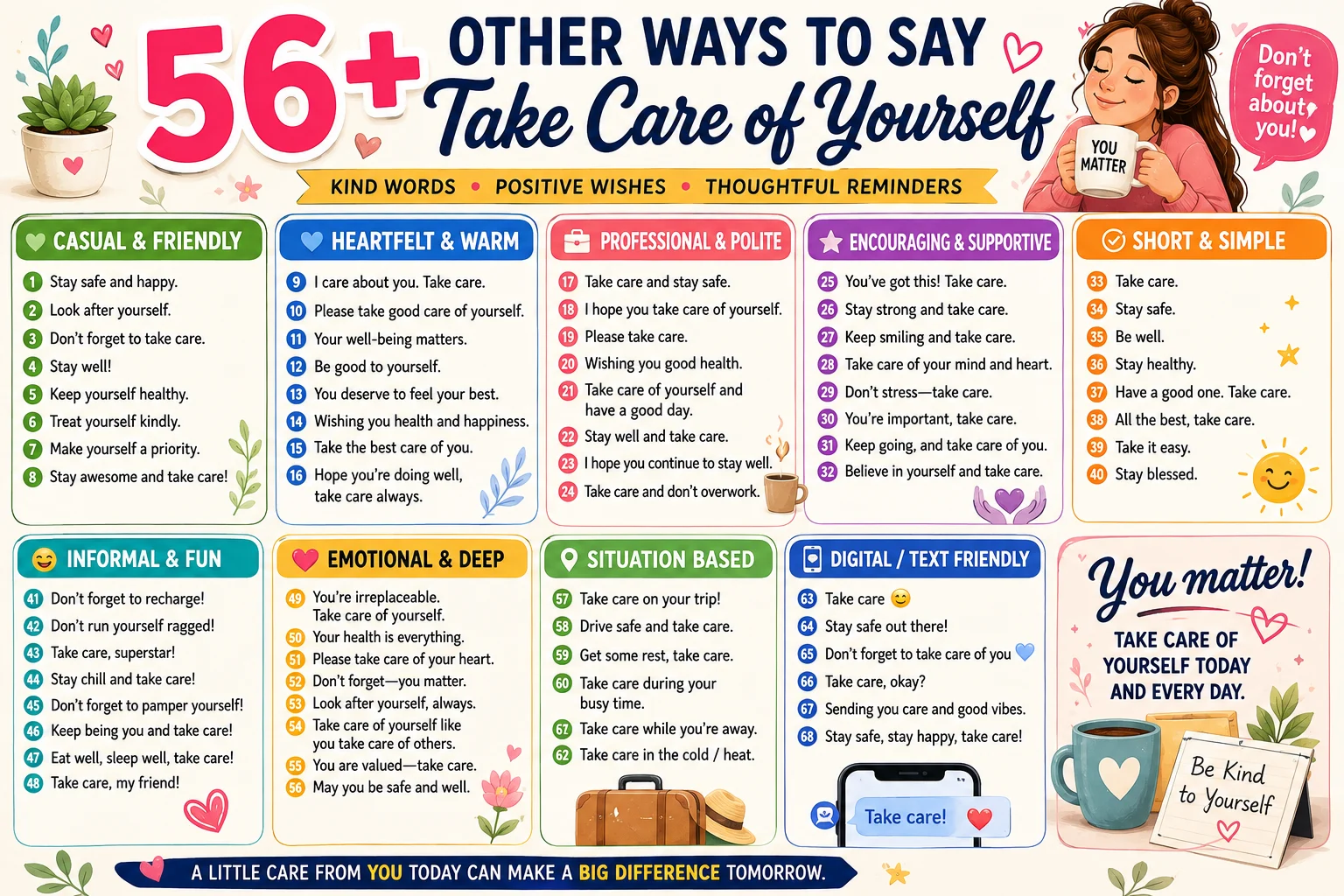
Take care of yourself is a warm, caring phrase used to express concern for someone’s well-being. It’s a staple of English farewells, but using it repeatedly can feel automatic or impersonal. The phrase works well in many situations, but sometimes you need a more specific alternative. For a friend going through a tough time, a colleague leaving for a new job, or a family member traveling abroad, the right choice of words can make your farewell more meaningful.
Mastering other ways to say “take care of yourself” helps you express genuine care and empathy in different contexts. This guide provides 30+ alternatives, helping you choose the right phrase for every situation.
Top 5 alternatives: Look after yourself, Stay well, Take it easy, Be good to yourself, I hope you’re doing okay.
Quick Categories
Formal Alternatives
- I wish you well
- May you stay healthy
- I trust you are well
- Please take every precaution
- Wishing you the best in health
Pro Tip: Use formal alternatives in professional correspondence, official letters, or when speaking to senior colleagues. They maintain professionalism while showing genuine care.
Professional Alternatives
- I hope all is well with you
- Wishing you continued success
- I hope you stay well
- Take care in the meantime
- Please keep me posted on how you are
Pro Tip: Professional alternatives show you value the person both as a colleague and as an individual. They work well in workplace emails and meetings.
Business Email Alternatives
- Wishing you all the best
- I hope you’re doing well
- Please take care of yourself
- I hope your recovery goes smoothly
- Stay healthy and happy
Pro Tip: In business emails, balance professionalism with warmth. These phrases show care without crossing professional boundaries.
Academic Alternatives
- Please look after yourself
- I hope you are thriving
- Take care of your health
- I trust you are managing well
- Wishing you strength and health
Pro Tip: Academic alternatives are suitable for correspondence with professors, advisors, and fellow students. They show respect and empathy.
Casual Alternatives
- Take it easy
- Look after yourself
- Stay safe
- Be good to yourself
- I hope you’re okay
Pro Tip: Casual alternatives are perfect for friends, family, and close colleagues. They feel natural and heartfelt.
Informal Expressions
- Chill out
- Relax and recharge
- Take a break
- Look after yourself, yeah?
- All the best
Pro Tip: Informal expressions work well in text messages, social media, and very relaxed conversations. Use them with people you know well.
The best way to say ‘take care of yourself’ is the one that shows you truly understand what the other person needs.
Common Mistakes
Mistake 1: Using “Chill out” in serious situations
Why it is incorrect: “Chill out” is too casual and dismissive when someone is genuinely struggling. It can make you seem uncaring.
Correct version: Use “I hope you’re doing okay” or “Look after yourself.”
Example Sentence: Instead of “Chill out” to a friend who lost a job, say “I hope you’re doing okay.”
Mistake 2: Saying “Take care of yourself” too formally
Why it is incorrect: In very close relationships, this phrase can feel distant or automatic.
Correct version: Use more personal alternatives like “Be good to yourself” or “I’ll be thinking of you.
Example Sentence: Instead of “Take care of yourself” to your best friend, say “Be good to yourself I’ll check on you soon.”
Mistake 3: Overusing “Stay safe” for non-safety situations
Why it is incorrect: “Stay safe” is best for situations involving travel, illness, or potential danger. Overusing it can sound insincere.
Correct version: Match the phrase to the situation.
Example Sentence: For a friend moving to a new city, “Look after yourself” is more appropriate than “Stay safe.”
Mistake 4: Using “Wishing you continued success” for personal struggles
Why it is incorrect: This phrase focuses on work success, which may be irrelevant or insensitive when someone is facing personal challenges.
Correct version: Use “I hope you’re doing well” or “Please take care of yourself.”
Example Sentence: Instead of “Wishing you continued success” to someone recovering from illness, say “I hope you’re doing well.”
Mistake 5: Using “May you stay healthy” without sincerity
Why it is incorrect: This phrase can sound stiff or insincere if not used genuinely.
Correct version: Use it only when you genuinely care about the person’s health.
Example Sentence: Use “May you stay healthy” with warmth and sincerity, not as a routine phrase.
What Does “Take Care of Yourself” Mean?
Definition: A caring expression used to encourage someone to prioritize their well-being, health, and happiness.
Grammar: It’s a sentence in the imperative mood (a command or request). “Take care” is the verb phrase, and “of yourself” is the object.
Simple Explanation: It’s a way of saying “I care about you and want you to be well.” It acknowledges that life can be difficult and encourages the person to look after themselves.
Example Sentence: “I know you’ve been working hard. Please take care of yourself.”
When to Use “Take Care of Yourself”
“Take care of yourself” is versatile and appropriate in many contexts. Use it when:
- Someone is going through a difficult time
- You’re saying goodbye after a meaningful conversation
- Someone is about to travel or face a challenge
- A friend or colleague is dealing with illness or stress
- You want to express genuine care and concern
“The right farewell phrase shows you understand what the other person is going through.”
Is It Professional or Polite?
Polite? ✔ Yes. It is a polite and caring expression.
Professional? ✔ Yes, in many contexts. It shows empathy while remaining appropriate for the workplace.
Formal? ⚠ Sometimes. “Take care of yourself” is semi-formal and works in many professional settings.
Natural? ✔ Yes. It sounds natural and genuine.
Business-style example: “Please take care of yourself during this busy period.”
Explanation: “Take care of yourself” is widely accepted in professional settings. It shows empathy and concern without being overly emotional.
Pros and Cons
Pros
- Warm and caring
- Appropriate in many contexts
- Shows genuine concern
- Easy to understand
Cons
- Can feel automatic if overused
- Too generic for specific situations
- May not feel personal enough for close relationships
- Can sound dismissive in serious situations
30+ Alternatives to Say “Take Care of Yourself”
1. Phrase: Look After Yourself
Meaning: A warm and caring way to encourage someone to care for themselves.
Explanation: This is one of the most common alternatives. It’s friendly, genuine, and slightly more personal than “take care of yourself.” Native speakers use it often with friends and family.
Example Sentence: “Make sure you get enough rest look after yourself!”
Best Use: Friends, family, colleagues
Avoid Using In: Very formal business correspondence
Tone: Caring, Warm
Formality Level: ⭐⭐⭐ Neutral
Usage Frequency: Very Common
CEFR Level: A2
Common Collocations:
- look after yourself
- look after your health
- take care of yourself
Context Variability:
- Spoken English: “Look after yourself!”
- Professional English: Acceptable but casual.
- Casual Conversation: Very common and natural.
2. Phrase: Stay Well
Meaning: A short, positive wish for someone’s continued health.
Explanation: “Stay well” is a concise and uplifting alternative. It focuses specifically on health and well-being. It’s common in emails and casual conversation.
Example Sentence: “I hope you have a great week. Stay well!”
Best Use: Friends, colleagues, casual professional settings
Avoid Using In: Very formal contexts
Tone: Positive, Caring
Formality Level: ⭐⭐⭐ Neutral
Usage Frequency: Common
CEFR Level: A2
Common Collocations:
- stay well
- stay healthy
- stay safe
Context Variability:
- Spoken English: “Stay well!”
- Professional English: Acceptable.
- Casual Conversation: Very common.
3. Phrase: Take It Easy
Meaning: A relaxed way of telling someone to relax and not work too hard.
Explanation: This is a common, friendly expression. It’s used when someone is stressed or working too much.
Example Sentence: “I know you’re stressed about exams. Take it easy.”
Best Use: Friends, close colleagues
Avoid Using In: Formal contexts, serious illness
Tone: Relaxed, Friendly
Formality Level: ⭐⭐ Casual
Usage Frequency: Very Common
CEFR Level: B1
Common Collocations:
- take it easy
- take it slow
- don’t overdo it
Context Variability:
- Spoken English: “Take it easy, man.”
- Professional English: Acceptable but casual.
- Casual Conversation: Very common.
4. Phrase: Be Good to Yourself
Meaning: A gentle reminder to treat oneself with kindness and compassion.
Explanation: This phrase is especially meaningful when someone is going through a hard time. It encourages self-care and self-compassion.
Example Sentence: “I know things are tough right now. Be good to yourself.”
Best Use: Friends, family, emotional support
Avoid Using In: Professional contexts
Tone: Kind, Compassionate
Formality Level: ⭐⭐ Casual
Usage Frequency: Common
CEFR Level: B1
Common Collocations:
- be good to yourself
- be kind to yourself
- treat yourself well
Context Variability:
- Spoken English: “Be good to yourself.”
- Professional English: Acceptable but personal.
- Casual Conversation: Very warm and caring.
5. Phrase: I Hope You’re Doing Okay
Meaning: A caring inquiry about someone’s well-being.
Explanation: This phrase is perfect when you know someone is facing challenges. It shows empathy and genuine concern.
Example Sentence: “I haven’t seen you in a while. I hope you’re doing okay.”
Best Use: Friends, family, colleagues with personal struggles
Avoid Using In: When you don’t want to ask about personal matters
Tone: Caring, Empathetic
Formality Level: ⭐⭐⭐ Neutral
Usage Frequency: Very Common
CEFR Level: B1
Common Collocations:
- hope you’re doing okay
- hope you’re doing well
- hope everything is okay
Context Variability:
- Spoken English: “I hope you’re doing okay.”
- Professional English: Acceptable.
- Casual Conversation: Very natural.
6. Phrase: I Wish You Well
Meaning: A sincere expression of good wishes.
Explanation: “I wish you well” is formal and heartfelt. It’s often used in professional contexts and serious situations.
Example Sentence: “Thank you for your contribution. I wish you well in your future endeavors.”
Best Use: Professional farewells, formal situations
Avoid Using In: Casual daily conversation
Tone: Formal, Sincere
Formality Level: ⭐⭐⭐⭐ Formal
Usage Frequency: Common
CEFR Level: B2
Common Collocations:
- wish you well
- wish you all the best
- best wishes
Context Variability:
- Spoken English: “I wish you well.”
- Professional English: Standard.
- Casual Conversation: Sounds formal.
7. Phrase: May You Stay Healthy
Meaning: A formal wish for someone’s continued health.
Explanation: This phrase is more formal than “stay well.” It carries a sense of blessing and sincere hope.
Example Sentence: “May you stay healthy during this challenging time.”
Best Use: Formal contexts, thoughtful messages
Avoid Using In: Casual conversation
Tone: Formal, Blessing
Formality Level: ⭐⭐⭐⭐ Formal
Usage Frequency: Occasional
CEFR Level: B2
Common Collocations:
- may you stay healthy
- may you be well
- may you find peace
Context Variability:
- Spoken English: “May you stay healthy.”
- Professional English: Formal and sincere.
- Casual Conversation: Sounds very formal.
8. Phrase: I Trust You Are Well
Meaning: A formal inquiry about someone’s well-being.
Explanation: This is a polished and respectful phrase used in formal correspondence. It sounds professional and caring.
Example Sentence: “I trust you are well and enjoying your new role.”
Best Use: Formal emails, business letters
Avoid Using In: Casual contexts
Tone: Formal, Respectful
Formality Level: ⭐⭐⭐⭐⭐ Very Formal
Usage Frequency: Common
CEFR Level: B2
Common Collocations:
- trust you are well
- hope you are well
- trust this finds you well
Context Variability:
- Spoken English: Rare.
- Professional English: Standard in formal emails.
- Casual Conversation: Very formal.
9. Phrase: Please Take Every Precaution
Meaning: A caring reminder to be careful.
Explanation: This phrase is often used in health or safety contexts. It shows concern and encourages caution.
Example Sentence: “The weather is getting worse please take every precaution.”
Best Use: Safety concerns, health situations
Avoid Using In: General farewells
Tone: Caring, Concerned
Formality Level: ⭐⭐⭐⭐ Formal
Usage Frequency: Occasional
CEFR Level: B2
Common Collocations:
- take precautions
- take every precaution
- take necessary precautions
Context Variability:
- Spoken English: “Please take every precaution.”
- Professional English: Acceptable.
- Casual Conversation: Sounds formal.
10. Phrase: Wishing You the Best in Health
Meaning: A formal expression of good health wishes.
Explanation: This phrase is often used in cards, formal letters, or when someone is recovering from illness.
Example Sentence: “I hope your recovery goes smoothly. Wishing you the best in health.”
Best Use: Health concerns, formal contexts
Avoid Using In: Casual conversation
Tone: Formal, Caring
Formality Level: ⭐⭐⭐⭐ Formal
Usage Frequency: Occasional
CEFR Level: B2
Common Collocations:
- wishing you the best
- best in health
- all the best
Context Variability:
- Spoken English: Rare.
- Professional English: Formal and caring.
- Casual Conversation: Sounds formal.
11. Phrase: I Hope All Is Well with You
Meaning: A common, polite inquiry about someone’s well-being.
Explanation: This is a standard phrase in professional and semi-formal contexts. It’s warm and expresses genuine interest.
Example Sentence: “I hope all is well with you and your family.”
Best Use: Emails, social situations
Avoid Using In: Very casual contexts
Tone: Warm, Polite
Formality Level: ⭐⭐⭐ Neutral
Usage Frequency: Very Common
CEFR Level: B1
Common Collocations:
- hope all is well
- hope everything is well
- all well with you
Context Variability:
- Spoken English: “I hope all is well.”
- Professional English: Standard.
- Casual Conversation: Acceptable but semi-formal.
12. Phrase: Wishing You Continued Success
Meaning: A professional wish for someone’s ongoing success.
Explanation: This phrase is ideal for professional farewells. It shows you value their achievements and hope for future success.
Example Sentence: “Thank you for your hard work. Wishing you continued success.”
Best Use: Workplace farewells, professional contexts
Avoid Using In: Personal or health-related situations
Tone: Professional, Encouraging
Formality Level: ⭐⭐⭐⭐ Formal
Usage Frequency: Common
CEFR Level: B2
Common Collocations:
- continued success
- much success
- every success
Context Variability:
- Spoken English: “Wishing you continued success.”
- Professional English: Standard.
- Casual Conversation: Sounds formal.
13. Phrase: I Hope You Stay Well
Meaning: A caring wish for someone’s continued health.
Explanation: This is a simple, heartfelt phrase. It’s a direct and caring alternative to “take care of yourself.”
Example Sentence: “I hope you stay well during the winter months.”
Best Use: Friends, family, casual professional settings
Avoid Using In: Very formal contexts
Tone: Caring, Warm
Formality Level: ⭐⭐⭐ Neutral
Usage Frequency: Common
CEFR Level: A2
Common Collocations:
- hope you stay well
- hope you are well
- stay well
Context Variability:
- Spoken English: “I hope you stay well.”
- Professional English: Acceptable.
- Casual Conversation: Very common.
14. Phrase: Take Care in the Meantime
Meaning: A caring phrase for temporary separations.
Explanation: “In the meantime” suggests the person should look after themselves until you meet again. It’s warm and thoughtful.
Example Sentence: “I’ll see you next week. Take care in the meantime.”
Best Use: Friends, colleagues, temporary farewells
Avoid Using In: Very formal contexts
Tone: Caring, Friendly
Formality Level: ⭐⭐⭐ Neutral
Usage Frequency: Common
CEFR Level: B1
Common Collocations:
- in the meantime
- for now
- until then
Context Variability:
- Spoken English: “Take care in the meantime.”
- Professional English: Acceptable.
- Casual Conversation: Very natural.
15. Phrase: Please Keep Me Posted on How You Are
Meaning: A caring request for updates.
Explanation: This phrase shows you genuinely care. It’s a way of saying, “I want to know how you’re doing.
Example Sentence: “I hope everything goes well. Please keep me posted on how you are.”
Best Use: Friends, close colleagues
Avoid Using In: Very formal contexts
Tone: Caring, Supportive
Formality Level: ⭐⭐⭐ Neutral
Usage Frequency: Common
CEFR Level: B1
Common Collocations:
- keep me posted
- keep me updated
- let me know
Context Variability:
- Spoken English: “Keep me posted.”
- Professional English: Acceptable.
- Casual Conversation: Very common.
16. Phrase: Wishing You All the Best
Meaning: A versatile and positive farewell.
Explanation: This is one of the most common and versatile phrases in English. It works in almost any context and expresses good wishes.
Example Sentence: “Thank you for everything. Wishing you all the best.”
Best Use: Professional, personal, everything
Avoid Using In: Very specific health concerns
Tone: Positive, Warm
Formality Level: ⭐⭐⭐ Neutral
Usage Frequency: Very Common
CEFR Level: A2
Common Collocations:
- all the best
- best wishes
- all the best to you
Context Variability:
- Spoken English: “All the best!”
- Professional English: Standard.
- Casual Conversation: Very common.
17. Phrase: I Hope You’re Doing Well
Meaning: A common, friendly inquiry.
Explanation: This is a standard, polite phrase. It’s used to greet someone or express care.
Example Sentence: “I haven’t seen you in a while. I hope you’re doing well.”
Best Use: Friends, colleagues, semi-formal contexts
Avoid Using In: Very casual contexts
Tone: Friendly, Polite
Formality Level: ⭐⭐⭐ Neutral
Usage Frequency: Very Common
CEFR Level: A2
Common Collocations:
- hope you’re doing well
- hope you’re okay
- hope you’re good
Context Variability:
- Spoken English: “I hope you’re doing well.”
- Professional English: Standard.
- Casual Conversation: Very common.
18. Phrase: Please Take Care of Your Health
Meaning: A direct and caring health reminder.
Explanation: This phrase is specific to health. It’s used when you want to encourage someone to prioritize their physical or mental health.
Example Sentence: “You’ve been working so hard. Please take care of your health.”
Best Use: Health concerns, stress situations
Avoid Using In: Casual daily goodbyes
Tone: Caring, Direct
Formality Level: ⭐⭐⭐ Neutral
Usage Frequency: Common
CEFR Level: B1
Common Collocations:
- take care of your health
- look after your health
- prioritize your health
Context Variability:
- Spoken English: “Take care of your health.”
- Professional English: Acceptable.
- Casual Conversation: Very caring.
19. Phrase: I Hope Your Recovery Goes Smoothly
Meaning: A specific wish for someone recovering from illness.
Explanation: This is a thoughtful, specific phrase for health-related situations. It shows you understand what they’re going through.
Example Sentence: “I hope your recovery goes smoothly and you feel better soon.”
Best Use: Health concerns, illness recovery
Avoid Using In: General situations
Tone: Caring, Specific
Formality Level: ⭐⭐⭐ Neutral
Usage Frequency: Common
CEFR Level: B2
Common Collocations:
- recovery goes smoothly
- speedy recovery
- recover quickly
Context Variability:
- Spoken English: “I hope your recovery goes smoothly.”
- Professional English: Acceptable.
- Casual Conversation: Very caring.
20. Phrase: Stay Healthy and Happy
Meaning: A cheerful wish for well-being.
Explanation: This phrase combines health and happiness, making it warm and uplifting.
Example Sentence: “Take good care of yourself. Stay healthy and happy!”
Best Use: Friends, family, positive farewells
Avoid Using In: Formal professional contexts
Tone: Cheerful, Warm
Formality Level: ⭐⭐ Casual
Usage Frequency: Common
CEFR Level: A2
Common Collocations:
- stay healthy and happy
- be happy and healthy
- stay well and happy
Context Variability:
- Spoken English: “Stay healthy and happy!”
- Professional English: Acceptable but casual.
- Casual Conversation: Very warm.
21. Phrase: Chill Out
Meaning: A very casual way to tell someone to relax.
Explanation: This is a slang expression. It’s used only in very relaxed contexts and with people you know well.
Example Sentence: “You’re too stressed. Just chill out and relax!”
Best Use: Close friends, very casual situations
Avoid Using In: All professional contexts
Tone: Very Casual, Friendly
Formality Level: ⭐ Very Casual
Usage Frequency: Very Common
CEFR Level: B1
Common Collocations:
- chill out
- relax
- take a breather
Context Variability:
- Spoken English: “Chill out, man.”
- Professional English: Avoid.
- Casual Conversation: Very common.
22. Phrase: Relax and Recharge
Meaning: A caring suggestion to rest.
Explanation: This phrase is gentle and encouraging. It’s used when someone is exhausted or overworked.
Example Sentence: “You’ve earned a break. Relax and recharge.”
Best Use: Friends, close colleagues
Avoid Using In: Formal professional contexts
Tone: Gentle, Caring
Formality Level: ⭐⭐ Casual
Usage Frequency: Common
CEFR Level: B1
Common Collocations:
- relax and recharge
- rest and recharge
- take a break
Context Variability:
- Spoken English: “Relax and recharge.”
- Professional English: Acceptable but casual.
- Casual Conversation: Very caring.
23. Phrase: Take a Break
Meaning: A direct suggestion to pause.
Explanation: This phrase encourages rest. It’s used when someone is working too much.
Example Sentence: “You’ve been going non-stop. Take a break.”
Best Use: Friends, colleagues
Avoid Using In: Formal contexts
Tone: Direct, Caring
Formality Level: ⭐⭐⭐ Neutral
Usage Frequency: Very Common
CEFR Level: A2
Common Collocations:
- take a break
- have a break
- rest up
Context Variability:
- Spoken English: “Take a break.”
- Professional English: Acceptable.
- Casual Conversation: Very common.
24. Phrase: Look After Yourself, Yeah?
Meaning: A friendly, conversational way to say “take care of yourself.
Explanation: Adding “yeah?” makes the phrase more casual and conversational. It’s common in British English.
Example Sentence: “I’ll see you soon. Look after yourself, yeah?”
Best Use: Friends, casual contexts
Avoid Using In: Professional settings
Tone: Casual, Friendly
Formality Level: ⭐⭐ Casual
Usage Frequency: Common (UK)
CEFR Level: B1
Common Collocations:
- look after yourself
- yeah
- alright
Context Variability:
- Spoken English: “Look after yourself, yeah?”
- Professional English: Avoid.
- Casual Conversation: Very common in the UK.
25. Phrase: I Trust You Are Managing Well
Meaning: A formal and respectful inquiry.
Explanation: This phrase is used in formal contexts when you want to show respect and care.
Example Sentence: “I trust you are managing well with the new workload.”
Best Use: Formal professional contexts
Avoid Using In: Casual conversation
Tone: Formal, Respectful
Formality Level: ⭐⭐⭐⭐ Formal
Usage Frequency: Occasional
CEFR Level: B2
Common Collocations:
- managing well
- coping well
- handling well
Context Variability:
- Spoken English: Rare.
- Professional English: Formal and respectful.
- Casual Conversation: Very formal.
26. Phrase: Wishing You Strength and Health
Meaning: A formal wish for resilience and well-being.
Explanation: This is a thoughtful and powerful phrase. It shows you recognize the person may be facing challenges.
Example Sentence: “I know this is a difficult time. Wishing you strength and health.”
Best Use: Formal contexts, difficult situations
Avoid Using In: Casual contexts
Tone: Formal, Strong
Formality Level: ⭐⭐⭐⭐ Formal
Usage Frequency: Occasional
CEFR Level: B2
Common Collocations:
- strength and health
- strength and courage
- strength and peace
Context Variability:
- Spoken English: “Wishing you strength and health.”
- Professional English: Formal and caring.
- Casual Conversation: Sounds formal.
27. Phrase: I Hope You’re Thriving
Meaning: A positive wish for success and well-being.
Explanation: “Thriving” means growing and doing well. This is a very positive, uplifting phrase.
Example Sentence: “I hope you’re thriving in your new role!”
Best Use: Friends, colleagues, positive situations
Avoid Using In: Difficult situations
Tone: Positive, Uplifting
Formality Level: ⭐⭐⭐ Neutral
Usage Frequency: Common
CEFR Level: B2
Common Collocations:
- hope you’re thriving
- hope you’re flourishing
- hope you’re doing great
Context Variability:
- Spoken English: “I hope you’re thriving!”
- Professional English: Acceptable.
- Casual Conversation: Very positive.
28. Phrase: Please Look After Your Health
Meaning: A direct caring reminder about health.
Explanation: This phrase is specific and direct. It’s used when you’re concerned about someone’s health.
Example Sentence: “You’ve been working too hard. Please look after your health.”
Best Use: Health concerns, stress situations
Avoid Using In: General farewells
Tone: Caring, Direct
Formality Level: ⭐⭐⭐ Neutral
Usage Frequency: Common
CEFR Level: B1
Common Collocations:
- look after your health
- care for your health
- mind your health
Context Variability:
- Spoken English: “Look after your health.”
- Professional English: Acceptable.
- Casual Conversation: Very caring.
29. Phrase: Don’t Overdo It
Meaning: A caring warning to not work too hard.
Explanation: This is used when someone is doing too much. It’s friendly and caring.
Example Sentence: “You’ve been working late every night. Don’t overdo it.”
Best Use: Friends, colleagues
Avoid Using In: Formal contexts
Tone: Caring, Friendly
Formality Level: ⭐⭐ Casual
Usage Frequency: Very Common
CEFR Level: B1
Common Collocations:
- don’t overdo it
- don’t push yourself too hard
- take it easy
Context Variability:
- Spoken English: “Don’t overdo it.”
- Professional English: Acceptable but casual.
- Casual Conversation: Very common.
30. Phrase: I Hope You Find Peace and Rest
Meaning: A formal wish for rest and tranquility.
Explanation: This is a beautiful, heartfelt phrase. It’s used in difficult or stressful situations.
Example Sentence: “I know things have been chaotic. I hope you find peace and rest.”
Best Use: Difficult situations, stress
Avoid Using In: Casual contexts
Tone: Formal, Heartfelt
Formality Level: ⭐⭐⭐⭐ Formal
Usage Frequency: Occasional
CEFR Level: B2
Common Collocations:
- find peace and rest
- find peace
- find rest
Context Variability:
- Spoken English: “I hope you find peace and rest.”
- Professional English: Formal and caring.
- Casual Conversation: Sounds formal.
31. Phrase: Sending You Good Vibes
Meaning: A modern, positive, and casual wish.
Explanation: “Good vibes” is a slang term for positive feelings. This is a friendly, modern way to show care.
Example Sentence: “I know you’re going through a lot. Sending you good vibes.”
Best Use: Friends, social media
Avoid Using In: Professional contexts
Tone: Modern, Casual
Formality Level: ⭐⭐ Casual
Usage Frequency: Very Common
CEFR Level: B1
Common Collocations:
- good vibes
- positive vibes
- sending good vibes
Context Variability:
- Spoken English: “Sending you good vibes.”
- Professional English: Avoid.
- Casual Conversation: Very common.
Top 10 Alternatives Compared
| Phrase | Tone | Formality | Best Use | Frequency |
| Look after yourself | Warm, Caring | Neutral | Friends, family | Very Common |
| Stay well | Positive, Uplifting | Neutral | All contexts | Very Common |
| Take it easy | Relaxed, Friendly | Casual | Stressful situations | Very Common |
| Be good to yourself | Kind, Compassionate | Casual | Emotional support | Common |
| I hope you’re doing okay | Caring, Empathetic | Neutral | Difficult times | Very Common |
| I wish you well | Formal, Sincere | Formal | Professional farewells | Common |
| All the best | Positive, Warm | Neutral | All contexts | Very Common |
| Wishing you continued success | Professional, Encouraging | Formal | Workplace farewells | Common |
| Stay healthy and happy | Cheerful, Warm | Casual | Friends, family | Common |
| Don’t overdo it | Caring, Friendly | Casual | Overworked people | Very Common |
Which One Should You Use?
Best Overall
“Look after yourself” This phrase is warm, caring, and appropriate in almost any context. It shows genuine concern without being overly formal.
Best Professional
“I wish you well” This is polished and sincere. It works well in professional farewells and formal situations.
Best for Difficult Times
“Be good to yourself” This encourages self-compassion. It’s perfect when someone is going through personal challenges.
Best for Friends
“Take it easy” This is relaxed and friendly. It’s ideal for casual conversations with people you know well.
Best for Health Concerns
“Stay well” This is direct and caring. It focuses specifically on health and well-being.
Avoid These in Formal Situations
“Chill out” This is too casual and dismissive for formal contexts. Use “Please take care of yourself” instead.
“Sending you good vibes” This is too modern and slangy. Use “I wish you well” instead.
“Don’t overdo it” This is too casual. Use “Please take care of your health” instead.
“Look after yourself, yeah?” The “yeah” makes this too casual. Use “Look after yourself” instead.
FAQ Section
What is the most professional way to say “take care of yourself”?
The most professional way is “I wish you well” or “I hope all is well with you.” These phrases show care while maintaining professionalism. They work well in emails and formal meetings.
Which phrase is best for someone going through a difficult time?
“Be good to yourself” or “I hope you’re doing okay” are excellent choices. They show empathy and encourage self-compassion without being intrusive.
What is the difference between “take care” and “take care of yourself”?
“Take care” is shorter and often used as a casual farewell. “Take care of yourself” is warmer and more personal, showing deeper concern for the person’s well-being.
Which alternative sounds most natural in British English?
“Look after yourself” and “Take care of yourself” are both very common in British English. “Look after yourself, yeah?” is also natural and conversational.
Can I use these expressions in professional emails?
Yes, but choose carefully. “I wish you well,” “I hope all is well,” and “Wishing you all the best” are all appropriate. Avoid casual phrases like “Take it easy” or “Chill out.”
Conclusion
There are many meaningful ways to say “Take care of yourself,” and the best choice depends on the person, situation, and tone you want to convey. Whether you need a caring goodbye, a friendly text, a professional message, or a heartfelt reminder, the right words can make someone feel valued and supported.
From simple phrases like “Stay safe” to warmer expressions like “Be good to yourself,” these alternatives help you show genuine care without sounding repetitive. Choose the phrase that feels natural, send it sincerely, and let someone know that their well-being matters.

6 thoughts on “Other Ways to Say “Take Care of Yourself” |56+ Examples for 2026”