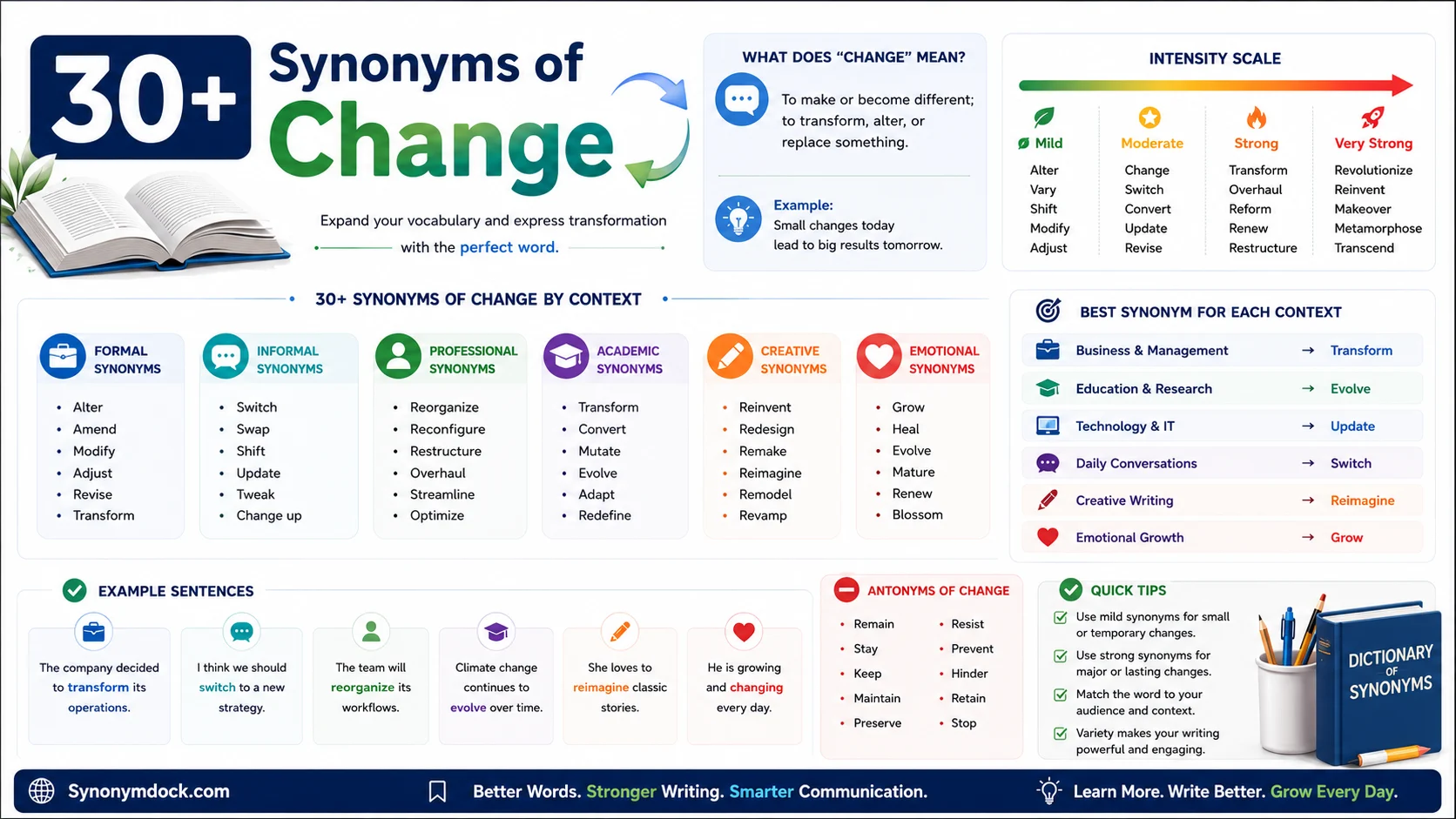
Change means the act or process of becoming different. It is a neutral, general term that covers everything from small adjustments to complete transformations. For formal writing, choose “modification” or “amendment.” For professional communication, use “adjustment” or “revision.” For casual conversation, try “shift” or “switch.” For complete transformation, select “transformation” or “conversion.”
You are writing an important email, a college essay, or a social media caption. You realize you have typed the word “change” three times in two sentences. The repetition makes your writing feel flat and unoriginal. You need a better way to express the idea. Choosing the right synonym of change can transform your writing from repetitive to refined. The word “change” appears constantly in professional communication, academic writing, and everyday conversation. Understanding its synonyms helps you communicate with greater precision and impact. The best writers know that word choice shapes how readers perceive your message. This guide helps you choose the perfect alternative for any situation.
Meaning, Tone, and Context
Simple Definition: Change is the act or process of becoming different. It can involve alterations in form, structure, character, position, or direction. The term applies to physical objects, ideas, behaviors, systems, and situations.
Part of Speech: Change functions as both a noun and a verb. As a noun, it refers to the result or process of becoming different. As a verb, it means to make or become different.
Overall Tone: Neutral. Change does not carry inherent positive or negative meaning. Its tone depends entirely on context. A change in weather could be welcome or unwelcome. A change in policy could be beneficial or harmful. The word itself simply describes difference.
Formality Level: Neutral to semi-formal. “Change” works in almost any setting, from casual conversation to formal reports. However, more precise alternatives often improve clarity in professional and academic writing.
Common Uses: Native English speakers use “change” in countless situations. People discuss changing clothes, changing minds, changing jobs, changing plans, changing the subject, and changing the world. The word appears in daily conversation, business meetings, academic papers, news reports, and creative writing.
When and How to Use “Change”
Use “change” when you need a general, versatile word that almost everyone understands. It works well when the specific nature of the difference is not important. Choose “change” when you want to keep your language simple and accessible. The word is appropriate in most contexts, but more precise alternatives often strengthen your writing.
Examples by Context
Professional: “We need to change our approach to client communication to improve response times.”
Academic: “The study examined how climate change affects agricultural productivity in the region.”
Workplace: “Please change the meeting time from 2 PM to 3 PM to accommodate the guest speaker.”
Personal: “After ten years in marketing, I decided to change careers and pursue graphic design.”
Email: “I would like to change my appointment from Friday to Monday if possible.”
Resume: “Implemented policy changes that reduced operational costs by 15 percent.”
Social Media: “Change is the only constant in life. Embrace it.”
Best Synonyms of “Change”
No synonym is identical in every situation. The best choice depends on your audience, purpose, and the specific kind of difference you want to describe. Here are the top recommendations for common contexts.
Professional writing: “Adjustment” works best for minor modifications. “Revision” suits documents and plans. “Amendment” fits policies and contracts. These words sound more deliberate and careful than “change.”
Academic writing: “Alteration” and “modification” are precise choices. “Transformation” works for significant shifts. “Evolution” describes gradual development. These terms demonstrate sophisticated vocabulary without sounding forced.
Business communication: “Revision” works for documents. “Conversion” fits processes. “Restructuring” describes organizational shifts. “Transition” covers periods of change.
Casual conversation: “Shift” and “switch” sound natural. “Turnaround” describes reversals. These words feel conversational and approachable.
Emotional writing: “Transformation” and “metamorphosis” convey profound personal change. “Revolution” suggests dramatic, passionate shifts. These words add emotional weight to your writing.
Creative writing: “Metamorphosis” adds literary flair. “Transfiguration” sounds poetic. “Mutation” works for science fiction and fantasy. These alternatives create vivid imagery.
Resume writing: “Transformed” shows strong impact. “Revamped” suggests modernizing. “Restructured” demonstrates leadership. These action verbs impress employers.
Workplace communication: “Adjustment” sounds practical. “Revision” signals thoughtfulness. “Update” feels current and proactive.
Stronger meaning: “Revolution,” “transformation,” “overhaul,” and “metamorphosis” convey dramatic, significant change.
Softer meaning: “Adjustment,” “modification,” “alteration,” and “refinement” suggest minor, careful changes.
When Not to Use “Change”
Using “change” in every situation makes your writing repetitive and vague. Recognize when the word is not the best choice.
Too general: When you need to specify the type of difference, choose a more precise word. “Change” does not distinguish between a minor tweak and a complete overhaul. Instead of “We made changes to the design,” say “We refined the design” or “We overhauled the design.
Too vague in resumes: Hiring managers see “change” constantly. Stronger action verbs impress them more. Instead of “Changed company policy,” say “Revised company policy” or “Restructured company policy.”
Too informal in academic writing: Some academic contexts require more formal vocabulary. Instead of “This changed the results,” say “This altered the results” or “This modified the outcomes.”
Too weak for significant shifts: When describing major transformations, “change” sounds underwhelming. Instead of “The company changed completely,” say “The company transformed completely” or “The company underwent a revolution.”
Too strong for minor adjustments: When describing small differences, “change” can sound dramatic. Instead of “We changed the font size,” say “We adjusted the font size” or “We modified the font size.”
Words Commonly Confused With “Change”
Change vs Alter
Difference: “Alter” usually means a partial or slight change that does not affect the basic nature of something. “Change” is broader and can mean complete transformation.
When to Use: Use “alter” for minor adjustments. Use “change” for any kind of difference.
Example: “We altered the schedule slightly” versus “We changed the entire schedule.”
Change vs Modify
Difference: “Modify” implies making partial or small changes, often to improve something. “Change” is more general.
When to Use: Use “modify” when you are making improvements or adjustments to an existing thing.
Example: “The mechanic modified the engine for better performance” versus “The mechanic changed the engine.”
Change vs Transform
Difference: “Transform” means a complete and dramatic change in form, appearance, or character. “Change” can be minor.
When to Use: Use “transform” for dramatic, complete changes. Use “change” for any degree of difference.
Example: “The caterpillar transformed into a butterfly” versus “The caterpillar changed position.”
Change vs Shift
Difference: “Shift” suggests a change in position, direction, or emphasis. It often implies movement from one place or state to another.
When to Use: Use “shift” for changes in position, opinion, or focus.
Example: “Public opinion shifted dramatically” versus “Public opinion changed dramatically.”
Change vs Convert
Difference: “Convert” means to change from one form, system, or use to another. It often implies a functional change.
When to Use: Use “convert” when something is adapted for a different purpose or form.
Example: “They converted the warehouse into apartments” versus “They changed the warehouse.”
Change vs Transition
Difference: “Transition” emphasizes the process or period of changing from one state to another. “Change” focuses on the result.
When to Use: Use “transition” when describing the period or process of change.
Example: “The company is in transition” versus “The company changed.”
Best Synonyms of “Change” by Context
| Context | Best Synonym | Why It Works | Example |
|---|---|---|---|
| Formal writing | Modification | Sounds deliberate and precise | “The modification improved system performance.” |
| Academic writing | Alteration | Demonstrates sophisticated vocabulary | “The alteration affected the study’s outcomes.” |
| Professional communication | Adjustment | Sounds careful and practical | “We made adjustments to the budget.” |
| Business emails | Revision | Signals thoughtful improvement | “Please review the revisions to the proposal.” |
| Resume writing | Transformation | Shows significant impact | “Transformed the department’s workflow.” |
| Workplace communication | Update | Sounds current and proactive | “We need an update on the project status.” |
| Casual conversation | Switch | Sounds natural and conversational | “Let’s switch our lunch plans.” |
| Everyday speaking | Shift | Easy to understand and versatile | “The weather shifted suddenly.” |
| Creative writing | Metamorphosis | Adds literary and dramatic flair | “Her character underwent a metamorphosis.” |
| Storytelling | Evolution | Suggests gradual, meaningful development | “The story traces his evolution as a leader.” |
| Emotional writing | Revolution | Conveys dramatic, passionate change | “She sparked a revolution in thinking.” |
| Strong emphasis | Overhaul | Suggests complete renovation | “The system needs a complete overhaul.” |
| Mild tone | Tweak | Suggests small, careful adjustment | “We just need to tweak the design.” |
| Social media | Shift | Short, punchy, and modern | “Big shift in my perspective this year.” |
How to Choose the Best Synonym of “Change”
Choosing the right synonym depends on understanding what kind of difference you want to describe. Follow this practical decision guide.
Consider the size of the change: Use “adjustment,” “modification,” or “refinement” for small changes. Use “transformation,” “overhaul,” or “revolution” for large changes. Use “alteration,” “revision,” or “shift” for medium changes.
Consider your audience: Use “modification” and “revision” in professional and academic settings. Use “switch” and “shift” in casual conversation. Use “transformation” and “evolution” in creative and personal writing.
Consider your purpose: Use “update” when sharing new information. Use “revision” when improving documents. Use “adjustment” when fixing problems. Use “transformation” when describing growth.
Consider emotional tone: Use neutral words like “alteration” and “modification” for objective writing. Use emotional words like “metamorphosis” and “revolution” for expressive writing.
Consider formality: Formal contexts call for “amendment,” “conversion,” and “modification.” Informal contexts work well with “switch,” “swap,” and “shift.”
Trust your ear: Read your sentence aloud with each synonym. Choose the word that sounds most natural and communicates your intended meaning clearly.
Real Life Examples of “Change”
School: “The teacher asked us to change our essay topics before submission.” Better: “The teacher asked us to revise our essay topics.”
College: “I decided to change my major from engineering to communications.” Better: “I decided to switch my major from engineering to communications.”
Workplace: “We need to change our meeting schedule for next week.” Better: “We need to adjust our meeting schedule for next week.”
Business: “The CEO announced a change in company structure.” Better: “The CEO announced a restructuring of the company.”
Email: “I want to change our appointment time.” Better: “I would like to reschedule our appointment.”
Resume: “Changed the sales process to increase revenue.” Better: “Revamped the sales process to increase revenue.”
Conversation: “I need to change my plans for tonight.” Better: “I need to shift my plans for tonight.”
Storytelling: “Her life changed after she moved to the city.” Better: “Her life transformed after she moved to the city.”
Blogging: “Here is how I changed my morning routine.” Better: “Here is how I revamped my morning routine.”
Social Media: “Changed my mindset and everything improved.” Better: “Shifted my mindset and everything improved.”
25 Best Synonyms of “Change”
Synonyms of “Change” by Usage
Professional vs Personal Synonyms
Professional settings favor precise, deliberate language. Choose “modification,” “adjustment,” “revision,” “restructuring,” and “optimization” in the workplace. These words suggest careful, intentional action. Personal conversations work better with “switch,” “shift,” “swap,” “turnaround,” and “makeover.” These words feel more natural and less formal in everyday speech.
Formal vs Conversational Synonyms
Formal writing in reports, academic papers, and business documents benefits from “alteration,” “amendment,” “conversion,” “modification,” and “transformation.” These words demonstrate vocabulary sophistication. Conversational writing for emails, texts, and casual messages works well with “switch,” “shift,” “swap,” “tweak,” and “shake-up.” These words sound approachable and natural.
Academic Synonyms
Academic writing demands precise, authoritative vocabulary. Use “alteration” for partial changes. Use “modification” for deliberate improvements. Use “evolution” for gradual development. Use “transformation” for complete changes. Use “variation” for differences in data. Use “fluctuation” for changing measurements. These words sound scholarly and demonstrate careful thinking.
Professional and Business Synonyms
Resumes, interviews, and business communication benefit from impactful vocabulary. Use “transformed” to show major impact. Use “revamped” to show modernizing. Use “restructured” to show leadership. Use “optimized” to show improvement. Use “streamlined” to show efficiency. Use “overhauled” to show comprehensive improvement. These action verbs impress employers and clients.
Creative and Literary Synonyms
Storytelling, poetry, and creative writing require vivid, expressive vocabulary. Use “metamorphosis” for magical transformation. Use “transfiguration” for spiritual or visual change. Use “revolution” for dramatic cultural shifts. Use “evolution” for character development. Use “mutation” for science fiction. Use “permutation” for complex changes. These words add depth and imagery to creative writing.
Slang or Modern Synonyms
Change” does not have many established slang synonyms. “Makeover” works for personal appearance changes. “Shake-up” describes organizational changes. “Flip” describes sudden reversals. These words are acceptable in casual conversation but should be avoided in formal writing.
Strongest to Mildest Synonyms
Mild: Tweak, adjust, refine, modify, alter
Moderate: Revise, update, shift, convert, amend
Strong: Transform, overhaul, restructure, revamp
Very Strong: Revolution, metamorphosis, transmutation, transfiguration
Emotional vs Neutral Synonyms
Emotional Synonyms: “Transformation” suggests inspiring personal growth. “Metamorphosis” implies dramatic and often beautiful change. “Revolution” conveys passionate, dramatic shifts. “Transfiguration” suggests spiritual or awe-inspiring change. Use these for writing that aims to inspire or move readers.
Neutral Synonyms: “Alteration,” “modification,” “adjustment,” “revision,” and “shift” communicate information without adding emotional weight. Use these for objective, professional, and academic writing.
Antonyms of “Change”
Comparison: “Change” vs Similar Words
Change vs Alter
Main Difference: “Alter” typically means a partial or slight change that does not affect the basic nature of something. “Change” is broader and can mean complete transformation.
Which Is Stronger? “Change” can be stronger when it implies significant transformation. “Alter” usually suggests smaller modifications.
Which Is More Formal? Both are relatively neutral, but “alter” often sounds slightly more formal and precise.
When to Use Each: Use “alter” for minor adjustments. Use “change” for any degree of difference.
Examples:
Change: “The company changed its logo.”
Alter: “The designer altered the logo slightly.”
Change vs Modify
Main Difference: “Modify” implies making partial or small changes, often to improve something. “Change” is more general.
Which Is Stronger? “Change” can describe larger transformations. “Modify” suggests careful, partial improvement.
Which Is More Formal? “Modify” is more formal and technical than “change.”
When to Use Each: Use “modify” when making improvements. Use “change” for any kind of difference.
Examples:
Change: “We need to change the plan.”
Modify: “We need to modify the plan to improve efficiency.”
Change vs Transform
Main Difference: “Transform” means a complete and dramatic change in form, appearance, or character. “Change” can be minor.
Which Is Stronger? “Transform” is much stronger and implies complete, fundamental change.
Which Is More Formal? Both work in formal contexts, but “transform” sounds more dramatic and sophisticated.
When to Use Each: Use “transform” for dramatic, complete changes. Use “change” for any degree of difference.
Examples:
Change: “The room changed after the renovation.”
Transform: “The renovation transformed the room into a beautiful space.”
Change vs Shift
Main Difference: “Shift” suggests a change in position, direction, or emphasis. It implies movement from one place or state to another.
Which Is Stronger? “Change” can describe larger, more fundamental differences. “Shift” focuses on movement or repositioning.
Which Is More Formal? “Shift” is neutral and works in both formal and casual contexts.
When to Use Each: Use “shift” for changes in position, opinion, or focus.
Examples:
Change: “The market changed significantly.”
Shift: “The market shifted toward online sales.”
Change vs Convert
Main Difference: “Convert” means to change from one form, system, or use to another. It implies a functional change.
Which Is Stronger? “Convert” suggests a complete change of function or purpose, which can be a strong change.
Which Is More Formal? “Convert” is relatively formal and technical.
When to Use Each: Use “convert” when something is adapted for a different purpose or form.
Examples:
Change: “We need to change the room.”
Convert: “We need to convert the room into an office.”
Change vs Revise
Main Difference: “Revise” specifically means to change something in order to improve or update it, especially written material. “Change” is more general.
Which Is Stronger? “Revise” suggests careful, thoughtful change. “Change” can describe any kind of difference.
Which Is More Formal? “Revise” is more formal and specific than “change.”
When to Use Each: Use “revise” for written documents, plans, and opinions.
Examples:
Change: “The teacher asked me to change my essay.”
Revise: “The teacher asked me to revise my essay to improve clarity.”
Common Phrases and Expressions with “Change”
Change of heart
Meaning: A change in opinion, attitude, or feeling.
Example Sentence: “He was going to quit, but he had a change of heart at the last minute.”
Change one’s mind
Meaning: To decide to do something different from what was originally planned.
Example Sentence: “I was going to stay home, but I changed my mind and went to the party.”
Change of pace
Meaning: A break from the usual routine or speed.
Example Sentence: “Taking a walk during lunch is a nice change of pace.”
Change the subject
Meaning: To start talking about something different.
Example Sentence: “The conversation became awkward, so I changed the subject.”
A change for the better
Meaning: An improvement.
Example Sentence: “Moving to the city was a change for the better.”
A change for the worse
Meaning: A deterioration.
Example Sentence: “The new policy was a change for the worse.”
Small change
Meaning: Coins of low value; something insignificant.
Example Sentence: “I only have small change in my pocket.”
Common Mistakes to Avoid
Choosing a vague synonym instead of a precise one
Incorrect: “The company made a change to the product.”
Better: “The company made an improvement to the product.”
Why: “Improvement” specifies the nature of the change, making the sentence more informative.
Confusing “change” with “adjustment”
Incorrect: “The CEO announced a complete adjustment of the company structure.”
Better: “The CEO announced a complete restructuring of the company.”
Why: “Adjustment” suggests small changes, not the major restructuring described.
Using an informal synonym in formal writing
Incorrect: “The study showed a switch in consumer behavior.” (too informal)
Better: “The study showed a shift in consumer behavior.” (more formal)
Selecting an overly dramatic synonym
Incorrect: “We need to revolutionize our meeting schedule.” (too dramatic)
Better: “We need to revise our meeting schedule.” (more appropriate)
Why: “Revolutionize” implies dramatic, fundamental change, not minor schedule adjustments.
Repeating the same synonym too often
Incorrect: “The change was significant. The change affected everyone. The change created opportunities.”
Better: “The transformation was significant. The shift affected everyone. The evolution created opportunities.”
Why: Synonyms add variety and keep writing engaging.
Choosing a synonym with the wrong emotional tone
Incorrect: “The minor adjustment transformed the project.” (too dramatic)
Better: “The minor adjustment improved the project.” (more measured)
Why: “Transformed” suggests complete change, not minor improvement.
Using slang in academic or professional writing
Incorrect: “The study shows a shake-up in the data.” (too informal)
Better: “The study shows variation in the data.” (more appropriate)
Frequently Asked Questions
What are the best synonyms of “change”?
The best synonyms depend on context. For formal writing, use “modification” or “alteration.” For dramatic transformation, use “transformation” or “overhaul.” For casual conversation, use “shift” or “switch.” Choose based on your audience and purpose.
What are the best formal synonyms of “change”?
The best formal synonyms are “modification,” “alteration,” “amendment,” and “revision.” “Conversion” and “transformation” work for significant formal changes. “Adjustment” and “refinement” suit formal writing about minor changes.
What are common informal synonyms of “change”?
Common informal synonyms include “switch,” “shift,” “swap,” and “turnaround.” These words work well in conversation, texts, and casual writing. They sound natural and approachable.
What is another word for “change” in professional writing?
In professional writing, use “adjustment,” “revision,” “restructuring,” “optimization,” or “streamlining.” These words suggest careful, deliberate action and impress employers and colleagues.
What is the difference between “change” and “transform”?
“Change” is a general term that can describe any degree of difference. “Transform” specifically means a complete, dramatic change in form, appearance, or character. “Transform” implies a fundamental shift, while “change” can be minor.
What is the opposite of “change”?
The opposites include “stability,” “constancy,” “permanence,” “preservation,” “continuation,” “sameness,” and “status quo.” These words describe the absence of change.
Conclusion
Understanding the word “change” is essential for clear communication. This versatile word describes everything from minor adjustments to complete transformations. However, relying on it too heavily makes writing repetitive and vague. The best writers choose precise synonyms that match their intended meaning, audience, and tone. A synonym of change like “modification” works for formal writing. “Transformation” suits creative expression. “Adjustment” fits practical situations. No single synonym works perfectly in every context. Consider your purpose, audience, and the specific kind of difference you want to describe. With the vocabulary in this guide, you can choose the perfect synonym for any situation. Your writing will become clearer, more precise, and more engaging.

1 thought on “Synonyms of Change| 30+ Best Alternatives & Examples”