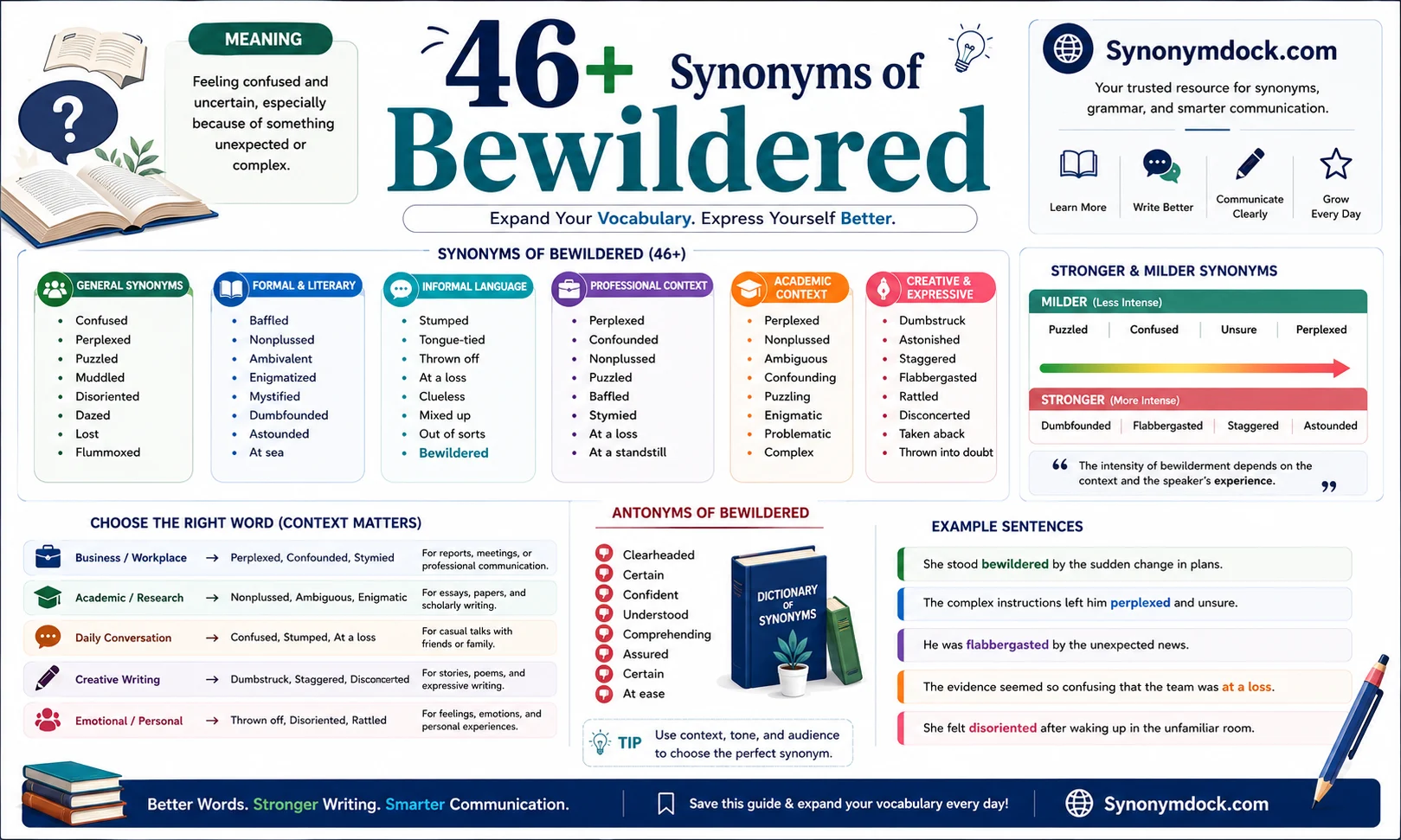
“Bewildered” describes a state of being completely puzzled or confused, often by something complicated or unexpected. It carries a sense of being lost or not knowing what to do next . The best synonym depends on your context: use “perplexed” for formal writing, “baffled” when you are completely unable to understand something, “confused” for everyday situations, and “disoriented” when feeling lost physically or mentally .
Have you ever been writing an email, a school assignment, or even a social media caption and found yourself stuck using the same word over and over? Maybe you felt confused, but “confused” didn’t quite capture the depth of what you experienced. That is where understanding a word like “bewildered” and its synonyms becomes valuable. Choosing the right synonym does more than just avoid repetition. It sharpens your message, clarifies your tone, and helps your reader truly understand what you mean. This guide explores the best synonyms of bewildered, showing you exactly which word to use in professional writing, casual conversation, creative storytelling, and everything in between.
Meaning, Tone, and Context
Simple Definition
“Bewildered” means being completely confused and unable to understand something or decide what to do. It goes beyond simple confusion and implies a state of being lost or overwhelmed.
Part of Speech
Adjective.
Overall Tone
Neutral to mildly negative. It describes a state of puzzlement that can be frustrating or unsettling.
Formality Level
Semi-formal. It is appropriate in both written and spoken English, though it sounds more sophisticated than basic words like “confused.”
Common Uses
Native speakers use “bewildered” to describe situations where they cannot make sense of what is happening. It often appears in storytelling, personal anecdotes, and professional writing when describing reactions to unexpected news or complex information. It suggests that the person is not just confused but also unsure how to proceed . For example, shoppers might look bewildered by a vast array of choices .
Word Forms
- Noun: bewilderment
- Verb: bewilder
- Adjective: bewildering
When and How to Use “Bewildered”
Use “bewildered” when you want to describe a state of confusion that is deep enough to leave someone unable to act or decide. It is particularly effective when the confusion stems from something overwhelming, complex, or unexpected. Here are seven examples showing how to use it in different contexts.
Professional:
The new software update left the team bewildered, as none of the usual functions worked the same way.”
Academic:
“The student felt bewildered by the conflicting theories presented in the research papers.”
Workplace:
“Employees were bewildered by the sudden announcement of the company restructure.”
Personal:
“She was bewildered by her friend’s unexpected and abrupt change in attitude.”
Email:
“I apologize for the confusion in my previous email; I realize the instructions may have left you feeling a bit bewildered.”
Resume (describing a challenge):
“Navigated a complex system transition that initially bewildered the entire department, implementing a training program to facilitate adaptation.”
Social Media:
“This new update has me completely bewildered. Why change something that worked perfectly?”
Best Synonyms of “Bewildered”
No synonym is a perfect match for every situation, and “bewildered” is no different. Here are the best alternatives for specific contexts.
Professional writing: “Perplexed” conveys confusion with an intellectual or problem-solving tone. It is more formal and suggests a puzzle to be solved .
Academic writing: “Perplexed” or “confounded” both work well. “Confounded” adds a touch of drama while remaining formal, perfect for describing results that defy expectations.
Business communication: “Baffled” can be effective but use it carefully as it implies complete inability to understand . “Perplexed” is often a safer, more neutral choice for client communication.
Casual conversation: “Confused” is the most natural and common choice for everyday speech.
Emotional writing: “Dazed” suggests shock and an inability to think clearly after an accident or bad news .
Creative writing: “Bemused” offers a lighter, often more detached kind of confusion, perfect for a character who is puzzled but not distressed.
Resume writing: Instead of stating you were bewildered, phrase it as a challenge you overcame, such as “navigated complex situations.”
Workplace communication: “Perplexed” is often the best choice for showing you are thinking through a problem without sounding overwhelmed.
Stronger meaning: “Flabbergasted” or “astounded” are much stronger and imply a huge degree of surprise or shock .
Softer meaning: “Puzzled” is a gentler, more casual way to say you do not understand something .
When Not to Use “Bewildered”
While “bewildered” is a useful word, there are times when it is not the best choice.
When the word sounds too vague: If you only need to say you do not understand simple directions, “confused” or “puzzled” are more direct and natural.
Why it is less effective: “Bewildered” sounds overly dramatic for small inconveniences.
Recommendation: Use “confused” or “lost” instead.
Rewrite: “I was confused by the instructions for the coffee machine.” (Instead of “I was bewildered”)
When the word sounds too formal: In a text message to a friend, “bewildered” can sound stiff or overly literary.
Why it is less effective: It does not fit the casual tone of texting.
Recommendation: Use “confused” or “huh?” or simply describe the situation.
Rewrite: “I am so lost, what are you talking about?” (Instead of “I am bewildered”)
When the word sounds too strong: If you just do not know the answer to a trivia question, “bewildered” is too intense.
Why it is less effective: It exaggerates your state of mind.
Recommendation: Use “stumped” or “perplexed” for a lighter intellectual challenge.
Rewrite: “That trivia question really stumped me.” (Instead of “That trivia question left me bewildered.”)
Words Commonly Confused With “Bewildered”
Bewildered vs Confused
Difference: “Confused” is a general term for a lack of understanding. “Bewildered” is a stronger, more dramatic version that implies being lost or overwhelmed .
When to Use It: Use “confused” for everyday situations and “bewildered” when the confusion is deep enough to be disorienting.
Example (Bewildered): “I was bewildered by the contradictory statements.”
Example (Confused): “I am confused about the meeting time.”
Bewildered vs Puzzled
Difference: “Puzzled” suggests you are trying to figure out a specific problem or question. It is a more active, intellectual state compared to “bewildered,” which suggests total overwhelm .
When to Use It: Use “puzzled” when you are thinking through a mystery or riddle and feel confident you can solve it.
Example (Bewildered): “He looked bewildered by the sheer amount of paperwork.”
Example (Puzzled): “She had a puzzled look on her face after reading the riddle.”
Bewildered vs Perplexed
Difference: Both are formal, but “perplexed” is more neutral and tied to intellectual confusion. “Bewildered” often includes an emotional component of feeling lost or helpless .
When to Use It: Use “perplexed” in formal writing or when discussing a problem that requires analysis.
Example (Bewildered): “The crowd was bewildered by the magician’s disappearing act.”
Example (Perplexed): “The scientist was perplexed by the unexpected results of the experiment.”
Best Synonyms of “Bewildered” by Context
| Context | Best Synonym | Why It Works | Example |
|---|---|---|---|
| Formal writing | Perplexed | Conveys intellectual confusion without being overly emotional . | “The committee was perplexed by the findings.” |
| Academic writing | Confounded | Adds a sense of challenge and contradictory results . | “The data confounded the research team.” |
| Professional communication | Perplexed | Sounds thoughtful and measured . | “I was perplexed by the client’s new demands.” |
| Business emails | Perplexed | Professional and appropriate for discussing complex issues. | “I am somewhat perplexed by the delay.” |
| Resume writing | Navigated | Shows you handled a complex situation rather than succumbing to confusion. | “Navigated a complex system migration.” |
| Workplace communication | Perplexed | Indicates you are thinking through a problem. | “We were perplexed by the error codes.” |
| Casual conversation | Confused | Simple, natural, and widely understood. | “I am confused, can you explain that again?” |
| Everyday speaking | Confused | The most common and straightforward choice. | “She looked confused by his question.” |
| Creative writing | Dazed | Suggests shock or disorientation . | “After the news, he walked away dazed.” |
| Storytelling | Dumbfounded | Emphasizes being rendered speechless by surprise . | “She stood dumbfounded by the offer.” |
| Emotional writing | Disoriented | Captures a feeling of being lost and unsteady . | “He felt disoriented by the sudden turn of events.” |
| Strong emphasis | Flabbergasted | Very strong, informal word for a huge shock . | “I was absolutely flabbergasted by his honesty.” |
| Mild tone | Puzzled | Soft and inquisitive . | “I am a bit puzzled by this note.” |
| Social media captions | Confused | Short, relatable, and fits the casual tone. | “Still confused about this new trend.” |
| American English | All of the above | All listed synonyms are common in American English. | N/A |
How to Choose the Best Synonym of “Bewildered”
Choosing the right synonym can be simple if you consider a few factors. First, think about your audience and the level of formality required. For a school report, “perplexed” or “confounded” may sound more academic than “confused.” For a text to a friend, “confused” or “baffled” is more natural.
Next, consider the intensity of the emotion you want to convey. Is the person just a little confused, or are they completely lost and overwhelmed? Use milder words like “puzzled” for a light confusion and stronger words like “flabbergasted” or “dumbfounded” for a significant shock.
Finally, think about the nuance. Are you focusing on the intellectual challenge of a problem (“perplexed”), the inability to explain something (“baffled”), or the feeling of being lost and helpless (“bewildered”)? The synonym you choose should accurately reflect the specific situation.
Real Life Examples of “Bewildered”
Here are realistic examples showing how to use “bewildered” in different situations. Some examples also show how to replace it with a stronger or more precise synonym for better clarity.
School:
“The student was bewildered when the teacher gave instructions in three different languages.”
College:
“Freshmen often feel bewildered by the sheer scale of the university campus and the number of extracurricular activities available.”
Workplace:
“During the merger, employees were bewildered by the constant changes to company policy.”
Business:
“The start-up’s marketing team was bewildered when their ad campaign went viral for reasons they could not understand.”
Email (formal):
“I am rather perplexed by the invoice discrepancy and would appreciate clarification.”
Resume (improved):
“Navigated the bewildering transition to a new operating system, maintaining 100% team productivity.” (Instead of “I was bewildered”)
Conversation:
“When he started explaining his conspiracy theory, I was totally lost.”
Storytelling:
“Bewildered and alone, he wandered through the unfamiliar city streets.”
Blogging:
“I was completely baffled when I saw the final results of the election.”
Social media:
“Staring at this IKEA instruction manual and I am so confused.”
25 Best Synonyms of “Bewildered”
Synonyms of “Bewildered” by Usage
Professional vs Personal Synonyms
In professional settings, choose words that sound competent and measured. Perplexed is an excellent choice because it suggests you are actively thinking about a problem without sounding overwhelmed or emotional. In personal settings, you have more freedom. Confused, baffled, or even stumped are common and natural.
Formal vs Conversational Synonyms
Formal writing, such as reports or essays, benefits from words like perplexed, confounded, or nonplussed . These words convey a sophisticated level of vocabulary. In conversational writing, like emails or text messages, simpler words like confused, puzzled, or lost sound more natural.
Academic Synonyms
For research and academic discussion, perplexed is ideal for conveying analytical confusion. Confounded is also highly appropriate, especially when discussing data that contradicts a hypothesis . These words are precise and carry the necessary gravitas for scholarly work.
Professional and Business Synonyms
For resumes and professional communications, the goal is to demonstrate competence. Instead of using a synonym for “bewildered,” reframe the situation. Saying you “navigated a complex project” or “managed a challenging transition” sounds proactive. If you must describe a state of confusion, perplexed is the most professional option.
Creative and Literary Synonyms
Creative writing allows for more expressive choices. Dazed and disoriented are excellent for conveying shock . Bemused creates a specific, often amused, tone. Dumbfounded and flabbergasted are fantastic for dramatic moments .
Slang or Modern Synonyms
“Bewildered” does not have a direct slang equivalent. Phrases like “huh?” or “lost” are used informally to express the same feeling. You might also hear “discombobulated” used in a humorous, slightly old-fashioned way, but it is not common slang.
Strongest to Mildest Synonyms
Here is an intensity scale from mild to very strong.
Mild: Puzzled, confused, lost
Moderate: Perplexed, baffled, stumped
Strong: Confounded, mystified
Very Strong: Dumbfounded, flabbergasted, astounded
Emotional vs Neutral Synonyms
Emotional Synonyms: These words express a stronger feeling, often of distress or shock. Examples include dazed, disoriented, dumbfounded, and flabbergasted. Use these when the situation has an emotional impact.
Neutral Synonyms: These words simply communicate a lack of understanding without adding extra emotion. Confused, perplexed, and puzzled are neutral. Use these for straightforward situations where you want to avoid overdramatizing.
Antonyms of “Bewildered”
Comparison: “Bewildered” vs Similar Words
Bewildered vs Confused
Main Difference: “Confused” is a broad, general term for a lack of understanding. “Bewildered” is a much stronger and more dramatic form of confusion that implies being completely lost and unable to decide what to do .
Which Is Stronger? Bewildered is significantly stronger.
Which Is More Formal? Both are neutral, but “bewildered” often appears in more formal writing.
When to Use Each: Use “confused” for everyday situations. Use “bewildered” for a state of overwhelming perplexity.
Examples:
- Confused: “I am confused by this math problem.”
- Bewildered: “I was bewildered by the complex legal jargon.”
Bewildered vs Perplexed
Main Difference: “Perplexed” suggests an intellectual puzzle that needs solving. “Bewildered” suggests an emotional or situational state of being lost and overwhelmed .
Which Is Stronger? Bewildered is generally stronger and more emotionally charged.
Which Is More Formal? Perplexed is more formal and academic .
When to Use Each: Use “perplexed” when discussing a difficult intellectual challenge. Use “bewildered” when describing a situation that leaves someone feeling helpless.
Examples:
- Perplexed: “The researcher was perplexed by the contradictory data.”
- Bewildered: “She was bewildered by the sudden loss of her job.”
Bewildered vs Baffled
Main Difference: Both are strong, but “baffled” focuses on the inability to understand or explain something. “Bewildered” focuses more on the resulting feeling of being lost and not knowing what to do .
Which Is Stronger? They are similar in strength.
Which Is More Formal? Both are used in informal and formal contexts.
When to Use Each: Use “baffled” when you cannot find an explanation. Use “bewildered” when you are in a situation you cannot navigate.
Examples:
- Baffled: “I am completely baffled by his behavior.”
- Bewildered: “The citizens were bewildered by the city’s new laws.”
Bewildered vs Puzzled
Main Difference: “Puzzled” is a mild word suggesting you are trying to figure something out. It is an active, inquisitive state. “Bewildered” is a passive state of being overwhelmed .
Which Is Stronger? Bewildered is much stronger.
Which Is More Formal? Both are used, but “puzzled” is more common in casual speech.
When to Use Each: Use “puzzled” when you have a question you are working to answer. Use “bewildered” when you have no idea what to do.
Examples:
- Puzzled: “I am puzzled by the first clue in the puzzle.”
- Bewildered: “I was bewildered by the first day of my new job.”
Bewildered vs Dazed
Main Difference: “Dazed” specifically implies being unable to think clearly due to a shock, an accident, or extreme tiredness. “Bewildered” does not necessarily have a physical or shock element .
Which Is Stronger? Dazed implies a physical or emotional blow that has temporarily incapacitated someone.
Which Is More Formal? Bewildered is more formal.
When to Use Each: Use “dazed” after a specific event. Use “bewildered” to describe a general state of confusion.
Examples:
- Dazed: “After the collision, he sat dazed on the curb.”
- Bewildered: “Her cryptic comment left the room bewildered.”
Bewildered vs Disoriented
Main Difference: “Disoriented” has a strong physical component, meaning someone is confused about their location, time, or physical bearings. “Bewildered” is more mental .
Which Is Stronger? They are similar, but “disoriented” often implies a more severe state.
Which Is More Formal? Both are appropriate in formal and informal contexts.
When to Use Each: Use “disoriented” for confusion about direction or place. Use “bewildered” for confusion about a situation.
Examples:
- Disoriented: “He woke up disoriented in the middle of the night.”
- Bewildered: “She was bewildered by the conflicting advice from her friends.”
Common Phrases and Expressions with “Bewildered”
The word “bewildered” is often used with modifiers to show how intense the confusion is.
Bewildered by
Meaning: The cause of the confusion.
Example Sentence: “The crowd was bewildered by the magician’s final trick.”
Completely bewildered
Meaning: Emphasizes a full state of confusion .
Example Sentence: “I was completely bewildered by the instructions.”
Left feeling bewildered
Meaning: Describes the effect of an event.
Example Sentence: “His comments left everyone feeling bewildered.”
Somewhat bewildered
Meaning: A moderate degree of confusion.
Example Sentence: “I was somewhat bewildered by the question.”
Bewildered and confused
Meaning: A common expression for emphasis .
Example Sentence: “She stood there, bewildered and confused.”
Bewildering array/range
Meaning: Used to describe a large, confusing number of choices .
Example Sentence: “The store offered a bewildering array of flavors.”
Common Mistakes to Avoid
Choosing a vague synonym instead of a precise one
- Incorrect: “I was bewildered by the difficult math problem.” (This is too dramatic.)
- Better: “I was perplexed by the difficult math problem.” (This is more precise for an intellectual challenge.)
- Why: The word should match the situation. Math problems cause intellectual confusion, not the overwhelming, helpless feeling of being bewildered .
Confusing “bewildered” with “bemused”
- Incorrect: “He was bemused by the tragedy.” (This implies he found it amusing.)
- Better: “He was bewildered by the tragedy.” (This correctly shows confusion and shock.)
- Why: “Bemused” often has a tone of amusement, while “bewildered” is serious .
Using an informal synonym in formal writing
- Incorrect: “The committee was flabbergasted by the report.”
- Better: “The committee was perplexed by the report.”
- Why: “Flabbergasted” is too informal and dramatic for a professional committee report .
Selecting an overly dramatic synonym
- Incorrect: “I was dumbfounded by my friend’s new haircut.”
- Better: “I was surprised by my friend’s new haircut.”
- Why: “Dumbfounded” implies a level of shock that does not fit a routine event like a haircut .
Repeating the same word too often
- Incorrect: “The instructions were confusing. I was confused. The process confused me.”
- Better: “The instructions were perplexing. I was baffled. The process mystified me.”
- Why: Using synonyms makes writing more varied and engaging.
Choosing a synonym with the wrong emotional tone
- Incorrect: “She was dazed by his question.”
- Better: “She was surprised by his question.”
- Why: “Dazed” implies a state of shock, not just simple surprise. It does not fit a simple question .
Using slang in academic or professional writing
- Incorrect: “The data left the researchers totally lost.”
- Better: “The data perplexed the researchers.”
- Why: “Totally lost” is too casual for an academic context .
Frequently Asked Questions
What are the best synonyms of “bewildered”?
The best synonyms include “perplexed” for formal settings, “confused” for everyday use, and “baffled” when you cannot understand something . These cover the most common situations and levels of intensity.
What are the best formal synonyms of “bewildered”?
For formal writing, use “perplexed,” “confounded,” or “nonplussed” . These words are precise, sound professional, and convey intellectual confusion without being overly emotional.
What are common informal synonyms of “bewildered”?
Common informal synonyms include “lost,” “stumped,” and “baffled” . These words are natural in conversation and text messages with friends.
What is another word for “bewildered” in professional writing?
The best word is “perplexed” . It shows you are thoughtfully considering a problem rather than feeling helplessly confused. It maintains a professional and competent tone.
What is the difference between “bewildered” and “baffled”?
While both mean confused, “baffled” means you cannot explain something, and “bewildered” means you feel lost and do not know what to do . “Bewildered” focuses on the feeling, while “baffled” focuses on the failure to understand.
What is the opposite of “bewildered”?
Antonyms include “clear,” “certain,” “composed,” and “clearheaded” . These words describe a state of understanding, calm, and orientation, which is the direct opposite of being bewildered.
Conclusion
“Bewildered” is a powerful word used to describe a deep state of confusion where you feel lost and unsure of what to do . While it is a useful term, the best communication comes from choosing the most precise word for your situation. For formal writing, “perplexed” is excellent. For everyday conversation, “confused” is perfect. When you want to emphasize a complete inability to understand, “baffled” works well . No single synonym works perfectly in every context, so always consider your audience, the tone of your writing, and the exact feeling you want to convey . A practical tip for improving your vocabulary is to keep a list of these synonyms and practice using them in your writing to find which ones feel most natural.

1 thought on “46+ Bewildered Synonyms| Meanings, Uses, and Examples”