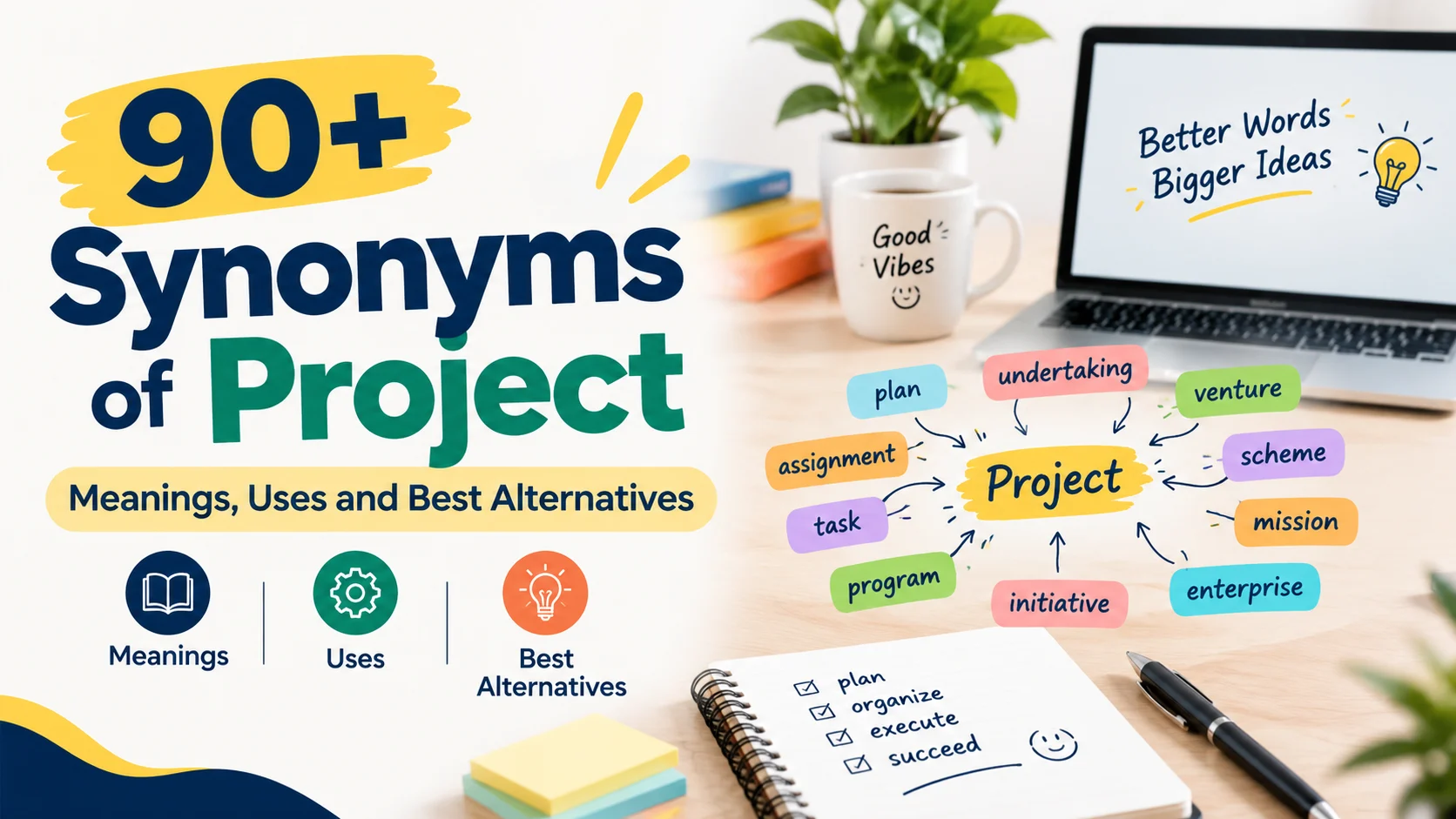
A project is a planned undertaking or organized effort to achieve a specific goal. The best formal synonyms include initiative, undertaking, and enterprise. For casual contexts, try task, job, or assignment. Academic writing favors study or investigation, while business communication prefers program or venture. Creative work often uses endeavor or pursuit for more expressive language.
Have you ever found yourself repeating the word “project” over and over in emails, reports, or presentations? You are not alone. Many writers struggle to find fresh alternatives when describing their work, assignments, or initiatives. Choosing the right synonym of project can transform your writing from repetitive and dull to precise and engaging.
The word “project” appears constantly in professional communication, academic writing, and everyday conversation. But using the same term repeatedly makes your language sound lazy and imprecise. Different situations call for different words. A creative endeavor needs a different label than a business initiative. A school assignment deserves more specific language than a casual task.
This guide will help you master every synonym of project so you can communicate with greater clarity and confidence. You will learn which words work best in formal reports, which ones shine in creative writing, and which alternatives will make your resume stand out. By the end, you will never have to settle for a vague or overused word again.
Meaning, Tone, and Context
Simple Definition
A project is a temporary organized effort with a clear beginning and end, designed to produce a specific outcome, deliverable, or result.
Part of Speech
Noun (primary), Verb (secondary)
Overall Tone
Neutral. The word itself carries no strong emotional weight, making it versatile across many contexts.
Formality Level
Neutral to semi-formal. “Project” works in almost every setting, from casual workplace conversation to formal academic papers.
Common Uses
Native English speakers use “project” in countless situations. You will hear it in business meetings when discussing new initiatives. Teachers assign projects to students. Creative professionals talk about passion projects. Researchers describe their study as a project. Everyday conversations reference home improvement projects or weekend projects.
Word Forms
- Noun: project (the undertaking itself)
- Verb: to project (to estimate, predict, or cast forward)
- Projected (adjective)
- Projection (noun)
- Projecting (verb/adjective)
When and How to Use “Project”
Choose “project” when you need a neutral, widely understood term for any organized effort with a specific goal. It works in virtually every situation and carries no unintended emotional baggage. However, its very versatility can make it boring. Use it when clarity matters more than style.
Examples by Context
Professional
Our team has been assigned a new project focused on improving customer retention rates across all regions.
Academic
The history project requires each student to analyze primary source documents from the colonial period.
Workplace
I will send you the project timeline by tomorrow morning so we can coordinate our efforts effectively.
Personal
My weekend project involves reorganizing the garage and finally installing those new shelves.
Email
Please review the attached project proposal and share your feedback before our meeting on Thursday.
Resume
Led a cross-functional project that increased operational efficiency by twenty percent within six months.
Social Media
Excited to share progress on my latest creative project. Stay tuned for the big reveal next week.
Best Synonyms of “Project”
No synonym perfectly replaces “project” in every situation. Each alternative carries its own tone, formality level, and emotional weight. Choosing the right one depends entirely on your audience, purpose, and context.
Professional Writing
Choose initiative when describing a proactive business effort that requires leadership and strategic thinking. It sounds more purposeful and ambitious than “project.”
Academic Writing
Select study or investigation for research-based work. These words signal scholarly rigor and systematic inquiry.
Business Communication
Use program for large-scale efforts with multiple components. Venture works well for entrepreneurial or risk-taking activities.
Casual Conversation
Pick task or job for everyday situations. These words feel natural and unpretentious in spoken language.
Emotional Writing
Choose endeavor or pursuit when you want to convey dedication, passion, or personal investment.
Creative Writing
Use undertaking or enterprise to add weight and significance to a creative effort.
Resume Writing
Select initiative to emphasize leadership and proactive behavior. Campaign works well for marketing or sales efforts.
Workplace Communication
Use assignment for work given to an individual. Operation fits technical or logistical work.
Stronger Meaning
Choose enterprise, venture, or initiative when you want to convey ambition and significance.
Softer Meaning
Select task, job, or activity when you want to downplay scale or formality.
When Not to Use “Project”
Too General
“Project” sometimes fails to communicate what actually matters about the work.
Incorrect: I have a project to research climate change.
Better: I have a research study examining climate change impacts on coastal communities.
Why: “Project” is too vague here. “Research study” tells the reader exactly what kind of work is involved.
Too Vague for Resumes
Resume readers see the word “project” constantly and skip right over it.
Incorrect: Managed a project to improve customer service.
Better: Led a company-wide initiative that reduced customer complaint response time by forty percent.
Why: “Initiative” sounds more strategic and impactful. Adding specific results makes the achievement memorable.
Too Casual for Formal Reports
Technical or formal documents deserve more precise language.
Incorrect: The project will examine manufacturing defects.
Better: The investigation will analyze the root causes of manufacturing defects.
Why: “Investigation” sounds more rigorous and systematic for a formal report.
Too Weak for Academic Writing
Academic readers expect sophisticated vocabulary.
Incorrect: This project studies language acquisition in children.
Better: This research examines language acquisition patterns in preschool children.
Why: “Research” carries more scholarly weight than “project” in academic contexts.
Too Informal in Professional Emails
Important client communications need polished language.
Incorrect: We are starting a project to update your systems.
Better: We are launching an initiative to upgrade your technology infrastructure.
Why: “Launching” and “initiative” sound more professional and reassuring to clients.
Outdated Usage
While not strictly outdated, “project” can sound tired and uninspired when used repeatedly.
Incorrect: Our project goals include project completion by the project deadline.
Better: Our objectives include final delivery by the scheduled completion date.
Why: Varying your vocabulary keeps writing fresh and engaging.
Words Commonly Confused With “Project”
Project vs Program
Difference: A program is a larger, longer-term effort that often contains multiple projects. Programs continue indefinitely while projects have clear end dates.
When to Use: Use “program” for ongoing initiatives with multiple phases. Use “project” for single, time-bound efforts.
Example Program: The company launched a five-year wellness program that includes quarterly health screenings.
Example Project: This quarter’s wellness project focuses specifically on stress reduction workshops.
Project vs Task
Difference: A task is a smaller, simpler unit of work. Projects consist of many tasks. Tasks are more limited in scope and duration.
When to Use: Use “task” for individual action items. Use “project” for complex efforts requiring coordination of multiple tasks.
Example Task: Please complete the data entry task by end of day.
Example Project: We are building a new client database project that requires data entry, testing, and training.
Project vs Assignment
Difference: Assignments are tasks given by someone in authority. Projects can be self-initiated. Assignments often have clear instructions and expectations.
When to Use: Use “assignment” for work delegated to you. Use “project” for broader work you may have initiated yourself.
Example Assignment: The professor gave us an assignment to write a five-page essay.
Example Project: I started a personal project to document local history through interviews.
Project vs Venture
Difference: Ventures involve risk and typically relate to business or entrepreneurial activities. Projects can be safe and predictable.
When to Use: Use “venture” for business opportunities with financial risk. Use “project” for more routine organizational work.
Example Venture: Their new restaurant venture required significant capital investment.
Example Project: The restaurant’s marketing project focuses on social media outreach.
Project vs Undertaking
Difference: Undertaking suggests a large, serious, or difficult effort that requires significant commitment. Projects can vary in size.
When to Use: Use “undertaking” for challenging efforts requiring special determination. Use “project” for more routine work.
Example Undertaking: Writing the comprehensive history book was a massive undertaking.
Example Project: The book’s first chapter project is due next week.
Project vs Initiative
Difference: Initiatives are proactive, often addressing problems or opportunities. They suggest leadership and strategic thinking.
When to Use: Use “initiative” for strategic efforts you champion. Use “project” for assigned or routine work.
Example Initiative: She launched a diversity initiative to improve hiring practices.
Example Project: The diversity committee’s next project is updating employee handbooks.
Best Synonyms of “Project” by Context
| Context | Best Synonym | Why It Works | Example |
| Formal Writing | Undertaking | Adds gravity and seriousness to the effort | The environmental undertaking required cooperation from multiple agencies. |
| Academic Writing | Research | Signals scholarly rigor and systematic inquiry | Her research explores the effects of sleep on cognitive performance. |
| Professional Communication | Initiative | Emphasizes proactive leadership and strategic thinking | Our team launched an initiative to reduce waste across all departments. |
| Business Emails | Program | Sounds organized and substantial for ongoing efforts | The training program will roll out in phases over the next six months. |
| Resume Writing | Initiative | Makes achievements sound leadership-oriented and impressive | Spearheaded a cost reduction initiative that saved the company $200,000. |
| Workplace Communication | Assignment | Feels natural for delegated tasks and individual responsibilities | Please complete this assignment before Friday’s deadline. |
| Casual Conversation | Task | Simple, unpretentious, and easy to understand | I have a few tasks to finish before I can leave for the day. |
| Everyday Speaking | Job | Extremely common and natural in spoken English | Mowing the lawn is a job I put off all weekend. |
| Creative Writing | Endeavor | Adds emotional weight and artistic significance | Their creative endeavor brought together artists from five different countries. |
| Storytelling | Enterprise | Makes the effort sound ambitious and dramatic | The rescue enterprise required courage few could summon. |
| Emotional Writing | Pursuit | Suggests passion, dedication, and personal meaning | Writing this novel has been the greatest pursuit of my life. |
| Strong Emphasis | Venture | Implies risk, ambition, and bold action | Their new business venture could revolutionize the industry. |
| Mild Tone | Activity | Downplays scale and keeps things simple | This afternoon’s activity involves sorting through old files. |
| Social Media | Project | Familiar and relatable for online audiences | Sharing a sneak peek of my latest creative project today. |
| American English | Project | Standard usage across all American contexts | Our team just wrapped up the biggest project of the year. |
How to Choose the Best Synonym of “Project”
Choosing the perfect synonym starts with asking yourself a few simple questions about your communication goal.
Consider Your Meaning
What exactly are you describing? A research effort needs different language than a creative endeavor. A business initiative sounds different from a household task. Be specific about what the work actually involves.
Consider Your Tone
Do you want to sound ambitious or humble? Formal or casual? Professional or personal? Your tone should match your relationship with your audience and your purpose for communicating.
Consider Your Audience
Who will read your words? Executives expect professional language. Friends appreciate casual terms. Academics value precision. Teachers respond to appropriate formality. Always write with your reader in mind.
Consider Emotional Strength
Do you want to emphasize the importance of the work or downplay it? Words like “enterprise” and “venture” add weight. “Task” and “job” keep things light. Match your intensity to the situation.
Consider Your Writing Purpose
Are you writing to inform, persuade, inspire, or instruct? Different purposes call for different vocabulary. A persuasive proposal needs strong language. An instructional email needs clarity above all.
Consider Formality
Formal writing demands sophisticated vocabulary like “undertaking” or “initiative.” Casual writing welcomes simpler words like “job” or “task.” Choose what fits your context.
Consider Natural Sound
The best word sounds natural in your sentence and matches your overall writing style. Never force a synonym that feels awkward or out of place. Trust your ear for what sounds right.
Real Life Examples of “Project”
School
Our science fair project required six weeks of data collection and careful observation of plant growth patterns.
College
For my senior project, I developed a mobile application that helps students find study groups on campus.
Workplace
The team project involved coordinating with three different departments to launch the new software system.
Business
Our next project focuses on expanding into European markets while maintaining our domestic customer base.
I attached the project summary document that outlines our key milestones and resource requirements.
Resume
Managed a complex project that streamlined supply chain operations and reduced delivery times by fifteen percent. Better: Orchestrated an operational initiative that cut delivery times by fifteen percent through supply chain optimization.
Conversation
“What are you working on this weekend?” “Just a small project around the house. Nothing too exciting.”
Storytelling
The project had started as a simple idea over coffee, but it grew into something that changed all our lives.
Blogging
This DIY project completely transformed my home office, and I can’t wait to share the before and after photos.
Social Media
Day one of my new creative project. Feeling inspired and ready to make something meaningful. Better: Embarking on a new creative endeavor. Feeling inspired to bring something meaningful to life.
18 Best Synonyms of “Project”
| Synonym | Simple Meaning | Best Used For | Example Sentence |
| Undertaking | A serious or difficult effort requiring commitment | Formal writing and describing major efforts | Writing the comprehensive report was a significant undertaking for the small team. |
| Initiative | A proactive effort to solve problems or create opportunities | Professional communication and resumes | She launched a sustainability initiative that reduced company waste by thirty percent. |
| Enterprise | A bold, ambitious, or complex undertaking | Business contexts and dramatic descriptions | The new enterprise required substantial investment and months of careful planning. |
| Venture | A risky or daring business effort | Entrepreneurial and investment contexts | Their tech venture attracted significant attention from major investors. |
| Program | A coordinated set of activities over time | Ongoing organizational efforts | The wellness program includes fitness challenges, nutrition workshops, and health screenings. |
| Assignment | Work delegated by someone in authority | Academic and workplace contexts | The professor gave us an assignment to analyze a case study. |
| Task | A smaller unit of work or action item | Everyday conversation and to-do lists | Completing this task will take approximately two hours. |
| Operation | A coordinated activity involving systematic processes | Technical and military contexts | The warehouse operation required careful coordination of shipping and receiving. |
| Study | A systematic investigation or research effort | Academic and research contexts | The study examined the long-term effects of exercise on mental health. |
| Campaign | An organized effort to achieve a specific goal | Marketing, political, and advocacy contexts | The marketing campaign increased brand awareness by forty percent. |
| Endeavor | An attempt to achieve something requiring effort | Creative and professional contexts | Their collaborative endeavor produced remarkable results. |
| Activity | An action or series of actions | Casual and general contexts | The afternoon activity involved team-building exercises. |
Synonyms of “Project” by Usage
Professional vs Personal Synonyms
Professional settings demand words that sound strategic, organized, and leadership-oriented. Choose “initiative,” “program,” or “undertaking” for workplaces. These words signal professionalism and serious commitment.
Personal conversations welcome simpler language. “Task,” “job,” and “activity” sound natural and unpretentious when talking with friends or family. Save the fancy words for professional contexts.
Formal vs Conversational Synonyms
Formal writing includes reports, academic papers, business proposals, and professional presentations. Use “enterprise,” “undertaking,” or “investigation” to sound sophisticated and authoritative.
Conversational writing includes emails to friends, social media posts, blog comments, and everyday speech. Use “task,” “job,” or “activity” for natural, approachable communication.
Academic Synonyms
Academic writing requires precise, scholarly vocabulary that sounds authoritative and rigorous. “Study,” “research,” and “investigation” signal systematic inquiry. “Inquiry” and “examination” work well for detailed analysis. These words demonstrate intellectual seriousness and methodological awareness.
Professional and Business Synonyms
Business communication benefits from strategic vocabulary. “Initiative” suggests proactive leadership. “Program” indicates structured, ongoing effort. “Venture” implies entrepreneurial thinking. “Campaign” works for marketing and sales. These words sound impressive on resumes and compelling in proposals.
Creative and Literary Synonyms
Creative writers need expressive alternatives that add imagery and emotional weight. “Endeavor” suggests artistic dedication. “Pursuit” implies passionate commitment. “Enterprise” adds dramatic scale. “Undertaking” signals significant effort. These words enrich storytelling and descriptive writing.
Slang or Modern Synonyms
“Project” has limited slang alternatives. In some casual contexts, people say “gig” to describe a work project, especially in creative industries. “Side hustle” describes personal projects with income potential. These terms are acceptable in casual conversation but inappropriate for formal writing.
Strongest to Mildest Synonyms
Mild
- Activity: A simple, low-commitment effort
- Job: An everyday task or responsibility
- Task: A straightforward unit of work
Moderate
- Project: The standard neutral term
- Assignment: Work given by authority
- Effort: A focused attempt
Strong
- Initiative: A proactive, strategic effort
- Program: A substantial, coordinated undertaking
- Campaign: An organized effort with clear goals
Very Strong
- Undertaking: A serious, challenging commitment
- Enterprise: A bold, ambitious effort
- Venture: A risky, potentially rewarding pursuit
Emotional vs Neutral Synonyms
Emotional Synonyms
Endeavor conveys dedication and artistic passion. Writers and creative professionals use it to express personal investment in their work.
Pursuit suggests following something with determination and enthusiasm. It carries romantic or idealistic undertones.
Venture implies courage and willingness to take risks. Entrepreneurs and adventurers favor this word.
Enterprise suggests ambition, boldness, and significant scale. It evokes images of daring and achievement.
Neutral Synonyms
Task simply describes work without emotional baggage. It works in virtually any context.
Job communicates responsibility without added meaning. It is the plainest possible alternative.
Activity describes action without judgment or emotion. It is safe and unremarkable.
Assignment indicates delegated work without emotional weight. It is purely functional.
Program describes structured efforts without emotional coloring. It sounds organized and professional.
Antonyms of “Project”
| Antonym | Meaning | Example Sentence |
| Inaction | Lack of action or activity | The committee’s inaction frustrated everyone who wanted meaningful progress. |
| Idleness | Being inactive or doing nothing | His idleness during the summer wasted valuable time. |
| Inactivity | Lack of movement or effort | The project’s inactivity led to missed deadlines and lost opportunities. |
| Completion | The state of being finished | After completion, the team celebrated their successful work. |
| Conclusion | The end or final part of something | The project’s conclusion marked the beginning of a new phase. |
| Finish | The end point of an effort | The finish of the construction came right on schedule. |
| Cessation | The act of stopping or ending | The cessation of work left many employees uncertain about their future. |
| End | The final point of something | The end of the project brought both relief and satisfaction. |
| Termination | The act of bringing something to an end | The termination of the program surprised everyone on the team. |
| Abandonment | Giving up or discontinuing an effort | The abandonment of the project wasted months of preparation. |
| Neglect | Failure to care for or complete something | His neglect of responsibilities caused the entire operation to fail. |
| Stagnation | A state of no movement or progress | The team’s stagnation resulted from poor leadership and unclear goals. |
| Standstill | A complete stop in activity | The project reached a standstill when funding was withdrawn. |
| Shutdown | The closure or termination of operations | The shutdown occurred due to budget cuts and changing priorities. |
| Rest | A state of relaxation or inactivity | After years of work, she finally allowed herself some rest. |
Comparison: “Project” vs Similar Words
Project vs Initiative
Main Difference: An initiative involves proactive leadership and strategic thinking. A project can be assigned or routine. Initiatives often address problems or opportunities.
Which Is Stronger? Initiative is stronger because it implies leadership, vision, and proactive behavior.
Which Is More Formal? Initiative is slightly more formal and business-oriented.
When to Use Each: Use “initiative” for self-started, strategic efforts that demonstrate leadership. Use “project” for assigned or routine work.
Examples:
- Project: The team completed the software development project on time.
- Initiative: She launched a diversity initiative to improve company culture.
Project vs Program
Main Difference: Programs are larger, longer-term efforts containing multiple projects. Projects are single, time-bound undertakings.
Which Is Stronger? Program suggests greater scale and ongoing commitment.
Which Is More Formal? Both are professional, but program sounds more structured and organized.
When to Use Each: Use “program” for multi-year, multi-phase efforts. Use “project” for specific, time-limited work.
Examples:
- Project: The marketing project focused on social media campaigns.
- Program: The comprehensive training program runs throughout the year.
Project vs Task
Main Difference: Tasks are smaller units of work. Projects consist of many tasks. Tasks are simpler and take less time.
Which Is Stronger? Project implies greater complexity and scope.
Which Is More Formal? Both are neutral, though task is more common in casual contexts.
When to Use Each: Use “task” for individual action items. Use “project” for complex efforts requiring coordination.
Examples:
- Project: We are building a new website project.
- Task: Please upload the images as your first task.
Project vs Undertaking
Main Difference: Undertaking suggests a difficult or serious effort requiring real commitment. Projects can be simple.
Which Is Stronger? Undertaking is significantly stronger and more dramatic.
Which Is More Formal? Undertaking is more formal and literary.
When to Use Each: Use “undertaking” for challenging, significant efforts. Use “project” for routine work.
Examples:
- Project: The office renovation project takes three weeks.
- Undertaking: Restoring the historic building was a massive undertaking.
Project vs Venture
Main Difference: Ventures involve risk and usually relate to business. Projects can be safe and predictable.
Which Is Stronger? Venture implies greater risk and potential reward.
Which Is More Formal? Venture is professional but carries entrepreneurial connotations.
When to Use Each: Use “venture” for business opportunities with financial risk. Use “project” for organizational work.
Examples:
- Project: The team completed the market research project.
- Venture: The new restaurant venture required significant capital.
Project vs Campaign
Main Difference: Campaigns are organized efforts to achieve specific goals, often in marketing or advocacy. Projects are broader.
Which Is Stronger? Campaign suggests strategic coordination and specific objectives.
Which Is More Formal? Both are professional, though campaign has specific connotations.
When to Use Each: Use “campaign” for marketing, political, or advocacy efforts. Use “project” for general work.
Examples:
- Project: We need to finish the website redesign project.
- Campaign: The marketing campaign increased sales by twenty percent.
Common Phrases and Expressions with “Project”
“Passion Project”
Meaning: A personal endeavor pursued for enjoyment rather than financial gain, often creative in nature.
Example Sentence: Her passion project involves writing children’s books about environmental conservation.
“Pet Project”
Meaning: A project someone personally champions, often one that others consider less important.
Example Sentence: He spends every spare moment on his pet project of restoring vintage motorcycles.
“Side Project”
Meaning: A project pursued outside one’s primary work or responsibilities.
Example Sentence: Her side project of creating handmade jewelry eventually became a full-time business.
“Project Manager”
Meaning: The person responsible for planning, executing, and closing projects.
Example Sentence: The project manager coordinated all team activities and ensured deadlines were met.
“Proof of Concept Project”
Meaning: A small-scale project designed to test whether an idea is feasible.
Example Sentence: We completed a proof of concept project before committing to full development.
“Pilot Project”
Meaning: A small initial project to test whether a larger effort should proceed.
Example Sentence: The pilot project helped us identify potential issues before launching nationwide.
“Project Timeline”
Meaning: The schedule showing when project tasks will be completed.
Example Sentence: The project timeline includes milestones for each phase of development.
“Greenlight a Project”
Meaning: To give official approval to begin a project.
Example Sentence: The board finally greenlit the expansion project after months of review.
Common Mistakes to Avoid
Mistake 1: Choosing a Vague Synonym
Using “thing” or “stuff” instead of a precise synonym weakens your writing.
Incorrect: We are working on this thing for our clients.
Better: We are developing an initiative to improve client satisfaction.
Why: Specific vocabulary demonstrates professionalism and clarity.
Mistake 2: Confusing “Project” with “Product”
Projects produce deliverables, but the terms are not interchangeable.
Incorrect: Our latest project is a mobile application.
Better: Our latest product is a mobile application developed through a rigorous project process.
Why: Products are the outputs; projects are the processes to create them.
Mistake 3: Using Informal Synonyms in Formal Writing
“Job” and “task” feel too casual for academic or executive communications.
Incorrect: The research job examined climate patterns.
Better: The research study examined climate patterns.
Why: “Study” sounds scholarly and appropriate for academic contexts.
Mistake 4: Selecting an Overly Dramatic Synonym
Using “undertaking” or “enterprise” for routine work sounds pretentious.
Incorrect: My laundry undertaking took two hours.
Better: My laundry task took two hours.
Why: “Undertaking” implies significance that laundry simply does not possess.
Mistake 5: Repeating “Project” Too Often
Repeated words bore readers and make writing feel lazy.
Incorrect: The project requires project funding and project approval before the project can start.
Better: The initiative requires funding and approval before implementation can begin.
Why: Varying vocabulary keeps writing fresh and engaging.
Mistake 6: Choosing the Wrong Emotional Tone
Using emotionally charged words in neutral contexts creates confusion.
Incorrect: Our mundane data entry pursuit continues.
Better: Our data entry work continues.
Why: “Pursuit” implies passion and dedication, which data entry rarely inspires.
Mistake 7: Using Slang in Professional Writing
Words like “gig” or “side hustle” have no place in formal documents.
Incorrect: My current gig involves client consulting.
Better: My current project involves client consulting.
Why: “Gig” sounds casual and unprofessional in business writing.
Frequently Asked Questions
1. What are the best synonyms of “project”?
The best synonyms depend on context. For professional writing, choose “initiative” or “undertaking.” For academic work, select “study” or “research.” For casual conversation, use “task” or “job.”
2. What are the best formal synonyms of “project”?
Formal synonyms include “undertaking,” “enterprise,” “initiative,” and “program.” These words sound sophisticated and appropriate for academic papers, business reports, and professional presentations.
3. What are common informal synonyms of “project”?
Informal synonyms include “task,” “job,” “activity,” and “assignment.” These words work well in everyday conversation, emails to colleagues, and casual social media posts.
4. What is another word for “project” in professional writing?
In professional writing, “initiative” is an excellent alternative. It suggests proactive leadership and strategic thinking. “Program” works for ongoing efforts, and “undertaking” adds gravity.
5. What is the difference between “project” and “program”?
A program is larger and longer-term, often containing multiple projects. Projects are individual, time-bound efforts. Programs continue indefinitely while projects have clear end dates.
6. What is the opposite of “project”?
The opposite of a project includes words like “inaction,” “idleness,” “completion,” “conclusion,” and “cessation.” These terms describe the absence of effort or the end of an undertaking.
Conclusion
The word “project” serves as a useful default for describing organized efforts, but relying on it too often makes your writing sound repetitive and imprecise. Understanding the subtle differences between synonyms helps you communicate with greater clarity and impact.
The best synonym depends entirely on your context, audience, and purpose. Formal writing benefits from sophisticated choices like “undertaking” and “initiative.” Creative expression comes alive with “endeavor” and “pursuit.” Casual conversation welcomes simple alternatives like “task” and “job.
No single synonym works perfectly in every situation, and that is the beauty of rich vocabulary. The more alternatives you know, the more precisely you can express your thoughts. Pay attention to tone, formality, and emotional weight when choosing your words.
The next time you write about a project, take a moment to consider whether a stronger, more precise synonym could enhance your message. Your readers will notice the difference, and your writing will become more engaging and effective.

3 thoughts on “90+Synonyms of Project|Meanings, Uses and Best Alternatives”