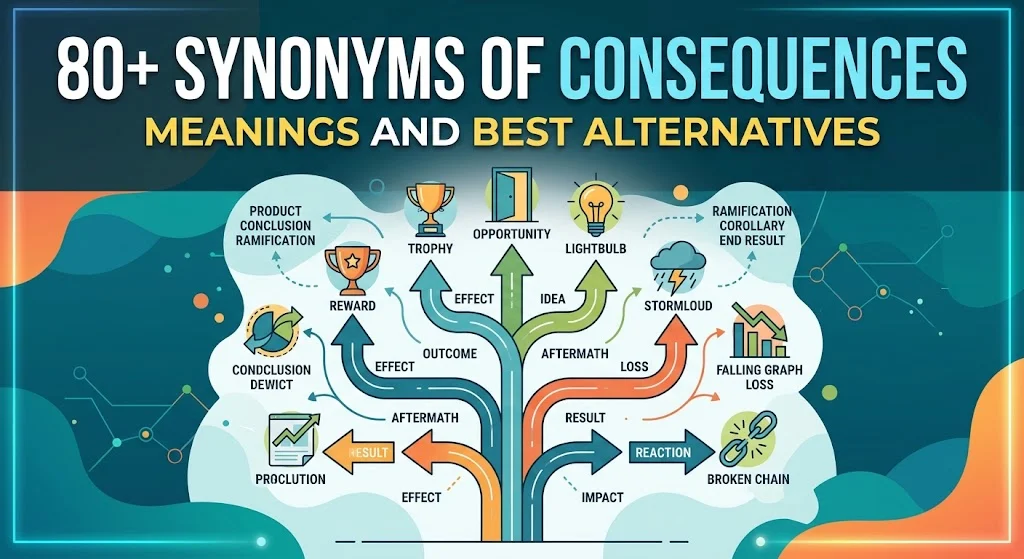
Consequences mean the results or effects that follow an action, decision, or event. The best synonyms depend on your context. For formal writing, use “ramifications” or “implications.” For casual conversation, try “aftermath” or “fallout.” For academic work, choose “outcomes” or “repercussions.” Professional settings call for “results” or “effects.” Emotional writing benefits from “impact” or “reverberations.”
Have you ever written an email, essay, or report and used the word “consequences” three times in a single paragraph? It happens to everyone. You know the word fits, but repeating it makes your writing feel flat and unpolished. Finding a synonym of consequences can instantly upgrade your writing and help you sound more precise, professional, and confident.
The right word choice changes how people perceive your message. Whether you are writing a business proposal, a college essay, or a social media caption, choosing the best synonym of consequences allows you to match your tone to your audience. This guide will help you understand what consequences really means, explore the best alternatives for every situation, and avoid common vocabulary mistakes.
Meaning, Tone, and Context
Simple Definition
Consequences are the results, effects, or outcomes that happen because of a specific action, decision, or set of circumstances. They can be positive, negative, or neutral, though the word often carries a slightly serious or weighty tone in everyday usage.
Part of Speech
Consequences is a plural noun. The singular form is consequence.
Overall Tone
Consequences is generally neutral but leans toward serious or significant in most contexts. It does not inherently suggest positivity or negativity, but it often appears in discussions about cause and effect, responsibility, and decision-making.
Formality Level
Consequences is neutral to semi-formal. It works well in professional writing, academic papers, and everyday conversation. It is rarely too casual or too stiff for any context, which makes it a versatile choice.
Common Uses
Native English speakers use consequences in many situations:
- Discussing cause and effect relationships
- Explaining outcomes of decisions or actions
- Describing results of policies, laws, or rules
- Talking about personal choices and their effects
- Writing about historical events and their impacts
- Discussing business strategies and their results
Word Forms
Noun: consequence / consequences
Verb: Not directly. Related verbs include “result” and “follow.”
Adjective: consequential
Adverb: consequentially
Opposite: cause (as a noun)
When and How to Use “Consequences”
Choose consequences when you want to emphasize that something happened as a direct result of something else. This word works best when the relationship between action and result is clear and when you want to sound measured and professional rather than overly emotional or dramatic.
Professional
The company is evaluating the financial consequences of expanding into three new international markets next quarter.
Academic
Researchers examined the long-term consequences of childhood nutrition on cognitive development in adulthood.
Workplace
Our team needs to discuss the potential consequences of missing the project deadline before we present to the client.
Personal
She spent weeks considering the consequences before deciding to move across the country for a new job opportunity.
Please review the attached document and let me know if you have concerns about any potential consequences for our current workflow.
Resume
Successfully implemented a new inventory system that reduced waste and minimized negative consequences during supply chain disruptions.
Social Media
Every choice we make has consequences, but not every consequence is something we can predict ahead of time.
Best Synonyms of “Consequences”
No synonym is identical in every situation. Each alternative carries a slightly different tone, emotional weight, and level of formality. Here are the best synonyms of consequences for specific writing contexts.
Professional Writing
Ramifications works best for professional writing because it suggests widespread or complex effects that unfold over time. It sounds sophisticated without being pretentious.
Academic Writing
Outcomes is the academic gold standard. It is neutral, precise, and widely used in research papers, studies, and scholarly discussions.
Business Communication
Implications fits business communication perfectly because it suggests future effects that are not yet fully realized. It shows strategic thinking.
Casual Conversation
Aftermath works naturally in casual conversation, especially when discussing events that already happened and their lasting effects.
Emotional Writing
Impact carries emotional weight without being dramatic. It suggests significance and importance in a way that resonates with readers.
Creative Writing
Fallout adds texture and imagery to creative writing. It suggests scattered, wide-reaching effects that are often unexpected.
Resume Writing
Results is the safest and strongest choice for resumes. It is concrete, measurable, and directly tied to actions you took.
Workplace Communication
Effects is clear, direct, and universally understood in workplace settings. It avoids unnecessary complexity.
Stronger Meaning
Reverberations suggests effects that echo or continue to spread. Use this when you want to emphasize lasting or ongoing impact.
Softer Meaning
Consequences itself is relatively neutral. For a softer tone, use “outcomes” or “results” to remove any hint of negativity.
When Not to Use “Consequences”
Too General
Using consequences without explaining the specific effects can sound vague and unhelpful.
- Less effective: “There will be consequences.”
- Better: “There will be significant financial implications for the department.”
- Why: The second version tells the reader exactly what kind of consequences to expect.
Too Vague
When discussing specific, measurable results, consequences can feel abstract.
- Less effective: “The consequences of the marketing campaign were positive.”
- Better: “The marketing campaign produced measurable results, including a 15% increase in sales.”
- Why: Measurable outcomes are more convincing than vague consequences.
Too Formal in Casual Settings
Consequences can sound stiff in very casual conversations or text messages.
- Less effective: “What were the consequences of your decision to skip breakfast?”
- Better: “What happened after you skipped breakfast?”
- Why: Casual conversations benefit from simpler, more direct language.
Too Weak for Serious Situations
When discussing severe, life-changing effects, consequences may feel too mild.
- Less effective: “The consequences of the accident were severe.”
- Better: “The repercussions of the accident permanently altered their lives.”
- Why: Repercussions carries greater weight and seriousness.
When Overused
Repeating consequences multiple times in a single paragraph weakens your writing. Vary your vocabulary to maintain reader engagement.
- Less effective: “The consequences of the policy included several consequences for employees.”
- Better: “The ramifications of the policy included several outcomes for employees.”
Words Commonly Confused With “Consequences”
Consequences vs Results
Difference: Results are neutral and factual. Consequences often imply a cause-and-effect relationship and can carry a slight sense of seriousness.
When to Use It: Results for neutral findings. Consequences for decisions and their effects.
Example: “The results of the experiment were published in the journal.”
Consequences vs Outcomes
Difference: Outcomes focus on the final state after a process. Consequences focus on the chain of effects from an action.
When to Use It: Outcomes in academic or program evaluation contexts. Consequences in discussions of decisions.
Example: “The patient outcomes improved after the new treatment was introduced.”
Consequences vs Repercussions
Difference: Repercussions suggest negative effects that spread outward, like ripples in water. Consequences can be neutral or positive.
When to Use It: Repercussions for negative outcomes. Consequences for neutral discussions.
Example: “The repercussions of the scandal affected the entire industry.”
Consequences vs Ramifications
Difference: Ramifications suggest complex, unfolding effects that become clearer over time. Consequences are more immediate and direct.
When to Use It: Ramifications for strategic planning. Consequences for immediate cause-and-effect.
Example: “The ramifications of the decision will become apparent over the next fiscal year.”
Consequences vs Aftermath
Difference: Aftermath specifically refers to the period following a significant event, often a disaster or crisis.
When to Use It: Aftermath for post-event discussions. Consequences for general cause-and-effect.
Example: “The aftermath of the hurricane required a massive relief effort.”
Consequences vs Impact
Difference: Impact suggests a force or effect that makes a significant difference. Consequences are the direct results of actions.
When to Use It: Impact for emotional or significant effects. Consequences for formal, measured discussions.
Example: “The new policy had a positive impact on employee morale.”
Best Synonyms of “Consequences” by Context
| Context | Best Synonym | Why It Works | Example |
| Formal writing | Ramifications | Suggests complex, far-reaching effects | “The ramifications of the treaty are still being studied by historians.” |
| Academic writing | Outcomes | Neutral, precise, widely accepted in research | “We measured the learning outcomes of students in the experimental group.” |
| Professional communication | Implications | Suggests future effects that require attention | “The implications for our quarterly projections are significant.” |
| Business emails | Effects | Clear, direct, and professional without being stuffy | “Please consider the effects of this change on our existing clients.” |
| Resume writing | Results | Concrete and measurable, tied to actions | “Achieved measurable results that exceeded departmental goals.” |
| Workplace communication | Outcomes | Practical and focused on what was achieved | “The team reviewed the outcomes of the project before planning the next phase.” |
| Casual conversation | Aftermath | Natural, relatable, easy to use in everyday talk | “The aftermath of the party was a kitchen full of dirty dishes.” |
| Everyday speaking | Results | Simple, clear, universally understood | “What were the results of your conversation with the manager?” |
| Creative writing | Fallout | Adds imagery and suggests wide-reaching effects | “The fallout from their argument affected everyone in the friend group.” |
| Storytelling | Repercussions | Builds tension and suggests negative consequences | “The repercussions of his choice haunted him for years.” |
| Emotional writing | Impact | Carries weight and significance without drama | “The impact of her words stayed with him long after the conversation ended.” |
| Strong emphasis | Reverberations | Suggests echoes and lasting effects | “The reverberations of the economic crisis were felt globally.” |
| Mild tone | Outcomes | Neutral and non-threatening | “We considered all possible outcomes before making a decision.” |
| Social media captions | Aftermath | Relatable and conversational | “No filter needed. Just the aftermath of a perfect weekend getaway.” |
| American English | Consequences | Standard and widely used across all contexts | “Every action has consequences, whether we plan for them or not.” |
How to Choose the Best Synonym of “Consequences”
Choosing the right synonym depends on four key factors: your audience, your purpose, the emotional tone you want to convey, and the level of formality required.
Start by considering who will read your writing. Academic audiences respond well to “outcomes” and “implications.” Business readers appreciate “results” and “effects.” Casual readers connect with “aftermath” and “fallout.”
Next, think about your purpose. Are you explaining a process? Use “outcomes.” Are you warning about potential problems? Use “ramifications.” Are you reporting what happened? Use “results.”
Consider emotional strength. “Impact” adds weight without being dramatic. “Reverberations” suggests lasting significance. “Fallout” feels more casual but still carries a sense of seriousness.
Finally, match your formality level. Formal documents need “ramifications” and “implications.” Everyday writing can use “aftermath” and “results.” When in doubt, “results” and “outcomes” work well in almost every situation.
Real Life Examples of “Consequences”
School
The teacher explained the consequences of submitting assignments late, and the students took notes carefully.
College
Original: “The consequences of not attending lectures were reflected in exam scores.”
Improved: “The outcomes of skipping lectures were clear in the exam results.”
Workplace
Original: “We should discuss the consequences of this decision before moving forward.”
Improved: “We should evaluate the implications of this decision before moving forward.”
Business
The CFO presented a detailed report on the financial consequences of the merger.
Original: “The consequences of this delay could affect our delivery schedule.”
Improved: “The effects of this delay could affect our delivery schedule.”
Resume
Original: “Managed projects and assessed consequences of operational changes.”
Improved: “Directed project initiatives and evaluated outcomes of operational changes.”
Conversation
“What were the consequences of telling her the truth?” “Honestly, she appreciated the honesty.”
Storytelling
The consequences of his betrayal reached further than anyone could have imagined.
Blogging
Understanding the consequences of your marketing choices is the first step toward smarter strategy.
Social Media
Every decision has consequences. Choose wisely, but don’t be afraid to adapt when things change.
18 Best Synonyms of “Consequences”
| Synonym | Simple Meaning | Best Used For | Example Sentence |
| Results | Things that happen because of actions | General, neutral writing | The results of the survey confirmed our initial hypothesis. |
| Outcomes | Final states after a process | Academic and planning contexts | We analyzed the learning outcomes of the new curriculum. |
| Effects | Changes caused by something | Clear, straightforward writing | The effects of the medication were noticeable within hours. |
| Ramifications | Complex, unfolding consequences | Formal and strategic discussions | The long-term ramifications of the policy are still unclear. |
| Implications | Possible future effects | Business and strategic contexts | The implications of this technology are enormous for the industry. |
| Repercussions | Negative spreading effects | Serious and cautionary contexts | The repercussions of the data breach were felt for months. |
| Aftermath | Period after a significant event | Casual and storytelling contexts | The aftermath of the storm left the town without power for days. |
| Fallout | Wide-reaching, often negative effects | Creative and conversational writing | The political fallout from the scandal changed the entire election. |
| Impact | Significant or meaningful effects | Emotional and persuasive writing | The program’s impact on local communities has been remarkable. |
| Reverberations | Echoing, lasting effects | Dramatic and descriptive contexts | The reverberations of the speech were felt in every corner of the country. |
| Sequelae | Medical or clinical aftereffects | Medical and scientific writing | The patient experienced several sequelae following the treatment. |
| Byproducts | Secondary or unintended results | Technical and process-oriented writing | Increased productivity was a welcome byproduct of the new system. |
| Offshoots | Direct outcomes from a source | Creative and developmental contexts | The research produced several valuable offshoots in related fields. |
| Corollaries | Natural consequences that follow | Logical and philosophical writing | One corollary of the theory is that economic growth cannot continue indefinitely. |
| Side effects | Unintended secondary effects | Medical and product discussions | The medication proved effective, but the side effects were concerning. |
| Spinoffs | Positive or beneficial outcomes | Business and innovation contexts | The research generated several profitable spinoffs for the company. |
| Residuals | What remains after the main event | Financial and statistical writing | The residuals from the sale were reinvested in new projects. |
| Trails | Effects that can be followed | Creative and metaphorical writing | The trail of his decisions led to a place he never expected to end up. |
Synonyms of “Consequences” by Usage
Professional vs Personal Synonyms
Professional settings benefit from precise, measured vocabulary. “Ramifications” and “implications” signal strategic thinking. “Outcomes” and “results” show attention to measurable achievements. These words help you sound credible and competent in business environments.
Personal conversations work better with approachable alternatives. “Aftermath” and “fallout” feel natural in everyday talk. “Results” and “effects” are simple enough for any personal discussion. Matching your word choice to your audience builds trust and understanding.
Formal vs Conversational Synonyms
Reports and essays require formal alternatives. “Ramifications” suggests careful analysis. “Implications” signals forward-thinking. “Outcomes” provides academic credibility. “Corollaries” fits logical and philosophical discussions.
Conversational writing uses more accessible words. “Aftermath” works in storytelling. “Fallout” adds personality. “Results” keeps things simple. “Effects” is universally understood in casual settings.
Academic Synonyms
“Outcomes” is the most widely accepted academic choice for research papers and studies. “Corollaries” works well in theoretical discussions. “Sequelae” has specific medical and scientific applications. “Byproducts” appears in technical and research contexts. “Implications” frequently appears in academic conclusions and recommendations.
Professional and Business Synonyms
“Results” and “outcomes” appear consistently in resumes and performance reviews. “Implications” is standard in strategic planning and business proposals. “Ramifications” signals thoughtful risk assessment. “Effects” provides clear communication in client interactions. “Spinoffs” appears in innovation and business development contexts.
Creative and Literary Synonyms
“Fallout” adds visual imagery to creative writing. “Reverberations” suggests echoing effects that continue. “Aftermath” creates a sense of something significant having occurred. “Trails” offers a metaphorical way to describe consequences. “Offshoots” suggests organic development from a source.
Slang or Modern Synonyms
“Aftermath” and “fallout” are the closest to conversational slang in modern English, though they are not true slang terms. No widely accepted slang synonyms for consequences exist in current American English. Most speakers simply use “results,” “effects,” or the more casual “what happened next.”
Strongest to Mildest Synonyms
Mild
- Results
- Outcomes
- Effects
- Byproducts
- Offshoots
Moderate
- Consequences
- Implications
- Corollaries
- Spinoffs
- Residuals
Strong
- Ramifications
- Repercussions
- Impact
- Aftermath
- Fallout
Very Strong
- Reverberations
- Sequelae
- Trails (metaphorically strong)
The mildest synonyms simply describe what happened without emotional weight. Stronger alternatives suggest seriousness, lasting effects, or negative implications. Choose based on how significant you want the effects to sound.
Emotional vs Neutral Synonyms
Emotional Synonyms
- Impact
- Reverberations
- Aftermath
- Fallout
- Repercussions
These words carry emotional weight and suggest that the effects matter on a human level. Use them when you want readers to feel the significance of what happened.
Neutral Synonyms
- Results
- Outcomes
- Effects
- Byproducts
- Corollaries
These words simply communicate information. They are perfect for professional, academic, and scientific writing where emotional tone would be inappropriate.
Antonyms of “Consequences”
| Antonym | Meaning | Example Sentence |
| Cause | The reason something happens | We identified the root cause of the problem before proposing solutions. |
| Origin | The starting point or source | The origin of the tradition remains unclear to historians. |
| Source | Where something comes from | The source of the funding was a private foundation. |
| Basis | The foundation or starting point | Their friendship formed the basis of a successful business partnership. |
| Foundation | Underlying support or starting point | The foundation of their argument rested on solid evidence. |
| Catalyst | Something that causes change without being affected | The new policy acted as a catalyst for industry-wide improvements. |
| Trigger | Something that sets events in motion | The speech served as a trigger for widespread social change. |
| Impetus | The force that moves something forward | Economic growth provided the impetus for infrastructure investment. |
| Motive | The reason behind an action | The motive for the decision was clear to everyone involved. |
| Instigation | The act of starting something | His instigation of the project led to remarkable results. |
| Precedent | An earlier event that guides future actions | The court ruling set a precedent for similar cases. |
| Antecedent | Something that came before | We must understand the antecedent factors before analyzing the current situation. |
| Derivation | The process of coming from a source | The derivation of the formula was explained in detail. |
| Root | The primary source or origin | The root of the problem was poor communication between departments. |
| Seed | The beginning or starting point | The seed of the idea came from a casual conversation. |
Comparison: “Consequences” vs Similar Words
Consequences vs Results
Main Difference: Consequences emphasize cause and effect. Results are broader and more neutral.
Which Is Stronger? Consequences feels weightier, especially when discussing decisions and their effects.
Which Is More Formal? Both are neutral, but consequences appears more frequently in serious discussions.
When to Use Each: Use consequences when you want to emphasize the relationship between action and outcome. Use results when you simply want to state what happened.
Examples:
Consequences: “The consequences of his actions affected everyone in the department.”
Results: “The results of the test were available on Friday.”
Consequences vs Repercussions
Main Difference: Repercussions always suggest negative effects. Consequences can be neutral.
Which Is Stronger? Repercussions carries a more serious, often ominous tone.
Which Is More Formal? Both are formal, but repercussions is slightly more dramatic.
When to Use Each: Use repercussions when discussing negative consequences, especially those that spread widely. Use consequences for neutral or balanced discussions.
Examples:
Consequences: “We considered the potential consequences of both options.”
Repercussions: “The repercussions of the mistake were felt across the entire organization.”
Consequences vs Ramifications
Main Difference: Ramifications suggest complex, unfolding effects that take time to become clear. Consequences are more immediate and direct.
Which Is Stronger? Ramifications suggests greater complexity and longer-term significance.
Which Is More Formal? Ramifications is more formal and strategic in tone.
When to Use Each: Use ramifications in strategic planning or when discussing effects that will develop over time. Use consequences for more direct cause-and-effect situations.
Examples:
Consequences: “The immediate consequence of the power outage was lost productivity.”
Ramifications: “The ramifications of the trade agreement will take years to fully understand.”
Consequences vs Impact
Main Difference: Impact suggests force or significance. Consequences are the direct results of actions.
Which Is Stronger? Impact often sounds more significant because it suggests meaningful change.
Which Is More Formal? Both are appropriate in formal and informal contexts.
When to Use Each: Use impact when emphasizing importance or emotional significance. Use consequences when discussing direct cause-and-effect relationships.
Examples:
Consequences: “The consequences of the decision were documented in the report.”
Impact: “The decision had a lasting impact on company culture.”
Consequences vs Aftermath
Main Difference: Aftermath refers specifically to the period following a significant event, especially a crisis or disaster.
Which Is Stronger? Aftermath often sounds more dramatic because it suggests events worth remembering.
Which Is More Formal? Aftermath is less formal and more narrative in tone.
When to Use Each: Use aftermath when describing the period after something significant happened. Use consequences for broader cause-and-effect discussions.
Examples:
Consequences: “The consequences of the recession affected many industries.”
Aftermath: “In the aftermath of the earthquake, rescue teams worked around the clock.
Consequences vs Implications
Main Difference: Implications focus on what might happen in the future. Consequences focus on what has already happened or is currently happening.
Which Is Stronger? Implications sounds more strategic and forward-looking.
Which Is More Formal? Implications is very formal and appears often in academic and business writing.
When to Use Each: Use implications when discussing future possibilities or potential effects. Use consequences when discussing actual outcomes.
Examples:
Consequences: “The immediate consequences of the policy change were positive.”
Implications: “The long-term implications of the policy are still being studied.”
Common Phrases and Expressions with “Consequences”
Face the consequences
Meaning: To accept the results of your actions, especially negative ones.
Example Sentence: After breaking the contract, he knew he would have to face the consequences.
Consequences of actions
Meaning: The results that follow from what someone does.
Example Sentence: We should always consider the consequences of actions before making important decisions.
Unintended consequences
Meaning: Results that were not expected or planned for.
Example Sentence: The new law created several unintended consequences for small businesses.
Direct consequences
Meaning: Results that follow immediately and clearly from an action.
Example Sentence: The direct consequences of the policy were evident within the first month.
Negative consequences
Meaning: Unfavorable or harmful results.
Example Sentence: The company tried to mitigate the negative consequences of the product recall.
Serious consequences
Meaning: Significant or important results, often negative.
Example Sentence: The judge warned that there would be serious consequences for violating the order.
Long-term consequences
Meaning: Results that develop or continue over a long period.
Example Sentence: We must consider the long-term consequences of our environmental policies.
Common Mistakes to Avoid
Choosing a Vague Synonym Instead of a Precise One
Incorrect: “The effects of the decision were significant.” (Too vague.)
Better: “The ramifications of the decision affected every department in the company.”
Why: The improved version tells the reader exactly what kind of effects and how widespread they were.
Confusing Consequences with Results
Incorrect: “The results of missing the deadline were severe.” (Results sounds too neutral.)
Better: “The consequences of missing the deadline were severe.”
Why: Consequences better emphasizes the cause-and-effect relationship in this serious context.
Using an Informal Synonym in Formal Writing
Incorrect: “The fallout of the policy change created confusion among employees.”
Better: “The implications of the policy change created confusion among employees.”
Why: Fallout is too casual for formal business writing. Implications sounds more professional.
Selecting an Overly Dramatic Synonym
Incorrect: “The repercussions of the team meeting were extensive.” (Too dramatic.)
Better: “The outcomes of the team meeting were extensive.”
Why: Repercussions suggests something much more serious than a team meeting warrants.
Repeating the Same Word Too Often
Incorrect: “The consequences of the merger included several consequences for employees. One consequence was… (Too repetitive.)
Better: “The ramifications of the merger included several outcomes for employees. One result was…”
Why: Varying your word choice keeps your writing engaging and avoids repetition.
Choosing a Synonym with the Wrong Emotional Tone
Incorrect: “The aftermath of the product launch was positive and exciting.”
Better: “The impact of the product launch was positive and exciting.”
Why: Aftermath suggests something dramatic or difficult, which conflicts with the positive description.
Using Slang in Academic Writing
Incorrect: “The fallout from the experiment provided interesting data.”
Better: “The outcomes of the experiment provided interesting data.”
Why: Fallout is too casual for academic writing. Outcomes is the standard academic term.
Frequently Asked Questions
1. What are the best synonyms of “consequences”?
The best synonyms depend on your context. For formal writing, use “ramifications.” For academic work, choose “outcomes.” For casual conversation, “aftermath” works well. “Results” and “effects” are excellent universal choices.
2. What are the best formal synonyms of “consequences”?
The best formal synonyms include “ramifications,” “implications,” “repercussions,” and “corollaries.” These words appear frequently in academic papers, business documents, and professional reports where precise vocabulary is essential.
3. What are common informal synonyms of “consequences”?
Common informal synonyms include “aftermath,” “fallout,” and “results.” These words work well in everyday conversations, text messages, social media posts, and casual writing where a lighter tone is appropriate.
4. What is another word for “consequences” in professional writing?
“Implications” and “ramifications” are the strongest professional choices. Both suggest strategic thinking and consideration of future effects. “Outcomes” and “results” also work well for professional communication that focuses on measurable achievements.
5. What is the difference between “consequences” and “repercussions”?
Repercussions always suggest negative effects that spread outward, like ripples in water. Consequences can be neutral, positive, or negative. Use repercussions when emphasizing harmful or widespread negative effects.
6. What is the opposite of “consequences”?
The primary opposite is “cause.” Other opposites include “origin,” “source,” “basis,” “foundation,” and “catalyst.” These words describe the starting point or reason for something, rather than the results that follow.
Conclusion
Consequences are the results, effects, or outcomes that follow from actions, decisions, and events. This versatile word fits many contexts, but choosing the right synonym makes your writing more precise and impactful. Formal writing benefits from “ramifications” and “implications.” Academic work uses “outcomes.” Casual conversation prefers “aftermath” and “fallout.” Professional settings value “results” and “effects.”
No synonym works perfectly in every situation. The best word depends on your audience, your tone, and your purpose. Match your vocabulary to your context, and your writing will become stronger and more persuasive. A practical tip: read your sentence aloud after choosing a synonym. If it sounds natural and clear, you have made the right choice.
Definitions, meanings, and usage recommendations should be verified with trusted language references before publication. Recommended sources include Cambridge Dictionary, Oxford English Dictionary, Merriam Webster, Collins Dictionary, and Britannica.
