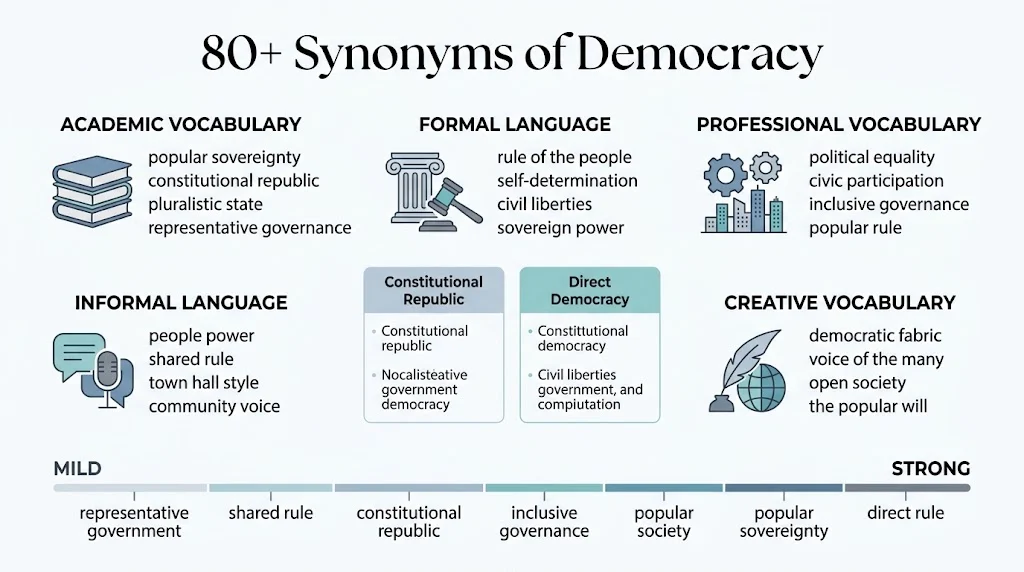
Democracy is a system of government where power is held by the people, either directly or through elected representatives. The best synonym depends on your context: for formal writing, use representative government; for casual conversation, try self-rule; for academic work, republic or constitutional government are strong choices; and for professional communication, popular government is effective.
Have you ever been writing an important essay or a professional email and found yourself using the word “democracy” over and over? It is a powerful and important term, but repetition can make your writing sound flat and uninspired. Choosing a fitting synonym of democracy can sharpen your message and demonstrate a stronger command of language. This guide will help you understand the meaning, context, and best alternatives for this crucial word, so you can write with greater clarity and confidence.
Meaning, Tone, and Context
Simple Definition
Democracy is a form of government in which the supreme power is vested in the people and exercised by them directly or indirectly through a system of representation, typically involving periodic free elections.
Part of Speech
Noun.
Overall Tone
Neutral.
Formality Level
Formal. It is a technical, political science term that is also used in everyday conversation.
Common Uses
Native English speakers use “democracy” in political discussions, news reports, academic papers, civics classes, and when discussing governance and citizens’ rights. It is a foundational term in both formal and informal discourse about society.
Word Forms
- Noun: democracy
- Adjective: democratic
- Adverb: democratically
- Related Noun: democrat (a person who supports democracy)
- Opposite Form: autocracy
When and How to Use “Democracy”
You should choose “democracy” when you are referring specifically to the system of government by the people, often in the context of political structures, rights, and elections. It is the most direct and formal term for this concept.
Here are 7 realistic examples:
- Professional (Political Analysis): The stability of any democracy depends on the active participation of its informed citizenry.
- Academic (Political Science Essay): The transition from authoritarian rule to a stable democracy is a complex and multifaceted process.
- Workplace (Company Culture): Our company values a form of workplace democracy, where every team member’s voice contributes to the final decision.
- Personal (Conversation): I believe that a healthy democracy requires open dialogue and respect for differing opinions.
- Email (Civic Engagement): As part of our civic duties in a democracy, we must ensure everyone has access to fair and accurate information.
- Resume (Government/Advocacy): Led a community initiative to increase voter registration, strengthening the local democracy.
- Social Media (Political Commentary): A functioning democracy relies on a free press to hold those in power accountable.
Best Synonyms of “Democracy”
No synonym is an identical match in every situation. The power of language lies in choosing the most precise word for your specific context.
- For Professional Writing: Use “representative government” because it sounds authoritative and technically accurate.
- For Academic Writing: Use “republic” to denote a system where the people elect representatives, often with a constitutional framework.
- For Business Communication: Use “stakeholder governance” to describe a system where all parties have a voice.
- For Casual Conversation: Use “self-rule” for a clear, straightforward, and unpretentious alternative.
- For Emotional Writing: Use “people’s power” to evoke a sense of collective strength and unity.
- For Creative Writing: Use “populist governance” to add a critical or nuanced layer to a story.
- For Resume Writing: Use “participatory governance” to describe your role in a collaborative decision-making process.
- For Workplace Communication: Use “shared governance” to highlight a collaborative and fair management style.
- For a Stronger Meaning: Use “direct democracy” to emphasize immediate and unmediated popular control.
- For a Softer Meaning: Use “constitutional rule” to focus on the legal and procedural aspects of governance.
When Not to Use “Democracy”
There are situations where “democracy” is not the most effective word choice.
When the word is too formal
If you are discussing internal team dynamics in a casual office meeting, saying “democracy” might sound overly academic and out of place.
- Less Effective: We need a little more democracy in our project planning sessions.
- Better Synonym: participation
- Rewrite: We need a little more participation in our project planning sessions.
When the word is too vague
If you are trying to praise a company’s inclusive culture, “democracy” is too broad. It refers to a system of government, not a workplace style.
- Less Effective: This company is a democracy.
- Better Synonym: collaborative
- Rewrite: This is a highly collaborative environment.
When the word is too strong
If you are describing a parents’ group at a school, “democracy” sounds like an overstatement for a simple decision-making process.
- Less Effective: We have a democracy on the PTA board.
- Better Synonym: majority rule
- Rewrite: We make decisions by majority rule on the PTA board.
When the word is outdated
“Democracy” is not outdated, but in some contexts, terms like “commonwealth” can feel archaic when discussing modern governance. Use “representative government” instead.
Words Commonly Confused With “Democracy”
Democracy vs. Republic
- Difference: A democracy can be direct, where people vote on all laws, while a republic is a representative system. In practice, most modern democracies are republics.
- When to Use It: Use “democracy” when emphasizing the power of the people. Use “republic” when emphasizing the rule of law and a system of elected representatives.
- Example: The United States is a democratic republic, where representatives are elected to serve the public will.
Democracy vs. Autocracy
- Difference: Democracy is rule by the people, while autocracy is rule by a single person with unlimited power.
- When to Use It: Use “autocracy” to create a strong contrast or to criticize an undemocratic system.
- Example: The country’s move from autocracy to democracy was a historic moment for its citizens.
Democracy vs. Oligarchy
- Difference: Democracy is rule by the many, whereas an oligarchy is rule by a small, privileged group.
- When to Use It: Use “oligarchy” to describe a system where a few powerful individuals control the government.
- Example: Critics argue that economic disparity is turning the democracy into a de facto oligarchy.
Democracy vs. Monarchy
- Difference: Democracy is rule by the people, typically through elected officials, while a monarchy is rule by a king, queen, or emperor.
- When to Use It: Use “monarchy” in discussions of historical governance or countries with royal families.
- Example: The nation transitioned from a monarchy to a democracy after the revolution.
Democracy vs. Theocracy
- Difference: Democracy bases its authority on the will of the people, whereas a theocracy bases it on divine guidance or religious law.
- When to Use It: Use “theocracy” when discussing governments where religious leaders hold political power.
- Example: The country is a theocracy, so its laws are far different from those in a secular democracy.
Democracy vs. Totalitarianism
- Difference: Democracy emphasizes freedom and participation, while totalitarianism is a system where the state holds total authority over society.
- When to Use It: Use “totalitarianism” to describe a repressive and all-controlling government.
- Example: The opposition is fighting to dismantle the totalitarian regime and establish a democracy.
Best Synonyms of “Democracy” by Context
| Context | Best Synonym | Why It Works | Example |
| Formal Writing | Representative Government | It is precise and conveys the institutional process. | The country is a robust representative government with free and fair elections. |
| Academic Writing | Constitutional Government | It emphasizes the rule of law and established principles. | A stable constitutional government requires a functioning judiciary and separation of powers. |
| Business Emails | Stakeholder Governance | It is relevant to corporate and organizational structures. | We need to adopt a stakeholder governance model to improve transparency. |
| Everyday Speaking | People Power | It is a short, punchy, and inspiring phrase. | The movement is all about people power and the will of the majority. |
| Creative Writing | Populist Governance | It adds a layer of critical or narrative depth. | The novel explores the dangers of populist governance manipulated by a charismatic leader. |
| Storytelling | The Voice of the People | It is metaphorical and evokes a strong, collective image. | The king was forced to listen to the voice of the people. |
| Emotional Writing | Freedom | It focuses on the personal liberties that democracy protects. | They were fighting for freedom and the right to choose their own leaders. |
| Strong Emphasis | Direct Democracy | It shows the most powerful and immediate form of popular rule. | Direct democracy is the purest form of self-governance. |
| Mild Tone | Civil Society | It focuses on the peaceful and organized participation of citizens. | The reforms were driven by a strong and active civil society. |
| Social Media Captions | Majority Rule | It is a simple and relatable concept for a quick post. | It’s just majority rule on this issue. Let’s vote. |
| American English | Representative Democracy | It is the standard term used in the U.S. context. | The United States operates as a representative democracy. |
How to Choose the Best Synonym of “Democracy”
Choosing the right synonym of democracy depends on your specific needs. Here is a practical decision guide.
- Consider Your Audience: Are you writing a legal document for a judge or a friendly text to a colleague? For formal audiences, stick with “representative government.” For a general audience, “self-rule” or “people power” is more accessible.
- Define Your Purpose: Are you trying to inform, persuade, or describe? An academic essay requires precision (“constitutional government”). A persuasive speech might benefit from emotional weight (“freedom”).
- Assess the Tone: Do you want to sound neutral or passionate? A news report should use “democracy” or “representative government” for objectivity. A political rally might use the emotional “people’s power.”
- Evaluate the Emotional Strength: Are you discussing a political theory or the struggle for rights? Use neutral terms for theory and stronger ones like “people’s power” for human stories.
- Think About Formality: Match the formality of your synonym to your writing. Business reports need formal synonyms, while blogs and social media posts often use informal ones.
Real Life Examples of “Democracy”
- School (Student Council): Our school has a small democracy where students vote for their class representatives.
- College (Research Project): The research compared the effectiveness of different forms of democracy in post-conflict nations.
- Workplace (Town Hall): The CEO held a town hall to practice workplace democracy and gather feedback.
- Business (Partnership): The partners agreed to operate as a true democracy, where every partner’s vote carries equal weight.
- Email (Newsletter): In a democracy, an informed voter is the most important participant in the electoral process.
- Resume (Campaign Volunteer): Helped register voters to strengthen democracy and ensure civic participation.
- Conversation (Dinner Party): “It’s amazing how resilient a healthy democracy can be in the face of challenges,” he said.
- Storytelling (Fictional Narrative): The crumbling walls of the old regime gave way to the fragile, beautiful hope of a new democracy.
- Blogging (Opinion): The key to a functioning democracy is not just the right to vote, but the ability to access accurate information.
- Social Media (TikTok): Here is a quick breakdown of how a democracy is supposed to work. #civics #politics
18 Best Synonyms of “Democracy”
| Synonym | Simple Meaning | Best Used For | Example Sentence |
| 3. Republic | A state with a constitution and elected leaders. | Academic and historical contexts. | The constitution established a republic, not a direct democracy. |
| 5. Popular Government | A government based on the people’s will. | Professional and political science writing. | The foundation of any popular government is the consent of the governed. |
| 7. Self-determination | The right of a people to choose their own status. | Political and historical writing about independence. | The nation’s right to self-determination was recognized by the international community. |
| 8. Egalitarianism | The belief in the equality of all people. | Philosophical and sociological contexts. | The country’s constitution is based on principles of egalitarianism. |
| 10. Open Society | A society with freedom of information and speech. | Political philosophy and discussions of civil society. | A thriving open society is a hallmark of a healthy democracy. |
| 12. Participatory Governance | Involving all stakeholders in decisions. | Professional, corporate, and community settings. | The new policy was created through a process of participatory governance. |
| 13. Shared Governance | A collaborative system of decision-making. | Workplace and organizational communication. | Shared governance has improved trust and efficiency in our department. |
| 16. Polyarchy | A system with many centers of power. | Advanced academic and political science terms. | The country is considered a polyarchy with multiple competing interest groups. |
| 17. Commonwealth | A political community founded on the common good. | Historical or formal, slightly archaic contexts. | The nation was founded as a commonwealth for the betterment of all its citizens. |
Synonyms of “Democracy” by Usage
Professional vs Personal Synonyms
In a professional setting, you should use terms like “representative government” or “participatory governance.” These sound more formal and structured. In personal or casual conversations, words like “self-rule” and “people power” sound more natural and accessible.
Formal vs Conversational Synonyms
For formal writing like reports, academic essays, and business presentations, the best choices are “constitutional government,” “popular government,” or “republic.” For emails, casual conversations, and texting, use simpler terms like “self-rule” or “majority rule.”
Academic Synonyms
In academic writing, precision is vital. Use “representative government,” “constitutional government,” “polyarchy,” or “egalitarianism.” These terms are used in political science literature and convey a high level of authority and specificity.
Professional and Business Synonyms
For resumes, interviews, and client communication, choose “participatory governance,” “shared governance,” or “stakeholder governance.” These synonyms demonstrate your understanding of collaborative and organizational structures, making you sound more effective and management-ready.
Creative and Literary Synonyms
For storytelling and creative writing, use evocative terms like “people’s power,” “populist governance,” or “the voice of the people.” These words add a layer of emotion and imagery to your narrative, which can help build a vivid world and engage the reader.
Slang or Modern Synonyms
There is no widely accepted slang for “democracy.” In modern English, “people power” is the closest to an informal, punchy alternative, but it is still a legitimate political phrase. You might hear it in protest chants or informal political discussions.
Strongest to Mildest Synonyms
- Mild: Civil Society (emphasizes organization), Egalitarianism (focuses on belief).
- Moderate: Republic (a system), Self-rule (a principle), Popular Government (a process).
- Strong: Representative Government (direct action), Participatory Governance (active involvement), Majority Rule (the core mechanism).
- Very Strong: Direct Democracy (absolute popular control), People Power (unstoppable collective force), Self-determination (absolute right to choose).
Emotional vs Neutral Synonyms
Emotional Synonyms:
These words, such as “people power,” “freedom,” and “self-determination,” express strong feelings of hope, pride, and collective action. Use them in speeches, op-eds, and social media to inspire and persuade.
Neutral Synonyms:
These words simply communicate information. Use terms like “representative government,” “constitutional rule,” and “popular government” in reports, news articles, and academic papers to maintain objectivity and a formal tone.
Antonyms of “Democracy”
| Antonym | Meaning | Example Sentence |
| 1. Autocracy | Rule by a single absolute leader. | The general established an autocracy after seizing power in the coup. |
| 2. Dictatorship | A government with absolute power. | The dictatorship abolished all political opposition and free speech. |
| 3. Totalitarianism | Complete state control over society. | Life under totalitarianism was characterized by constant surveillance and fear. |
| 4. Oligarchy | Rule by a small group of elites. | Critics argue the nation is no longer a republic but a corrupt oligarchy. |
| 5. Monarchy | Rule by a king or queen. | The monarchy was abolished, and a republic was declared. |
| 6. Theocracy | Rule by divine guidance or religious law. | The theocracy imposes strict religious laws on all citizens. |
| 7. Tyranny | Cruel and oppressive government. | The people rose up against the tyranny of their oppressors. |
| 8. Despotism | Rule by a ruler with absolute power. | The country suffered under decades of despotic rule. |
| 9. Authoritarianism | Rule with strong central power, limited freedoms. | The authoritarian regime has a history of suppressing dissent. |
| 10. Plutocracy | Rule by the wealthy. | The senator warned that the country is becoming a plutocracy. |
| 11. Junta | A military group ruling after a coup. | The military junta suspended the constitution. |
| 12. Absolutism | A form of government with unlimited power. | Absolutism was the standard form of governance in Europe’s early modern period. |
| 13. Aristocracy | Rule by the privileged or noble class. | The revolution was a revolt against the ruling aristocracy. |
| 14. Police State | A state controlled by political police. | The country has devolved into a police state, with secret police on every corner. |
| 15. Fascism | A far-right, authoritarian ultranationalism. | The history of fascism serves as a warning against extreme nationalism. |
Comparison: “Democracy” vs Similar Words
Democracy vs Republic
- Main Difference: A republic is a specific type of democracy where people elect representatives. They are often used interchangeably, but a republic is defined by its constitution and rule of law.
- Which Is Stronger? “Democracy” can feel more powerful because it directly invokes the people. “Republic” is a more technical term.
- Which Is More Formal? Both are formal, but “republic” is more formal and academic.
- When to Use Each: Use “democracy” to emphasize popular will. Use “republic” to describe a formal, constitutional system.
- Examples:
- Democracy: The democracy must stand firm against those who would threaten its institutions.
- Republic: The republic is governed by a constitution that protects individual rights.
Democracy vs Oligarchy
- Main Difference: Democracy is rule by the many, while oligarchy is rule by the few. It is a contrast between popular rule and elite rule.
- Which Is Stronger? “Oligarchy” often carries a strongly negative and critical tone.
- Which Is More Formal? Both are formal political science terms.
- When to Use Each: Use “democracy” to describe your system. Use “oligarchy” as a criticism or warning about a system gone wrong.
- Examples:
- Democracy: The government is a democracy that ensures every vote counts.
- Oligarchy: The government has become an oligarchy where only the wealthy have a say.
Democracy vs Monarchy
- Main Difference: Democracy is rule by the people, and monarchy is rule by a hereditary ruler.
- Which Is Stronger? Both are neutral terms. The strength is in the contrast between them.
- Which Is More Formal? Both are formal terms.
- When to Use Each: Use “monarchy” in historical contexts, discussions of royal families, or when describing a transition of power.
- Examples:
- Democracy: The country transitioned to a democracy in the 20th century.
- Monarchy: The constitutional monarchy serves as a symbol of national unity.
Democracy vs Theocracy
- Main Difference: Democracy bases its laws on the will of the people. Theocracy bases its laws on religious doctrine.
- Which Is Stronger? The contrast between the secular and the religious is very strong.
- Which Is More Formal? Both are formal and precise.
- When to Use Each: Use these terms when comparing systems of governance based on different sources of authority.
- Examples:
- Democracy: Democracy is based on the principle of popular sovereignty.
- Theocracy: In a theocracy, the religious leaders hold the ultimate authority.
Common Phrases and Expressions with “Democracy”
“Democracy in Action”
- Meaning: A phrase used to describe a situation where people are actively participating in making decisions or exercising their rights.
- Example Sentence: The lively town hall meeting was a perfect example of democracy in action.
“Defender of Democracy”
- Meaning: Someone who actively works to protect democratic institutions and rights.
- Example Sentence: The journalist was a courageous defender of democracy, even in the face of threats.
“Foundations of Democracy”
- Meaning: The core principles and institutions, like free elections and the rule of law, that a democratic system is built upon.
- Example Sentence: We must protect the foundations of democracy for future generations.
“The Democratic Process”
- Meaning: The formal procedures and steps, from campaigns to elections, that are part of a democratic government.
- Example Sentence: The democratic process ensures that power is transferred peacefully and fairly.
“A Healthy Democracy”
- Meaning: A democratic system that is functioning well, with high citizen participation and robust checks and balances.
- Example Sentence: A healthy democracy requires an active and independent press.
Common Mistakes to Avoid
Mistake 1: Using a vague synonym instead of a precise one
- Incorrect: The new policy was a good example of democracy.
- Better: The new policy was a good example of participatory governance.
- Why? “Participatory governance” is more precise than the overly broad “democracy” in this context.
Mistake 2: Confusing “democracy” with “republic”
- Incorrect: The United States is a direct democracy.
- Better: The United States is a representative democracy or a republic.
- Why? The U.S. is not a direct democracy, where people vote on every law.
Mistake 3: Using an informal synonym in formal writing
- Incorrect: The nation’s transition to people power was smooth.
- Better: The nation’s transition to representative government was smooth.
- Why? “People power” is too informal for an academic paper.
Mistake 4: Selecting an overly dramatic synonym
- Incorrect: Our book club practices people power when choosing the next read.
- Better: Our book club uses majority rule when choosing the next read.
- Why? “People power” is too strong and dramatic for a simple book club.
Mistake 5: Using a synonym with the wrong emotional tone
- Incorrect: The budget was approved through a healthy democracy.
- Better: The budget was approved through a standard democratic process.
- Why? “Healthy democracy” sounds overly positive and emotional for a routine budget approval.
Mistake 6: Using slang in academic or professional writing
- Incorrect: The country’s new government is based on mob rule.
- Better: The country’s new government lacks established democratic institutions.
- Why? “Mob rule” is a pejorative slang term that should be avoided in formal writing.
Mistake 7: Repeating the same word too often
- Incorrect: The democracy is strong. The democracy has free elections. The democracy is a model for the world.
- Better: The representative government is strong. It has free elections and serves as a model for the world.
- Why? Using different synonyms (“democracy,” “representative government,” “it”) improves flow and clarity.
Frequently Asked Questions
1. What are the best synonyms of “democracy”?
The best synonyms include “representative government,” “self-rule,” and “republic.” The ideal choice depends on your specific context, audience, and the level of formality you require.
2. What are the best formal synonyms of “democracy”?
For formal writing, use “representative government,” “constitutional government,” or “popular government.” These terms are precise, authoritative, and appropriate for reports and academic essays.
3. What are common informal synonyms of “democracy”?
Common informal synonyms are “self-rule,” “people power,” and “majority rule.” These terms are straightforward and commonly used in everyday conversation and social media.
4. What is another word for “democracy” in professional writing?
In professional writing, “participatory governance,” “shared governance,” and “stakeholder governance” are excellent alternatives. They are particularly effective in describing collaborative decision-making in organizations.
5. What is the difference between “democracy” and “republic”?
A democracy can be a system where citizens vote on laws directly, while a republic is a system where citizens elect representatives to make laws. In the U.S., we often use the terms interchangeably to describe our representative system.
6. What is the opposite of “democracy”?
The most direct opposites are “autocracy,” “dictatorship,” and “totalitarianism.” Other antonyms include “oligarchy,” “monarchy,” and “tyranny.”
Conclusion
Democracy is a powerful word that captures a profound idea: the authority of the people to govern themselves. While it is a vital and respected term, using it repeatedly can weaken your message. By learning and applying its many synonyms, you can sharpen your communication, whether you are writing a formal report, a compelling essay, a professional email, or a casual social media post. The best choice, whether it is “representative government,” “self-rule,” or “republic,” depends entirely on your audience, tone, and purpose. A great vocabulary tip is to always ask yourself: am I using the most precise word for this situation? This simple question will instantly improve your writing.

7 thoughts on “80+ Synonyms of Democracy| Meanings, and Best Alternatives”