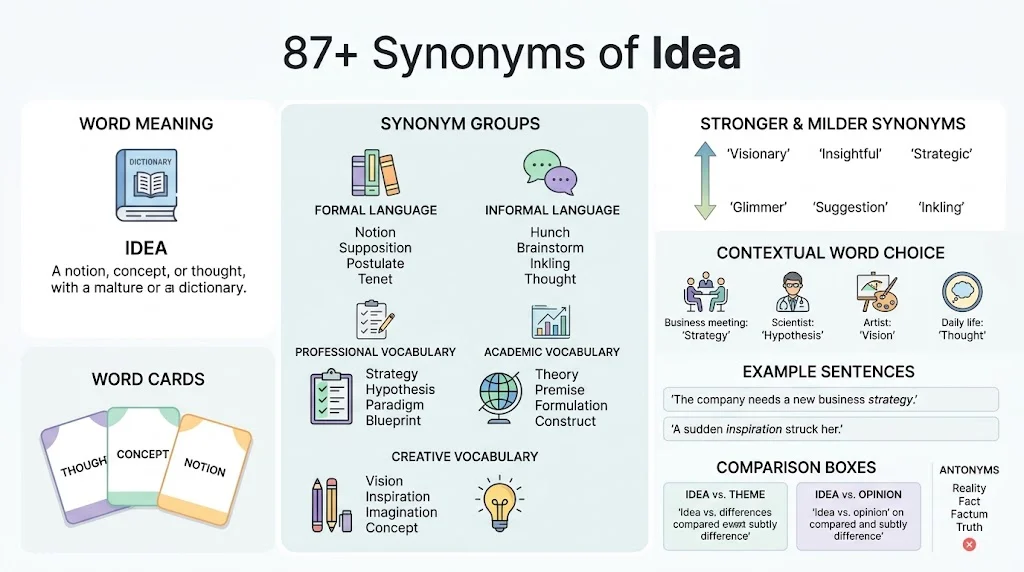
The word “idea” means a thought, suggestion, or mental picture about something. For formal writing, use concept or proposal. For casual conversation, try thought or notion. In professional settings, choose insight or strategy. For creative writing, consider inspiration or vision.
Have you ever found yourself repeating the word “idea” multiple times in a single email, essay, or presentation? You know there must be a better way to express yourself, but the right word just won’t come to mind. This happens to everyone from students to seasoned professionals. Choosing the right synonym of idea can transform your writing from repetitive and vague to precise and impactful.
A strong vocabulary allows you to communicate with clarity and confidence. When you select the exact word for your meaning, your audience understands you more quickly and takes your message more seriously. This guide will help you master the synonyms of idea so you can choose the perfect word every time.
Meaning, Tone, and Context
Simple Definition
An idea is a thought, plan, or suggestion that exists in your mind. It can be anything from a sudden inspiration to a carefully developed theory.
Part of Speech
Noun
Overall Tone
Neutral
Formality Level
Neutral to informal. The word “idea” works in almost any setting, which makes it versatile but sometimes too vague for professional or academic writing .
Common Uses
Native English speakers use “idea” constantly in everyday conversation. You will hear it in phrases like “good idea,” “no idea,” “have an idea,” and “bright idea” . It appears in emails, meetings, classrooms, and casual chats.
Word Forms
- Noun: idea
- Plural: ideas
- Adjective: ideal (meaning perfect)
- Related forms: idealize, ideation
When and How to Use “Idea”
Choose “idea” when you want a simple, neutral word that everyone understands. It works best when you do not need to emphasize formality, emotion, or technical precision.
Professional
We need to generate some fresh ideas for the client presentation.
Academic
The researcher presented a compelling idea about climate adaptation.
Workplace
Let’s hear everyone’s ideas before we make a decision.
Personal
I have an idea for where we should go on vacation.
Thanks for sharing your idea about the new workflow process.
Resume
Developed innovative ideas that increased team productivity by 15%.
Social Media
Just had the best idea for a new recipe. Stay tuned.
Best Synonyms of “Idea”
No synonym perfectly matches “idea” in every situation. Each alternative carries subtle differences in tone, formality, and intensity.
Professional Writing
Concept – This word suggests a structured, developed idea with substance .
Academic Writing
Theory – Best for ideas that explain how something works, backed by reasoning and evidence .
Business Communication
Proposal – Use when you are formally suggesting a plan or course of action .
Casual Conversation
Thought – A simple, natural alternative for everyday speaking .
Emotional Writing
Vision – This word expresses an inspiring, forward-looking idea about what could be.
Creative Writing
Inspiration – Use for ideas that feel original, exciting, and creatively driven.
Resume Writing
Strategy – This communicates that your idea was part of a thoughtful plan .
Workplace Communication
Suggestion – A polite way to offer an idea without sounding pushy .
Stronger Meaning
Conviction – Use when you hold an idea with strong personal belief.
Softer Meaning
Notion – This expresses a vague or partially formed idea .
When Not to Use “Idea”
When It Sounds Too General
If you are writing a business proposal or academic paper, “idea” can sound imprecise.
Weak: My idea for the project is to increase sales.
Better: My strategy for the project is to increase sales through targeted marketing.
When It Sounds Too Vague
In creative writing, “idea” lacks the color and imagery your readers want.
Weak: She had an idea for a painting.
Better: She had a vision for a painting that would capture the sunset’s intensity.
When It Sounds Too Informal
Avoid “idea” in highly formal documents or speeches where a more authoritative word is expected.
Weak: The idea of democracy guides our nation.
Better: The principle of democracy guides our nation.
When It Sounds Too Weak
If you want to express strong belief or passion, “idea” is not enough.
Weak: I have an idea that this is the right choice.
Better: I have a conviction that this is the right choice.
Words Commonly Confused With “Idea”
Idea vs Thought
Difference: “Thought” often suggests the process of thinking or a single mental event, while “idea” implies a more formed concept .
When to Use It: Use “thought” for casual reflections; use “idea” for developed plans.
Example: I just had a thought about dinner. (casual) vs. I have an idea for a new business. (developed)
Idea vs Concept
Difference: A “concept” is a general, abstract idea that applies to many things. It sounds more formal and academic than “idea” .
When to Use It: Use “concept” in academic writing and professional discussions .
Example: The concept of sustainability is complex.
Idea vs Notion
Difference: “Notion” suggests a vague, unclear, or possibly incorrect idea .
When to Use It: Use “notion” when the idea is not fully formed.
Example: She had a vague notion that something was wrong.
Idea vs Suggestion
Difference: A “suggestion” is an idea offered for others to consider. It is often a polite recommendation .
When to Use It: Use “suggestion” in feedback or brainstorming.
Example: Do you have any suggestions for improvements?
Idea vs Proposal
Difference: A “proposal” is a formal suggestion, often written down and presented for approval .
When to Use It: Use “proposal” in business or academic formal settings.
Example: The proposal for a new stadium has been rejected.
Idea vs Insight
Difference: “Insight” means a deep, clear understanding or a clever idea that reveals a truth .
When to Use It: Use “insight” when your idea shows wise understanding.
Example: His insight into customer behavior was invaluable.
Best Synonyms of “Idea” by Context
| Context | Best Synonym | Why It Works | Example |
| Formal writing | Concept | Sounds abstract and scholarly | The concept of justice is essential. |
| Academic writing | Theory | Implies research and reasoning | Einstein’s theory revolutionized physics. |
| Professional communication | Insight | Shows deep understanding | Her insight improved our strategy. |
| Business emails | Suggestion | Polite and collaborative | I have a suggestion for the meeting. |
| Resume writing | Strategy | Shows thoughtful planning | Developed a strategy that boosted sales. |
| Workplace communication | Proposal | Formal and action-oriented | The proposal was approved by management. |
| Casual conversation | Thought | Natural and simple | I had a thought about that movie. |
| Creative writing | Inspiration | Suggests originality and emotion | The painting was born from inspiration. |
| Emotional writing | Vision | Inspiring and forward-looking | His vision gave us hope. |
| Strong emphasis | Conviction | Expresses firm belief | She spoke with conviction. |
| Mild tone | Notion | Vague or playful | I have a notion we should leave early. |
| Social media captions | Brainwave | Fun and sudden | Had a brainwave for a new post. |
| American English | Brainstorm | Sudden, clever idea | I had a brainstorm and solved it. |
How to Choose the Best Synonym of “Idea”
Choosing the right word depends on your audience, purpose, and tone. Ask yourself these questions:
What is my audience? If you are writing for a professor or boss, choose formal words like concept or proposal . For friends, choose thought or notion.
What is my purpose? Are you suggesting a plan, explaining a theory, or sharing a creative spark? Each purpose points to a different synonym.
How strong is my idea? If your idea is fully developed, use concept or theory. If it is still vague, use notion or impression .
What tone do I want? For a neutral, safe choice, use “idea.” For authority, use principle or doctrine. For creativity, use inspiration or vision.
Does it sound natural? Read your sentence aloud. If the synonym feels forced or awkward, try a simpler word. The most natural choice is often the best.
Real Life Examples of “Idea”
School
The science fair winner presented a creative idea about renewable energy.
College
Her thesis explored the idea that social media affects attention spans.
Workplace
The team brainstormed ideas for the new advertising campaign.
Business
We need to pitch our proposal to investors next week.
I am writing to share a suggestion about the upcoming project deadline.
Resume
Implemented cost-saving ideas that reduced expenses by 8%.
Conversation
That is a great thought. I never considered that perspective.
Storytelling
A wild notion struck him as he stared at the abandoned house.
Blogging
Here is a concept that will change how you approach productivity.
Social Media
Just had a brainstorm for a new DIY project. You will love this.
18 Best Synonyms of “Idea”
| Synonym | Simple Meaning | Best Used For | Example Sentence |
| Concept | A general, abstract idea | Academic and professional writing | The concept of democracy is central to political theory. |
| Thought | A single mental event or reflection | Casual conversation and personal writing | I just had a thought about our dinner plans. |
| Notion | A vague or playful idea | Informal speech and storytelling | She had a notion that something was wrong. |
| Suggestion | An idea offered for consideration | Brainstorming and feedback | Do you have any suggestions for improvements? |
| Proposal | A formal plan or offer | Business and academic proposals | The proposal was accepted by the committee. |
| Insight | A deep, clever understanding | Professional and analytical writing | His insight into the problem was invaluable. |
| Theory | An idea supported by reasoning | Academic research and essays | He presented a new theory about climate change. |
| Vision | An inspiring, forward-looking idea | Leadership and emotional writing | Her vision for the company inspired the team. |
| Inspiration | A sudden creative idea | Creative writing and art | The poem came from pure inspiration. |
| Strategy | A planned method to achieve a goal | Business and resume writing | We developed a strategy to expand our market. |
| Plan | A detailed idea for action | Personal and professional planning | The plan is to hire a car when we get there. |
| Brainwave | A sudden clever idea | Casual conversation | I had a brainwave and figured it out. |
| Brainstorm | A sudden bright idea | American casual speech | She had a brainstorm and solved the puzzle. |
| Impression | An uncertain or initial idea | Describing gut feelings | I had the impression that he was unhappy. |
| Hunch | An intuitive guess | Informal and personal speech | I have a hunch that she will say yes. |
| Concept | A structured mental picture | Professional discussions | The architect’s concept delighted the clients. |
| Angle | A particular point of view | Strategic thinking | We need a new angle for our marketing. |
| Answer | A solution idea | Problem-solving contexts | He found the answer to our problem. |
Synonyms of “Idea” by Usage
Professional vs Personal Synonyms
In the workplace, choose concept, proposal, or insight . These words sound competent and thoughtful. In personal conversations, choose thought, notion, or brainwave for a natural, friendly tone.
Formal vs Conversational Synonyms
Formal (reports, essays, business writing): concept, proposal, theory, principle, doctrine
Conversational (emails, texting, casual chats): thought, notion, brainwave, hunch, guess
Academic Synonyms
For research papers and essays, use concept, theory, hypothesis, or paradigm. These words sound authoritative and precise . Hypothesis works when your idea is a testable proposition. Paradigm works for a big-picture idea that shapes how people think.
Professional and Business Synonyms
For resumes, interviews, and meetings, choose strategy, proposal, or insight. These words show you think deeply and act intentionally. Strategy suggests you plan carefully. Proposal shows you are formal and professional. Insight demonstrates that you understand things clearly.
Creative and Literary Synonyms
For storytelling, poetry, and descriptive writing, try inspiration, vision, imagery, or conceit. These words add emotion and artistic depth . Conceit is an older term for a clever or elaborate idea .
Slang or Modern Synonyms
“Brainwave” is a common British term for a sudden idea . “Brainstorm” serves the same purpose in American English . Use these in casual settings. Avoid them in formal or academic writing.
Strongest to Mildest Synonyms
Mild: notion, impression, suggestion
Moderate: idea, thought, plan
Strong: concept, theory, proposal
Very Strong: conviction, principle, doctrine
Emotional vs Neutral Synonyms
Emotional: vision, inspiration, conviction, dream – These words carry feeling and passion.
Neutral: concept, plan, suggestion, thought – These simply communicate information without added emotion.
Antonyms of “Idea”
| Antonym | Meaning | Example Sentence |
| Reality | What actually exists | We need to focus on reality, not just ideas. |
| Fact | Something proven true | The facts contradict your idea. |
| Certainty | Complete confidence | We have certainty about the outcome now. |
| Truth | What is real and correct | His idea did not align with the truth. |
| Ignorance | Lack of knowledge | Her ignorance of the topic showed. |
| Confusion | Lack of clear understanding | There was confusion about the new policy. |
| Blindness | Not seeing or understanding | His blindness to the problem was frustrating. |
| Misconception | An incorrect idea | That is a common misconception about history. |
| Delusion | A false belief | He lives under a delusion about his abilities. |
| Fiction | Something imagined | The story is pure fiction, not a plan. |
| Inaction | No plan or action | Inaction led to the project’s failure. |
| Disbelief | Lack of acceptance | She expressed disbelief at his suggestion. |
| Denial | Refusal to accept an idea | His denial made it hard to move forward. |
| Void | Empty of ideas or content | The proposal was a void of substance. |
| Absurdity | A ridiculous idea | We laughed at the absurdity of his thought. |
Comparison: “Idea” vs Similar Words
Idea vs Thought
Main Difference: “Thought” often reflects the mental process itself, while “idea” focuses on the result or product .
Which Is Stronger? “Idea” is generally stronger, suggesting a more formed concept.
Which Is More Formal? Both are neutral; “idea” can be slightly more formal.
When to Use Each: Use “thought” for fleeting reflections; use “idea” for developed plans .
Examples:
Idea: We need to generate new ideas for the project.
Thought: A sudden thought crossed her mind.
Idea vs Concept
Main Difference: “Concept” is abstract and theoretical; “idea” can be practical or simple .
Which Is Stronger? “Concept” is more substantial and intellectual.
Which Is More Formal? “Concept” is much more formal .
When to Use Each: Use “concept” in academic writing; use “idea” in everyday speech.
Examples:
Idea: I have an idea for dinner.
Concept: The concept of gravity is fundamental to physics.
Idea vs Notion
Main Difference: “Notion” suggests vagueness or uncertainty; “idea” is more definite .
Which Is Stronger? “Idea” is stronger and more formed.
Which Is More Formal? Both are casual, but “notion” is slightly more literary.
When to Use Each: Use “notion” when the idea is unclear; use “idea” when it is clear.
Examples:
Idea: We have a clear idea of what to do.
Notion: She had a vague notion that she forgot something.
Idea vs Suggestion
Main Difference: A “suggestion” is offered to others for consideration; an “idea” may be private .
Which Is Stronger? “Idea” is more personal; “suggestion” is more social.
Which Is More Formal? “Suggestion” is neutral to formal .
When to Use Each: Use “suggestion” in collaborative settings; use “idea” for personal thoughts.
Examples:
Idea: My idea is to write a book.
Suggestion: Can I offer a suggestion for your essay?
Idea vs Proposal
Main Difference: A “proposal” is a formal, often written suggestion for action .
Which Is Stronger? “Proposal” is more official and action-oriented.
Which Is More Formal? “Proposal” is highly formal.
When to Use Each: Use “proposal” in business and official contexts; use “idea” for casual thoughts.
Examples:
Idea: I have an idea for the party.
Proposal: The committee approved the proposal for the new building.
Idea vs Insight
Main Difference: “Insight” reveals a deep understanding or truth; an “idea” may be ordinary .
Which Is Stronger? “Insight” is stronger and more impressive.
Which Is More Formal? “Insight” is more professional and intellectual .
When to Use Each: Use “insight” when your idea demonstrates wisdom; use “idea” for basic thoughts.
Examples:
Idea: I have an idea about the meeting.
Insight: His insight into customer needs transformed our strategy.
Common Phrases and Expressions with “Idea”
Good idea
Meaning: A positive response to someone’s plan or suggestion.
Example Sentence: That is a good idea. Let us start tomorrow.
No idea
Meaning: I do not know.
Example Sentence: I have no idea where she went.
Bright idea
Meaning: A clever or good plan. Often used sarcastically.
Example Sentence: Whose bright idea was it to paint the walls yellow?
Have an idea
Meaning: To think of a plan or thought.
Example Sentence: I have an idea for how we can improve our service.
The idea that
Meaning: Expresses a belief or opinion.
Example Sentence: The idea that money brings happiness is common but not always true.
Get the idea
Meaning: To understand the main point.
Example Sentence: I think you get the idea. Let us move on.
Toy with an idea
Meaning: To consider something casually.
Example Sentence: He is toying with the idea of moving to another city.
Hit upon an idea
Meaning: To suddenly think of something.
Example Sentence: She hit upon an idea while walking her dog.
Common Mistakes to Avoid
1. Using “Idea” When You Need Formality
Incorrect: The idea of the study is to examine social behavior.
Better: The purpose of the study is to examine social behavior.
Why: “Purpose” sounds more formal and academic.
2. Confusing “Idea” with “Notion”
Incorrect: She presented a fully developed notion about climate policy.
Better: She presented a fully developed concept about climate policy.
Why: “Notion” suggests vagueness, not a fully formed plan .
3. Using “Brainstorm” in Formal Writing
Incorrect: Our brainstorm for the annual report is outlined below.
Better: Our concept for the annual report is outlined below.
Why: “Brainstorm” is informal; “concept” is professional.
4. Overusing “Good Idea” Repeatedly
Incorrect: Good idea. That is a good idea. I like your good idea.
Better: Good idea. That is a thoughtful suggestion. I appreciate your concept.
Why: Variation keeps your writing interesting.
5. Choosing a Synonym That Does Not Match the Tone
Incorrect: I have a conviction that we should order pizza.
Better: I have a thought that we should order pizza.
Why: “Conviction” is too strong for casual choices.
6. Using “Suggestion” When You Need “Proposal”
Incorrect: We need to write a formal suggestion for the grant.
Better: We need to write a formal proposal for the grant.
Why: “Proposal” fits formal documents; “suggestion” is for casual ideas .
7. Using “Idea” When “Plan” Is More Accurate
Incorrect: Our idea is to launch next month.
Better: Our plan is to launch next month.
Why: “Plan” implies you have already worked out the details.
Frequently Asked Questions
1. What are the best synonyms of “idea”?
The best synonyms depend on context. For formal writing, use concept or proposal. For casual use, try thought or notion. For business, insight or strategy work well .
2. What are the best formal synonyms of “idea”?
The best formal synonyms include concept, proposal, theory, and principle. These words are suitable for academic papers, business reports, and professional presentations .
3. What are common informal synonyms of “idea”?
Common informal synonyms include thought, notion, brainwave, hunch, and guess. Use these in everyday conversation, personal emails, and social media .
4. What is another word for “idea” in professional writing?
In professional writing, choose proposal for formal suggestions, insight for deep understanding, or strategy for planned actions. These alternatives sound more authoritative than “idea” .
5. What is the difference between “idea” and “concept”?
An “idea” is a general thought or plan, while a “concept” is a more abstract, developed, and theoretical idea. “Concept” is more formal and often used in academic or professional contexts .
6. What is the opposite of “idea”?
Common opposites include reality, fact, certainty, confusion, and misconception. These words represent the absence of a clear thought or the presence of false information.
Conclusion
The word “idea” serves as a useful, everyday term for a thought, plan, or mental image. However, using the same word repeatedly makes your writing feel flat and imprecise. By learning the best synonyms of idea for different contexts, you can choose the exact word that fits your audience and purpose.
Remember that no synonym works perfectly in every situation. A concept sounds academic, a thought sounds casual, and a proposal sounds formal. The key is to consider your tone, audience, and meaning before you write. Your readers will notice the difference.
Here is a practical tip: keep a list of your favorite synonyms nearby when you write. When you catch yourself typing “idea,” pause and consider whether a more precise word could strengthen your sentence. Over time, choosing the right word will become a natural habit. Use the many synonyms of idea in this guide to communicate with greater clarity, confidence, and impact.
Definitions, meanings, and usage recommendations should be verified with trusted language references before publication. Recommended sources include Cambridge Dictionary, Oxford English Dictionary, Merriam Webster, Collins Dictionary, and Britannica.

5 thoughts on “87+ Synonyms of Idea| Meanings and Best Alternatives”