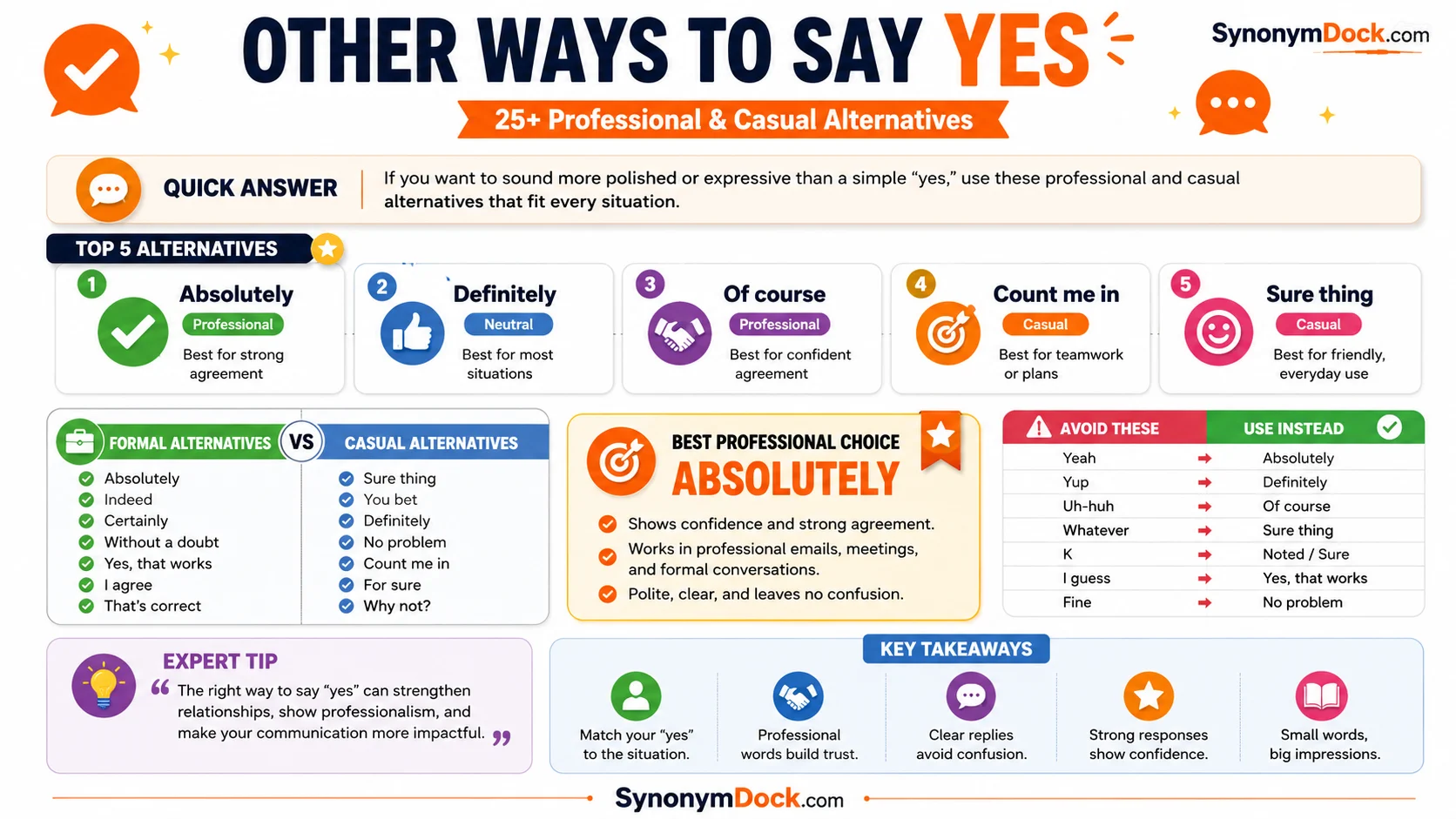
What are other ways to say yes professionally and casually?Other ways to say yes include “Absolutely,” “Certainly,” and “I’d be delighted” for professional settings. For casual conversations, use “Yeah,” “Yep,” or “Sure thing.” In formal writing, “Indeed,” “I concur,” and “By all means” convey polished agreement. The right choice depends on context and your relationship with the listener.
Yes is one of the first words English learners master. But relying on it too often can make your speech sound repetitive and flat. This article explores 25+ other ways to say yes, from professional expressions for the workplace to casual alternatives for everyday conversations.
Whether you’re writing a business email, participating in a meeting, or chatting with friends, you’ll find the right phrase for every situation.
Quick Categories
Formal Alternatives
- I concur
- Indeed
- By all means
- I am in full agreement
- Affirmative
Pro Tip: Use these in business meetings, academic writing, and professional correspondence. They demonstrate respect and polish.
Professional Alternatives
- Absolutely
- Certainly
- I’m on board
- Sounds good
- Consider it done
Pro Tip: These work well in workplace emails and team discussions. They show enthusiasm while remaining professional.
Business Email Alternatives
- I’d be delighted
- That works for me
- Happy to
- Will do
- I’m happy to assist
Pro Tip: Emails benefit from warm, clear agreement phrases. These convey professionalism and positivity.
Academic Alternatives
- I concur with your assessment
- That aligns with my perspective
- I share your view
- Precisely
- That’s correct
Pro Tip: Academic writing requires precise, measured language. These phrases maintain scholarly tone.
Casual Alternatives
- Yeah
- Yep / Yup
- Sure
- No problem
- Okay
Pro Tip: Save these for friends, family, and informal settings. They’re natural but too casual for professional use.
Informal Expressions
- You bet
- Totally
- Cool
- Sounds like a plan
- Alrighty
Pro Tip: These add personality and energy to casual conversations. Use them with people you know well.
“The right tone makes your English sound more confident.”
Common Mistakes
Mistake 1: Using “Yeah” in Formal Situations
Why it’s incorrect: “Yeah” is informal and can sound disrespectful in professional settings.
Correct version: Use “Absolutely” or “Certainly.”
Example Sentence: Instead of saying “Yeah, I’ll do that,” say “Certainly, I’ll take care of that.”
Mistake 2: Mixing Formal and Casual Styles
Why it’s incorrect: Inconsistent tone confuses listeners and undermines professionalism.
Correct version: Match your language to the context.
Example Sentence: Avoid saying “I concur, dude.” Choose either formal or casual consistently.
Mistake 3: Overusing “Sure” in Writing
Why it’s incorrect: In written communication, “sure” can sound dismissive or reluctant.
Correct version: “Certainly” or “Absolutely” in emails.
Example Sentence: Instead of “Sure, I can help,” write “I’d be happy to help.”
Mistake 4: Using “I guess so” When You Mean “Yes”
Why it’s incorrect: This phrase suggests uncertainty or reluctance. Use it only when you truly mean “maybe.”
Correct version: “Absolutely” or “Definitely.”
Example Sentence: Instead of “I guess so,” try “Yes, I agree.”
Mistake 5: Saying “No problem” in Formal Emails
Why it’s incorrect: “No problem” is casual and can feel dismissive in professional writing.
Correct version: “My pleasure” or “I’d be happy to.”
Example Sentence: Use “I’d be happy to assist” rather than “No problem.”
What Does “Yes” Mean?
Yes is the most common affirmative response in English. It signals agreement, approval, confirmation, or willingness.
Simple Explanation: When you say “yes,” you’re telling someone you agree, accept, or confirm what they’ve said.
Grammar Note: “Yes” functions as an interjection in response to questions, requests, and statements.
Example Sentence: “Would you like to attend the conference?” “Yes, I’d love to.”
When to Use “Yes”
“Yes” is versatile and works in many situations, but alternatives add nuance.
Common Situations:
- Business: Responding to requests, confirming plans
- Academic: Agreeing with theories, confirming understanding
- Daily Conversation: Accepting invitations, answering questions
- Emails: Confirming arrangements, agreeing to tasks
- Meetings: Supporting ideas, giving approval
Professional Context: In workplace English, a simple “yes” can sometimes sound flat. Using varied expressions shows engagement and confidence.
Is It Professional or Polite?
“Yes” is both professional and polite in most situations.
| Attribute | Rating | Explanation |
|---|---|---|
| Polite? | ✔ Yes | “Yes” is polite and clear. |
| Professional? | Depends | In formal settings, alternatives like “Certainly” sound more polished. |
| Formal? | Sometimes | “Yes” is neutral; context determines formality. |
| Natural? | Yes | “Yes” is widely used by native speakers. |
Business Example: “Yes, I’ll prepare the report” is fine, but “Certainly, I’ll prepare the report” sounds more professional.
Pros and Cons of “Yes”
Pros
- Easy to understand
- Friendly and approachable
- Common in all English varieties
- Appropriate for most situations
Cons
- Overused can sound repetitive
- Lacks nuance and enthusiasm
- Too casual for some workplaces
- Not ideal for formal writing
“Choosing the right phrase matters as much as choosing the right words.”
25+ Other Ways to Say Yes
Native speakers use a wide range of expressions instead of “yes.” Here are the most useful alternatives, organized by formality and context.
1. Absolutely
Meaning: Complete agreement without doubt.
Explanation: This phrase adds strong emphasis to your agreement. Native speakers use it to show confidence and enthusiasm. It works in both professional and casual contexts.
Example Sentence: “Are you coming to the strategy meeting?” “Absolutely, I wouldn’t miss it.”
Best Use: Workplace Meetings, Professional Emails
Avoid Using In: Casual Text Messages (it can sound overly formal)
Tone: Confident, Enthusiastic
Formality Level: ⭐⭐⭐⭐ Formal
Usage Frequency: Very Common
CEFR Level: B1
Common Collocations:
- absolutely agree
- absolutely certain
- absolutely sure
- absolutely yes
- absolutely perfect
Context Variability:
- Spoken English: “Absolutely!” expresses strong enthusiasm.
- Professional English: “I absolutely agree with your proposal.”
- Casual Conversation: “Do you want to go?” “Absolutely!”
2. Certainly
Meaning: A polite, formal way to agree or confirm.
Explanation: “Certainly” is a favorite in professional and customer service contexts. It sounds helpful and respectful. Native speakers often use it when offering assistance or confirming arrangements.
Example Sentence: “Can you send the files by 3 PM?” “Certainly, I’ll have them ready.”
Best Use: Business Emails, Client Communication
Avoid Using In: Casual Conversation (sounds too formal)
Tone: Polite, Professional
Formality Level: ⭐⭐⭐⭐ Formal
Usage Frequency: Very Common
CEFR Level: B1
Common Collocations:
- certainly can
- certainly will
- certainly hope so
- certainly not
- certainly agree
Context Variability:
- Spoken English: “Certainly!” is polite and warm.
- Professional English: “I certainly support this initiative.”
- Casual Conversation: Rare, sounds stiff.
3. Of Course
Meaning: An obvious or expected yes.
Explanation: “Of course” implies the answer is natural or expected. It can sound very polite, but tone matters it can also sound sarcastic if used incorrectly. Native speakers use it frequently in service settings.
Example Sentence: “Would you mind helping me with this?” “Of course, I’d be happy to.”
Best Use: Customer Service, Everyday Conversation
Avoid Using In: Formal Academic Writing
Tone: Helpful, Warm
Formality Level: ⭐⭐⭐ Neutral
Usage Frequency: Very Common
CEFR Level: A2
Common Collocations:
- of course not
- of course I will
- of course you can
- of course not
- of course it is
Context Variability:
- Spoken English: Very common and natural.
- Professional English: “Of course, I’ll handle it.” (warm but professional)
- Casual Conversation: “Of course, I’ll come!”
4. Definitely
Meaning: A strong, confident yes.
Explanation: “Definitely” removes all doubt. It’s more forceful than a simple “yes” and shows certainty. Native speakers use it to reassure or emphasize commitment.
Example Sentence: “Will you be at the conference?” “Definitely. I’ve already booked my flight.”
Best Use: Workplace Meetings, Commitments
Avoid Using In: Situations requiring formality (e.g., legal contracts)
Tone: Confident, Assured
Formality Level: ⭐⭐⭐ Neutral
Usage Frequency: Very Common
CEFR Level: B1
Common Collocations:
- definitely agree
- definitely will
- definitely want
- definitely need
- definitely going
Context Variability:
- Spoken English: “Definitely!” is enthusiastic.
- Professional English: “I definitely support this direction.”
- Casual Conversation: “Definitely coming tonight!”
5. I Concur
Meaning: Formal agreement with an opinion or statement.
Explanation: “I concur” is distinctly formal. It’s used in academic and professional discussions when you want to sound precise. Native speakers use it less often than “I agree” but appreciate its elegance in formal settings.
Example Sentence: “I concur with your assessment of the quarterly results.”
Best Use: Academic Writing, Formal Meetings
Avoid Using In: Daily Conversation (sounds stiff)
Tone: Formal, Precise
Formality Level: ⭐⭐⭐⭐⭐ Very Formal
Usage Frequency: Occasional
CEFR Level: C1
Common Collocations:
- concur with
- concur that
- concur wholeheartedly
- concur fully
- concur in the view
Context Variability:
- Spoken English: Rare, sounds academic.
- Professional English: Effective in formal presentations.
- Casual Conversation: Avoid; sounds strange.
“Mastering agreement phrases helps you sound more fluent and confident.”
6. By All Means
Meaning: A polite, encouraging yes.
Explanation: “By all means” gives enthusiastic permission. It’s friendly yet formal enough for professional use. Native speakers use it to warmly agree to requests.
Example Sentence: “May I use your printer?” “By all means, go ahead.”
Best Use: Permission Requests, Professional Email
Avoid Using In: Casual Texting (sounds formal)
Tone: Encouraging, Polite
Formality Level: ⭐⭐⭐⭐ Formal
Usage Frequency: Occasional
CEFR Level: B2
Common Collocations:
- by all means, go ahead
- by all means, please
- by all means, do
- by all means, take
- by all means, feel free
Context Variability:
- Spoken English: Warm and polite.
- Professional English: Great for granting permissions.
- Casual Conversation: Works but sounds a bit formal.
7. I’m On Board
Meaning: Agreement and willingness to participate.
Explanation: This phrase is common in workplace discussions. It suggests you not only agree but are ready to contribute. Native speakers use it to show active support.
Example Sentence: “The team’s plan sounds solid. I’m on board.”
Best Use: Team Meetings, Collaborative Projects
Avoid Using In: Formal Academic Essays
Tone: Collaborative, Positive
Formality Level: ⭐⭐⭐ Neutral
Usage Frequency: Common
CEFR Level: B2
Common Collocations:
- fully on board
- completely on board
- happy to be on board
- get on board
- on board with the plan
Context Variability:
- Spoken English: “I’m totally on board with that!”
- Professional English: “I’m on board with the new strategy.”
- Casual Conversation: “I’m on board for the trip!”
8. Consider It Done
Meaning: Confirmation that a task will be completed.
Explanation: This phrase shows reliability. It’s common in professional settings when agreeing to take on a task. Native speakers use it to reassure colleagues or clients.
Example Sentence: “Please handle the client’s request.” “Consider it done.”
Best Use: Task Confirmation, Client Communication
Avoid Using In: Situations Requiring Tentative Agreement
Tone: Reliable, Confident
Formality Level: ⭐⭐⭐ Neutral
Usage Frequency: Common
CEFR Level: B2
Common Collocations:
- consider it handled
- consider it settled
- consider it taken care of
- consider it resolved
- consider it a done deal
Context Variability:
- Spoken English: “Consider it done!” shows confidence.
- Professional English: Reassuring in emails.
- Casual Conversation: “Done!” is more common.
9. I’d Be Delighted
Meaning: A warm, polite way to accept an offer.
Explanation: This phrase expresses genuine pleasure. It’s formal enough for professional contexts but carries a friendly tone. Native speakers use it to respond positively to invitations or requests.
Example Sentence: “Would you join us for the presentation?” “I’d be delighted.”
Best Use: Accepting Invitations, Formal Responses
Avoid Using In: Very Casual Settings
Tone: Warm, Formal
Formality Level: ⭐⭐⭐⭐ Formal
Usage Frequency: Occasional
CEFR Level: B2
Common Collocations:
- delighted to help
- delighted to assist
- delighted to join
- delighted to accept
- delighted to be here
Context Variability:
- Spoken English: “I’d be delighted!” sounds charming.
- Professional English: “I’d be delighted to help with that.”
- Casual Conversation: “Delighted!” can sound slightly old-fashioned.
10. That Works for Me
Meaning: Agreement that a suggestion is acceptable.
Explanation: This is a practical, clear way to agree to a plan. It’s common in workplace scheduling and collaboration. Native speakers use it frequently in discussion settings.
Example Sentence: “Shall we meet at 2 PM on Thursday?” “That works for me.”
Best Use: Scheduling, Team Collaboration
Avoid Using In: Formal Written Reports
Tone: Practical, Clear
Formality Level: ⭐⭐⭐ Neutral
Usage Frequency: Very Common
CEFR Level: B1
Common Collocations:
- works for me
- works perfectly
- works well
- works fine
- sounds like it works
Context Variability:
- Spoken English: Very common in conversation.
- Professional English: “That works for me” is widely used.
- Casual Conversation: “Works for me” is natural.
“Choosing the right phrase matters as much as choosing the right words.”
11. I Share Your View
Meaning: Agreement with someone’s perspective.
Explanation: This is a professional way to align with someone. It shows respect for their opinion while stating your own agreement. It’s useful in collaborative discussions.
Example Sentence: “I share your view on prioritizing customer feedback.”
Best Use: Strategic Discussions, Collaborative Meetings
Avoid Using In: Casual Daily Conversation
Tone: Respectful, Professional
Formality Level: ⭐⭐⭐⭐ Formal
Usage Frequency: Occasional
CEFR Level: B2
Common Collocations:
- share your view on
- share your perspective
- share your opinion
- share your assessment
- share your concerns
Context Variability:
- Spoken English: “I share your view” sounds thoughtful.
- Professional English: Excellent in meetings.
- Casual Conversation: “I see it that way too” is more natural.
12. That’s Spot On
Meaning: Agreement that something is exactly correct.
Explanation: “Spot on” is a common British English phrase meaning “exactly right.” It’s casual but widely used in professional contexts as well. Native speakers use it to praise accuracy.
Example Sentence: “Her analysis of the market was spot on.”
Best Use: Praising Accuracy, Affirming Ideas
Avoid Using In: Very Formal Academic Writing
Tone: Affirmative, Warm
Formality Level: ⭐⭐ Casual
Usage Frequency: Common
CEFR Level: B2
Common Collocations:
- spot on assessment
- spot on analysis
- spot on prediction
- absolutely spot on
- completely spot on
Context Variability:
- Spoken English: “Your answer was spot on!”
- Professional English: Works well in casual workplace settings.
- Casual Conversation: Very common and natural.
13. Sounds Like a Plan
Meaning: Agreement with a suggested course of action.
Explanation: This is a friendly, informal way to agree to a proposal. Native speakers use it when finalizing plans with colleagues or friends. It signals enthusiasm for the idea.
Example Sentence: “Let’s grab lunch at 1 and discuss the project.” “Sounds like a plan.”
Best Use: Daily Conversation, Team Coordination
Avoid Using In: Formal Written Communication
Tone: Friendly, Agreeable
Formality Level: ⭐⭐ Casual
Usage Frequency: Common
CEFR Level: B1
Common Collocations:
- sounds like a good plan
- sounds like a solid plan
- sounds like a great plan
- sounds like the perfect plan
- like that plan
Context Variability:
- Spoken English: “Sounds like a plan!” is very natural.
- Professional English: Accepted in workplace conversations.
- Casual Conversation: Very common.
14. You Bet
Meaning: An enthusiastic, confident yes.
Explanation: “You bet” is a casual American expression. It’s used to strongly agree or show eagerness. Native speakers use it in friendly, informal situations.
Example Sentence: “Can you help me move that table?” “You bet!”
Best Use: Casual Requests, Informal Agreements
Avoid Using In: Business Emails, Formal Situations
Tone: Enthusiastic, Friendly
Formality Level: ⭐ Casual
Usage Frequency: Common
CEFR Level: B1
Common Collocations:
- you betcha (informal variant)
- you bet your life (stronger emphasis)
- you better believe it
- bet on it
Context Variability:
- Spoken English: “You bet!” is warm and energetic.
- Professional English: “Absolutely” is more professional.
- Casual Conversation: Very natural.
15. Indeed
Meaning: Formal confirmation or emphatic agreement.
Explanation: “Indeed” is a classic formal agreement word. It can confirm statements or add emphasis. Native speakers use it in formal writing and polite conversation to sound articulate.
Example Sentence: “The data supports this conclusion.” “Indeed, it does.”
Best Use: Formal Writing, Academic Discussion
Avoid Using In: Casual Daily Conversation
Tone: Formal, Emphatic
Formality Level: ⭐⭐⭐⭐⭐ Very Formal
Usage Frequency: Common (in formal contexts)
CEFR Level: B2
Common Collocations:
- indeed it does
- indeed it is
- indeed it was
- indeed, I think
- very much indeed
Context Variability:
- Spoken English: “Indeed” sounds articulate but formal.
- Professional English: Excellent in formal communication.
- Casual Conversation: Rare, sounds stiff.
16. Gladly
Meaning: Willing agreement with positive attitude.
Explanation: “Gladly” shows enthusiasm for helping. It’s polite and works in both professional and personal contexts. Native speakers use it to accept tasks or invitations warmly.
Example Sentence: “Could you answer this client’s call?” “Gladly.”
Best Use: Accepting Tasks, Offering Help
Avoid Using In: Very Formal Legal Documents
Tone: Warm, Willing
Formality Level: ⭐⭐⭐ Neutral
Usage Frequency: Common
CEFR Level: B1
Common Collocations:
- gladly help
- gladly assist
- gladly accept
- gladly agree
- gladly do it
Context Variability:
- Spoken English: “Gladly!” sounds helpful.
- Professional English: “I’d gladly take that on.”
- Casual Conversation: “I’ll gladly help.”
Native Speaker Tip #1: The Power of Context
Native speakers choose their “yes” based on context. In professional emails, “Certainly” and “Absolutely” are safe choices. In conversation, “Yeah,” “Yep,” and “Sure” dominate. The most natural speakers match their language to the situation and relationship.
17. I’m In
Meaning: Agreement to participate or join.
Explanation: This is a very common way to accept an invitation or join a group activity. Native speakers use it frequently in social and professional settings.
Example Sentence: “We’re planning a team dinner on Friday.” “I’m in!”
Best Use: Social Invitations, Team Activities
Avoid Using In: Formal Written Agreements
Tone: Enthusiastic, Casual
Formality Level: ⭐⭐ Casual
Usage Frequency: Very Common
CEFR Level: B1
Common Collocations:
- count me in
- I’m in for
- I’m totally in
- I’m in if you are
- sign me in
Context Variability:
- Spoken English: “I’m in!” is energetic.
- Professional English: “Count me in” is acceptable in workplace chat.
- Casual Conversation: Very common.
18. Sure Thing
Meaning: A friendly, confident yes.
Explanation: “Sure thing” is a casual but warm way to agree. Native speakers use it to respond to requests or confirm plans. It’s less formal than “Certainly” but more than “Sure” alone.
Example Sentence: “Can you hold this for me?” “Sure thing!”
Best Use: Customer Service, Friendly Agreements
Avoid Using In: Formal Business Emails
Tone: Friendly, Helpful
Formality Level: ⭐⭐ Casual
Usage Frequency: Common
CEFR Level: B1
Common Collocations:
- sure thing, no problem
- sure thing, will do
- sure thing, I’ll handle it
- sure thing, coming right up
Context Variability:
- Spoken English: “Sure thing!” is very natural.
- Professional English: Accepted in workplace situations.
- Casual Conversation: Common and friendly.
19. Will Do
Meaning: Agreement to complete a task.
Explanation: “Will do” is common in professional and casual contexts. It’s a quick, reliable way to confirm a request. Native speakers use it frequently to acknowledge tasks.
Example Sentence: “Please send me the updated file.” “Will do.”
Best Use: Task Confirmation, Workplace Communication
Avoid Using In: Formal Written Reports
Tone: Reliable, Direct
Formality Level: ⭐⭐⭐ Neutral
Usage Frequency: Very Common
CEFR Level: B1
Common Collocations:
- will do right away
- will do that
- will do it
- will do first thing
- will do as requested
Context Variability:
- Spoken English: “Will do” is brief and direct.
- Professional English: “Will do” is workplace-appropriate.
- Casual Conversation: “Will do” works well.
20. I’m Happy To
Meaning: Willing agreement with a positive tone.
Explanation: This phrase shows you’re pleased to help or participate. It’s professional yet warm. Native speakers use it in emails and conversations to sound helpful.
Example Sentence: “Can you review the presentation?” “I’m happy to.”
Best Use: Accepting Requests, Professional Emails
Avoid Using In: Extremely Formal Legal Contexts
Tone: Positive, Helpful
Formality Level: ⭐⭐⭐ Neutral
Usage Frequency: Common
CEFR Level: B1
Common Collocations:
- happy to help
- happy to assist
- happy to participate
- happy to contribute
- happy to support
Context Variability:
- Spoken English: “I’m happy to!” sounds sincere.
- Professional English: Great for email responses.
- Casual Conversation: “Happy to help” is natural.
“Native speakers choose their words based on context. The right phrase makes your English sound more natural and confident.”
21. No Problem
Meaning: A casual, friendly agreement.
Explanation: “No problem” is widely used in informal contexts. It suggests willingness without feeling like you’re making an effort. Native speakers use it to respond to requests or thanks.
Example Sentence: “Could you help with this order?” “No problem.”
Best Use: Casual Requests, Everyday Conversations
Avoid Using In: Formal Business Emails
Tone: Relaxed, Helpful
Formality Level: ⭐⭐ Casual
Usage Frequency: Very Common
CEFR Level: A2
Common Collocations:
- no problem at all
- no problem whatsoever
- not a problem
- problem solved
Context Variability:
- Spoken English: “No problem” is everywhere in casual speech.
- Professional English: Some workplaces consider it too casual.
- Casual Conversation: Very natural.
22. You Got It
Meaning: Confirmation that you understand and will comply.
Explanation: This is a friendly, reassuring way to agree. Native speakers use it to show they’ve understood a request. It’s common in customer service and casual conversation.
Example Sentence: “Please update the schedule for next week.” “You got it.”
Best Use: Customer Service, Workplace Communication
Avoid Using In: Formal Written Agreements
Tone: Reassuring, Friendly
Formality Level: ⭐⭐ Casual
Usage Frequency: Common
CEFR Level: B1
Common Collocations:
- got it
- you got it right away
- you got it, boss
- you got it, no problem
Context Variability:
- Spoken English: “You got it” is reassuring.
- Professional English: Common in workplace chat.
- Casual Conversation: Very friendly.
23. Fair Enough
Meaning: Accepting a point as reasonable.
Explanation: This is a slightly cautious way to agree. It suggests you’re convinced by the reasoning. Native speakers use it in discussions when they accept someone’s logic.
Example Sentence: “I think we should wait until next week.” “Fair enough.”
Best Use: Negotiations, Informal Discussions
Avoid Using In: Formal Corporate Meetings (could sound uncertain)
Tone: Accepting, Reasonable
Formality Level: ⭐⭐ Casual
Usage Frequency: Common
CEFR Level: B2
Common Collocations:
- that’s fair
- fair enough, I agree
- fair point
- fairly reasonable
Context Variability:
- Spoken English: “Fair enough” is natural.
- Professional English: Works in discussions.
- Casual Conversation: Common and accepted.
24. Right On
Meaning: Strong approval or agreement.
Explanation: This is an enthusiastic, informal phrase. It originated in American counterculture but is now mainstream. Native speakers use it to express strong support for an idea.
Example Sentence: “We need to reduce plastic waste.” “Right on!”
Best Use: Enthusiastic Agreement, Social Conversations
Avoid Using In: Formal Business Contexts
Tone: Enthusiastic, Supportive
Formality Level: ⭐ Casual
Usage Frequency: Occasional
CEFR Level: B2
Common Collocations:
- right on, man
- right on, that’s the spirit
- right on, exactly
Context Variability:
- Spoken English: “Right on” is energetic.
- Professional English: “Absolutely” is better.
- Casual Conversation: Shows enthusiasm.
25. Go On Then
Meaning: Reluctant but amused agreement.
Explanation: This phrase is very British. It suggests you’re agreeing despite reservations, often with humor. Native speakers use it when someone insists.
Example Sentence: “You must try this dessert.” “Oh, go on then.”
Best Use: Casual Conversation, Social Settings
Avoid Using In: Professional Communication
Tone: Playful, Reluctant
Formality Level: ⭐ Very Casual
Usage Frequency: Occasional
CEFR Level: B2
Common Collocations:
- oh, go on then
- fine, go on
- go on, I’ll have one
Context Variability:
- Spoken English: British and charming.
- Professional English: Too casual.
- Casual Conversation: Fun and natural.
Expert Insight: Matching Tone to Audience
The most important skill is matching your language to the audience. In a corporate email, “Certainly” projects professionalism. In a team meeting, “I’m on board” shows collaboration. With friends, “You bet” feels natural. The same word in the wrong context can feel out of place.
Top 10 Alternatives Compared
| Phrase | Tone | Formality | Best Use | Frequency |
|---|---|---|---|---|
| Absolutely | Enthusiastic | Formal | Professional Emails | Very Common |
| Certainly | Polite | Formal | Client Communication | Very Common |
| Of Course | Warm | Neutral | Everyday Use | Very Common |
| Definitely | Confident | Neutral | Commitments | Very Common |
| I Concur | Precise | Very Formal | Academic Writing | Occasional |
| I’m On Board | Collaborative | Neutral | Team Meetings | Common |
| You Bet | Enthusiastic | Casual | Social Settings | Common |
| Indeed | Formal | Very Formal | Formal Writing | Common (Formal) |
| Sure Thing | Friendly | Casual | Customer Service | Common |
| Will Do | Reliable | Neutral | Task Confirmation | Very Common |
Which One Should You Use?
Best Overall
Absolutely – works in almost every context.
Best Professional
Certainly – polished and respectful.
Best Academic
I Concur – precise and scholarly.
Best Business Email
I’m happy to – warm and professional.
Best Everyday Conversation
Sure – simple and natural.
Most Natural
Yeah – the native speaker’s default in casual settings.
Most Polite
I’d be delighted – warmly enthusiastic.
Scenario Practice
Scenario 1: Business Meeting
Your boss proposes launching a new product line. You support the idea.
Best Choice: “I’m on board with that strategy. The market research supports it.”
Scenario 2: Job Interview
The interviewer asks if you can handle tight deadlines.
Best Choice: “Certainly. I’ve managed several high-pressure projects successfully.”
Scenario 3: Friend’s Invitation
Your friend invites you to a concert.
Best Choice: “Definitely! I’d love to come.”
Scenario 4: Colleague Request
A colleague asks for help with a task.
Best Choice: “I’d be happy to help. What do you need?”
Scenario 5: Formal Email
You’re responding to a client who proposed a timeline.
Best Choice: “I concur with your proposed timeline and look forward to proceeding.”
Mini Quiz
1. Which phrase is best for a formal business email?
- a) You bet
- b) Sure thing
- c) Certainly
2. Which is the most informal way to say yes?
- a) I concur
- b) Yep
- c) I’m on board
3. Which phrase works best for accepting an invitation?
- a) I’d be delighted
- b) No problem
- c) Indeed
4. Which phrase shows reluctant agreement?
- a) Go on then
- b) Absolutely
- c) By all means
5. Which phrase is best for agreeing in a team meeting?
- a) I concur
- b) I’m on board
- c) Yeah
Answer Key
- c) Certainly – formal and polite.
- b) Yep – very informal, only for casual settings.
- a) I’d be delighted – warm and professional.
- a) Go on then – playful, reluctant agreement.
- b) I’m on board – collaborative and professional.
FAQs
What is the most formal way to say “yes”?
“I concur” is among the most formal. “Indeed” and “By all means” are also very formal and polished. Use these in academic writing, formal presentations, or professional documents where precision matters .
Which phrase is best for professional emails?
“Absolutely,” “Certainly,” and “I’d be happy to” are excellent choices for professional emails. They project confidence, warmth, and professionalism. Avoid “Yeah,” “Yep,” and “No problem” in formal correspondence .
What is the difference between “Sure” and “Certainly”?
“Sure” is casual and works in everyday conversation. “Certainly” is formal and more polite. In a professional email, “Certainly, I’ll handle it” sounds polished, while “Sure, I’ll handle it” may feel too relaxed for the workplace .
Which alternative sounds most natural?
“Yeah” is the most natural in casual spoken English. It’s the default among native speakers in everyday conversation. For professional contexts, “Absolutely” and “Certainly” sound natural and polished.
Can I use these expressions in business meetings?
Yes, but choose wisely. “I’m on board,” “That works for me,” and “Absolutely” are excellent in meetings. Avoid “Yeah,” “Yep,” and “You bet” unless the culture is very relaxed .
Conclusion
Learning other ways to say yes expands your English vocabulary and helps you sound more fluent and natural. From the formal “I concur” to the friendly “You bet,” each expression serves a purpose. The key is matching your language to the situation.
Start using these alternatives in your daily conversations, emails, and professional writing. With practice, you’ll feel confident choosing the right phrase for every context. Remember: variety is the spice of language and native speakers appreciate the effort!

7 thoughts on “Other Ways to Say Yes |25+ Alternatives With Examples 2026”