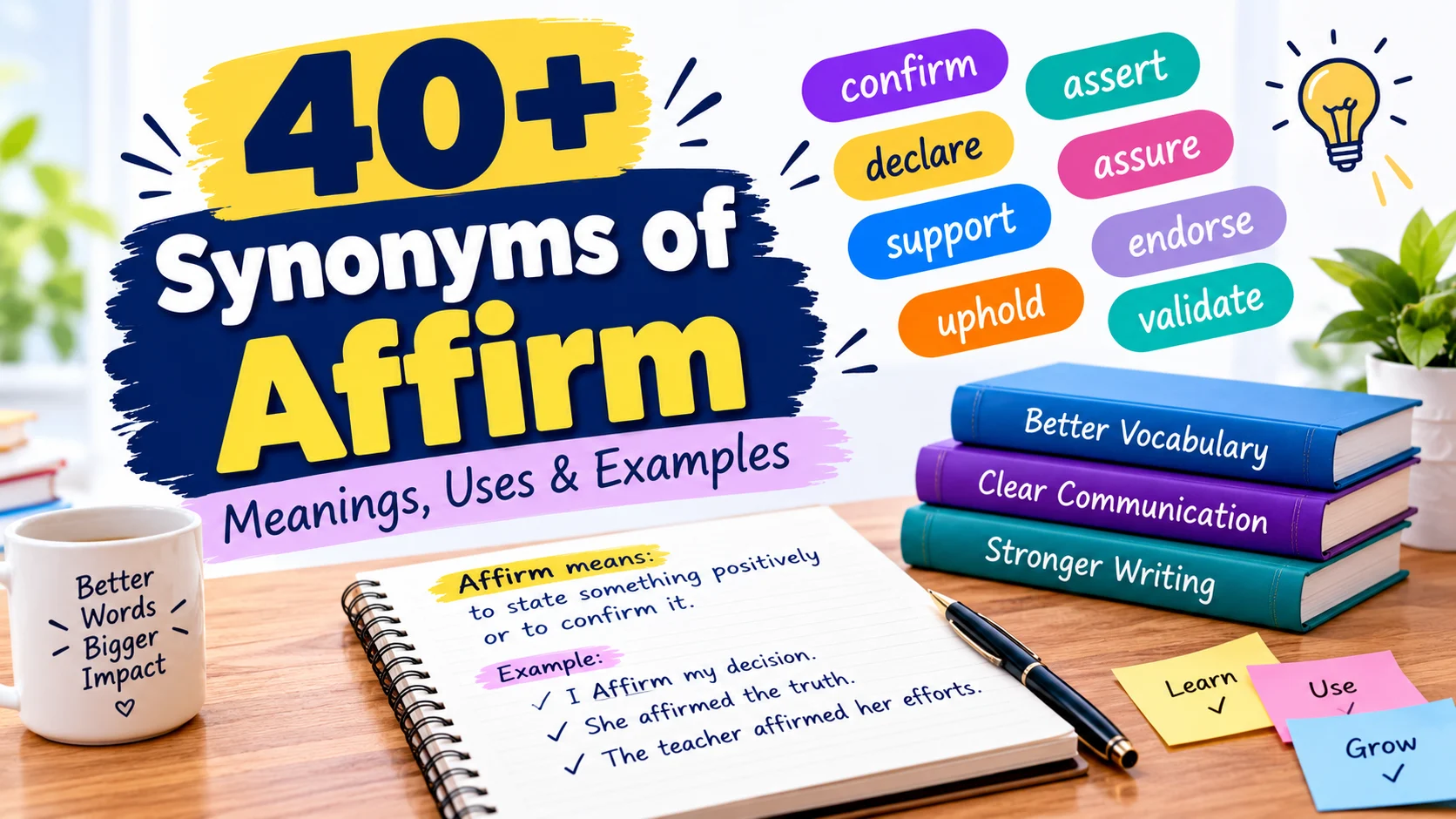
Affirm means to state something as true or to offer emotional support and validation. The best synonyms depend on your context. For formal writing, use “confirm” or “validate.” For casual conversation, say “yes” or “acknowledge.” For professional communication, choose “certify” or “corroborate.” In emotional or supportive contexts, “reassure” works well.
Have you ever caught yourself using the same word over and over in an email, essay, or social media caption? Maybe you wrote “confirm” three times in one paragraph and felt stuck. Most writers face this challenge. Finding the right synonym of affirm can transform dull repetition into clear, confident communication. Choosing the right word improves clarity, sets the right tone, and helps readers understand your exact meaning. This guide will help you discover every useful synonym of affirm so you can write with precision and confidence.
Meaning, Tone, and Context
Simple Definition
Affirm means to declare something is true or to express strong agreement. It can also mean offering emotional support, encouragement, or validation to someone.
Part of Speech
Verb
Overall Tone
Positive
Formality Level
Semi-formal to formal
Common Uses
Native English speakers use affirm in several common situations. Lawyers use it in court when witnesses swear to tell the truth. Managers use it in meetings to confirm decisions. Therapists and counselors use it to validate someone’s feelings. Writers use it in persuasive essays to state a position clearly. It appears often in academic writing, professional communication, and personal encouragement.
Word Forms
| Form | Word |
| Verb | Affirm |
| Noun | Affirmation |
| Adjective | Affirmative |
| Adverb | Affirmatively |
| Opposite | Deny, Contradict |
When and How to Use “Affirm”
Choose “affirm” when you want to state something with confidence or offer genuine emotional support. It carries weight without sounding aggressive.
7 Realistic Examples
Professional
The CEO affirmed the company’s commitment to sustainability during the quarterly meeting.
Academic
The research findings affirm the connection between sleep quality and cognitive performance.
Workplace
I want to affirm your contribution to this project. Your work made a real difference.
Personal
She affirmed his feelings by listening carefully and responding with compassion.
Email
Please affirm your attendance by replying to this message before Friday.
Resume
Affirmed client satisfaction through consistent follow-up and quality service delivery.
Social Media
I want to affirm every person working toward their goals today. Keep going. You matter.
Best Synonyms of “Affirm”
No synonym works perfectly in every situation. Each alternative carries its own tone, intensity, and best use case.
Professional Writing
Confirm – This is the safest and most common choice. It works well in business reports, meeting summaries, and official documents.
Academic Writing
Corroborate – This sounds more formal and precise. Use it when your writing needs a higher level of scholarly authority.
Business Communication
Validate – Use this to show something meets required standards or has been properly reviewed.
Casual Conversation
Acknowledge – This feels natural in everyday speech and shows you heard and understood someone.
Emotional Writing
Reassure – Use this to comfort someone or ease their concerns. It carries warmth and support.
Creative Writing
Proclaim – This adds drama and energy. Use it in storytelling to show a character making a bold statement.
Resume Writing
Certify – This demonstrates verified skills or accomplishments. It adds credibility to your qualifications.
Workplace Communication
Assure – Use this to build trust and remove doubt in professional relationships.
Stronger Meaning
Avow – This is stronger than affirm. It suggests public declaration and firm conviction.
Softer Meaning
Say – When you need a simple, neutral verb without added weight.
When Not to Use “Affirm”
When the Word Sounds Too General
If you simply need to acknowledge something minor, “affirm” feels too formal.
Weak: I affirm your email.
Better: I acknowledge your email.
When the Word Sounds Too Vague
Affirm can feel unclear when you need to specify exactly what action is being confirmed.
Weak: Please affirm this.
Better: Please confirm your attendance.
When the Word Sounds Too Formal
In casual texting or everyday conversation, “affirm” sounds stiff.
Weak: I affirm that I’ll be there.
Better: Yes, I’ll be there.
When the Word Sounds Too Weak
For bold, passionate statements, “affirm” lacks energy.
Weak: I affirm my belief in justice.
Better: I proclaim my belief in justice.
When the Word Sounds Outdated
Some synonyms like “aver” are rarely used today. Avoid them unless writing period dialogue.
When the Word Is Overused
Using the same word repeatedly weakens your writing. Replace it with stronger or more specific alternatives.
Words Commonly Confused With “Affirm”
Affirm vs Confirm
Difference
Affirm focuses on stating something as true. Confirm focuses on verifying facts or details.
When to Use It
Use affirm for declarations of truth and support. Use confirm when checking accuracy.
Example
She affirmed her loyalty to the team.
The lab results confirmed the diagnosis.
Affirm vs Assert
Difference
Assert suggests defending a position with confidence, sometimes aggressively. Affirm feels gentler and more supportive.
When to Use It
Use assert when you need to defend a point forcefully. Use affirm for confident statements that don’t require argument.
Example
He asserted his rights during the negotiation.
She affirmed the value of her colleague’s idea.
Affirm vs Avow
Difference
Avow is more emotional and public. It suggests openly declaring something deeply personal.
When to Use It
Use avow for passionate public statements. Use affirm for straightforward declarations.
Example
The politician avowed his commitment to reform.
The witness affirmed the truth of his statement.
Affirm vs Validate
Difference
Validate focuses on proving something is correct or acceptable. Affirm focuses on stating truth or offering support.
When to Use It
Use validate when discussing processes, data, or qualifications. Use affirm for emotional support or statements.
Example
We need to validate these findings with more research.
I want to affirm your feelings about this situation.
Affirm vs Reassure
Difference
Reassure is entirely about reducing fear or worry. Affirm can be about stating truth without emotional support.
When to Use It
Use reassure when someone is anxious. Use affirm when you’re simply stating a fact.
Example
The doctor reassured the anxious patient.
The data affirms our original hypothesis.
Affirm vs Corroborate
Difference
Corroborate means to support something with evidence. Affirm means to state something as true, with or without evidence.
When to Use It
Use corroborate in research or legal contexts. Use affirm for statements of belief or support.
Example
The witness corroborated the suspect’s alibi.
The board affirmed the new policy direction.
Best Synonyms of “Affirm” by Context
| Context | Best Synonym | Why It Works | Example |
| Formal writing | Confirm | Clear, widely accepted, professional | Please confirm your receipt of this document. |
| Academic writing | Corroborate | Sounds rigorous and evidence-based | The study corroborates earlier research. |
| Professional communication | Validate | Shows thorough review and approval | We need to validate these figures before release. |
| Business emails | Acknowledge | Polite and appropriate for correspondence | I acknowledge the concerns you raised. |
| Resume writing | Certify | Demonstrates verified achievement | Certified in project management methodology. |
| Workplace communication | Assure | Builds trust and removes doubt | I assure you the deadline will be met. |
| Casual conversation | Say | Simple and natural | I say you’re absolutely right. |
| Everyday speaking | Yes | Direct and clear | Yes, I agree with that. |
| Creative writing | Proclaim | Adds drama and boldness | She proclaimed her love in front of everyone. |
| Storytelling | Declare | Clear and emphatic for narrative | The king declared his decision. |
| Emotional writing | Reassure | Offers comfort and support | Let me reassure you that you’re not alone. |
| Strong emphasis | Avow | Carries passionate conviction | He avowed his dedication to the cause. |
| Mild tone | Acknowledge | Gentle and respectful | I acknowledge your point. |
| Social media captions | Validate | Modern and relatable | Validate your friends. Tell them they matter. |
How to Choose the Best Synonym of “Affirm”
Start by asking yourself a few questions.
What is my purpose?
Are you stating a fact, verifying information, offering support, or making a public declaration?
Who is my audience?
A formal report needs words like “confirm” or “corroborate.” A friendly email can use “acknowledge” or “say.”
What tone do I want?
Do you want to sound warm, formal, bold, or neutral? Your tone guides your word choice.
How strong should it be?
Use “avow” for powerful declarations. Use “say” for simple statements.
Is emotion involved?
Use “reassure” or “validate” when supporting others.
Does this sound natural?
Read your sentence aloud. If the synonym feels forced or strange, choose a different one.
The goal is clear communication. Choose the word that conveys your exact meaning without confusing your reader.
Real Life Examples of “Affirm”
School
The teacher affirmed every student who participated in the discussion.
College
The professor affirmed the student’s interpretation of the literary text.
Workplace
My manager affirmed my proposal during the meeting.
Business
The contract affirms our commitment to deliver quality service.
I want to affirm that we received your application and will review it soon.
Resume
Affirmed customer satisfaction scores through consistent service excellence.
Conversation
“I affirm what you just said,” she replied. “That’s exactly how I feel too.”
Storytelling
The elders affirmed the young warrior’s place in the group.
Blogging
Affirm your readers. Let them know their struggles and successes matter.
Social Media
Affirm someone today. A kind word can change their whole day.
18 Best Synonyms of “Affirm”
| Synonym | Simple Meaning | Best Used For | Example Sentence |
| Confirm | State that something is true or accurate | Professional communication | The committee confirmed the meeting date. |
| Validate | Prove something is correct or acceptable | Academic writing | The study validates the theory. |
| Corroborate | Support with evidence | Research and legal contexts | The data corroborates our hypothesis. |
| Acknowledge | Recognize or admit something | Everyday conversation | I acknowledge your contribution to this project. |
| Assure | Tell someone confidently to remove doubt | Workplace communication | I assure you the project is on schedule. |
| Reassure | Comfort someone and ease their worries | Emotional writing | She reassured him that everything would be fine. |
| Certify | Officially confirm something is true | Resumes and official documents | The school certified his graduation status. |
| Proclaim | Announce something publicly and boldly | Creative writing | The mayor proclaimed a new holiday. |
| Declare | State something clearly and firmly | Storytelling | The judge declared the verdict. |
| Avow | Openly admit or declare something personal | Strong declarations | She avowed her commitment to social justice. |
| Endorse | Publicly support or approve something | Professional recommendations | The expert endorsed the new product. |
| Attest | Provide evidence or proof of something | Legal and formal contexts | The witness attested to the incident. |
| Aver | State something confidently | Formal declarations | He averred that the policy was effective. |
| Maintain | Keep stating something as true | Argumentative writing | The lawyer maintained his client’s innocence. |
| Hold | Believe or consider something to be true | Philosophical discussions | I hold that honesty is always the best policy. |
| Submit | Offer something for consideration | Academic writing | The researcher submitted his findings. |
| Profess | Claim something openly | Professional and social contexts | She professed her expertise in the field. |
| Allege | State something without proof yet | Legal and journalistic contexts | The report alleges misconduct in the organization. |
Synonyms of “Affirm” by Usage
Professional vs Personal Synonyms
Professional contexts call for words like “confirm,” “validate,” “certify,” and “corroborate.” These sound credible and businesslike. Personal settings work better with “acknowledge,” “reassure,” and “say.” They feel warmer and more natural in everyday speech.
Formal vs Conversational Synonyms
Formal writing uses “corroborate,” “attest,” “aver,” and “proclaim.” These work in reports, essays, and presentations. Conversational English prefers “say,” “yes,” “tell,” and “agree.” They sound relaxed and human in texts and casual chats.
Academic Synonyms
“Corroborate,” “validate,” “substantiate,” and “confirm” are precise academic choices. They show evidence-based thinking and sound authoritative in research papers, essays, and scholarly discussions.
Professional and Business Synonyms
Confirm,” “validate,” “certify,” and “endorse” are excellent for work settings. They sound professional and demonstrate competence in resumes, interviews, meetings, and client communication.
Creative and Literary Synonyms
“Proclaim,” “declare,” “avow,” and “profess” add drama and flair to creative writing. They work well in storytelling, fiction, poetry, and speeches. They add emotional weight and visual imagery to your work.
Slang or Modern Synonyms
Modern English includes casual phrases like “for real,” “facts,” and “bet” in informal conversations. These work well in texts and on social media. Avoid them in professional or academic writing because they lack credibility.
Strongest to Mildest Synonyms
Mild
Acknowledge, Say, Yes, Agree
Moderate
Confirm, Validate, Assure, Endorse
Strong
Affirm, Declare, Certify, Attest
Very Strong
Avow, Proclaim, Corroborate, Aver
Emotional intensity increases as you move up the scale. Mild words are simple and neutral. Strong words carry conviction and power. Choose based on how much emphasis your message needs.
Emotional vs Neutral Synonyms
Emotional Synonyms
Reassure, Avow, Proclaim, Endorse, Profess
These words express feelings, support, passion, and personal conviction. Use them in personal conversations, supportive messages, and creative writing.
Neutral Synonyms
Confirm, Validate, Corroborate, Say, Acknowledge
These words share information without adding emotion. Use them in business communication, academic writing, and factual reporting.
Antonyms of “Affirm”
| Antonym | Meaning | Example Sentence |
| Deny | State something is not true | The politician denied the allegations. |
| Contradict | Say the opposite of what was said | His statement contradicts the evidence. |
| Dispute | Challenge the truth of something | The lawyer disputed the witness’s testimony. |
| Refute | Prove something is false | The scientist refuted the outdated theory. |
| Reject | Refuse to accept or agree with something | The committee rejected the proposal. |
| Negate | Make something ineffective or invalid | The new evidence negates our previous conclusion. |
| Disavow | Deny any responsibility or connection | The company disavowed knowledge of the incident. |
| Disclaim | Refuse to acknowledge or accept | The expert disclaimed any involvement in the project. |
| Repudiate | Refuse to accept or support something | The government repudiated the treaty. |
| Disprove | Show something is false | The experiment disproved the old theory. |
| Overturn | Reverse a decision or conclusion | The ruling overturned the lower court’s decision. |
| Invalidate | Make something no longer valid | The new law invalidates previous regulations. |
| Gainsay | Deny or contradict | No one could gainsay the evidence presented. |
| Forbid | Refuse to allow or accept | The rules forbid such behavior. |
| Veto | Reject a decision or proposal | The president vetoed the legislation. |
Comparison: “Affirm” vs Similar Words
Affirm vs Confirm
Main Difference
Affirm is about declaring truth or offering support. Confirm is about checking and verifying details.
Which Is Stronger?
Affirm is stronger emotionally. Confirm is stronger factually.
Which Is More Formal?
Both are formal, but confirm is more common in business and everyday use.
When to Use Each
Use affirm for statements of belief, loyalty, or support. Use confirm for verifying appointments, data, or processes.
Examples
Affirm: The witness affirmed his statement in court.
Confirm: Please confirm your attendance by tomorrow.
Affirm vs Assert
Main Difference
Affirm is supportive and gentle. Assert is forceful and defensive.
Which Is Stronger?
Assert is stronger and more argumentative.
Which Is More Formal?
Both are formal, but assert appears more often in legal and political contexts.
When to Use Each
Use affirm when you want to agree or support. Use assert when you need to defend a position.
Examples
Affirm: She affirmed her team’s hard work.
Assert: He asserted his authority in the meeting.
Affirm vs Avow
Main Difference
Avow is more passionate and public. Affirm can be private or public.
Which Is Stronger?
Avow is much stronger emotionally.
Which Is More Formal?
Avow is formal but less common in everyday writing.
When to Use Each
Use avow for passionate public declarations. Use affirm for straightforward statements of truth.
Examples
Affirm: The board affirmed the new policy.
Avow: She avowed her dedication to equality.
Affirm vs Validate
Main Difference
Validate proves something is correct or acceptable. Affirm states something is true.
Which Is Stronger?
Validate is stronger factually. Affirm is stronger emotionally.
Which Is More Formal?
Validate is more formal and technical.
When to Use Each
Use validate for data, processes, and qualifications. Use affirm for beliefs, feelings, and support.
Examples
Affirm: I want to affirm your feelings about this.
Validate: We need to validate these test results.
Affirm vs Corroborate
Main Difference
Corroborate adds supporting evidence. Affirm can stand alone as a statement.
Which Is Stronger?
Corroborate is stronger because it implies evidence backing the claim.
Which Is More Formal?
Corroborate is more formal and academic.
When to Use Each
Use corroborate when you have evidence to support your claim. Use affirm when you’re making a declaration.
Examples
Affirm: The CEO affirmed the company’s goals.
Corroborate: The video footage corroborates his alibi.
Affirm vs Acknowledge
Main Difference
Affirm shows agreement or support. Acknowledge shows recognition without necessarily agreeing.
Which Is Stronger?
Affirm is stronger because it involves agreement or endorsement.
Which Is More Formal?
Both are semi-formal and widely used.
When to Use Each
Use affirm when you support the statement. Use acknowledge when you simply recognize it.
Examples
Affirm: I affirm your decision to pursue this career.
Acknowledge: I acknowledge the points you’ve made.
Common Phrases and Expressions with “Affirm”
Affirm Your Commitment
Meaning
State clearly that you remain dedicated to something.
Example Sentence
The CEO used the press conference to affirm her commitment to ethical business practices.
Affirm One’s Belief
Meaning
State what you personally believe with confidence.
Example Sentence
The pastor affirmed his belief in forgiveness during the sermon.
Affirm a Decision
Meaning
Officially confirm that a choice is correct.
Example Sentence
The board affirmed their decision to expand into international markets.
Affirm Someone’s Feelings
Meaning
Validate what someone is feeling emotionally.
Example Sentence
A good therapist knows how to affirm their client’s feelings without judgment.
Affirm the Truth
Meaning
State clearly that something is true.
Example Sentence
The affidavit affirmed the truth of the witness’s statements.
Affirm a Policy
Meaning
Officially confirm support for a policy.
Example Sentence
The committee affirmed the new environmental policy.
Affirm a Relationship
Meaning
Confirm the importance or strength of a relationship.
Example Sentence
The letter affirmed their lifelong friendship.
Common Mistakes to Avoid
Choosing a Vague Synonym Instead of a Precise One
Incorrect
I affirm that the report is on my desk.
Better
I confirm that the report is on my desk.
Explanation
“Affirm” sounds too formal for simple verification. “Confirm” is clearer and more natural.
Confusing “Affirm” with “Confirm”
Incorrect
She affirmed the appointment time.
Better
She confirmed the appointment time.
Explanation
Use “confirm” for checking details. Use “affirm” for statements of support or truth.
Using an Informal Synonym in Formal Writing
Incorrect
I for real agree with that policy.
Better
I affirm my support for that policy.
Explanation
Casual slang lacks credibility in professional documents. Formal writing requires appropriate vocabulary.
Selecting an Overly Dramatic Synonym
Incorrect
I proclaim that I received your email.
Better
I confirm that I received your email.
Explanation
“Proclaim” is too strong for mundane emails. Save dramatic words for important announcements.
Repeating the Same Word Too Often
Incorrect
The study affirms the findings. The researchers affirm the data. The team affirms the conclusion.
Better
The study affirms the findings. The researchers confirm the data. The team validates the conclusion.
Explanation
Variety in word choice keeps writing fresh and engaging.
Choosing a Synonym with the Wrong Emotional Tone
Incorrect
I avow that your presentation was fine.
Better
I confirm that your presentation was fine.
Explanation
“Avow” suggests intense emotion. “Confirm” fits routine professional feedback better.
Using Slang in Academic or Professional Writing
Incorrect
Facts, I agree with the research.
Better
I affirm the research conclusions.
Explanation
Slang has no place in formal academic or professional documents.
Frequently Asked Questions
What are the best synonyms of affirm?
The best synonyms of affirm are confirm, validate, corroborate, acknowledge, and reassure. The right choice depends on your context and tone.
What are the best formal synonyms of affirm?
Formal synonyms include corroborate, attest, aver, and validate. These words sound authoritative and scholarly for academic writing, legal documents, and professional reports.
What are common informal synonyms of affirm?
Informal synonyms include say, yes, agree, and acknowledge. These feel natural in conversations, texts, and casual writing without sounding stiff.
What is another word for affirm in professional writing?
In professional writing, use confirm, validate, certify, or endorse. These choices sound competent, credible, and appropriate for business contexts.
What is the difference between affirm and confirm?
Affirm means to declare truth or offer support. Confirm means to verify facts or details. Affirm is emotional; confirm is factual.
What is the opposite of affirm?
The opposite of affirm is deny. Other antonyms include contradict, refute, reject, disavow, and negate.
Conclusion
Affirm is a powerful verb that lets you state truth with confidence and offer genuine support to others. The best synonyms include confirm for professional contexts, validate for academic work, reassure for emotional situations, and proclaim for creative writing. No single synonym fits every situation perfectly. Consider your audience, your tone, and your purpose before choosing. The right word makes your message clearer and more effective. Next time you write, test a few different options and pick the one that feels most natural. Your readers will notice the difference. And remember, the best synonym of affirm is the one that communicates your exact meaning with clarity and confidence.
