“Easy to work with” is one of the most common phrases in professional English. It appears in resumes, performance reviews, cover letters, and emails constantly. The problem? It has become so overused that it often fails to make an impact.
Finding strong synonyms for “easy to work with” helps you stand out in job applications, write more compelling professional documents, and describe colleagues with greater precision. This guide provides 25+ powerful alternatives to help you communicate collaborative qualities with confidence and clarity.
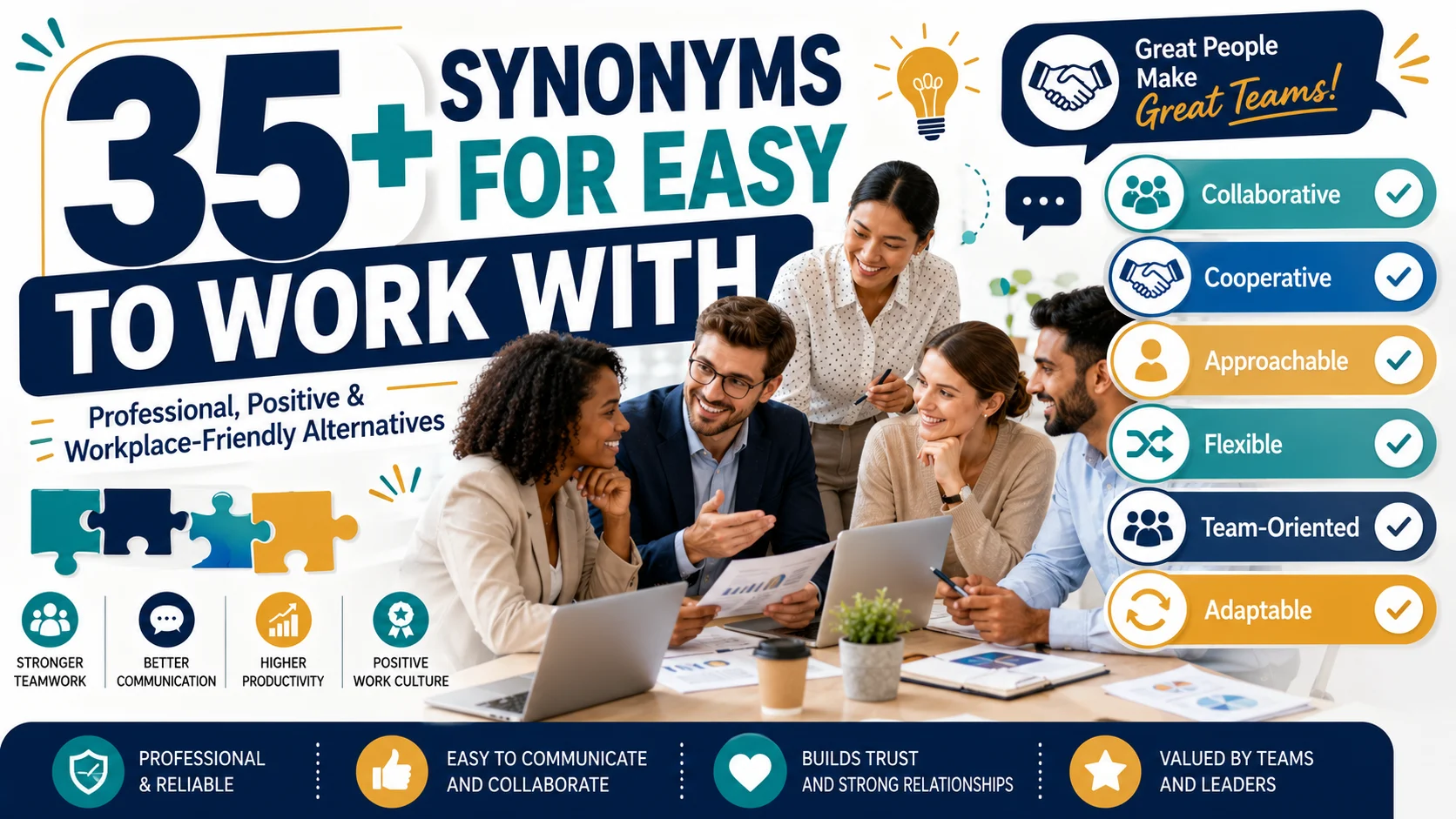
Top 5 alternatives: Collaborative, Team-oriented, Adaptable, Personable, Approachable.
Quick Categories
Formal Alternatives
- Collaborative
- Collegial
- A pleasure to work with
- Highly collaborative
- An asset to any team
Pro Tip: Formal alternatives work best in recommendation letters, performance reviews, and professional references where you need to sound authoritative and polished.
Professional & Resume Alternatives
- Team-oriented
- Adaptable
- Personable
- Interpersonally skilled
- Consensus-builder
Pro Tip: Use professional alternatives in resumes, cover letters, and LinkedIn profiles. These phrases show employers you have strong soft skills.
Business Email Alternatives
- Easy to collaborate with
- Professional and approachable
- A pleasure to work alongside
- Open and accommodating
- Reliable and cooperative
Pro Tip: Business email alternatives help you describe colleagues positively while maintaining a polished, professional tone.
Academic Alternatives
- Congenial
- Cooperative
- Respectful and collaborative
- A strong team player
- Collegial and supportive
Pro Tip: Academic alternatives are ideal for letters of recommendation, academic references, and scholarly contexts where precision matters.
Casual Alternatives
- Easygoing
- Down to earth
- Great to work with
- Nice to work with
- Gets along with everyone
Pro Tip: Casual alternatives are perfect for informal recommendations, conversations with colleagues, and relaxed professional settings.
Common Mistakes
Mistake 1: Using “easy to work with” repeatedly in a resume
Why it is incorrect: Repeating this phrase makes your resume sound generic and unoriginal. Recruiters see it hundreds of times.
Correct version: Use specific, varied alternatives like “collaborative,” “team-oriented,” or “adaptable.”
Example Sentence: Instead of “I am easy to work with and a team player,” say “I am a collaborative professional who thrives in cross-functional teams.
Mistake 2: Using “easygoing” in a professional reference
Why it is incorrect: “Easygoing” can sound passive or lacking ambition in professional contexts. It may suggest you’re too relaxed about deadlines and standards.
Correct version: Use “approachable,” “collaborative,” or “interpersonally skilled.”
Example Sentence: Instead of “She’s very easygoing,” say “She is approachable and highly collaborative.
Mistake 3: Describing yourself as “nice to work with” in a cover letter
Why it is incorrect: “Nice” is too vague and subjective for professional documents. It doesn’t communicate specific, valuable qualities.
Correct version: Use “personable,” “team-oriented,” or “adaptable.”
Example Sentence: Instead of “I’m nice to work with,” say “I build strong, collaborative relationships with colleagues.
Mistake 4: Using “collegial” in everyday conversation
Why it is incorrect: “Collegial” is formal and may sound pretentious in casual workplace conversations.
Correct version: Use “collaborative” or “a pleasure to work with.”
Example Sentence: Instead of “He’s very collegial,” say “He’s a pleasure to work with.”
Mistake 5: Overlooking the importance of specificity
Why it is incorrect: Vague praise like “easy to work with” doesn’t give specific examples of teamwork or collaboration skills.
Correct version: Show, don’t tell. Use “consensus-builder,” “problem-solver,” or “mediator.”
Example Sentence: Instead of “easy to work with,” say “a skilled consensus-builder who aligns diverse perspectives.”
What Does “Easy to Work With” Mean?
Definition: Describes someone who is cooperative, approachable, and pleasant to collaborate with.
Grammar: This is an adjective phrase. It can be used after a verb (e.g., “She is easy to work with”) or before a noun (e.g., “an easy-to-work-with colleague”).
Simple Explanation: It means the person makes collaborative tasks smoother, communicates well, and creates a positive work environment.
Example Sentence: “James is easy to work withhe always listens to everyone’s ideas before making decisions.”
When to Use “Easy to Work With”
Easy to work with” is appropriate in many professional contexts but often lacks the impact of more specific alternatives. Use it when:
- Describing a colleague in a reference letter
- Writing about teamwork on a resume
- Mentioning a positive working relationship
- Giving casual praise to a coworker
The right synonym can transform a generic compliment into a powerful professional endorsement.
Is It Professional or Polite?
Polite? ✔ Yes. It is a polite way to describe a colleague.
Professional? ✔ Yes, but it often sounds generic and lacks impact.
Formal? ⚠ Sometimes. It depends on the context and phrasing.
Natural? ✔ Yes. It is very natural in everyday conversation.
Business-style example: “Sarah is a pleasure to work withshe consistently delivers high-quality work on time.”
Explanation: While “easy to work with” is acceptable, more specific alternatives demonstrate greater professionalism and attention to detail. Recruiters and managers appreciate precise language that paints a clear picture.
Pros and Cons
Pros
- Universally understood
- Positive and inoffensive
- Easy to use
- Appropriate in most contexts
Cons
- Overused and clichéd
- Lacks specificity and impact
- Sounds generic and unoriginal
- Fails to demonstrate exceptional qualities
“In a competitive job market, the words you choose matter. Specificity demonstrates sophistication.”
25+ Powerful Synonyms for “Easy to Work With”
1. Phrase: Collaborative
Meaning: Able to work well with others toward a common goal.
Explanation: This is one of the most professional alternatives. “Collaborative” demonstrates that you value teamwork and shared success, not just individual achievement.
Example Sentence: “I’m a collaborative team member who enjoys combining different perspectives to solve complex problems.”
Best Use: Resumes, cover letters, LinkedIn profiles
Avoid Using In: Very casual conversations
Tone: Professional, Team-Oriented
Formality Level: ⭐⭐⭐⭐ Formal
Usage Frequency: Very Common
CEFR Level: B2
Common Collocations:
- collaborative approach
- collaborative team player
- highly collaborative
Context Variability:
- Spoken English: “I’m collaborative.”
- Professional English: “I take a collaborative approach.”
- Casual Conversation: Sounds professional.
2. Phrase: Team-Oriented
Meaning: Prioritizing the success of the team over individual achievement.
Explanation: This phrase shows you are focused on collective success. It signals that you contribute positively and prioritize group goals.
Example Sentence: “I’m a team-oriented professional who believes that diverse perspectives lead to better results.”
Best Use: Resumes, cover letters, interviews
Avoid Using In: Very formal academic writing
Tone: Professional, Team-Focused
Formality Level: ⭐⭐⭐⭐ Formal
Usage Frequency: Very Common
CEFR Level: B2
Common Collocations:
- team-oriented environment
- team-oriented professional
- highly team-oriented
Context Variability:
- Spoken English: “I’m very team-oriented.”
- Professional English: “I value team-oriented outcomes.”
- Casual Conversation: Sounds professional.
3. Phrase: Adaptable
Meaning: Able to adjust to changing circumstances and different working styles.
Explanation: This phrase shows you can work effectively with different personalities. It signals flexibility and emotional intelligence.
Example Sentence: “I’m adaptable and comfortable working with diverse teams and shifting priorities.”
Best Use: Resumes, interviews, professional bios
Avoid Using In: Casual social situations
Tone: Professional, Flexible
Formality Level: ⭐⭐⭐⭐ Formal
Usage Frequency: Very Common
CEFR Level: B2
Common Collocations:
- highly adaptable
- adaptable and flexible
- adaptable to change
Context Variability:
- Spoken English: “I’m adaptable.”
- Professional English: “I’m adaptable to changing needs.”
- Casual Conversation: Sounds professional.
4. Phrase: Personable
Meaning: Pleasant, approachable, and able to connect with others easily.
Explanation: This phrase emphasizes emotional intelligence and social grace. Personable people make others feel comfortable and valued.
Example Sentence: “I’m personable and work well with people at all levels of the organization.”
Best Use: Resumes, cover letters, personal bios
Avoid Using In: Very formal job descriptions
Tone: Warm, Professional
Formality Level: ⭐⭐⭐ Neutral
Usage Frequency: Common
CEFR Level: B2
Common Collocations:
- personable and professional
- warm and personable
- personable demeanor
Context Variability:
- Spoken English: “She’s very personable.”
- Professional English: “I’m a personable professional.”
- Casual Conversation: Very natural.
5. Phrase: Approachable
Meaning: Easy to talk to and open to others’ ideas and concerns.
Explanation: This phrase suggests people feel comfortable coming to you with questions or problems. It signals approachability and openness.
Example Sentence: “I’m approachable and encourage open communication within my team.”
Best Use: Professional bios, management roles, interviews
Avoid Using In: Highly formal legal documents
Tone: Open, Friendly
Formality Level: ⭐⭐⭐ Neutral
Usage Frequency: Common
CEFR Level: B2
Common Collocations:
- approachable and friendly
- approachable leader
- easy to approach
Context Variability:
- Spoken English: “He’s very approachable.”
- Professional English: “I strive to be approachable.”
- Casual Conversation: Very natural.
6. Phrase: Interpersonally Skilled
Meaning: Possessing strong social and communication abilities.
Explanation: This formal phrase demonstrates strong emotional intelligence and relationship-building skills. It sounds sophisticated and professional.
Example Sentence: “I’m interpersonally skilled, which helps me navigate complex team dynamics.”
Best Use: Resumes, professional profiles, LinkedIn
Avoid Using In: Casual conversations, social media
Tone: Professional, Formal
Formality Level: ⭐⭐⭐⭐⭐ Very Formal
Usage Frequency: Occasional
CEFR Level: C1
Common Collocations:
- interpersonally skilled professional
- strong interpersonal skills
- interpersonally effective
Context Variability:
- Spoken English: Sounds formal.
- Professional English: “I’m interpersonally skilled.”
- Casual Conversation: Avoid.
7. Phrase: A Pleasure to Work With
Meaning: An enjoyable and positive colleague to collaborate with.
Explanation: This phrase carries more warmth than “easy to work with.” It suggests that collaboration feels effortless and rewarding.
Example Sentence: “I can say with confidence that I’m a pleasure to work withI bring positivity and focus to every project.”
Best Use: Recommendation letters, performance reviews
Avoid Using In: Self-description in resumes
Tone: Warm, Positive
Formality Level: ⭐⭐⭐ Neutral
Usage Frequency: Very Common
CEFR Level: B1
Common Collocations:
- a pleasure to work with
- a pleasure to collaborate with
- absolute pleasure to work with
Context Variability:
- Spoken English: “She’s a pleasure to work with.”
- Professional English: “I was a pleasure to work with.”
- Casual Conversation: Very natural.
8. Phrase: Consensus-Builder
Meaning: Someone who aligns diverse perspectives and resolves disagreements.
Explanation: This phrase highlights leadership and collaboration skills. It shows you can find common ground and create harmonious teams.
Example Sentence: “I’m a natural consensus-builder who helps teams find solutions everyone can support.”
Best Use: Leadership roles, management applications, team projects
Avoid Using In: Individual contributor roles
Tone: Professional, Leadership-Oriented
Formality Level: ⭐⭐⭐⭐ Formal
Usage Frequency: Occasional
CEFR Level: C1
Common Collocations:
- consensus-building skills
- natural consensus-builder
- skilled consensus-builder
Context Variability:
- Spoken English: “He’s a consensus-builder.”
- Professional English: “I’m a consensus-builder.”
- Casual Conversation: Sounds professional.
9. Phrase: Collegial
Meaning: Cooperative and respectful in professional relationships.
Explanation: This is a formal word used in academic and professional settings. It emphasizes mutual respect and supportive working relationships.
Example Sentence: “I’m known for my collegial approachI treat everyone with respect and professionalism.”
Best Use: Academic letters, professional references
Avoid Using In: Casual workplace conversations
Tone: Formal, Professional
Formality Level: ⭐⭐⭐⭐⭐ Very Formal
Usage Frequency: Occasional
CEFR Level: C1
Common Collocations:
- collegial relationship
- collegial atmosphere
- collegial environment
Context Variability:
- Spoken English: Rare in casual speech.
- Professional English: “I enjoy a collegial working relationship.”
- Casual Conversation: Sounds pretentious.
10. Phrase: Cooperative
Meaning: Willing to work with others and contribute to shared goals.
Explanation: This phrase emphasizes willingness and positive attitude. It is straightforward and professional.
Example Sentence: “I’m cooperative and always ready to support my colleagues when needed.”
Best Use: Professional references, performance reviews
Avoid Using In: Self-promotional resumes
Tone: Professional, Helpful
Formality Level: ⭐⭐⭐⭐ Formal
Usage Frequency: Common
CEFR Level: B2
Common Collocations:
- cooperative and helpful
- cooperative team member
- cooperative attitude
Context Variability:
- Spoken English: “I’m cooperative.”
- Professional English: “I have a cooperative approach.”
- Casual Conversation: Acceptable.
11. Phrase: Easygoing
Meaning: Relaxed and flexible in interactions.
Explanation: This casual phrase is used when you want to describe someone as low-pressure and easy to get along with. It implies a harmonious, low-stress working relationship.
Example Sentence: “I’m easygoing and enjoy helping others wherever possible.”
Best Use: Casual conversations, informal recommendations
Avoid Using In: Resumes, formal professional documents
Tone: Casual, Relaxed
Formality Level: ⭐⭐ Casual
Usage Frequency: Very Common
CEFR Level: B1
Common Collocations:
- easygoing attitude
- easygoing personality
- easygoing and friendly
Context Variability:
- Spoken English: “She’s so easygoing.”
- Professional English: Avoid in formal documents.
- Casual Conversation: Very common.
12. Phrase: Great to Work With
Meaning: A positive and easy collaboration.
Explanation: This phrase is warm and friendly. It is commonly used in recommendations and testimonials.
Example Sentence: “My colleagues would say I’m great to work withI always deliver on time and offer support.
Best Use: Professional references, testimonials
Avoid Using In: Formal resumes (can sound vague)
Tone: Warm, Positive
Formality Level: ⭐⭐⭐ Neutral
Usage Frequency: Very Common
CEFR Level: B1
Common Collocations:
- great to work with
- great to collaborate with
- always great to work with
Context Variability:
- Spoken English: “She’s great to work with.”
- Professional English: “I’m great to work with.”
- Casual Conversation: Very natural.
13. Phrase: Down to Earth
Meaning: Practical, humble, and easy to relate to.
Explanation: This casual phrase describes someone approachable and not arrogant. It is often used in positive performance reviews.
Example Sentence: “I’m down to earthpeople tell me I don’t take myself too seriously.”
Best Use: Casual professional references, team culture
Avoid Using In: Formal resumes, interviews
Tone: Casual, Warm
Formality Level: ⭐⭐ Casual
Usage Frequency: Common
CEFR Level: B1
Common Collocations:
- down-to-earth personality
- down-to-earth and relatable
- friendly and down to earth
Context Variability:
- Spoken English: “He’s so down to earth.”
- Professional English: Acceptable in casual professional contexts.
- Casual Conversation: Very common.
14. Phrase: Reliable
Meaning: Dependable and trustworthy in collaboration.
Explanation: This phrase suggests you are someone people can count on. It implies that others trust you to deliver consistently.
Example Sentence: “I’m reliable and follow through on commitments, which makes me a trusted team member.”
Best Use: Resumes, professional profiles, interviews
Avoid Using In: Very formal academic writing
Tone: Professional, Dependable
Formality Level: ⭐⭐⭐⭐ Formal
Usage Frequency: Very Common
CEFR Level: B1
Common Collocations:
- reliable and trustworthy
- highly reliable
- consistently reliable
Context Variability:
- Spoken English: “I’m reliable.”
- Professional English: “I’m a reliable professional.”
- Casual Conversation: Very natural.
15. Phrase: Approachable and Collaborative
Meaning: Open to communication and committed to working together.
Explanation: This combination emphasizes both approachability and teamwork. It’s an excellent phrase for describing management potential.
Example Sentence: “I’m approachable and collaborativeI believe that great work happens when everyone’s voice is heard.”
Best Use: Leadership descriptions, professional bios
Avoid Using In: Casual conversations
Tone: Professional, Open
Formality Level: ⭐⭐⭐⭐ Formal
Usage Frequency: Common
CEFR Level: B2
Common Collocations:
- approachable and collaborative leader
- approachable and open
- approachable and supportive
Context Variability:
- Spoken English: “She’s approachable and collaborative.”
- Professional English: “I’m approachable and collaborative.”
- Casual Conversation: Sounds professional.
16. Phrase: A Strong Team Player
Meaning: Someone who prioritizes the team’s success and contributes effectively.
Explanation: This phrase is common in resumes and interviews. It suggests you work well with others and support shared goals.
Example Sentence: “I’m a strong team player who brings out the best in those around me.”
Best Use: Resumes, interviews, performance reviews
Avoid Using In: Very casual contexts
Tone: Professional, Team-Oriented
Formality Level: ⭐⭐⭐⭐ Formal
Usage Frequency: Very Common
CEFR Level: B1
Common Collocations:
- strong team player
- dedicated team player
- exceptional team player
Context Variability:
- Spoken English: “I’m a team player.”
- Professional English: “I’m a strong team player.”
- Casual Conversation: Acceptable.
17. Phrase: Open-Minded
Meaning: Receptive to new ideas and different perspectives.
Explanation: This phrase suggests you listen to others and value diverse opinions. It works well in descriptions of leaders and collaborators.
Example Sentence: “I’m open-minded and welcome feedback, making me an effective collaborator.”
Best Use: Leadership roles, creative teams, professional bios
Avoid Using In: Formal legal documents
Tone: Professional, Receptive
Formality Level: ⭐⭐⭐ Neutral
Usage Frequency: Common
CEFR Level: B2
Common Collocations:
- open-minded and adaptable
- open-minded leader
- open-minded and curious
Context Variability:
- Spoken English: “I’m open-minded.”
- Professional English: “I’m open-minded in my approach.”
- Casual Conversation: Very natural.
18. Phrase: Supportive
Meaning: Encouraging, helpful, and willing to assist colleagues.
Explanation: This phrase emphasizes your willingness to help others succeed. It suggests emotional intelligence and generosity.
Example Sentence: “I’m supportive and always ready to help team members overcome challenges.”
Best Use: Leadership roles, team environments, professional bios
Avoid Using In: Competitive team descriptions
Tone: Professional, Helpful
Formality Level: ⭐⭐⭐ Neutral
Usage Frequency: Very Common
CEFR Level: B1
Common Collocations:
- supportive and encouraging
- supportive team member
- supportive leader
Context Variability:
- Spoken English: “I’m supportive.”
- Professional English: “I’m a supportive colleague.”
- Casual Conversation: Very natural.
19. Phrase: Responsive
Meaning: Quick to respond and communicate effectively.
Explanation: This phrase suggests you value others’ time and keep communication flowing. It’s particularly valuable in client-facing roles.
Example Sentence: “I’m responsive and ensure team members always get timely feedback.”
Best Use: Client communication, project management, professional bios
Avoid Using In: Very formal academic writing
Tone: Professional, Efficient
Formality Level: ⭐⭐⭐⭐ Formal
Usage Frequency: Common
CEFR Level: B2
Common Collocations:
- responsive and proactive
- highly responsive
- responsive communicator
Context Variability:
- Spoken English: “I’m responsive.”
- Professional English: “I’m responsive to client needs.”
- Casual Conversation: Acceptable.
20. Phrase: Open and Accommodating
Meaning: Receptive to others’ needs and willing to adjust.
Explanation: This phrase shows flexibility and a customer-service mindset. It signals that you value others’ needs.
Example Sentence: “I’m open and accommodatingI always consider others’ preferences and constraints.”
Best Use: Client service, management, professional bios
Avoid Using In: Competitive individual contributor roles
Tone: Professional, Flexible
Formality Level: ⭐⭐⭐⭐ Formal
Usage Frequency: Common
CEFR Level: B2
Common Collocations:
- open and accommodating attitude
- open and flexible
- accommodating and helpful
Context Variability:
- Spoken English: “She’s very accommodating.”
- Professional English: “I’m open and accommodating.”
- Casual Conversation: Sounds professional.
21. Phrase: Self-Aware
Meaning: Conscious of one’s strengths, weaknesses, and impact on others.
Explanation: This phrase demonstrates emotional intelligence. Self-aware people are easier to work with because they reflect on their behavior.
Example Sentence: “I’m self-aware and always seek to improve how I work with others.”
Best Use: Leadership descriptions, professional bios, interviews
Avoid Using In: Very casual contexts
Tone: Professional, Reflective
Formality Level: ⭐⭐⭐⭐ Formal
Usage Frequency: Occasional
CEFR Level: C1
Common Collocations:
- self-aware and reflective
- emotionally self-aware
- highly self-aware
Context Variability:
- Spoken English: “I’m self-aware.”
- Professional English: “I’m a self-aware professional.”
- Casual Conversation: Sounds intellectual.
22. Phrase: Diplomatic
Meaning: Tactful and able to handle sensitive situations with grace.
Explanation: This phrase shows you can navigate difficult conversations and maintain positive relationships. It’s particularly valuable in management.
Example Sentence: “I’m diplomatic and handle disagreements with tact and professionalism.”
Best Use: Management roles, conflict resolution, leadership
Avoid Using In: Individual contributor roles
Tone: Professional, Tactful
Formality Level: ⭐⭐⭐⭐ Formal
Usage Frequency: Occasional
CEFR Level: C1
Common Collocations:
- diplomatic and tactful
- diplomatic approach
- diplomatic communication
Context Variability:
- Spoken English: “I’m diplomatic.”
- Professional English: “I’m diplomatic in my approach.”
- Casual Conversation: Sounds professional.
23. Phrase: Positive and Constructive
Meaning: Uplifting and focused on building solutions.
Explanation: This phrase shows you bring energy and optimism to the workplace. It suggests you solve problems rather than create them.
Example Sentence: “I’m positive and constructive, focusing on solutions rather than problems.”
Best Use: Professional bios, leadership descriptions, interviews
Avoid Using In: Very formal legal documents
Tone: Professional, Optimistic
Formality Level: ⭐⭐⭐ Neutral
Usage Frequency: Common
CEFR Level: B2
Common Collocations:
- positive and constructive mindset
- constructive feedback
- positive attitude
Context Variability:
- Spoken English: “I’m very positive.”
- Professional English: “I’m positive and constructive.”
- Casual Conversation: Very natural.
24. Phrase: A Great Fit for the Team
Meaning: Well-suited to the team’s culture and dynamics.
Explanation: This phrase is used in hiring contexts to describe candidates who align with the team’s values and working style.
Example Sentence: “My collaborative nature makes me a great fit for any team environment.”
Best Use: Interviews, professional bios, LinkedIn
Avoid Using In: Performance reviews
Tone: Professional, Positive
Formality Level: ⭐⭐⭐ Neutral
Usage Frequency: Common
CEFR Level: B2
Common Collocations:
- great fit for the team
- perfect fit for the team
- strong team fit
Context Variability:
- Spoken English: “He’d be a great fit.”
- Professional English: “I’m a great fit for the team.”
- Casual Conversation: Acceptable.
25. Phrase: An Asset to Any Team
Meaning: A valuable and positive addition to any group.
Explanation: This is a strong endorsement phrase. It suggests that you consistently contribute to team success and improve the group dynamic.
Example Sentence: “I’ve been told I’m an asset to any teammy collaborative approach benefits everyone.”
Best Use: Recommendation letters, performance reviews
Avoid Using In: Self-description in resumes (can sound arrogant)
Tone: Professional, Endorsing
Formality Level: ⭐⭐⭐⭐ Formal
Usage Frequency: Common
CEFR Level: B2
Common Collocations:
- asset to any team
- valuable team asset
- asset to the organization
Context Variability:
- Spoken English: “She’s an asset to the team.”
- Professional English: “I’m an asset to any team.”
- Casual Conversation: Acceptable.
Top 10 Alternatives Compared
| Phrase | Tone | Formality | Best Use | Frequency |
| Collaborative | Professional | Formal | Resumes, interviews | Very Common |
| Team-oriented | Professional | Formal | Resumes, interviews | Very Common |
| Adaptable | Professional | Formal | Resumes, interviews | Very Common |
| Personable | Warm, Professional | Neutral | Professional bios | Common |
| Approachable | Open, Friendly | Neutral | Leadership roles | Common |
| A pleasure to work with | Warm, Positive | Neutral | References | Very Common |
| Interpersonally skilled | Formal, Professional | Very Formal | Professional profiles | Occasional |
| Consensus-builder | Leadership-oriented | Formal | Management roles | Occasional |
| Collegial | Formal, Professional | Very Formal | Academic settings | Occasional |
| Easygoing | Casual, Relaxed | Casual | Casual references | Very Common |
Which One Should You Use?
Best Overall
“Collaborative” This is the most versatile and professional option. It shows you value teamwork without being vague.
Best for Resumes
“Team-oriented” This is a standard, powerful phrase that recruiters recognize and respect.
Best for Interviews
“Adaptable” This shows flexibility and emotional intelligence, which are highly valued by employers.
Best for Leadership Roles
“Consensus-builder” This demonstrates the ability to align diverse perspectives and lead effectively.
Best for Recommendations
“A pleasure to work with” This is warm, positive, and carries genuine endorsement.
Best for Professional Bios
“Approachable and collaborative” This combination shows openness and teamwork.
Avoid These in Formal Situations
“Easygoing” Too casual for professional documents. Use “adaptable” or “personable” instead.
“Nice” Too vague and subjective. Use “collaborative” or “approachable” instead.
“Flexible” While acceptable, “adaptable” is more professional and impactful.
“Good with people” Too informal. Use “interpersonally skilled” or “personable.”
“Friendly” Too casual for formal contexts. Use “approachable” or “personable.”
FAQ Section
What is the best synonym for “easy to work with” on a resume?
Collaborative” and “team-oriented” are the best synonyms for resumes. They are professional, specific, and convey valuable soft skills. “Adaptable” is also excellent for showing flexibility.
What is the most professional way to say “easy to work with”?
The most professional way is “collaborative” or “interpersonally skilled.” These phrases demonstrate emotional intelligence and communication abilities.
Which phrase should I use for a recommendation letter?
Use “a pleasure to work with,” “collegial,” or “collaborative.” These phrases work well in recommendation letters because they are warm and professional.
What is the difference between “collaborative” and “cooperative”?
“Collaborative” emphasizes working together to achieve a shared goal, suggesting contribution and creativity. “Cooperative” emphasizes willingness and compliance, which is more passive. “Collaborative” is stronger and more valued.
Can I use “easygoing” in a job interview?
Use “easygoing” cautiously. It can sound too casual and may suggest a lack of drive. “Adaptable” or “personable” are better alternatives for interviews.
Conclusion
Choosing the right synonym for “easy to work with” can help you describe someone’s personality and professional qualities more effectively. Whether you’re writing a resume, recommendation, performance review, or workplace message, phrases like “collaborative,” “cooperative,” “approachable,” “flexible,” and “team-oriented” can communicate the same positive idea with greater precision.
The best alternative depends on the context. Choose a professional term for resumes and evaluations, a warm expression for personal recommendations, or a straightforward phrase for everyday workplace communication.

31 thoughts on “Synonyms for “Easy to Work With” |35+ Powerful Alternatives for 2026”