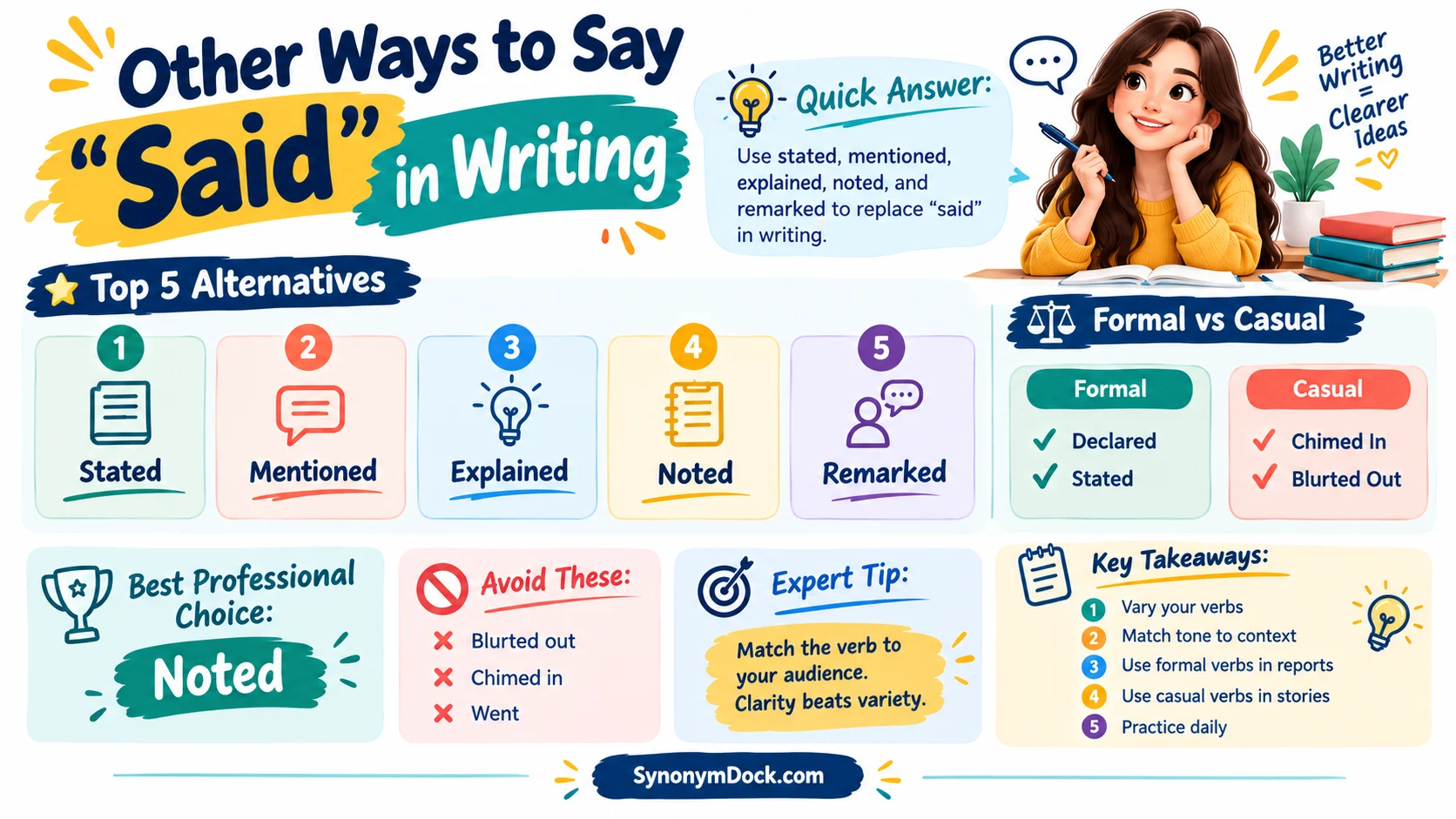
Other ways to say “said” in writing include stated, mentioned, explained, noted, and remarked. These alternatives help you avoid repetition while matching the tone and context of your writing. The best choice depends on whether you need a formal, professional, or casual expression.
Top 5 alternatives: stated, mentioned, explained, noted, remarked.
The word “said” is one of the most common verbs in English writing. It appears everywhere from novels and news articles to business emails and academic essays. But repeating “said” too often makes writing feel flat and monotonous.
That is why so many writers search for other ways to say said in writing. Finding alternatives to said helps you sound more fluent, precise, and professional. Each alternative carries a slightly different meaning, tone, and level of formality.
This guide gives you 15 practical alternatives, complete with examples, tone notes, and advice on when to use each one. Whether you are writing a business email, an academic essay, or a short story, you will find the right phrase here.
“Choosing the right verb matters as much as choosing the right words.”
Quick Categories
Formal Alternatives
- Stated – neutral and precise
- Declared – strong and official
- Asserted – confident and firm
- Affirmed – positive and certain
- Observed – thoughtful and reflective
Pro Tip
Formal alternatives work best in academic papers, legal documents, and official reports. They add authority and precision.
Professional Alternatives
- Mentioned – light and neutral
- Noted – attentive and businesslike
- Explained – clear and helpful
- Added – natural in meetings
- Indicated – indirect and formal
Pro Tip
Professional alternatives keep workplace communication clear and respectful. They suit emails, reports, and meeting notes.
Business Email Alternatives
- Noted – confirms receipt
- Mentioned – refers to earlier points
- Explained – clarifies details
- Suggested – offers ideas
- Confirmed – verifies information
Pro Tip
In business emails, choose verbs that reflect action. “Noted” and “confirmed” show you are engaged and responsive.
Academic Alternatives
- Argued – presents a position
- Proposed – offers a theory
- Maintained – defends a view
- Contended – disputes a point
- Posited – suggests academically
Pro Tip
Academic writing favors verbs that show critical thinking. “Argued” and “proposed” signal analysis and evidence.
Casual Alternatives
- Said – simple and direct
- Went – informal storytelling
- Told – direct speech
- Asked – questions
- Replied – responses
Pro Tip
Casual alternatives suit blogs, social media, and personal writing. They feel natural and conversational.
Informal Expressions
- Blurted out – sudden speech
- Chimed in – joining a conversation
- Piped up – speaking timidly
- Shot back – quick reply
- Muttered – quiet speech
Pro Tip
Informal expressions add personality to creative writing. Use them sparingly to avoid clutter.
“The right tone makes your English sound more confident.”
Common Mistakes
Mistake 1: Using “Said” Repeatedly
Why it is incorrect: Repetition makes writing dull and robotic.
Correct version: Vary your verbs.
Example: “She said she was tired. He said he understood.” → “She mentioned she was tired. He replied that he understood.”
Mistake 2: Using Overly Formal Verbs in Casual Writing
Why it is incorrect: It sounds unnatural and stiff.
Correct version: Match the verb to the context.
Example: “My friend asserted that pizza is the best food.” → “My friend said pizza is the best food.”
Mistake 3: Using “Said” with Questions
Why it is incorrect: “Said” does not introduce questions naturally.
Correct version: Use “asked” for questions.
Example: “He said, ‘Are you coming?'” → “He asked, ‘Are you coming?'”
Mistake 4: Using “Said” for Commands
Why it is incorrect: Commands need stronger verbs.
Correct version: Use “ordered,” “told,” or “instructed.”
Example: “She said me to leave.” → “She told me to leave.”
Mistake 5: Using the Wrong Verb for the Tone
Why it is incorrect: Tone mismatch confuses readers.
Correct version: Choose a verb that fits the emotion.
Example: “He whispered loudly.” → “He shouted.”
“Mixing formality and casual tone without reason weakens your message.”
What Does “Said” Mean?
Definition: “Said” is the past tense of “say.” It means to speak words or express something in speech or writing.
Grammar note: “Said” is a verb. It is often followed by a clause or quotation.
Simple explanation: “Said” introduces what someone spoke or wrote.
Example sentence: She said she would arrive by noon.
When to Use “Said”
- Business: Formal reports and emails
- Academic: Essays and research papers
- Emails: Professional correspondence
- Meetings: Notes and summaries
- Daily conversation: Storytelling and updates
- Spoken English: Narrating events
- Written English: News and articles
- Formal: Official statements
- Informal: Blogs and chats
Is “Said” Professional or Polite?
Polite? ✔ Yes
Professional? ✔ Yes, in moderation
Formal? Sometimes
Natural? ✔ Yes
Business example: She said the report was ready.
Explanation: “Said” is neutral. It works in most situations but becomes repetitive if overused.
“Precision in verb choice shows mastery of English.”
Pros and Cons
Pros
- Easy to understand
- Neutral tone
- Common in all contexts
- Natural in speech
- Safe choice
Cons
- Overused
- Limited emotional range
- Can sound flat
- Weak in creative writing
- Repetitive in long texts
Transition to the Main List
In the sections below, you will learn 15 powerful alternatives to “said.” Each one includes meaning, tone, examples, and best-use advice.
These alternatives help you sound more fluent, improve professional English, expand your vocabulary, and choose the right tone for every situation.
“The best writers do not avoid ‘said’ they choose it wisely.”
Expert Tip Box
Expert Tip: Native speakers choose verbs like “said,” “mentioned,” and “explained” based on context, audience, and emotion. The goal is clarity, not variety for its own sake.
Other Ways to Say “Said” in Writing (With Examples)
Below are 15 alternatives. They range from formal to informal. Use them to add precision and rhythm to your writing.
1. Phrase: Stated
Meaning: To express something clearly and officially.
Explanation: “Stated” sounds formal and precise. It is common in reports, news, and academic writing.
Example Sentence: The manager stated that the deadline would remain unchanged.
Best Use: Business Report
Avoid Using In: Casual Text
Tone: Formal, Confident
Formality Level: ⭐⭐⭐⭐ Formal
Usage Frequency: Very Common
CEFR Level: B2
Common Collocations: clearly stated, officially stated, stated that, stated in the report
Context Variability:
- Spoken: He stated his position calmly.
- Professional: The CEO stated the company’s goals.
- Casual: She stated her opinion without hesitation.
2. Phrase: Mentioned
Meaning: To refer to something briefly.
Explanation: “Mentioned” is neutral and light. Native speakers use it often in both speech and writing.
Example Sentence: She mentioned that the meeting had been moved.
Best Use: Workplace Email
Avoid Using In: Legal Contract
Tone: Neutral, Friendly
Formality Level: ⭐⭐⭐ Neutral
Usage Frequency: Very Common
CEFR Level: B1
Common Collocations: briefly mentioned, mentioned earlier, mentioned that, as mentioned
Context Variability:
- Spoken: He mentioned your name in the meeting.
- Professional: As mentioned, the report is due Friday.
- Casual: She mentioned she might visit.
3. Phrase: Explained
Meaning: To make something clear.
Explanation: “Explained” shows helpfulness and clarity. It suits teaching, meetings, and reports.
Example Sentence: The teacher explained why the experiment had failed.
Best Use: Academic Writing
Avoid Using In: Casual Text
Tone: Helpful, Clear
Formality Level: ⭐⭐⭐ Neutral
Usage Frequency: Very Common
CEFR Level: B1
Common Collocations: clearly explained, explained why, explained the process, explained in detail
Context Variability:
- Spoken: She explained the rules to the team.
- Professional: The analyst explained the results.
- Casual: He explained why he was late.
4. Phrase: Noted
Meaning: To observe or record something.
Explanation: “Noted” is short and professional. It is common in business emails.
Example Sentence: The client noted that the design needed more color.
Best Use: Business Email
Avoid Using In: Creative Writing
Tone: Professional, Brief
Formality Level: ⭐⭐⭐⭐ Formal
Usage Frequency: Common
CEFR Level: B2
Common Collocations: duly noted, noted that, noted in the report, noted with concern
Context Variability:
- Spoken: She noted the change in schedule.
- Professional: We noted your feedback.
- Casual: He noted the odd smell.
5. Phrase: Remarked
Meaning: To say something casually or thoughtfully.
Explanation: “Remarked” sounds slightly literary. It fits narratives and reflective writing.
Example Sentence: He remarked that the city had changed a lot.
Best Use: Narrative Writing
Avoid Using In: Business Report
Tone: Thoughtful, Neutral
Formality Level: ⭐⭐⭐ Neutral
Usage Frequency: Occasional
CEFR Level: C1
Common Collocations: casually remarked, remarked that, remarked on, remarked with a smile
Context Variability:
- Spoken: She remarked on the weather.
- Professional: He remarked that sales had improved.
- Casual: They remarked how fast time flies.
Native Speaker Tip
“Stated” and “noted” sound most formal. “Mentioned” and “explained” feel natural in daily speech. “Remarked” is less common today and sounds slightly literary.
6. Phrase: Added
Meaning: To include extra information.
Explanation: “Added” is natural in meetings and conversations. It introduces a follow-up point.
Example Sentence: She added that the budget would need approval.
Best Use: Workplace Meeting
Avoid Using In: Legal Document
Tone: Neutral, Natural
Formality Level: ⭐⭐⭐ Neutral
Usage Frequency: Very Common
CEFR Level: B1
Common Collocations: added that, quickly added, added with a smile, added later
Context Variability:
- Spoken: He added a few comments.
- Professional: The director added that timelines were tight.
- Casual: She added that she loved the idea.
7. Phrase: Declared
Meaning: To announce something firmly.
Explanation: “Declared” is strong and official. It suits public statements.
Example Sentence: The mayor declared the festival open.
Best Use: Official Statement
Avoid Using In: Casual Chat
Tone: Strong, Formal
Formality Level: ⭐⭐⭐⭐⭐ Very Formal
Usage Frequency: Occasional
CEFR Level: C1
Common Collocations: declared open, publicly declared, declared that, declared independence
Context Variability:
- Spoken: She declared her intention to run.
- Professional: The board declared the results final.
- Casual: He declared it the best pizza ever.
8. Phrase: Asserted
Meaning: To state confidently.
Explanation: “Asserted” shows confidence and sometimes disagreement. Common in academic writing.
Example Sentence: The author asserted that the theory was flawed.
Best Use: Academic Essay
Avoid Using In: Casual Text
Tone: Confident, Firm
Formality Level: ⭐⭐⭐⭐ Formal
Usage Frequency: Occasional
CEFR Level: C1
Common Collocations: strongly asserted, asserted that, asserted authority, asserted a claim
Context Variability:
- Spoken: He asserted his point firmly.
- Professional: The lawyer asserted the client’s innocence.
- Casual: She asserted that she was right.
9. Phrase: Suggested
Meaning: To offer an idea.
Explanation: “Suggested” is polite and indirect. It works well in meetings and emails.
Example Sentence: He suggested that we postpone the launch.
Best Use: Team Collaboration
Avoid Using In: Legal Contract
Tone: Polite, Helpful
Formality Level: ⭐⭐⭐ Neutral
Usage Frequency: Very Common
CEFR Level: B1
Common Collocations: suggested that, politely suggested, suggested a solution, suggested a change
Context Variability:
- Spoken: She suggested a new approach.
- Professional: We suggested revising the plan.
- Casual: He suggested watching a movie.
10. Phrase: Confirmed
Meaning: To verify or make certain.
Explanation: “Confirmed” is direct and reliable. It suits scheduling and agreements.
Example Sentence: The supplier confirmed that the order had shipped.
Best Use: Client Communication
Avoid Using In: Creative Story
Tone: Confident, Clear
Formality Level: ⭐⭐⭐⭐ Formal
Usage Frequency: Common
CEFR Level: B2
Common Collocations: confirmed that, confirmed the date, confirmed in writing, confirmed by email
Context Variability:
- Spoken: He confirmed the time.
- Professional: The client confirmed the proposal.
- Casual: She confirmed she was coming.
Expert Insight
In workplace writing, verbs like “noted,” “confirmed,” and “suggested” show action and respect. They reduce ambiguity and help teams move forward.
11. Phrase: Replied
Meaning: To respond in speech or writing.
Explanation: “Replied” is neutral and natural. It focuses on the response.
Example Sentence: She replied that the offer was still open.
Best Use: Email Reply
Avoid Using In: Academic Abstract
Tone: Neutral, Friendly
Formality Level: ⭐⭐⭐ Neutral
Usage Frequency: Very Common
CEFR Level: B1
Common Collocations: replied quickly, replied that, replied politely, replied in writing
Context Variability:
- Spoken: He replied with a smile.
- Professional: The team replied to the inquiry.
- Casual: She replied to my text.
12. Phrase: Argued
Meaning: To present reasons for a position.
Explanation: “Argued” is common in academic writing. It signals analysis and debate.
Example Sentence: The researcher argued that the data supported the claim.
Best Use: Academic Paper
Avoid Using In: Casual Conversation
Tone: Analytical, Firm
Formality Level: ⭐⭐⭐⭐ Formal
Usage Frequency: Common
CEFR Level: C1
Common Collocations: argued that, argued against, argued persuasively, argued for reform
Context Variability:
- Spoken: She argued her case well.
- Professional: The consultant argued for change.
- Casual: He argued with his brother.
13. Phrase: Proposed
Meaning: To put forward an idea or plan.
Explanation: “Proposed” is formal and forward-looking. It suits business and academia.
Example Sentence: The committee proposed a new budget.
Best Use: Business Proposal
Avoid Using In: Personal Diary
Tone: Professional, Positive
Formality Level: ⭐⭐⭐⭐ Formal
Usage Frequency: Common
CEFR Level: B2
Common Collocations: proposed a plan, proposed that, proposed changes, proposed a solution
Context Variability:
- Spoken: He proposed a new idea.
- Professional: The board proposed a merger.
- Casual: She proposed a weekend trip.
14. Phrase: Chimed In
Meaning: To join a conversation.
Explanation: “Chimed in” is informal and friendly. It adds energy to storytelling.
Example Sentence: Her brother chimed in with a funny story.
Best Use: Casual Conversation
Avoid Using In: Formal Report
Tone: Friendly, Informal
Formality Level: ⭐ Casual
Usage Frequency: Occasional
CEFR Level: B2
Common Collocations: chimed in with, chimed in quickly, chimed in to say, chimed in from the back
Context Variability:
- Spoken: He chimed in during the meeting.
- Professional: A colleague chimed in with support.
- Casual: She chimed in with a joke.
15. Phrase: Blurted Out
Meaning: To say something suddenly.
Explanation: “Blurted out” shows emotion or lack of control. It suits creative writing.
Example Sentence: He blurted out the answer before thinking.
Best Use: Creative Writing
Avoid Using In: Business Email
Tone: Emotional, Informal
Formality Level: ⭐ Very Casual
Usage Frequency: Occasional
CEFR Level: B2
Common Collocations: blurted out the truth, blurted out an answer, suddenly blurted, blurted out loud
Context Variability:
- Spoken: She blurted out a question.
- Professional: He blurted out the news early.
- Casual: They blurted out the surprise.
Native Speaker Tip
“Replied” and “mentioned” sound most natural in everyday speech. “Argued” and “proposed” fit academic and professional writing. “Blurted out” and “chimed in” are best for creative or casual contexts.
Comparison Section
Top 10 Alternatives Compared
| Phrase | Tone | Formality | Best Use | Frequency |
|---|---|---|---|---|
| Stated | Formal, Confident | ⭐⭐⭐⭐ | Business Report | Very Common |
| Mentioned | Neutral, Friendly | ⭐⭐⭐ | Workplace Email | Very Common |
| Explained | Helpful, Clear | ⭐⭐⭐ | Academic Writing | Very Common |
| Noted | Professional, Brief | ⭐⭐⭐⭐ | Business Email | Common |
| Remarked | Thoughtful, Neutral | ⭐⭐⭐ | Narrative Writing | Occasional |
| Added | Neutral, Natural | ⭐⭐⭐ | Workplace Meeting | Very Common |
| Declared | Strong, Formal | ⭐⭐⭐⭐⭐ | Official Statement | Occasional |
| Asserted | Confident, Firm | ⭐⭐⭐⭐ | Academic Essay | Occasional |
| Suggested | Polite, Helpful | ⭐⭐⭐ | Team Collaboration | Very Common |
| Confirmed | Confident, Clear | ⭐⭐⭐⭐ | Client Communication | Common |
Which One Should You Use?
Best Overall
Mentioned – natural, flexible, and widely understood.
Best Professional
Noted – brief, respectful, and action-oriented.
Best Academic
Argued – signals analysis and evidence.
Best Business Email
Confirmed – clear and reliable.
Best Everyday Conversation
Replied – simple and natural.
Most Natural
Explained – common in both speech and writing.
Most Polite
Suggested – soft and respectful.
Commonly Confused Phrases
“Said” vs “Mentioned”
“Said” introduces direct speech. “Mentioned” refers to something briefly.
“Stated” vs “Asserted”
“Stated” is neutral. “Asserted” shows confidence or disagreement.
“Explained” vs “Argued”
“Explained” clarifies. “Argued” defends a position.
“Noted” vs “Confirmed”
“Noted” means observed. “Confirmed” means verified.
“Small verb changes create big tone shifts.”
Scenario Practice
1. Business Meeting: You want to add a quick point. Which phrase? Added – natural and brief.
2. Job Interview: You describe a past achievement. Explained – clear and confident.
3. Presentation: You introduce a new plan. Proposed – formal and forward-looking.
4. Class Discussion: You defend an idea. Argued – academic and strong.
5. Email Reply: You confirm details. Confirmed – direct and reliable.
Mini Quiz
1. Which verb is most formal?
A) Mentioned B) Declared C) Replied
2. Which verb suits a business email?
A) Blurted out B) Noted C) Chimed in
3. Which verb introduces a question?
A) Said B) Asked C) Stated
4. Which verb is best for academic writing?
A) Argued B) Added C) Replied
5. Which verb is most casual?
A) Asserted B) Proposed C) Chimed in
Answer Key
- B – Declared is very formal.
- B – Noted is professional.
- B – Asked introduces questions.
- A – Argued fits academic tone.
- C – Chimed in is informal.
FAQs
What is the most formal way to say “said” in writing?
“Declared” and “stated” are the most formal options. They appear in official statements, news reports, and academic papers. Use them when you need authority and precision. Avoid them in casual writing, where they sound stiff.
Which phrase is best for professional emails?
“Noted” and “confirmed” work best in professional emails. They are brief, clear, and action-oriented. “Mentioned” also works well when referring to earlier points. Avoid informal verbs like “blurted out” in business communication.
What is the difference between “said” and “mentioned”?
“Said” introduces direct speech or a specific statement. “Mentioned” refers to something briefly or indirectly. For example, “She said, ‘I’m leaving'” vs “She mentioned she might leave.” Both are correct, but they serve different purposes.
Which alternative sounds most natural?
“Mentioned,” “explained,” and “replied” sound most natural in everyday English. Native speakers use them often in both speech and writing. They are neutral, flexible, and easy to understand.
Can I use these expressions in business meetings?
Yes. “Added,” “suggested,” “noted,” and “confirmed” are common in meetings. They keep communication clear and professional. Avoid informal verbs like “chimed in” unless the meeting is casual.
Conclusion
Learning different ways to say “said” in writing helps you communicate with precision and style. Each alternative carries its own tone, formality, and best-use context. Choosing wisely makes your English sound more fluent and professional.
Practice these alternatives in your emails, essays, meetings, and conversations. Start with one or two new verbs each week. Over time, they will become natural parts of your vocabulary. You already have the tools now use them with confidence.

1 thought on “Other Ways to Say “Said” in Writing |12+ Examples For 2026”