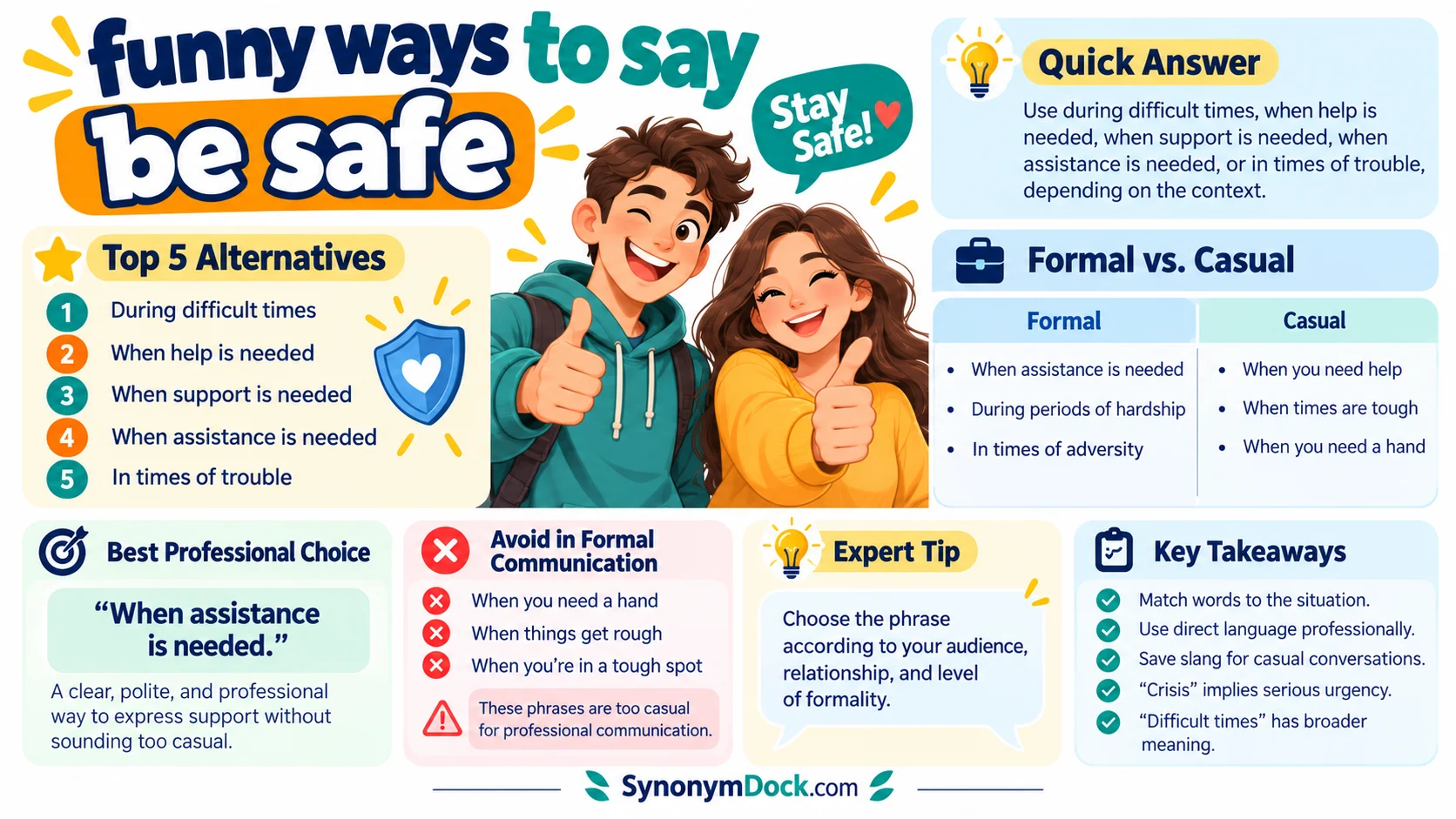
Funny ways to say “be safe” include “Stay safe out there!”, “Don’t let chaos win!”, “Adventure responsibly!”, “Go carefully, troublemaker!”, and “Come back with stories, not problems.”
“Be safe” is a simple and caring way to wish someone well, but sometimes you want something more playful. Learning funny ways to say be safe can make texts, goodbyes, and friendly conversations sound warmer and more natural.
Knowing alternatives to be safe also helps you match your words to the relationship. A joke may work perfectly with a close friend but sound strange in a business email.
These other ways to say be safe range from light humor to playful warnings. The key is knowing when humor fits the situation.
“Good English is not only about correct words it is also about choosing the right tone.”
Formal Alternatives
For formal situations, humor should be subtle. Useful choices include:
- Take care and stay safe.
- Please take care.
- Wishing you a safe journey.
- Travel safely.
- Take every precaution.
Pro Tip
In formal English, warmth is usually more useful than comedy. Save obvious jokes for people you know well.
Professional Alternatives
In workplace communication, try:
- Take care out there.
- Stay safe and take care.
- Have a safe trip.
- Take care on your way home.
- Stay safe and enjoy your evening.
Pro Tip
Professional communication can be friendly without becoming silly. Choose wording that sounds natural for your workplace culture.
Business Email Alternatives
For business emails, these work well:
- Wishing you a safe journey.
- Take care and have a safe trip.
- Safe travels.
- Please take care on your journey.
- Have a safe trip home.
Pro Tip
“Safe travels” is especially useful when a colleague, client, or business partner is traveling. It is warm but still professional.
Academic Alternatives
For teachers, students, and academic settings:
- Take care on your way home.
- Have a safe journey.
- Travel safely.
- Take care and see you next class.
- Stay safe during your trip.
Pro Tip
Academic English does not require stiff language. A simple, friendly phrase is often more natural than an elaborate expression.
Casual Alternatives
With friends, you have much more freedom:
- Stay safe out there!
- Don’t let chaos win!
- Adventure responsibly!
- Go carefully, troublemaker!
- Come back with stories, not problems!
Pro Tip
Casual humor works best when it sounds like something you would actually say to that person.
Informal Expressions
For texts and close friends, try:
- Keep your good decisions switched on!
- Be safe-ish!
- Keep the drama low!
- Don’t do anything too adventurous!
- Go easy on the chaos!
Pro Tip
These expressions are deliberately playful. They are better suited to friends and family than clients, teachers, or formal professional contacts.
“Humor makes a safety message memorable, but context decides whether the joke works.”
What Does “Funny Ways to Say Be Safe” Mean?
“Funny ways to say be safe” means using a humorous, playful, or creative expression instead of the standard phrase “be safe.”
The basic message remains the same: you care about someone’s well-being and want them to avoid unnecessary trouble.
For example:
“Don’t let chaos win!”
This does not literally mean that a person is fighting chaos. It humorously communicates, “Take care and don’t get yourself into unnecessary trouble.”
Grammar
Be safe uses the verb be followed by the adjective safe. It is an imperative expression, but it normally sounds friendly rather than commanding.
Funny alternatives can use commands, jokes, exaggeration, or playful descriptions.
Natural Example
“Have fun at the concert, and don’t let chaos win!”
The phrase is casual and works best when the relationship already allows playful language.
When to Use “Be Safe” and Its Funny Alternatives
The right expression depends on the setting.
- Business: Use polite, straightforward wording.
- Academic settings: Keep the tone friendly but appropriate.
- Emails: “Take care” or “Safe travels” usually works well.
- Meetings: A brief “Take care” sounds natural.
- Daily conversation: Humor can make the goodbye warmer.
- Spoken English: Playful expressions often sound especially natural.
- Written English: Consider the relationship before using jokes.
- Formal communication: Avoid exaggerated humor.
- Informal communication: Creative expressions are usually acceptable.
- Messages to close friends: Humor can make the phrase more personal.
Is “Be Safe” Professional or Polite?
Polite? ✔ Yes
Professional? ✔ Yes, depending on context
Formal? Sometimes
Natural? ✔ Very
“Be safe” is not inherently casual or unprofessional. A manager can say it to an employee, a teacher can say it to students, and a colleague can use it with another colleague.
The humorous versions are different. Their suitability depends heavily on your relationship with the reader.
Business example:
“Thanks for your time today. Take care and have a safe journey home.”
This sounds warm and professional without forcing humor.
“Professional English does not have to be cold; it simply needs the right level of restraint.”
Pros and Cons
Pros
- Makes friendly conversations more memorable
- Shows warmth and personality
- Helps avoid repetitive wording
- Can make a goodbye feel more personal
- Gives English learners more natural vocabulary
Cons
- Humor can be misunderstood
- Some expressions are too casual for work
- Jokes may not translate well across cultures
- A playful phrase can sound insensitive in serious situations
- Some expressions depend heavily on the relationship
15 Funny Ways to Say “Be Safe” With Examples
These alternatives move from widely useful expressions to more playful ones. Choose according to your audience, relationship, and setting.
1. Phrase: Stay Safe Out There!
Meaning: A friendly way to tell someone to take care while they are away.
Explanation:
This is one of the most natural alternatives in everyday spoken English. The word “there” makes the phrase feel conversational and slightly playful. It can work after someone leaves for a trip, event, late-night outing, or busy day.
Example Sentence:
“Have fun at the festival stay safe out there!”
Best Use:
Friendly Goodbye
Avoid Using In:
Formal Documents
Tone:
Friendly, Warm
Formality Level:
⭐⭐ Casual
Usage Frequency:
Very Common
CEFR Level:
B1
Common Collocations:
- stay safe out there
- stay safe tonight
- stay safe on your trip
- stay safe everyone
Context Variability:
- Spoken English: “Alright, stay safe out there!”
- Professional English: “Take care and stay safe out there.”
- Casual Conversation: “Have fun, and stay safe out there!”
2. Phrase: Don’t Let Chaos Win!
Meaning: A humorous way to remind someone to avoid unnecessary trouble.
Explanation:
This expression turns an ordinary safety reminder into a playful joke. It is not a literal warning about “chaos.” It works best between friends who understand each other’s sense of humor.
Example Sentence:
“Enjoy your road trip, and don’t let chaos win!”
Best Use:
Friends’ Messages
Avoid Using In:
Formal Emails
Tone:
Playful, Light
Formality Level:
⭐ Very Casual
Usage Frequency:
Occasional
CEFR Level:
B2
Common Collocations:
- let chaos win
- avoid the chaos
- embrace the adventure
- keep things under control
Context Variability:
- Spoken English: “Okay, don’t let chaos win!”
- Professional English: Not generally recommended.
- Casual Conversation: “Go have fun, but don’t let chaos win.”
3. Phrase: Adventure Responsibly!
Meaning: A playful reminder to enjoy an adventure without being reckless.
Explanation:
This phrase imitates the style of serious safety advice while applying it humorously to ordinary adventures. It is especially useful for travel, outings, hiking, or spontaneous plans.
Example Sentence:
“You’re heading into the mountains? Adventure responsibly!”
Best Use:
Travel Goodbye
Avoid Using In:
Serious Warnings
Tone:
Playful, Cheerful
Formality Level:
⭐⭐ Casual
Usage Frequency:
Occasional
CEFR Level:
B2
Common Collocations:
- adventure responsibly
- travel responsibly
- explore responsibly
- enjoy the adventure
Context Variability:
- Spoken English: “Have fun and adventure responsibly!”
- Professional English: “Please travel safely” is better.
- Casual Conversation: “Adventure responsibly, explorer!”
4. Phrase: Go Carefully, Troublemaker!
Meaning: A teasing way to tell a friend to take care.
Explanation:
Calling someone a “troublemaker” here is affectionate rather than genuinely critical. It should only be used when the relationship supports teasing.
Example Sentence:
“Have a great evening go carefully, troublemaker!”
Best Use:
Close Friends
Avoid Using In:
Workplace Messages
Tone:
Teasing, Friendly
Formality Level:
⭐ Very Casual
Usage Frequency:
Occasional
CEFR Level:
B2
Common Collocations:
- little troublemaker
- professional troublemaker
- stay out of trouble
- avoid trouble
Context Variability:
- Spoken English: “Go carefully, troublemaker!”
- Professional English: “Take care on your way home.”
- Casual Conversation: “See you tomorrow, troublemaker!”
5. Phrase: Come Back With Stories, Not Problems!
Meaning: A humorous way to wish someone an enjoyable and trouble-free experience.
Explanation:
The contrast between “stories” and “problems” makes this phrase memorable. It suggests that the person should enjoy their experience while avoiding unnecessary trouble.
Example Sentence:
“Enjoy your camping trip come back with stories, not problems!”
Best Use:
Travel Goodbye
Avoid Using In:
Formal Correspondence
Tone:
Warm, Playful
Formality Level:
⭐⭐ Casual
Usage Frequency:
Occasional
CEFR Level:
B2
Common Collocations:
- come back safely
- good stories
- avoid problems
- enjoy your trip
Context Variability:
- Spoken English: “Have fun and come back with stories, not problems!”
- Professional English: “Have a safe and enjoyable trip.”
- Casual Conversation: “Bring back stories, not problems!”
Native Speaker Tip
For modern everyday English, “Stay safe out there!” is the most natural choice in this group. The other expressions are more deliberately humorous and depend on your relationship with the listener.
6. Phrase: Keep Your Good Decisions Switched On!
Meaning: A humorous reminder to use common sense.
Explanation:
This expression personifies good judgment as something that can be switched on or off. It sounds playful and slightly exaggerated, making it suitable for friends rather than formal communication.
Example Sentence:
“Have fun tonight, and keep your good decisions switched on!”
Best Use:
Friendly Text
Avoid Using In:
Formal Email
Tone:
Humorous, Friendly
Formality Level:
⭐ Very Casual
Usage Frequency:
Rare
CEFR Level:
B2
Common Collocations:
- good decisions
- use common sense
- make good choices
- think carefully
Context Variability:
- Spoken English: “Keep those good decisions switched on!”
- Professional English: “Please use caution.”
- Casual Conversation: “Keep your good decisions switched on tonight!”
7. Phrase: Be Safe-ish!
Meaning: A deliberately playful version of “be safe.”
Explanation:
The suffix “-ish” normally means “somewhat” or “approximately.” Here it creates a joke by pretending that safety can be approximate. It is highly informal.
Example Sentence:
“Enjoy your spontaneous adventure and be safe-ish!”
Best Use:
Close Friends
Avoid Using In:
Professional Messages
Tone:
Silly, Playful
Formality Level:
⭐ Very Casual
Usage Frequency:
Rare
CEFR Level:
C1
Common Collocations:
- safe-ish
- quiet-ish
- ready-ish
- finished-ish
Context Variability:
- Spoken English: “Alright, be safe-ish!”
- Professional English: Avoid this expression.
- Casual Conversation: “Have fun and be safe-ish!”
8. Phrase: Keep the Drama Low!
Meaning: A humorous reminder to avoid unnecessary problems or stressful situations.
Explanation:
This phrase is especially natural among friends. “Drama” can refer to unnecessary arguments, complications, or chaotic situations rather than literal theatrical drama.
Example Sentence:
“Have a good night and keep the drama low!”
Best Use:
Casual Goodbye
Avoid Using In:
Client Communication
Tone:
Light, Playful
Formality Level:
⭐⭐ Casual
Usage Frequency:
Common
CEFR Level:
B2
Common Collocations:
- avoid drama
- unnecessary drama
- keep things calm
- low drama
Context Variability:
- Spoken English: “Alright, keep the drama low!”
- Professional English: “Have a safe evening.”
- Casual Conversation: “Go have fun and keep the drama low.”
9. Phrase: Don’t Do Anything Too Adventurous!
Meaning: A playful warning not to take unnecessary risks.
Explanation:
The humor comes from understatement. Instead of directly saying “be careful,” the speaker jokingly suggests limiting the level of adventure.
Example Sentence:
“Enjoy your weekend, but don’t do anything too adventurous!”
Best Use:
Friendly Goodbye
Avoid Using In:
Serious Situations
Tone:
Light, Teasing
Formality Level:
⭐⭐ Casual
Usage Frequency:
Common
CEFR Level:
B2
Common Collocations:
- adventurous plan
- adventurous weekend
- too adventurous
- enjoy the adventure
Context Variability:
- Spoken English: “Have fun, but don’t do anything too adventurous!”
- Professional English: “Enjoy your weekend and take care.”
- Casual Conversation: “See you Monday don’t do anything too adventurous!”
10. Phrase: Go Easy on the Chaos!
Meaning: A playful request to keep things under control.
Explanation:
This phrase treats “chaos” as something a person can use too much of. It is humorous and conversational, especially when talking about parties, trips, or busy plans.
Example Sentence:
“Have fun at the party, but go easy on the chaos!”
Best Use:
Friends’ Messages
Avoid Using In:
Formal Writing
Tone:
Funny, Casual
Formality Level:
⭐ Very Casual
Usage Frequency:
Occasional
CEFR Level:
B2
Common Collocations:
- total chaos
- avoid chaos
- controlled chaos
- weekend chaos
Context Variability:
- Spoken English: “Go easy on the chaos tonight!”
- Professional English: “Enjoy the event and take care.”
- Casual Conversation: “Have fun, but go easy on the chaos!”
Native Speaker Tip
Expressions such as “Be safe-ish!” and “Go easy on the chaos!” are creative rather than standard safety phrases. Native speakers understand them easily, but they are not appropriate for every relationship.
11. Phrase: Keep It Safe and Slightly Sensible!
Meaning: A humorous reminder to enjoy yourself while still making reasonable choices.
Explanation:
The word “slightly” creates the joke because sensible behavior is normally not something people measure. This phrase is playful and works best with people who enjoy light teasing.
Example Sentence:
“Enjoy the weekend and keep it safe and slightly sensible!”
Best Use:
Friends’ Messages
Avoid Using In:
Formal Emails
Tone:
Playful, Warm
Formality Level:
⭐⭐ Casual
Usage Frequency:
Rare
CEFR Level:
C1
Common Collocations:
- stay sensible
- make sensible choices
- keep it safe
- sensible decision
Context Variability:
- Spoken English: “Keep it safe and slightly sensible!”
- Professional English: “Please take care.”
- Casual Conversation: “Have fun and stay slightly sensible!”
12. Phrase: Let Common Sense Do Some Work!
Meaning: A playful reminder to make sensible choices.
Explanation:
This phrase focuses on judgment rather than physical safety. It can sound humorous when said to someone who is known for spontaneous decisions.
Example Sentence:
“Have fun on your trip, and let common sense do some work!”
Best Use:
Friendly Advice
Avoid Using In:
Sensitive Situations
Tone:
Teasing, Practical
Formality Level:
⭐⭐ Casual
Usage Frequency:
Occasional
CEFR Level:
B2
Common Collocations:
- common sense
- use common sense
- sensible choice
- practical decision
Context Variability:
- Spoken English: “Let common sense do some work!”
- Professional English: “Please use appropriate caution.”
- Casual Conversation: “Go enjoy yourself, but let common sense do some work.”
13. Phrase: Stay Out of Trouble!
Meaning: A friendly reminder to avoid problems.
Explanation:
This is one of the most established casual alternatives to “be safe.” It can be sincere or teasing depending on the speaker’s tone.
Example Sentence:
“Have a great evening, and stay out of trouble!”
Best Use:
Everyday Goodbye
Avoid Using In:
Formal Documents
Tone:
Friendly, Familiar
Formality Level:
⭐⭐ Casual
Usage Frequency:
Very Common
CEFR Level:
B1
Common Collocations:
- stay out of trouble
- get into trouble
- avoid trouble
- cause trouble
Context Variability:
- Spoken English: “See you later stay out of trouble!”
- Professional English: “Take care and have a good evening.”
- Casual Conversation: “Have fun and stay out of trouble!”
14. Phrase: Keep the Adventure Under Control!
Meaning: A playful way to encourage someone to enjoy themselves sensibly.
Explanation:
This phrase works well when someone is going somewhere exciting or unpredictable. It sounds less personal than teasing phrases but remains informal.
Example Sentence:
“Have fun exploring the city, and keep the adventure under control!”
Best Use:
Travel Messages
Avoid Using In:
Formal Reports
Tone:
Playful, Encouraging
Formality Level:
⭐⭐ Casual
Usage Frequency:
Occasional
CEFR Level:
B2
Common Collocations:
- exciting adventure
- outdoor adventure
- adventure trip
- control the situation
Context Variability:
- Spoken English: “Keep the adventure under control!”
- Professional English: “Have a safe and enjoyable trip.”
- Casual Conversation: “Enjoy the adventure, but keep it under control!”
15. Phrase: Take Care, Superstar!
Meaning: A warm and playful way to say goodbye while wishing someone well.
Explanation:
“Superstar” adds affection and positive energy. It is suitable for friends, family members, or someone you know well, but it may sound overly familiar in professional communication.
Example Sentence:
“Good luck with your presentation tomorrow. Take care, superstar!”
Best Use:
Friendly Goodbye
Avoid Using In:
Formal Communication
Tone:
Warm, Cheerful
Formality Level:
⭐ Very Casual
Usage Frequency:
Common
CEFR Level:
B1
Common Collocations:
- take care
- take good care
- take care tonight
- take care of yourself
Context Variability:
- Spoken English: “Take care, superstar!”
- Professional English: “Take care and have a good evening.”
- Casual Conversation: “See you soon, superstar!”
Expert Insight
In workplace communication, humor should support the relationship rather than become the main message. For emails, meetings, and client communication, “Take care,” “Safe travels,” or “Have a safe trip” will usually communicate warmth without creating ambiguity.
Avoid These Expressions in Formal Situations
Some phrases may be funny among friends but can sound careless in professional communication.
| Informal Expression | Why Avoid It Professionally | Better Alternative |
| Be safe-ish! | Too playful | Take care. |
| Go easy on the chaos! | Too casual | Have a safe trip. |
| Go carefully, troublemaker! | Too familiar | Take care on your way home. |
| Don’t let chaos win! | Humorous but vague | Please take care. |
| Keep your good decisions switched on! | Sounds teasing | Travel safely. |
The issue is not that these expressions are grammatically wrong. The issue is register the level of formality appropriate for a particular relationship.
Best Phrases by Situation
| Situation | Best Phrase |
| Business Email | Take care and stay safe. |
| Client Meeting | Have a safe trip. |
| Academic Essay | Wishing you a safe journey. |
| Presentation | Take care and see you soon. |
| Workplace Discussion | Stay safe and take care. |
| Job Interview | Thank you, and have a safe journey home. |
| Team Collaboration | Take care on your way home. |
| Everyday Conversation | Stay safe out there! |
Top 10 Alternatives Compared
| Phrase | Tone | Formality | Best Use | Frequency |
| Stay safe out there! | Friendly | ⭐⭐ | Everyday conversation | Very Common |
| Stay out of trouble! | Familiar | ⭐⭐ | Friends | Very Common |
| Take care and stay safe. | Warm | ⭐⭐⭐⭐ | Workplaces | Common |
| Safe travels. | Polite | ⭐⭐⭐⭐ | Travel/business | Very Common |
| Adventure responsibly! | Playful | ⭐⭐ | Travel/friends | Occasional |
| Don’t let chaos win! | Humorous | ⭐ | Close friends | Occasional |
| Go carefully, troublemaker! | Teasing | ⭐ | Close friends | Occasional |
| Keep the drama low! | Casual | ⭐⭐ | Friends | Common |
| Be safe-ish! | Silly | ⭐ | Close friends | Rare |
| Take care, superstar! | Warm | ⭐ | Friends/family | Common |
Which One Should You Use?
Best Overall
Stay safe out there! is versatile, natural, and easy to understand in everyday English.
Best Professional
Take care and stay safe. adds warmth while remaining appropriate for many workplace situations.
Best Academic
Wishing you a safe journey is a polished option for formal academic or institutional communication.
Best Business Email
Safe travels is concise, friendly, and widely useful when someone is traveling.
Best Everyday Conversation
Stay out of trouble! works especially well as a playful goodbye between people who know each other.
Most Natural
Stay safe out there! sounds particularly natural in modern spoken English.
Most Polite
Take care and stay safe. communicates concern without sounding overly familiar.
Commonly Confused Phrases
“Be Safe” vs. “Stay Safe”
Be safe is a direct wish or instruction. Stay safe suggests remaining safe during an activity or period.
“Be safe on your way home.”
“Stay safe while you’re traveling.”
Both are natural.
“Stay Safe” vs. “Stay Out of Trouble”
“Stay safe” focuses directly on safety. “Stay out of trouble” is broader and often more humorous. It may suggest avoiding arguments, mistakes, or unnecessary problems.
“Take Care” vs. “Be Safe”
“Take care” is broader and often softer. It can mean looking after yourself generally, while “be safe” puts more emphasis on avoiding danger.
“Safe Travels” vs. “Have a Safe Trip”
Both are excellent for travel. “Safe travels” is shorter and works nicely as a closing phrase. “Have a safe trip” sounds slightly more conversational.
Scenario Practice
1. Business Meeting
Situation: A colleague is leaving for an overseas business trip.
Which phrase would you choose?
Answer: “Have a safe trip.”
Why: It is friendly and professional without sounding overly familiar.
2. Job Interview
Situation: You have finished an interview and the interviewer is traveling later.
Which phrase would you choose?
Answer: “Thank you for your time. Have a safe journey.”
Why: The wording is polite and professional.
3. Presentation
Situation: Your friend is traveling to another city to give a presentation.
Which phrase would you choose?
Answer: “Good luck with the presentation, and stay safe out there!”
Why: The relationship allows a friendly tone while still sounding sincere.
4. Class Discussion
Situation: A classmate is leaving for a weekend trip.
Which phrase would you choose?
Answer: “Have a great trip and stay safe!”
Why: It is natural, simple, and appropriate for a friendly academic setting.
5. Email Reply
Situation: A coworker tells you they are traveling home for the weekend.
Which phrase would you choose?
Answer: “Thanks for letting me know. Have a safe trip home!”
Why: It is warm enough for workplace communication without being overly casual.
Mini Quiz
1. Which phrase is most suitable for a business email?
A. Be safe-ish!
B. Go easy on the chaos!
C. Have a safe trip.
D. Go carefully, troublemaker!
2. Which expression is the most playful?
A. Wishing you a safe journey.
B. Be safe-ish!
C. Please take care.
D. Have a safe trip.
3. Which phrase is most natural with a close friend?
A. Stay out of trouble!
B. Take every precaution.
C. Please travel safely.
D. Wishing you a safe journey.
4. Which phrase is best when you want to sound warm but professional?
A. Don’t let chaos win!
B. Take care and stay safe.
C. Be safe-ish!
D. Go carefully, troublemaker!
5. Which phrase is specifically useful for travel?
A. Safe travels.
B. Keep the drama low!
C. Take care, superstar!
D. Don’t let chaos win!
Answer Key
- C “Have a safe trip” is professional and natural.
- B “Be safe-ish!” deliberately creates a humorous effect.
- A “Stay out of trouble!” is common in friendly conversation.
- B It combines warmth with professional restraint.
- A “Safe travels” is a standard travel-related expression.
FAQs
What is the most formal way to say “be safe”?
A formal option is “Wishing you a safe journey” when someone is traveling. For a general situation, “Please take care” or “Please take appropriate precautions” can work. The best choice depends on context because formal English usually avoids unnecessary humor.
Which phrase is best for professional emails?
“Take care and stay safe” is a warm professional option, while “Safe travels” is especially useful when the recipient is traveling. If you are writing to a client or senior colleague, keep the message concise and avoid highly playful expressions.
What is the difference between “be safe” and “stay safe”?
“Be safe” is a direct wish or instruction to act safely. “Stay safe” suggests remaining safe during an activity, journey, or period of time. Both are natural, but “stay safe” is particularly common in casual spoken English and friendly messages.
Which alternative sounds most natural?
“Stay safe out there!” is one of the most natural casual alternatives. It is friendly, widely understandable, and flexible enough for many everyday situations. For professional settings, however, “Take care” or “Have a safe trip” may fit better.
Can I use funny expressions in business meetings?
You can use mild humor when you know the audience and workplace culture well, but safety-related jokes should not replace clear communication. In formal meetings, client conversations, and sensitive situations, straightforward phrases such as “Please take care” or “Have a safe journey” are safer choices.
Conclusion
Learning different ways to say “be safe” helps you sound more natural because English communication is shaped by tone as much as vocabulary. A phrase such as “Safe travels” fits a professional email, while “Don’t let chaos win!” belongs more naturally in a friendly conversation. Understanding these differences helps you communicate with confidence.
The best approach is simple: consider your relationship, the setting, and how serious the situation is before choosing an expression. Practice these alternatives in texts, conversations, emails, meetings, and travel messages. When your words match the situation, your English sounds more fluent, natural, and confident.

3 thoughts on “Funny Ways to Say Be Safe |34+ Examples For 2026”