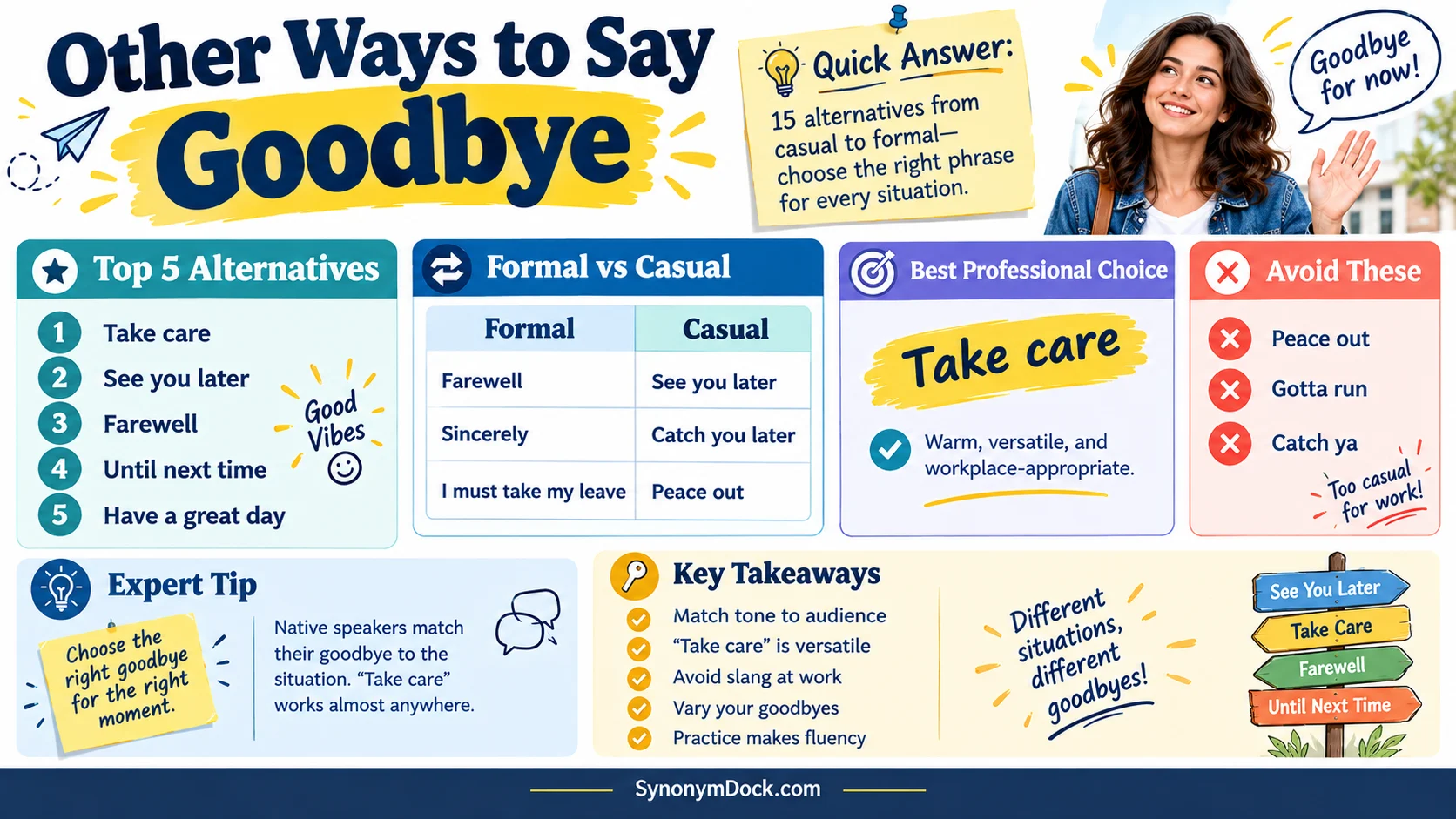
The most common other ways to say goodbye include “take care,” “see you later,” “farewell,” “until next time,” and “have a great day.” These alternatives range from casual to formal, letting you match your tone to any situation whether you’re ending a business call, leaving a party, or writing a professional email.
Top 5 Alternatives: Take care, See you later, Farewell, Until next time, Have a great day.
“Goodbye” is one of the first English words every learner masters. It’s simple, clear, and universally understood. But here’s the problem: using it constantly makes your English sound repetitive and flat.
When you search for other ways to say goodbye, you’re not just looking for synonyms. You’re looking for phrases that fit specific moments ending a meeting, leaving a voicemail, or signing off an email to a client. Each situation demands a different tone.
This guide gives you 15 practical alternatives to goodbye, complete with examples, formality ratings, and native speaker insights. By the end, you’ll know exactly which phrase to use whether you’re in a boardroom or chatting with a friend.
Quick Categories
Formal Alternatives
- Farewell A classic, slightly dramatic way to say goodbye.
- I bid you farewell Very formal, almost literary.
- Until we meet again Formal and somewhat old-fashioned.
- I must take my leave Extremely formal, used in ceremonial settings.
- Adieu Borrowed from French, very formal and rare.
Pro Tip
These expressions work well in speeches, formal letters, or when you want to sound dignified. Avoid them in everyday conversation they’ll sound theatrical.
Professional Alternatives
- Take care Warm but professional.
- Have a great day Friendly and workplace-appropriate.
- I look forward to our next conversation Professional and forward-looking.
- Wishing you all the best Polite and supportive.
- Until next time Neutral and professional.
Pro Tip
These phrases strike the right balance between warmth and professionalism. They’re ideal for client emails, video calls, and office interactions.
Business Email Alternatives
- Best regards The gold standard for email sign-offs.
- Kind regards Slightly warmer than “best regards.”
- Sincerely Formal and traditional.
- Looking forward to hearing from you Action-oriented and professional.
- Thank you for your time Respectful and appreciative.
Pro Tip
Email sign-offs depend on your relationship with the recipient. “Best regards” works for almost anyone. “Sincerely” is safer for formal or first-time contacts.
Academic Alternatives
- I appreciate your attention Polite and academic.
- Thank you for your consideration Formal and respectful.
- I look forward to further discussion Scholarly and engaged.
- With appreciation Formal and warm.
- Respectfully Very formal, often used in academic correspondence.
Pro Tip
Academic goodbyes should sound respectful and thoughtful. Avoid casual phrases like “catch you later” in essays, emails to professors, or conference presentations.
Casual Alternatives
- See you later The most common casual goodbye.
- Catch you later Friendly and relaxed.
- Talk soon Simple and warm.
- Bye for now Soft and friendly.
- Take it easy Relaxed and caring.
Pro Tip
These phrases are perfect for friends, family, and informal settings. They sound natural and approachable.
Informal Expressions
- Later! Very casual, often used among close friends.
- Peace out Slang, casual, and youthful.
- I’m out Blunt and informal.
- Gotta run Casual and busy-sounding.
- Catch ya Very informal, regional.
Pro Tip
Informal expressions are great for texting or hanging out with friends. Never use them in professional or academic settings.
“The right goodbye can leave a lasting impression choose your words as carefully as you choose your greetings.”
Common Mistakes
Mistake 1: Using “Goodbye” in Every Situation
Why it’s incorrect: “Goodbye” is neutral but can sound abrupt or final in casual or professional contexts.
Correct version: Match your goodbye to the situation.
Example: Instead of saying “Goodbye” at the end of a meeting, try “I look forward to our next conversation.
Mistake 2: Using “Farewell” in Casual Conversation
Why it’s incorrect: “Farewell” sounds dramatic and old-fashioned in everyday speech.
Correct version: Use “See you later” or “Take care” instead.
Example: Saying “Farewell” to a coworker at lunch sounds odd. “See you later” is natural.
Mistake 3: Using “Peace Out” in Professional Emails
Why it’s incorrect: “Peace out” is slang and inappropriate for business communication.
Correct version: Use “Best regards” or “Take care.”
Example: Ending a client email with “Peace out” damages your professional credibility.
Mistake 4: Overusing “Best Regards”
Why it’s incorrect: Repeating the same sign-off in every email feels robotic.
Correct version: Vary your closings based on context.
Example: Use “Kind regards” for warmer emails, “Sincerely” for formal ones.
Mistake 5: Forgetting to Match Tone to Audience
Why it’s incorrect: A casual goodbye to a senior executive can seem disrespectful.
Correct version: Always consider your audience before choosing a phrase.
Example: “Catch you later” works with colleagues you know well, not with new clients.
What Does “Goodbye” Mean?
Definition: “Goodbye” is a farewell expression used when parting from someone.
Grammar: It functions as an interjection or noun. Goodbye” can stand alone or appear in phrases like “say goodbye.
Simple explanation: It’s what you say when you leave or end a conversation.
Example sentence: She waved goodbye as the train pulled away.
When to Use “Goodbye”
- Business: Ending meetings, calls, or emails.
- Academic: Closing presentations or formal correspondence.
- Emails: Signing off professionally.
- Meetings: Wrapping up discussions.
- Daily conversation: Leaving friends or family.
- Spoken English: Casual partings.
- Written English: Letters, emails, messages.
- Formal: Ceremonies, speeches, official letters.
- Informal: Texting, casual chats.
Is It Professional or Polite?
| Aspect | Explanation |
|---|---|
| Polite? | ✔ Yes, always |
| Professional? | Depends on context |
| Formal? | Sometimes |
| Natural? | Yes |
Business-style example: “Thank you for your time. Goodbye.”
Simple explanation: “Goodbye” is never rude, but it can sound stiff. Alternatives add warmth or professionalism.
Pros and Cons
Pros
- Universally understood
- Neutral tone
- Easy to pronounce
- Appropriate in most situations
Cons
- Overused
- Can sound abrupt
- Lacks warmth
- Doesn’t convey specific tone
Transition to the Main List
Below are 15 alternatives to “goodbye,” each with detailed explanations, examples, and usage guidance. You’ll learn when to use each phrase and how native speakers actually talk.
Choose phrases based on your audience, setting, and relationship with the listener. The right goodbye can strengthen connections even in brief interactions.
Expert Tip: Native speakers often choose different expressions depending on formality, workplace culture, and the relationship with the listener.
Other Ways to Say “Goodbye” (With Examples)
These alternatives help you sound more fluent, improve professional English, and communicate naturally. Each entry includes meaning, tone, formality, and examples so you can choose with confidence.
1. Take Care
Meaning: A warm way to say goodbye while showing concern for someone’s well-being.
Explanation: “Take care” is versatile and friendly. It works in professional and casual settings. Native speakers use it to end conversations warmly without being overly formal.
Example Sentence: Thanks for meeting with me today. Take care!
Best Use: Business Email, Daily Conversation
Avoid Using In: Legal Documents, Academic Papers
Tone: Warm, Friendly
Formality Level: ⭐⭐⭐ Neutral
Usage Frequency: Very Common
CEFR Level: B1
Common Collocations: take care of yourself, take care now, you take care, take good care
Context Variability:
- Spoken English: “Alright, I’m heading out. Take care!”
- Professional English: “Thank you for your help. Take care.”
- Casual Conversation: “See ya! Take care!”
2. See You Later
Meaning: A casual way to say goodbye with the implication of meeting again.
Explanation: “See you later” is one of the most common alternatives to goodbye. It’s informal but polite, used among friends, colleagues, and acquaintances.
Example Sentence: I’ve got to run. See you later!
Best Use: Daily Conversation, Workplace
Avoid Using In: Formal Letters, Ceremonies
Tone: Friendly, Casual
Formality Level: ⭐⭐ Casual
Usage Frequency: Very Common
CEFR Level: A2
Common Collocations: see you later, see you soon, see you around, see you tomorrow
Context Variability:
- Spoken English: “I’ll see you later at the meeting.”
- Professional English: “See you later at the conference.”
- Casual Conversation: “Bye! See you later!”
3. Farewell
Meaning: A formal, sometimes dramatic way to say goodbye.
Explanation: “Farewell” sounds literary or ceremonial. It’s rarely used in everyday speech but works in speeches, formal writing, or when saying goodbye permanently.
Example Sentence: Farewell, my friend. May our paths cross again.
Best Use: Formal Speeches, Literary Writing
Avoid Using In: Casual Text, Daily Conversation
Tone: Formal, Dramatic
Formality Level: ⭐⭐⭐⭐⭐ Very Formal
Usage Frequency: Rare
CEFR Level: C1
Common Collocations: bid farewell, a fond farewell, farewell address, farewell party
Context Variability:
- Spoken English: “Farewell, everyone. It’s been an honor.”
- Professional English: “We bid farewell to our retiring director.”
- Casual Conversation: Rarely used.
4. Until Next Time
Meaning: A polite way to say goodbye while implying you’ll meet again.
Explanation: “Until next time” is neutral and professional. It’s warmer than “goodbye” and works well in both business and casual settings.
Example Sentence: It was great chatting with you. Until next time!
Best Use: Business Meetings, Client Calls
Avoid Using In: Final Goodbyes, Legal Documents
Tone: Professional, Warm
Formality Level: ⭐⭐⭐ Neutral
Usage Frequency: Common
CEFR Level: B1
Common Collocations: until next time, until we meet again, until then
Context Variability:
- Spoken English: “Great seeing you. Until next time!”
- Professional English: “Thank you for your time. Until next time.”
- Casual Conversation: “Catch you later! Until next time.”
5. Have a Great Day
Meaning: A friendly farewell that wishes someone well.
Explanation: “Have a great day” is cheerful and polite. It’s common in customer service, retail, and casual professional interactions.
Example Sentence: Thanks for stopping by. Have a great day!
Best Use: Customer Service, Daily Conversation
Avoid Using In: Formal Academic Writing, Legal Contexts
Tone: Friendly, Upbeat
Formality Level: ⭐⭐⭐ Neutral
Usage Frequency: Very Common
CEFR Level: A2
Common Collocations: have a great day, have a wonderful day, have a good one
Context Variability:
- Spoken English: “Bye! Have a great day!”
- Professional English: “Thank you for your business. Have a great day.”
- Casual Conversation: “See you tomorrow. Have a great day!”
Native Speaker Tip
“Take care” and “See you later” are the most natural choices for everyday goodbyes. “Farewell” sounds old-fashioned and dramatic native speakers rarely use it in conversation. “Until next time” is perfect for professional settings where you want to sound warm but polished.
6. Catch You Later
Meaning: A casual, friendly way to say goodbye.
Explanation: “Catch you later” is informal and relaxed. It’s common among friends, colleagues, and peers. It implies you’ll see or talk to them again soon.
Example Sentence: I’m off to lunch. Catch you later!
Best Use: Casual Conversation, Workplace
Avoid Using In: Formal Emails, Academic Writing
Tone: Casual, Friendly
Formality Level: ⭐⭐ Casual
Usage Frequency: Common
CEFR Level: B1
Common Collocations: catch you later, catch you soon, catch ya later
Context Variability:
- Spoken English: “I gotta go. Catch you later!”
- Professional English: “Catch you later at the team meeting.”
- Casual Conversation: “Bye! Catch you later!”
7. Best Regards
Meaning: A formal, professional email sign-off.
Explanation: “Best regards” is the standard closing for business emails. It’s polite, neutral, and appropriate for almost any professional context.
Example Sentence: Thank you for your prompt response. Best regards, Sarah.
Best Use: Business Email, Client Communication
Avoid Using In: Casual Text, Personal Letters
Tone: Professional, Formal
Formality Level: ⭐⭐⭐⭐ Formal
Usage Frequency: Very Common
CEFR Level: B2
Common Collocations: best regards, kind regards, warm regards, regards
Context Variability:
- Spoken English: Rarely used in speech.
- Professional English: “I’ve attached the report. Best regards.”
- Casual Conversation: Not used.
8. Talk Soon
Meaning: A friendly way to end a conversation with the expectation of talking again.
Explanation: “Talk soon” is casual but polite. It’s common in phone calls, video meetings, and text messages.
Example Sentence: I’ll let you go now. Talk soon!
Best Use: Phone Calls, Daily Conversation
Avoid Using In: Formal Writing, Legal Documents
Tone: Friendly, Relaxed
Formality Level: ⭐⭐ Casual
Usage Frequency: Common
CEFR Level: B1
Common Collocations: talk soon, talk later, speak soon
Context Variability:
- Spoken English: “Alright, talk soon!”
- Professional English: “Thanks for the update. Talk soon.”
- Casual Conversation: “Gotta go. Talk soon!”
9. I Look Forward to Our Next Conversation
Meaning: A professional way to say goodbye while expressing anticipation.
Explanation: This phrase is polished and forward-looking. It’s ideal for business calls, client meetings, and networking.
Example Sentence: Thank you for your insights. I look forward to our next conversation.
Best Use: Client Meetings, Business Calls
Avoid Using In: Casual Text, Informal Chat
Tone: Professional, Respectful
Formality Level: ⭐⭐⭐⭐ Formal
Usage Frequency: Occasional
CEFR Level: C1
Common Collocations: look forward to, next conversation, future discussion
Context Variability:
- Spoken English: “It’s been a pleasure. I look forward to our next conversation.”
- Professional English: “Thank you for your time. I look forward to our next conversation.”
- Casual Conversation: Rarely used.
10. Bye for Now
Meaning: A soft, friendly way to say goodbye temporarily.
Explanation: “Bye for now” suggests you’ll reconnect soon. It’s warmer than “goodbye” and works in casual and semi-professional settings.
Example Sentence: I need to finish some work. Bye for now!
Best Use: Daily Conversation, Workplace
Avoid Using In: Formal Letters, Ceremonies
Tone: Friendly, Gentle
Formality Level: ⭐⭐ Casual
Usage Frequency: Common
CEFR Level: B1
Common Collocations: bye for now, bye for today, goodbye for now
Context Variability:
- Spoken English: “I’m heading home. Bye for now!”
- Professional English: “I’ll follow up tomorrow. Bye for now.”
- Casual Conversation: “Bye for now! Text me later.”
Expert Insight
In workplace communication, “Take care” and “Until next time” are safe, professional choices. For emails, “Best regards” remains the gold standard. Avoid slang like “Peace out” in any professional context it undermines credibility. Academic writing calls for “Respectfully” or “With appreciation.”
11. Peace Out
Meaning: A slang way to say goodbye, often used among younger speakers.
Explanation: “Peace out” is very informal and casual. It’s common in texting and among friends but never appropriate in professional settings.
Example Sentence: Alright, I’m heading out. Peace out!
Best Use: Casual Conversation, Texting
Avoid Using In: Business Emails, Academic Writing
Tone: Casual, Playful
Formality Level: ⭐ Very Casual
Usage Frequency: Occasional
CEFR Level: B1
Common Collocations: peace out, I’m out, peace
Context Variability:
- Spoken English: “Peace out, everyone!”
- Professional English: Not used.
- Casual Conversation: “Gotta go. Peace out!”
12. I Must Take My Leave
Meaning: A very formal way to announce your departure.
Explanation: “I must take my leave” sounds ceremonial and old-fashioned. It’s used in formal speeches, historical dramas, or very polite settings.
Example Sentence: I must take my leave now. Thank you for your hospitality.
Best Use: Formal Events, Ceremonial Speeches
Avoid Using In: Casual Conversation, Texting
Tone: Formal, Dignified
Formality Level: ⭐⭐⭐⭐⭐ Very Formal
Usage Frequency: Rare
CEFR Level: C2
Common Collocations: take my leave, take leave, must take my leave
Context Variability:
- Spoken English: “I must take my leave. Good evening.”
- Professional English: Rarely used.
- Casual Conversation: Never used.
13. Wishing You All the Best
Meaning: A warm, professional farewell that expresses goodwill.
Explanation: “Wishing you all the best” is supportive and polite. It’s common in emails, cards, and professional partings.
Example Sentence: It’s been a pleasure working with you. Wishing you all the best!
Best Use: Business Email, Farewell Messages
Avoid Using In: Casual Text, Daily Chat
Tone: Warm, Professional
Formality Level: ⭐⭐⭐⭐ Formal
Usage Frequency: Common
CEFR Level: B2
Common Collocations: wishing you all the best, all the best, best wishes
Context Variability:
- Spoken English: “Wishing you all the best in your new role.”
- Professional English: “Thank you for everything. Wishing you all the best.”
- Casual Conversation: “Good luck! Wishing you all the best.”
14. Gotta Run
Meaning: A casual way to say you need to leave quickly.
Explanation: “Gotta run” is informal and hurried. It’s perfect for ending conversations when you’re short on time.
Example Sentence: Sorry, gotta run! Let’s catch up later.
Best Use: Casual Conversation, Phone Calls
Avoid Using In: Formal Emails, Business Meetings
Tone: Casual, Urgent
Formality Level: ⭐ Very Casual
Usage Frequency: Common
CEFR Level: B1
Common Collocations: gotta run, gotta go, I’ve gotta run
Context Variability:
- Spoken English: “Gotta run! See you later.”
- Professional English: Rarely used.
- Casual Conversation: “Sorry, gotta run. Talk soon!”
15. Sincerely
Meaning: A formal, traditional email sign-off.
Explanation: “Sincerely” is one of the most formal ways to end a letter or email. It’s appropriate for job applications, formal requests, and official correspondence.
Example Sentence: Thank you for considering my application. Sincerely, John Smith.
Best Use: Formal Letters, Job Applications
Avoid Using In: Casual Emails, Texting
Tone: Formal, Respectful
Formality Level: ⭐⭐⭐⭐⭐ Very Formal
Usage Frequency: Common
CEFR Level: B2
Common Collocations: sincerely yours, yours sincerely, sincerely
Context Variability:
- Spoken English: Not used in speech.
- Professional English: “I appreciate your time. Sincerely, Maria.”
- Casual Conversation: Never used.
Native Speaker Tip
“See you later” and “Take care” are the go-to phrases for most native speakers. “Farewell” and “I must take my leave” sound theatrical and are rarely used outside formal ceremonies. “Gotta run” is perfect for quick exits but too casual for work.
“Choosing the right phrase matters as much as choosing the right words.”
Top 10 Alternatives Compared
| Phrase | Tone | Formality | Best Use | Frequency |
|---|---|---|---|---|
| Take care | Warm, Friendly | Neutral | Business Email, Daily | Very Common |
| See you later | Friendly, Casual | Casual | Daily Conversation | Very Common |
| Farewell | Formal, Dramatic | Very Formal | Speeches, Writing | Rare |
| Until next time | Professional, Warm | Neutral | Business Meetings | Common |
| Have a great day | Friendly, Upbeat | Neutral | Customer Service | Very Common |
| Catch you later | Casual, Friendly | Casual | Workplace, Friends | Common |
| Best regards | Professional, Formal | Formal | Business Email | Very Common |
| Talk soon | Friendly, Relaxed | Casual | Phone Calls | Common |
| I look forward to our next conversation | Professional, Respectful | Formal | Client Meetings | Occasional |
| Sincerely | Formal, Respectful | Very Formal | Job Applications | Common |
Which One Should You Use?
Best Overall
Take care Warm, versatile, and appropriate in almost any setting.
Best Professional
Until next time Polished and forward-looking without being stiff.
Best Academic
Respectfully Formal and appropriate for academic correspondence.
Best Business Email
Best regards The standard, trusted sign-off for professional emails.
Best Everyday Conversation
See you later Natural, friendly, and universally understood.
Most Natural
See you later What most native speakers actually say.
Most Polite
I look forward to our next conversation Respectful and considerate.
Commonly Confused Phrases
“Goodbye” vs. “Farewell” vs. “See You Later”
| Phrase | Tone | When to Use |
|---|---|---|
| Goodbye | Neutral | Any situation, but can sound abrupt |
| Farewell | Formal, Dramatic | Ceremonies, permanent partings |
| See you later | Casual, Friendly | Everyday conversations |
Explanation: “Goodbye” is safe but generic. “Farewell” is dramatic and rare. “See you later” is the most natural choice for daily use.
“Take Care” vs. “Have a Great Day”
| Phrase | Tone | When to Use |
|---|---|---|
| Take care | Warm, Caring | Any friendly parting |
| Have a great day | Upbeat, Polite | Customer service, casual |
Explanation: “Take care” shows concern for well-being. “Have a great day” is more cheerful and wishful.
Scenario Practice
Scenario 1: Business Meeting
You’re ending a productive meeting with a client. Which phrase do you choose?
Answer: “I look forward to our next conversation.” Professional and forward-looking.
Scenario 2: Job Interview
You’re leaving an interview. What’s the best goodbye?
Answer: “Thank you for your time. Sincerely.” Formal and respectful.
Scenario 3: Presentation
You’ve just finished a presentation at a conference. How do you close?
Answer: “Thank you for your attention. Until next time.” Professional and appreciative.
Scenario 4: Class Discussion
You’re leaving a study group. What do you say?
Answer: “Great discussion! Catch you later.” Casual and friendly.
Scenario 5: Email Reply
You’re responding to a colleague’s email. How do you sign off?
Answer: “Thanks for the update. Best regards.” Professional and standard.
Mini Quiz
Question 1: Which phrase is most appropriate for a formal speech?
A) Peace out
B) Farewell
C) Catch you later
D) Gotta run
Question 2: Which phrase works best in a business email?
A) See you later
B) Best regards
C) Talk soon
D) Bye for now
Question 3: Which phrase is too casual for a job interview?
A) Sincerely
B) Thank you for your time
C) Peace out
D) Respectfully
Question 4: Which phrase implies you’ll meet again?
A) Farewell
B) Until next time
C) I must take my leave
D) Goodbye
Question 5: Which phrase is warm and professional?
A) Take care
B) Peace out
C) Gotta run
D) Later!
Answer Key
- B) Farewell Formal and appropriate for ceremonies.
- B) Best regards The standard professional email sign-off.
- C) Peace out Slang, never appropriate in interviews.
- B) Until next time Implies a future meeting.
- A) Take care Warm but professional.
Avoid These in Formal Situations
| Expression | Why to Avoid | Better Alternative |
|---|---|---|
| Peace out | Slang, unprofessional | Take care |
| Gotta run | Too casual | Until next time |
| Catch ya | Very informal | See you later |
| Later! | Abrupt, casual | Best regards |
| I’m out | Blunt, informal | I look forward to our next conversation |
FAQs
What is the most formal way to say goodbye?
The most formal ways to say goodbye include “Farewell,” “I must take my leave,” and “Sincerely.” These expressions are appropriate for ceremonies, formal letters, and official correspondence. “Farewell” carries a dramatic tone, while “Sincerely” is standard for written communication.
Which phrase is best for professional emails?
“Best regards” is the safest and most widely accepted professional email sign-off. “Kind regards” is slightly warmer, while “Sincerely” works for formal or first-time contacts. Choose based on your relationship with the recipient and the email’s purpose.
What is the difference between “Take care” and “Have a great day”?
“Take care” expresses concern for someone’s well-being and works in most situations. “Have a great day” is more cheerful and wishful, commonly used in customer service. Both are friendly, but “Take care” feels more personal.
Which alternative sounds most natural?
“See you later” is the most natural and commonly used alternative to goodbye in everyday conversation. Native speakers use it casually among friends, colleagues, and acquaintances. It’s friendly without being too formal or informal.
Can I use these expressions in business meetings?
Yes, many of these expressions work in business meetings. “Take care,” “Until next time,” and “I look forward to our next conversation” are all appropriate. Avoid casual phrases like “Peace out” or “Gotta run” in professional settings.
Conclusion
Learning different ways to say goodbye is more than a vocabulary exercise it’s a communication skill. Each phrase carries its own tone, formality, and cultural nuance. Choosing the right one helps you connect with others, whether you’re closing a business deal or saying goodbye to a friend.
Practice using these alternatives in everyday conversations, emails, and meetings. Start with “Take care” or “See you later” if you’re unsure. As you grow more confident, experiment with formal and professional options. Your English will sound more natural, polished, and fluent with every conversation.

3 thoughts on “Best Other Ways to Say Goodbye |15+ Examples and Alternatives”