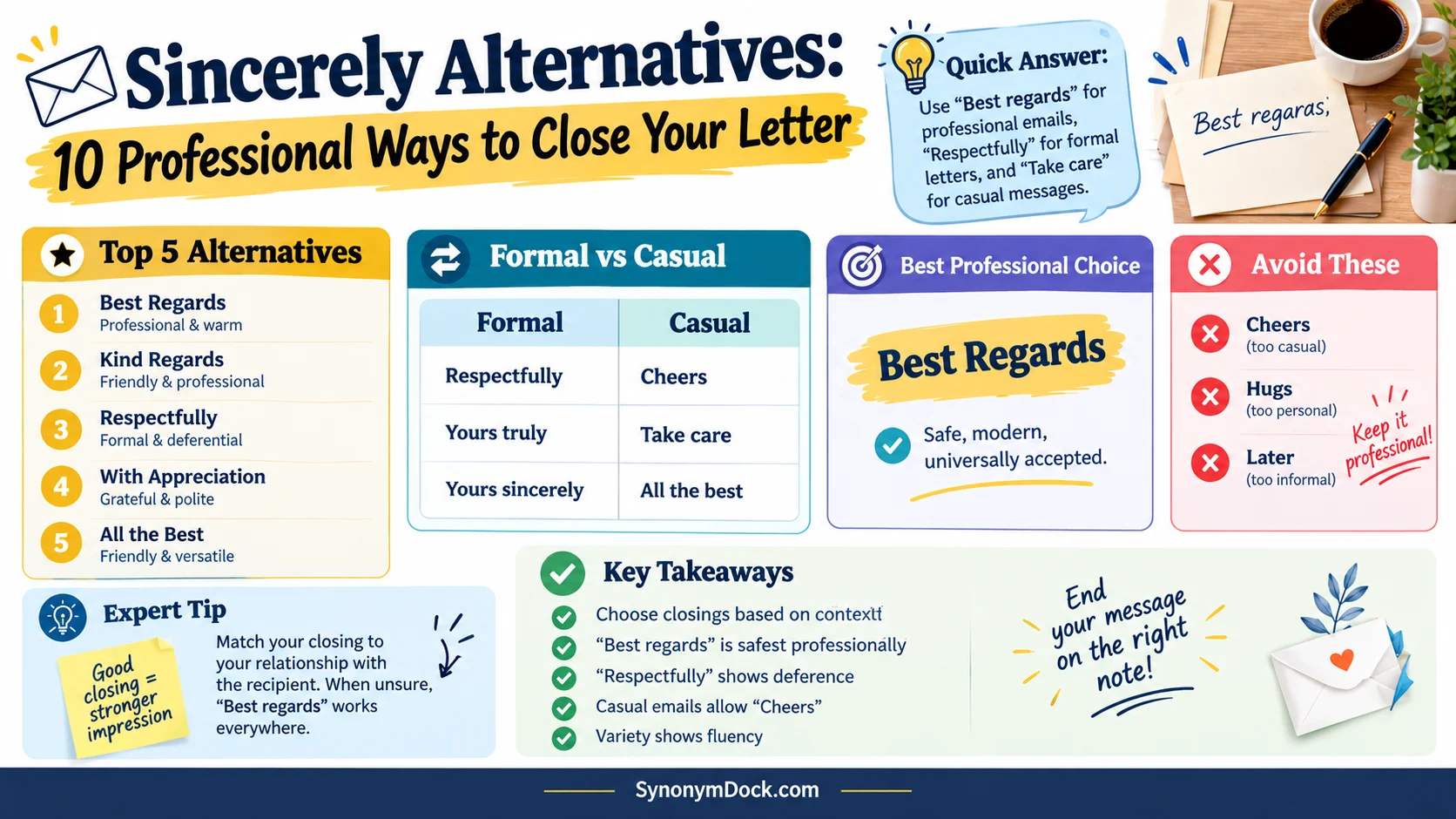
What are other ways to say sincerely? Other ways to say sincerely include: Yours truly, Best regards, Kind regards, Respectfully, With appreciation, Cordially, Faithfully yours, Warm regards, With gratitude, and Best wishes. Choose based on your relationship with the recipient and the formality of your message.
Top 5 alternatives: Yours truly, Best regards, Kind regards, Respectfully, With appreciation.
“Sincerely” is one of the most recognized closing phrases in English correspondence. It signals respect and formality, making it a safe choice for job applications, business letters, and official communication. However, using the same closing repeatedly can make your writing feel formulaic.
Many English learners search for alternatives to “sincerely” because they want their emails and letters to sound more natural and varied. The good news is that English offers dozens of other ways to say sincerely, each suited to different situations and relationships.
This guide will help you choose the right closing for every context. Whether you need professional English phrases for business emails or formal expressions for academic writing, you will find practical options here.
“The right closing phrase leaves a lasting impression on your reader.”
Quick Categories
Formal Alternatives
These closings work well in official letters, legal correspondence, and academic writing.
- Yours truly – A classic formal closing for unknown recipients
- Respectfully – Shows deference, ideal for authority figures
- Faithfully yours – Very formal, common in British English
- Cordially – Professional yet slightly warmer than “sincerely”
- With highest regards – Extremely formal, used in executive communication
Professional Alternatives
These options suit workplace emails and business correspondence.
- Best regards – The most common professional email closing
- Kind regards – Slightly warmer than “best regards”
- Warm regards – Friendly yet professional
- With appreciation – Shows gratitude and respect
- Many thanks – Professional when you have requested something
Business Email Alternatives
These phrases work well in client communication and corporate settings.
- Best regards – Safe, professional, widely accepted
- Thank you for your time – Respectful of the recipient’s schedule
- Looking forward to hearing from you – Encourages a response
- Thanks again – Casual professional tone
- All the best – Friendly and professional
Academic Alternatives
These closings suit scholarly writing and formal academic correspondence.
- Respectfully submitted – Common in academic petitions
- With sincere thanks – Appropriate for thanking professors
- Yours faithfully – Standard in formal British correspondence
- With kind regards – Professional academic tone
- Sincerely yours – Traditional academic closing
Casual Alternatives
These work in informal emails to colleagues you know well.
- Thanks – Simple and friendly
- Cheers – Common in British and Australian English
- Talk soon – Warm and conversational
- Take care – Friendly and caring
- Best – Short and modern
Informal Expressions
These closings suit friends, family, and very casual communication.
- Later – Very casual, common among friends
- Catch you later – Friendly and relaxed
- Bye for now – Warm and informal
- Hugs – Affectionate, for close relationships
- Love – Intimate, for family and close friends
Pro Tip
Match your closing to your relationship with the recipient. When in doubt, “Best regards” works in almost any professional situation.
“Your closing phrase is your final handshake—make it count.”
Common Mistakes
English learners often make these errors when using “sincerely” and its alternatives.
Mistake 1: Using “Sincerely” with a Comma and Name on the Same Line
Incorrect: Sincerely, John Smith
Why it is incorrect: In formal letters, the closing and your name should be on separate lines.
Correct version:
Sincerely,
John Smith
Example sentence: Sincerely,
Dr. Maria Chen
Mistake 2: Mixing Formal Closings with Casual Openings
Incorrect: Hey buddy, Sincerely, Mark
Why it is incorrect: The tone is inconsistent, confusing the reader.
Correct version: Dear James, Best regards, Mark
Example sentence: Dear Mr. Thompson, Kind regards, Sarah Williams
Mistake 3: Using “Sincerely” in Text Messages
Incorrect: Sincerely, can you pick up milk?
Why it is incorrect: “Sincerely” is far too formal for casual texts.
Correct version: Can you pick up milk? Thanks!
Example sentence: See you tonight! Take care.
Mistake 4: Overusing “Sincerely” in Every Email
Incorrect: Using “Sincerely” in every single email, even quick replies.
Why it is incorrect: It sounds robotic and impersonal in casual exchanges.
Correct version: Use “Best regards” for routine emails and “Sincerely” for formal correspondence.
Example sentence: Thanks for the update. Best regards, Tom.
Mistake 5: Forgetting the Closing Entirely
Incorrect: I have attached the report. [No closing]
Why it is incorrect: A missing closing can seem abrupt or rude.
Correct version: I have attached the report. Best regards, Anna.
Example sentence: Please review the proposal. Kind regards, David.
“Small details in your closing create big impressions.”
What Does “Sincerely” Mean?
Definition: “Sincerely” is an adverb meaning “in a genuine, honest, and heartfelt way.” As a letter closing, it signals that your words are truthful and respectful.
Grammar explanation: In correspondence, “Sincerely” functions as a valediction (closing phrase). It traditionally pairs with “Dear [Name]” when you know the recipient’s name.
Simple explanation: “Sincerely” tells the reader you mean what you wrote. It is polite, professional, and safe for most formal situations.
Natural example sentence: Sincerely, I hope this letter finds you well and that we can work together soon.
When to Use “Sincerely”
“Sincerely” works in many contexts. Here is when it fits best:
Business situations:
- Formal business letters to new contacts
- Cover letters for job applications
- Official complaints or requests
- Communication with senior executives
Academic situations:
- Letters to professors or administrators
- Scholarship applications
- Formal academic correspondence
Emails:
- First-time contact with a professional
- Formal requests or proposals
- Communication with clients
Meetings and presentations:
- Written follow-ups after formal meetings
- Official minutes or summaries
Daily conversation:
- Rarely used in speech; more common in writing
Spoken English:
- Not typical; “sincerely” is almost exclusively written
Written English:
- Very common in letters and formal emails
Formal contexts:
- Legal correspondence
- Government communication
- Official announcements
Informal contexts:
- Avoid “sincerely” in casual messages
“Knowing when to use a phrase matters as much as knowing the phrase itself.”
Is It Professional or Polite?
Understanding the difference between polite, professional, formal, and natural helps you choose wisely.
| Quality | Does “Sincerely” Fit? | Explanation |
|---|---|---|
| Polite? | ✔ Yes | Always respectful |
| Professional? | ✔ Yes | Standard in business |
| Formal? | ✔ Yes | Very formal |
| Natural? | Depends on context | Sounds stiff in casual settings |
Business-style example: Sincerely, I appreciate your consideration of my application.
Simple explanation: “Sincerely” is safe and respectful, but it can feel distant. In modern workplaces, “Best regards” often feels more approachable.
“Professional does not always mean stiff—choose warmth when appropriate.”
Pros and Cons
Pros
- Universally recognized and respected
- Safe for formal and official correspondence
- Works when you do not know the recipient well
- Signals genuine intent and honesty
- Appropriate across cultures and industries
Cons
- Can sound old-fashioned or stiff
- Overused in business communication
- Feels impersonal in casual contexts
- Limited warmth compared to alternatives
- Not ideal for quick or informal emails
Transition to the Main List
Now that you understand the basics, it is time to explore the best alternatives to “sincerely.” Each option comes with clear explanations, examples, and guidance on when to use it.
You will learn which phrases work best for business emails, academic writing, and everyday communication. By the end, you will feel confident choosing the right closing for any situation.
“Variety in your vocabulary shows mastery of the language.”
Expert Tip Box
Expert Tip: Native speakers often choose closings based on their relationship with the recipient, not just formality. A warm “Best regards” to a colleague can build rapport, while “Respectfully” to a senior leader shows appropriate deference.
Other Ways to Say “Sincerely” (With Examples)
This section provides 15 alternatives to “sincerely,” each with detailed explanations. These phrases will help you sound more fluent, improve your professional English, and communicate naturally.
Choose phrases based on your audience and situation. What works for a job application may not suit a quick email to a coworker.
1. Phrase: Yours Truly
Meaning: A formal closing indicating genuine regard for the recipient.
Explanation: “Yours truly” is a classic letter closing used when you do not know the recipient’s name or want to maintain distance. It sounds formal and slightly old-fashioned but remains appropriate in legal and official correspondence.
Example Sentence: Yours truly, the management team appreciates your patience during this transition.
Best Use: Formal Letters, Legal Documents
Avoid Using In: Casual Emails, Text Messages
Tone: Formal, Respectful
Formality Level: ⭐⭐⭐⭐⭐ Very Formal
Usage Frequency: Common
CEFR Level: B2
Common Collocations:
- Yours truly
- Yours very truly
- I remain yours truly
Context Variability:
- Spoken English: Rarely used in speech
- Professional English: Suitable for formal letters to unknown recipients
- Casual Conversation: Avoid entirely
2. Phrase: Best Regards
Meaning: A professional closing that conveys polite goodwill.
Explanation: “Best regards” is the most common professional email closing in modern English. It is warm enough to feel friendly but formal enough for business. Native speakers use it daily in workplace communication.
Example Sentence: Best regards, I look forward to our continued collaboration on this project.
Best Use: Business Emails, Client Communication
Avoid Using In: Academic Papers, Legal Contracts
Tone: Professional, Warm
Formality Level: ⭐⭐⭐⭐ Formal
Usage Frequency: Very Common
CEFR Level: B1
Common Collocations:
- Best regards
- Warmest regards
- Kindest regards
Context Variability:
- Spoken English: Occasionally used to end phone calls formally
- Professional English: Ideal for emails to colleagues and clients
- Casual Conversation: Too formal for friends
3. Phrase: Kind Regards
Meaning: A polite and slightly warmer version of “best regards.”
Explanation: “Kind regards” adds a touch of warmth while remaining professional. It works well when you have a friendly but professional relationship with the recipient. British English speakers favor this closing.
Example Sentence: Kind regards, thank you for taking the time to review my proposal.
Best Use: Business Emails, Follow-ups
Avoid Using In: Informal Texts, Personal Letters
Tone: Professional, Friendly
Formality Level: ⭐⭐⭐⭐ Formal
Usage Frequency: Very Common
CEFR Level: B1
Common Collocations:
- Kind regards
- With kind regards
- Kindest regards
Context Variability:
- Spoken English: Rare in speech
- Professional English: Excellent for client and colleague emails
- Casual Conversation: Too formal
4. Phrase: Respectfully
Meaning: A closing that shows deference and high respect.
Explanation: “Respectfully” is appropriate when writing to someone in authority or when cultural norms require formal deference. It is common in military, government, and formal institutional communication.
Example Sentence: Respectfully, I request your consideration of my application for the scholarship.
Best Use: Official Letters, Authority Figures
Avoid Using In: Casual Emails, Friendly Notes
Tone: Formal, Deferential
Formality Level: ⭐⭐⭐⭐⭐ Very Formal
Usage Frequency: Common
CEFR Level: B2
Common Collocations:
- Respectfully
- Respectfully submitted
- Yours respectfully
Context Variability:
- Spoken English: Used in formal addresses
- Professional English: Suitable for hierarchical organizations
- Casual Conversation: Never appropriate
5. Phrase: With Appreciation
Meaning: A closing that expresses gratitude alongside sincerity.
Explanation: “With appreciation” works when you want to thank the recipient while closing your message. It feels warmer than “sincerely” and acknowledges the recipient’s time or effort.
Example Sentence: With appreciation, I thank you for your mentorship throughout this project.
Best Use: Thank-you Emails, Professional Correspondence
Avoid Using In: Complaints, Neutral Messages
Tone: Grateful, Professional
Formality Level: ⭐⭐⭐⭐ Formal
Usage Frequency: Occasional
CEFR Level: B2
Common Collocations:
- With appreciation
- With sincere appreciation
- With deep appreciation
Context Variability:
- Spoken English: Used in formal speeches
- Professional English: Great for thank-you notes
- Casual Conversation: Too formal
Native Speaker Tip
“Best regards” and “Kind regards” are the most natural choices for everyday professional emails. “Yours truly” sounds increasingly old-fashioned in modern business communication, though it remains acceptable in legal contexts. Native speakers rarely use “Respectfully” outside of formal or hierarchical settings.
6. Phrase: Cordially
Meaning: A warm yet formal closing indicating friendly respect.
Explanation: “Cordially” strikes a balance between warmth and formality. It works well in business correspondence where you want to sound approachable but professional. Some find it slightly old-fashioned.
Example Sentence: Cordially, we invite you to attend our annual conference next month.
Best Use: Invitations, Business Letters
Avoid Using In: Casual Emails, Personal Texts
Tone: Warm, Formal
Formality Level: ⭐⭐⭐⭐ Formal
Usage Frequency: Occasional
CEFR Level: B2
Common Collocations:
- Cordially
- Cordially yours
- Yours cordially
Context Variability:
- Spoken English: Rare
- Professional English: Suitable for invitations and announcements
- Casual Conversation: Too formal
7. Phrase: Faithfully Yours
Meaning: A very formal British closing used when the recipient’s name is unknown.
Explanation: “Faithfully yours” follows the British convention: use “Dear Sir/Madam” with “Faithfully yours.” It sounds traditional and is less common in American English.
Example Sentence: Faithfully yours, I remain committed to resolving this matter promptly.
Best Use: Formal British Letters, Official Correspondence
Avoid Using In: American Business Emails, Casual Messages
Tone: Formal, Traditional
Formality Level: ⭐⭐⭐⭐⭐ Very Formal
Usage Frequency: Occasional
CEFR Level: C1
Common Collocations:
- Faithfully yours
- Yours faithfully
- I remain faithfully yours
Context Variability:
- Spoken English: Never used
- Professional English: British formal letters only
- Casual Conversation: Never appropriate
8. Phrase: Warm Regards
Meaning: A friendly but professional closing that conveys warmth.
Explanation: “Warm regards” is slightly more personal than “best regards.” It works well when you have an established relationship with the recipient. Use it in follow-up emails or ongoing correspondence.
Example Sentence: Warm regards, I hope you and your team have a wonderful holiday season.
Best Use: Follow-up Emails, Colleague Communication
Avoid Using In: First Contact, Legal Documents
Tone: Friendly, Professional
Formality Level: ⭐⭐⭐ Neutral
Usage Frequency: Common
CEFR Level: B1
Common Collocations:
- Warm regards
- Warmest regards
- With warm regards
Context Variability:
- Spoken English: Occasionally in voicemails
- Professional English: Great for ongoing relationships
- Casual Conversation: Slightly formal but acceptable
9. Phrase: With Gratitude
Meaning: A heartfelt closing expressing thankfulness.
Explanation: “With gratitude” emphasizes appreciation. It suits situations where someone has helped you significantly, such as a mentor, reference writer, or supportive colleague.
Example Sentence: With gratitude, I acknowledge the support you have given me during this challenging time.
Best Use: Thank-you Letters, Personal Correspondence
Avoid Using In: Complaints, Neutral Business Emails
Tone: Grateful, Warm
Formality Level: ⭐⭐⭐⭐ Formal
Usage Frequency: Occasional
CEFR Level: B2
Common Collocations:
- With gratitude
- With deep gratitude
- With heartfelt gratitude
Context Variability:
- Spoken English: Used in speeches
- Professional English: Suitable for thank-you messages
- Casual Conversation: Too formal for friends
10. Phrase: All the Best
Meaning: A friendly, versatile closing wishing the recipient well.
Explanation: “All the best” is professional yet approachable. It works in most business contexts and feels less stiff than “sincerely.” Native speakers use it frequently in emails.
Example Sentence: All the best, and please do not hesitate to reach out if you have questions.
Best Use: Business Emails, General Correspondence
Avoid Using In: Legal Documents, Very Formal Letters
Tone: Friendly, Professional
Formality Level: ⭐⭐⭐ Neutral
Usage Frequency: Very Common
CEFR Level: B1
Common Collocations:
- All the best
- Wishing you all the best
- All the best wishes
Context Variability:
- Spoken English: Common in farewells
- Professional English: Excellent for most emails
- Casual Conversation: Perfectly natural
Expert Insight
In workplace communication, the closing you choose reflects your awareness of context. “Best regards” remains the gold standard for professional emails because it balances respect with approachability. For academic writing, “Sincerely” or “Respectfully” are safer choices. When writing to clients, “Kind regards” or “Warm regards” can strengthen relationships without sacrificing professionalism.
11. Phrase: Many Thanks
Meaning: A polite closing that emphasizes gratitude.
Explanation: “Many thanks” works well when you have asked for something or received help. It is professional but warmer than “sincerely.” Common in British English.
Example Sentence: Many thanks, I truly appreciate your quick response to my request.
Best Use: Request Emails, Follow-ups
Avoid Using In: Formal Complaints, Legal Letters
Tone: Grateful, Professional
Formality Level: ⭐⭐⭐ Neutral
Usage Frequency: Common
CEFR Level: B1
Common Collocations:
- Many thanks
- Many thanks in advance
- Thanks many times over
Context Variability:
- Spoken English: Common in informal speech
- Professional English: Great for requests
- Casual Conversation: Natural and friendly
12. Phrase: Looking Forward to Hearing from You
Meaning: A closing that politely encourages a response.
Explanation: This phrase works as a closing when you expect a reply. It is professional and action-oriented. Use it in proposals, applications, or inquiries.
Example Sentence: Looking forward to hearing from you, I remain available for any further discussion.
Best Use: Proposals, Inquiry Emails
Avoid Using In: Final Responses, Thank-you Notes
Tone: Professional, Expectant
Formality Level: ⭐⭐⭐⭐ Formal
Usage Frequency: Common
CEFR Level: B2
Common Collocations:
- Looking forward to hearing from you
- I look forward to your response
- Awaiting your reply
Context Variability:
- Spoken English: Rare in speech
- Professional English: Standard in business emails
- Casual Conversation: Too formal
13. Phrase: Take Care
Meaning: A warm, caring closing suitable for familiar contacts.
Explanation: “Take care” is friendly and sincere. It works well with colleagues you know well or in semi-formal emails. It shows you care about the recipient’s well-being.
Example Sentence: Take care, and I hope your presentation goes smoothly tomorrow.
Best Use: Colleague Emails, Friendly Notes
Avoid Using In: Formal Letters, Client Communication
Tone: Warm, Caring
Formality Level: ⭐⭐ Casual
Usage Frequency: Very Common
CEFR Level: B1
Common Collocations:
- Take care
- Take care of yourself
- Take good care
Context Variability:
- Spoken English: Very common in farewells
- Professional English: Acceptable with close colleagues
- Casual Conversation: Perfect
14. Phrase: Cheers
Meaning: A casual, friendly closing common in British and Australian English.
Explanation: “Cheers” works in informal emails and messages. It is friendly and relaxed but too casual for formal business communication. Younger professionals use it frequently.
Example Sentence: Cheers, let me know if you need anything else before Friday.
Best Use: Casual Emails, Team Messages
Avoid Using In: Client Emails, Formal Letters
Tone: Casual, Friendly
Formality Level: ⭐⭐ Casual
Usage Frequency: Common (UK/Australia)
CEFR Level: B1
Common Collocations:
- Cheers
- Cheers mate
- Thanks, cheers
Context Variability:
- Spoken English: Very common in UK/Australia
- Professional English: Acceptable in informal teams
- Casual Conversation: Natural
15. Phrase: Yours Sincerely
Meaning: A formal closing used when you know the recipient’s name.
Explanation: “Yours sincerely” is the traditional British counterpart to “Dear [Name].” It is more formal than “sincerely” alone and remains standard in British formal correspondence.
Example Sentence: Yours sincerely, I thank you for considering my application for the position.
Best Use: Formal British Letters, Job Applications
Avoid Using In: American Emails, Casual Messages
Tone: Formal, Respectful
Formality Level: ⭐⭐⭐⭐⭐ Very Formal
Usage Frequency: Common (UK)
CEFR Level: B2
Common Collocations:
- Yours sincerely
- Sincerely yours
- I remain yours sincerely
Context Variability:
- Spoken English: Never used
- Professional English: Standard in British formal letters
- Casual Conversation: Never appropriate
Native Speaker Tip
“Cheers” and “Take care” are perfectly natural in informal workplace emails, especially in the UK and Australia. “Many thanks” sounds polite without being stiff. “Yours sincerely” remains essential in British formal correspondence but sounds out of place in American business emails.
Comparison Section
Top 10 Alternatives Compared
| Phrase | Tone | Formality | Best Use | Frequency |
|---|---|---|---|---|
| Best Regards | Professional, Warm | ⭐⭐⭐⭐ | Business Emails | Very Common |
| Kind Regards | Professional, Friendly | ⭐⭐⭐⭐ | Client Communication | Very Common |
| Respectfully | Formal, Deferential | ⭐⭐⭐⭐⭐ | Official Letters | Common |
| With Appreciation | Grateful, Professional | ⭐⭐⭐⭐ | Thank-you Emails | Occasional |
| Warm Regards | Friendly, Professional | ⭐⭐⭐ | Follow-ups | Common |
| All the Best | Friendly, Professional | ⭐⭐⭐ | General Emails | Very Common |
| Cordially | Warm, Formal | ⭐⭐⭐⭐ | Invitations | Occasional |
| Yours Truly | Formal, Respectful | ⭐⭐⭐⭐⭐ | Legal Letters | Common |
| Many Thanks | Grateful, Professional | ⭐⭐⭐ | Request Emails | Common |
| Take Care | Warm, Caring | ⭐⭐ | Colleague Emails | Very Common |
Which One Should You Use?
Best Overall
Best Regards – Works in almost any professional situation without sounding stiff.
Best Professional
Kind Regards – Adds warmth while maintaining professionalism.
Best Academic
Respectfully – Shows appropriate deference to professors and administrators.
Best Business Email
Best Regards – The modern standard for workplace communication.
Best Everyday Conversation
Take Care – Friendly and sincere for casual emails.
Most Natural
Best Regards – Native speakers use it daily without hesitation.
Most Polite
With Appreciation – Expresses genuine gratitude and respect.
Commonly Confused Phrases
“Sincerely” vs “Yours Sincerely” vs “Sincerely Yours”
Sincerely – Standard American closing, works with or without a name.
Yours Sincerely – British convention when you know the recipient’s name.
Sincerely Yours – American variant, slightly more formal than “Sincerely.”
“Best Regards” vs “Kind Regards” vs “Warm Regards”
Best Regards – Neutral professional, safe for any business context.
Kind Regards – Slightly warmer, good for ongoing relationships.
Warm Regards – Friendliest option, best for people you know well.
“Respectfully” vs “Cordially”
Respectfully – Shows deference, ideal for authority figures.
Cordially – Warm but formal, good for invitations and announcements.
“Understanding subtle differences helps you choose with confidence.”
Scenario Practice
Test your understanding with these real-world situations.
Scenario 1: Business Meeting Follow-up
You met a new client at a conference and want to follow up.
Which phrase would you choose?
Answer: Best regards or Kind regards
Explanation: These closings are professional yet approachable for new business relationships.
Scenario 2: Job Interview Thank-you
You just interviewed for your dream job and want to send a thank-you email.
Which phrase would you choose?
Answer: With appreciation or Best regards
Explanation: These express gratitude while remaining professional.
Scenario 3: Presentation to Senior Executives
You are emailing a summary of your presentation to the CEO.
Which phrase would you choose?
Answer: Respectfully or Best regards
Explanation: “Respectfully” shows deference; “Best regards” is safe and professional.
Scenario 4: Class Discussion Follow-up
You are emailing your professor about a class discussion.
Which phrase would you choose?
Answer: Respectfully or Sincerely
Explanation: Academic contexts call for formal closings that show respect.
Scenario 5: Email Reply to a Close Colleague
You are replying to a coworker you have known for years.
Which phrase would you choose?
Answer: Take care or Cheers
Explanation: These casual closings suit friendly workplace relationships.
Mini Quiz
Test your knowledge with these five questions.
Question 1: Which closing is most appropriate for a formal job application?
A) Cheers
B) Take care
C) Yours sincerely
D) All the best
Question 2: Which phrase works best for a quick email to a close colleague?
A) Respectfully
B) Cheers
C) Yours truly
D) With highest regards
Question 3: Which closing expresses gratitude?
A) Cordially
B) With appreciation
C) Yours faithfully
D) Best regards
Question 4: Which phrase is most formal?
A) Best regards
B) Kind regards
C) Respectfully
D) Warm regards
Question 5: Which closing is best for a British formal letter when you know the recipient’s name?
A) Yours faithfully
B) Yours sincerely
C) Cheers
D) Take care
Answer Key
- C) Yours sincerely – Standard for formal British job applications.
- B) Cheers – Casual and friendly for close colleagues.
- B) With appreciation – Directly expresses gratitude.
- C) Respectfully – The most formal option listed.
- B) Yours sincerely – British convention when the name is known.
Avoid These in Formal Situations
Some closings should never appear in professional or formal writing. Here are five to avoid.
1. Cheers
Why avoid: Too casual for formal correspondence.
Better alternative: Best regards
2. Later
Why avoid: Extremely informal, sounds dismissive.
Better alternative: Looking forward to hearing from you
3. Hugs
Why avoid: Overly personal for professional settings.
Better alternative: Warm regards
4. Bye for now
Why avoid: Too casual and conversational.
Better alternative: All the best
5. Love
Why avoid: Intimate, inappropriate for business.
Better alternative: Kind regards
“Knowing what to avoid is as important as knowing what to use.”
Best Phrases by Situation
| Situation | Best Phrase |
|---|---|
| Business Email | Best regards |
| Client Meeting | Kind regards |
| Academic Essay | Respectfully |
| Presentation | Best regards |
| Workplace Discussion | All the best |
| Job Interview | Yours sincerely |
| Team Collaboration | Take care |
| Everyday Conversation | Cheers |
FAQs
What is the most formal way to say “sincerely”?
The most formal alternatives are “Respectfully,” “Yours faithfully,” and “Yours truly.” These work in legal, governmental, and highly official correspondence. “Respectfully” shows deference to authority, while “Yours faithfully” follows traditional British convention when the recipient’s name is unknown.
Which phrase is best for professional emails?
“Best regards” is the best choice for most professional emails. It is universally accepted, appropriately formal, and never sounds out of place. “Kind regards” works well when you want a slightly warmer tone, especially with clients or colleagues you know well.
What is the difference between “Sincerely” and “Best regards”?
“Sincerely” is more formal and traditional, suited to official letters and job applications. “Best regards” is modern, professional, and slightly warmer. Native speakers use “Best regards” daily in workplace emails, while “Sincerely” appears more in formal correspondence.
Which alternative sounds most natural?
“Best regards” sounds most natural in modern English. Native speakers use it constantly in professional emails without hesitation. “All the best” and “Take care” also sound natural in semi-formal and casual contexts.
Can I use these expressions in business meetings?
Yes, many of these expressions work in written follow-ups after business meetings. In spoken meetings, you would not use letter closings, but phrases like “Looking forward to hearing from you” can be adapted for verbal communication.
Conclusion
Learning different ways to say “sincerely” gives you flexibility in every writing situation. Each closing carries its own tone, from the warmth of “Warm regards” to the deference of “Respectfully.” Choosing the right one shows you understand both the language and the context.
Practice using these alternatives in your emails, letters, and professional writing. Start with “Best regards” for business and “Take care” for colleagues. With time, you will naturally select the perfect closing for every situation. Your English will sound more fluent, confident, and professional.

1 thought on “Other Ways to Say Sincerely |10+ Examples For 2026”