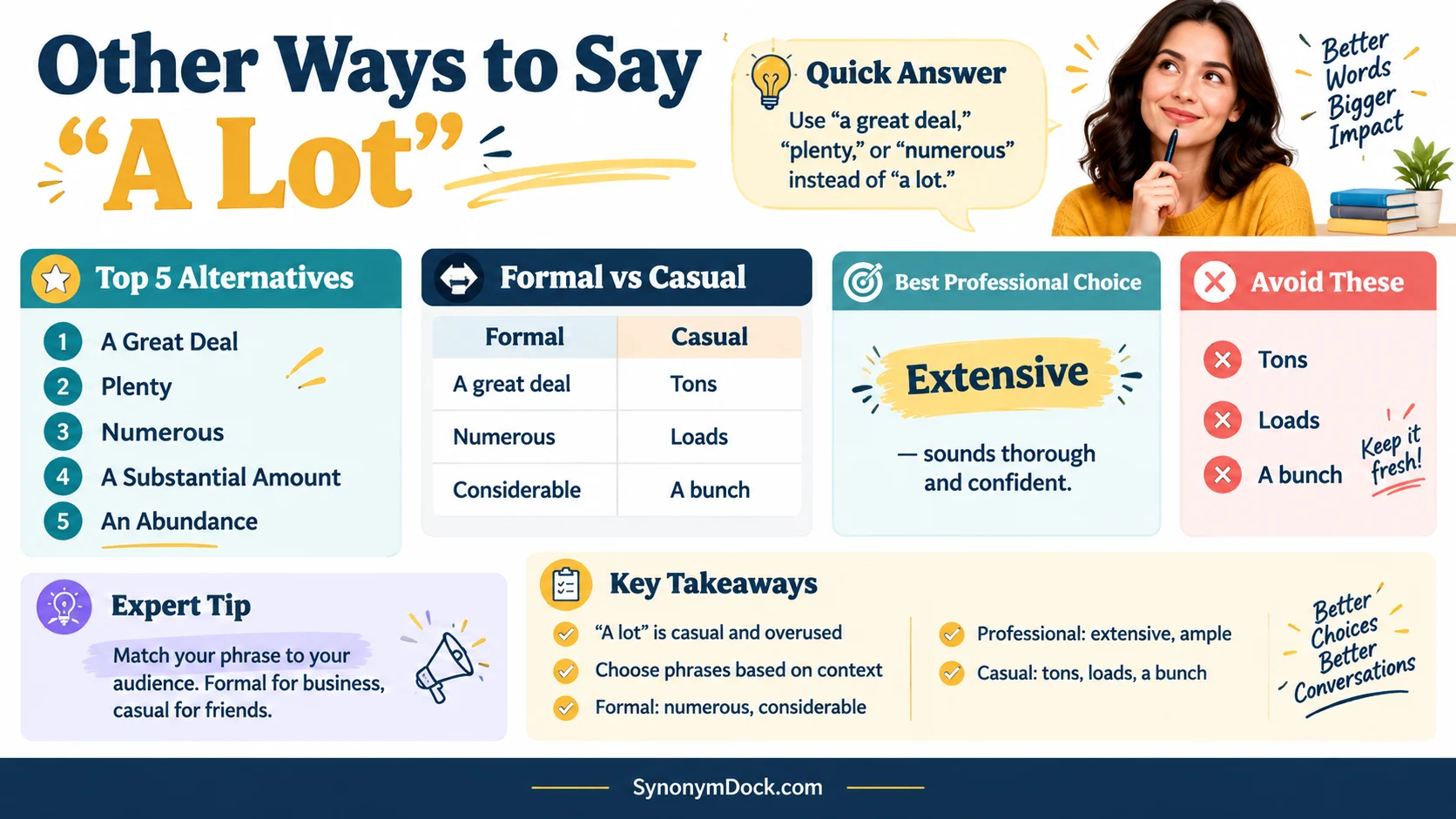
Other ways to say “a lot” include: a great deal, plenty, numerous, a substantial amount, and an abundance. These alternatives help you express large quantities with precision and variety.
Top 5 Alternatives: A great deal, plenty, numerous, a substantial amount, an abundance.
“A lot” is one of the most common phrases in English. It works fine in casual conversation, but it gets repetitive fast. When you use it in every other sentence, your writing and speech start to sound basic.
That’s why so many English learners search for alternatives to “a lot.” You want vocabulary that matches the situation whether you’re writing a business email, giving a presentation, or chatting with friends. Knowing other ways to say “a lot” helps you communicate more precisely.
This guide covers 15 practical alternatives. Each one comes with clear examples, tone guidance, and advice on when to use it. By the end, you’ll know exactly which phrase fits your context.
Quick Categories
Formal Alternatives
- A great deal
- A substantial amount
- Considerable
- Numerous
- A significant number
Pro Tip
Formal alternatives work best in academic writing, reports, and official documents. They add weight to your statements without sounding stiff.
Professional Alternatives
- Plenty
- A large volume
- Extensive
- Ample
- A wide range
Pro Tip
Professional alternatives sound confident and clear. Use them in meetings, client emails, and workplace discussions where you need to sound competent but approachable.
Business Email Alternatives
- A considerable amount
- A high number
- Substantial
- A broad range
- Significant
Pro Tip
Business emails need clarity and professionalism. These phrases keep your message direct while maintaining a polished tone.
Academic Alternatives
- A plethora
- A myriad
- Numerous
- A considerable number
- An abundance
Pro Tip
Academic writing values precision. These alternatives help you avoid repetition in essays, research papers, and dissertations.
Casual Alternatives
- Loads
- Tons
- A bunch
- Plenty
- A heap
Pro Tip
Casual alternatives work in everyday conversation, text messages, and informal emails to friends. They sound natural and friendly.
Informal Expressions
- A ton
- Buckets
- Piles
- A stack
- Heaps
Pro Tip
Informal expressions add personality to your speech. Use them with friends, family, or in relaxed settings never in formal writing.
“The right phrase for the right moment makes your English sound natural and confident.”
Common Mistakes
Mistake 1: Using “a lot of” in formal writing
Why it’s incorrect: “A lot of” sounds too casual for academic or professional documents.
Correct version: Use “a great deal of” or “a substantial amount of.”
Example: The project required a substantial amount of resources.
Mistake 2: Saying “lots of” in business emails
Why it’s incorrect: “Lots of” is informal and can make you sound unprofessional.
Correct version: Use “numerous” or “a significant number of.”
Example: We received numerous requests for the new product.
Mistake 3: Overusing “many” in every sentence
Why it’s incorrect: Repeating “many” makes your writing monotonous.
Correct version: Rotate between “numerous,” “a variety of,” and “a large number of.”
Example: The survey collected a variety of responses from participants.
Mistake 4: Using “a plethora” incorrectly
Why it’s incorrect: “A plethora” already means “too much” or “an excess.” Using “a plethora of many” is redundant.
Correct version: Say “a plethora of options” not “a plethora of many options.”
Example: The store offers a plethora of choices for customers.
Mistake 5: Mixing formal and casual phrases in one document
Why it’s incorrect: Switching between “tons” and “a substantial amount” in the same email confuses the tone.
Correct version: Choose one tone and stick with it throughout.
Example: The report contains extensive data and numerous charts.
What Does “A Lot” Mean?
Definition: “A lot” means a large quantity or a great amount of something. It functions as a pronoun, adverb, or determiner.
Grammar explanation: “A lot” is informal. “A lot of” precedes nouns. “A lot” can also stand alone as an adverb meaning “very much.”
Simple explanation: When you want to say there’s a big amount of something, “a lot” is the easy choice. But it’s not your only option.
Example sentence: She has a lot of experience in marketing.
When to Use “A Lot”
Use “a lot” in these situations:
- Daily conversation: “I learned a lot today.”
- Informal emails: “Thanks a lot for your help.”
- Casual writing: “There were a lot of people at the party.”
- Spoken English: “That means a lot to me.”
Avoid “a lot” in:
- Academic papers
- Business reports
- Formal presentations
- Legal documents
- Professional proposals
Is “A Lot” Professional or Polite?
“A lot” is polite in casual settings but not professional in formal contexts.
| Context | Is “A Lot” Appropriate? |
|---|---|
| Casual conversation | ✔ Yes |
| Text messages | ✔ Yes |
| Business emails | ✗ No |
| Academic writing | ✗ No |
| Presentations | Depends on audience |
| Client communication | ✗ No |
Business-style example: Instead of “We got a lot of feedback,” say “We received a substantial amount of feedback.
Simple explanation: “A lot” is friendly and natural, but it lacks the polish needed for professional English.
Pros and Cons
Pros
- Easy to understand
- Friendly and natural
- Common in everyday speech
- Works in most casual situations
Cons
- Overused
- Too informal for business writing
- Limited tone range
- Sounds basic in academic contexts
“Choosing the right phrase matters as much as choosing the right words.”
Transition to the Main List
You’re about to learn 15 alternatives to “a lot.” Each one includes meaning, examples, tone, and best-use guidance. This will help you choose the right phrase for any situation.
Pay attention to the formality levels and native speaker tips. They’ll help you sound more fluent and natural in English.
Expert Tip
Expert Tip: Native speakers rarely use “a lot” in professional settings. They choose phrases like “a great deal” or “numerous” depending on the audience and context. Match your vocabulary to the situation, not the other way around.
Other Ways to Say “A Lot” (With Examples)
These 15 alternatives will help you sound more fluent, improve your professional English, and expand your vocabulary. Each phrase serves a different purpose. Choose based on your audience and tone.
1. A Great Deal
Meaning: A large amount or quantity of something.
Explanation: “A great deal” sounds formal but natural. Native speakers use it in business writing, academic essays, and polite conversation. It adds weight without sounding stiff.
Example Sentence: She invested a great deal of time into preparing for the presentation.
Best Use: Business Email, Academic Essay
Avoid Using In: Casual Text, Slang Conversation
Tone: Formal, Respectful
Formality Level: ⭐⭐⭐⭐ Formal
Usage Frequency: Very Common
CEFR Level: B2
Common Collocations:
- a great deal of time
- a great deal of effort
- a great deal of money
- a great deal of research
- a great deal of attention
Context Variability:
- Spoken English: He knows a great deal about local history.
- Professional English: The team put a great deal of work into the proposal.
- Casual Conversation: I spent a great deal of my weekend relaxing.
2. Plenty
Meaning: More than enough; a sufficient or abundant amount.
Explanation: “Plenty” is friendly and positive. It suggests abundance without sounding excessive. Native speakers use it in both casual and professional settings.
Example Sentence: Don’t worry we have plenty of time to finish the project.
Best Use: Daily Conversation, Workplace Meeting
Avoid Using In: Legal Contract, Academic Paper
Tone: Friendly, Reassuring
Formality Level: ⭐⭐⭐ Neutral
Usage Frequency: Very Common
CEFR Level: B1
Common Collocations:
- plenty of time
- plenty of room
- plenty of options
- plenty of opportunities
- plenty of experience
Context Variability:
- Spoken English: There’s plenty of food for everyone.
- Professional English: We have plenty of resources to complete the task.
- Casual Conversation: She has plenty of friends in the city.
3. Numerous
Meaning: Many; a large number of things or people.
Explanation: “Numerous” is formal and precise. It works well in reports, academic writing, and professional communication. Native speakers use it to sound authoritative.
Example Sentence: Numerous studies have confirmed the benefits of regular exercise.
Best Use: Academic Essay, Business Report
Avoid Using In: Casual Text, Friendly Chat
Tone: Formal, Professional
Formality Level: ⭐⭐⭐⭐ Formal
Usage Frequency: Very Common
CEFR Level: B2
Common Collocations:
- numerous studies
- numerous benefits
- numerous opportunities
- numerous challenges
- numerous examples
Context Variability:
- Spoken English: She has visited numerous countries in Europe.
- Professional English: The company faced numerous obstacles during expansion.
- Casual Conversation: I’ve seen that movie numerous times.
4. A Substantial Amount
Meaning: A large or significant quantity of something.
Explanation: “A substantial amount” sounds professional and precise. It’s common in business emails, financial reports, and formal discussions.
Example Sentence: The charity received a substantial amount of donations this year.
Best Use: Business Email, Financial Report
Avoid Using In: Casual Text, Slang Conversation
Tone: Professional, Formal
Formality Level: ⭐⭐⭐⭐ Formal
Usage Frequency: Common
CEFR Level: B2
Common Collocations:
- a substantial amount of money
- a substantial amount of time
- a substantial amount of data
- a substantial amount of evidence
- a substantial amount of support
Context Variability:
- Spoken English: He earns a substantial amount every month.
- Professional English: We need a substantial amount of funding for this project.
- Casual Conversation: That repair cost a substantial amount.
5. An Abundance
Meaning: A very large quantity; more than enough.
Explanation: “An abundance” sounds elegant and positive. It suggests having more than you need. Native speakers use it in formal writing and polished speech.
Example Sentence: The region is known for its abundance of natural resources.
Best Use: Academic Essay, Formal Presentation
Avoid Using In: Casual Text, Quick Chat
Tone: Formal, Elegant
Formality Level: ⭐⭐⭐⭐ Formal
Usage Frequency: Occasional
CEFR Level: C1
Common Collocations:
- an abundance of resources
- an abundance of caution
- an abundance of opportunities
- an abundance of evidence
- an abundance of talent
Context Variability:
- Spoken English: There’s an abundance of fresh produce at the market.
- Professional English: The report highlighted an abundance of growth opportunities.
- Casual Conversation: We have an abundance of snacks for the party.
Native Speaker Tip
“A great deal” and “numerous” sound most natural in professional settings. “Plenty” works almost anywhere and feels friendly. “An abundance” is elegant but less common in everyday speech save it for formal writing.
6. Loads
Meaning: A large amount; much. Used informally.
Explanation: “Loads” is very casual and common in British English. It’s friendly and relaxed. Native speakers use it with friends, not in professional settings.
Example Sentence: There were loads of people at the concert last night.
Best Use: Casual Conversation, Text Messages
Avoid Using In: Business Email, Academic Paper
Tone: Casual, Friendly
Formality Level: ⭐ Very Casual
Usage Frequency: Common
CEFR Level: B1
Common Collocations:
- loads of fun
- loads of people
- loads of time
- loads of work
- loads of options
Context Variability:
- Spoken English: We had loads of fun at the beach.
- Professional English: (Not appropriate)
- Casual Conversation: She has loads of experience in retail.
7. Tons
Meaning: A very large amount. Informal and expressive.
Explanation: “Tons” adds energy to casual speech. It’s common in American English. Native speakers use it to emphasize quantity in a friendly way.
Example Sentence: I have tons of homework to finish this weekend.
Best Use: Daily Conversation, Informal Writing
Avoid Using In: Formal Report, Legal Document
Tone: Casual, Enthusiastic
Formality Level: ⭐⭐ Casual
Usage Frequency: Very Common
CEFR Level: B1
Common Collocations:
- tons of work
- tons of fun
- tons of people
- tons of information
- tons of experience
Context Variability:
- Spoken English: Thanks tons for your help!
- Professional English: (Avoid in formal contexts)
- Casual Conversation: There are tons of restaurants near my apartment.
8. A Bunch
Meaning: A group or large amount of something. Informal.
Explanation: “A bunch” is friendly and conversational. It’s common in American English. Native speakers use it for countable items and informal situations.
Example Sentence: She brought a bunch of flowers to the dinner party.
Best Use: Casual Conversation, Friendly Email
Avoid Using In: Business Proposal, Academic Essay
Tone: Friendly, Relaxed
Formality Level: ⭐⭐ Casual
Usage Frequency: Very Common
CEFR Level: B1
Common Collocations:
- a bunch of people
- a bunch of flowers
- a bunch of ideas
- a bunch of questions
- a bunch of options
Context Variability:
- Spoken English: I have a bunch of errands to run today.
- Professional English: (Too casual for most workplaces)
- Casual Conversation: He sent me a bunch of funny videos.
9. Considerable
Meaning: Large in size, amount, or degree.
Explanation: “Considerable” is formal and precise. It works well in academic and professional writing. Native speakers use it to describe significant quantities.
Example Sentence: The project required considerable investment from all stakeholders.
Best Use: Academic Essay, Business Report
Avoid Using In: Casual Text, Friendly Chat
Tone: Formal, Authoritative
Formality Level: ⭐⭐⭐⭐ Formal
Usage Frequency: Common
CEFR Level: B2
Common Collocations:
- considerable time
- considerable effort
- considerable amount
- considerable influence
- considerable progress
Context Variability:
- Spoken English: She has considerable knowledge of the subject.
- Professional English: The merger required considerable negotiation.
- Casual Conversation: That took considerable patience.
10. Extensive
Meaning: Covering a large area or range; very great in amount.
Explanation: “Extensive” sounds professional and thorough. It’s common in business, academic, and technical writing. Native speakers use it to describe broad scope.
Example Sentence: The company has extensive experience in international markets.
Best Use: Business Email, Academic Essay
Avoid Using In: Casual Text, Quick Chat
Tone: Professional, Thorough
Formality Level: ⭐⭐⭐⭐ Formal
Usage Frequency: Very Common
CEFR Level: B2
Common Collocations:
- extensive research
- extensive experience
- extensive knowledge
- extensive damage
- extensive range
Context Variability:
- Spoken English: He has extensive training in martial arts.
- Professional English: The report includes extensive data analysis.
- Casual Conversation: She has an extensive collection of vinyl records.
Expert Insight
In workplace communication, “considerable” and “extensive” are safe choices. They sound professional without being overly formal. For emails, “a substantial amount” works well when discussing budgets, timelines, or resources. Always match your vocabulary to your reader’s expectations.
11. A Plethora
Meaning: An excess or large amount of something.
Explanation: “A plethora” is formal and slightly literary. It implies more than enough. Native speakers use it in academic writing and polished speeches.
Example Sentence: The library offers a plethora of resources for researchers.
Best Use: Academic Essay, Formal Presentation
Avoid Using In: Casual Text, Daily Chat
Tone: Formal, Literary
Formality Level: ⭐⭐⭐⭐⭐ Very Formal
Usage Frequency: Occasional
CEFR Level: C1
Common Collocations:
- a plethora of options
- a plethora of information
- a plethora of opportunities
- a plethora of problems
- a plethora of choices
Context Variability:
- Spoken English: The conference offered a plethora of networking opportunities.
- Professional English: The report contains a plethora of recommendations.
- Casual Conversation: (Rarely used in casual settings)
12. A Myriad
Meaning: A countless or extremely large number of things.
Explanation: “A myriad” sounds elegant and formal. It’s common in academic and literary writing. Native speakers use it to describe vast variety.
Example Sentence: The city offers a myriad of cultural experiences for visitors.
Best Use: Academic Essay, Formal Writing
Avoid Using In: Casual Text, Friendly Chat
Tone: Formal, Elegant
Formality Level: ⭐⭐⭐⭐⭐ Very Formal
Usage Frequency: Occasional
CEFR Level: C1
Common Collocations:
- a myriad of possibilities
- a myriad of colors
- a myriad of reasons
- a myriad of challenges
- a myriad of details
Context Variability:
- Spoken English: She faced a myriad of decisions after graduation.
- Professional English: The proposal outlines a myriad of potential benefits.
- Casual Conversation: (Too formal for everyday use)
13. Ample
Meaning: Enough or more than enough; plentiful.
Explanation: “Ample” is professional and reassuring. It suggests sufficiency. Native speakers use it in business and formal contexts.
Example Sentence: We have ample time to complete the project before the deadline.
Best Use: Business Email, Workplace Meeting
Avoid Using In: Casual Text, Slang Conversation
Tone: Professional, Reassuring
Formality Level: ⭐⭐⭐⭐ Formal
Usage Frequency: Common
CEFR Level: B2
Common Collocations:
- ample time
- ample space
- ample opportunity
- ample evidence
- ample resources
Context Variability:
- Spoken English: There’s ample room for everyone in the car.
- Professional English: The budget provides ample funding for research.
- Casual Conversation: We had ample snacks for the road trip.
14. A Heap
Meaning: A large amount or pile of something. Informal.
Explanation: “A heap” is casual and descriptive. It’s common in British English. Native speakers use it to describe piles or large quantities.
Example Sentence: There’s a heap of laundry waiting to be folded.
Best Use: Casual Conversation, Informal Writing
Avoid Using In: Business Email, Academic Paper
Tone: Casual, Descriptive
Formality Level: ⭐⭐ Casual
Usage Frequency: Occasional
CEFR Level: B1
Common Collocations:
- a heap of clothes
- a heap of work
- a heap of problems
- a heap of praise
- a heap of rubble
Context Variability:
- Spoken English: She has a heap of assignments due this week.
- Professional English: (Avoid in formal settings)
- Casual Conversation: He earned a heap of compliments for his speech.
15. A Wide Range
Meaning: A large variety or selection of things.
Explanation: “A wide range” is professional and versatile. It emphasizes variety, not just quantity. Native speakers use it in business, academic, and casual contexts.
Example Sentence: The store offers a wide range of products for home improvement.
Best Use: Business Email, Presentation
Avoid Using In: Legal Contract, Technical Manual
Tone: Professional, Versatile
Formality Level: ⭐⭐⭐ Neutral
Usage Frequency: Very Common
CEFR Level: B2
Common Collocations:
- a wide range of options
- a wide range of products
- a wide range of services
- a wide range of experience
- a wide range of topics
Context Variability:
- Spoken English: The museum has a wide range of exhibits.
- Professional English: We offer a wide range of consulting services.
- Casual Conversation: There’s a wide range of movies on that streaming platform.
Native Speaker Tip
“A wide range” is one of the most versatile phrases on this list. It works in almost any context. “Ample” sounds confident and professional. “A myriad” and “a plethora” are elegant but can sound pretentious in casual conversation.
Avoid These in Formal Situations
1. Tons
Why avoid: Too casual for professional communication.
Better alternative: Numerous or a substantial amount.
2. Loads
Why avoid: Informal and regional.
Better alternative: A great deal or extensive.
3. A Bunch
Why avoid: Sounds relaxed and conversational.
Better alternative: A variety or a range.
4. Heaps
Why avoid: Too informal for business or academic writing.
Better alternative: A considerable amount or ample.
5. A Lot
Why avoid: Overused and lacks precision.
Better alternative: A great deal or a significant number.
Best Phrases by Situation
| Situation | Best Phrase |
|---|---|
| Business Email | A substantial amount |
| Client Meeting | Extensive |
| Academic Essay | Numerous |
| Presentation | A wide range |
| Workplace Discussion | Plenty |
| Job Interview | Considerable |
| Team Collaboration | Ample |
| Everyday Conversation | Tons |
Top 10 Alternatives Compared
| Phrase | Tone | Formality | Best Use | Frequency |
|---|---|---|---|---|
| A Great Deal | Formal, Respectful | ⭐⭐⭐⭐ | Business Email | Very Common |
| Plenty | Friendly, Reassuring | ⭐⭐⭐ | Daily Conversation | Very Common |
| Numerous | Formal, Professional | ⭐⭐⭐⭐ | Academic Essay | Very Common |
| A Substantial Amount | Professional, Formal | ⭐⭐⭐⭐ | Business Email | Common |
| An Abundance | Formal, Elegant | ⭐⭐⭐⭐ | Formal Presentation | Occasional |
| Extensive | Professional, Thorough | ⭐⭐⭐⭐ | Business Report | Very Common |
| Considerable | Formal, Authoritative | ⭐⭐⭐⭐ | Academic Essay | Common |
| Ample | Professional, Reassuring | ⭐⭐⭐⭐ | Workplace Meeting | Common |
| A Wide Range | Professional, Versatile | ⭐⭐⭐ | Presentation | Very Common |
| Tons | Casual, Enthusiastic | ⭐⭐ | Daily Conversation | Very Common |
“Sound fluent by choosing phrases that match the moment.”
Which One Should You Use?
Best Overall
A wide range works in almost any context and sounds natural.
Best Professional
Extensive conveys thoroughness and expertise.
Best Academic
Numerous precise and widely accepted in scholarly writing.
Best Business Email
A substantial amount clear, professional, and specific.
Best Everyday Conversation
Plenty friendly, positive, and easy to use.
Most Natural
Plenty native speakers use it constantly without thinking.
Most Polite
A great deal respectful and appreciative in tone.
Commonly Confused Phrases
“A lot” vs. “A great deal”
“A lot” is casual. “A great deal” is formal and works in professional writing.
“Plenty” vs. “Numerous”
“Plenty” suggests more than enough. “Numerous” simply means many. Use “plenty” for reassurance, “numerous” for precision.
“Tons” vs. “A substantial amount”
“Tons” is informal and expressive. “A substantial amount” is professional and measured.
“An abundance” vs. “A plethora”
Both mean a large amount. “An abundance” is positive. “A plethora” can imply excess or overwhelm.
“Extensive” vs. “Considerable”
“Extensive” emphasizes scope and range. “Considerable” emphasizes size or degree.
Scenario Practice
Scenario 1: Business Meeting
You’re presenting quarterly results. You want to say the company received many customer complaints.
Which phrase would you choose?
Answer: A significant number professional and precise.
Scenario 2: Job Interview
You’re describing your experience. You want to say you’ve worked on many projects.
Which phrase would you choose?
Answer: Extensive shows depth and professionalism.
Scenario 3: Presentation
You’re explaining your company’s services. You want to say there are many options.
Which phrase would you choose?
Answer: A wide range emphasizes variety and versatility.
Scenario 4: Class Discussion
You’re summarizing research. You want to say there are many studies on the topic.
Which phrase would you choose?
Answer: Numerous academic and precise.
Scenario 5: Email Reply
You’re responding to a client. You want to say you have enough time to complete the work.
Which phrase would you choose?
Answer: Ample professional and reassuring.
Mini Quiz
1. Which phrase is best for a business email?
A) Tons
B) A substantial amount
C) Loads
D) A bunch
2. Which phrase sounds most casual?
A) Numerous
B) Extensive
C) Tons
D) Considerable
3. Which phrase is most formal?
A) Plenty
B) A plethora
C) A bunch
D) Tons
4. Which phrase means “more than enough”?
A) Numerous
B) Ample
C) Considerable
D) Extensive
5. Which phrase works best in academic writing?
A) Loads
B) Tons
C) Numerous
D) A bunch
Answer Key
- B) A substantial amount Professional and precise for business contexts.
- C) Tons Informal and energetic, best for casual conversation.
- B) A plethora Very formal and literary.
- B) Ample Means enough or more than enough.
- C) Numerous Standard in academic writing.
FAQs
What is the most formal way to say “a lot”?
The most formal alternatives include “a plethora,” “a myriad,” and “an abundance.” These phrases work well in academic writing, formal presentations, and literary contexts. They sound elegant and precise, but avoid them in casual conversation where they might sound pretentious.
Which phrase is best for professional emails?
“A substantial amount” and “extensive” are excellent choices for professional emails. They sound clear, confident, and polished. Use “a substantial amount” when discussing quantities, and “extensive” when describing scope or experience.
What is the difference between “plenty” and “numerous”?
“Plenty” means more than enough and often carries a reassuring tone. “Numerous” simply means many and sounds more formal and precise. Use “plenty” in friendly conversation and “numerous” in academic or professional writing.
Which alternative sounds most natural?
“Plenty” sounds the most natural in everyday conversation. Native speakers use it constantly without thinking. For professional settings, “a wide range” and “extensive” sound natural and polished.
Can I use these expressions in business meetings?
Yes, many of these expressions work well in business meetings. “Extensive,” “ample,” “a wide range,” and “a substantial amount” are all appropriate. Avoid “tons,” “loads,” and “a bunch” in professional settings.
Conclusion
Learning different ways to say “a lot” helps you communicate with precision and confidence. Each alternative carries its own tone, formality level, and best-use scenario. The more you practice, the more naturally you’ll choose the right phrase.
Start using these alternatives in your everyday conversations, emails, meetings, and professional writing. Pay attention to how native speakers use them. With time, your English will sound more fluent, polished, and natural. You’ve got this.

7 thoughts on “Other Ways to Say “A Lot” |17+ Examples for 2026”