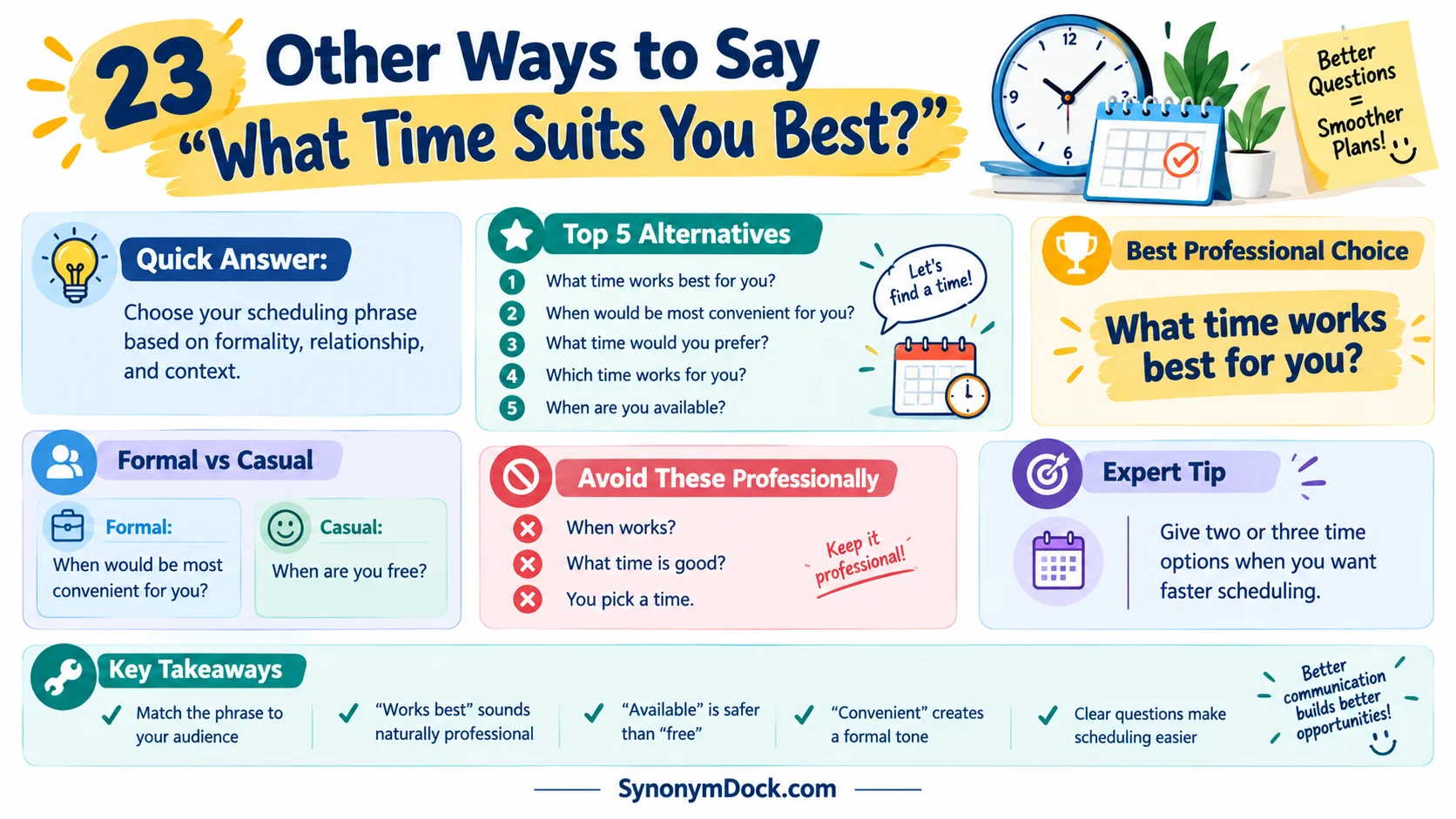
If you are looking for other ways to say what time suits you best, natural alternatives include “What time works best for you?”, “When would be most convenient for you?”, and “What time would you prefer?”
5 Best Alternatives: What time works best for you?, When would be most convenient for you?, What time would you prefer?, Which time works for you?, When are you available?
“What time suits you best?” is a polite way to ask someone to choose a convenient time for a meeting, call, appointment, or activity. It is correct English, but native speakers often use slightly different wording depending on the situation.
Learning alternatives to “what time suits you best” helps you sound more natural in emails, workplace conversations, client communication, and everyday English. Different expressions can sound warmer, more professional, more direct, or more casual.
This guide covers practical other ways to say what time suits you best, explains their tone, and shows exactly when each phrase works best.
Quick Categories
Formal Alternatives
- When would be most convenient for you?
- At what time would you be available?
- Which time would be most suitable for you?
- What time would you prefer?
Pro Tip
Choose these when writing to clients, senior colleagues, interviewers, or people you do not know well. They sound respectful without becoming overly stiff.
Professional Alternatives
- What time works best for you?
- Which time works for you?
- When would work best for you?
- When are you available?
Pro Tip
“What time works best for you?” is especially useful in modern workplace English because it is polite, efficient, and natural.
Business Email Alternatives
- Please let me know what time works best for you.
- Let me know when you are available.
- What time would be convenient for you?
- Could you let me know your preferred time?
Pro Tip
In business emails, adding “please let me know” can soften the request and make the message feel cooperative rather than demanding.
Academic Alternatives
- What time would be suitable for you?
- When would you be available to meet?
- Which time would be most convenient?
- What time would you prefer?
Pro Tip
Use clear, neutral expressions when contacting a professor, supervisor, researcher, or academic adviser. There is rarely a need for highly elaborate wording.
Casual Alternatives
- What time works for you?
- When are you free?
- What time is good for you?
- When works for you?
Pro Tip
These expressions are ideal with friends, classmates, and colleagues you know well. They are natural but may be too relaxed for formal correspondence.
Informal Expressions
- When are you free?
- What time is good?
- When works?
- What time are you thinking?
Pro Tip
Shortened expressions such as “When works?” are common in quick messages, but use complete sentences when professionalism matters.
“A polite scheduling question should make choosing a time feel easy.”
Common Mistakes
1. Mistake: “What time suit you best?”
Why it is incorrect: “Time” is singular, so the verb needs suits.
Correct version: What time suits you best?
Example: What time suits you best for tomorrow’s call?
2. Mistake: “Which time is suit for you?”
Why it is incorrect: “Suit” cannot follow “is” in this structure.
Correct version: Which time suits you best?
Example: Which time suits you best for the interview?
3. Mistake: “What time is comfortable for you?”
Why it sounds awkward: “Comfortable” usually describes physical or emotional comfort rather than scheduling.
Correct version: What time is convenient for you?
Example: What time would be convenient for you on Thursday?
4. Mistake: “Tell me your suitable time.”
Why it sounds unnatural: Although understandable, native speakers usually say “preferred time” or ask what time works.
Correct version: Please let me know your preferred time.
Example: Please let me know your preferred time for the meeting.
5. Mistake: “What timing suits you?”
Why it can sound unnatural: “Timing” often refers to when an event happens rather than a specific clock time.
Correct version: What time suits you?
Example: What time suits you for our discussion?
What Does “What Time Suits You Best” Mean?
Definition: “What time suits you best?” asks someone to choose the time that is most convenient or appropriate for them.
Grammatically, what time asks for a specific time, while suits you best means “is most convenient for you.”
In simple English, it means: Which time is easiest or best for you?
Example: What time suits you best for our meeting on Friday?
When to Use “What Time Suits You Best”
Use the phrase when arranging:
- Business meetings: to ask colleagues for a convenient meeting time.
- Client calls: when giving the client flexibility.
- Academic meetings: when contacting teachers, supervisors, or classmates.
- Professional emails: when scheduling appointments or interviews.
- Workplace meetings: when coordinating calendars.
- Daily conversation: when arranging plans with another person.
- Spoken English: when asking directly during a conversation.
- Written English: in emails, messages, and invitations.
- Formal settings: especially when a courteous tone is needed.
- Informal settings: although shorter phrases may sound more natural.
“Good scheduling language is clear, courteous, and easy to answer.”
Is It Professional or Polite?
Polite? ✔ Yes
Professional? ✔ Yes
Formal? Moderately
Natural? ✔ Yes
“What time suits you best?” is polite and grammatically correct. In international and British-influenced English, suit is a familiar way to discuss convenient arrangements.
In many modern workplaces, however, “What time works best for you?” may sound slightly more conversational.
Business-style example:
I would be happy to discuss the proposal tomorrow. What time suits you best?
Simple explanation: The phrase respects the other person’s schedule instead of choosing a time for them.
Pros
- Clear and easy to understand
- Polite without being overly formal
- Gives the listener flexibility
- Suitable for professional communication
- Works in speech and writing
Cons
- Slightly less common in some varieties of conversational English
- Can become repetitive in long email exchanges
- “Works best” may sound more natural in some workplaces
- Does not specify available options unless you provide them
“Natural English is often about choosing the simplest phrase that fits the relationship.”
Before You Choose an Alternative
The expressions below help you improve your English vocabulary while also understanding important tone differences.
Some work best in business communication, while others suit casual conversation. Choose according to your relationship with the listener and the level of formality.
Expert Tip: For scheduling, clarity usually matters more than sophisticated vocabulary. Give two or three possible times when you want to reduce unnecessary back-and-forth.
Other Ways to Say “What Time Suits You Best” With Examples
These 15 alternatives can help you sound more fluent, improve professional English, and communicate naturally when arranging meetings, interviews, calls, lessons, or everyday plans.
1. Phrase: What Time Works Best for You?
Meaning:
Which time fits your schedule most conveniently?
Explanation:
This is one of the most natural alternatives in modern professional English. It sounds polite and collaborative without becoming formal.
Example Sentence:
I can arrange the demonstration tomorrow afternoon. What time works best for you?
Best Use:
Workplace Meetings
Avoid Using In:
Very Formal Notices
Tone:
Professional, Natural
Formality Level:
⭐⭐⭐ Neutral
Usage Frequency:
Very Common
CEFR Level:
B1
Common Collocations:
- works best for you
- time that works
- whichever time works
- schedule that works
Context Variability
- Spoken English: What time works best for you tomorrow?
- Professional English: Please confirm what time works best for your team.
- Casual Conversation: What time works for you?
2. Phrase: When Would Be Most Convenient for You?
Meaning:
When would cause the least difficulty for your schedule?
Explanation:
This expression is more formal and courteous. It works particularly well with clients, senior professionals, interviewers, and people you do not know closely.
Example Sentence:
I would be pleased to arrange a brief consultation. When would be most convenient for you?
Best Use:
Client Communication
Avoid Using In:
Casual Texts
Tone:
Formal, Respectful
Formality Level:
⭐⭐⭐⭐ Formal
Usage Frequency:
Common
CEFR Level:
B2
Common Collocations:
- most convenient for you
- convenient time
- mutually convenient
- convenient to meet
Context Variability
- Spoken English: When would be convenient for you?
- Professional English: When would be most convenient for a follow-up call?
- Casual Conversation: Usually shortened to “When are you free?”
3. Phrase: What Time Would You Prefer?
Meaning:
Which time would you personally choose?
Explanation:
This neutral, polite question focuses on preference rather than availability. It is suitable for professional emails, appointments, interviews, and everyday scheduling.
Example Sentence:
We have openings at 10 a.m. and 2 p.m. What time would you prefer?
Best Use:
Appointments
Avoid Using In:
No Major Restriction
Tone:
Polite, Neutral
Formality Level:
⭐⭐⭐ Neutral
Usage Frequency:
Very Common
CEFR Level:
B1
Common Collocations:
- prefer to meet
- preferred time
- time you prefer
- preferred appointment
Context Variability
- Spoken English: What time would you prefer?
- Professional English: Please tell me which appointment time you would prefer.
- Casual Conversation: Which time do you want?
4. Phrase: Which Time Works for You?
Meaning:
Which available option fits your schedule?
Explanation:
Use this phrase when several times have already been suggested. It is direct, natural, and appropriate in most workplace conversations.
Example Sentence:
I can meet at 11:30 or 3:00. Which time works for you?
Best Use:
Scheduling Options
Avoid Using In:
Ceremonial Writing
Tone:
Friendly, Professional
Formality Level:
⭐⭐⭐ Neutral
Usage Frequency:
Very Common
CEFR Level:
B1
Common Collocations:
- which time works
- whichever works
- option works
- works for your schedule
Context Variability
- Spoken English: Which time works for you?
- Professional English: Please confirm which proposed time works for you.
- Casual Conversation: Which one works?
5. Phrase: When Are You Available?
Meaning:
At what time are you free to meet or talk?
Explanation:
This straightforward question focuses on availability. Native speakers commonly use it when the exact meeting time has not yet been discussed.
Example Sentence:
I would like to review your project outline this week. When are you available?
Best Use:
Workplace Scheduling
Avoid Using In:
Highly Formal Letters
Tone:
Direct, Neutral
Formality Level:
⭐⭐⭐ Neutral
Usage Frequency:
Very Common
CEFR Level:
B1
Common Collocations:
- available tomorrow
- available to meet
- available this week
- next available time
Context Variability
- Spoken English: When are you available?
- Professional English: Could you let me know when you are available for a call?
- Casual Conversation: When are you free?
Native Speaker Tip
Among the first five choices, “What time works best for you?” is especially natural in workplace English. “When would be most convenient for you?” is more formal, while “When are you available?” is the most direct.
6. Phrase: What Time Would Be Convenient for You?
Meaning:
Which time would fit your schedule comfortably?
Explanation:
This is a courteous option for business emails, appointments, and client communication. It feels slightly more formal than “What time works for you?”
Example Sentence:
I can call to explain the next steps. What time would be convenient for you?
Best Use:
Business Email
Avoid Using In:
Very Casual Chats
Tone:
Polite, Professional
Formality Level:
⭐⭐⭐⭐ Formal
Usage Frequency:
Common
CEFR Level:
B2
Common Collocations:
- convenient for you
- convenient time
- convenient appointment
- mutually convenient time
Context Variability
- Spoken English: What time would be convenient?
- Professional English: What time would be convenient for a short meeting?
- Casual Conversation: What time is good for you?
7. Phrase: When Would Work Best for You?
Meaning:
When would fit your plans most easily?
Explanation:
This phrase combines warmth with professionalism. It is particularly natural when arranging meetings through email, messaging platforms, or workplace conversations.
Example Sentence:
We can discuss the revised budget later this week. When would work best for you?
Best Use:
Office Communication
Avoid Using In:
Legal Documents
Tone:
Natural, Polite
Formality Level:
⭐⭐⭐ Neutral
Usage Frequency:
Very Common
CEFR Level:
B1
Common Collocations:
- would work best
- day that works
- time that works
- whatever works best
Context Variability
- Spoken English: When would work best?
- Professional English: Let me know when would work best for your department.
- Casual Conversation: When works for you?
8. Phrase: Could You Let Me Know Your Preferred Time?
Meaning:
Please tell me which time you would choose.
Explanation:
This complete request is excellent for professional emails because it is clear, courteous, and easy to answer.
Example Sentence:
We are scheduling next week’s onboarding sessions. Could you let me know your preferred time?
Best Use:
Professional Email
Avoid Using In:
Quick Friend Texts
Tone:
Professional, Courteous
Formality Level:
⭐⭐⭐⭐ Formal
Usage Frequency:
Common
CEFR Level:
B2
Common Collocations:
- preferred time
- preferred meeting time
- let me know
- confirm your preference
Context Variability
- Spoken English: Let me know which time you prefer.
- Professional English: Could you let me know your preferred meeting time?
- Casual Conversation: Tell me what time you want.
9. Phrase: At What Time Would You Be Available?
Meaning:
At which specific time are you free?
Explanation:
This phrase is grammatically correct and formal, but it sounds more structured than ordinary conversation. Use it where a more polished tone is appropriate.
Example Sentence:
We would like to arrange your final interview on Tuesday. At what time would you be available?
Best Use:
Formal Scheduling
Avoid Using In:
Friendly Conversation
Tone:
Formal, Precise
Formality Level:
⭐⭐⭐⭐ Formal
Usage Frequency:
Occasional
CEFR Level:
B2
Common Collocations:
- available at
- available for
- available to meet
- available for discussion
Context Variability
- Spoken English: Sounds formal in everyday speech.
- Professional English: At what time would you be available for the interview?
- Casual Conversation: When are you free?
10. Phrase: Which Time Would Be Most Suitable for You?
Meaning:
Which time would be the most appropriate for your circumstances?
Explanation:
“Suitable” creates a formal, careful tone. It works in official scheduling and academic communication but may sound unnecessarily elaborate in casual English.
Example Sentence:
Three presentation slots remain available. Which time would be most suitable for you?
Best Use:
Academic Communication
Avoid Using In:
Casual Messages
Tone:
Formal, Considerate
Formality Level:
⭐⭐⭐⭐ Formal
Usage Frequency:
Occasional
CEFR Level:
B2
Common Collocations:
- most suitable
- suitable time
- suitable appointment
- suitable arrangement
Context Variability
- Spoken English: Understandable but somewhat formal.
- Professional English: Which time would be most suitable for your schedule?
- Casual Conversation: Which time is better for you?
Native Speaker Tip
For modern communication, “When would work best for you?” usually sounds smoother than more formal constructions. “At what time would you be available?” and “most suitable” are correct, but native speakers often choose simpler wording in everyday workplace communication.
Expert Insight
In professional email writing, do not make politeness more complicated than necessary. A short question such as “What time works best for you?” often sounds more confident than a long, heavily formal request.
11. Phrase: What Time Is Best for You?
Meaning:
Which time is easiest or preferable for you?
Explanation:
This short question is clear and conversational. It works in most ordinary situations, although “works best” can sound slightly more polished professionally.
Example Sentence:
I can drop off the documents this afternoon. What time is best for you?
Best Use:
Daily Conversation
Avoid Using In:
Highly Formal Correspondence
Tone:
Friendly, Natural
Formality Level:
⭐⭐⭐ Neutral
Usage Frequency:
Very Common
CEFR Level:
B1
Common Collocations:
- best for you
- best time
- time is best
- whichever is best
Context Variability
- Spoken English: What time is best for you?
- Professional English: Please tell me what time is best for your schedule.
- Casual Conversation: What time is best?
12. Phrase: What Time Is Good for You?
Meaning:
Which time is convenient enough for you?
Explanation:
This is natural spoken English and sounds relaxed. Use it with friends, classmates, or familiar colleagues rather than in polished formal writing.
Example Sentence:
We can meet for coffee after class. What time is good for you?
Best Use:
Casual Conversation
Avoid Using In:
Formal Email
Tone:
Friendly, Casual
Formality Level:
⭐⭐ Casual
Usage Frequency:
Very Common
CEFR Level:
B1
Common Collocations:
- good for you
- good time
- sounds good
- time is good
Context Variability
- Spoken English: Very natural.
- Professional English: Better replaced by “What time works for you?”
- Casual Conversation: What time is good for you?
13. Phrase: When Are You Free?
Meaning:
When do you have no other commitments?
Explanation:
This is one of the simplest casual alternatives. It sounds friendly and natural with friends, classmates, and close colleagues.
Example Sentence:
I want to go over our presentation together. When are you free?
Best Use:
Friendly Scheduling
Avoid Using In:
Client Emails
Tone:
Casual, Direct
Formality Level:
⭐⭐ Casual
Usage Frequency:
Very Common
CEFR Level:
B1
Common Collocations:
- free tomorrow
- free later
- free this weekend
- free to meet
Context Variability
- Spoken English: When are you free?
- Professional English: Better: “When are you available?”
- Casual Conversation: Extremely common.
14. Phrase: When Works for You?
Meaning:
Which time fits your plans?
Explanation:
This shortened conversational expression is common in messages and informal workplace communication. It is efficient but less polished than the complete form.
Example Sentence:
I can talk anytime after lunch. When works for you?
Best Use:
Quick Messages
Avoid Using In:
Formal Correspondence
Tone:
Casual, Efficient
Formality Level:
⭐⭐ Casual
Usage Frequency:
Common
CEFR Level:
B1
Common Collocations:
- when works
- whatever works
- works for you
- works on your end
Context Variability
- Spoken English: Common and relaxed.
- Professional English: Fine with familiar teammates.
- Casual Conversation: Very natural.
15. Phrase: What Time Are You Thinking?
Meaning:
What time do you currently have in mind?
Explanation:
This casual expression invites the other person to suggest a time. It works best when plans are still flexible and informal.
Example Sentence:
Saturday should be fine for me. What time are you thinking?
Best Use:
Everyday Plans
Avoid Using In:
Formal Invitations
Tone:
Casual, Friendly
Formality Level:
⭐⭐ Casual
Usage Frequency:
Common
CEFR Level:
B1
Common Collocations:
- thinking of
- time in mind
- what are you thinking
- thinking about meeting
Context Variability
- Spoken English: Very natural.
- Professional English: Possible with close teammates.
- Casual Conversation: Excellent for flexible plans.
Native Speaker Tip
For everyday plans, “When are you free?” sounds especially natural. “What time is good for you?” is also common, while “What time are you thinking?” works best when the other person is expected to suggest the plan.
“Professional English sounds strongest when courtesy and simplicity work together.”
Avoid These in Formal Situations
| Expression | Why Avoid It | Better Alternative |
| When works? | Too abbreviated | When would work for you? |
| What time is good? | Too casual and vague | What time would be convenient? |
| When are you free? | Too familiar for some clients | When are you available? |
| You pick a time | Can sound abrupt | Please let me know your preferred time. |
| Whatever time | May sound indifferent | I’m flexible, so please choose a convenient time. |
Best Phrases by Situation
| Situation | Best Phrase |
| Business Email | What time works best for you? |
| Client Meeting | When would be most convenient for you? |
| Academic Meeting | What time would be suitable for you? |
| Presentation Planning | Which time works for you? |
| Workplace Discussion | When would work best for you? |
| Job Interview | What time would you prefer? |
| Team Collaboration | When are you available? |
| Everyday Conversation | When are you free? |
Top 10 Alternatives Compared
| Phrase | Tone | Formality | Best Use | Frequency |
| What time works best for you? | Professional, Natural | ⭐⭐⭐ | Workplace | Very Common |
| When would be most convenient for you? | Respectful | ⭐⭐⭐⭐ | Clients | Common |
| What time would you prefer? | Polite | ⭐⭐⭐ | Appointments | Very Common |
| Which time works for you? | Friendly | ⭐⭐⭐ | Scheduling | Very Common |
| When are you available? | Direct | ⭐⭐⭐ | Workplace | Very Common |
| What time would be convenient for you? | Professional | ⭐⭐⭐⭐ | Common | |
| When would work best for you? | Natural | ⭐⭐⭐ | Office | Very Common |
| Could you let me know your preferred time? | Courteous | ⭐⭐⭐⭐ | Common | |
| At what time would you be available? | Formal | ⭐⭐⭐⭐ | Interviews | Occasional |
| Which time would be most suitable for you? | Formal | ⭐⭐⭐⭐ | Academic | Occasional |
Which One Should You Use?
Best Overall
What time works best for you? is flexible enough for most professional and everyday situations.
Best Professional
When would work best for you? sounds polished while remaining conversational.
Best Academic
Which time would be most suitable for you? fits formal academic communication.
Best Business Email
Could you let me know your preferred time? makes the request clear and courteous.
Best Everyday Conversation
When are you free? is short, familiar, and easy to understand.
Most Natural
What time works best for you? is highly natural in modern scheduling conversations.
Most Polite
When would be most convenient for you? gives the other person maximum flexibility.
Commonly Confused Phrases
“What time suits you best?” vs. “What time works best for you?”
Both ask about convenience. “Works best” often feels more conversational in workplace English.
“When are you available?” vs. “When are you free?”
“Available” sounds more professional. “Free” feels more personal and casual.
“What time would you prefer?” vs. “What time is convenient?”
“Prefer” asks about choice. “Convenient” focuses more directly on the person’s schedule.
“Which time works for you?” vs. “When would work for you?”
Use “which time” when options have already been offered. Use “when” when the schedule remains open.
“Small changes in wording can make the same question sound formal, friendly, or conversational.”
Scenario Practice
1. Business Meeting
You need to schedule a meeting with a colleague.
Which phrase would you choose?
Answer: “What time works best for you?” It is professional without sounding stiff.
2. Job Interview
An applicant can choose between two interview slots.
Which phrase would you choose?
Answer: “What time would you prefer?” It clearly invites a choice.
3. Presentation
Your project partner needs to choose between 2 p.m. and 4 p.m.
Which phrase would you choose?
Answer: “Which time works for you?” The options are already known.
4. Class Discussion
You want to study with a friend after class.
Which phrase would you choose?
Answer: “When are you free?” It sounds relaxed and natural.
5. Client Email
You want the client to choose a convenient call time.
Which phrase would you choose?
Answer: “When would be most convenient for you?” It communicates respect and flexibility.
Mini Quiz
1. Which phrase is best for a formal client email?
A. When works?
B. When would be most convenient for you?
C. What time is good?
D. You pick.
2. Which expression sounds most casual?
A. At what time would you be available?
B. Could you confirm your preferred time?
C. When are you free?
D. Which time would be suitable?
3. You have offered 10 a.m. and 2 p.m. Which question fits best?
A. Which time works for you?
B. When are you available someday?
C. What timing suits?
D. When works best generally?
4. Which is the more professional version of “When are you free?”
A. When are you available?
B. When are you empty?
C. What timing?
D. When you free?
5. Which phrase directly asks about preference?
A. What time would you prefer?
B. When are you free?
C. At what time are you there?
D. What time exists?
Answer Key
- B It is courteous and appropriate for client communication.
- C “When are you free?” is natural but casual.
- A “Which” works well when specific options are available.
- A “Available” is the standard professional choice.
- A “Prefer” directly asks which option the person wants.
Frequently Asked Questions
What is the most formal way to say “what time suits you best”?
A polished formal alternative is “When would be most convenient for you?” It communicates consideration for the other person’s schedule and works well in client emails, interviews, formal appointments, and professional communication. “At what time would you be available?” is another formal option, although it can sound slightly more structured.
Which phrase is best for professional emails?
“What time works best for you?” is an excellent choice for most professional emails because it is clear, polite, and natural. For a more courteous tone, you can write, “Could you let me know your preferred time?” Client-facing messages may also benefit from “When would be most convenient for you?”
What is the difference between “what time suits you” and “what time works for you”?
Both expressions ask whether a time fits someone’s schedule. “What time suits you?” emphasizes convenience, while “What time works for you?” has a more conversational feel. Both are correct, but “works for you” is especially common in modern workplace communication and informal professional conversations.
Which alternative to “what time suits you best” sounds most natural?
“What time works best for you?” is one of the most versatile choices because it fits business meetings, emails, appointments, and ordinary conversation. In casual situations, “When are you free?” sounds even more relaxed. The most natural phrase ultimately depends on your relationship with the person you are addressing.
Can I use these expressions in business meetings?
Yes. Phrases such as “What time works best for you?”, “When are you available?”, and “Which time works for you?” are appropriate in business meetings. With clients or senior professionals, a more courteous expression such as “When would be most convenient for you?” can create a slightly more formal tone.
Conclusion
Learning other ways to say what time suits you best helps you communicate more naturally and choose the right level of formality. Expressions such as “What time works best for you?”, “When are you available?”, and “When would be most convenient for you?” may communicate the same basic idea, but each creates a slightly different tone.
Practice these alternatives in everyday conversations, professional emails, meetings, interviews, and client communication. As you become familiar with their tone and context, choosing the right expression will become easier and your English will sound clearer, more confident, and more natural.

3 thoughts on “23 Other Ways to Say What Time Suits You Best For 2026”