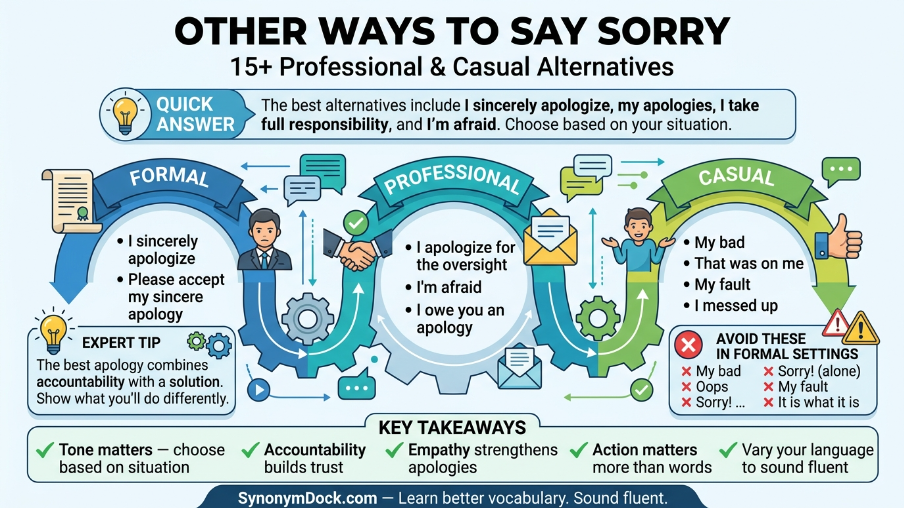
The best alternatives to “sorry” include I apologize, my apologies, I take full responsibility, I’m afraid, please forgive me, I owe you an apology, and I regret. For professional emails, try I sincerely apologize or please accept my sincere apology. The top five alternatives are: I sincerely apologize, my apologies, I take full responsibility, I’m afraid, and please forgive me.
Sorry is one of the first English words many learners master. It’s short, simple, and useful in almost any situation. But in everyday and professional communication, relying on the same word repeatedly can sometimes make an apology sound routine, vague, or less sincere than intended.
That’s why learning other ways to say sorry can make your English more natural, precise, and effective. Whether you’re writing a business email, responding to a customer, attending a meeting, or having a casual conversation, choosing the right sorry alternative allows you to match your wording to the seriousness and context of the situation.
If you’re searching for sorry other ways to say, other words to say sorry, or different words to say sorry, the best alternative depends on what you’re apologizing for. For example, “I apologize” is appropriate in many professional situations, while “I sincerely apologize” communicates stronger remorse. In a workplace email, phrases such as “My apologies for the oversight” can sound more specific and professional than simply saying “Sorry.
The same principle applies when you’re looking for a sorry for the inconvenience alternative. Depending on the situation, you might say “I apologize for the inconvenience,” “Thank you for your patience,” or “We regret any disruption this may have caused.” These alternatives can acknowledge the problem while keeping the tone professional and solution-focused.
Understanding how to say sorry in a formal way is particularly useful in workplace communication. A professional apology should generally be clear, sincere, and proportionate to the situation rather than overly emotional or repetitive. Likewise, sincere apologies synonyms can help you express genuine regret without making every apology sound identical. If the action has already happened, the word “apologized” may also be useful when describing the apology in past tense.
This guide focuses on natural English usage, tone, and real-world communication rather than simply replacing one word with another. You’ll discover 15 powerful alternatives to sorry, with clear definitions, example sentences, tone guidance, and practical advice on when to use each expression. We’ll also cover formal and casual options, professional email examples, common mistakes, and frequently asked questions including the question “How many words are in ‘my apologies for the oversight’?” so you can choose the right apology for the situation with confidence.
Quick Categories
Formal Alternatives
- I sincerely apologize
- My apologies
- Please accept my sincere apology
- I take full responsibility
- I regret
Pro Tip: Use these in official letters, formal emails, and when addressing senior colleagues or clients.
Professional Alternatives
- I apologize for the oversight
- I’m afraid
- I owe you an apology
- Please excuse me
Pro Tip: These work well in workplace emails and meetings where you need to sound competent, not overly emotional.
Business Email Alternatives
- I sincerely apologize for the delay
- Please accept my sincere apology
- I take full responsibility
- Thank you for your patience (instead of apologizing)
- I understand your frustration
Pro Tip: In emails, combine an apology with a solution. Research shows 70% of workplace conflicts worsen from poor apologies.
Academic Alternatives
- I apologize
- I regret
- Please forgive me
- I must apologize
Pro Tip: Academic writing values precision and humility. Use these when acknowledging errors in research or missing deadlines.
Casual Alternatives
- My bad
- My fault
- I messed up
- Oops, sorry about that
- I owe you one
Pro Tip: Use these with friends, family, and close colleagues. Never use them in formal or professional writing.
Informal Expressions
- My bad
- I goofed
- That was on me
- My mistake
- I wasn’t thinking
Pro Tip: These show self-awareness without sounding overly serious. Perfect for everyday conversations with people you know well.
“A thoughtful apology builds trust. A careless one breaks it.”
Common Mistakes
Mistake 1: Overusing “Sorry” in Emails
- Why it’s incorrect: It undermines your confidence and sounds unprofessional.
- Correct version: Replace “Sorry for the delay” with “Thank you for your patience”.
- Example: Instead of “Sorry for the late response,” write “Thank you for your patience with my reply.
Mistake 2: Apologizing When You Should Thank
- Why it’s incorrect: Apologizing focuses on the negative; thanking focuses on the positive.
- Correct version: Say “Thank you for your understanding” instead of “Sorry for the inconvenience.
- Example: Instead of “Sorry to bother you,” write “Thank you for your time.
Mistake 3: Using Casual Apologies in Formal Situations
- Why it’s incorrect: Phrases like “my bad” sound immature in professional contexts.
- Correct version: Use “I apologize” or “my apologies.”
- Example: Instead of “My bad, I forgot the report,” write “I apologize for forgetting the report.
Mistake 4: Apologizing Without Taking Responsibility
- Why it’s incorrect: Vague apologies like “Sorry if anyone was offended” sound insincere.
- Correct version: Take ownership with “I take full responsibility.”
- Example: Instead of “Sorry if there was confusion,” write “I take full responsibility for the confusion.
Mistake 5: Making Excuses After Apologizing
- Why it’s incorrect: “Sorry, but…” undermines the apology and shifts blame.
- Correct version: Apologize without excuses.
- Example: Instead of “Sorry I’m late, but traffic was terrible,” write “I apologize for being late. I’ll ensure it doesn’t happen again.”
What Does “Sorry” Mean?
Definition: “Sorry” expresses regret, remorse, or sympathy for a mistake, inconvenience, or unfortunate situation.
Grammar note: “Sorry” is an adjective. It can be used with “for” (sorry for being late) or “about” (sorry about the confusion).
Simple explanation: When you say sorry, you acknowledge that something went wrong and you wish it hadn’t happened.
Example: “I’m sorry I missed your call.
When to Use “Sorry”
“Sorry” works in many situations, but alternatives often communicate more effectively:
- Business emails Use professional alternatives to sound competent
- Academic writing Use formal expressions for humility and precision
- Meetings Use thoughtful apologies to maintain credibility
- Daily conversation Use casual alternatives for natural speech
- Spoken English Vary your language to sound fluent
- Written English Choose formal alternatives for professional documents
- Formal situations Use “I apologize” or “my apologies”
- Informal situations Use “my bad” or “my fault”
Is It Professional or Polite?
| Aspect | Rating | Explanation |
|---|---|---|
| Polite? | ✔ Yes | “Sorry” is universally understood as polite. |
| Professional? | Depends | In formal writing, it can sound too casual. |
| Formal? | Sometimes | Only when combined with “I’m” or “very.” |
| Natural? | Yes | Native speakers use it daily. |
Business-style example: “I’m very sorry for the oversight” sounds professional. “Sorry!” in an email sounds too casual.
Pros and Cons
Pros
- Easy to understand
- Friendly and approachable
- Common and natural
- Works in almost any situation
Cons
- Overused and can sound insincere
- Limited emotional range
- Too casual for some workplaces
- Not ideal in formal writing
- Can undermine authority when overused
15 Powerful Alternatives to Sorry
Before we dive into the alternatives, here’s what you’ll learn: when to use each phrase, how formal it is, and which situations demand a specific tone. Native speakers choose different expressions based on formality, workplace culture, and their relationship with the listener and now you will too.
[1]. I Sincerely Apologize
Meaning: A formal and heartfelt way to express genuine regret.
Explanation: Adding “sincerely” elevates a standard apology to one that feels genuine and professional. Native speakers use this when they’ve made a significant mistake that affected others. It’s more formal than “I’m sorry” and shows you’re taking the situation seriously.
Example Sentence: “I sincerely apologize for the error in the financial report it was my oversight.
Best Use: Business Email, Client Communication, Formal Letter
Avoid Using In: Casual Conversation, Text Message
Tone: Formal, Sincere, Professional
Formality Level: ⭐⭐⭐⭐⭐ Very Formal
Usage Frequency: Common
CEFR Level: B2
Common Collocations:
- sincerely apologize for
- sincerely apologize for the inconvenience
- sincerely apologize for the oversight
- sincerely apologize for any confusion
Context Variability:
- Spoken: “I sincerely apologize for my mistake.”
- Professional: “I sincerely apologize for the delay in processing your request.”
- Casual: (Too formal for casual use)
[2]. My Apologies
Meaning: A formal, concise way to say sorry, often used in writing.
Explanation: “My apologies” is the noun form of apologizing and sounds more polished than a simple “sorry”. It’s commonly used in professional emails and formal conversations. Native speakers often use it when they want to acknowledge a mistake without over-apologizing.
Example Sentence: “My apologies for not responding sooner I was out of the office.”
Best Use: Business Email, Professional Meetings, Formal Letters
Avoid Using In: Casual Text, Friends & Family Conversations
Tone: Professional, Concise, Polite
Formality Level: ⭐⭐⭐⭐ Formal
Usage Frequency: Very Common
CEFR Level: B2
Common Collocations:
- my sincere apologies
- my apologies for the delay
- please accept my apologies
- my apologies for any inconvenience
Context Variability:
- Spoken: “My apologies I completely forgot.”
- Professional: “My apologies for the oversight in the budget.”
- Casual: (Rarely used casually)
[3]. Please Accept My Sincere Apology
Meaning: A very formal request for forgiveness after a significant mistake.
Explanation: This is one of the most formal apology phrases available. Native speakers reserve it for serious errors that affected clients, senior leaders, or large groups. It’s often used in official apology letters and high-stakes business communications.
Example Sentence: “Please accept my sincere apology for the disruption to your services.”
Best Use: Official Letter, Client Apology, Major Mistake
Avoid Using In: Everyday Conversation, Casual Email, Minor Errors
Tone: Very Formal, Respectful, Humble
Formality Level: ⭐⭐⭐⭐⭐ Very Formal
Usage Frequency: Occasional
CEFR Level: C1
Common Collocations:
- accept my sincere apology
- accept my sincerest apologies
- accept my apology for
- accept our sincere apologies
Context Variability:
- Spoken: (Rarely used in speech)
- Professional: “Please accept my sincere apology for the error in your invoice.”
- Casual: (Too formal)
[4]. I Take Full Responsibility
Meaning: A powerful statement that accepts complete blame without excuses.
Explanation: This phrase goes beyond apologizing it shows accountability. Native speakers use it when they want to demonstrate maturity and leadership. It’s particularly effective in professional settings because it shows you’re not deflecting blame.
Example Sentence: “I take full responsibility for the project’s delays and will ensure we meet the new deadline.”
Best Use: Workplace Meeting, Client Communication, Leadership Context
Avoid Using In: Minor Mistakes, Casual Conversation
Tone: Professional, Accountable, Confident
Formality Level: ⭐⭐⭐⭐ Formal
Usage Frequency: Common
CEFR Level: B2
Common Collocations:
- take full responsibility for
- accept full responsibility
- take responsibility for the mistake
- full responsibility for the error
Context Variability:
- Spoken: “I take full responsibility for what happened.”
- Professional: “I take full responsibility for the team’s performance issues.”
- Casual: (Usually too formal)
[5]. I’m Afraid
Meaning: A formal way to deliver bad news or apologize for something, without meaning “scared.
Explanation: In British English especially, “I’m afraid” is a common way to soften bad news or apologize. It does not mean the speaker is scared it’s simply a more formal alternative to “sorry”. Native speakers use it before delivering disappointing information.
Example Sentence: “I’m afraid I won’t be able to attend the meeting tomorrow.”
Best Use: Formal Conversation, Professional Emails, Delivering Bad News
Avoid Using In: Casual Text, When You Mean “Scared”
Tone: Formal, Polite, Softening
Formality Level: ⭐⭐⭐⭐ Formal
Usage Frequency: Very Common
CEFR Level: B1
Common Collocations:
- I’m afraid I can’t
- I’m afraid I won’t
- I’m afraid there’s been
- I’m afraid I didn’t
Context Variability:
- Spoken: “I’m afraid I forgot to send the document.”
- Professional: “I’m afraid we need to reschedule.”
- Casual: “I’m afraid I ate the last cookie.” (used playfully)
Native Speaker Tip: “I’m afraid” is much more common in British English than American English. Americans often use “I’m sorry” or “unfortunately” instead.
[6]. I Owe You an Apology
Meaning: Acknowledges that you’ve wronged someone and need to make amends.
Explanation: This phrase shows self-awareness you recognize you’ve done something wrong and are taking the first step to fix it. Native speakers use it when they’ve been avoiding an apology or when the mistake was personal.
Example Sentence: “I owe you an apology for my behavior at the meeting last week.”
Best Use: Personal Apology, Relationship Repair, After Conflict
Avoid Using In: Minor Errors, Formal Business Letters
Tone: Sincere, Humble, Personal
Formality Level: ⭐⭐⭐ Neutral
Usage Frequency: Common
CEFR Level: B2
Common Collocations:
- owe you an apology for
- owe you a huge apology
- I think I owe you an apology
- we owe you an apology
Context Variability:
- Spoken: “I owe you an apology for being so rude.”
- Professional: “I owe you an apology for missing the deadline.”
- Casual: “I owe you an apology I completely forgot your birthday.”
[7]. I Regret
Meaning: Expresses deep sadness or disappointment about a past action.
Explanation: “Regret” is more formal and emotional than “sorry”. Native speakers use it when they feel genuinely remorseful about something that cannot be undone. It’s common in formal apologies and when expressing sympathy.
Example Sentence: “I deeply regret the way I handled that situation.
Best Use: Formal Letter, Personal Apology, Academic Writing
Avoid Using In: Casual Conversation, Minor Mistakes
Tone: Emotional, Formal, Sincere
Formality Level: ⭐⭐⭐⭐ Formal
Usage Frequency: Common
CEFR Level: B2
Common Collocations:
- deeply regret
- sincerely regret
- regret to inform
- regret the error
Context Variability:
- Spoken: “I regret not taking that job offer.”
- Professional: “I regret to inform you that your application was unsuccessful.”
- Casual: “I regret eating that whole pizza.” (used humorously)
[8]. Please Forgive Me
Meaning: A humble request for forgiveness after a significant wrong.
Explanation: This phrase goes beyond apologizing it asks the other person to let go of any anger or disappointment. Native speakers use it when they’ve hurt someone personally or professionally and want to restore the relationship.
Example Sentence: “Please forgive me for missing such an important deadline.”
Best Use: Personal Apology, Relationship Repair, After Major Mistake
Avoid Using In: Minor Errors, Professional Emails (unless very serious)
Tone: Humble, Sincere, Emotional
Formality Level: ⭐⭐⭐⭐ Formal
Usage Frequency: Common
CEFR Level: B2
Common Collocations:
- please forgive me for
- I hope you can forgive me
- please forgive my
- forgive me for asking
Context Variability:
- Spoken: “Please forgive me I didn’t mean to hurt you.”
- Professional: “Please forgive me for the oversight in the report.”
- Casual: “Forgive me, but I have to ask…”
[9]. I Apologize for the Oversight
Meaning: A professional way to admit you missed something important.
Explanation: “Oversight” means an unintentional failure to notice something. This phrase is perfect for professional settings because it acknowledges the mistake without sounding overly emotional. Native speakers use it in emails and meetings when they’ve missed a detail.
Example Sentence: “I apologize for the oversight in the budget calculations.”
Best Use: Professional Email, Workplace Meeting, Project Review
Avoid Using In: Casual Conversation, Personal Apologies
Tone: Professional, Precise, Accountable
Formality Level: ⭐⭐⭐⭐ Formal
Usage Frequency: Common
CEFR Level: B2
Common Collocations:
- oversight in
- oversight on my part
- apologize for the oversight
- regrettable oversight
Context Variability:
- Spoken: “I apologize for the oversight I’ll fix it immediately.”
- Professional: “I apologize for the oversight in the contract terms.”
- Casual: (Too formal)
Native Speaker Tip: “Oversight” sounds professional and competent. It’s much better than saying “I forgot” in a business context.
[10]. That Was on Me
Meaning: A casual way to accept blame for a mistake.
Explanation: This informal phrase is popular among native speakers in relaxed settings. It shows you’re taking responsibility without being overly serious. Use it with friends, family, or close colleagues never in formal writing.
Example Sentence: “That was on me I should have double-checked the numbers.”
Best Use: Casual Conversation, Team Settings, Friendly Context
Avoid Using In: Formal Email, Client Communication, Official Letters
Tone: Casual, Friendly, Accountable
Formality Level: ⭐ Very Casual
Usage Frequency: Very Common
CEFR Level: B2
Common Collocations:
- that was on me
- that’s on me
- that one’s on me
- all on me
Context Variability:
- Spoken: “That was on me I forgot to bring the documents.”
- Professional: (Avoid)
- Casual: “That was on me, I should have called first.”
[11]. My Bad
Meaning: A very casual, informal way to admit a minor mistake.
Explanation: “My bad” is one of the most common informal apologies in modern English. Native speakers use it constantly in casual settings. However, it’s never appropriate in professional or formal contexts it can make you sound immature or unprofessional.
Example Sentence: “My bad I completely forgot about our meeting.”
Best Use: Friends & Family, Casual Conversation, Text Messages
Avoid Using In: Business Email, Professional Meeting, Academic Writing
Tone: Casual, Friendly, Informal
Formality Level: ⭐ Very Casual
Usage Frequency: Very Common
CEFR Level: B1
Common Collocations:
- my bad, I
- my bad, sorry
- totally my bad
- my bad on that
Context Variability:
- Spoken: “My bad I grabbed the wrong file.”
- Professional: ❌ Never use in professional settings.
- Casual: “My bad, I should have told you earlier.”
[12]. I Understand Your Frustration
Meaning: Shows empathy and acknowledges the other person’s feelings.
Explanation: This phrase validates the other person’s emotions, which is a crucial part of a sincere apology. Native speakers use it when someone is upset and needs to feel heard. It’s especially effective in customer service and client communication.
Example Sentence: “I understand your frustration with the delayed delivery we’re working to resolve it.
Best Use: Customer Service, Client Communication, Conflict Resolution
Avoid Using In: Casual Conversation, Minor Mistakes
Tone: Empathetic, Professional, Understanding
Formality Level: ⭐⭐⭐ Neutral
Usage Frequency: Common
CEFR Level: B2
Common Collocations:
- understand your frustration
- understand your concern
- understand why you’re upset
- completely understand
Context Variability:
- Spoken: “I understand your frustration let me fix this.”
- Professional: “I understand your frustration with the service delay.”
- Casual: “I understand your frustration, but let’s find a solution.”
[13]. I Must Apologize
Meaning: A formal way to acknowledge that an apology is necessary and expected.
Explanation: This phrase shows you recognize the seriousness of a situation. Native speakers use it when they feel compelled to apologize often in formal or professional contexts where “sorry” would feel too casual.
Example Sentence: “I must apologize for the confusion caused by my earlier email.”
Best Use: Formal Letter, Professional Email, Official Apology
Avoid Using In: Casual Conversation, Text Messages
Tone: Formal, Sincere, Professional
Formality Level: ⭐⭐⭐⭐ Formal
Usage Frequency: Occasional
CEFR Level: B2
Common Collocations:
- must apologize for
- must apologize to
- I really must apologize
- we must apologize
Context Variability:
- Spoken: “I must apologize for my behavior last night.”
- Professional: “I must apologize for the error in the report.”
- Casual: (Rarely used casually)
Native Speaker Tip: “I must apologize” sounds slightly old-fashioned to some younger native speakers. Use “I apologize” or “my apologies” for a more modern feel.
[14]. Please Excuse Me
Meaning: A polite way to apologize for a minor interruption or inconvenience.
Explanation: This phrase is used to apologize for small disruptions interrupting someone, leaving a room, or making a minor error. Native speakers use it constantly in daily life. It’s more formal than “sorry” but less formal than “I apologize”.
Example Sentence: “Please excuse me for interrupting I have an urgent question.”
Best Use: Meetings, Interruptions, Minor Inconveniences
Avoid Using In: Major Mistakes, Formal Letters
Tone: Polite, Respectful, Soft
Formality Level: ⭐⭐⭐ Neutral
Usage Frequency: Very Common
CEFR Level: A2
Common Collocations:
- excuse me for
- please excuse
- excuse the interruption
- excuse my
Context Variability:
- Spoken: “Please excuse me, I need to take this call.”
- Professional: “Please excuse me for the delay in responding.”
- Casual: “Excuse me, could I grab that?”
[15]. I Apologize for the Inconvenience
Meaning: A standard professional apology for causing trouble or difficulty.
Explanation: This is one of the most common professional apology phrases. Native speakers use it in customer service, business emails, and formal communications when someone has been put out. However, it can sound generic so use it sparingly.
Example Sentence: “I apologize for the inconvenience caused by the system outage.”
Best Use: Customer Service, Business Email, Formal Apology
Avoid Using In: Casual Conversation, Personal Apologies
Tone: Professional, Standard, Polite
Formality Level: ⭐⭐⭐⭐ Formal
Usage Frequency: Very Common
CEFR Level: B2
Common Collocations:
- apologize for the inconvenience
- sorry for the inconvenience
- inconvenience caused by
- any inconvenience
Context Variability:
- Spoken: “I apologize for the inconvenience we’ll fix it now.”
- Professional: “I apologize for the inconvenience this has caused.”
- Casual: (Too formal)
Expert Insight: In professional communication, the best apology combines accountability with a solution. Simply saying “I apologize” isn’t enough show what you’ll do differently. Native speakers respect action more than words.
Top 10 Alternatives Compared
| Phrase | Tone | Formality | Best Use | Frequency |
|---|---|---|---|---|
| I sincerely apologize | Sincere, Professional | ⭐⭐⭐⭐⭐ | Business Email | Common |
| My apologies | Concise, Polite | ⭐⭐⭐⭐ | Professional Writing | Very Common |
| Please accept my sincere apology | Formal, Humble | ⭐⭐⭐⭐⭐ | Official Letter | Occasional |
| I take full responsibility | Accountable, Confident | ⭐⭐⭐⭐ | Workplace Meeting | Common |
| I’m afraid | Softening, Formal | ⭐⭐⭐⭐ | Delivering Bad News | Very Common |
| I owe you an apology | Sincere, Personal | ⭐⭐⭐ | Personal Apology | Common |
| I regret | Emotional, Formal | ⭐⭐⭐⭐ | Formal Letter | Common |
| Please forgive me | Humble, Emotional | ⭐⭐⭐⭐ | Major Mistake | Common |
| That was on me | Casual, Friendly | ⭐ | Casual Conversation | Very Common |
| My bad | Casual, Informal | ⭐ | Friends & Family | Very Common |
Which One Should You Use?
Best Overall
I sincerely apologize works in almost any professional situation and sounds genuine.
Best Professional
My apologies concise, professional, and widely accepted in business communication.
Best Academic
I regret shows humility and reflection, perfect for acknowledging errors in research.
Best Business Email
I apologize for the oversight specific and professional, shows attention to detail.
Best Everyday Conversation
My apologies formal enough for most situations, natural enough for daily use.
Most Natural
I’m afraid extremely common in British English, softens bad news perfectly.
Most Polite
Please forgive me shows genuine humility and respect for the other person.
Commonly Confused Phrases
“I apologize” vs “My apologies”
- “I apologize” verb form, more personal and direct
- “My apologies” noun form, more formal and concise
“I’m sorry” vs “I apologize”
- “I’m sorry” can express sympathy or regret; more emotional
- “I apologize” strictly for admitting fault; more professional
“I regret” vs “I’m sorry”
- “I regret” focuses on your own feelings of disappointment
- “I’m sorry” focuses on the impact on the other person
“Please forgive me” vs “I apologize”
- “Please forgive me” asks for the other person’s response
- “I apologize” focuses solely on your own admission
“A sincere apology isn’t about saying the right words it’s about meaning them.”
Scenario Practice
Scenario 1: Business Meeting
You’re leading a team meeting and realize you forgot to share an important document. Which phrase should you choose?
Best Answer: “My apologies I forgot to share the document. I’ll send it immediately after this meeting.”
Scenario 2: Job Interview
You arrive 5 minutes late to an interview. Which phrase should you choose?
Best Answer: “I sincerely apologize for being late. There was unexpected traffic, but I should have planned better.”
Scenario 3: Email to a Client
Your team made an error in a client’s invoice. Which phrase should you choose?
Best Answer: “Please accept my sincere apology for the error in your invoice. We’ve corrected it and will ensure it doesn’t happen again.”
Scenario 4: Classroom Discussion
You accidentally interrupt your professor during a lecture. Which phrase should you choose?
Best Answer: “Please excuse me for interrupting, Professor. I had a quick question.”
Scenario 5: Text to a Friend
You forgot about plans you made with a friend. Which phrase should you choose?
Best Answer: “My bad I totally forgot about our plans. Can we reschedule?”
Mini Quiz
1. Which phrase is best for a formal business email?
- A) My bad
- B) I sincerely apologize
- C) Oops
- D) That was on me
2. What does “I’m afraid” mean in a professional context?
- A) The speaker is scared
- B) The speaker is sorry
- C) The speaker is angry
- D) The speaker is confused
3. Which phrase shows you’re taking full responsibility?
- A) I’m sorry if anyone was offended
- B) I take full responsibility
- C) My apologies for any confusion
- D) I regret any inconvenience
4. Which phrase is too casual for a professional email?
- A) My apologies
- B) I apologize
- C) My bad
- D) I sincerely apologize
5. Which phrase is best for expressing empathy?
- A) I owe you an apology
- B) I understand your frustration
- C) Please forgive me
- D) I’m afraid
Answer Key
- B “I sincerely apologize” is formal and professional.
- B “I’m afraid” means “I’m sorry” in formal contexts.
- B “I take full responsibility” directly accepts blame.
- C “My bad” is too casual for professional writing.
- B “I understand your frustration” shows empathy.
Avoid These in Formal Situations
| Phrase | Why to Avoid | Better Alternative |
|---|---|---|
| My bad | Too casual and immature | “My apologies” or “I apologize” |
| Oops | Childish and unprofessional | “I apologize for the error” |
| Sorry! (alone) | Too brief, sounds insincere | “I sincerely apologize” |
| My fault | Too casual for formal settings | “I take full responsibility” |
| It is what it is | Dismissive, avoids accountability | “I take full responsibility for this” |
FAQs
What is the most formal way to say “sorry”?
“Please accept my sincere apology” is among the most formal expressions. It’s typically reserved for official letters, major mistakes, and high-stakes professional situations where a simple “sorry” would seem inadequate.
Which phrase is best for professional emails?
“I sincerely apologize” or “my apologies” work best for professional emails. They strike the right balance between formality and sincerity without sounding overly emotional. For minor oversights, “I apologize for the oversight” is specific and professional.
What is the difference between “I’m sorry” and “I apologize”?
“I’m sorry” expresses sympathy or regret and can be used in both personal and professional contexts. “I apologize” is more formal and is specifically for admitting fault. Use “I apologize” in business settings and “I’m sorry” in personal situations.
Which alternative sounds most natural to native speakers?
“My apologies” sounds natural in professional contexts, while “my bad” is extremely common in casual conversation. “I’m afraid” is very natural in British English for delivering bad news. The most natural choice depends entirely on the context.
Can I use these expressions in business meetings?
Yes, but choose carefully. Use “I apologize for the oversight,” “I take full responsibility,” or “my apologies” in meetings. Avoid “my bad,” “oops,” or any casual alternatives. In professional meetings, accountability and sincerity matter more than informality.
Conclusion
Learning other ways to say sorry transforms your English from basic to sophisticated. Whether you’re writing a business email, attending a meeting, or having a casual conversation, the right apology shows emotional intelligence and communication skills.
Start practicing these alternatives today. Use “I apologize” in your next work email. Try “my apologies” in your next meeting. And save “my bad” for conversations with friends. The more you practice, the more natural these alternatives will feel.
Remember: A thoughtful apology builds trust. A careless one breaks it. Choose your words wisely.

22 thoughts on “15+ Other Ways to Say Sorry |Professional & Casual Alternatives For 2026”