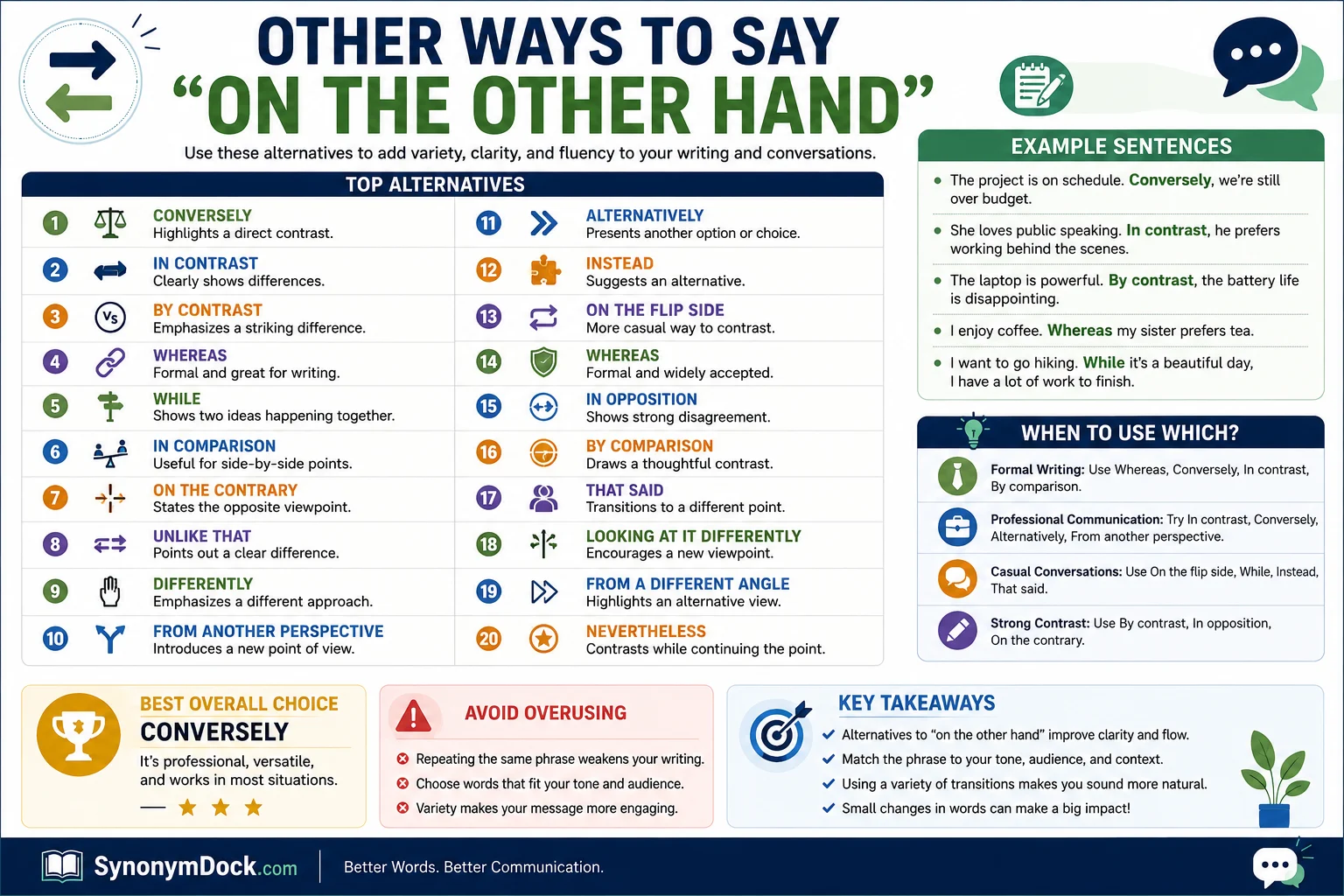
“On the other hand” is a transition phrase used to introduce a contrasting viewpoint. Professional alternatives include however, in contrast, conversely, on the contrary, and from another perspective. For formal writing, use in contrast or conversely; for casual conversations, use then again or but then.
“On the other hand” is one of the most common transition phrases in English. It’s useful for presenting contrasting ideas, showing different perspectives, and creating balanced arguments.
But here’s the problem: using this phrase too often makes your writing sound repetitive and less professional. Native speakers naturally vary their language, and so should you.
In this article, you’ll discover 15 powerful alternatives to “on the other hand” that will make your English sound more fluent, professional, and natural.
Quick Categories
Formal Alternatives
- In contrast
- Conversely
- On the contrary
- By comparison
- From a different angle
Pro Tip: Use these in academic writing, formal reports, and professional presentations where precision matters.
Professional Alternatives
- However
- Nevertheless
- Nonetheless
- That said
- Having said that
Pro Tip: These work well in business emails, meetings, and professional documents where you need to acknowledge counterpoints.
Business Email Alternatives
- At the same time
- That being said
- Even so
- Still
- Yet
Pro Tip: These sound confident and diplomatic in workplace communication.
Academic Alternatives
- In contrast
- Conversely
- On the contrary
- By contrast
- From another perspective
Pro Tip: Academic writing values precision. These phrases signal your ability to present balanced arguments.
Casual Alternatives
- Then again
- But then
- Mind you
- At the same time
- Even so
Pro Tip: Use these in everyday conversation with friends, family, or coworkers in relaxed settings.
Informal Expressions
- On the flip side
- The flip side is
- You could also say
- Looking at it another way
- From where I stand
Pro Tip: These work great in casual conversations, social media, and informal writing.
“Using the same transition phrase repeatedly weakens your message. Variety signals confidence and fluency.”
Common Mistakes
1. Confusing “On the Other Hand” with “On the Contrary”
Mistake: Using them interchangeably.
Why It’s Incorrect: They express different relationships. On the other hand” presents an alternative perspective. “On the contrary” contradicts or denies a previous statement.
Correct Version: Use “on the contrary” when contradicting, “on the other hand” when offering a different perspective.
Example Sentence: “The project wasn’t delayed due to poor planning. On the contrary, the team exceeded all expectations.”
2. Using “On the Other Hand” Without a Previous Point
Mistake: Introducing the first point with “on the other hand.”
Why It’s Incorrect: The phrase indicates a shift from one perspective to another. It needs a previous point to contrast with.
Correct Version: Introduce the first perspective with another transition, like “first” or “one perspective.”
Example Sentence: “The software is affordable. On the other hand, it lacks certain advanced features.”
3. Overusing “On the Other Hand” Multiple Times
Mistake: Using the same phrase repeatedly in one document.
Why It’s Incorrect: Repetition makes writing feel monotonous and unprofessional.
Correct Version: Vary your transitions throughout the document.
Example Sentence: Instead of three “on the other hands,” use “however,” “conversely,” and “in contrast.”
4. Using “On the Other Hand” in Casual Conversation
Mistake: Using a formal phrase in informal settings.
Why It’s Incorrect: It can sound stiff or overly formal among friends.
Correct Version: Use “then again,” “but then,” or “on the flip side.”
Example Sentence: “The coffee shop is crowded. Then again, the service is always excellent.”
5. Placing “On the Other Hand” Incorrectly in a Sentence
Mistake: Starting a sentence with the phrase in the wrong grammatical position.
Why It’s Incorrect: The phrase needs to be placed correctly to maintain sentence flow.
Correct Version: Place it at the beginning of a clause or sentence.
Example Sentence: “The hotel was expensive. On the other hand, the view was spectacular.”
What Does “On the Other Hand” Mean?
Definition: “On the other hand” is a discourse marker that introduces a contrasting viewpoint, alternative perspective, or opposing argument to something previously mentioned.
Grammar Explanation: It functions as a conjunctive adverb or transitional phrase that links two clauses, sentences, or paragraphs. It often appears with “on the one hand” to present two sides of an argument.
Simple Explanation: Think of it as a way to say, “Now let’s look at the opposite side of this idea.
Example Sentence: “The city is expensive to live in. On the other hand, job opportunities are abundant.”
When to Use “On the Other Hand”
- 🔹 Academic Essays – To present balanced arguments
- 🔹 Business Reports – To show different perspectives
- 🔹 Professional Emails – To acknowledge other viewpoints
- 🔹 Workplace Meetings – To offer alternative solutions
- 🔹 Daily Conversations – Less common, but used occasionally
- 🔹 Written English – Very common in formal and professional writing
- 🔹 Spoken English – Used in discussions and presentations
- 🔹 Formal Settings – Excellent choice
- 🔹 Informal Settings – Sounds a bit too formal
“Professional English is about knowing which phrase fits which situation.”
Is It Professional or Polite?
Polite? ✔️ Yes
Professional? ✔️ Yes, in most contexts
Formal? ✔️ Yes, especially in academic and business writing
Natural? ✔️ Yes, when used appropriately
Business Example: “The new policy will reduce costs. On the other hand, it may impact employee morale.”
Explanation: The phrase is considered neutral, professional, and widely accepted in formal contexts. It isn’t aggressive or informal, making it a safe choice in most professional environments.
Pros and Cons
Pros
- Easy to understand
- Widely recognized by English speakers
- Clearly signals contrast
- Acceptable in most contexts
Cons
- Overused by English learners
- Sounds repetitive when used often
- Too formal for casual conversations
- Requires two points to contrast
- Can feel academic
- Not ideal for very informal settings
- Can be vague without clear context
Transition to the Main List
Ready to expand your vocabulary? The following 15 alternatives will help you:
- ✅ Sound more fluent and natural
- ✅ Improve professional communication
- ✅ Understand subtle tone differences
- ✅ Avoid repetitive language
- ✅ Choose the right phrase for every situation
Remember: the best phrase depends on your audience, context, and the tone you want to convey.
Expert Tip Box
Expert Tip:
Native speakers rarely use “on the other hand” more than once or twice in a single document. Instead, they choose alternatives based on the relationship between ideas. Is it a direct contrast? A concession? An alternative perspective? Understanding these nuances makes your English sound more sophisticated.
Other Ways to Say “On the Other Hand” (With Examples)
Here are 15 powerful alternatives organized by formality and usage. Each includes explanations, examples, and practical guidance to help you choose the right phrase every time.
Formal Alternatives
1. In Contrast
Meaning: Highlights differences between two things.
Explanation: This phrase is widely used in academic and professional writing. It signals a direct comparison between two different ideas, situations, or perspectives. Writers often use it to emphasize distinctions clearly and formally.
Example Sentence: “The first proposal emphasizes cost savings. In contrast, the second proposal prioritizes long-term sustainability.”
Best Use: Academic Essays, Business Reports, Presentations
Avoid Using In: Casual Conversations, Text Messages
Tone: Formal, Analytical
Formality Level: ⭐⭐⭐⭐⭐ Very Formal
Usage Frequency: Very Common
CEFR Level: B2
Common Collocations:
- in stark contrast
- in sharp contrast
- in clear contrast
- in contrast to
- stands in contrast
Context Variability:
- Spoken English: “The old model was unreliable. In contrast, the new one works perfectly.”
- Written English: “The company reported record profits. In contrast, its competitors suffered losses.”
- Casual Conversation: “I love coffee. In contrast, my sister only drinks tea.”
2. Conversely
Meaning: Indicates the opposite of a stated point.
Explanation: This formal transition shows a direct reversal of the previous idea. It’s precise and academic. In mathematical or logical arguments, it suggests the exact opposite proposition. Native speakers use it most frequently in academic writing.
Example Sentence: “Higher taxes may reduce consumer spending. Conversely, tax cuts could stimulate economic growth.”
Best Use: Academic Papers, Professional Reports, Legal Writing
Avoid Using In: Everyday Conversation, Informal Writing
Tone: Formal, Precise
Formality Level: ⭐⭐⭐⭐⭐ Very Formal
Usage Frequency: Common
CEFR Level: C1
Common Collocations:
- conversely stated
- conversely speaking
- conversely if
- conversely when
- conversely however
Context Variability:
- Spoken English: “Urban areas offer more jobs. Conversely, rural areas provide more space.”
- Written English: “The drug may cause side effects. Conversely, it also offers significant benefits.”
- Academic: “This theory explains social behavior. Conversely, biological factors may also play a role.”
3. On the Contrary
Meaning: Contradicts a previously stated idea directly.
Explanation: Unlike “on the other hand,” “on the contrary” explicitly rejects what was said before. It’s used to correct a misunderstanding or to deny a claim. The phrase signals strong disagreement.
Example Sentence: “The campaign wasn’t a failure. On the contrary, it exceeded our targets by 40%.”
Best Use: Academic Arguments, Professional Corrections
Avoid Using In: Casual Texting, Friendly Conversation
Tone: Strong, Corrective
Formality Level: ⭐⭐⭐⭐ Formal
Usage Frequency: Common
CEFR Level: C1
Common Collocations:
- on the contrary indeed
- on the contrary in fact
- on the contrary actually
- quite the contrary
- very much on the contrary
Context Variability:
- Spoken: “The restaurant wasn’t expensive. On the contrary, it was surprisingly affordable.”
- Written: “Many assume remote work reduces productivity. On the contrary, studies show it increases efficiency.”
4. By Comparison
Meaning: Evaluates differences between subjects.
Explanation: This phrase is perfect when you need to compare specific characteristics. It often appears when discussing qualities, statistics, or attributes. It can point to a notable distinction between items being compared.
Example Sentence: “The smaller city has limited cultural events. By comparison, the capital offers hundreds of museums and theaters.”
Best Use: Comparative Analysis, Research Papers
Avoid Using In: Casual Conversation
Tone: Analytical, Objective
Formality Level: ⭐⭐⭐⭐ Formal
Usage Frequency: Common
CEFR Level: B2
Common Collocations:
- by comparison with
- by comparison to
- by comparison however
- in comparison
- in comparison with
Context Variability:
- Spoken: “Our apartment is small. By comparison, their house is enormous.”
- Written: “The iPhone is expensive. By comparison, many Android phones offer better value.”
5. From a Different Angle
Meaning: Examines an issue from a new perspective.
Explanation: This phrase encourages thinking differently about a topic. It signals a shift in how you’re looking at the problem or situation. It’s less common but effective in academic writing.
Example Sentence: “From a different angle, the same data suggests an entirely different conclusion.”
Best Use: Essays, Brainstorming Sessions
Avoid Using In: Very Formal Contracts
Tone: Analytical, Open-Minded
Formality Level: ⭐⭐⭐⭐ Formal
Usage Frequency: Occasional
CEFR Level: C1
Common Collocations:
- from a different perspective
- from a new angle
- from another angle
- consider it from a different angle
- looking from a different angle
Context Variability:
- Spoken: “The project seems doomed. From a different angle, it’s a learning opportunity.”
- Written: “From a different angle, the policy actually helps small businesses.”
“Native English speakers choose transition phrases based on how close or far the contrast is. Close contrasts use ‘but.’ Distant ones use ‘however’ or ‘in contrast.'”
Professional & Business Alternatives
6. However
Meaning: Introduces a contrast or contradiction.
Explanation: “However” is one of the most versatile alternatives. It works in almost any professional context, from emails to presentations. It’s considered neutral—not too formal, not too casual. It can appear at the beginning or middle of sentences.
Example Sentence: “We’ve cut our expenses significantly. However, we still need to increase revenue.”
Best Use: Emails, Business Meetings, Professional Communication
Avoid Using In: Very Formal Legal Documents
Tone: Neutral, Professional
Formality Level: ⭐⭐⭐⭐ Formal
Usage Frequency: Very Common
CEFR Level: B1
Common Collocations:
- however in fact
- however despite
- however although
- however nevertheless
- however nonetheless
Context Variability:
- Spoken: “I’d love to help. However, I’m already committed elsewhere.”
- Written: “The product is excellent. However, the price point may discourage customers.”
7. Nevertheless
Meaning: Acknowledges a point while maintaining an opposing position.
Explanation: This phrase means “despite what was just said.” It shows you understand the previous point but still hold a different view. It’s very formal but less common in modern business writing.
Example Sentence: “The weather forecast predicted rain. Nevertheless, we proceeded with the outdoor event.”
Best Use: Formal Reports, Presentations, Business Writing
Avoid Using In: Casual Conversation
Tone: Formal, Resilient
Formality Level: ⭐⭐⭐⭐⭐ Very Formal
Usage Frequency: Occasional
CEFR Level: C1
Common Collocations:
- nevertheless however
- nevertheless nonetheless
- nevertheless still
- nevertheless despite
- nevertheless although
Context Variability:
- Spoken: “The plan was risky. Nevertheless, we decided to proceed.”
- Written: “The company faced many challenges. Nevertheless, it achieved record growth.”
8. Nonetheless
Meaning: Despite the previous point.
Explanation: “Nonetheless” is very similar to “nevertheless.” It’s used to concede a point while maintaining your position. Some native speakers use it to make writing sound more dynamic. It’s more common in modern writing than “nevertheless.”
Example Sentence: “The opposition had strong arguments. Nonetheless, the proposal was approved.”
Best Use: Academic Writing, Professional Emails
Avoid Using In: Informal Chat
Tone: Formal, Diplomatic
Formality Level: ⭐⭐⭐⭐⭐ Very Formal
Usage Frequency: Common
CEFR Level: C1
Common Collocations:
- nonetheless however
- nonetheless still
- nonetheless despite
- nonetheless even so
- but nonetheless
Context Variability:
- Spoken: “I disagree with your point. Nonetheless, I understand your reasoning.”
- Written: “The team lacked experience. Nonetheless, they delivered exceptional results.”
9. That Said
Meaning: Introduces a contrasting idea while acknowledging the previous point.
Explanation: This phrase softens the contrast. It sounds polite and thoughtful, making it perfect for workplace discussions. It’s popular in modern business English because it sounds professional without being stiff.
Example Sentence: “The new software is expensive. That said, it will save us time in the long run.”
Best Use: Business Meetings, Professional Emails
Avoid Using In: Very Formal Legal Writing
Tone: Diplomatic, Thoughtful
Formality Level: ⭐⭐⭐ Formal
Usage Frequency: Common
CEFR Level: B2
Common Collocations:
- having said that
- that said though
- with that said
- that said however
- that said nevertheless
Context Variability:
- Spoken: “I’m not a fan of this plan. That said, I’ll support the team.”
- Written: “The data is inconclusive. That said, we should still consider the implications.”
10. Yet
Meaning: Despite something that has been mentioned.
Explanation: This short, powerful transition signals contrast in a concise way. It works well in both spoken and written English. At the start of a sentence, it’s more formal; in the middle, it’s more conversational.
Example Sentence: “The economy is struggling. Yet, we’ve seen some encouraging signs.”
Best Use: Business Writing, Formal Speeches
Avoid Using In: Very Casual Chat
Tone: Professional, Concise
Formality Level: ⭐⭐⭐⭐ Formal
Usage Frequency: Very Common
CEFR Level: B2
Common Collocations:
- and yet
- yet still
- yet however
- yet nevertheless
- yet despite
Context Variability:
- Spoken: “It was raining. Yet, we still went for a walk.”
- Written: “The evidence is strong. Yet, we must remain cautious.”
“When you use ‘however’ or ‘nevertheless,’ you’re telling the listener, ‘I’ve heard you, but here’s another angle.'”
Casual & Everyday Conversation
11. Then Again
Meaning: Offers a different perspective after considering something.
Explanation: This is a common phrase in spoken English. It’s used when you’re reconsidering or thinking about alternatives. It sounds natural and conversational, often appearing in discussions where people are weighing options.
Example Sentence: “The restaurant is expensive. Then again, the food is outstanding.”
Best Use: Daily Conversation, Social Settings
Avoid Using In: Academic Papers, Legal Documents
Tone: Casual, Reflective
Formality Level: ⭐⭐ Casual
Usage Frequency: Very Common
CEFR Level: B1
Common Collocations:
- but then again
- then again though
- then again maybe
- then again perhaps
- then again on the other hand
Context Variability:
- Spoken: “We could stay home. Then again, a movie would be fun.”
- Written (informal): “The deal is expensive. Then again, the quality is unmatched.”
12. But Then
Meaning: Introduces a contrasting viewpoint.
Explanation: This transition is extremely common in everyday speech. It’s used to present a counterargument or alternative view. It’s more informal than “however” but still acceptable in most casual contexts.
Example Sentence: “I love my job. But then, the commute is terrible.”
Best Use: Casual Conversation, Social Media
Avoid Using In: Formal Writing
Tone: Natural, Conversational
Formality Level: ⭐⭐ Casual
Usage Frequency: Very Common
CEFR Level: B1
Common Collocations:
- but then again
- but then though
- but then however
- but then on the other hand
- but then still
Context Variability:
- Spoken: “The hotel is great. But then, it’s quite expensive.”
- Written (informal): “I love the new phone. But then, the battery life is disappointing.”
13. Mind You
Meaning: Adds a contrasting point or warning.
Explanation: This is a very natural spoken English phrase. It’s used to add a contrast or caveat after making a point. It sounds distinctly British but is understood everywhere. It often introduces an important exception to what you’ve just said.
Example Sentence: “The job pays well. Mind you, you’ll have to work weekends.”
Best Use: Everyday Conversation, Informal Writing
Avoid Using In: Formal Writing, Business Emails
Tone: Conversational, Natural
Formality Level: ⭐⭐ Casual
Usage Frequency: Common (UK)
CEFR Level: B2
Common Collocations:
- mind you though
- mind you but
- mind you however
- mind you still
- mind you nevertheless
Context Variability:
- Spoken: “He’s very talented. Mind you, he’s also quite lucky.”
- Written (informal): “The food is amazing. Mind you, the portions are small.”
14. On the Flip Side
Meaning: Explores the opposite perspective.
Explanation: This informal expression means the same thing as “on the other hand” but sounds more modern and conversational. It’s often used in discussions, debates, and social media. It conveys the same meaning but with a fresh tone.
Example Sentence: “The hotel is affordable. On the flip side, it’s far from the main attractions.”
Best Use: Casual Conversation, Business Brainstorming
Avoid Using In: Academic Writing, Legal Documents
Tone: Informal, Fresh
Formality Level: ⭐⭐ Casual
Usage Frequency: Common
CEFR Level: B2
Common Collocations:
- flip side of
- on the flip side though
- the flip side is
- flip side however
- flip side but
Context Variability:
- Spoken: “We could save money by staying home. On the flip side, we might miss a great vacation.”
- Written (informal): “The product is cheap. On the flip side, it’s not very durable.”
15. At the Same Time
Meaning: Acknowledges two seemingly contradictory ideas.
Explanation: This phrase is great for presenting two ideas that are true simultaneously, even if they appear contradictory. It sounds professional enough for business contexts while remaining accessible for casual use.
Example Sentence: “She’s incredibly strict with deadlines. At the same time, she’s very fair.”
Best Use: Professional Conversations, Emails
Avoid Using In: Very Formal Academic Writing
Tone: Balanced, Diplomatic
Formality Level: ⭐⭐⭐ Neutral
Usage Frequency: Very Common
CEFR Level: B1
Common Collocations:
- at the same time though
- at the same time however
- but at the same time
- yet at the same time
- while at the same time
Context Variability:
- Spoken: “I love my job. At the same time, I need more flexibility.”
- Written: “The proposal is creative. At the same time, it’s risky.”
“Good transition phrases act like signposts. They guide your listener or reader through your thinking without confusing them.”
Native Speaker Tips
Native Speaker Tip #1 (After Alternative 5)
In everyday conversation, native speakers rarely use “in contrast” or “conversely.” They’re too formal. Instead, they often use “but” or “though” at the end of a sentence. For example: “It’s raining. Nice weather for a walk, though!” This is how native speakers naturally switch perspectives.
Native Speaker Tip #2 (After Alternative 10)
When choosing between “nevertheless,” “nonetheless,” and “however,” native speakers often default to “however” in most professional writing. “Nevertheless” sounds quite formal and is declining in everyday use. “Nonetheless” is slightly more common in modern writing but still sounds formal.
Native Speaker Tip #3 (After Alternative 15)
In casual speech, native speakers often combine phrases: “But then again, though…” This double transition sounds very natural and conversational. It’s a common feature of natural spoken English that you’ll hear in everyday conversations, podcasts, and TV shows.
Expert Insights
Expert Insight #1 (After Alternative 5)
The Art of Showing Difference
In professional English, the strength of your contrast matters. “In contrast” suggests a clear difference, while “from a different angle” suggests a new perspective. Choosing the right phrase shows sophisticated thinking and makes your writing more persuasive. Think about the relationship between your ideas before choosing a transition.
Expert Insight #2 (After Alternative 10)
Making It Sound Natural in Business
In business emails, “that said” has become increasingly popular because it sounds professional without being overly formal. It’s the sweet spot between respectfulness and natural communication. When you’re not sure which phrase to use, “that said” is often a safe, modern choice.
Expert Insight #3 (After Alternative 15)
The Context Dilemma
One common challenge English learners face is knowing whether a phrase is acceptable in both spoken and written English. Most alternatives work in both contexts, but their frequency differs. “However” is common in writing; “then again” is common in speech. When in doubt, ask yourself: “Would I say this in a conversation?” If yes, it’s probably natural enough.
Top 10 Alternatives Compared
| Phrase | Tone | Formality | Best Use | Frequency |
|---|---|---|---|---|
| In Contrast | Analytical | ⭐⭐⭐⭐⭐ | Academic Essays | Very Common |
| Conversely | Precise | ⭐⭐⭐⭐⭐ | Academic Papers | Common |
| However | Neutral | ⭐⭐⭐⭐ | Business Emails | Very Common |
| Nevertheless | Resilient | ⭐⭐⭐⭐⭐ | Formal Reports | Occasional |
| Nonetheless | Diplomatic | ⭐⭐⭐⭐⭐ | Professional Emails | Common |
| That Said | Thoughtful | ⭐⭐⭐ | Business Meetings | Common |
| Yet | Concise | ⭐⭐⭐⭐ | Business Writing | Very Common |
| Then Again | Reflective | ⭐⭐ | Daily Conversation | Very Common |
| On the Flip Side | Fresh | ⭐⭐ | Casual Conversation | Common |
| At the Same Time | Balanced | ⭐⭐⭐ | Professional Conversations | Very Common |
Which One Should You Use?
Best Overall
However – It works in almost every context and is widely understood.
Best Professional
That Said – Diplomatic, modern, and perfect for workplace communication.
Best Academic
Conversely – Precise and commonly used in scholarly writing.
Best Business Email
However – Professional without being overly formal.
Best Everyday Conversation
Then Again – Natural and common in spoken English.
Most Natural
At the Same Time – Sounds balanced and thoughtful.
Most Polite
That Said – Acknowledges other viewpoints respectfully.
Commonly Confused Phrases
| Phrase | Meaning |
|---|---|
| However | Simply introduces a contrast. |
| Nevertheless | Acknowledges previous point but holds position. |
| On the Contrary | Directly contradicts a claim. |
| In Contrast | Highlights differences between two things. |
Avoid These in Formal Situations
1. “On the Flip Side”
Why to Avoid: It’s too casual for professional or academic writing.
Better Alternative: “In contrast” or “however.”
2. “Mind You”
Why to Avoid: Sounds informal and conversational.
Better Alternative: “It’s worth noting that…” or “however.”
3. “But Then”
Why to Avoid: Too casual for formal documents.
Better Alternative: “Nevertheless” or “however.”
4. “Then Again”
Why to Avoid: Works best in spoken English, not formal writing.
Better Alternative: “On the other hand” (once) or “conversely.”
5. “At the Same Time”
Why to Avoid: Can sound vague in formal writing.
Better Alternative: “Nevertheless” or “nonetheless.”
Scenario Practice
Scenario 1: Business Email to a Client
You need to acknowledge a client’s concern about costs while explaining the quality of your product.
Your Choice: “However” or “That said”
Explanation: These phrases sound professional and diplomatic, showing you understand the client’s concerns while maintaining your position.
Scenario 2: Job Interview
You’re discussing your strengths and weaknesses.
Your Choice: “At the same time”
Explanation: This phrase shows balance and self-awareness, presenting two sides of your professional profile.
Scenario 3: Class Discussion
You want to offer a different perspective on a topic.
Your Choice: “From a different angle”
Explanation: This is a natural, academic-sounding phrase that shows critical thinking.
Scenario 4: Academic Essay
You’re presenting both sides of an argument.
Your Choice: “Conversely” and “In contrast”
Explanation: These formal phrases are standard in academic writing and show scholarly thinking.
Scenario 5: Chatting with Friends
You’re discussing two possible vacation destinations.
Your Choice: “Then again” or “On the flip side”
Explanation: These casual phrases keep the conversation natural and friendly.
Mini Quiz
Test your understanding of different alternatives.
Question 1
Which phrase is best for a formal academic paper?
A) Then again
B) On the flip side
C) Conversely
D) But then
Question 2
You’re in a meeting and want to acknowledge another viewpoint diplomatically. Which phrase works best?
A) That said
B) On the contrary
C) Mind you
D) The flip side is
Question 3
Which phrase directly contradicts a previous statement?
A) In contrast
B) Nevertheless
C) On the contrary
D) At the same time
Question 4
Your friend suggests going to an expensive restaurant. You want to acknowledge their point. Which phrase sounds most natural?
A) Conversely
B) Then again
C) Nevertheless
D) However
Question 5
You’re writing an email proposing a solution with benefits and drawbacks. Which transition works best?
A) On the contrary
B) Then again
C) At the same time
D) Mind you
Answer Key
Question 1
Answer: C) Conversely
Explanation: “Conversely” is a very formal phrase commonly used in academic writing.
Question 2
Answer: A) That said
Explanation: “That said” sounds diplomatic and professional in workplace meetings.
Question 3
Answer: C) On the contrary
Explanation: “On the contrary” directly contradicts a previous claim.
Question 4
Answer: B) Then again
Explanation: “Then again” sounds natural and conversational for casual discussions.
Question 5
Answer: C) At the same time
Explanation: “At the same time” presents two perspectives simultaneously in business writing.
Frequently Asked Questions
What is the most formal way to say “on the other hand”?
The most formal ways are “conversely” and “on the contrary.” “Conversely” works in academic writing to show an opposite viewpoint. “On the contrary” contradicts a claim directly. Both sound extremely professional and are common in research papers and legal documents.
Which phrase is best for professional emails?
“However” and “that said” are the best choices for professional emails. “However” is direct and widely understood. “That said” sounds polite and acknowledges other viewpoints. Both maintain a professional tone while being easy to read.
What is the difference between “on the other hand” and “on the contrary”?
“On the other hand” presents a different viewpoint that supports an alternative perspective. “On the contrary” directly contradicts or denies a previous statement. Use “on the other hand” when offering a balanced alternative; use “on the contrary” when rejecting a claim.
Which alternative sounds most natural in everyday conversation?
“Then again,” “but then,” and “on the flip side” sound most natural in everyday conversation. Native speakers use these phrases in casual discussions when considering different perspectives. They’re friendly, accessible, and common in spoken English.
Can I use these phrases in business meetings?
Yes, many alternatives are ideal for business meetings. “However,” “that said,” and “at the same time” all work well in professional contexts. Choose “however” for direct contrasts and “that said” when acknowledging another team member’s point. These phrases help you sound prepared, confident, and diplomatic.
Conclusion
Learning alternatives to “on the other hand” is a simple but powerful way to improve your English fluency. Instead of repeating the same phrase, you can now choose from 15 different expressions, each with its own tone and purpose.
The key is to match the phrase to your audience and situation. Use formal alternatives like “conversely” in academic writing, professional alternatives like “however” in business emails, and casual alternatives like “then again” in everyday conversation.
Practice using these alternatives in your daily communication. Whether you’re writing emails, preparing for a presentation, or having a conversation, varying your transitions will make your English sound more confident and natural.
Remember: The best phrase is the one that fits the moment perfectly. With practice, choosing the right alternative will become second nature.

1 thought on “Other Ways to Say “On the Other Hand” 19+ Examples For 2026”