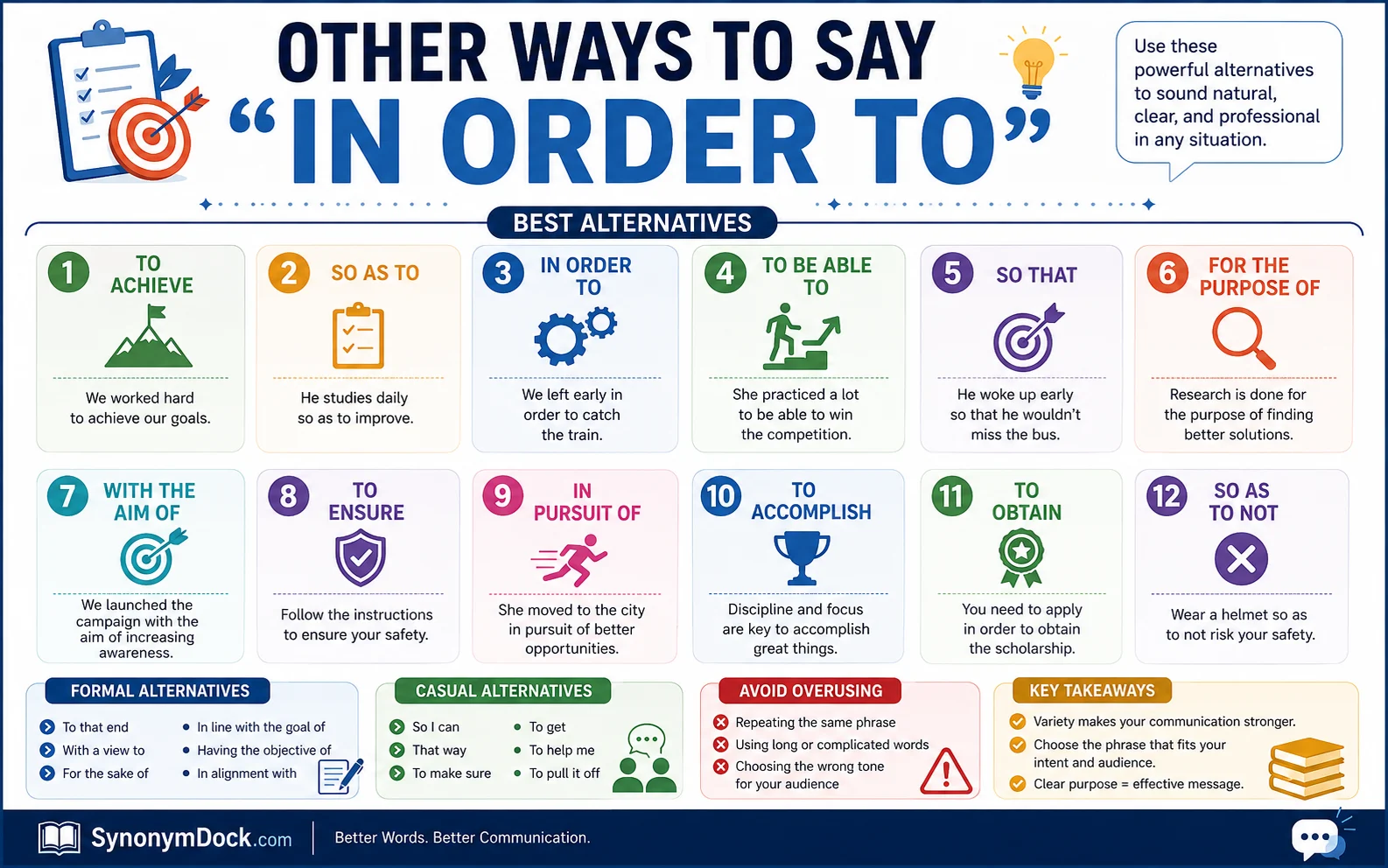
Learn 20+ natural ways to say “in order to”, including formal, professional, and concise alternatives with examples to make your writing clearer and more effective. Native English speakers often choose shorter or more varied expressions to sound more natural.
You have probably used the phrase “in order to” countless times in your emails, essays, and conversations. It is a dependable way to explain why you are doing something. However, using it repeatedly can make your writing feel heavy and overly formal.
This guide will teach you exactly how to replace “in order to” with more precise and fluent alternatives for any situation.
What Does “In Order To” Mean?
“In order to” is a conjunction that expresses the purpose or intention behind an action. It answers the question, “Why?”
- Grammar Rule: It is always followed by the base form of a verb (the infinitive).
- Example: “I am studying hard in order to pass the exam.”
- Example: “In order to avoid traffic, we left early.”
When to Use “In Order To”
While “in order to” is grammatically correct, it is often seen as wordy and overly formal for everyday conversation. You will most commonly find it in:
- Formal Writing: Academic essays, business reports, and legal documents.
- Professional Emails: When clarity and politeness are required.
- Spoken English: To add emphasis, especially when placed at the beginning of a sentence.
Pro Tip:
In most cases, you can simply use the word “to.” It is shorter, more concise, and means the exact same thing when expressing a purpose.
Is “In Order To” Professional or Polite?
Polite? ✔ Yes, it maintains a respectful tone.
Professional? Yes, but it can sound overly formal or bureaucratic if overused.
Natural? Not always. Native speakers often avoid it in casual conversation in favor of simpler phrases.
Key Tip: In professional writing, variety is key. Use “in order to” for emphasis, but rely on alternatives for clarity and flow.
| Situation | Best Phrase |
|---|---|
| Business Email | “To” or “So that” |
| Client Meeting | “With the aim of” |
| Academic Essay | “For the purpose of” |
| Presentation | “To ensure” |
| Workplace Discussion | “In an effort to” |
| Job Interview | “With the intention of” |
| Team Collaboration | “To achieve” |
| Everyday Conversation | “To” or “So that” |
15 Other Ways to Say “In Order To”
Here are the best alternatives, categorized by formality and context.
Formal & Academic Alternatives
These phrases are excellent for essays, formal business reports, and professional presentations.
[1]. So As To
- Meaning: With the intention of; in order to.
- Explanation: This phrase is a direct synonym for “in order to” and carries a slightly more formal tone. It is often used in careful writing to sound professional.
- Example: “We have implemented new safety protocols so as to minimize workplace accidents.”
- Best Use: Formal Reports, Official Statements
- Avoid Using In: Casual Conversations, Text Messages
- Tone: Formal, Careful
- Formality Level: ⭐⭐⭐⭐⭐ Very Formal
- Usage Frequency: Occasional
- CEFR Level: B2
[2]. For the Purpose Of
- Meaning: Used to state the specific reason or objective of an action.
- Explanation: This phrase is highly formal and often found in legal, bureaucratic, or academic contexts. It is usually followed by a gerund (-ing verb).
- Example: “The committee was established for the purpose of reviewing the budget proposal.”
- Best Use: Legal Documents, Academic Writing
- Avoid Using In: Everyday Speech
- Tone: Official, Bureaucratic
- Formality Level: ⭐⭐⭐⭐⭐ Very Formal
- Usage Frequency: Occasional
- CEFR Level: C1
[3]. With the Aim of
- Meaning: Focusing on a specific objective or goal.
- Explanation: This phrase is a professional way to state an objective. It emphasizes the target or goal of an action.
- Example: “The company has restructured its departments with the aim of increasing efficiency.”
- Best Use: Professional Emails, Business Plans
- Avoid Using In: Casual Texting
- Tone: Professional, Goal-Oriented
- Formality Level: ⭐⭐⭐⭐ Formal
- Usage Frequency: Common
- CEFR Level: B2
[4]. With a View To
- Meaning: Having a long-term plan or goal in mind.
- Explanation: This is a polished and professional phrase often used when discussing future plans or ambitions.
- Example: “She is learning French with a view to relocating to Paris next year.”
- Best Use: Long-Term Planning, Career Goals
- Avoid Using In: Quick Instructions
- Tone: Formal, Ambitious
- Formality Level: ⭐⭐⭐⭐ Formal
- Usage Frequency: Occasional
- CEFR Level: C1
[5]. In Order That
- Meaning: So that; for the purpose that.
- Explanation: Unlike “in order to,” this phrase is followed by a clause (a subject and a verb). It is very formal and often used in written English.
- Example: “The instructions were simplified in order that all students could understand.
- Best Use: Very Formal Writing, Legal Texts
- Avoid Using In: Spoken English
- Tone: Formal, Archaic
- Formality Level: ⭐⭐⭐⭐⭐ Very Formal
- Usage Frequency: Rare
- CEFR Level: C1
Native Speaker Tip:
“In order that” is rarely used in everyday conversation. Most native speakers would simply say “so that” because it sounds much more natural and modern.
Professional & Business English Alternatives
These are perfect for emails, meetings, and workplace communication.
[6]. To
- Meaning: The most straightforward and common way to express purpose.
- Explanation: While “in order to” is grammatically correct, the word “to” is shorter and less wordy. It can replace “in order to” in almost any context and is the most natural choice for native speakers.
- Example: “I went to the store to buy some milk.” (Instead of “in order to buy milk”)
- Best Use: All contexts, especially emails and conversations
- Avoid Using In: When you need to emphasize formality
- Tone: Neutral, Natural
- Formality Level: ⭐⭐ Neutral
- Usage Frequency: Very Common
- CEFR Level: A2
[7]. So That
- Meaning: Used to show purpose, often with a different subject in the second clause.
- Explanation: This is a very common and natural connector. It is especially useful when the subject of the purpose is different from the subject of the main clause (e.g., “I left early so that you could have time”).
- Example: “We are leaving early so that we can avoid the traffic.”
- Best Use: Workplace Meetings, Emails
- Avoid Using In: Extremely Formal Writing
- Tone: Natural, Friendly
- Formality Level: ⭐⭐⭐ Neutral
- Usage Frequency: Very Common
- CEFR Level: B1
[8]. To Ensure
- Meaning: To make certain that something happens.
- Explanation: This phrase is commonly used when the purpose involves guaranteeing a specific result. It sounds confident and proactive.
- Example: “We conducted a second review to ensure the accuracy of the data.”
- Best Use: Quality Control, Safety Procedures
- Avoid Using In: Daily Errands
- Tone: Confident, Proactive
- Formality Level: ⭐⭐⭐⭐ Formal
- Usage Frequency: Common
- CEFR Level: B2
[9]. In an Effort To
- Meaning: Highlighting an attempt or hard work being done to achieve something.
- Explanation: This phrase emphasizes the struggle or energy behind the action. It is often used when results are not guaranteed.
- Example: “The team worked overtime in an effort to meet the deadline.”
- Best Use: Project Updates, Performance Reviews
- Avoid Using In: Simple or Routine Actions
- Tone: Purposeful, Hard-Working
- Formality Level: ⭐⭐⭐⭐ Formal
- Usage Frequency: Common
- CEFR Level: B2
[10]. With the Intention of
- Meaning: Explaining the planned purpose behind an action.
- Explanation: This is a great phrase for professional writing when you want to explain someone’s motive or plan.
- Example: “She joined the program with the intention of becoming a manager.”
- Best Use: Job Interviews, Career Plans
- Avoid Using In: Casual Conversation
- Tone: Professional, Planned
- Formality Level: ⭐⭐⭐⭐ Formal
- Usage Frequency: Common
- CEFR Level: B2
Native Speaker Tip:
In modern English, “in order to” is often seen as unnecessary. Using a simple “to” makes you sound more fluent and less like a non-native speaker.
Neutral & Casual Alternatives
Use these in daily conversations, friendly emails, and informal writing.
[11]. For
- Meaning: Used to express the purpose of an action or the use of something.
- Explanation: In informal contexts, you can use “for” to state a purpose, often followed by a gerund (verb + -ing).
- Example: “We use this app for tracking our expenses.”
- Best Use: Daily Conversation, Informal Emails
- Avoid Using In: Formal Essays
- Tone: Casual, Easy
- Formality Level: ⭐ Casual
- Usage Frequency: Very Common
- CEFR Level: A2
[12]. To Achieve
- Meaning: Used to state the successful completion of a goal.
- Explanation: This is a clear and active verb that is excellent for both casual and professional settings when discussing goals.
- Example: “We are working together to achieve our sales targets.”
- Best Use: Goal-Oriented Conversations, Teams
- Avoid Using In: Stative verbs (feel, know)
- Tone: Direct, Motivated
- Formality Level: ⭐⭐⭐ Neutral
- Usage Frequency: Common
- CEFR Level: B1
[13]. In the Hope of
- Meaning: Acting with optimism about a specific result.
- Explanation: This phrase is used when you are doing something, but you are not entirely sure it will work. It conveys a sense of wishful thinking.
- Example: “He applied for the job in the hope of getting a better salary.”
- Best Use: Personal Stories, Emotional Contexts
- Avoid Using In: Legal Contracts
- Tone: Optimistic, Hopeful
- Formality Level: ⭐⭐ Neutral
- Usage Frequency: Occasional
- CEFR Level: B1
[14]. To Make Sure
- Meaning: To check or verify something.
- Explanation: A very common phrase in spoken English used to show you want to guarantee something.
- Example: “She checked the door twice to make sure it was locked.”
- Best Use: Daily Errands, Instructions
- Avoid Using In: Formal Business Emails
- Tone: Natural, Reassuring
- Formality Level: ⭐ Casual
- Usage Frequency: Very Common
- CEFR Level: A2
[15]. With the Goal of
- Meaning: Expressing a specific target or objective.
- Explanation: Similar to “with the aim of,” but this sounds slightly more driven and motivational.
- Example: “She practices every day with the goal of winning the competition.”
- Best Use: Sports, Personal Development
- Avoid Using In: Formal Academia
- Tone: Motivational, Strong
- Formality Level: ⭐⭐⭐ Neutral
- Usage Frequency: Common
- CEFR Level: B1
Common Mistakes
Mistake #1: Using the Wrong Verb Form
- Incorrect: I need to study in order to passing the exam.
- Correct: I need to study in order to pass the exam.
- Why: “In order to” must always be followed by the base form of the verb (the infinitive without “to”).
Mistake #2: Using it with Stative Verbs
- Incorrect: I read the book in order to know the answer.
- Correct: I read the book so as to know the answer. OR I read the book to find out the answer.
- Why: Before stative verbs (like know, seem, have), native speakers often prefer “so as to.”
Mistake #3: Wordiness
- Incorrect: I went to the kitchen in order to get water.
- Correct: I went to the kitchen to get water.
- Why: While not grammatically wrong, “in order to” is unnecessary and sounds too formal for a simple action.
Mistake #4: Incorrect Negation
- Incorrect: I left early in order to not be late.
- Correct: I left early in order not to be late.
- Why: The standard formal structure for a negative purpose is “in order not to” + verb.
Mistake #5: Using “For + Verb” Incorrectly
- Incorrect: I am here for help you.
- Correct: I am here to help you. OR I am here for helping you.
- Why: After “for,” use a noun or a gerund (-ing), not a bare infinitive.
Which One Should You Use?
Best Overall:
“To” is the best choice for 90% of situations because it is clear, concise, and natural.
Best Professional:
“So that” is excellent for showing collaboration and clarity in the workplace.
Best Academic:
“With the aim of” provides a strong, goal-oriented focus.
Best Business Email:
“To ensure” sounds proactive and professional.
Best Everyday Conversation:
“To” is the most common and fluent way to speak.
Most Natural:
“To” is what native speakers use most often.
Scenario Practice
Scenario 1: Business Meeting
You are explaining why you want to hire a new employee.
- Question: Which phrase sounds most professional?
- Answer: “We need to hire a new developer to ensure we can handle the upcoming project load.” This sounds proactive and strategic.
Scenario 2: Job Interview
You are explaining why you want the job.
- Question: Which phrase is most appropriate?
- Answer: “I am applying for this role with the aim of developing my leadership skills.” This sounds ambitious and goal-oriented.
Scenario 3: Academic Essay
You are explaining the methodology of a study.
- Question: Which is the most formal choice?
- Answer: “The survey was conducted for the purpose of gathering demographic data.” This is formal and precise.
Frequently Asked Questions
What is the most formal way to say “in order to”?
The most formal alternatives are “so as to” and “for the purpose of.” “So as to” is a direct replacement, while “for the purpose of” is often followed by a gerund and is common in legal or academic writing.
Which phrase is best for professional emails?
The best options are simply “to” or “so that.” “To” makes your writing concise, while “so that” is great for showing cause and effect when the subject changes.
What is the difference between “to” and “in order to”?
“To” is shorter and less formal, used for all contexts. “In order to” is more formal and wordy. They are interchangeable when expressing purpose, but you cannot replace “to” with “in order to” when “to” functions as a preposition of movement (e.g., “I went to the store”).
Which alternative sounds most natural?
“To” sounds the most natural and is the number one choice for native speakers. For example, “I came here to help you” sounds much more natural than “I came here in order to help you.”
Can I use these expressions in business meetings?
Yes, you should. Using “in order to” repeatedly can sound repetitive. Replacing it with phrases like “to ensure,” “so that,” or “with the aim of” will make you sound more articulate and professional.
Conclusion
Learning to replace “in order to” is a simple but powerful way to upgrade your English. By choosing the right alternative, you can adjust your tone, sound more like a native speaker, and keep your writing fresh.
Start small. The next time you are about to write “in order to,” try using “to” instead. You will instantly notice how much smoother your sentences sound. Practice these alternatives in your next email or conversation, and you will build confidence in no time.

1 thought on “Other Ways to Say “In Order To” 21+ Examples For 2026”