
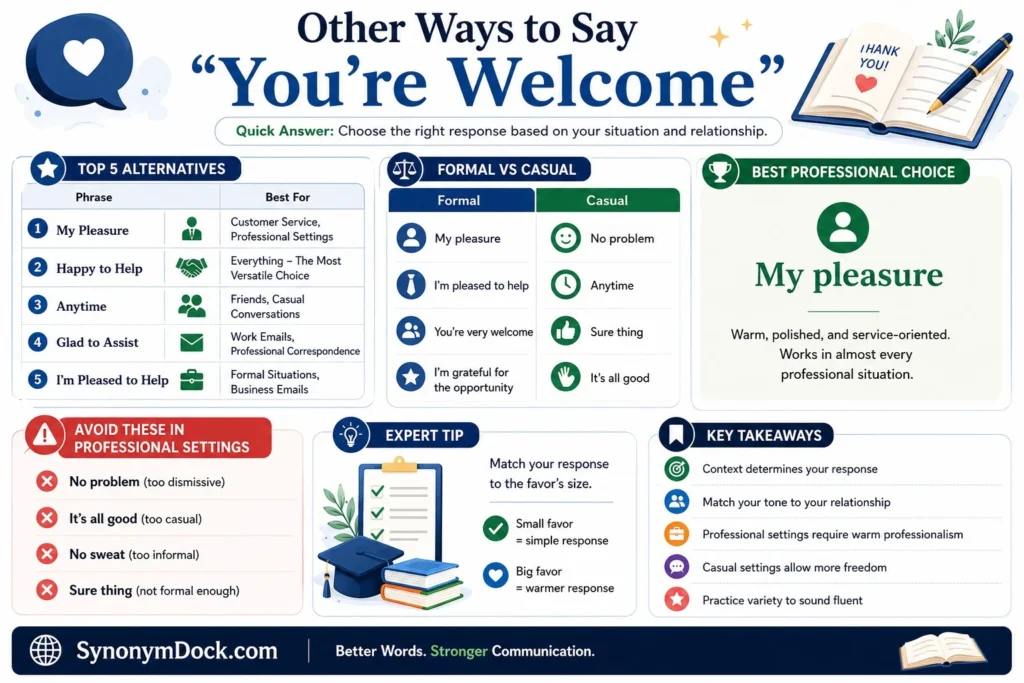
“You’re welcome” is the standard polite response to “thank you.” While it works in most situations, native English speakers use many alternatives depending on the context. The most useful alternatives include: my pleasure, happy to help, anytime, I’m glad to assist, and don’t mention it.
“You’re welcome” is a natural and polite response to “thank you,” but using the same phrase in every situation can make your communication feel repetitive. English offers many alternatives, and choosing the right one can help you sound more natural, confident, and socially aware.
If you’re searching for other ways to say you’re welcome, ways of saying you’re welcome, or another way of saying you’re welcome, the best choice depends on the setting, your relationship with the other person, and the tone you want to convey. A casual response such as “No problem” may work well with a friend, while “My pleasure” or “I’m happy to help” can sound more polished in professional communication.
Learning different ways to say you’re welcome is also useful for avoiding repetition and making conversations feel more genuine. Common alternatives include “You’re very welcome,” “My pleasure,” “Anytime,” “Happy to help,” “Of course,” and “No worries.” Each expression carries a slightly different level of warmth, formality, or friendliness.
You may also see searches such as you’re welcome synonym, you’re welcome synonyms, you’re welcome other words, you’re welcome synonym, another way to say you’re welcome, and another word for you’re welcome. Strictly speaking, “you’re welcome” is a phrase rather than a single synonym, so the most useful alternatives are expressions that perform the same conversational function while matching the intended tone.
From a communication perspective, context matters. A phrase that sounds perfectly natural among friends may be too casual for a client or workplace email. Likewise, an overly formal response can feel distant in a relaxed conversation. Understanding these differences can help you choose language that is both grammatically appropriate and socially effective.
In this guide, you’ll find 20+ practical alternatives to “you’re welcome”, organized by tone and situation. We’ll cover casual responses, professional options, warm and friendly expressions, formal alternatives, examples in texts and emails, and guidance on when certain phrases are best avoided. Whether you’re replying to a colleague, client, friend, family member, or stranger, you’ll find clear, practical choices for saying “you’re welcome” in a more natural and context-appropriate way.
Quick Categories
Formal Alternatives
- My pleasure – Warm and professional
- I’m delighted to help – Very formal, courteous
- I’m grateful for the opportunity – Expresses appreciation
- It was my honor – Respectful and polished
- I’m at your service – Traditional, professional
Professional Alternatives
- Happy to help – Friendly and work-appropriate
- Glad to assist – Professional and approachable
- I’m glad I could help – Warm and sincere
- I’m pleased to help – Polite and professional
- It’s always a pleasure – Great for repeat clients
Business Email Alternatives
- You’re very welcome – Formal yet personal
- It was my pleasure – Common in email closings
- I’m glad I could be of assistance – Professional and helpful
- Please don’t hesitate to reach out – Opens future communication
- Happy to be of service – Customer service standard
Academic Alternatives
- I’m happy to contribute – Collaborative tone
- Glad to be part of this – Team-oriented
- I’m pleased to support your work – Supportive
- It was a pleasure collaborating – Academic partnership
- I appreciate your acknowledgment – Mutual respect
Casual Alternatives
- Anytime – Friendly and relaxed
- No problem – Very common, informal
- Sure thing – Confident and casual
- You got it – Reassuring and friendly
- No worries – Relaxed, laid-back
Informal Expressions
- Don’t mention it – Humble and dismissive
- It’s all good – Very casual, modern
- Not a problem at all – Emphatic and friendly
- Think nothing of it – Old-fashioned but warm
- No sweat – Extremely informal, friendly
Pro Tip
Choose casual alternatives for friends and family. Use professional or formal options in workplaces, emails, and with people you don’t know well. When in doubt, “happy to help” works in almost every situation.
“The right response shows you value the person, not just their thanks.”
Common Mistakes
1: “You’re welcome” sounding dismissive
Why it’s incorrect: In some situations, a short “you’re welcome” can sound like you’re brushing someone off.
Correct version: Add warmth or enthusiasm to your response.
Example: Instead of “You’re welcome,” say “Of course, I’m happy to help!
2: Using “no problem” with older people or in formal settings
Why it’s incorrect: Some people interpret “no problem” as implying there was a problem. Older generations often prefer traditional responses.
Correct version: Use “my pleasure” or “happy to help.”
Example: A senior colleague thanks you. Say “My pleasure” instead of “No problem.”
3: Overusing “anytime”
Why it’s incorrect: While friendly, “anytime” can sound dismissive in serious situations.
Correct version: Add context or warmth.
Example: Instead of “Anytime,” say “Anytime. I’m always here if you need anything.”
4: Replying too informally in professional emails
Why it’s incorrect: Professional emails require respectful, polished language.
Correct version: Use “I’m glad I could assist” or “It was my pleasure.”
Example: Instead of “No worries” in a work email, say “I’m happy I could help with this.
5: Saying “no problem” when you solved a major issue
Why it’s incorrect: It downplays your effort and contribution.
Correct version: Use a phrase that acknowledges your work.
Example: Instead of “No problem,” say “I’m glad I could resolve that for you.”
What Does “You’re Welcome” Mean?
Definition: A polite response to someone who has thanked you for something. It acknowledges their gratitude while showing you were happy to help.
Simple Explanation: When someone says “thank you,” “you’re welcome” tells them you accept their thanks and that helping them didn’t bother you.
Grammar Note: The phrase is a contraction of “you are welcome.” “Welcome” here means “gladly received” – you’re telling the person their thanks is gladly received.
Example Sentence: “Thank you for helping me with the report.” “You’re welcome. Let me know if you need anything else.”
When to Use “You’re Welcome”
“You’re welcome” is appropriate in many situations, but it’s most natural in:
- Casual conversations with friends and family
- Everyday interactions with strangers
- Workplace settings that aren’t overly formal
- Service environments like restaurants and shops
- Written communication in emails and messages
Use it when:
- Someone thanks you and you want a simple response
- The situation doesn’t require formality
- You’re unsure which alternative to choose (it’s always safe)
Avoid it when:
- You’ve gone above and beyond (your response should reflect your effort)
- You want to sound more professional in emails
- You’re in very formal situations like court or diplomatic events
- You want to show extra warmth or enthusiasm
“Context determines whether ‘you’re welcome’ sounds natural or awkward.”
Is It Professional or Polite?
| Aspect | Rating | Explanation |
|---|---|---|
| Polite? | ✔ Yes | It acknowledges thanks respectfully |
| Professional? | Depends | Works in most workplaces but less polished than alternatives |
| Formal? | Sometimes | Neutral by itself; tone depends on delivery |
| Natural? | Yes | The most common response in English |
| Warm? | Neutral | Sounds pleasant but not particularly warm |
Example in a professional setting: “Thank you for reviewing my proposal.” “You’re welcome. I was happy to look at it.”
Explanation: “You’re welcome” is never wrong, but adding warmth (“I was happy to”) makes it sound more professional and engaged.
Pros and Cons
Pros
- Widely understood by all English speakers
- Appropriate in almost any situation
- Simple and easy to remember
- Never sounds offensive or rude
- Works in spoken and written English
- Safe choice when you’re unsure
Cons
- Can sound robotic if overused
- Doesn’t convey enthusiasm or warmth
- May seem dismissive if delivered flatly
- Lacks variety in professional contexts
- Not memorable in personal interactions
- Can sound like a reflex rather than genuine gratitude
Transition to the Main List
Now that you understand the basics, let’s explore 15 alternatives you can use immediately. Each option will help you:
- Build better vocabulary for everyday situations
- Sound more professional in emails and meetings
- Speak more naturally like native English speakers
- Choose the right tone for every situation
Remember: The best phrase depends on your relationship with the person, the formality of the situation, and what you’re responding to.
Expert Tip Box
Expert Tip:
Native speakers choose responses based on three factors: the favor’s size, their relationship with the person, and the setting. Someone who helped you move a couch deserves a warmer response than someone who held a door open. Match your response to the effort involved.
15 Alternatives to Say “You’re Welcome”
[1]. My Pleasure
Meaning: Expresses that helping was genuinely enjoyable.
Explanation: This phrase conveys that you didn’t just help – you truly enjoyed doing it. It’s warmer than “you’re welcome” and works beautifully in customer service, professional settings, and personal interactions. Native speakers use it frequently when they want to sound gracious and enthusiastic.
Example Sentence: “Thanks for staying late to finish the presentation.” “My pleasure. The project is really exciting.”
Best Use: Customer Service, Professional Settings, Personal Favors
Avoid Using In: Very Casual Conversations (sounds too formal)
Tone: Warm, Professional, Gracious
Formality Level: ⭐⭐⭐⭐ Formal
Usage Frequency: Very Common
CEFR Level: B1
Common Collocations:
- my pleasure entirely
- it was my pleasure
- truly my pleasure
- always my pleasure
- my absolute pleasure
Context Variability:
- Spoken: “My pleasure, anytime you need help.”
- Professional: “It was my pleasure working with your team.”
- Casual: “My pleasure! I enjoyed it.”
[2]. Happy to Help
Meaning: Shows you were glad to assist.
Explanation: This is one of the most practical alternatives because it works in almost every situation. It’s friendly, professional, and doesn’t sound forced. Customer service representatives use it frequently, but it’s equally natural between colleagues, friends, and acquaintances. The phrase suggests you care about the person’s needs.
Example Sentence: “Thank you for explaining the new system.” “Happy to help. It takes some getting used to, doesn’t it?”
Best Use: Business Emails, Workplace Chat, Customer Service, Daily Conversation
Avoid Using In: Very Formal Legal Documents (too informal)
Tone: Friendly, Professional, Approachable
Formality Level: ⭐⭐⭐ Neutral
Usage Frequency: Very Common
CEFR Level: A2
Common Collocations:
- always happy to help
- very happy to help
- happy to assist
- happy to be of service
- happy to help out
Context Variability:
- Spoken: “Happy to help, let me know if you need more.”
- Professional: “I’m happy to help with the quarterly report.”
- Casual: “Happy to help anytime.”
[3]. Anytime
Meaning: You’re always available to help.
Explanation: This short, friendly response tells someone you’d help them again without hesitation. It’s perfect for casual relationships, friends, and coworkers you work closely with. Native speakers love “anytime” because it’s quick, positive, and implies ongoing willingness to support someone.
Example Sentence: “Thanks for covering my shift.” “Anytime. You’ve done the same for me before.”
Best Use: Friends, Close Colleagues, Casual Conversation
Avoid Using In: Formal Business Letters, Client Emails (too casual)
Tone: Friendly, Casual, Reassuring
Formality Level: ⭐⭐ Casual
Usage Frequency: Very Common
CEFR Level: A2
Common Collocations:
- anytime at all
- you’re welcome anytime
- feel free anytime
- anytime, really
- just let me know anytime
Context Variability:
- Spoken: “Anytime, just text me if you need more help.”
- Professional: “Anytime, I’m happy to assist.”
- Casual: “Anytime, dude. No worries.”
[4]. Glad to Assist
Meaning: You’re pleased to have provided help.
Explanation: “Glad to assist” sounds professional and capable. It’s particularly effective in workplace emails and formal settings because it combines warmth with competence. You’re not just helping – you’re showing satisfaction in your ability to help. This phrase works well when offering ongoing support.
Example Sentence: “I appreciate your guidance on this project.” “Glad to assist. Your questions were very thoughtful.”
Best Use: Workplace Correspondence, Professional Emails, Client Communication
Avoid Using In: Personal Text Messages (sounds stiff)
Tone: Professional, Competent, Polite
Formality Level: ⭐⭐⭐⭐ Formal
Usage Frequency: Common
CEFR Level: B1
Common Collocations:
- glad to assist you
- glad to be of assistance
- very glad to assist
- always glad to assist
- glad to assist with that
Context Variability:
- Spoken: “Glad to assist, let me know how it goes.”
- Professional: “I’m glad to assist your department.”
- Casual: “Glad to assist, happy to help.”
[5]. I’m Grateful for the Opportunity
Meaning: You appreciate the chance to help.
Explanation: This response is much more formal and humble. It turns the thanks back on the person thanking you by expressing your own gratitude. While it sounds quite formal, it’s genuine and memorable. Use it when someone has trusted you with an important task or offered you a chance to demonstrate your skills.
Example Sentence: “Thank you for organizing the training.” “I’m grateful for the opportunity. I learned a lot from everyone.”
Best Use: Job Interviews, Formal Events, Important Projects
Avoid Using In: Everyday Conversations (sounds too heavy)
Tone: Humble, Formal, Appreciative
Formality Level: ⭐⭐⭐⭐⭐ Very Formal
Usage Frequency: Occasional
CEFR Level: C1
Common Collocations:
- truly grateful for the opportunity
- deeply grateful for the opportunity
- grateful for the chance
- grateful for this opportunity
- genuinely grateful for the opportunity
Context Variability:
- Spoken: “I’m grateful for the opportunity to work with you.”
- Professional: “I’m deeply grateful for this opportunity.”
- Formal: “I am truly grateful for the opportunity.”
“Your response to thanks reveals more about you than the thanks itself.”
[6]. Don’t Mention It
Meaning: The favor wasn’t worth mentioning or thanks isn’t necessary.
Explanation: This humble response downplays your help. It’s similar to saying “it was nothing” but sounds more natural and idiomatic. Native speakers often use it when they don’t want to seem like they’re seeking credit or attention. It’s appropriate in both casual and professional settings, though it’s more common in British English.
Example Sentence: “Thank you for proofreading my article.” “Don’t mention it. I enjoyed reading it anyway.”
Best Use: Friends, Colleagues, Casual Professional Situations
Avoid Using In: Formal Business Settings (might sound dismissive)
Tone: Humble, Dismissive (in a positive way), Warm
Formality Level: ⭐⭐⭐ Neutral
Usage Frequency: Common
CEFR Level: B1
Common Collocations:
- please don’t mention it
- don’t even mention it
- oh, don’t mention it
- don’t mention it at all
- honestly, don’t mention it
Context Variability:
- Spoken: “Don’t mention it, it was nothing.”
- Professional: “Don’t mention it. Happy to collaborate.”
- Casual: “Don’t mention it, forget about it!”
[7]. I’m Glad I Could Help
Meaning: You’re pleased you were able to provide assistance.
Explanation: This response emphasizes satisfaction and competence. By saying you’re glad you could help, you’re subtly reminding the person you had the ability and willingness to assist. It’s slightly more thoughtful than the shorter “glad to help” and sounds warmer and more genuine.
Example Sentence: “Thanks for fixing the printer.” “I’m glad I could help. It wasn’t as complicated as it looked.”
Best Use: Workplaces, Personal Favors, After Solving Problems
Avoid Using In: Very Quick Interactions (sounds too elaborate)
Tone: Warm, Satisfied, Genuine
Formality Level: ⭐⭐⭐ Neutral
Usage Frequency: Very Common
CEFR Level: B1
Common Collocations:
- glad I could be of help
- glad I could assist
- glad I could make a difference
- glad I could contribute
- really glad I could help
Context Variability:
- Spoken: “I’m glad I could help with that issue.”
- Professional: “I’m glad I could help the team succeed.”
- Casual: “Glad I could help, no problem.”
[8]. No Problem
Meaning: You didn’t have any difficulty helping.
Explanation: “No problem” has become incredibly common, especially in American English. It’s friendly, short, and suggests the favor didn’t inconvenience you. However, be careful in formal situations – some older people feel it implies there could have been a problem. It’s best reserved for casual interactions and informal workplaces.
Example Sentence: “Thanks for waiting for me.” “No problem, I was enjoying the view anyway.”
Best Use: Friends, Casual Workplace Chat, Everyday Interactions
Avoid Using In: Formal Emails, With Senior Colleagues, Customer Complaints
Tone: Casual, Friendly, Relaxed
Formality Level: ⭐⭐ Casual
Usage Frequency: Very Common
CEFR Level: A2
Common Collocations:
- no problem at all
- no problem whatsoever
- absolutely no problem
- no problem, happy to help
- no problem, anytime
Context Variability:
- Spoken: “No problem, happy to do it.”
- Professional: “No problem at all, I was happy to help.”
- Casual: “No problem, don’t worry about it.”
[9]. I’m Pleased to Help
Meaning: Helping you made me feel positive.
Explanation: This phrase is similar to “happy to help” but sounds slightly more formal and refined. It conveys genuine pleasure in assisting someone. It’s particularly effective in emails and professional correspondence because it’s both polite and warm, without being overly emotional.
Example Sentence: “Thank you for attending the meeting.” “I’m pleased to help. The discussion was very productive.”
Best Use: Business Emails, Formal Correspondence, Professional Settings
Avoid Using In: Text Messages (sounds too formal)
Tone: Professional, Warm, Refined
Formality Level: ⭐⭐⭐⭐ Formal
Usage Frequency: Common
CEFR Level: B1
Common Collocations:
- very pleased to help
- truly pleased to help
- pleased to assist
- pleased to be of assistance
- pleased to have helped
Context Variability:
- Spoken: “I’m pleased to help, it’s been enjoyable.”
- Professional: “I’m very pleased to help your organization.”
- Formal: “I’m truly pleased to help with this matter.”
“Saying you’re ‘pleased to help’ shows you connect your success to their success.”
[10]. Sure Thing
Meaning: A confident, positive confirmation that you’re happy to help.
Explanation: “Sure thing” is enthusiastic and reassuring. It’s short, punchy, and expresses both willingness and confidence. It’s very common in American English, especially in service settings and between colleagues who have a good relationship. The phrase suggests that helping is natural and not a burden.
Example Sentence: “Can you send me those files?” “Sure thing, they’re in your inbox now.”
Best Use: Customer Service, Casual Workplace, Friends, Quick Interactions
Avoid Using In: Formal Business Letters, Academic Settings
Tone: Enthusiastic, Confident, Friendly
Formality Level: ⭐⭐ Casual
Usage Frequency: Common
CEFR Level: B1
Common Collocations:
- sure thing, no problem
- sure thing, happy to
- yeah, sure thing
- sure thing, absolutely
- sure thing, anytime
Context Variability:
- Spoken: “Sure thing, I’ll get right on it.”
- Professional: “Sure thing, glad to help out.”
- Casual: “Sure thing, just ask whenever.”
[11]. It Was My Honor
Meaning: You felt privileged to help.
Explanation: This very formal response communicates deep respect and gratitude. Use it when you’ve done something significant for someone you respect or in situations that carry emotional weight. It’s not for everyday use but can be powerful when delivered authentically.
Example Sentence: “Thank you for being our keynote speaker.” “It was my honor. I was thrilled to be invited.”
Best Use: Award Ceremonies, Weddings, Formal Events, Special Recognition
Avoid Using In: Daily Conversations, Regular Workplaces
Tone: Formal, Respectful, Humble
Formality Level: ⭐⭐⭐⭐⭐ Very Formal
Usage Frequency: Occasional
CEFR Level: C1
Common Collocations:
- it was truly my honor
- it was such an honor
- it was my distinct honor
- it was my honor and privilege
- it was a great honor
Context Variability:
- Spoken: “It was my honor to be part of this.”
- Professional: “It was my honor to contribute to the project.”
- Formal: “It was truly my honor to meet you.”
[12]. Not a Problem at All
Meaning: Emphatically, there was no difficulty.
Explanation: This is a stronger version of “no problem.” Adding “at all” emphasizes how effortless the help was. It’s still casual, but the extra words make it sound more genuine and less dismissive. Native speakers use this when they want to reassure someone they’ve truly inconvenienced them.
Example Sentence: “I’m so sorry for the trouble.” “Not a problem at all. I had time this afternoon.”
Best Use: Customer Service, Reassuring Someone, After Someone Apologizes
Avoid Using In: Very Formal Settings
Tone: Friendly, Reassuring, Casual
Formality Level: ⭐⭐ Casual
Usage Frequency: Common
CEFR Level: A2
Common Collocations:
- not a problem at all, really
- it’s not a problem at all
- absolutely not a problem at all
- not a problem at all, happy to
- no, not a problem at all
Context Variability:
- Spoken: “Not a problem at all, I was free anyway.”
- Professional: “Not a problem at all, I’m happy to help.”
- Casual: “Not a problem at all, relax.”
[13]. You’re Very Welcome
Meaning: A more emphatic version of “you’re welcome.”
Explanation: Adding “very” to “you’re welcome” makes it sound warmer and more personal. This phrase is particularly useful in emails, where tone can be harder to convey. It’s professional, polite, and shows more engagement than the simple version.
Example Sentence: “Thank you for the wonderful presentation.” “You’re very welcome. I enjoyed preparing it.”
Best Use: Business Emails, Formal Correspondence, Professional Settings
Avoid Using In: Text Messages (sounds too formal)
Tone: Warm, Professional, Polite
Formality Level: ⭐⭐⭐⭐ Formal
Usage Frequency: Common
CEFR Level: A2
Common Collocations:
- you’re very welcome indeed
- you’re very welcome, anytime
- you’re very welcome, I’m glad
- you’re most welcome
- you’re more than welcome
Context Variability:
- Spoken: “You’re very welcome, I’m happy to help.”
- Professional: “You’re very welcome, please contact me again.”
- Casual: “You’re very welcome, don’t worry.”
[14]. I’m at Your Service
Meaning: I’m available to help you whenever needed.
Explanation: This traditional, formal phrase comes from service industries but has broader applications. While it can sound old-fashioned, it works well in customer service, hospitality, and when offering ongoing professional support. Use it when you want to express dedication and availability.
Example Sentence: “Thank you for your excellent assistance.” “I’m at your service. Please call me if you need anything else.”
Best Use: Luxury Services, Professional Services, Customer Service
Avoid Using In: Casual Settings, Friends (sounds too formal)
Tone: Formal, Humble, Dedicated
Formality Level: ⭐⭐⭐⭐⭐ Very Formal
Usage Frequency: Occasional
CEFR Level: B2
Common Collocations:
- always at your service
- here at your service
- ready and at your service
- forever at your service
- at your service, sir/madam
Context Variability:
- Spoken: “I’m at your service, just let me know.”
- Professional: “We’re at your service 24/7.”
- Formal: “I remain at your service should you need me.”
“In business, how you respond to thanks often matters more than how you asked.”
[15]. It’s All Good
Meaning: Everything is fine, no thanks are needed.
Explanation: This modern, informal phrase is popular with younger native speakers. It’s friendly, relaxed, and dismissive in a positive way. While “it’s all good” is extremely natural in casual settings, it’s too informal for most professional situations. Save this one for friends and family.
Example Sentence: “I’m so sorry I’m late.” “It’s all good. We haven’t started yet anyway.”
Best Use: Friends, Casual Situations, Text Messages
Avoid Using In: Any Professional Setting
Tone: Very Casual, Friendly, Modern
Formality Level: ⭐ Very Casual
Usage Frequency: Very Common
CEFR Level: A2
Common Collocations:
- it’s all good, no worries
- hey, it’s all good
- it’s all good, don’t stress
- it’s all good, really
- it’s all good, forget about it
Context Variability:
- Spoken: “It’s all good, I wasn’t waiting long.”
- Casual: “It’s all good, happens to everyone.”
- Informal: “It’s all good, don’t worry about it.”
Native Speaker Tip
Many native speakers avoid “you’re welcome” in casual conversations because it can sound stiff. Instead, they use “no problem,” “anytime,” or “sure thing.” However, in professional settings and with older generations, traditional responses like “you’re welcome” or “my pleasure” are often preferred.
Expert Insight
In professional communication, your response to thanks sets the tone for future interactions. Warm, appreciative responses like “I’m glad I could help” build stronger working relationships than dismissive ones like “no problem.” Choose responses that acknowledge the other person’s appreciation while showing you value the relationship.
Top 10 Alternatives Compared
| Phrase | Tone | Formality | Best Use | Frequency |
|---|---|---|---|---|
| My Pleasure | Warm, Professional | Formal | Customer Service | Very Common |
| Happy to Help | Friendly, Approachable | Neutral | Everything | Very Common |
| Anytime | Casual, Reassuring | Casual | Friends | Very Common |
| Glad to Assist | Professional | Formal | Work Emails | Common |
| I’m Grateful for the Opportunity | Humble | Very Formal | Important Events | Occasional |
| Don’t Mention It | Humble, Warm | Neutral | Friends, Colleagues | Common |
| I’m Glad I Could Help | Warm, Genuine | Neutral | Problem-Solving | Common |
| No Problem | Casual | Casual | Everyday | Very Common |
| I’m Pleased to Help | Professional | Formal | Business Emails | Common |
| Sure Thing | Enthusiastic | Casual | Customer Service | Common |
Which One Should You Use?
Best Overall: Happy to help – It works in almost every situation.
Best Professional: My pleasure – Warm, polished, and service-oriented.
Best Academic: I’m pleased to support your work – Collaborative and respectful.
Best Business Email: You’re very welcome – Professional and personal.
Best Everyday Conversation: Anytime – Friendly and natural.
Most Natural: Happy to help – Native speakers use it constantly.
Most Polite: I’m pleased to help – Shows genuine appreciation.
Commonly Confused Phrases
“No problem” vs “Don’t mention it”
These phrases are similar but used differently. “No problem” focuses on how easy the task was for you. “Don’t mention it” focuses on not needing thanks. Both are casual, but “don’t mention it” sounds more polite to older speakers.
“My pleasure” vs “It was my honor”
“My pleasure” is about enjoying helping. “It was my honor” is about feeling privileged to help. Use “my pleasure” for everyday professional situations. Use “it was my honor” for significant or emotionally meaningful moments.
“Glad to assist” vs “Happy to help”
“Glad to assist” sounds more formal and professional. “Happy to help” is warmer and more approachable. In emails, “glad to assist” might be better. In conversation, “happy to help” sounds more natural.
Scenario Practice
Scenario 1: A colleague thanks you for covering their meeting.
Which phrase should you use?
Answer: “My pleasure” or “Happy to help.” These are professional and warm, showing you didn’t mind covering for them.
Scenario 2: A close friend thanks you for driving them to the airport at 5 AM.
Which phrase should you use?
Answer: “Anytime” or “No problem.” These show you’re happy to help, and your casual tone matches your friendship.
Scenario 3: A client thanks you for an excellent presentation.
Which phrase should you use?
Answer: “I’m pleased to help” or “You’re very welcome.” These sound professional and grateful, helping maintain a strong client relationship.
Scenario 4: An older neighbor thanks you for carrying their groceries.
Which phrase should you use?
Answer: “My pleasure” or “Don’t mention it.” Older people often prefer traditional responses, and these phrases show respect and humility.
Scenario 5: A CEO thanks you for a successful project.
Which phrase should you use?
Answer: “I’m glad I could contribute” or “It was my pleasure.” These acknowledge your role while staying professional and respectful.
Mini Quiz
1. Which alternative is BEST for a formal business email?
A) No problem
B) Anytime
C) You’re very welcome
D) It’s all good
2. Which phrase is TOO casual for a client meeting?
A) My pleasure
B) Happy to help
C) Sure thing
D) I’m pleased to help
3. What does “Don’t mention it” suggest?
A) You don’t want to talk about the favor
B) The favor wasn’t worth mentioning
C) You want to be thanked again
D) You’re angry about helping
4. Which is the MOST formal alternative?
A) I’m grateful for the opportunity
B) No problem
C) Anytime
D) Happy to help
5. Which phrase works in EVERY situation?
A) It’s all good
B) Happy to help
C) No sweat
D) Don’t mention it
Answer Key
1. C – “You’re very welcome” is professional and formal, perfect for business emails.
2. C – “Sure thing” is too casual for important client meetings.
3. B – “Don’t mention it” means the favor wasn’t important enough to need thanks.
4. A – “I’m grateful for the opportunity” is the most formal and humble option.
5. B – “Happy to help” works in almost every professional and casual situation.
FAQs
What is the most professional way to say “you’re welcome”?
My pleasure” or “I’m pleased to help” are the most professional alternatives. They sound warm without being too casual, and they show genuine appreciation for the opportunity to assist. Both work well in emails, meetings, and professional correspondence.
Can I say “no problem” in a business email?
It depends. “No problem” is usually too casual for formal business emails. Use “happy to help,” “my pleasure,” or “I’m glad I could assist” instead. These sound more professional while remaining approachable and helpful.
What is the difference between “my pleasure” and “happy to help”?
“My pleasure” suggests you truly enjoyed helping and found it fulfilling. “Happy to help” suggests you were willing and able to assist. Both are professional, but “my pleasure” sounds slightly warmer and more personal. “Happy to help” is more versatile.
Which alternative sounds most natural to native speakers?
“Happy to help” sounds the most natural in most situations. Native speakers also frequently use “no problem” and “anytime” in casual settings. The most natural choice depends on your relationship with the person and the formality of the situation.
Is “you’re welcome” still acceptable?
Absolutely. “You’re welcome” remains completely acceptable and appropriate in almost every situation. It’s the standard, safe response. However, using variety in your responses shows better English fluency and emotional intelligence.
Conclusion
Learning different ways to say “you’re welcome” transforms your English from basic to brilliant. You’ll sound more fluent, more professional, and more emotionally aware in every conversation.
Start practicing these alternatives in your daily interactions. Try using “my pleasure” in your next work email. Say “anytime” to a friend who thanks you. Gradually, these phrases will become natural. Your English will feel more confident, and people will notice your communication skills have improved.
