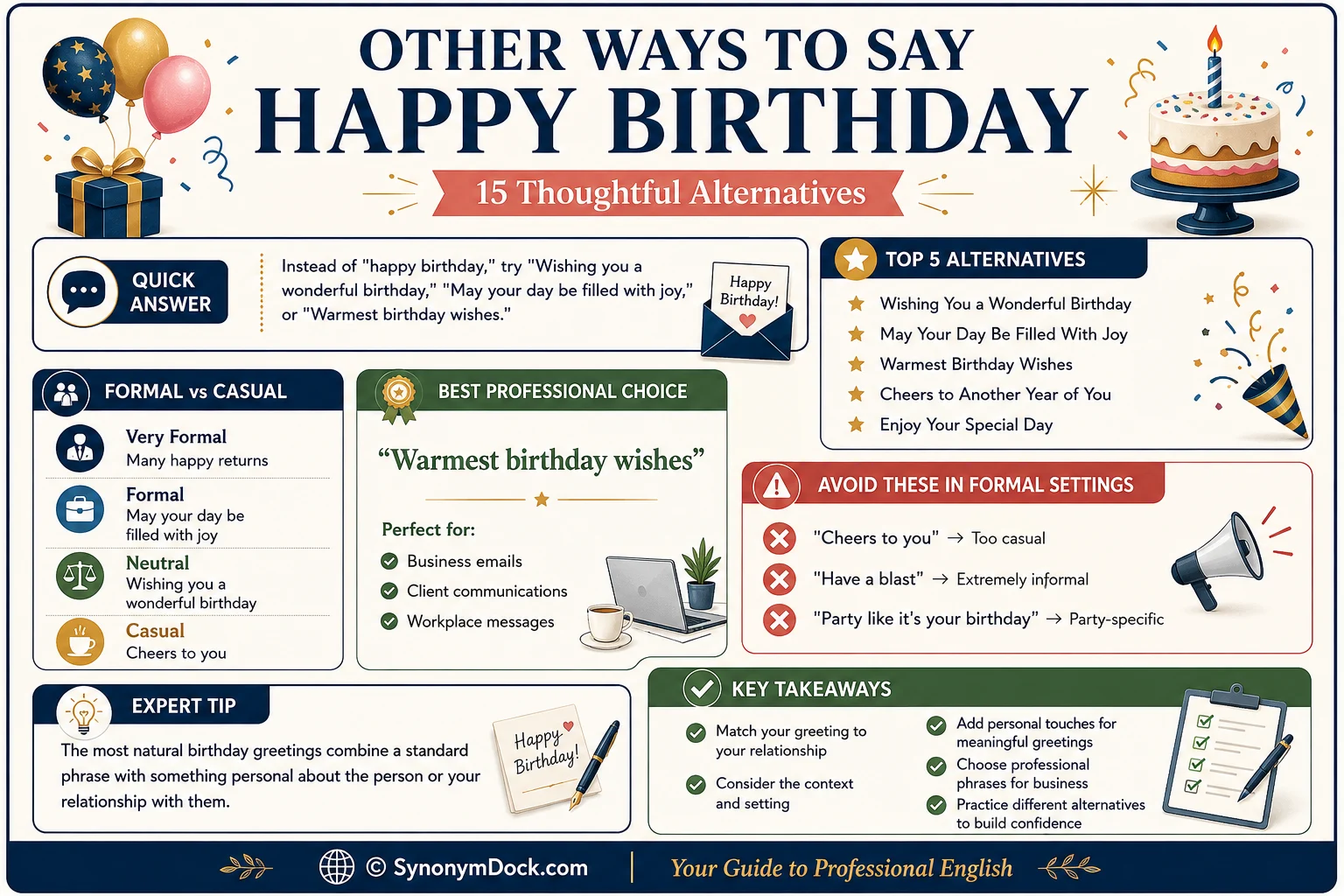
What are other ways to say happy birthday? Instead of the standard phrase, try “Wishing you a wonderful birthday,” “Happy celebration day,” “May your day be filled with joy,” “Cheers to another year of you,” or “Warmest birthday wishes.” These alternatives work for cards, emails, social media, and in-person greetings while matching different tones and relationships.
Top 5 Alternatives:
Wishing you a wonderful birthday, Happy celebration day, May your day be filled with joy, Cheers to another year of you, Warmest birthday wishes.
Everyone knows how to say happy birthday. That phrase works perfectly for most situations. But sometimes you want something different. Maybe you need a more professional tone for a colleague. Perhaps you want something warmer for a close friend. Or you might need a formal expression for a client.
Learning other ways to say happy birthday helps you communicate more effectively. You can match your words to your audience. You can sound more thoughtful, creative, or professional. This vocabulary variety makes your English sound natural and fluent. After reading this guide, you’ll confidently choose the perfect birthday greeting for any situation.
The right birthday wish can make someone feel truly special. Whether you’re writing a business email, crafting a heartfelt card, or sending a quick text, having diverse expressions in your vocabulary toolkit is essential. Let’s explore the most useful alternatives to the traditional birthday greeting.
Quick Categories
Formal Alternatives
- Wishing you a very happy birthday
- May your day be filled with joy
- Warmest birthday wishes
- Sending you birthday greetings
- May this year bring you happiness
Pro Tip
Formal alternatives work best for professional relationships, older colleagues, or people you don’t know well. They show respect while still conveying genuine good wishes. Always pair formal greetings with proper titles like Mr., Mrs., or Dr. when appropriate.
Professional Alternatives
- Congratulations on your birthday
- Celebrating your special day with you
- Honored to wish you a happy birthday
- Sending professional birthday greetings
- Wishing you success and joy today
Pro Tip
Professional greetings suit workplace communications, LinkedIn messages, and business interactions. They maintain a respectful tone while acknowledging the personal occasion. Consider the workplace culture before choosing your greeting style.
Business Email Alternatives
- Wishing you a productive and happy year ahead
- Happy birthday from all of us
- Sending birthday wishes your way
- May your birthday be as successful as you are
- Celebrating you and your contributions
Pro Tip
Business email greetings should balance warmth with professionalism. They work well when your organization has an established culture of recognizing personal milestones. Always consider whether a public or private greeting is more appropriate.
Academic Alternatives
- Wishing you a joyful celebration
- May your birthday bring you happiness
- Sending you best wishes on your special day
- Wishing you a wonderful celebration
- May your day be filled with joy
Pro Tip
Academic greetings should remain professional while showing personal warmth. They work well with professors, academic advisors, and scholarly colleagues. Consider the academic relationship and institutional culture when selecting your phrase.
Casual Alternatives
- Happy birthday!
- Cheers to you
- Have a fantastic day
- Enjoy your special day
- Happy celebration day
Pro Tip
Casual greetings suit friends, family, and close colleagues. They feel natural and conversational. Use them when you have an established personal relationship with the person you’re greeting.
Informal Expressions
- Happy birthday!
- Cheers to you
- Have a blast
- Enjoy your day
- Happy celebration day
Pro Tip
Informal expressions work best for close friends and family members. They feel warm and personal without being overly sentimental. Use them in texts, social media posts, and casual conversations.
“The right birthday greeting can strengthen relationships and show genuine care.”
Common Mistakes
Mistake 1: Being Too Formal in Personal Settings
Why it’s incorrect: Using overly formal language with close friends can feel cold and impersonal.
Correct version: Match your greeting to your relationship. Use casual expressions for friends and family.
Example sentence: Instead of “May your day be filled with joy,” try “Have an amazing day, friend!”
Mistake 2: Being Too Casual in Professional Settings
Why it’s incorrect: Casual greetings with clients or superiors can seem disrespectful or unprofessional.
Correct version: Choose professional greetings for workplace communications.
Example sentence: Instead of “Cheers to you,” try “Wishing you a very happy birthday.”
Mistake 3: Forgetting the Person’s Name
Why it’s incorrect: Birthday wishes without a name can seem generic and impersonal.
Correct version: Always include the person’s name in birthday greetings.
Example sentence: “Happy birthday, [Name]” sounds more personal than just “Happy birthday.”
Mistake 4: Not Including a Personal Touch
Why it’s incorrect: Generic greetings can feel lazy and thoughtless.
Correct version: Add something personal about the person or your relationship.
Example sentence: “Wishing you a birthday as wonderful as your sense of humor” shows you’ve thought about them.
Mistake 5: Overcomplicating the Message
Why it’s incorrect: Long, complex birthday messages often lose their impact.
Correct version: Keep messages clear, warm, and genuine.
Example sentence: “Wishing you a wonderful birthday filled with joy” is simple and effective.
What Does “Happy Birthday” Mean?
Definition: A standard greeting offered to someone on their birthday, expressing good wishes for the occasion.
Simple explanation: It’s a traditional way to acknowledge someone’s birth anniversary. The phrase combines “happy” (feeling pleasure) with “birthday” (the anniversary of birth). While simple, it carries cultural significance in many English-speaking countries.
Example sentence: “Happy birthday! I hope you have an amazing celebration today.”
When to Use “Happy Birthday”
Common situations:
- Birthdays of friends and family
- Social media posts
- Cards and gifts
- Work celebrations
- Group gatherings
Business:
- Professional emails
- Workplace announcements
- Client communications
- Team meetings
Academic:
- Messages to professors
- Departmental celebrations
- Academic colleagues
Daily conversation:
- In-person greetings
- Phone calls
- Text messages
Spoken English:
- Casual conversations
- Social gatherings
- Celebrations and parties
Written English:
- Cards
- Letters
- Social media posts
Formal:
- Professional settings
- Client relationships
- Official communications
Informal:
- Friends and family
- Social media
- Text messages
Is “Happy Birthday” Professional or Polite?
Polite? ✔ Yes – The phrase is universally considered polite and appropriate.
Professional? ✔ Generally yes – Works well in most business settings.
Formal? ❌ Not very formal – Can seem too casual for some official contexts.
Natural? ✔ Yes – Native speakers use it constantly.
Example in a business context:
“Happy birthday, Jessica. Wishing you a wonderful day from the entire marketing team.” – This works perfectly in a workplace setting.
When to be careful: In some cultures or highly formal settings, you might want a more elaborate greeting. Also consider office culture some workplaces don’t celebrate birthdays, while others go all out.
Pro Tip: Even in professional settings, “happy birthday” is acceptable. Just add something personal or professional to make it feel more thoughtful.
Pros and Cons
Pros
- Universally understood – Everyone knows what it means
- Friendly and warm – Creates a positive interaction
- Perfect for all relationships – Works with friends, family, and colleagues
- Natural in conversation – Flows easily in speech
- Appropriate for all ages – Works for children and adults
- Easy to customize – Add names or details easily
Cons
- Overused – Can feel routine or generic
- Limited emotional range – Doesn’t convey deep sentiment
- Too casual for formal occasions – May not suit official ceremonies
- Lacks creativity – Doesn’t show much thought or effort
- Can feel impersonal – Without a name or personal touch
- Cultural limitations – Some cultures prefer different greetings
Expert Tip
Native speakers rarely use “happy birthday” alone. They almost always add something personal to make it meaningful. The most natural greetings combine a standard phrase with something specific about the person their interests, achievements, or your relationship with them.
“A personal touch transforms a simple birthday greeting into something memorable.”
15 Other Ways to Say Happy Birthday
[1]. Wishing You a Wonderful Birthday
Meaning: A warm expression of hope for someone’s special day.
Explanation: Native speakers use this as a slightly more polished version of “happy birthday.” It sounds thoughtful while remaining approachable. The phrase works well for friends, family members, and colleagues.
Example Sentence: Wishing you a wonderful birthday, Maria. You deserve the best celebration possible.
Best Use: Birthday cards and personal messages
Avoid Using In: Very formal business communications
Tone: Warm and Natural
Formality Level: ⭐⭐⭐ Neutral
Usage Frequency: Common
CEFR Level: B1
Common Collocations:
- wonderful birthday celebration
- wonderful birthday wishes
- truly wonderful birthday
- absolutely wonderful birthday
Context Variability:
- Spoken English: Perfect for in-person greetings
- Professional English: Good for workplace messages
- Casual Conversation: Works well with friends and family
[2]. Happy Celebration Day
Meaning: A modern greeting focused on the celebratory aspect of birthdays.
Explanation: This alternative has gained popularity in recent years. It shifts focus from “birth” specifically to celebrating the person generally. Native speakers often use this for milestone birthdays or when they want to sound contemporary.
Example Sentence: Happy celebration day! I’m so happy we can celebrate together.
Best Use: Social media and informal messages
Avoid Using In: Formal written communications
Tone: Modern and Friendly
Formality Level: ⭐⭐ Casual
Usage Frequency: Occasional
CEFR Level: B1
Common Collocations:
- happy celebration
- day of celebration
- celebration time
- celebration mode
Context Variability:
- Spoken English: Natural in casual conversation
- Professional English: Suitable for casual workplace settings
- Casual Conversation: Excellent for friends and social media
Native Speaker Tip: “Happy celebration day” sounds contemporary but can seem trendy. Use it with younger people or in casual settings.
[3]. May Your Day Be Filled With Joy
Meaning: A traditional and graceful birthday wish.
Explanation: This phrase carries a formal, almost poetic quality. Native speakers use it when they want to sound particularly thoughtful or traditional. It’s commonly found in formal cards and messages.
Example Sentence: May your day be filled with joy, laughter, and all the things you love most.
Best Use: Formal cards and special messages
Avoid Using In: Casual text messages
Tone: Formal and Graceful
Formality Level: ⭐⭐⭐⭐ Formal
Usage Frequency: Common
CEFR Level: B2
Common Collocations:
- filled with joy
- brimming with joy
- overflowing with joy
- complete with joy
Context Variability:
- Spoken English: Sounds beautiful in speeches
- Professional English: Excellent for formal workplace greetings
- Casual Conversation: Works for special occasions
[4]. Cheers to Another Year of You
Meaning: A casual, celebratory toast to someone’s birthday.
Explanation: This phrase has become popular in informal settings. Native speakers often use it in toasts at birthday parties. It acknowledges the person’s presence and celebrates their existence in a friendly, unpretentious way.
Example Sentence: Cheers to another year of you, James. I’m so lucky to know you.
Best Use: Birthday toasts and casual gatherings
Avoid Using In: Professional emails
Tone: Friendly and Warm
Formality Level: ⭐⭐ Casual
Usage Frequency: Common
CEFR Level: B1
Common Collocations:
- cheers to you
- cheers to another year
- cheers to the birthday
- cheers to many more
Context Variability:
- Spoken English: Very natural in conversation
- Professional English: Rarely used in formal contexts
- Casual Conversation: Perfect for informal settings
Native Speaker Tip: “Cheers to another year of you” sounds very natural and modern. Native speakers of all ages use this phrase.
[5]. Warmest Birthday Wishes
Meaning: An expression of sincere goodwill for someone’s birthday.
Explanation: This phrase conveys genuine warmth and thoughtfulness. Native speakers use it in cards, emails, and formal messages. It feels more personal than the standard greeting without being too emotional or casual.
Example Sentence: Warmest birthday wishes to you, Professor Chen. We appreciate everything you do.
Best Use: Formal cards and professional messages
Avoid Using In: Casual text messages
Tone: Warm and Professional
Formality Level: ⭐⭐⭐⭐ Formal
Usage Frequency: Common
CEFR Level: B2
Common Collocations:
- warmest wishes
- warmest regards
- warmest congratulations
- warmest greetings
Context Variability:
- Spoken English: Sounds lovely in speeches
- Professional English: Excellent for business communications
- Casual Conversation: Used for important relationships
[6]. Happy Birthday to You
Meaning: A traditional and slightly formal birthday greeting.
Explanation: This is the most standard alternative to “happy birthday.” The phrase adds “to you” which makes it feel slightly more personal and deliberate. Native speakers commonly use this when they want to acknowledge someone specifically.
Example Sentence: Happy birthday to you, Olivia. I hope all your dreams come true.
Best Use: Cards and birthday wishes
Avoid Using In: Very casual texts
Tone: Traditional and Warm
Formality Level: ⭐⭐⭐ Neutral
Usage Frequency: Very Common
CEFR Level: A2
Common Collocations:
- happy birthday to you
- happy birthday to my friend
- happy birthday to the best
- happy birthday to a wonderful
Context Variability:
- Spoken English: Extremely natural
- Professional English: Good for most settings
- Casual Conversation: Works for everyone
[7]. Sending You Birthday Greetings
Meaning: A formal expression of birthday wishes sent from a distance.
Explanation: This phrase is perfect when you can’t be with someone on their birthday. It sounds professional and thoughtful. Native speakers often use this in emails or when writing from another location.
Example Sentence: Sending you birthday greetings from the entire London office.
Best Use: Distant communications
Avoid Using In: In-person greetings
Tone: Professional and Thoughtful
Formality Level: ⭐⭐⭐⭐ Formal
Usage Frequency: Occasional
CEFR Level: B2
Common Collocations:
- birthday greetings
- warm greetings
- seasonal greetings
- holiday greetings
Context Variability:
- Spoken English: Used for distant greetings
- Professional English: Excellent for professional settings
- Casual Conversation: Less common casually
[8]. Have a Fantastic Birthday
Meaning: An enthusiastic and friendly birthday wish.
Explanation: This phrase adds energy to the traditional greeting. Native speakers use it when they want to express genuine excitement for someone’s day. It works well for younger people or when you want to inject some enthusiasm.
Example Sentence: Have a fantastic birthday, Ethan! I know you’ll make today amazing.
Best Use: Young people and enthusiastic greetings
Avoid Using In: Formal business settings
Tone: Enthusiastic and Friendly
Formality Level: ⭐⭐ Casual
Usage Frequency: Common
CEFR Level: B1
Common Collocations:
- fantastic day
- fantastic year
- fantastic celebration
- fantastic birthday
Context Variability:
- Spoken English: Perfect for conversation
- Professional English: Suitable for casual workplaces
- Casual Conversation: Great for friends
Native Speaker Tip: “Have a fantastic birthday” sounds youthful and energetic. It’s less appropriate for formal or older relationships.
[9]. Many Happy Returns
Meaning: A traditional, slightly formal wish for someone to celebrate many more birthdays.
Explanation: This phrase is often used in British English. It’s a shortened version of “many happy returns of the day.” Native speakers use this in formal settings or in writing. The phrase sounds sophisticated and traditional.
Example Sentence: Many happy returns, Lady Victoria. May you have many more years of health.
Best Use: Formal occasions and British English
Avoid Using In: Casual American conversations
Tone: Traditional and Formal
Formality Level: ⭐⭐⭐⭐⭐ Very Formal
Usage Frequency: Occasional
CEFR Level: B2
Common Collocations:
- many happy returns
- many returns of the day
- happy returns
- many happy years
Context Variability:
- Spoken English: Formal and British-leaning
- Professional English: Good for traditional settings
- Casual Conversation: Rarely used casually
[10]. Wishing You All the Best on Your Birthday
Meaning: A comprehensive greeting that combines general good wishes with birthday-specific sentiment.
Explanation: This phrase is comprehensive and warm. Native speakers use it when they want to cover all bases wishing success, happiness, and health. It’s adaptable for various relationships and situations.
Example Sentence: Wishing you all the best on your birthday, Michael. May this year bring everything you deserve.
Best Use: Versatile greeting for various situations
Avoid Using In: Very brief social media posts
Tone: Warm and Complete
Formality Level: ⭐⭐⭐ Neutral
Usage Frequency: Common
CEFR Level: B1
Common Collocations:
- all the best
- all the success
- all the happiness
- all the very best
Context Variability:
- Spoken English: Perfectly natural
- Professional English: Excellent for professional use
- Casual Conversation: Works for everyone
[11]. Congratulations on Your Birthday
Meaning: A congratulatory greeting that treats birthdays as achievements.
Explanation: This phrase frames birthdays as accomplishments and in many ways, they are. Native speakers use this for milestone birthdays or when they want to sound particularly respectful. It works well in professional settings.
Example Sentence: Congratulations on your birthday, Dr. Williams. Your achievements continue to inspire us.
Best Use: Professional settings and milestone birthdays
Avoid Using In: Very informal conversations
Tone: Respectful and Professional
Formality Level: ⭐⭐⭐⭐ Formal
Usage Frequency: Occasional
CEFR Level: B2
Common Collocations:
- congratulations on your achievement
- congratulations on your success
- congratulations on your milestone
- congratulations on your birthday
Context Variability:
- Spoken English: Good for speeches
- Professional English: Excellent for business
- Casual Conversation: Less common
[12]. Enjoy Your Special Day
Meaning: A warm encouragement for someone to have a good birthday experience.
Explanation: This phrase focuses on the person’s enjoyment. Native speakers use it when they want to emphasize that the day belongs to the person. It’s friendly and encouraging without being formal or long-winded.
Example Sentence: Enjoy your special day, Anna! You deserve every moment of celebration.
Best Use: Encouraging birthday wishes
Avoid Using In: Formal business emails
Tone: Friendly and Encouraging
Formality Level: ⭐⭐ Casual
Usage Frequency: Common
CEFR Level: B1
Common Collocations:
- special day
- special occasion
- special moment
- special celebration
Context Variability:
- Spoken English: Very natural
- Professional English: Suitable for casual workplaces
- Casual Conversation: Excellent for friends
Native Speaker Tip: “Enjoy your special day” feels warm and personal. Native speakers often use this with close friends and family.
[13]. Happy Birthday in Style
Meaning: A playful encouragement for someone to celebrate in an impressive way.
Explanation: This phrase adds a touch of humor and style. Native speakers use it when they want to be creative and fun. It works best for extroverted personalities or when the birthday person is known for their style.
Example Sentence: Happy birthday in style, Tiffany! We expect nothing less from the fashion queen.
Best Use: Creative and playful greetings
Avoid Using In: Formal or professional settings
Tone: Playful and Creative
Formality Level: ⭐ Casual
Usage Frequency: Occasional
CEFR Level: B1
Common Collocations:
- in style
- with style
- stylish birthday
- style and grace
Context Variability:
- Spoken English: Fun and playful
- Professional English: Rarely used
- Casual Conversation: Perfect for friends
[14]. Here’s to You
Meaning: A toast-like phrase that acknowledges the birthday person specifically.
Explanation: This phrase works well in celebratory contexts. Native speakers use it during toasts or when raising a glass. It’s short, warm, and focuses entirely on the person being celebrated.
Example Sentence: Here’s to you, David. May your year ahead be your best yet.
Best Use: Birthday toasts and celebrations
Avoid Using In: Written formal communications
Tone: Toast-like and Warm
Formality Level: ⭐⭐ Casual
Usage Frequency: Occasional
CEFR Level: B1
Common Collocations:
- here’s to you
- here’s to your health
- here’s to another year
- here’s to your success
Context Variability:
- Spoken English: Perfect for spoken greetings
- Professional English: Good for workplace celebrations
- Casual Conversation: Excellent for parties
[15]. Wishing You Everything You Desire
Meaning: A comprehensive and thoughtful birthday wish.
Explanation: This phrase expresses deep goodwill. Native speakers use it when they want to be particularly meaningful. It acknowledges the person’s wishes and hopes, making the greeting feel deeply personal and thoughtful.
Example Sentence: Wishing you everything you desire on your birthday and always, Nathan.
Best Use: Meaningful cards and messages
Avoid Using In: Brief social media posts
Tone: Thoughtful and Complete
Formality Level: ⭐⭐⭐⭐ Formal
Usage Frequency: Occasional
CEFR Level: B2
Common Collocations:
- everything you desire
- all your wishes
- your heart’s desire
- your dream life
Context Variability:
- Spoken English: Beautiful for speeches
- Professional English: Great for professional messages
- Casual Conversation: Used for important relationships
Native Speaker Tip: The most natural way to use any alternative is to add a personal touch. Combining these phrases with something specific about the person makes your greeting memorable and meaningful.
Expert Insight
When choosing a birthday greeting in professional settings, consider the workplace culture. Some offices embrace warm, personal messages, while others prefer more formal communication. When in doubt, start with a professional option like “Warmest birthday wishes” and observe how colleagues respond.
For client communications, always err on the side of formality. Personal relationships can be damaged by overly familiar greetings in business contexts. A phrase like “Wishing you a wonderful birthday” balances professionalism with warmth.
In international settings, be aware that birthday celebrations vary dramatically across cultures. Some cultures place significant importance on specific birthdays, while others celebrate differently. Research cultural norms before sending birthday greetings in multicultural business environments.
Top 15 Alternatives Compared
| Phrase | Tone | Formality | Best Use | Frequency |
| Wishing You a Wonderful Birthday | Warm and Natural | ⭐⭐⭐ Neutral | Personal messages | Very Common |
| Happy Celebration Day | Modern and Friendly | ⭐⭐ Casual | Social media | Occasional |
| May Your Day Be Filled With Joy | Formal and Graceful | ⭐⭐⭐⭐ Formal | Formal cards | Common |
| Cheers to Another Year of You | Friendly and Warm | ⭐⭐ Casual | Birthday toasts | Common |
| Warmest Birthday Wishes | Warm and Professional | ⭐⭐⭐⭐ Formal | Professional messages | Common |
| Happy Birthday to You | Traditional and Warm | ⭐⭐⭐ Neutral | Cards | Very Common |
| Sending You Birthday Greetings | Professional and Thoughtful | ⭐⭐⭐⭐ Formal | Distant communications | Occasional |
| Have a Fantastic Birthday | Enthusiastic and Friendly | ⭐⭐ Casual | Young people | Common |
| Many Happy Returns | Traditional and Formal | ⭐⭐⭐⭐⭐ Very Formal | British formal settings | Occasional |
| Wishing You All the Best | Warm and Complete | ⭐⭐⭐ Neutral | Versatile greetings | Common |
| Congratulations on Your Birthday | Respectful and Professional | ⭐⭐⭐⭐ Formal | Milestone birthdays | Occasional |
| Enjoy Your Special Day | Friendly and Encouraging | ⭐⭐ Casual | Encouraging wishes | Common |
| Happy Birthday in Style | Playful and Creative | ⭐ Casual | Creative greetings | Occasional |
| Here’s to You | Toast-like and Warm | ⭐⭐ Casual | Birthday toasts | Occasional |
| Wishing You Everything You Desire | Thoughtful and Complete | ⭐⭐⭐⭐ Formal | Meaningful messages | Occasional |
Which One Should You Use?
Best Overall
Wishing you a wonderful birthday – Works in almost every situation.
Best Professional
Warmest birthday wishes – Perfect for colleagues and business relationships.
Best Academic
Wishing you a joyful celebration – Suitable for professors and academic colleagues.
Best Business Email
Warmest birthday wishes from all of us – Excellent for team messages.
Best Everyday Conversation
Enjoy your special day – Natural and friendly for daily use.
Most Natural
Wishing you a wonderful birthday – Sounds like a native speaker.
Most Polite
Wishing you all the best on your birthday – Comprehensive and respectful.
Commonly Confused Phrases
“Happy birthday” vs. “Wishing you a wonderful birthday”
Difference: “Happy birthday” is standard and direct. “Wishing you a wonderful birthday” sounds more thoughtful and complete. The second option feels like you’ve put more thought into the greeting.
“Many happy returns” vs. “Happy birthday”
Difference: “Many happy returns” is more formal and traditional. It’s commonly used in British English and in formal settings. “Happy birthday” is universal.
“Cheers to you” vs. “Here’s to you”
Difference: Both are toast-like, but “cheers to you” feels slightly more casual. “Here’s to you” works better in spoken toasts and celebrations.
“Congratulations on your birthday” vs. “Happy birthday”
Difference: “Congratulations” treats birthdays as achievements. It’s more formal and respectful. “Happy birthday” is simpler and more casual.
Scenario Practice
Scenario 1: Workplace Email to a Client
Situation: Your company’s client is celebrating their birthday. You need to send a professional email.
Which phrase would you choose?
“Warmest birthday wishes to you, Mr. Anderson. Our team looks forward to continuing our productive relationship.”
Why this works: It’s professional and respectful while showing genuine goodwill.
Scenario 2: Birthday Toast at a Party
Situation: You’re giving a toast at your best friend’s birthday party.
Which phrase would you choose?
“Cheers to another year of you, Sarah! You make our lives better every day.”
Why this works: It’s casual, warm, and perfect for a celebration.
Scenario 3: LinkedIn Message to a Colleague
Situation: A former colleague has a birthday. You want to send a professional message.
Which phrase would you choose?
“Wishing you a wonderful birthday, Jessica. It was great working with you.”
Why this works: It balances professionalism with personal warmth.
Scenario 4: Text Message to a Close Friend
Situation: You’re sending a quick birthday text to your best friend.
Which phrase would you choose?
“Happy celebration day! Can’t wait to celebrate with you later 🎉”
Why this works: It’s casual, excited, and appropriate for a close relationship.
Scenario 5: Formal Birthday Card
Situation: You’re writing a birthday card for your older neighbor.
Which phrase would you choose?
“May your day be filled with joy and happiness. You deserve the very best.”
Why this works: It’s formal, respectful, and suitable for an older person.
Avoid These in Formal Situations
1. “Cheers to you”
Why to avoid: It’s too casual for formal business communications.
Better alternative: “Warmest birthday wishes” for professional settings.
2. “Have a blast”
Why to avoid: It’s extremely informal and not suitable for professional contexts.
Better alternative: “Enjoy your special day” for a friendly but professional tone.
3. “Happy birthday in style”
Why to avoid: It’s playful and might seem unprofessional.
Better alternative: “Wishing you a wonderful birthday” for a balanced approach.
4. “Celebrate in style”
Why to avoid: It’s too casual for formal communications.
Better alternative: “Celebrating your special day with you” for professional settings.
5. “Party like it’s your birthday”
Why to avoid: It’s very informal and has a specific party context.
Better alternative: “Enjoy your celebration” for a more professional tone.
Mini Quiz
Question 1
Which phrase is most appropriate for a formal business email?
a) “Cheers to another year of you”
b) “Warmest birthday wishes”
c) “Happy celebration day”
d) “Have a fantastic birthday”
Question 2
What does “Many happy returns” mean?
a) “I hope you return many gifts”
b) “May you have many more birthdays”
c) “Please return to your party”
d) “Many people are happy for you”
Question 3
Which alternative sounds most natural for a close friend?
a) “May your day be filled with joy”
b) “Wishing you all the best”
c) “Enjoy your special day”
d) “Warmest birthday wishes”
Question 4
Which phrase adds a congratulatory tone to birthdays?
a) “Happy birthday in style”
b) “Congratulations on your birthday”
c) “Cheers to you”
d) “Here’s to you”
Question 5
Which phrase is best for sending birthday wishes from a distance?
a) “Sending you birthday greetings”
b) “Happy birthday to you”
c) “Enjoy your special day”
d) “Have a fantastic birthday”
Answer Key
Question 1: b) “Warmest birthday wishes” – This is the most appropriate for formal business emails.
Question 2: b) “May you have many more birthdays” – “Many happy returns” wishes someone many more birthdays.
Question 3: c) “Enjoy your special day” – This phrase feels natural and warm for close friends.
Question 4: b) “Congratulations on your birthday” – This phrase explicitly adds a congratulatory tone.
Question 5: a) “Sending you birthday greetings” – This phrase specifically indicates sending wishes from a distance.
Frequently Asked Questions
What is the most formal way to say happy birthday?
“May your day be filled with joy” and “Many happy returns” are the most formal alternatives. These phrases work well in official correspondence, traditional cards, and formal celebrations where standard language is expected.
Which phrase is best for professional emails?
“Warmest birthday wishes” is excellent for professional emails. It balances warmth and professionalism perfectly. For workplace messages, “Wishing you a wonderful birthday” also works very well.
What is the difference between “Happy birthday” and “Wishing you a wonderful birthday”?
“Happy birthday” is direct and standard. “Wishing you a wonderful birthday” sounds more thoughtful and complete. The latter feels like you’ve put more effort into your greeting, making it perfect for cards and messages.
Which alternative sounds most natural to native speakers?
“Wishing you a wonderful birthday” and “Enjoy your special day” sound very natural. Native speakers regularly use these phrases with friends, family, and colleagues. They balance warmth with natural conversation flow.
Can I use these expressions in business meetings?
Yes, but choose carefully. In business meetings, “Wishing you a wonderful birthday” or “Warmest birthday wishes” work well. Avoid casual expressions like “Cheers to you” or “Have a blast” in professional settings.
Conclusion
Learning alternative ways to say happy birthday makes you a more effective communicator. The right greeting can strengthen relationships, show thoughtfulness, and reflect your respect for someone’s special day. Whether you need professional email language, casual conversational phrases, or formal expressions for special occasions, this guide has provided you with versatile options.
Practice using these different phrases in various contexts. Notice how people respond to different tones and styles. With time, you’ll naturally choose the perfect greeting for every situation. Remember that the best birthday greeting is one that comes from genuine warmth and respect for the person you’re celebrating.

2 thoughts on “Other Ways to Say Happy Birthday |15+ Examples for 2026”