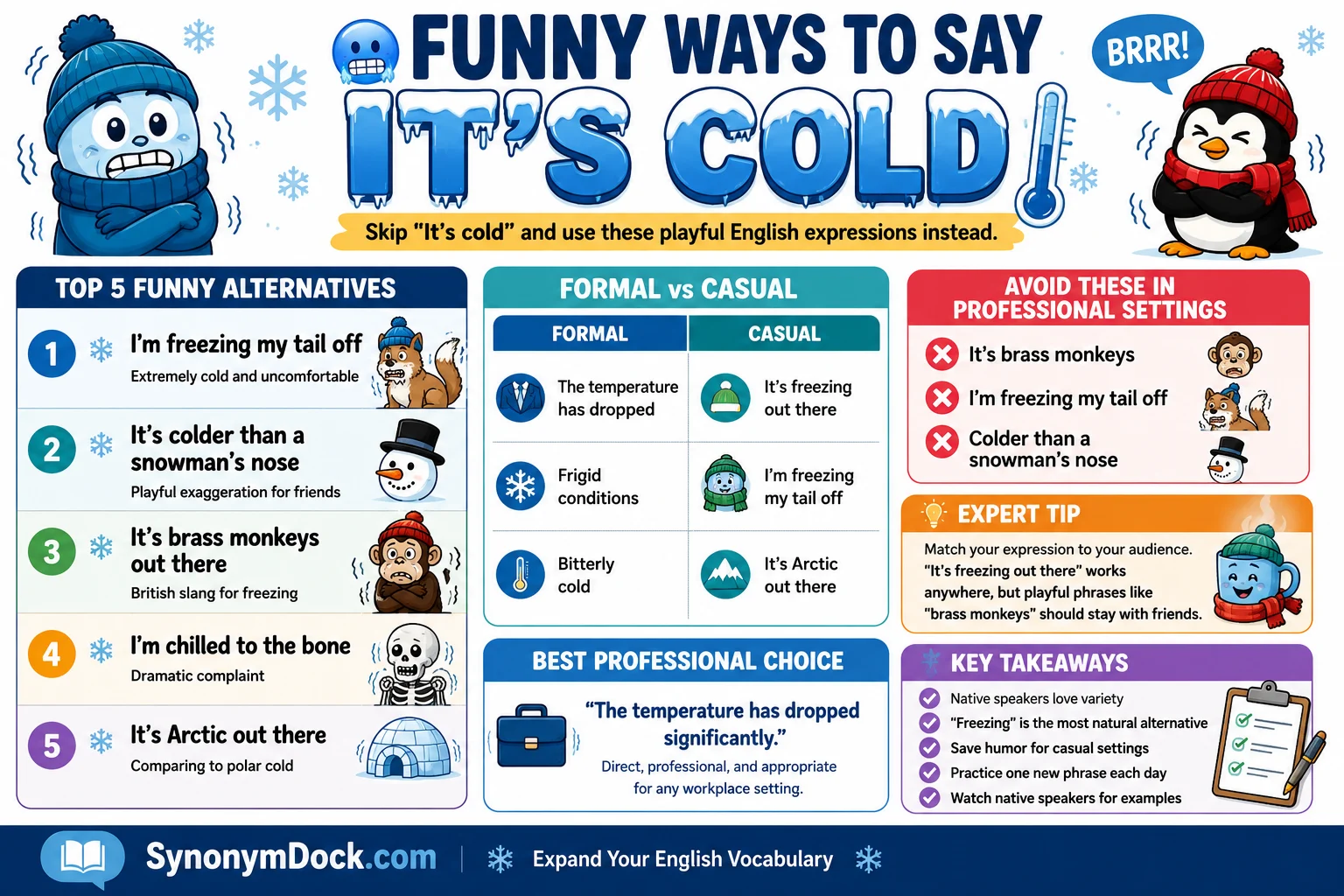
Need a funny way to say it’s cold? Try “I’m freezing my tail off,” “It’s colder than a snowman’s nose,” “It’s brass monkeys out there,” or “I’m chilled to the bone.” These playful expressions help you sound more natural and fluent in English conversations .
Top 5 Alternatives:
I’m freezing my tail off, It’s colder than a snowman’s nose, It’s brass monkeys out there, I’m chilled to the bone, It’s Arctic out there.
We’ve all been there. You step outside, the wind hits your face, and the only words that come out are “It’s cold.” While that phrase works perfectly fine, native English speakers rarely stop there.
Using creative and funny expressions to describe cold weather shows you understand the playfulness of English. It makes you sound more fluent, more natural, and much more engaging in conversation . Whether you’re chatting with friends, posting on social media, or looking for alternatives to “it’s cold” for a writing project, these expressions will elevate your English.
Quick Categories
Formal Alternatives
- The temperature has dropped significantly.
- We’re experiencing unusually cold conditions.
- Bitterly cold.
Pro Tip: Use these in professional emails or weather reports where humor isn’t appropriate.
Professional Alternatives
- It’s extremely cold today.
- The weather is quite frigid.
- It’s subzero outside.
Pro Tip: In workplace settings, clear and direct language is usually best. Save the humor for casual conversations with colleagues you know well.
Casual Alternatives
- It’s freezing out there.
- It’s nippy.
- It’s chilly.
Pro Tip: These are perfect for everyday small talk and are the most common phrases used by native speakers.
Informal Expressions (Funny)
- I’m freezing my tail off.
- It’s colder than a snowman’s nose.
- It’s brass monkeys out there.
- I’m chilled to the bone.
- It’s Arctic out there.
Pro Tip: These are best used with friends, family, or in social media posts. They’re engaging and show personality.
What Does “It’s Cold” Mean?
Definition: A simple statement that the temperature is low or that someone feels uncomfortably cold.
Grammar: “It’s” is the contraction of “it is.” The word “cold” can function as an adjective describing the weather or as a noun describing a condition (e.g., “I can’t stand the cold”).
Simple Explanation: It’s the most basic way to say that the temperature is low. However, it’s also the most overused expression. Native speakers often choose more colorful alternatives for variety.
Example: “It’s cold today. Don’t forget your jacket.”
When to Use Funny Cold Expressions
Common situations:
- Casual conversation with friends and family
- Social media posts and Instagram captions
- Comedic writing and storytelling
- Breaking the ice (pun intended!) in social settings
- When you want to sound more fluent and natural
Avoid using funny cold expressions in:
- Professional emails to clients
- Formal business meetings
- Academic writing
- Job interviews
- News reports or weather forecasting
Is It Professional or Polite?
Polite? ✔ Yes
Professional? ✘ No (funny versions are casual)
Formal? ✘ No
Natural? ✔ Yes
Example: “It’s pretty chilly out there today. You might want a coat.”
Simple Explanation: While “it’s cold” is perfectly acceptable in most situations, adding humor creates a more casual, friendly tone. Professional environments generally require neutral, factual statements about the weather.
Pros and Cons
Pros
- Easy to understand – Everyone knows what you mean
- Friendly and approachable
- Common – Used by almost all native speakers
- Neutral – Works in almost any situation
Cons
- Overused – It’s the most repetitive way to describe cold weather
- Limited tone – Doesn’t convey emotion or playfulness
- Too casual for some workplaces – Might be seen as unprofessional
- Not ideal in formal writing – Lacks precision and variety
15 Funny Ways to Say It’s Cold
[1]. I’m freezing my tail off
Meaning: I am extremely cold.
Explanation: This is one of the most common humorous expressions for cold weather. Native speakers use it when they’re genuinely uncomfortable in cold temperatures. The word “tail” adds a playful, exaggerated tone .
Example Sentence: “I forgot my gloves, and now I’m freezing my tail off waiting for the bus.”
Best Use: Casual conversation, complaining to friends
Avoid Using In: Professional emails, formal writing
Tone: Playful, exaggerated
Formality Level: ⭐⭐ Casual
Usage Frequency: Very Common
CEFR Level: B1
Common Collocations:
- freezing my tail off outside
- freezing my tail off waiting
- absolutely freezing my tail off
[2]. It’s colder than a snowman’s nose
Meaning: It’s extremely cold.
Explanation: Snowmen are already cold, so saying it’s colder than one’s nose is a playful exaggeration. This expression paints a vivid picture that makes native speakers smile .
Example Sentence: “I’d stay inside if I were you. It’s colder than a snowman’s nose out there.”
Best Use: With friends, kids, social media
Avoid Using In: Professional settings
Tone: Whimsical, visual
Formality Level: ⭐⭐ Casual
Usage Frequency: Occasional
CEFR Level: B2
Common Collocations:
- colder than a snowman’s nose
- feels colder than a snowman’s nose
[3]. It’s brass monkeys out there
Meaning: It is freezing cold.
Explanation: This British slang expression is short for “it’s cold enough to freeze the balls off a brass monkey.” The original phrase is considered vulgar, but “brass monkeys” is a cleaner version that native speakers use frequently in the UK and Australia .
Example Sentence: “Wrap up warm because it’s brass monkeys out there today.”
Best Use: Casual British English, conversation with friends
Avoid Using In: Formal writing, professional emails
Tone: Slangy, humorous
Formality Level: ⭐ Very Casual
Usage Frequency: Common in British English, rare in US
CEFR Level: C1
Common Collocations:
- brass monkeys weather
- absolutely brass monkeys
Native Speaker Tip: This expression is widely used in the UK, but Americans often don’t know it. If you’re speaking with Americans, try “It’s Arctic out there” instead.
[4]. I’m chilled to the bone
Meaning: I feel extremely cold, as if the cold has reached my bones.
Explanation: This is a dramatic and vivid way to describe being very cold. Native speakers use it when the cold feels intense and uncomfortable .
Example Sentence: “After waiting outside for an hour, I was chilled to the bone.”
Best Use: Casual conversation, dramatic complaints
Avoid Using In: Professional reports
Tone: Dramatic, strong
Formality Level: ⭐⭐ Casual
Usage Frequency: Common
CEFR Level: B2
Common Collocations:
- chilled to the bone
- absolutely chilled to the bone
- get chilled to the bone
[5]. It’s Arctic out there
Meaning: It is extremely cold, like the Arctic.
Explanation: This expression compares the current weather to the freezing conditions of the Arctic. It’s a simple but effective way to emphasize intense cold .
Example Sentence: “Don’t even think about going outside without a scarf. It’s Arctic out there.”
Best Use: Everyday conversation, exaggerating cold weather
Avoid Using In: Formal weather reports
Tone: Exaggerated, descriptive
Formality Level: ⭐⭐⭐ Neutral
Usage Frequency: Common
CEFR Level: B2
Common Collocations:
- absolutely Arctic
- feels like Arctic out there
[6]. I’m shivering like a penguin in a bikini
Meaning: I am very cold and shaking.
Explanation: This is a playful, silly expression. It creates a funny mental image of a penguin (an animal that likes the cold) wearing a bikini and shivering .
Example Sentence: “Can we turn up the heat? I’m shivering like a penguin in a bikini!”
Best Use: With kids, friends, social media
Avoid Using In: Professional environments
Tone: Silly, playful
Formality Level: ⭐ Very Casual
Usage Frequency: Rare
CEFR Level: B2
Common Collocations:
- shivering like a penguin
- shaking like a penguin
[7]. I think I just saw Frosty the Snowman applying for a job
Meaning: It’s so cold that even a snowman (who loves the cold) thinks it’s too much.
Explanation: This funny phrase is a pop culture reference to Frosty the Snowman. The joke is that if a snowman is looking for a job to escape the cold, it must be extremely cold .
Example Sentence: “It’s so cold I think I just saw Frosty the Snowman applying for a job at a beach resort.”
Best Use: With friends, family, holiday conversations
Avoid Using In: Any formal context
Tone: Whimsical, pop culture reference
Formality Level: ⭐ Very Casual
Usage Frequency: Rare
CEFR Level: B2
[8]. It’s so cold, even Elsa would say ‘Let it go’
Meaning: It’s extremely cold.
Explanation: Another pop culture reference, this time to the Disney movie “Frozen.” Elsa, the Ice Queen, loves the cold. The joke is that even she would want to escape .
Example Sentence: “I’m staying inside today. It’s so cold, even Elsa would say ‘Let it go’.”
Best Use: Family conversations, social media
Avoid Using In: Professional contexts
Tone: Playful, pop culture
Formality Level: ⭐ Very Casual
Usage Frequency: Rare
CEFR Level: B1
[9]. I need more layers than an onion
Meaning: I am very cold and need to wear many clothes.
Explanation: This expression compares dressing for cold weather to peeling an onion. It’s a funny way to say you need to wear many layers to stay warm .
Example Sentence: “It’s freezing out there. I need more layers than an onion to stay warm.”
Best Use: Casual conversation
Avoid Using In: Professional writing
Tone: Humorous, visual
Formality Level: ⭐⭐ Casual
Usage Frequency: Occasional
CEFR Level: B1
Common Collocations:
- layers like an onion
- more layers than an onion
[10]. I can’t feel my fingers. I think they migrated south for the winter
Meaning: It is so cold that my fingers have become numb.
Explanation: This playful expression extends the idea of birds migrating south for the winter to body parts. The joke is that the fingers have “left” due to the extreme cold .
Example Sentence: “I can’t feel my fingers. I think they migrated south for the winter!”
Best Use: Casual conversation, complaining to friends
Avoid Using In: Formal writing
Tone: Playful, exaggerated
Formality Level: ⭐⭐ Casual
Usage Frequency: Occasional
CEFR Level: B2
[11]. Cold enough for ya?
Meaning: It’s very cold, isn’t it?
Explanation: This is a classic, humorous rhetorical question. Native speakers use it as a conversation starter when it’s obviously cold. The playfulness comes from asking an obvious question .
Example Sentence: “Cold enough for ya today?” “I’ve had my heater on all day!
Best Use: Casual conversation, greeting people in cold weather
Avoid Using In: Professional writing
Tone: Conversational, friendly
Formality Level: ⭐⭐ Casual
Usage Frequency: Very Common
CEFR Level: B1
Native Speaker Tip: This phrase works best when you’re stating the obvious. The humor comes from the irony of asking if it’s cold enough when it clearly is.
[12]. It’s nippy
Meaning: It is a little bit cold.
Explanation: “Nippy” is a gentle word used for moderately cold weather. Native speakers use it when the cold is noticeable but not extreme .
Example Sentence: “It’s a bit nippy out there this morning. You might want a scarf.”
Best Use: Everyday conversation, describing mild cold
Avoid Using In: Very cold weather (use “freezing” instead)
Tone: Gentle, descriptive
Formality Level: ⭐⭐⭐ Neutral
Usage Frequency: Common
CEFR Level: B1
Common Collocations:
- a bit nippy
- quite nippy
Expert Insight: “Nippy” comes from the idea of the cold “nipping” at your nose or fingers. It’s a much more interesting word than just saying “cold” and it sounds very natural.
[13]. It’s brisk
Meaning: Pleasantly cold and refreshing.
Explanation: While this can be a neutral description, it’s often used in a positive way. A “brisk day” is cold but invigorating and pleasant .
Example Sentence: “It’s brisk out today. Perfect weather for a walk.”
Best Use: Positive descriptions of cold weather
Avoid Using In: Extremely cold conditions
Tone: Positive, refreshing
Formality Level: ⭐⭐⭐ Neutral
Usage Frequency: Common
CEFR Level: B1
Common Collocations:
- brisk walk
- brisk morning
- brisk air
[14]. I’m freezing
Meaning: I am very cold.
Explanation: This is probably the second most common way to say “it’s cold” in English. Native speakers use it frequently in everyday conversation .
Example Sentence: “Turn up the heater. I’m freezing!”
Best Use: Everyday conversation
Avoid Using In: Formal writing
Tone: Direct, casual
Formality Level: ⭐⭐⭐ Neutral
Usage Frequency: Very Common
CEFR Level: A2
Common Collocations:
- freezing cold
- absolutely freezing
[15]. It’s bitterly cold
Meaning: Extremely and unpleasantly cold.
Explanation: “Bitterly cold” describes cold weather that feels harsh and uncomfortable. Native speakers use this to emphasize that the cold is unpleasant .
Example Sentence: “It’s bitterly cold today. Don’t stay outside too long.”
Best Use: Weather descriptions, emphasizing discomfort
Avoid Using In: Casual small talk (a bit dramatic)
Tone: Serious, strong
Formality Level: ⭐⭐⭐⭐ Formal
Usage Frequency: Common
CEFR Level: B2
Common Collocations:
- bitterly cold weather
- bitterly cold wind
- bitterly cold temperatures
Native Speaker Tip
What sounds most natural? “I’m freezing” and “It’s chilly” are the most common alternatives to “it’s cold.”
Which is too formal? “It’s bitterly cold” can sound a bit dramatic for everyday conversation.
Which is old-fashioned? “It’s nippy” is still common but is more popular with older speakers.
What do native speakers prefer? In casual conversation, most native speakers use “It’s freezing out there” or “I’m freezing my tail off” for humor.
Common Mistakes
Mistake 1: Using “It’s very cold” in all situations
Why it’s incorrect: It’s repetitive and sounds robotic.
Correct version: Vary your vocabulary with “freezing,” “chilly,” or “nippy.”
Example: Instead of “It’s very cold today,” say “It’s freezing out there.
Mistake 2: Using “It’s brass monkeys” with American speakers
Why it’s incorrect: Americans often won’t understand this British slang.
Correct version: Use “It’s Arctic out there” instead.
Example: “It’s Arctic out there” for American English speakers.
Mistake 3: Overusing “I’m freezing my tail off”
Why it’s incorrect: It can sound repetitive if used too often.
Correct version: Mix in other expressions like “I’m chilled to the bone.”
Example: Sometimes use “I’m freezing,” other times use “I’m chilled to the bone.”
Mistake 4: Using “It’s brisk” for extremely cold weather
Why it’s incorrect: “Brisk” has positive connotations and describes pleasant cold.
Correct version: Use “freezing” or “bitterly cold” for extreme conditions.
Example: “It’s brisk” = nice and cool. “It’s freezing” = uncomfortably cold.
Mistake 5: Forgetting to consider your audience
Why it’s incorrect: Funny expressions aren’t appropriate everywhere.
Correct version: Match your expression to your setting.
Example: “The temperature has dropped” for work emails vs. “It’s Arctic out there” for friends.
Avoid These in Formal Situations
| Phrase | Why to Avoid | Better Alternative |
|---|---|---|
| “It’s brass monkeys” | Too casual, cultural slang | “The temperature is very low” |
| “I’m freezing my tail off” | Too informal | “It’s extremely cold” |
| “It’s colder than a snowman’s nose” | Too playful | “It’s very cold today” |
| “I need more layers than an onion” | Too humorous | “I need to dress warmly” |
| “It’s so cold, Elsa would say ‘Let it go'” | Pop culture reference | “The weather is quite cold” |
Best Phrases by Situation
| Situation | Best Phrase |
|---|---|
| Business Email | The temperature has dropped significantly |
| Client Meeting | We’re experiencing unusually cold conditions |
| Academic Essay | The weather has become bitterly cold |
| Presentation | Frigid conditions are affecting the region |
| Workplace Discussion | It’s quite cold outside today |
| Job Interview | The weather is chilly today |
| Team Collaboration | It’s freezing out there, so let’s stay inside |
| Everyday Conversation | It’s chilly / I’m freezing |
| Social Media | It’s colder than a snowman’s nose! 🥶 |
| With Friends | I’m freezing my tail off |
| With Family | It’s Arctic out there! |
Top 15 Alternatives Compared
| Phrase | Tone | Formality | Best Use | Frequency |
|---|---|---|---|---|
| I’m freezing my tail off | Playful | ⭐⭐ Casual | With friends | Very Common |
| It’s colder than a snowman’s nose | Whimsical | ⭐⭐ Casual | Social media | Occasional |
| It’s brass monkeys | Humorous | ⭐ Very Casual | British English | Common in UK |
| I’m chilled to the bone | Dramatic | ⭐⭐ Casual | Complaining | Common |
| It’s Arctic out there | Descriptive | ⭐⭐⭐ Neutral | Everyday talk | Common |
| I’m shivering like a penguin in a bikini | Silly | ⭐ Very Casual | Kids, family | Rare |
| Frosty the Snowman reference | Playful | ⭐ Very Casual | Holiday talk | Rare |
| Elsa reference | Playful | ⭐ Very Casual | Family | Rare |
| More layers than an onion | Humorous | ⭐⭐ Casual | Friends | Occasional |
| Fingers migrated south | Playful | ⭐⭐ Casual | Complaining | Occasional |
| Cold enough for ya | Conversational | ⭐⭐ Casual | Greeting | Very Common |
| It’s nippy | Gentle | ⭐⭐⭐ Neutral | Mild cold | Common |
| It’s brisk | Positive | ⭐⭐⭐ Neutral | Pleasant cold | Common |
| I’m freezing | Direct | ⭐⭐⭐ Neutral | Everyday talk | Very Common |
| It’s bitterly cold | Strong | ⭐⭐⭐⭐ Formal | Serious weather | Common |
Which One Should You Use?
Best Overall: “It’s freezing out there.” It’s natural, common, and understood by all English speakers .
Best Professional: “The temperature has dropped significantly.” Direct and formal without being awkward.
Best Academic: “Conditions are bitterly cold.” Formal enough for research papers.
Best Business Email: “We’re experiencing cold weather conditions.” Professional and safe.
Best Everyday Conversation: “It’s chilly today.” Simple, natural, and widely used .
Most Natural: “I’m freezing.” Native speakers say this constantly.
Most Polite: “It’s a bit nippy.” Gentle and inoffensive.
Scenario Practice
Scenario 1: You step outside with your friend and it’s extremely cold. What do you say?
Choose: “I’m freezing my tail off! Let’s get coffee.”
Correct Answer: This is perfect for a friend. It’s funny, casual, and invites action.
Scenario 2: You’re in a business meeting and someone asks about the weather.
Choose: “The temperature has dropped significantly today.”
Correct Answer: This is professional and avoids humor that might seem unprofessional.
Scenario 3: You’re posting a winter photo on Instagram.
Choose: “It’s colder than a snowman’s nose out here! 🥶”
Correct Answer: Social media welcomes playful and engaging phrases.
Scenario 4: Your boss asks you to describe today’s conditions for a report.
Choose: “We’re experiencing cold weather conditions across the region.”
Correct Answer: Keep it formal and factual.
Scenario 5: You want to make small talk with a colleague you don’t know well.
Choose: “It’s pretty chilly today, isn’t it?”
Correct Answer: This is friendly yet professional enough for colleagues.
FAQs
What is the most formal way to say “it’s cold”?
The most formal alternatives are “the temperature has dropped,” “we’re experiencing cold conditions,” and “the weather is frigid.” These phrases are appropriate for professional emails, academic writing, and weather reports.
Which phrase is best for social media posts?
“It’s colder than a snowman’s nose” or “I’m freezing my tail off” work best for social media because they’re engaging, visual, and likely to get interactions. Pop culture references like “Even Elsa would say ‘Let it go'” also perform well.
What is the difference between “chilly” and “freezing”?
“Chilly” describes mild to moderate cold that’s noticeable but not extreme. “Freezing” means very cold, often below 0°C (32°F). “It’s chilly” might make you grab a light jacket, while “It’s freezing” means you need heavy winter clothing .
Which alternative sounds most natural to native speakers?
“I’m freezing” and “It’s chilly” are the most natural-sounding alternatives. Native speakers use these constantly in everyday conversation. “It’s nippy” is also natural but more common with older speakers .
Can I use these expressions in business meetings?
Only the formal and professional alternatives like “the temperature has dropped” are appropriate in business meetings. Humorous expressions like “brass monkeys” should be reserved for casual conversations with colleagues you know well.
Conclusion
Learning different ways to say “it’s cold” is a simple but powerful way to improve your English fluency. You’ll sound more natural, more engaging, and more like a native speaker when you move beyond the basic phrase.
Remember to match your expression to your situation. Use formal alternatives in professional settings, casual alternatives with friends, and play it safe when you’re unsure. Start practicing these phrases today step outside, feel the cold, and try a new expression. Your English will sound more confident and natural in no time. Stay warm! 🔥

6 thoughts on “Funny Ways to Say It’s Cold |15+ Funny Alternatives For 2026”