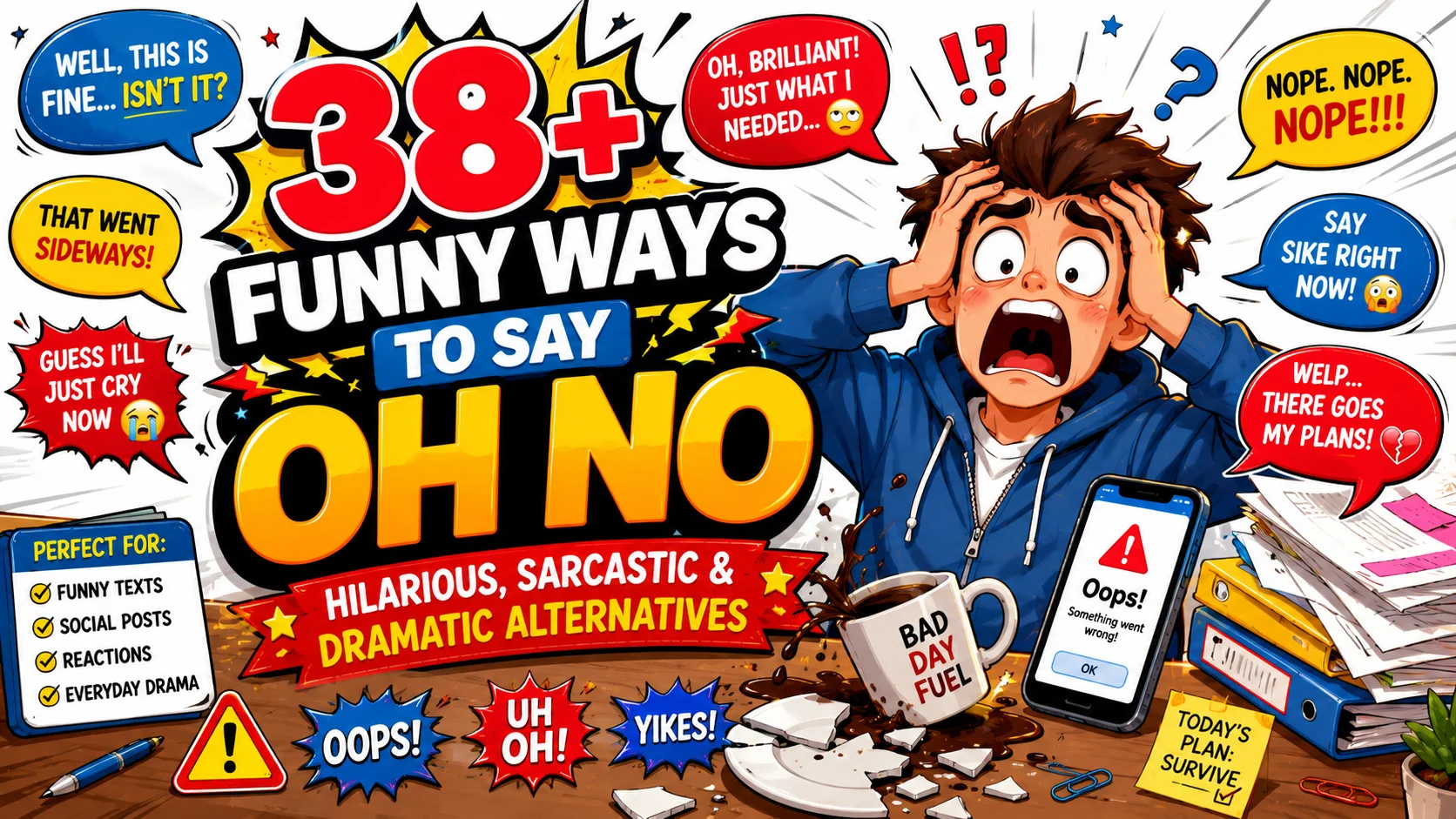
Oh no is one of those phrases we utter without thinking. It slips out when we drop our phone, hear bad news, or realize we’ve made a mistake. But saying it over and over gets boring fastfor you and for everyone listening.
The English language offers countless creative, hilarious, and sometimes downright absurd alternatives to express dismay, shock, or disappointment. Learning funny ways to say “oh no” helps you sound more like a native speaker, adds personality to your conversations, and lets you react to life’s little disasters with wit and humor.
This guide gives you over 35 alternatives, ranging from mildly concerned to full-blown dramatic, so you always have the perfect reaction ready.
Top 5 alternatives: Oh dear, Well, that’s unfortunate, Oh no no no, Yikes, Uh oh spaghetti-os.
Quick Categories
Classic & Clean Alternatives
- Oh dear
- Uh oh
- Oh my
- Yikes
- Oh boy
Pro Tip: These are perfect for everyday situations where you need a polite, inoffensive reaction. They work in almost any casual setting.
Playful & Silly Alternatives
- Uh oh spaghetti-os
- Oh fudge
- What the heck
- Well, this is awkward
- Oh sugar
Pro Tip: Use these with friends or in lighthearted situations. They add humor without being offensive.
Dramatic & Over-the-Top Alternatives
- This is fine (insert fire)
- Here we go again
- Well, that’s just fantastic
- Oh, wonderful
- This is exactly what I needed
Pro Tip: These are perfect for sarcastic reactions when things are going wrong. The contrast between the words and the situation creates the humor.
Professional & Polite Alternatives (for work!)
- That’s unfortunate
- This is concerning
- I see
- Well, that’s not ideal
- This is a challenge
Pro Tip: These are essential for workplace communication. They express dismay without sounding unprofessional or overly emotional.
Exaggerated & Humorous Alternatives
- This is a disaster of epic proportions
- The universe is conspiring against me
- I can’t even
- Send help
- Someone get me a snackI need to process this
Pro Tip: Use these when something is genuinely frustrating but you want to make light of it. They show you can find humor in difficult situations.
Common Mistakes
Mistake 1: Using overly dramatic phrases for minor problems
Why it is incorrect: Saying “This is a disaster of epic proportions” when you spill coffee is overkill and can make you seem dramatic.
Correct version: Match the intensity of your reaction to the situation.
Example Sentence: Instead of “This is a disaster!” for a small spill, say “Oops” or “Oh well.”
Mistake 2: Using casual phrases in professional settings
Why it is incorrect: Phrases like “What the heck” or “Oh sugar” sound unprofessional in meetings or emails.
Correct version: Use “That’s unfortunate” or “I see.”
Example Sentence: Instead of “Oh no, what happened to the budget?” say “That’s unfortunate. Could we review it?”
Mistake 3: Using sarcasm with people who don’t know you well
Why it is incorrect: Sarcastic phrases like “Well, that’s just fantastic” can be misunderstood as genuine enthusiasm.
Correct version: Save sarcasm for friends who know your sense of humor.
Example Sentence: Instead of “Oh, wonderful” to a new colleague, say “I understandlet’s find a solution.”
Mistake 4: Overusing the same alternative
Why it is incorrect: Using the same expression repeatedly makes you sound repetitive.
Correct version: Vary your reactions based on the situation.
Example Sentence: Instead of “Yikes” for every surprise, say “Yikes” one time and “Oh dear” the next.
Mistake 5: Using outdated expressions incorrectly
Why it is incorrect: Some phrases like “Oh bother” sound old-fashioned and can make you seem out of touch.
Correct version: Use phrases that feel natural to you and your social context.
Example Sentence: “Oh bother” is best reserved for playful moments or Winnie the Pooh fans.
What Does “Oh No” Mean?
Definition: An exclamation used to express dismay, concern, or shock when something bad happens.
Grammar: It is an interjectiona word or phrase used to express strong emotion.
Simple Explanation: “Oh no” is a reflexive reaction to bad news, small accidents, or unexpected problems. It’s the verbal equivalent of a wince.
Example Sentence: “Oh no, I forgot my keys!”
When to Use “Oh No”
“Oh no” is a very versatile, everyday phrase. Use it when:
- You realize you’ve made a mistake
- You hear bad news
- Something breaks or spills
- You see something concerning happen
“Expressing dismay with variety shows you’re a creative, fluent speaker.”
Is It Professional or Polite?
Polite? ✔ Yes, it is polite and inoffensive.
Professional? ⚠ Sometimes, but usually not. In most workplaces, it’s considered too informal.
Formal? ❌ No, it is informal.
Natural? ✔ Yes, it is very common and natural in spoken English.
Business-style example: Instead of “Oh no, what happened?” use “That’s concerning. Let’s look into it.”
Explanation: “Oh no” is a friendly, everyday phrase for casual conversation. In professional settings, opt for more neutral language to maintain credibility.
Pros and Cons
Pros
- Polite and inoffensive
- Widely understood
- Expresses concern clearly
- Easy to use
Cons
- Too casual for professional settings
- Can sound childish in some contexts
- Limited range of emotion
- Overused and can become repetitive
35+ Funny Alternatives to Say “Oh No”
1. Phrase: Oh Dear
Meaning: A mild, old-fashioned expression of dismay.
Explanation: This is a classic, polite, and slightly old-fashioned way to express concern. It’s perfect for situations that are annoying but not catastrophic.
Example Sentence: “Oh dear, I seem to have locked my keys in the car.”
Best Use: Everyday mishaps, polite company
Avoid Using In: Very dramatic situations
Tone: Mild, Concerned
Formality Level: ⭐⭐⭐ Neutral
Usage Frequency: Very Common
CEFR Level: A2
Common Collocations:
- oh dear
- oh dear me
Context Variability:
- Spoken English: “Oh dear, what now?”
- Professional English: Acceptable but informal.
- Casual Conversation: Very common.
2. Phrase: Uh Oh
Meaning: A very common, childish expression of realizing something is wrong.
Explanation: This is one of the most natural reactions in English. It sounds like a reflex, which is why it works so well.
Example Sentence: “Uh oh, I think I just deleted the file.”
Best Use: Casual situations, sudden realizations
Avoid Using In: Professional settings
Tone: Concerned, Reflexive
Formality Level: ⭐⭐ Casual
Usage Frequency: Very Common
CEFR Level: A1
Common Collocations:
- uh oh
- uh oh spaghetti-os
Context Variability:
- Spoken English: “Uh oh, I’m in trouble.”
- Professional English: Avoid.
- Casual Conversation: Very natural.
3. Phrase: Oh My
Meaning: A short, versatile expression of surprise or concern.
Explanation: This is a clean, versatile alternative. It can express surprise, dismay, or even admiration depending on tone.
Example Sentence: “Oh my, what happened to your hair?”
Best Use: Everyday surprises, mild concerns
Avoid Using In: Very formal settings
Tone: Surprised, Concerned
Formality Level: ⭐⭐⭐ Neutral
Usage Frequency: Very Common
CEFR Level: A2
Common Collocations:
- oh my
- oh my goodness
- oh my word
Context Variability:
- Spoken English: “Oh my, that’s expensive.”
- Professional English: Acceptable but casual.
- Casual Conversation: Very common.
4. Phrase: Yikes
Meaning: A sharp, expressive reaction to something unpleasant.
Explanation: This is a very modern, trendy, and slightly dramatic way to say “oh no.” It’s often used in response to embarrassing or awkward situations.
Example Sentence: “Yikes, that presentation did not go well.”
Best Use: Social situations, reacting to awkward moments
Avoid Using In: Professional reports
Tone: Sharp, Concerned
Formality Level: ⭐⭐ Casual
Usage Frequency: Very Common
CEFR Level: B1
Common Collocations:
- yikes
- yikes on bikes
Context Variability:
- Spoken English: “Yikes, that’s rough.”
- Professional English: Avoid.
- Casual Conversation: Very common and trendy.
5. Phrase: Oh Boy
Meaning: An expression of mild dismay or resignation.
Explanation: This phrase is used when you realize something is about to happen or has happened, usually not good. It’s a very American phrase.
Example Sentence: “Oh boy, here comes the boss.”
Best Use: Mild concerns, resignations
Avoid Using In: Professional settings
Tone: Resigned, Concerned
Formality Level: ⭐⭐ Casual
Usage Frequency: Very Common
CEFR Level: A2
Common Collocations:
- oh boy
- oh brother
Context Variability:
- Spoken English: “Oh boy, this is going to be fun.”
- Professional English: Avoid.
- Casual Conversation: Very common.
6. Phrase: Uh Oh Spaghetti-Os
Meaning: A silly, playful take on “uh oh.”
Explanation: This phrase is pure silliness. It’s a reference to the canned pasta brand and adds a childish, fun twist to expressing concern.
Example Sentence: “Uh oh spaghetti-os, I forgot to pick up the kids.”
Best Use: Friends, silly situations
Avoid Using In: Serious contexts
Tone: Playful, Childish
Formality Level: ⭐ Very Casual
Usage Frequency: Occasional
CEFR Level: B1
Common Collocations:
- uh oh spaghetti-os
Context Variability:
- Spoken English: “Uh oh spaghetti-os!”
- Professional English: Avoid.
- Casual Conversation: Very fun and silly.
7. Phrase: Oh Sugar
Meaning: A polite, old-fashioned substitute for a stronger expletive.
Explanation: “Sugar” is a clean substitute for “shit.” It’s a common, polite expression of frustration or dismay.
Example Sentence: “Oh sugar, I broke my favorite mug.”
Best Use: Mild frustration, polite company
Avoid Using In: Very dramatic situations
Tone: Frustrated, Polite
Formality Level: ⭐⭐⭐ Neutral
Usage Frequency: Common
CEFR Level: B1
Common Collocations:
- oh sugar
- sugar
- sugar cubes
Context Variability:
- Spoken English: “Oh sugar, I’m late.”
- Professional English: Acceptable but casual.
- Casual Conversation: Very common.
8. Phrase: Oh Fudge
Meaning: A clean, playful substitute for “oh fuck.”
Explanation: This is a very common euphemism. It sounds like you might be swearing, but you’re notwhich is the humor.
Example Sentence: “Oh fudge, I forgot my wallet.”
Best Use: Mild frustration, with friends or in mixed company
Avoid Using In: Very formal settings
Tone: Playful, Frustrated
Formality Level: ⭐⭐ Casual
Usage Frequency: Common
CEFR Level: B1
Common Collocations:
- oh fudge
- fudge
- oh fudge me
Context Variability:
- Spoken English: “Oh fudge, I’m late.”
- Professional English: Avoid.
- Casual Conversation: Very playful.
9. Phrase: Well, This Is Awkward
Meaning: A humorous way to acknowledge an uncomfortable situation.
Explanation: This phrase is often used when something goes wrong socially or unexpectedly. It turns the embarrassment into shared humor.
Example Sentence: “Well, this is awkward. I just told my boss his presentation was boring.”
Best Use: Social situations, awkward moments
Avoid Using In: Serious contexts
Tone: Awkward, Humorous
Formality Level: ⭐⭐⭐ Neutral
Usage Frequency: Very Common
CEFR Level: B1
Common Collocations:
- this is awkward
- awkward
- how awkward
Context Variability:
- Spoken English: “Well, this is awkward.”
- Professional English: Acceptable.
- Casual Conversation: Very common.
10. Phrase: This Is Fine (Insert Fire)
Meaning: An ironic statement when everything is clearly not fine.
Explanation: This is a reference to a popular meme of a dog sitting in a burning room saying “This is fine.” It’s used sarcastically in bad situations.
Example Sentence: “The project is behind, the budget is cut, and I just spilled coffee on my laptop. This is fine.”
Best Use: Internet culture, friends, dramatic irony
Avoid Using In: Professional contexts
Tone: Ironic, Sarcastic
Formality Level: ⭐⭐ Casual
Usage Frequency: Common
CEFR Level: B2
Common Collocations:
- this is fine
- everything is fine
- I’m fine
Context Variability:
- Spoken English: “This is fine” (sarcastic).
- Professional English: Avoid.
- Casual Conversation: Very common in meme culture.
11. Phrase: Here We Go Again
Meaning: An expression of resignation to a familiar, tiresome situation.
Explanation: This is used when something you don’t like is happening again. It’s a very common, relatable way to express mild annoyance.
Example Sentence: “Here we go againthe printer is out of paper.”
Best Use: Repetitive annoyances
Avoid Using In: Serious situations
Tone: Resigned, Annoyed
Formality Level: ⭐⭐⭐ Neutral
Usage Frequency: Very Common
CEFR Level: B1
Common Collocations:
- here we go again
- there we go again
Context Variability:
- Spoken English: “Here we go again.”
- Professional English: Acceptable but casual.
- Casual Conversation: Very common.
12. Phrase: Well, That’s Unfortunate
Meaning: A polite, slightly formal way to say “oh no.
Explanation: This is a great phrase for professional or semi-formal settings. It expresses concern without being overly emotional.
Example Sentence: “Well, that’s unfortunate. I’m sorry to hear that.”
Best Use: Professional settings, polite conversation
Avoid Using In: Close friends, dramatic situations
Tone: Polite, Concerned
Formality Level: ⭐⭐⭐⭐ Formal
Usage Frequency: Very Common
CEFR Level: B1
Common Collocations:
- that’s unfortunate
- unfortunate
- how unfortunate
Context Variability:
- Spoken English: “That’s unfortunate.”
- Professional English: “That’s unfortunate.”
- Casual Conversation: Sounds a bit formal.
13. Phrase: This Is Concerning
Meaning: A professional way to express worry.
Explanation: This is a calm, measured phrase for the workplace. It expresses concern without sounding overly emotional.
Example Sentence: “This is concerning. We need to investigate the drop in sales.”
Best Use: Workplace emails, meetings
Avoid Using In: Casual conversations
Tone: Professional, Concerned
Formality Level: ⭐⭐⭐⭐ Formal
Usage Frequency: Very Common
CEFR Level: B2
Common Collocations:
- this is concerning
- that’s concerning
- I’m concerned
Context Variability:
- Spoken English: “This is concerning.”
- Professional English: Standard.
- Casual Conversation: Sounds serious.
14. Phrase: I See
Meaning: A neutral, professional reaction to bad news.
Explanation: This is a very neutral, almost stoic response. It’s useful in a professional setting where you don’t want to show too much emotion.
Example Sentence: “The CEO resigned? I see.”
Best Use: Professional settings, receiving bad news
Avoid Using In: Emotional conversations
Tone: Neutral, Professional
Formality Level: ⭐⭐⭐⭐ Formal
Usage Frequency: Very Common
CEFR Level: A2
Common Collocations:
- I see
- I understand
- I see what you mean
Context Variability:
- Spoken English: “I see.”
- Professional English: Standard.
- Casual Conversation: Can sound cold.
15. Phrase: Well, That’s Not Ideal
Meaning: A polite, understated way to say “oh no.
Explanation: This is a very British and polite way to express that something is going wrong. The understatement is what makes it humorous.
Example Sentence: “Well, that’s not ideal. The hotel we booked doesn’t exist.”
Best Use: Professional settings, polite conversation
Avoid Using In: Close friends
Tone: Polite, Understated
Formality Level: ⭐⭐⭐⭐ Formal
Usage Frequency: Common
CEFR Level: B2
Common Collocations:
- not ideal
- less than ideal
- far from ideal
Context Variability:
- Spoken English: “That’s not ideal.”
- Professional English: “That’s not ideal.”
- Casual Conversation: Sounds very polite.
16. Phrase: This Is a Challenge
Meaning: A professional way to reframe a problem.
Explanation: Instead of expressing dismay, this phrase frames the problem as something to be solved. It’s very useful in a professional context.
Example Sentence: “This is a challenge, but I’m sure we can find a solution.”
Best Use: Professional meetings, problem-solving
Avoid Using In: Casual conversations
Tone: Professional, Optimistic
Formality Level: ⭐⭐⭐⭐ Formal
Usage Frequency: Very Common
CEFR Level: B1
Common Collocations:
- this is a challenge
- facing a challenge
- a new challenge
Context Variability:
- Spoken English: “This is a challenge.”
- Professional English: Standard.
- Casual Conversation: Sounds formal.
17. Phrase: This Is a Disaster of Epic Proportions
Meaning: An exaggerated, dramatic way to say “oh no.
Explanation: This is intentionally over-the-top. It’s used to make light of a bad situation by exaggerating it.
Example Sentence: “I dropped my toast jelly-side down. This is a disaster of epic proportions.”
Best Use: Friends, humorous situations
Avoid Using In: Professional settings
Tone: Exaggerated, Hilarious
Formality Level: ⭐⭐ Casual
Usage Frequency: Occasional
CEFR Level: C1
Common Collocations:
- epic proportions
- disaster of epic proportions
- biblical proportions
Context Variability:
- Spoken English: “This is a disaster!”
- Professional English: Avoid.
- Casual Conversation: Very dramatic and funny.
18. Phrase: The Universe Is Conspiring Against Me
Meaning: A dramatic, humorous way to say you’re having a bad day.
Explanation: This is a very common, relatable expression of frustration. It implies that everything is going wrong.
Example Sentence: “I missed the bus, it’s raining, and I forgot my umbrella. The universe is conspiring against me.”
Best Use: Friends, venting about a bad day
Avoid Using In: Professional settings
Tone: Dramatic, Humorous
Formality Level: ⭐⭐ Casual
Usage Frequency: Common
CEFR Level: B2
Common Collocations:
- conspiring against me
- working against me
- universe is against me
Context Variability:
- Spoken English: “The universe is conspiring against me.”
- Professional English: Avoid.
- Casual Conversation: Very relatable.
19. Phrase: I Can’t Even
Meaning: An expression of being so overwhelmed or frustrated you can’t finish your sentence.
Explanation: This is a very modern, slangy phrase. It’s used when you are so frustrated you are speechless.
Example Sentence: “He told me the Wi-Fi password is wrong for the fifth time. I can’t even.”
Best Use: Social media, young adults, friends
Avoid Using In: Professional contexts
Tone: Overwhelmed, Speechless
Formality Level: ⭐ Very Casual
Usage Frequency: Very Common
CEFR Level: B1
Common Collocations:
- I can’t even
- I can’t even right now
Context Variability:
- Spoken English: “I can’t even!”
- Professional English: Avoid.
- Casual Conversation: Very trendy.
20. Phrase: Send Help
Meaning: A humorous call for rescue.
Explanation: This is a very common, playful expression used when you’re overwhelmed. It implies you need immediate assistance.
Example Sentence: “Send helpI’ve assembled the bookshelf upside down.”
Best Use: Social media, texts, friends
Avoid Using In: Professional contexts
Tone: Playful, Humorous
Formality Level: ⭐ Very Casual
Usage Frequency: Common
CEFR Level: B1
Common Collocations:
- send help
- help
- someone help
Context Variability:
- Spoken English: “Send help!”
- Professional English: Avoid.
- Casual Conversation: Very common.
21. Phrase: Someone Get Me a SnackI Need to Process This
Meaning: A funny way to say you need time to process bad news.
Explanation: This is a very relatable expression. It combines the need for comfort food with the need to process shocking information.
Example Sentence: “Wait, they’re closing the restaurant? Someone get me a snackI need to process this.”
Best Use: Friends, humorous situations
Avoid Using In: Professional settings
Tone: Playful, Comforting
Formality Level: ⭐⭐ Casual
Usage Frequency: Occasional
CEFR Level: B2
Common Collocations:
- need to process this
- let me process
- processing
Context Variability:
- Spoken English: “I need to process this.”
- Professional English: Avoid.
- Casual Conversation: Very relatable.
22. Phrase: Oh No No No No No
Meaning: An elongated, dramatic expression of worry.
Explanation: Repeating “no” adds emphasis and drama. It’s a very common way to express a sinking feeling.
Example Sentence: “I forgot my passport. Oh no no no no no.”
Best Use: Realizations, dramatic moments
Avoid Using In: Professional settings
Tone: Dramatic, Worried
Formality Level: ⭐⭐ Casual
Usage Frequency: Very Common
CEFR Level: A2
Common Collocations:
- oh no no no
- no no no
- oh no
Context Variability:
- Spoken English: “Oh no no no!”
- Professional English: Avoid.
- Casual Conversation: Very natural.
23. Phrase: Oh No, It’s Happening Again
Meaning: An expression of resigned frustration.
Explanation: This is used when you recognize a bad situation repeating itself. It’s relatable and slightly humorous.
Example Sentence: “Oh no, it’s happening againthe printer is jamming.”
Best Use: Repetitive problems
Avoid Using In: Professional settings
Tone: Resigned, Frustrated
Formality Level: ⭐⭐ Casual
Usage Frequency: Common
CEFR Level: B1
Common Collocations:
- it’s happening again
- again
- not again
Context Variability:
- Spoken English: “Oh no, not again.”
- Professional English: Avoid.
- Casual Conversation: Very common.
24. Phrase: Not Again
Meaning: A short, frustrated expression.
Explanation: “Not again” is the verbal equivalent of rolling your eyes. It’s used when a familiar annoyance repeats itself.
Example Sentence: “Not againthe cat knocked over the plant for the third time.”
Best Use: Annoying repetition
Avoid Using In: Professional settings
Tone: Frustrated, Annoyed
Formality Level: ⭐⭐ Casual
Usage Frequency: Very Common
CEFR Level: A2
Common Collocations:
- not again
- again
- here we go again
Context Variability:
- Spoken English: “Not again!”
- Professional English: Avoid.
- Casual Conversation: Very natural.
25. Phrase: Well, That’s Just Fantastic
Meaning: A sarcastic way to say “oh no.
Explanation: This is a common, very effective use of sarcasm. The contrast between the positive word and the bad situation creates the humor.
Example Sentence: “The car broke down 50 miles from home. Well, that’s just fantastic.”
Best Use: Friends, dramatic irony
Avoid Using In: Professional settings, with people who don’t understand sarcasm
Tone: Sarcastic, Humorous
Formality Level: ⭐⭐ Casual
Usage Frequency: Common
CEFR Level: B2
Common Collocations:
- just fantastic
- absolutely fantastic
- that’s great
Context Variability:
- Spoken English: “That’s just fantastic” (sarcastic).
- Professional English: Avoid.
- Casual Conversation: Very common.
26. Phrase: Oh, Wonderful
Meaning: Another sarcastic expression of dismay.
Explanation: Like “just fantastic,” this uses a positive word to express negative feelings. It’s a common form of irony.
Example Sentence: “The internet is down right before my important meeting. Oh, wonderful.”
Best Use: Friends, dramatic irony
Avoid Using In: Professional settings
Tone: Sarcastic, Ironic
Formality Level: ⭐⭐ Casual
Usage Frequency: Common
CEFR Level: B1
Common Collocations:
- oh wonderful
- absolutely wonderful
- how wonderful
Context Variability:
- Spoken English: “Oh, wonderful” (sarcastic).
- Professional English: Avoid.
- Casual Conversation: Very common.
27. Phrase: Well, This Is Just Perfect
Meaning: A sarcastic expression of frustration.
Explanation: This is another variation of the “sarcastic positive word” theme. It works well in moments of frustration.
Example Sentence: “Well, this is just perfect. It started raining right when I left the house.”
Best Use: Friends, dramatic irony
Avoid Using In: Professional settings
Tone: Sarcastic, Frustrated
Formality Level: ⭐⭐ Casual
Usage Frequency: Common
CEFR Level: B2
Common Collocations:
- just perfect
- absolutely perfect
- perfect timing
Context Variability:
- Spoken English: “This is just perfect.”
- Professional English: Avoid.
- Casual Conversation: Very common.
28. Phrase: What Have You Done?
Meaning: A dramatic expression of dismay at someone’s actions.
Explanation: This is used when someone has made a mistake or caused a problem. It’s slightly theatrical.
Example Sentence: “What have you done? You dyed the dog pink?”
Best Use: Playful reactions to mistakes
Avoid Using In: Serious professional contexts
Tone: Dramatic, Concerned
Formality Level: ⭐⭐⭐ Neutral
Usage Frequency: Common
CEFR Level: A2
Common Collocations:
- what have you done
- what did you do
- what have you
Context Variability:
- Spoken English: “What have you done?”
- Professional English: Avoid.
- Casual Conversation: Very dramatic.
29. Phrase: How Could This Happen?
Meaning: An expression of disbelief at a problem.
Explanation: This is a slightly dramatic but common phrase. It expresses genuine shock or confusion.
Example Sentence: “How could this happen? The cupcakes are all gone.”
Best Use: Dismay, confusion
Avoid Using In: Professional settings
Tone: Disbelieving, Dramatic
Formality Level: ⭐⭐⭐ Neutral
Usage Frequency: Common
CEFR Level: A2
Common Collocations:
- how could this happen
- how could that happen
- how did this happen
Context Variability:
- Spoken English: “How could this happen?”
- Professional English: Avoid.
- Casual Conversation: Very natural.
30. Phrase: Great, Just Great
Meaning: A sarcastic expression of frustration.
Explanation: This is a very common, classic sarcastic response to bad news. It’s short and effective.
Example Sentence: “Great, just great. The server crashed right before the deadline.”
Best Use: Frustration, sarcasm
Avoid Using In: Professional settings
Tone: Sarcastic, Frustrated
Formality Level: ⭐⭐ Casual
Usage Frequency: Very Common
CEFR Level: B1
Common Collocations:
- great just great
- just great
- that’s great
Context Variability:
- Spoken English: “Great, just great.”
- Professional English: Avoid.
- Casual Conversation: Very common.
31. Phrase: I’m Going to Need Therapy After This
Meaning: A humorous expression of being overwhelmed.
Explanation: This is a very common, self-deprecating way to express that a situation is too stressful.
Example Sentence: “I just watched the entire season in one night. I’m going to need therapy after this.”
Best Use: Friends, humorous venting
Avoid Using In: Professional settings
Tone: Humorous, Dramatic
Formality Level: ⭐⭐ Casual
Usage Frequency: Common
CEFR Level: B2
Common Collocations:
- need therapy after this
- need a therapist
- therapy
Context Variability:
- Spoken English: “I need therapy after this.”
- Professional English: Avoid.
- Casual Conversation: Very relatable.
32. Phrase: Life Comes at You Fast
Meaning: A humorous, ironic expression.
Explanation: This phrase is often used sarcastically when a minor problem happens. It makes the situation seem more dramatic than it is.
Example Sentence: “I just dropped my phone in the toilet. Life comes at you fast.”
Best Use: Friends, dramatic irony
Avoid Using In: Professional settings
Tone: Ironic, Humorous
Formality Level: ⭐⭐ Casual
Usage Frequency: Common
CEFR Level: B2
Common Collocations:
- life comes at you fast
- life comes fast
Context Variability:
- Spoken English: “Life comes at you fast.”
- Professional English: Avoid.
- Casual Conversation: Very ironic.
33. Phrase: Well, That Escalated Quickly
Meaning: An ironic expression when a situation becomes serious suddenly.
Explanation: This is used when a situation quickly becomes worse than expected. It’s a very common meme quote.
Example Sentence: “I asked for a small change, and they redesigned the whole system. Well, that escalated quickly.”
Best Use: Ironic situations
Avoid Using In: Professional settings
Tone: Ironic, Humorous
Formality Level: ⭐⭐ Casual
Usage Frequency: Very Common
CEFR Level: B2
Common Collocations:
- escalated quickly
- escalated
- escalated rapidly
Context Variability:
- Spoken English: “That escalated quickly.”
- Professional English: Avoid.
- Casual Conversation: Very common.
34. Phrase: This Is Not Going to Be Good
Meaning: An ominous expression of impending doom.
Explanation: This is used when you can see a problem forming. It expresses a sense of dread.
Example Sentence: “My boss just called a meeting for 5 PM on Friday. This is not going to be good.”
Best Use: Ominous moments
Avoid Using In: Professional settings
Tone: Ominous, Dramatic
Formality Level: ⭐⭐⭐ Neutral
Usage Frequency: Very Common
CEFR Level: B1
Common Collocations:
- not going to be good
- not good
- this will not end well
Context Variability:
- Spoken English: “This is not going to be good.”
- Professional English: Acceptable but casual.
- Casual Conversation: Very natural.
35. Phrase: I Don’t Like This
Meaning: A direct expression of concern.
Explanation: This is a simple, direct way to express that something is going wrong. It’s very common and versatile.
Example Sentence: “The car is making a strange noise. I don’t like this.”
Best Use: Sensing a problem
Avoid Using In: Very formal settings
Tone: Concerned, Direct
Formality Level: ⭐⭐⭐ Neutral
Usage Frequency: Very Common
CEFR Level: A2
Common Collocations:
- don’t like this
- don’t like the look of this
- don’t like it
Context Variability:
- Spoken English: “I don’t like this.”
- Professional English: Acceptable.
- Casual Conversation: Very natural.
Top 10 Alternatives Compared
| Phrase | Tone | Formality | Best Use | Frequency |
| Oh dear | Mild, Concerned | Neutral | Everyday mishaps | Very Common |
| Yikes | Sharp, Concerned | Casual | Awkward moments | Very Common |
| Well, that’s unfortunate | Polite, Concerned | Formal | Professional settings | Very Common |
| This is concerning | Professional, Concerned | Formal | Workplace | Very Common |
| Uh oh spaghetti-os | Playful, Silly | Very Casual | Silly situations | Occasional |
| This is fine | Ironic, Sarcastic | Casual | Dramatic irony | Common |
| Here we go again | Resigned, Annoyed | Neutral | Repetitive problems | Very Common |
| Well, that’s just fantastic | Sarcastic, Humorous | Casual | Dramatic irony | Common |
| Well, that’s not ideal | Polite, Understated | Formal | Professional settings | Common |
| The universe is conspiring against me | Dramatic, Humorous | Casual | Venting | Common |
Which One Should You Use?
Best Overall
“Oh dear” This is polite, inoffensive, and widely understood. It works in almost any casual situation.
Best Professional
“That’s unfortunate” This is professional, polite, and expresses concern without being overly emotional.
Best Casual
“Yikes” This is trendy, sharp, and perfect for social situations.
Best Dramatic
“This is a disaster of epic proportions” This is hilarious and perfect for friends.
Best Sarcastic
“Well, that’s just fantastic” This is a classic sarcastic response that works well.
Most Natural
“Uh oh” This is a very natural, reflexive reaction.
Avoid These in Formal Situations
“Uh oh spaghetti-os” This is too silly for professional settings. Use “That’s unfortunate.”
“Oh fudge” This is too playful for the workplace. Use “I see.”
“This is fine” Sarcasm is risky in professional contexts. Use “That’s concerning.”
“I can’t even” This is too slangy for professional settings. Use “I’m surprised by this.”
“Send help” This is too dramatic. Use “Let’s work on this together.”
FAQs
What are some funny ways to say “Oh no”?
Some funny alternatives include “Well, that escalated quickly,” “Oopsie daisy,” “Houston, we have a problem,” “Welp, that’s unfortunate,” and “And there goes the plan.”
How can I say “Oh no” in a sarcastic way?
Try phrases like “Oh, that’s just fantastic,” “Well, this is going wonderfully,” “Could this day get any better?” or “Exactly what I needed today.”
What is a funny way to say “Oh no” over text?
For texting, you can use “Uh-oh spaghetti-o,” “Yikes on bikes,” “Oh dear, my dude,” “Welp…” or simply “🚨 Uh-oh alert! 🚨”
What are some dramatic ways to say “Oh no”?
For extra drama, try “This cannot be happening,” “The universe has betrayed me,” “Sound the alarms!” or “My entire plan has left the building.”
How do you say “Oh no” in a playful way?
Playful options include “Oopsie,” “Whoopsie daisy,” “Uh-oh, buttercup,” “Well, that went sideways,” and “Tiny problem, enormous panic.”
What is a professional alternative to “Oh no”?
In professional situations, use phrases such as “That’s unfortunate,” “I’m afraid we have an issue,” “That presents a challenge,” or “It looks like we’ve encountered a problem.”
What is a funny way to react to bad news?
You could say “Well, that’s not ideal,” “And the plot thickens,” “Add that to today’s blooper reel,” or “Well, this took an unexpected turn.”
Can I use funny “Oh no” phrases in captions?
Yes! Funny expressions work especially well for social media captions, memes, texts, and relatable posts. Short options like “Plot twist: disaster,” “Well, that happened,” and “Uh-oh, but make it dramatic” are caption-friendly.
Conclusion
There are plenty of ways to say “Oh no” without repeating the same old phrase. Whether you want to sound funny, sarcastic, dramatic, playful, or clever, the right alternative can make even an awkward moment a little more entertaining.
From “Uh-oh, spaghetti-o” to “Well, that escalated quickly,” these expressions are perfect for texts, conversations, captions, memes, and everyday mishaps. So the next time something goes spectacularly wrong, skip the ordinary “Oh no” and give your reaction a little personality.
Because sometimes the only thing you can do when everything goes sideways is laugh about it! 😂

5 thoughts on “Funny Ways to Say “Oh No” |38+ Alternatives for 2026”