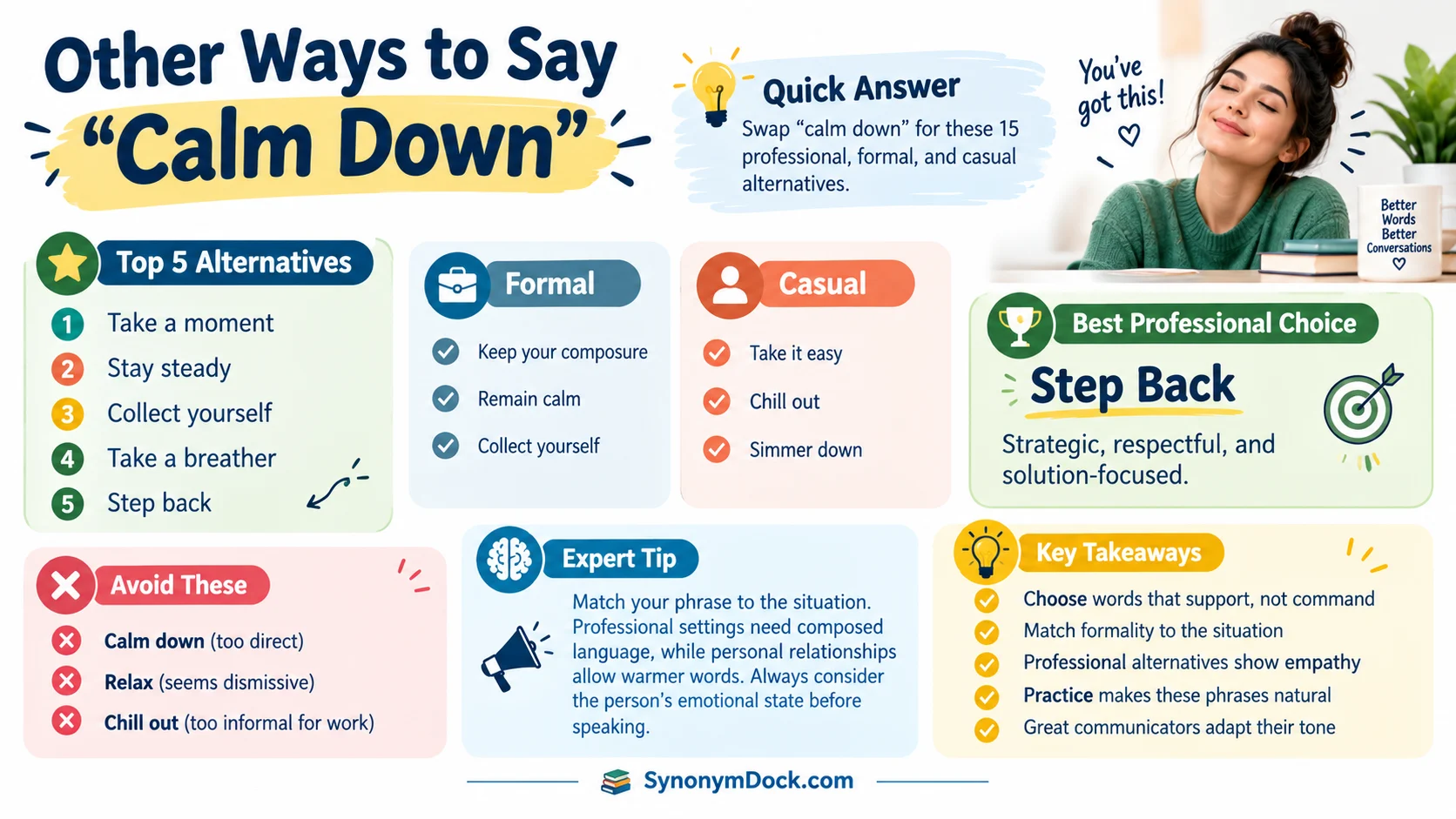
Looking for other ways to say “calm down”? Use these professional alternatives in workplace settings: take a moment, stay composed, keep your composure, remain steady, and collect yourself. For casual situations, try relax, take it easy, chill out, settle down, or breathe.
We’ve all been there. Someone is visibly stressed, and you want to help them feel better. But saying “calm down” often backfires. It can sound dismissive, condescending, or even make the person more frustrated.
The phrase “calm down” is common in everyday English. But native speakers know it can feel abrupt or overly direct. That’s why learning other ways to say calm down is essential for better communication.
Whether you’re managing a team, supporting a friend, or writing a professional email, having alternatives to calm down at your fingertips makes you sound more empathetic and fluent. Let’s explore the best options for every situation.
“The words you choose in tense moments can either soothe or escalate.”
QUICK CATEGORIES
Formal Alternatives
- Please take a moment
- Remain composed
- Keep your composure
- Stay steady
- Collect yourself
Pro Tip
Use these in professional settings like job interviews, board meetings, or formal correspondence. They show emotional intelligence without sounding bossy.
Professional Alternatives
- Let’s take a pause
- Take a breather
- Step back for a moment
- Regroup
- Center yourself
Pro Tip
These work well in workplace meetings, team discussions, and client presentations. They sound collaborative rather than commanding.
Business Email Alternatives
- Please take a moment to collect your thoughts
- Let’s approach this with a clear mind
- I’d suggest we pause and reassess
- Let’s maintain a steady perspective
- Take a step back and review
Pro Tip
When writing to colleagues or clients, these phrases show professionalism and respect for the recipient’s emotional state.
Academic Alternatives
- Please remain calm
- Maintain your composure
- Stay focused
- Keep a level head
- Exercise patience
Pro Tip
Academic settings value measured responses. These phrases help maintain a scholarly tone during stressful research or exam situations.
Casual Alternatives
- Take it easy
- Chill out
- Settle down
- Relax
- Breathe
Pro Tip
Perfect for friends, family, and informal social situations. They feel warm and supportive, not demanding.
Informal Expressions
- Easy does it
- Take a chill pill
- Cool your jets
- Simmer down
- Whoa, take it down a notch
Pro Tip
Use these only with close friends or in very casual settings. They can sound rude in professional contexts.
COMMON MISTAKES
Mistake 1: Saying “Calm Down” Too Directly
Why it’s incorrect: It often triggers more stress because it sounds like a command.
Correct version: Use softer language like “Let’s take a moment.”
Example sentence:
❌ “Calm down, it’s not a big deal.”
✅ “Let’s take a moment to look at this together.”
Mistake 2: Using “Relax” in Professional Settings
Why it’s incorrect: It can sound dismissive of someone’s valid concerns.
Correct version: Use “Let’s approach this with a clear perspective.”
Example sentence:
❌ “Relax, everything will be fine.”
✅ “Let’s approach this with a clear perspective and find the best solution.”
Mistake 3: Adding “Just” Before the Phrase
Why it’s incorrect: “Just calm down” sounds even more dismissive.
Correct version: Remove “just” entirely or use a different phrase.
Example sentence:
❌ “Just calm down and think about it.”
✅ “Take a moment to think about it from a different angle.”
Mistake 4: Ignoring the Person’s Emotions
Why it’s incorrect: It invalidates how the person feels.
Correct version: Acknowledge their feelings first, then suggest calm.
Example sentence:
❌ “Calm down, there’s no reason to be upset.”
✅ “I can see you’re frustrated. Let’s work through this together.”
Mistake 5: Using Slang in Professional Contexts
Why it’s incorrect: Phrases like “chill out” seem unprofessional.
Correct version: Always match your language to the situation.
Example sentence:
❌ “Chill out, we can fix this.”
✅ “Let’s take a step back and assess our options.”
“The way you ask someone to calm down often matters more than the words themselves.”
WHAT DOES “CALM DOWN” MEAN?
Definition:
“Calm down” means to become less angry, excited, or upset. It refers to the process of returning to a quieter, more relaxed emotional state.
Grammar Explanation:
This is a phrasal verb. “Calm” is the main verb, and “down” is the particle. Together, they function as a single unit of meaning. It can be used as an imperative (“Calm down, please.”) or a descriptive verb (“She finally calmed down after the meeting.”).
Simple Explanation:
Think of it like a balloon slowly deflating. When you’re stressed, you’re filled with tension. Calming down is the process of letting that tension out so you can think clearly again.
Example Sentence:
“After the presentation ended, Sarah took a deep breath to calm down before answering questions.”
WHEN TO USE “CALM DOWN”
Common Situations
Business Meetings
Use this when someone is getting too emotional during a negotiation or discussion. But rememberthere are better alternatives to calm down in professional environments.
Academic Settings
Students facing exams or presentations might need gentle reassurance rather than a direct command to calm down.
Emails
Writing “Please calm down” in an email seems harsh. Better alternatives exist for written communication.
Daily Conversation
With friends and family, “calm down” might be acceptable if said kindly. But even then, softer words work better.
Spoken English
In casual speech, “calm down” appears often. However, expanding your vocabulary helps you respond more thoughtfully in high-stress moments.
Written English
For formal writing, avoid “calm down.” Use professional alternatives like “maintain composure” instead.
IS IT PROFESSIONAL OR POLITE?
| Attribute | Assessment |
| Polite? | Rarely |
| Professional? | Almost never |
| Formal? | Not at all |
| Natural? | Yes, in casual settings |
Business-Style Example:
❌ “Please calm down about the deadline change.”
✅ “I understand your concerns about the deadline adjustment. Let’s discuss how we can manage this effectively.”
Simple Explanation:
“Calm down” feels like a command. It tells someone what to do without considering their emotional state. In professional environments, this lacks empathy. Most native speakers avoid it at work unless the relationship is very close. They prefer alternatives that sound supportive rather than bossy.
“Professional communication isn’t about telling people how to feelit’s about helping them find solutions.”
PROS AND CONS
Pros
- ✅ Easy to understand – Even beginner English learners know this phrase.
- ✅ Friendly in tone – When said gently, it shows concern.
- ✅ Common and natural – Native speakers use it daily in casual settings.
- ✅ Short and direct – Gets the message across quickly in emergencies.
Cons
- ❌ Overused – Many people have heard it too many times.
- ❌ Limited tone – It sounds demanding rather than supportive.
- ❌ Too casual for many workplaces – Most offices expect more professional language.
- ❌ Not ideal in formal writing – Academic and business writing require more refined alternatives.
- ❌ Often backfires – The more stressed someone is, the worse this phrase works.
15 BETTER ALTERNATIVES TO “CALM DOWN”
[1]. Phrase: Take a Moment
Meaning:
Pause briefly before reacting to collect your thoughts.
Explanation:
Native speakers often use this when they want someone to slow down without sounding bossy. It acknowledges the person needs space, not orders. This works wonderfully in both professional and personal situations because it feels gentle and supportive.
Example Sentence:
“Before we continue this discussion, let’s all take a moment to think about the proposal.”
Best Use:
Workplace meetings, client conversations, team discussions.
Avoid Using In:
Emergency situations where immediate action is needed.
Tone:
Calm, Supportive
Formality Level:
⭐⭐⭐⭐ Formal
Usage Frequency:
Very Common
CEFR Level:
B1
Common Collocations:
- take a moment to reflect
- take a moment to think
- take a moment to breathe
- take a moment for yourself
Context Variability:
Spoken English:
“Just take a moment and let that sink in.”
Professional English:
“May I suggest we all take a moment before responding?”
Casual Conversation:
“Hey, take a moment. You’ve got this.”
[2]. Phrase: Keep Your Composure
Meaning:
Maintain self-control even when under pressure.
Explanation:
This is a sophisticated phrase that signals emotional intelligence. Business leaders use it to encourage teams during challenging projects. It suggests the person has the capability to handle stressthey just need a gentle reminder. The phrase feels respectful and empowering.
Example Sentence:
“Despite the budget cuts, the department head managed to keep her composure during the announcement.”
Best Use:
High-pressure meetings, public speaking, challenging negotiations.
Avoid Using In:
Informal chats with friendsit sounds too stiff.
Tone:
Professional, Respected
Formality Level:
⭐⭐⭐⭐⭐ Very Formal
Usage Frequency:
Occasional
CEFR Level:
C1
Common Collocations:
- keep your composure during stress
- maintain professional composure
- lose your composure
- regain your composure
Context Variability:
Spoken English:
“You need to keep your composure when the interviewer asks tough questions.”
Professional English:
“Please keep your composure during the client presentation.”
Casual Conversation:
This phrase is rarely used casually.
[3]. Phrase: Stay Steady
Meaning:
Remain balanced and stable despite challenges.
Explanation:
This alternative to calm down suggests stability rather than calmness. It’s less emotional and more about maintaining a solid position. Athletes use this phrase before big games. Professionals use it when projects get chaotic. The image is of standing firm like a rock in a storm.
Example Sentence:
“Stay steady through this transitionour team has handled tough projects before.”
Best Use:
Team motivation, sports coaching, personal encouragement.
Avoid Using In:
Very formal academic writing.
Tone:
Strong, Encouraging
Formality Level:
⭐⭐⭐ Neutral
Usage Frequency:
Common
CEFR Level:
B2
Common Collocations:
- stay steady under pressure
- stay steady and focused
- stay steady despite challenges
- keep a steady hand
Context Variability:
Spoken English:
“Stay steadyyou’re almost at the finish line.”
Professional English:
“We need to stay steady as market conditions shift.”
Casual Conversation:
“Stay steady, and everything will work out.”
[4]. Phrase: Collect Yourself
Meaning:
Gather your thoughts and emotions before acting.
Explanation:
This phrase feels like someone taking a time-out to reset. It’s gentle and privatenot demanding. Native speakers often use it after someone has received bad news or felt overwhelmed. It implies the person has the strength to manage their feelings with a moment of space.
Example Sentence:
“Excuse me for a momentI need to collect myself before continuing this presentation.”
Best Use:
Public speaking, emotional moments, difficult conversations.
Avoid Using In:
Very informal group settings.
Tone:
Empathetic, Considerate
Formality Level:
⭐⭐⭐⭐ Formal
Usage Frequency:
Common
CEFR Level:
B2
Common Collocations:
- collect your thoughts
- collect your emotions
- collect yourself before responding
- need a moment to collect myself
Context Variability:
Spoken English:
“Let me collect myself before I answer that question.”
Professional English:
“The team should collect themselves before the strategy session.”
Casual Conversation:
“Give me a second to collect myselfthat was overwhelming.”
[5]. Phrase: Take a Breather
Meaning:
Pause briefly to rest and reset.
Explanation:
This is among the most natural alternatives to calm down in professional settings. It’s not too formal or casual. The phrase literally suggests stepping away for air. In workplaces, it means stepping back from the problem temporarily. The tone feels supportive, not controlling.
Example Sentence:
“We’ve been working on this proposal for three hours. Let’s take a breather and come back fresh.”
Best Use:
Project deadlines, long meetings, creative brainstorming sessions.
Avoid Using In:
Emergency situations requiring immediate action.
Tone:
Relaxed, Practical
Formality Level:
⭐⭐⭐ Neutral
Usage Frequency:
Very Common
CEFR Level:
B1
Common Collocations:
- take a breather from work
- need a breather
- quick breather
- step out for a breather
Context Variability:
Spoken English:
“I’m taking a breather before the next session.”
Professional English:
“Should we take a breather and revisit this after lunch?”
Casual Conversation:
“Take a breatheryou’ve been going nonstop all day.”
Native Speaker Tip
Native speakers strongly prefer “take a moment” and “take a breather” in professional environments. “Keep your composure” sounds excellent but appears less often in daily conversation. “Collect yourself” feels more personal and empathetic.
[6]. Phrase: Step Back
Meaning:
Create distance from a situation to see it more clearly.
Explanation:
This phrase suggests temporary disengagement for better perspective. When people are emotionally invested, they often miss obvious solutions. “Step back” encourages them to change their viewpoint. In professional contexts, this sounds strategic rather than emotional. It’s about problem-solving, not controlling someone’s feelings.
Example Sentence:
“Let’s step back and evaluate whether this approach really serves our client’s needs.”
Best Use:
Strategic planning, conflict resolution, design thinking.
Avoid Using In:
Sensitive personal conversations where emotional support is needed.
Tone:
Strategic, Helpful
Formality Level:
⭐⭐⭐ Neutral
Usage Frequency:
Very Common
CEFR Level:
B1
Common Collocations:
- step back and think
- step back from the problem
- step back for perspective
- step back and reassess
Context Variability:
Spoken English:
“Step back and look at the big picture.”
Professional English:
“I recommend we step back and prioritize our goals.”
Casual Conversation:
“Step back for a secondyou’re overthinking this.”
[7]. Phrase: Regroup
Meaning:
Reorganize and refocus after difficulties.
Explanation:
This is one of the most dynamic alternatives to calm down. It suggests action, not just stillness. Originally a military term, it now appears commonly in business and sports. When teams face setbacks, regrouping sounds proactive. It doesn’t imply failurejust smart recalibration.
Example Sentence:
“After the technical failure, we need to regroup and adjust our launch timeline.”
Best Use:
Project setbacks, team challenges, strategic adjustments.
Avoid Using In:
Personal emotional support situations.
Tone:
Proactive, Professional
Formality Level:
⭐⭐⭐ Neutral
Usage Frequency:
Common
CEFR Level:
B2
Common Collocations:
- regroup and refocus
- regroup after setbacks
- regroup as a team
- time to regroup
Context Variability:
Spoken English:
“We lost the first half, but let’s regroup for the second.”
Professional English:
“Our department needs to regroup after the restructuring.”
Casual Conversation:
“Let’s regroup and figure this out together.”
[8]. Phrase: Remain Calm
Meaning:
Stay in a peaceful state despite stress.
Explanation:
This sounds more formal than just “calm down.” It’s often used in official announcements or written guidance. Emergency services use this phrase in public alerts. The difference is subtle but importantit’s about staying in a state, not changing from a bad one. It sounds less confrontational.
Example Sentence:
“Please remain calm while we address the technical difficulties.”
Best Use:
Official announcements, safety instructions, formal communications.
Avoid Using In:
Personal conversations where someone needs emotional support.
Tone:
Authoritative, Controlled
Formality Level:
⭐⭐⭐⭐ Formal
Usage Frequency:
Common
CEFR Level:
B1
Common Collocations:
- remain calm and collected
- remain calm during emergencies
- remain calm and focused
- remain calm in difficult situations
Context Variability:
Spoken English:
“Remain calmhelp is on the way.”
Professional English:
“Please remain calm while we investigate the system error.”
Casual Conversation:
This phrase sounds too formal for casual use.
[9]. Phrase: Center Yourself
Meaning:
Find your emotional balance and inner peace.
Explanation:
This phrase comes from mindfulness and meditation practices. It sounds thoughtful and modern. Many professionals use it when discussing mental wellness. It suggests returning to a core sense of calm rather than fighting stress. The imagery is strong but the tone is gentle.
Example Sentence:
“Before this important meeting, take a few minutes to center yourself and focus.”
Best Use:
Mental wellness discussions, high-stress moments, self-care conversations.
Avoid Using In:
Traditional business environments that prefer conventional language.
Tone:
Mindful, Gentle
Formality Level:
⭐⭐⭐ Neutral
Usage Frequency:
Occasional
CEFR Level:
C1
Common Collocations:
- center yourself through breathing
- center yourself before challenges
- take time to center yourself
- center your thoughts
Context Variability:
Spoken English:
“I need to center myself before the performance.”
Professional English:
“Consider centering yourself before the negotiation begins.”
Casual Conversation:
“When things get wild, I try to center myself.”
[10]. Phrase: Take It Easy
Meaning:
Relax and avoid unnecessary stress.
Explanation:
This is one of the friendliest alternatives to calm down. It feels like a hug in words. Native speakers use it constantly in casual settings. The tone is warm and reassuring. It works perfectly when someone is overthinking or stressing about small things. It suggests the situation isn’t as bad as they think.
Example Sentence:
“Take it easyyou’ve been working too hard, and the deadline isn’t for two weeks.”
Best Use:
Friends, family, casual colleagues, stress relief encouragement.
Avoid Using In:
Formal business emails, client communications, academic writing.
Tone:
Warm, Reassuring
Formality Level:
⭐⭐ Casual
Usage Frequency:
Very Common
CEFR Level:
A2
Common Collocations:
- take it easy on yourself
- take it easy at work
- just take it easy
- need to take it easy
Context Variability:
Spoken English:
“Take it easyyou’re doing great.”
Professional English:
This phrase is too casual for most professional writing.
Casual Conversation:
“Don’t stress about the test. Take it easy and do your best.”
Native Speaker Tip
“Take it easy” sounds natural and friendly in casual contexts. However, avoid it in professional settingsit can seem dismissive. “Step back” and “regroup” are more appropriate in workplace conversations.
[11]. Phrase: Chill Out
Meaning:
Relax and stop being upset or stressed.
Explanation:
This phrase is pure casual English. Native speakers use it among friends when someone is overreacting. It’s short, direct, and playful. However, it’s very informal. Using it in the wrong situation can offend people. It works only when the relationship is comfortable.
Example Sentence:
“Chill outit’s just a misunderstanding, and we can fix it easily.”
Best Use:
Close friends, siblings, casual social gatherings.
Avoid Using In:
Workplaces, formal events, with strangers, in writing.
Tone:
Playful, Direct
Formality Level:
⭐ Very Casual
Usage Frequency:
Common
CEFR Level:
B1
Common Collocations:
- chill out for a bit
- need to chill out
- chill out about it
- just chill out
Context Variability:
Spoken English:
“Chill out, we’ll figure something out.”
Professional English:
Never use this professionally.
Casual Conversation:
“Chill outeveryone makes mistakes.”
[12]. Phrase: Settle Down
Meaning:
Become quieter, calmer, or less active.
Explanation:
This phrase often appears when children are excited or a room is noisy. For adults, it sounds gentle and familiar. Native speakers use it when they want someone to reduce their energy level. It’s not as harsh as “calm down” because it suggests natural reduction, not forced stillness.
Example Sentence:
“The audience started to settle down as the speaker approached the stage.”
Best Use:
Large groups, classrooms, after excitement, reducing hyperactivity.
Avoid Using In:
Professional meetings where the tone needs to remain formal.
Tone:
Gentle, Guiding
Formality Level:
⭐⭐⭐ Neutral
Usage Frequency:
Very Common
CEFR Level:
B1
Common Collocations:
- settle down and listen
- settle down after excitement
- settle down for the evening
- let things settle down
Context Variability:
Spoken English:
“Settle downwe need to start the meeting.”
Professional English:
Could use in team discussions, but alternatives are better.
Casual Conversation:
“The kids are settling down for story time.”
[13]. Phrase: Simmer Down
Meaning:
Become less angry, excited, or intense.
Explanation:
This phrase comes from cooking. When water simmers, it’s hot but not boiling. The imagery is perfect for emotions. Someone who is simmering down is reducing their intensity. The phrase sounds gentle and non-judgmental. Native speakers often use it when someone is angry but not yet explosive.
Example Sentence:
“The debate team simmered down after their coach reminded them to focus on facts.”
Best Use:
Conflict situations, disagreements, heated discussions.
Avoid Using In:
Professional written communication, formal speeches.
Tone:
Calming, Relatable
Formality Level:
⭐⭐ Casual
Usage Frequency:
Common
CEFR Level:
B2
Common Collocations:
- simmer down after arguments
- need to simmer down
- simmer down and reflect
- let emotions simmer down
Context Variability:
Spoken English:
“Simmer downwe can resolve this without fighting.”
Professional English:
Better alternatives exist for workplace conflict.
Casual Conversation:
“Give him a minute to simmer down before talking.”
[14]. Phrase: Breathe
Meaning:
Focus on your breathing to reduce stress.
Explanation:
This is the simplest alternative to calm down. It’s just one word, but it’s powerful. Native speakers often say this when someone needs immediate relief. The act of breathing is physical and grounding. It bypasses intellectual arguments and goes directly to the body. It’s supportive without being demanding.
Example Sentence:
“Before you respond to that email, breatheand then consider your wording carefully.”
Best Use:
Anxiety moments, stress relief, before important decisions.
Avoid Using In:
Situations where the person needs practical solutions, not just comfort.
Tone:
Simple, Grounding
Formality Level:
⭐⭐⭐ Neutral
Usage Frequency:
Very Common
CEFR Level:
A2
Common Collocations:
- take a breath
- breathe deeply
- breathe and relax
- breathe through stress
Context Variability:
Spoken English:
“Just breathewe’ll handle this one step at a time.”
Professional English:
“Before the presentation, take a moment to breathe and center yourself.”
Casual Conversation:
“Breatheit’s going to be okay.”
[15]. Phrase: Take a Step Back
Meaning:
Create distance for better perspective.
Explanation:
This is a more specific version of “step back.” It emphasizes the action of moving away. Native speakers often use this when someone is too emotionally involved. It suggests the problem requires a new angle. The phrase is strategic and professional. It sounds like advice, not a command.
Example Sentence:
“I think we all need to take a step back and consider how our actions affect the entire team.”
Best Use:
Complex decisions, team dynamics, strategic planning.
Avoid Using In:
Emergency situations, urgent deadlines.
Tone:
Strategic, Wise
Formality Level:
⭐⭐⭐ Neutral
Usage Frequency:
Very Common
CEFR Level:
B1
Common Collocations:
- take a step back and reassess
- take a step back for perspective
- need to take a step back
- take a step back and reflect
Context Variability:
Spoken English:
“Take a step backyou’re too close to this project.”
Professional English:
“Before finalizing, let’s take a step back and review our assumptions.”
Casual Conversation:
“Take a step back and see the situation differently.”
Expert Insight
After reviewing these alternatives to calm down, consider this: Workplace communication requires emotional intelligence. The most effective leaders know how to de-escalate without making team members feel criticized. They choose words that preserve dignity while redirecting energy. Phrases like “step back” and “regroup” achieve both goals.
TOP 10 ALTERNATIVES COMPARED
| Phrase | Tone | Formality | Best Use | Frequency |
| Take a moment | Calm, Supportive | Formal | Workplace meetings | Very Common |
| Keep your composure | Professional, Respectful | Very Formal | High-pressure situations | Occasional |
| Stay steady | Strong, Encouraging | Neutral | Team motivation | Common |
| Collect yourself | Empathetic, Considerate | Formal | Emotional moments | Common |
| Take a breather | Relaxed, Practical | Neutral | Long meetings | Very Common |
| Step back | Strategic, Helpful | Neutral | Conflict resolution | Very Common |
| Regroup | Proactive, Professional | Neutral | Project setbacks | Common |
| Remain calm | Authoritative, Controlled | Formal | Official announcements | Common |
| Center yourself | Mindful, Gentle | Neutral | Mental wellness | Occasional |
| Take it easy | Warm, Reassuring | Casual | Friends and family | Very Common |
WHICH ONE SHOULD YOU USE?
Best Overall
“Take a moment” works in almost every situation, from boardrooms to breakups.
Best Professional
“Step back” sounds strategic and business-like without being cold.
Best Academic
“Remain calm” fits scholarly writing and formal academic discourse.
Best Business Email
“Take a breather” is professional yet approachable in written communication.
Best Everyday Conversation
“Take it easy” feels natural and friendly with people you know well.
Most Natural
“Take a step back” sounds like a native speaker’s first choice.
Most Polite
“Collect yourself” shows genuine care for someone’s wellbeing.
COMMONLY CONFUSED PHRASES
“Calm down” vs “Take it easy”
“Calm down” sounds like a command. “Take it easy” feels like a suggestion. One is demanding; the other is gentle.
“Relax” vs “Take a moment”
“Relax” can feel dismissive because it implies someone shouldn’t feel stressed. “Take a moment” acknowledges their stress and offers space.
“Stay steady” vs “Keep your composure”
Both sound professional, but “stay steady” feels more about balance, while “keep your composure” focuses specifically on emotional control.
“Step back” vs “Take a step back”
They mean the same thing, but “take a step back” sounds slightly more deliberate and thoughtful.
SCENARIO PRACTICE
Scenario 1: Business Meeting
Situation:
A team member is getting frustrated during a project review.
Which phrase would you choose?
“Let’s all take a moment before continuing.”
Correct Answer:
“Take a moment” works because it addresses the group, not just the frustrated person. It de-escalates without singling anyone out.
Scenario 2: Job Interview
Situation:
The candidate becomes nervous when asked a difficult question.
Which phrase would you choose?
“Take a breath. There’s no rush.”
Correct Answer:
“Breathe” is gentle and helps the candidate relax without embarrassing them.
Scenario 3: Presentation
Situation:
A speaker is visibly shaking and speaking too fast.
Which phrase would you choose?
“Collect yourselfyou’ve got this.”
Correct Answer:
“Collect yourself” acknowledges their anxiety while encouraging confidence.
Scenario 4: Class Discussion
Situation:
Students are arguing passionately about a controversial topic.
Which phrase would you choose?
“Let’s all settle down and hear different perspectives.”
Correct Answer:
“Settle down” works in classrooms because it’s familiar and gentle.
Scenario 5: Email Reply
Situation:
A client sent an angry email about a delay.
Which phrase would you choose?
“Please take a step back while we investigate this issue.”
Correct Answer:
“Step back” sounds professional and solution-oriented.
MINI QUIZ
Questions
1. Which phrase is most appropriate in a formal business email?
- A) Chill out
- B) Take a moment
- C) Simmer down
- D) Easy does it
2. Which alternative sounds most supportive during a job interview?
- A) Calm down
- B) Keep your composure
- C) Breathe
- D) Settle down
3. What tone does “take it easy” convey?
- A) Demanding
- B) Warm and reassuring
- C) Formal
- D) Authoritative
4. Which phrase should you avoid in professional settings?
- A) Regroup
- B) Step back
- C) Chill out
- D) Collect yourself
5. What is the best phrase for a team experiencing project setbacks?
- A) Relax
- B) Calm down
- C) Regroup
- D) Simmer down
Answer Key
1. B) Take a moment – This is professional and respectful in written communication.
2. C) Breathe – This supports the candidate without pressure.
3. B) Warm and reassuring – “Take it easy” is friendly and supportive.
4. C) Chill out – This is too casual for professional settings.
5. C) Regroup – This suggests proactive solutions, not just relaxation.
FAQ SECTION
What is the most formal way to say “calm down”?
“Keep your composure” is the most formal option. It appears in high-stakes settings like board meetings, legal proceedings, and diplomatic discussions. This phrase suggests emotional intelligence and professionalism. It’s not overly common in daily conversation, which makes it stand out in formal contexts.
Which phrase is best for professional emails?
“Take a moment” and “step back” work best in professional emails. They sound helpful without being condescending. Unlike “calm down,” they don’t imply criticism. These phrases show emotional intelligence in written communication, which is essential for maintaining professional relationships.
What is the difference between “calm down” and “take it easy”?
“Calm down” sounds like a direct command that can feel dismissive. “Take it easy” is a gentle suggestion that feels warm and supportive. Native speakers often use “take it easy” with friends and family because it shows care. “Calm down” can trigger defensiveness in many people.
Which alternative sounds most natural to native speakers?
“Take a step back” sounds extremely natural in both professional and personal contexts. Native speakers use it frequently because it’s versatile. It works for emotional situations, strategic discussions, and personal encouragement. The phrase doesn’t sound like a translationit feels authentically English.
Can I use these expressions in business meetings?
Yes, but choose carefully. “Take a moment” and “step back” are excellent for business meetings. They de-escalate tension without embarrassing anyone. Avoid “chill out,” “simmer down,” and “take it easy” in professional settings. They sound too casual and might undermine your professional reputation.
CONCLUSION
Learning alternatives to “calm down” transforms how you communicate in stressful moments. Instead of sounding demanding, you can sound supportive. Instead of creating distance, you can build connection. These 15 alternatives give you the vocabulary to respond with emotional intelligence in any situation.
Start practicing these phrases today. Use them in emails, meetings, conversations, and presentations. The more you use them, the more natural they’ll become. Remember, great communication isn’t just about wordsit’s about choosing the right words at the right time. You now have the tools to help others feel calm and supported.

1 thought on “Other Ways to Say “Calm Down” |15+ Professional & Casual Alternatives”