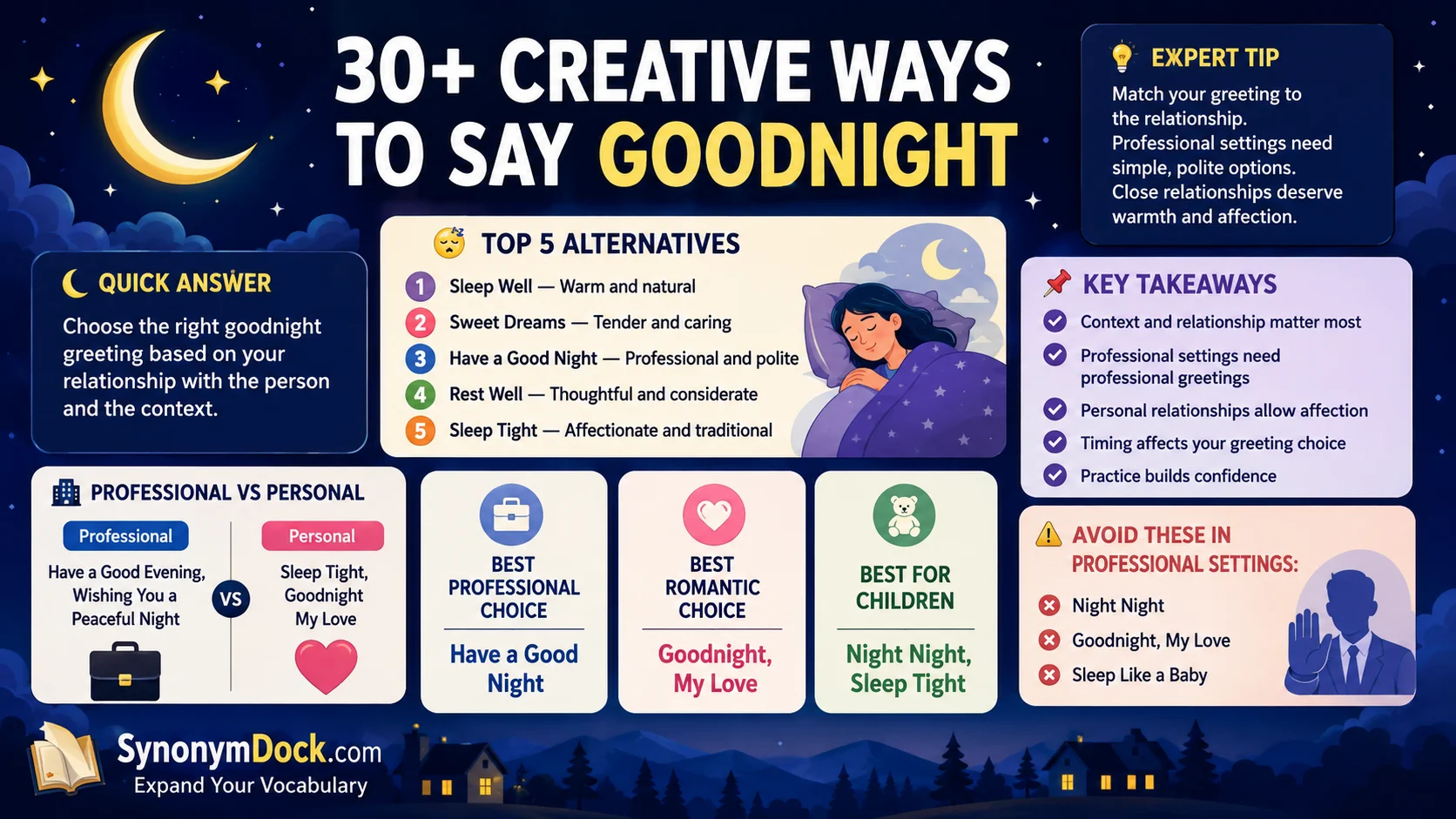
Looking for other ways to say goodnight? You can say Sleep Well, Sweet Dreams, Have a Good Night, Rest Well, or Sleep Tight. Choose the right alternative based on your relationship with the person and the context from romantic partners to professional colleagues.
Best alternatives: Sleep Well, Sweet Dreams, Have a Good Night, Rest Well, Sleep Tight.
Saying goodnight is a simple daily ritual—a small moment of connection at the end of the day. Yet repeating the same phrase every evening can sometimes feel predictable or uninspired. That’s why English learners and everyday speakers often search for other ways to say goodnight, especially when they want to sound warmer, more natural, thoughtful, or appropriate for a particular situation.
Learning different ways to say goodnight can make your communication more expressive and help you choose words that match the relationship and setting. Whether you’re saying goodbye to family, ending a conversation with a friend, sending a romantic text, or signing off from a professional conversation, knowing several ways to say good night gives you greater flexibility and confidence.
If you’re looking for good night synonyms, another word for good night, synonym goodnight, or good night other ways to say, it’s helpful to remember that not every alternative has exactly the same tone. Expressions such as “Sleep well,” “Sweet dreams,” and “Rest well” are warm and natural, while phrases such as “Have a restful evening” may sound more formal. For romantic conversations, “Dream of me” or “Goodnight, love” can feel more personal.
This guide presents 30+ meaningful alternatives to goodnight, covering casual, friendly, romantic, cute, professional, and thoughtful situations. Each expression includes a clear explanation, a practical example, and guidance on when it works best. Whether you’re searching for nice ways to say goodnight, good night in different ways, or simply want fresh ideas for everyday conversations, you’ll find natural options that fit a variety of contexts.
By understanding these ways to say good night, you can avoid repetitive wording while choosing expressions that communicate the right amount of warmth, affection, professionalism, or friendliness. The examples in this guide focus on standard English usage and real-world communication, helping you sound natural rather than overly formal or forced.
Quick Categories
Formal Alternatives
These greetings work well in professional settings, formal correspondence, and when addressing people you don’t know well.
- Have a Good Night
- Wishing You a Peaceful Evening
- May You Rest Well
- I Wish You a Good Night
- Pleasant Dreams
Pro Tip
Formal alternatives are ideal for professional emails, ending virtual meetings, and addressing clients or supervisors. They maintain professionalism while still showing consideration.
Professional Workplace Alternatives
Use these when saying goodnight to colleagues, managers, and business contacts.
- Have a Good Evening
- Wishing You a Restful Night
- Enjoy Your Evening
- Have a Good Rest
- All the Best for Tonight
Pro Tip
In workplace settings, keep your goodnight greetings professional but warm. Avoid overly familiar or romantic expressions, and focus on simple, clear well-wishes.
Business Email & Client Alternatives
These expressions are perfect for client communications, vendor relationships, and professional correspondence.
- Have a Good Night and See You Tomorrow
- Wishing You a Good Evening
- Have a Good Rest of Your Evening
- Wishing You a Peaceful Night
- Good Night and Best Wishes
Pro Tip
When emailing clients late in the day, a simple “Have a Good Evening” shows professionalism and courtesy without being overly familiar.
Academic & Writing Alternatives
These work well in essays, academic correspondence, and formal written communication.
- I Bid You Goodnight
- May You Have a Restful Night
- Wishing You a Good Night
- Pleasant Dreams
- Have a Peaceful Night
Pro Tip
In academic writing, maintain a respectful, clear tone. Traditional phrases like “Goodnight” or “Wishing You a Good Night” are universally appropriate.
Casual & Friendly Alternatives
These are perfect for friends, family, and people you know well.
- Sleep Well
- Sweet Dreams
- Night Night
- Have a Good One
- Catch You Tomorrow
Pro Tip
Casual greetings allow for more personality. Feel free to add personal touches like inside jokes or shared references to make them feel more genuine.
Romantic Expressions
Use these with a romantic partner, spouse, or someone you’re in a relationship with.
- Goodnight, My Love
- Sleep Tight, Darling
- Dream of Me
- Goodnight, Sweetheart
- Sleep Well, Beautiful
Pro Tip
Romantic goodnights should feel warm, affectionate, and genuine. Avoid overly cheesy phrases unless they fit your personal style and relationship dynamic.
“A simple goodnight can be the most meaningful moment of someone’s day.”
Common Mistakes to Avoid When Choosing Goodnight Greetings
Mistake #1: Using the same greeting for everyone
Many people say “goodnight” to everyone without considering the relationship or context. This can feel impersonal with close friends or too informal with professional contacts.
Correct: Match your greeting to your audience. Use “Sleep Well” with friends, “Have a Good Night” with colleagues, and “Goodnight, My Love” with a romantic partner.
Example:
Instead of “Goodnight” to a close friend, say “Sleep Well, talk tomorrow!”
Mistake #2: Using overly romantic phrases in professional settings
Saying “Goodnight, sweetheart” to a boss or “Dream of Me” to a colleague is inappropriate and can make people uncomfortable.
Correct: Keep professional settings strictly professional. “Have a Good Evening” or “Goodnight” are perfectly appropriate.
Example: “Goodnight everyone, have a good rest” works well for team meetings. Save “Sweet Dreams” for close friends.
Mistake #3: Forgetting to consider time zones
Saying “goodnight” to someone in a different time zone who isn’t going to sleep yet can be confusing.
Correct: Consider the recipient’s time zone before sending a goodnight message. If you’re unsure, “Hope you’re having a good evening” is a safer alternative.
Example: “I’m heading to bed now. Hope you’re having a great day!” acknowledges time differences.
Mistake #4: Being too formal with close friends
Saying “I Wish You a Good Night” to a close friend can sound stiff and unnatural. It lacks the warmth and familiarity that close relationships call for.
Correct: Use casual alternatives with friends. “Night Night” or “Sleep Tight” feel warm and natural.
Example: “Night Night, see you tomorrow!” sounds friendly and genuine with close friends.
Mistake #5: Using “Goodnight” too early or too late
Saying “goodnight” at 6 PM can be confusing, and saying it at 2 AM might sound dismissive.
Correct: Only use goodnight greetings when you know the person is going to sleep soon. Otherwise, “Have a Good Evening” works better.
Example: “Have a Good Evening” at 7 PM acknowledges the evening without assuming bedtime.
What Does “Goodnight” Mean?
Definition: “Goodnight” is a standard farewell used when someone is going to sleep or ending the day. It’s a way of wishing the other person a peaceful and restful night.
Grammar: “Goodnight” functions as an interjection or a noun. It’s often written as one word (“goodnight”) or two words (“good night”) depending on context. In modern usage, both are acceptable.
Simple Explanation: “Goodnight” means “I hope you sleep well and have a peaceful night.” It’s a warm way to end interactions that happen late in the day.
Example Sentence: “Goodnight, everyone sleep well and see you in the morning!”
When to Use “Goodnight”
Common Situations:
- Ending conversations in the evening
- Saying goodbye before someone goes to bed
- Signing off from late-night calls or messages
- Bidding farewell at social gatherings
- Concluding formal events or meetings
Business Context:
Use “Goodnight” or “Have a Good Evening” in professional settings when ending late meetings or calls. It’s appropriate with colleagues, clients, and supervisors.
Academic Context:
Formal academic settings often use “Goodnight” or “Have a Good Night” in closing remarks, especially in group study settings or evening classes.
Professional Emails:
“Have a Good Evening” or “Goodnight” are appropriate in late-night professional emails. They show courtesy while maintaining professionalism.
Daily Conversation:
“Goodnight” is the go-to greeting for everyday use. It’s natural, widely understood, and appropriate for most casual and formal situations.
Spoken English:
Use “Goodnight” freely in spoken English. It’s universally understood and naturally spoken by native speakers.
Written English:
“Goodnight” works well in texts, emails, and messages. Choose between “goodnight” and “good night” based on personal preference or style guide.
Formal:
“Goodnight” is neutral and can be used in formal contexts, but alternatives like “Have a Good Evening” may feel more polished.
Informal:
“Goodnight” is perfect for informal, everyday use. It’s simple, kind, and familiar.
The last words you say at night can be the first thoughts in someone’s mind.
Is It Professional or Polite?
Polite? ✔ Yes, “goodnight” is a kind and thoughtful way to end interactions.
Professional? ✔ Yes, in appropriate contexts. It’s commonly used in professional settings to end evening meetings, calls, or communications.
Formal? ✔ Sometimes. While “goodnight” is neutral, other alternatives like “May You Rest Well” are more formal.
Natural? ✔ Yes. Native speakers use “goodnight” naturally in daily life.
Business Context Example:
“Goodnight, everyone. I’ll see you all at the meeting tomorrow morning.” → This is appropriate for ending a late call or meeting.
Pros and Cons of “Goodnight”
Pros
- Universally understood: Everyone knows what “goodnight” means.
- Warm and friendly: It conveys genuine care and goodwill.
- Versatile: It works in almost all contexts.
- Easy to use: The phrase is simple, natural, and easy for English learners.
Cons
- Overused: “Goodnight” can feel repetitive and generic.
- Lack of variety: Using “goodnight” exclusively shows limited vocabulary.
- Can feel impersonal: It doesn’t convey the warmth of other alternatives.
- Time-specific: It only works at the end of the day.
30+ Creative Alternatives to Say Goodnight
The following alternatives will help you express goodnight wishes in ways that feel more thoughtful, professional, or appropriate for different situations. Each option includes clear guidance on when to use it and what tone it conveys.
Let’s begin with the most useful alternatives, starting with the safest and most professional options.
[1]. Phrase: Sleep Well
Meaning: A warm, simple greeting wishing someone a peaceful and restful sleep.
Explanation: “Sleep Well” is one of the most common alternatives to goodnight. Native speakers use it frequently because it’s natural, warm, and works in many contexts. It’s safe for both casual and professional settings, making it a great all-purpose choice.
Example Sentence: “Sleep well and I’ll see you in the morning!
Best Use: Family, Friends, Colleagues, General Use
Avoid Using In: Extremely Formal Settings
Tone: Warm, Caring, Natural
Formality Level: ⭐⭐⭐ (Neutral)
Usage Frequency: Very Common
CEFR Level: A2
Common Collocations:
- Sleep well and sweet dreams
- Sleep well tonight
- Hope you sleep well
- Sleep well, see you tomorrow
Context Variability:
- Spoken English: “Sleep well, don’t let the bed bugs bite!”
- Professional English: “Sleep well we have a big meeting tomorrow.”
- Casual Conversation: “Sleep well, catch you later!”
[2]. Phrase: Sweet Dreams
Meaning: A warm and gentle greeting expressing hope for pleasant and happy dreams.
Explanation: “Sweet Dreams” is a classic and widely used alternative. It feels soft, kind, and caring. Native speakers often use it with children, family, and close friends. It works beautifully in personal contexts and adds a touch of tenderness to your goodnight wishes.
Example Sentence: “Sweet dreams, my dear. I’ll be thinking of you.”
Best Use: Family, Children, Close Friends, Romantic Partners
Avoid Using In: Professional Settings, Business Communication
Tone: Warm, Tender, Caring
Formality Level: ⭐⭐ (Casual)
Usage Frequency: Very Common
CEFR Level: A2
Common Collocations:
- Sweet dreams and sleep tight
- Sweet dreams, see you in the morning
- Have sweet dreams
- Sweet dreams, I love you
Context Variability:
- Spoken English: “Sweet dreams, sweetheart!”
- Professional English: (avoid in professional settings)
- Casual Conversation: “Sweet dreams! Text me tomorrow.”
[3]. Phrase: Have a Good Night
Meaning: A friendly and widely accepted greeting wishing someone a pleasant and restful night.
Explanation: “Have a Good Night” is slightly more thoughtful than a simple “goodnight.” It sounds more complete and works well in most contexts. Native speakers use this frequently in both casual and professional settings.
Example Sentence: “Have a good night and thanks for a wonderful evening!
Best Use: Friends, Colleagues, General Use, Professional Settings
Avoid Using In: Extremely Informal Settings
Tone: Friendly, Professional, Warm
Formality Level: ⭐⭐⭐ (Neutral)
Usage Frequency: Very Common
CEFR Level: A1
Common Collocations:
- Have a good night’s sleep
- Have a good night and a great tomorrow
- Hope you have a good night
- Have a good night, see you soon
Context Variability:
- Spoken English: “Have a good night, talk to you soon!”
- Professional English: “Have a good night, everyone see you at the meeting.”
- Casual Conversation: “Have a good night! Sweet dreams.”
[4]. Phrase: Rest Well
Meaning: A caring greeting wishing someone a peaceful and restorative night of rest.
Explanation: “Rest Well” focuses on the restorative aspect of sleep. It’s particularly useful when someone has had a long day, is tired, or needs to recover from illness. Native speakers use this to show genuine care and concern.
Example Sentence: “Rest well tonight you deserve it after all your hard work today.”
Best Use: Tired Friends, Colleagues, People Who Are Unwell
Avoid Using In: Very Formal Settings
Tone: Caring, Considerate, Warm
Formality Level: ⭐⭐⭐ (Neutral)
Usage Frequency: Common
CEFR Level: B1
Common Collocations:
- Rest well and feel better
- Rest well, you’ve earned it
- Get some rest and rest well
- Rest well tonight
Context Variability:
- Spoken English: “Rest well, you need it.”
- Professional English: “Rest well we’ve got a big day tomorrow.”
- Casual Conversation: “Rest well, hope you feel better in the morning.”
[5]. Phrase: Sleep Tight
Meaning: A classic, affectionate greeting wishing someone a sound and comfortable sleep.
Explanation: “Sleep Tight” is an old-fashioned yet beloved alternative to goodnight. It’s often used with children and close family members. Native speakers use it to add warmth and a touch of tradition to their goodnight wishes.
Example Sentence: “Sleep tight and don’t let the bed bugs bite!”
Best Use: Children, Family, Close Friends, Romantic Partners
Avoid Using In: Professional Settings, Business Communication
Tone: Warm, Affectionate, Traditional
Formality Level: ⭐⭐ (Casual)
Usage Frequency: Very Common
CEFR Level: A2
Common Collocations:
- Sleep tight, see you in the morning
- Sleep tight and sweet dreams
- Sleep tight, little one
- Sleep tight, love
Context Variability:
- Spoken English: “Sleep tight, my precious!”
- Professional English: (avoid in professional settings)
- Casual Conversation: “Sleep tight, talk tomorrow!”
“The words you say at bedtime stay with people all night long.”
[6]. Phrase: Night Night
Meaning: A playful, affectionate, and childlike version of “goodnight.”
Explanation: “Night Night” is a sweet, repetitive greeting often used with young children. Native speakers also use it affectionately with romantic partners, close friends, and family members. It feels playful and loving.
Example Sentence: “Night night, my sweetheart. I love you!”
Best Use: Children, Romantic Partners, Close Family
Avoid Using In: Professional Settings, Adults You Don’t Know Well
Tone: Playful, Affectionate, Childlike
Formality Level: ⭐ (Very Casual)
Usage Frequency: Very Common (with children)
CEFR Level: A1
Common Collocations:
- Night night, sleep tight
- Night night, see you in the morning
- Night night, I love you
- Night night, don’t let the bed bugs bite
Context Variability:
- Spoken English: “Night night, baby. Sleep well.”
- Professional English: (never)
- Casual Conversation: “Night night! I’ll call you tomorrow.”
[7]. Phrase: Have a Good Rest
Meaning: A kind greeting wishing someone a peaceful and restorative period of rest.
Explanation: “Have a Good Rest” is more specific than “goodnight” because it focuses on rest rather than just the nighttime. Native speakers use this when someone is tired, unwell, or needs to recharge. It shows you care about their wellbeing.
Example Sentence: “Have a good rest you’ve been working so hard lately.
Best Use: Tired Colleagues, Friends, People Who Are Unwell
Avoid Using In: Extremely Formal Settings
Tone: Caring, Practical, Warm
Formality Level: ⭐⭐⭐ (Neutral)
Usage Frequency: Common
CEFR Level: A2
Common Collocations:
- Have a good rest and feel better
- Have a good rest tonight
- Have a good rest, see you tomorrow
- Have a good rest, you deserve it
Context Variability:
- Spoken English: “Have a good rest, hope you feel better.”
- Professional English: “Have a good rest you’ve earned it this week.”
- Casual Conversation: “Have a good rest! Sleep well.”
[8]. Phrase: Goodnight, My Love
Meaning: An affectionate greeting for a romantic partner, expressing love and care at bedtime.
Explanation: “Goodnight, My Love” is a warm, intimate alternative. Native speakers use this with romantic partners, spouses, and people they share a deep emotional connection with. It’s personal and carries emotional weight.
Example Sentence: “Goodnight, my love. I can’t wait to see you tomorrow.”
Best Use: Romantic Partners, Spouses
Avoid Using In: Friends, Colleagues, Professional Settings
Tone: Romantic, Intimate, Affectionate
Formality Level: ⭐⭐ (Casual)
Usage Frequency: Very Common (Romantic)
CEFR Level: A2
Common Collocations:
- Goodnight, my love, sleep well
- Goodnight, my love, I miss you
- Goodnight, my beautiful love
- Goodnight, my love, sweet dreams
Context Variability:
- Spoken English: “Goodnight, my love. I love you so much.”
- Professional English: (never)
- Casual Conversation: “Goodnight, my love. Text me when you wake up.”
[9]. Phrase: Sleep Well, See You Tomorrow
Meaning: Combining a sleep wish with anticipation for seeing the person the next day.
Explanation: This greeting acknowledges both the present moment and the future. Native speakers use this when they know they’ll see the person the next day at work, school, or social events. It’s friendly and forward-looking.
Example Sentence: “Sleep well, see you tomorrow I’m looking forward to it!”
Best Use: Colleagues, Classmates, Friends
Avoid Using In: Extremely Formal Settings
Tone: Friendly, Forward-Looking, Warm
Formality Level: ⭐⭐⭐ (Neutral)
Usage Frequency: Very Common
CEFR Level: A2
Common Collocations:
- Sleep well and see you tomorrow
- Sleep well, see you at work
- Sleep well, see you in the morning
- Sleep well, can’t wait to see you tomorrow
Context Variability:
- Spoken English: “Sleep well, see you tomorrow at school!”
- Professional English: “Sleep well, see you at the 9 AM meeting.”
- Casual Conversation: “Sleep well, see you tomorrow! Night.”
[10]. Phrase: Pleasant Dreams
Meaning: A slightly formal greeting expressing hope for enjoyable and peaceful dreams.
Explanation: “Pleasant Dreams” is a gentle, somewhat old-fashioned alternative to “sweet dreams.” Native speakers use this when they want a more polished or traditional expression. It works well in formal and semi-formal contexts.
Example Sentence: “Pleasant dreams to you may your night be peaceful and restful.”
Best Use: Formal Settings, Older Adults, Traditional Contexts
Avoid Using In: Very Casual Settings
Tone: Gentle, Formal, Traditional
Formality Level: ⭐⭐⭐⭐ (Formal)
Usage Frequency: Occasional
CEFR Level: B1
Common Collocations:
- Pleasant dreams and goodnight
- Wishing you pleasant dreams
- Pleasant dreams, sleep well
- May you have pleasant dreams
Context Variability:
- Spoken English: “Pleasant dreams, and we’ll see you in the morning.”
- Professional English: “Pleasant dreams have a restful night.”
- Casual Conversation: “Pleasant dreams! Talk soon.”
“A goodnight greeting is a small act of kindness that costs nothing but means everything.”
[11]. Phrase: Catch You Tomorrow
Meaning: A casual, informal greeting that looks forward to seeing someone the next day.
Explanation: “Catch You Tomorrow” is a modern, friendly alternative. Native speakers use this with friends and people they see regularly. It doesn’t directly mention sleep or rest but implies the day is ending and tomorrow is coming.
Example Sentence: “Catch you tomorrow have a great night!”
Best Use: Friends, Classmates, Colleagues in Casual Settings
Avoid Using In: Formal Settings, Professional Emails
Tone: Casual, Friendly, Modern
Formality Level: ⭐⭐ (Casual)
Usage Frequency: Very Common
CEFR Level: A2
Common Collocations:
- Catch you tomorrow, sleep well
- Catch you tomorrow, have a good night
- Catch you tomorrow, see you then
- Catch you tomorrow, goodnight
Context Variability:
- Spoken English: “Catch you tomorrow! Have a good one.”
- Professional English: “Catch you tomorrow, sleep well.” (with familiar colleagues)
- Casual Conversation: “Catch you tomorrow, text me if you need anything.”
[12]. Phrase: Wishing You a Peaceful Night
Meaning: A formal, thoughtful greeting expressing hope for a calm and restful night.
Explanation: “Wishing You a Peaceful Night” sounds polished and considerate. Native speakers use this when they want to show extra care, especially in professional or formal contexts. The word “peaceful” adds a sense of calm.
Example Sentence: “Wishing you a peaceful night thank you for your hard work today.
Best Use: Professional Settings, Formal Correspondence, Clients
Avoid Using In: Very Casual Settings
Tone: Formal, Caring, Considerate
Formality Level: ⭐⭐⭐⭐ (Formal)
Usage Frequency: Common
CEFR Level: B1
Common Collocations:
- Wishing you a peaceful night and restful sleep
- Wishing you a peaceful night, goodnight
- Wishing you a peaceful and restorative night
- Wishing you a peaceful night, see you tomorrow
Context Variability:
- Spoken English: “Wishing you a peaceful night, everyone.”
- Professional English: “Wishing you a peaceful night after a busy day.”
- Casual Conversation: “Wishing you a peaceful night! Sleep well.”
[13]. Phrase: Have a Good Evening
Meaning: A friendly greeting that focuses on the remaining part of the evening rather than specifically bedtime.
Explanation: “Have a Good Evening” is useful when it’s evening but you’re not sure if the person is going to sleep soon. Native speakers use this in professional settings, with acquaintances, and when goodnight might be too specific. It’s both polite and versatile.
Example Sentence: “Have a good evening I’ll follow up with you in the morning.”
Best Use: Professional Settings, Business Emails, Formal Conversations
Avoid Using In: Very Late Nights, Bedtime Settings
Tone: Professional, Polite, Friendly
Formality Level: ⭐⭐⭐ (Neutral)
Usage Frequency: Very Common
CEFR Level: A2
Common Collocations:
- Have a good evening and enjoy your night
- Have a good evening, see you tomorrow
- Have a good evening, take care
- Have a good evening, talk soon
Context Variability:
- Spoken English: “Have a good evening, see you at the party!”
- Professional English: “Have a good evening I’ll send you the report in the morning.”
- Casual Conversation: “Have a good evening! Enjoy your dinner.”
[14]. Phrase: Night Night, Sleep Tight
Meaning: A classic, rhyming goodnight greeting that’s playful and affectionate.
Explanation: This traditional rhyme is often used with children but works for adults in close relationships. Native speakers find it charming and endearing. The rhyme makes it memorable and fun.
Example Sentence: “Night night, sleep tight don’t let the bed bugs bite!”
Best Use: Children, Romantic Partners, Close Friends
Avoid Using In: Professional Settings, Acquaintances
Tone: Playful, Affectionate, Traditional
Formality Level: ⭐ (Very Casual)
Usage Frequency: Very Common (with children)
CEFR Level: A2
Common Collocations:
- Night night, sleep tight, see you in the morning light
- Night night, sleep tight, I love you
- Night night, sleep tight, sweet dreams
- Night night, sleep tight, don’t let the bed bugs bite
Context Variability:
- Spoken English: “Night night, sleep tight, my precious!”
- Professional English: (never)
- Casual Conversation: “Night night, sleep tight! Love you.”
[15]. Phrase: I Wish You a Good Night
Meaning: A polite and slightly formal greeting expressing good wishes for the night ahead.
Explanation: “I Wish You a Good Night” is more formal than “goodnight” because it uses a complete sentence structure. Native speakers use this in professional correspondence, formal interactions, and when they want to sound particularly courteous.
Example Sentence: “I wish you a good night speak with you tomorrow.”
Best Use: Formal Settings, Professional Emails, Polite Conversations
Avoid Using In: Very Casual Settings
Tone: Formal, Polite, Courteous
Formality Level: ⭐⭐⭐⭐ (Formal)
Usage Frequency: Common
CEFR Level: A2
Common Collocations:
- I wish you a good night and restful sleep
- I wish you a good night, goodnight
- I wish you a good night, see you tomorrow
- I wish you a good night and a great day tomorrow
Context Variability:
- Spoken English: “I wish you a good night enjoy the rest of your evening.”
- Professional English: “I wish you a good night. I’ll be available again at 8 AM.”
- Casual Conversation: “I wish you a good night! Sweet dreams.”
[16]. Phrase: May You Rest Well
Meaning: A formal and slightly poetic greeting expressing hope for good rest.
Explanation: “May You Rest Well” is elegant and slightly old-fashioned. Native speakers use this in formal writing, blessings, and sincere goodnight wishes. The word “may” adds a sense of hope and intention.
Example Sentence: “May you rest well and wake up feeling refreshed and ready for the day ahead.”
Best Use: Formal Settings, Blessings, Special Occasions
Avoid Using In: Casual Conversations
Tone: Formal, Poetic, Sincere
Formality Level: ⭐⭐⭐⭐ (Formal)
Usage Frequency: Occasional
CEFR Level: B1
Common Collocations:
- May you rest well and have peaceful dreams
- May you rest well tonight
- May you rest well, goodnight
- May you rest well and wake up restored
Context Variability:
- Spoken English: “May you rest well, and we’ll see you tomorrow.”
- Professional English: “May you rest well and be ready for the new day.”
- Casual Conversation: “May you rest well! Sleep tight.”
“The words you choose at night shape the mood of someone’s evening.”
[17]. Phrase: Get Some Rest
Meaning: A practical, caring greeting encouraging someone to take time to rest.
Explanation: “Get Some Rest” is direct, simple, and caring. Native speakers use this when they notice someone is tired or stressed. It’s less about wishing well and more about giving helpful advice.
Example Sentence: “Get some rest you’ve had a long day and you deserve it.”
Best Use: Friends, Colleagues, People Who Are Tired
Avoid Using In: Extremely Formal Settings
Tone: Caring, Practical, Direct
Formality Level: ⭐⭐⭐ (Neutral)
Usage Frequency: Very Common
CEFR Level: A2
Common Collocations:
- Get some rest and feel better
- Get some rest, you need it
- Get some rest, goodnight
- Get some rest, see you tomorrow
Context Variability:
- Spoken English: “Get some rest you look exhausted.”
- Professional English: “Get some rest, we’ll tackle this tomorrow.”
- Casual Conversation: “Get some rest! Night.”
[18]. Phrase: Goodnight and God Bless
Meaning: A religious greeting combining goodnight wishes with a spiritual blessing.
Explanation: “Goodnight and God Bless” is used by religious individuals when saying goodnight. Native speakers use this in faith communities, with family members who share their beliefs, and in religious contexts. It adds a spiritual dimension to the goodnight wish.
Example Sentence: “Goodnight and God bless you and your family.”
Best Use: Religious Contexts, Family, Faith Communities
Avoid Using In: Professional Settings, Diverse Groups
Tone: Spiritual, Caring, Traditional
Formality Level: ⭐⭐⭐ (Neutral)
Usage Frequency: Common (Religious)
CEFR Level: B1
Common Collocations:
- Goodnight and God bless you
- Goodnight and God bless, sleep well
- Goodnight and God bless you all
- Goodnight and God bless, sweet dreams
Context Variability:
- Spoken English: “Goodnight and God bless, my dear.”
- Professional English: (avoid unless appropriate)
- Casual Conversation: “Goodnight and God bless! Talk tomorrow.”
[19]. Phrase: Have a Peaceful Sleep
Meaning: A warm, caring greeting wishing someone calm and undisturbed sleep.
Explanation: “Have a Peaceful Sleep” is specific and thoughtful. Native speakers use this when they want to emphasize calm and tranquility. It’s particularly suitable for people who are anxious or stressed.
Example Sentence: “Have a peaceful sleep everything will seem better in the morning.”
Best Use: Friends, Anxious People, Thoughtful Settings
Avoid Using In: Very Casual Settings
Tone: Warm, Calm, Caring
Formality Level: ⭐⭐⭐ (Neutral)
Usage Frequency: Common
CEFR Level: B1
Common Collocations:
- Have a peaceful sleep and sweet dreams
- Have a peaceful sleep, goodnight
- Have a peaceful sleep, relax and rest
- Have a peaceful sleep, see you tomorrow
Context Variability:
- Spoken English: “Have a peaceful sleep you need it.”
- Professional English: “Have a peaceful sleep and I’ll speak with you tomorrow.”
- Casual Conversation: “Have a peaceful sleep! Night.”
[20]. Phrase: Goodnight, Take Care
Meaning: Combining goodnight wishes with a caring farewell that emphasizes looking after oneself.
Explanation: “Goodnight, Take Care” adds a protective, caring element to the standard goodnight. Native speakers use this when they want to show genuine concern for someone’s wellbeing. It feels warm and responsible.
Example Sentence: “Goodnight, take care of yourself and get some rest.”
Best Use: Friends, Family, Caring Conversations
Avoid Using In: Extremely Formal Settings
Tone: Caring, Warm, Protective
Formality Level: ⭐⭐⭐ (Neutral)
Usage Frequency: Very Common
CEFR Level: A2
Common Collocations:
- Goodnight, take care and sleep well
- Goodnight, take care of yourself
- Goodnight, take care, see you soon
- Goodnight, take care, I love you
Context Variability:
- Spoken English: “Goodnight, take care see you in the morning.”
- Professional English: “Goodnight, take care have a good weekend.”
- Casual Conversation: “Goodnight, take care! Text me when you’re home.”
Native Speaker Tip
After 20 alternatives, here’s what native speakers want you to know: The best goodnight greeting depends entirely on your relationship with the person. With close friends and family, affectionate expressions like “Sleep Tight” or “Sweet Dreams” feel natural. With colleagues and professional contacts, “Have a Good Night” or “Have a Good Evening” are safer and more appropriate. And with romantic partners, “Goodnight, My Love” adds the perfect touch of intimacy.
Remember that goodnight greetings are about connection, not just words. The tone and sincerity of your delivery matter just as much as the phrase you choose.
[21]. Phrase: Sleep Like a Baby
Meaning: A warm, affectionate greeting wishing someone deep, restful, and peaceful sleep.
Explanation: “Sleep Like a Baby” is a charming and widely understood expression. Native speakers use this to wish someone a deep, trouble-free sleep. It’s particularly common with parents and children but works for anyone.
Example Sentence: “Sleep like a baby I hope you get the best rest of your life.”
Best Use: Friends, Family, Children
Avoid Using In: Professional Settings
Tone: Warm, Affectionate, Playful
Formality Level: ⭐⭐ (Casual)
Usage Frequency: Common
CEFR Level: A2
Common Collocations:
- Sleep like a baby and sweet dreams
- Sleep like a baby, goodnight
- Sleep like a baby, you deserve it
- Sleep like a baby, see you tomorrow
Context Variability:
- Spoken English: “Sleep like a baby, my love!”
- Professional English: (avoid in professional settings)
- Casual Conversation: “Sleep like a baby! Night.”
[22]. Phrase: Have a Good Night’s Rest
Meaning: A specific greeting focusing on the full night’s sleep rather than the evening.
Explanation: “Have a Good Night’s Rest” emphasizes the entirety of sleep. Native speakers use this when they want to highlight the importance of quality sleep. It works well in professional and formal contexts.
Example Sentence: “Have a good night’s rest you’ve earned it!”
Best Use: Professional Settings, Formal Conversations, Caring Messages
Avoid Using In: Very Casual Settings
Tone: Professional, Caring, Specific
Formality Level: ⭐⭐⭐⭐ (Formal)
Usage Frequency: Common
CEFR Level: B1
Common Collocations:
- Have a good night’s rest and wake up refreshed
- Have a good night’s rest, goodnight
- Have a good night’s rest, see you tomorrow
- Have a good night’s rest, you need it
Context Variability:
- Spoken English: “Have a good night’s rest you’ve earned it.”
- Professional English: “Have a good night’s rest and we’ll continue tomorrow.”
- Casual Conversation: “Have a good night’s rest! Sleep well.”
[23]. Phrase: Goodnight, Sleep Well
Meaning: A warm combination of two classic goodnight greetings.
Explanation: This combination is direct and complete. Native speakers use this when they want to cover both the greeting and the wish for good sleep. It’s simple, effective, and works in many contexts.
Example Sentence: “Goodnight, sleep well I’ll talk to you in the morning.”
Best Use: Friends, Family, Colleagues, General Use
Avoid Using In: Extremely Formal Settings
Tone: Warm, Complete, Friendly
Formality Level: ⭐⭐⭐ (Neutral)
Usage Frequency: Very Common
CEFR Level: A1
Common Collocations:
- Goodnight, sleep well, see you tomorrow
- Goodnight, sleep well, sweet dreams
- Goodnight, sleep well, I love you
- Goodnight, sleep well, take care
Context Variability:
- Spoken English: “Goodnight, sleep well, everyone!”
- Professional English: “Goodnight, sleep well we’ll connect tomorrow.”
- Casual Conversation: “Goodnight, sleep well! Talk soon.”
[24]. Phrase: May Your Dreams Be Sweet
Meaning: A poetic and formal greeting expressing hope for pleasant and enjoyable dreams.
Explanation: “May Your Dreams Be Sweet” is an elegant and slightly old-fashioned expression. Native speakers use this in cards, formal messages, and when they want to sound especially thoughtful. It’s beautiful and memorable.
Example Sentence: “May your dreams be sweet and your night be peaceful.”
Best Use: Formal Cards, Thoughtful Messages, Special Occasions
Avoid Using In: Casual Conversations
Tone: Poetic, Formal, Thoughtful
Formality Level: ⭐⭐⭐⭐ (Formal)
Usage Frequency: Occasional
CEFR Level: B1
Common Collocations:
- May your dreams be sweet and your rest peaceful
- May your dreams be sweet, goodnight
- May your dreams be sweet and full of joy
- May your dreams be sweet, sleep well
Context Variability:
- Spoken English: “May your dreams be sweet goodnight.”
- Professional English: “May your dreams be sweet and the new day bring you success.”
- Casual Conversation: “May your dreams be sweet! Night.”
[25]. Phrase: Enjoy Your Evening
Meaning: A friendly greeting encouraging someone to enjoy the rest of their evening.
Explanation: “Enjoy Your Evening” is useful when it’s not yet bedtime. Native speakers use this when they’re ending a conversation but know the person will stay awake longer. It’s polite, friendly, and works well in professional settings.
Example Sentence: “Enjoy your evening I’ll see you tomorrow at the office.”
Best Use: Professional Settings, Social Gatherings, General Use
Avoid Using In: Bedtime Settings
Tone: Friendly, Polite, Professional
Formality Level: ⭐⭐⭐ (Neutral)
Usage Frequency: Very Common
CEFR Level: A2
Common Collocations:
- Enjoy your evening and see you tomorrow
- Enjoy your evening, take care
- Enjoy your evening, goodnight
- Enjoy your evening, have fun
Context Variability:
- Spoken English: “Enjoy your evening see you at the party!”
- Professional English: “Enjoy your evening I’ll email you in the morning.”
- Casual Conversation: “Enjoy your evening! Have a great time.”
A caring goodnight is one of the simplest ways to show someone you value them.
Top 10 Alternatives Compared
| Phrase | Tone | Formality | Best Use | Frequency |
|---|---|---|---|---|
| Sleep Well | Warm, Caring | ⭐⭐⭐ Neutral | General Use | Very Common |
| Sweet Dreams | Warm, Tender | ⭐⭐ Casual | Family, Friends | Very Common |
| Have a Good Night | Friendly, Warm | ⭐⭐⭐ Neutral | General, Professional | Very Common |
| Rest Well | Caring, Considerate | ⭐⭐⭐ Neutral | Tired People | Common |
| Sleep Tight | Affectionate, Traditional | ⭐⭐ Casual | Children, Family | Very Common |
| Have a Good Evening | Professional, Polite | ⭐⭐⭐ Neutral | Professional Settings | Very Common |
| Wishing You a Peaceful Night | Formal, Caring | ⭐⭐⭐⭐ Formal | Formal Settings | Common |
| Goodnight, My Love | Romantic, Intimate | ⭐⭐ Casual | Romantic Partners | Very Common |
| Pleasant Dreams | Gentle, Formal | ⭐⭐⭐⭐ Formal | Formal Settings | Occasional |
| Catch You Tomorrow | Casual, Friendly | ⭐⭐ Casual | Friends | Very Common |
Which One Should You Use?
Best Overall: Have a Good Night
This greeting is safe, professional, and warm works in almost every context.
Best Professional: Have a Good Evening
Professional and polished, perfect for workplace interactions and business settings.
Best Academic: Wishing You a Peaceful Night
Thoughtful and respectful, appropriate for academic and formal contexts.
Best Business Email: Have a Good Evening
Polite, professional, and works perfectly for late-day correspondence.
Best Everyday Conversation: Sleep Well
Natural, warm, and widely used by native speakers in daily life.
Most Natural: Goodnight
Simple, classic, and universally understood always appropriate.
Most Affectionate: Goodnight, My Love
Perfect for expressing love and warmth to a romantic partner.
Best for Children: Sleep Tight
Traditional and warm, used by native speakers with children everywhere.
Most Thoughtful: Rest Well
Shows genuine care for someone’s wellbeing and rest.
Commonly Confused Phrases
“Goodnight” vs. “Good Evening”
“Goodnight” is for when someone is going to sleep. “Good Evening” is for when you’re simply ending a conversation but the person will stay awake longer. Use the right one based on timing.
“Sleep Well” vs. “Rest Well”
“Sleep Well” is more general and focuses on sleep. “Rest Well” emphasizes rest and recovery, making it more specific and caring.
“Sweet Dreams” vs. “Pleasant Dreams”
“Sweet Dreams” is casual and common. “Pleasant Dreams” is more formal and traditional. Choose based on the level of formality.
“Sleep Tight” vs. “Night Night”
“Sleep Tight” is traditional and affectionate. “Night Night” is childlike and playful. Use both carefully based on your relationship.
Scenario Practice
Scenario 1: Ending a professional email to a client at 9 PM
You’ve just finished a late-night email exchange with a client about an important project.
Which phrase would you choose? “Have a Good Evening” or “Wishing You a Peaceful Night”
Why this works: Both are professional and show respect. They acknowledge the hour without assuming the client is going to sleep.
Scenario 2: Saying goodnight to your partner
You’re ending a phone call with your partner before bed.
Which phrase would you choose? “Goodnight, My Love” or “Sleep Tight, Darling”
Why this works: These greetings show affection and warmth, perfect for a romantic partner.
Scenario 3: Saying goodnight to a child
Your child is going to bed and you want to tuck them in with love.
Which phrase would you choose? “Night Night, Sleep Tight” or “Sweet Dreams”
Why this works: These are gentle, affectionate greetings that children understand and appreciate.
Scenario 4: Ending a late meeting with colleagues
You’re finishing a long evening meeting and want to say goodnight to your team.
Which phrase would you choose? “Have a Good Night” or “Get Some Rest”
Why this works: These greetings are professional, caring, and appropriate for workplace settings.
Scenario 5: Saying goodnight to a friend who’s been sick
Your friend has been unwell, and you want to send them a thoughtful goodnight message.
Which phrase would you choose? “Rest Well” or “Have a Peaceful Sleep”
Why this works: These greetings show genuine care and focus on recovery and wellbeing.
Mini Quiz
Question 1: Which greeting is most appropriate for a professional email to a client?
A) Night Night
B) Sleep Tight
C) Have a Good Evening
D) Goodnight, My Love
Question 2: Which greeting should you use with a romantic partner?
A) Have a Good Evening
B) Goodnight, My Love
C) Catch You Tomorrow
D) Pleasant Dreams
Question 3: Which phrase is best for ending a conversation at 7 PM when the person will stay awake?
A) Goodnight
B) Sleep Well
C) Have a Good Evening
D) Rest Well
Question 4: Which greeting is most affectionate and traditional for children?
A) Catch You Tomorrow
B) Sleep Tight
C) Wishing You a Peaceful Night
D) Goodnight, Take Care
Question 5: Which phrase shows the most care for someone who’s tired?
A) Night Night
B) Goodnight, Sleep Well
C) Rest Well
D) Pleasant Dreams
Answer Key
Question 1: C) Have a Good Evening
This greeting is professional, polite, and appropriate for client emails.Question 2: B) Goodnight, My Love
This greeting is personal and affectionate, perfect for romantic partners.Question 3: C) Have a Good Evening
This focuses on the evening rather than bedtime, making it appropriate for earlier hours.Question 4: B) Sleep Tight
This traditional, affectionate greeting is beloved by children and parents alike.Question 5: C) Rest Well
This shows genuine care and focuses on the recovery aspect of sleep.
FAQs
What is the most formal way to say “goodnight”?
The most formal alternatives are “Wishing You a Peaceful Night,” “May You Rest Well,” and “I Wish You a Good Night.” These greetings use complete sentences, sound polite, and work well in professional correspondence. They’re ideal for formal letters, professional emails, and formal interactions.
Which phrase is best for professional emails?
“Have a Good Evening” and “Have a Good Night” are excellent choices for professional emails. They’re polite, professional, and appropriate for late-day correspondence. They show courtesy without being overly familiar, making them perfect for business communication.
What is the difference between “Goodnight” and “Good Evening”?
“Goodnight” is used when someone is going to sleep or ending their day. “Good Evening” is used when you’re ending a conversation but the person will stay awake. “Goodnight” implies bedtime, while “Good Evening” simply acknowledges the time of day.
Which alternative sounds most natural?
“Goodnight” remains the most natural and widely used greeting. “Sleep Well” is also extremely natural and common. Native speakers use both regularly, so you can’t go wrong with either choice.
Can I use these expressions in business meetings?
Yes, but choose carefully. “Have a Good Evening” and “Have a Good Night” are appropriate for business meetings. Avoid casual expressions like “Night Night” or romantic expressions like “Goodnight, My Love” in professional settings.
Conclusion
Learning other ways to say goodnight enriches your English vocabulary and helps you express warmth and care in different situations. Whether you’re saying goodnight to a colleague, a friend, a family member, or a romantic partner, choosing the right phrase shows thoughtfulness and cultural awareness.
The key to effective goodnight greetings is matching your expression to your audience. Professional settings call for polished, neutral options like “Have a Good Evening.” Personal relationships allow for warmer, more affectionate expressions like “Sweet Dreams” or “Goodnight, My Love.” By building a diverse vocabulary of goodnight greetings, you’ll sound more natural and confident in every situation.
Don’t be afraid to experiment with different greetings this week. Practice using new expressions with different people and notice how they respond. With time and practice, choosing the perfect goodnight greeting will become second nature and your English will feel richer and more fluent than ever before.

1 thought on “Other Ways to Say Goodnight |30+ Examples And 2026 Guide”