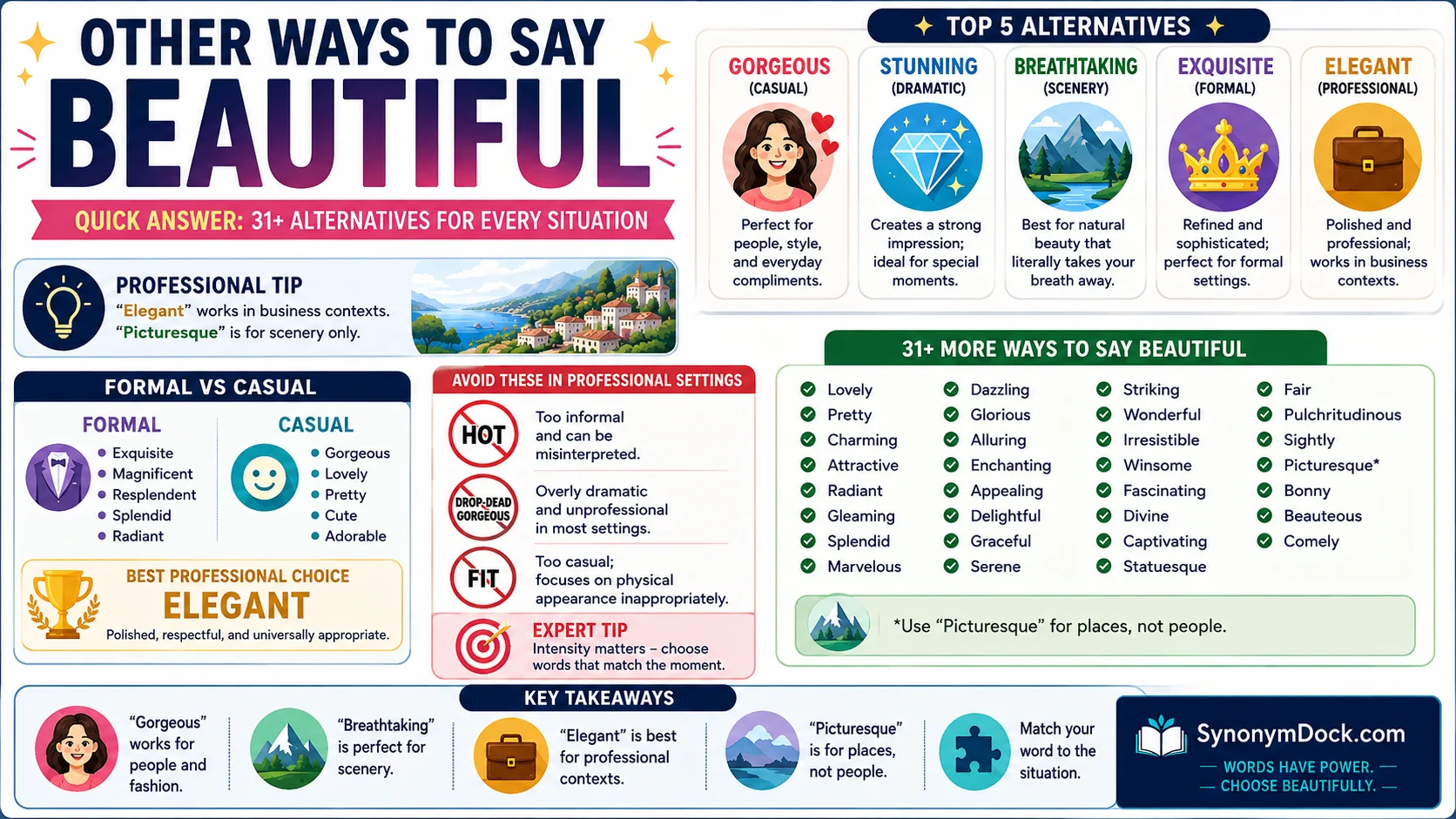
Looking for other ways to say beautiful? Try “gorgeous” for people, “stunning” for impactful impressions, “breathtaking” for scenery, “exquisite” for fine details, or “ravishing” for a romantic tone. The best alternatives include: gorgeous, stunning, breathtaking, exquisite, ravishing, captivating, alluring, magnificent, picturesque, and elegant.
“Beautiful” is a wonderful word. But using it for everything – from sunsets to people to art – makes your English sound repetitive and basic.
Whether you’re writing a love letter, describing a vacation destination, or complimenting a colleague’s work, having other ways to say beautiful helps you express yourself more precisely. The right alternative can capture exactly what you mean and leave a lasting impression. This article explores 15+ powerful alternatives to “beautiful” organized by tone and situation, so you can choose the perfect expression with confidence.
Quick Categories
Formal Alternatives
- Exquisite
- Resplendent
- Magnificent
- Splendid
- Opulent
Pro Tip: Formal alternatives work beautifully in academic writing, formal speeches, and sophisticated descriptions. They add elegance and refinement to your language.
Professional Alternatives
- Elegant
- Sophisticated
- Refined
- Polished
- Graceful
Pro Tip: Professional alternatives are perfect for business contexts, client communications, and workplace compliments. They sound polished without being overly personal.
Romantic Alternatives
- Gorgeous
- Ravishing
- Captivating
- Alluring
- Enchanting
Pro Tip: Romantic alternatives work wonderfully in personal relationships, love letters, and compliments. They express deep admiration and attraction.
Scenic & Nature Alternatives
- Breathtaking
- Picturesque
- Stunning
- Idyllic
- Spectacular
Pro Tip: Scenic alternatives are perfect for describing landscapes, views, sunsets, and travel experiences. They capture the visual impact of nature.
Casual Alternatives
- Gorgeous
- Lovely
- Nice-looking
- Good-looking
- Pretty
Pro Tip: Casual alternatives work well in everyday conversation with friends and family. They’re warm and natural without being too formal.
Informal Expressions
- Gorgeous
- Stunning
- Drop-dead gorgeous
- Hot
- Fit
Pro Tip: Informal expressions are great for close friends and very casual situations. Avoid them in professional or formal contexts.
“The right word paints a picture that ‘beautiful’ simply cannot capture.”
What Does “Beautiful” Mean?
“Beautiful” is an adjective used to describe something that is visually pleasing, attractive, or aesthetically excellent. It can describe people, places, objects, experiences, and even ideas.
Example: “The sunset was absolutely beautiful.”
Grammar: “Beautiful” is an adjective that modifies nouns. It can be used attributively (before a noun) or predicatively (after a linking verb).
Is It Professional or Polite?
“Beautiful” is both polite and generally acceptable in most contexts. However, using it in professional settings requires careful judgment.
Polite? ✅ Yes
Professional? ✅ Generally, but use with discretion
Formal? ⚠️ Sometimes – can feel too casual in formal writing
Natural? ✅ Yes
Example: “Your presentation was beautiful” works in creative fields. In finance or law, “elegant solution” or “refined approach” might be more appropriate.
Common Mistakes
Mistake #1: Overusing “Beautiful” for Everything
Why it’s incorrect: Repeating the same word makes your language sound limited and unsophisticated.
Correct version: Vary your vocabulary with specific alternatives.
Example: “The mountains were breathtaking” instead of “The mountains were beautiful.”
Mistake #2: Using “Hot” in Professional Contexts
Why it’s incorrect: “Hot” is informal and sexualized. It’s inappropriate for professional compliments.
Correct version: “Attractive” or “good-looking”
Example: “She’s very attractive” is professional. “She’s hot” is not.
Mistake #3: Using “Drop-dead Gorgeous” Formally
Why it’s incorrect: This phrase is very casual and intense for formal contexts.
Correct version: “Gorgeous” or “stunning”
Example: “She looked stunning” works formally. “Drop-dead gorgeous” sounds casual.
Mistake #4: Confusing “Beautiful” and “Handsome”
Why it’s incorrect: “Handsome” is typically used for men, while “beautiful” is more common for women.
Correct version: Use “handsome” for men and “beautiful” or “gorgeous” for women.
Example: “He’s a handsome man” sounds natural. “He’s a beautiful man” is less common.
Mistake #5: Using “Picturesque” for People
Why it’s incorrect: “Picturesque” is used for scenery and places, not people.
Correct version: Use “gorgeous” or “stunning” for people.
Example: “The village was picturesque.” Not “She was picturesque.”
When to Use “Beautiful”
Common Situations:
- Complimenting people
- Describing art and design
- Talking about nature
- Sharing travel experiences
- Expressing appreciation
Business:
- Describing presentations
- Complimenting design work
- Discussing aesthetics
- Creative industries
Academic:
- Describing artistic works
- Analyzing literature
- Discussing architecture
- Art history
Daily Conversation:
- Complimenting friends
- Discussing fashion
- Sharing experiences
- Expressing opinions
Written English:
- Descriptive writing
- Creative writing
- Travel writing
- Personal correspondence
“Great writers don’t just describe beauty – they make you feel it.”
Pros and Cons of “Beautiful”
Pros
- Widely understood
- Positive and uplifting
- Works in most contexts
- Easy to use
Cons
- Overused and generic
- Lacks precision
- Can sound basic
- Not specific enough
- Doesn’t convey intensity
15 Other Ways to Say Beautiful
[1]. Gorgeous
Meaning: Extremely beautiful, often with a sense of rich or vibrant attractiveness.
Explanation: “Gorgeous” is one of the most popular alternatives to “beautiful.” It suggests a striking, vivid attractiveness that commands attention. Native speakers use it for people, clothing, and scenes. It’s slightly more intense than “beautiful” and adds warmth to compliments.
Example Sentence: “That dress is absolutely gorgeous on you!”
Best Use: Daily Conversation, Compliments, Fashion
Avoid Using In: Extremely Formal Writing
Tone: Warm, Enthusiastic
Formality Level: ⭐⭐⭐ Neutral
Usage Frequency: Very Common
CEFR Level: B1
Common Collocations:
- absolutely gorgeous
- stunningly gorgeous
- drop-dead gorgeous
- gorgeous weather
- gorgeous sunset
Context Variability:
- Spoken English: “You look gorgeous tonight!”
- Casual Conversation: “The flowers in your garden are gorgeous!”
[2]. Stunning
Meaning: So beautiful that it shocks or overwhelms the senses.
Explanation: “Stunning” is more intense than “beautiful.” It suggests beauty that leaves you speechless or unable to react. Native speakers use it for dramatic beauty – a breathtaking view, a striking outfit, or a particularly attractive person. It’s perfect when you want to show deep admiration.
Example Sentence: “Her performance was absolutely stunning – the audience was mesmerized.”
Best Use: Performances, Scenery, Striking Beauty
Avoid Using In: Overly Formal Writing
Tone: Powerful, Impressive
Formality Level: ⭐⭐⭐ Neutral
Usage Frequency: Very Common
CEFR Level: B1
Common Collocations:
- absolutely stunning
- stunning beauty
- stunningly beautiful
- stunning performance
- stunning views
Context Variability:
- Spoken English: “You look stunning in that outfit!”
- Professional English: “Your presentation was stunning.”
[3]. Breathtaking
Meaning: So beautiful it takes your breath away.
Explanation: “Breathtaking” describes beauty that creates a physical reaction. It’s often used for natural scenery, but can describe any experience of overwhelming beauty. Native speakers love this word for travel writing and describing awe-inspiring moments.
Example Sentence: “The view from the mountaintop was breathtaking.”
Best Use: Nature, Scenery, Spectacular Views
Avoid Using In: Describing People (usually)
Tone: Awe-inspiring, Majestic
Formality Level: ⭐⭐⭐ Neutral
Usage Frequency: Common
CEFR Level: B2
Common Collocations:
- breathtaking view
- breathtaking scenery
- breathtaking beauty
- absolutely breathtaking
- breathtaking moment
Context Variability:
- Spoken English: “The sunset was breathtaking!”
- Written English: “The architecture was breathtaking in its scale and detail.”
[4]. Exquisite
Meaning: Extremely beautiful, elegant, and carefully crafted.
Explanation: “Exquisite” suggests refined, delicate beauty often associated with art, jewelry, or craftsmanship. It implies careful attention to detail and superior quality. Native speakers use it when they want to praise something as both beautiful and exceptionally well-made.
Example Sentence: “She wore an exquisite diamond necklace to the gala.”
Best Use: Art, Jewelry, Craftsmanship, Fine Details
Avoid Using In: Casual Conversation
Tone: Refined, Elegant
Formality Level: ⭐⭐⭐⭐ Formal
Usage Frequency: Occasional (Formal Contexts)
CEFR Level: B2
Common Collocations:
- exquisite taste
- exquisite craftsmanship
- exquisite details
- exquisite beauty
- exquisite design
Context Variability:
- Written English: “The restaurant served exquisite French cuisine.”
- Formal English: “The museum houses exquisite works of art.”
[5]. Ravishing
Meaning: Extremely beautiful, captivating, and enchanting.
Explanation: “Ravishing” is a romantic, slightly old-fashioned word. It suggests beauty that charms and delights. Native speakers use it primarily in romantic contexts, literature, or when describing a particularly stunning appearance. It’s less common in everyday speech but very effective.
Example Sentence: “She looked absolutely ravishing in her wedding gown.”
Best Use: Romantic Contexts, Literature, Weddings
Avoid Using In: Professional or Business Contexts
Tone: Romantic, Enchanting
Formality Level: ⭐⭐⭐⭐ Formal
Usage Frequency: Occasional (Romantic/Literary)
CEFR Level: C1
Common Collocations:
- ravishing beauty
- absolutely ravishing
- ravishing smile
- ravishing gown
- ravishing appearance
Context Variability:
- Spoken English: Rare in everyday conversation
- Literary English: “The princess was ravishing in her golden gown.”
“The most powerful compliments use words that match the moment.”
[6]. Captivating
Meaning: So beautiful it holds your attention completely.
Explanation: “Captivating” describes beauty that fascinates and mesmerizes. It suggests that you can’t look away. Native speakers use it for people, performances, and experiences that draw you in and hold your attention.
Example Sentence: “Her captivating smile lit up the entire room.”
Best Use: People, Performances, Charismatic Beauty
Avoid Using In: Describing Inanimate Objects
Tone: Mesmerizing, Engaging
Formality Level: ⭐⭐⭐ Neutral
Usage Frequency: Common
CEFR Level: B2
Common Collocations:
- captivating beauty
- captivating smile
- captivating presence
- captivating performance
- captivating story
Context Variability:
- Spoken English: “She has a captivating personality.”
- Professional English: “His presentation was captivating from start to finish.”
[7]. Alluring
Meaning: Beautiful in a way that attracts and tempts.
Explanation: “Alluring” suggests a seductive, magnetic beauty. It’s more passionate and enticing than “beautiful.” Native speakers use it to describe people, fashion, or anything with magnetic appeal. It carries a subtle hint of mystery and temptation.
Example Sentence: “The perfume had an alluring scent that drew everyone in.”
Best Use: Romantic Interest, Fashion, Mysterious Beauty
Avoid Using In: Professional Settings
Tone: Seductive, Enticing
Formality Level: ⭐⭐⭐ Neutral
Usage Frequency: Common
CEFR Level: B2
Common Collocations:
- alluring beauty
- alluring scent
- alluring eyes
- alluring smile
- alluring charm
Context Variability:
- Spoken English: “He has an alluring charm about him.”
- Written English: “The alluring landscape drew artists from around the world.”
[8]. Magnificent
Meaning: Grand, majestic, and strikingly beautiful.
Explanation: “Magnificent” describes beauty on a grand scale. It’s used for impressive buildings, vast landscapes, and anything that inspires awe through its size or grandeur. Native speakers use it for both physical beauty and achievements.
Example Sentence: “The magnificent cathedral stood at the center of the city.”
Best Use: Architecture, Grand Scenery, Impressive Achievements
Avoid Using In: Describing Delicate or Small Beauty
Tone: Majestic, Grand
Formality Level: ⭐⭐⭐⭐ Formal
Usage Frequency: Common
CEFR Level: B2
Common Collocations:
- magnificent view
- magnificent building
- magnificent achievement
- magnificent beauty
- magnificent scenery
Context Variability:
- Spoken English: “What a magnificent sunset!”
- Written English: “The magnificent palace attracted millions of visitors.”
[9]. Picturesque
Meaning: Visually attractive, especially in a quaint or charming way.
Explanation: “Picturesque” is specifically used for scenery and places. It suggests beauty that’s charming and postcard-perfect. Native speakers use it for villages, landscapes, and scenes that look like paintings. Don’t use it for people.
Example Sentence: “We spent the weekend in a picturesque village in the countryside.”
Best Use: Scenery, Villages, Landscapes, Travel
Avoid Using In: Describing People
Tone: Charming, Quaint
Formality Level: ⭐⭐⭐ Neutral
Usage Frequency: Common
CEFR Level: B2
Common Collocations:
- picturesque village
- picturesque scenery
- picturesque view
- picturesque landscape
- picturesque setting
Context Variability:
- Spoken English: “This town is so picturesque!”
- Written English: “The picturesque valley was dotted with wildflowers.”
[10]. Elegant
Meaning: Graceful, stylish, and refined in appearance.
Explanation: “Elegant” suggests a sophisticated, understated beauty. It’s about grace and refinement rather than striking or showy beauty. Native speakers use it for fashion, design, people, and even solutions to problems. It’s a highly versatile alternative.
Example Sentence: “The elegant design of the building impressed everyone.”
Best Use: Fashion, Design, Architecture, Sophisticated Beauty
Avoid Using In: Overly Casual Contexts
Tone: Sophisticated, Refined
Formality Level: ⭐⭐⭐⭐ Formal
Usage Frequency: Very Common
CEFR Level: B1
Common Collocations:
- elegant design
- elegant solution
- elegant style
- elegant simplicity
- elegant dress
Context Variability:
- Spoken English: “You look so elegant tonight!”
- Professional English: “That’s an elegant solution to the problem.”
[11]. Enchanting
Meaning: Beautiful in a magical, charming way.
Explanation: “Enchanting” describes beauty that feels magical or spellbinding. It suggests a fairy-tale quality. Native speakers use it for experiences, places, and people that feel special or otherworldly.
Example Sentence: “The enchanting forest looked like something from a storybook.
Best Use: Magical Experiences, Nature, Romantic Beauty
Avoid Using In: Business or Professional Contexts
Tone: Magical, Spellbinding
Formality Level: ⭐⭐⭐ Neutral
Usage Frequency: Occasional
CEFR Level: B2
Common Collocations:
- enchanting scenery
- enchanting beauty
- enchanting smile
- enchanting atmosphere
- enchanting melody
Context Variability:
- Spoken English: “This garden is enchanting!”
- Written English: “The enchanting music filled the ballroom.”
[12]. Glorious
Meaning: Magnificently beautiful, splendid.
Explanation: “Glorious” suggests beauty that inspires joy and admiration. It’s a positive, uplifting word. Native speakers use it for scenery, weather, and any beautiful experience. It carries a sense of celebration and delight.
Example Sentence: “It was a glorious summer morning with clear blue skies.”
Best Use: Weather, Scenery, Celebratory Beauty
Avoid Using In: Describing Quiet or Subtle Beauty
Tone: Joyful, Uplifting
Formality Level: ⭐⭐⭐ Neutral
Usage Frequency: Common
CEFR Level: B1
Common Collocations:
- glorious sunshine
- glorious view
- glorious colors
- glorious moment
- glorious victory
Context Variability:
- Spoken English: “What a glorious day!”
- Written English: “The glorious sunset painted the sky in orange and pink.”
[13]. Lovely
Meaning: Beautiful in a warm, gentle way.
Explanation: “Lovely” is a gentle, kind alternative. It suggests a wholesome, pleasing beauty. Native speakers use it often in everyday conversation. It’s less intense than “gorgeous” but more natural and warm.
Example Sentence: “You look lovely tonight – that color really suits you.”
Best Use: Daily Conversation, Friendly Compliments, Gentle Beauty
Avoid Using In: Formal Writing
Tone: Warm, Gentle
Formality Level: ⭐⭐ Casual
Usage Frequency: Very Common
CEFR Level: A2
Common Collocations:
- lovely day
- lovely smile
- lovely dress
- lovely view
- lovely person
Context Variability:
- Spoken English: “This is a lovely café.”
- Casual Conversation: “She has a lovely singing voice.”
[14]. Pretty
Meaning: Beautiful in a delicate, pleasant way.
Explanation: “Pretty” is one of the most common alternatives. It suggests a gentle, pleasing beauty. Native speakers use it for people, things, and scenes. It’s less intense than “beautiful” but very natural and versatile.
Example Sentence: “That’s a pretty dress – where did you get it?”
Best Use: Daily Conversation, Gentle Compliments
Avoid Using In: Describing Grand or Dramatic Beauty
Tone: Pleasant, Gentle
Formality Level: ⭐⭐ Casual
Usage Frequency: Very Common
CEFR Level: A1
Common Collocations:
- pretty girl
- pretty dress
- pretty view
- pretty smile
- pretty colors
Context Variability:
- Spoken English: “The sunset is so pretty tonight.”
- Casual Conversation: “She has pretty eyes.”
[15]. Spectacular
Meaning: Beautiful in a dramatic, impressive way.
Explanation: “Spectacular” suggests breathtaking, dramatic beauty. It’s used for shows, events, scenery, and anything that impresses through its scale or drama. Native speakers use it when they want to emphasize impact.
Example Sentence: “The fireworks display was spectacular.”
Best Use: Events, Shows, Dramatic Scenery
Avoid Using In: Subtle or Delicate Descriptions
Tone: Dramatic, Impressive
Formality Level: ⭐⭐⭐ Neutral
Usage Frequency: Common
CEFR Level: B1
Common Collocations:
- spectacular view
- spectacular performance
- spectacular display
- spectacular scenery
- spectacular beauty
Context Variability:
- Spoken English: “That was a spectacular show!”
- Written English: “The spectacular view from the top was worth the climb.”
“Native speakers rarely use ‘beautiful’ for dramatic scenes – they choose words that match the intensity.”
Native Speaker Tip
Native speakers rarely use “beautiful” for dramatic landscapes or intense experiences. They choose “breathtaking,” “stunning,” or “spectacular” instead. For people, “gorgeous” is more common than “beautiful” in casual conversation. In formal writing, “elegant” and “exquisite” are preferred.
Expert Insight
In professional settings, “elegant” and “sophisticated” are excellent alternatives to “beautiful.” They convey respect for quality without being overly personal. For example, “This is an elegant design solution” sounds more professional than “This is a beautiful design.” In creative fields, “captivating” and “stunning” work well.
Avoid These Expressions in Formal Situations
| Expression | Why to Avoid | Better Alternative |
|---|---|---|
| Hot | Too sexual/informal | Attractive or good-looking |
| Drop-dead gorgeous | Too casual | Stunning or gorgeous |
| Fit | Too slang | Attractive |
| Nice-looking | Too vague | Attractive or good-looking |
| Pretty | Too casual | Elegant or attractive |
Top 10 Alternatives Compared
| Phrase | Tone | Formality | Best Use | Frequency |
|---|---|---|---|---|
| Gorgeous | Warm, Enthusiastic | ⭐⭐⭐ | People, Fashion | Very Common |
| Stunning | Powerful, Impressive | ⭐⭐⭐ | Dramatic Beauty | Very Common |
| Breathtaking | Awe-inspiring | ⭐⭐⭐ | Scenery | Common |
| Exquisite | Refined, Elegant | ⭐⭐⭐⭐ | Art, Craftsmanship | Occasional |
| Ravishing | Romantic | ⭐⭐⭐⭐ | Romantic Contexts | Occasional |
| Captivating | Mesmerizing | ⭐⭐⭐ | People, Performances | Common |
| Alluring | Seductive | ⭐⭐⭐ | Romantic Interest | Common |
| Magnificent | Majestic | ⭐⭐⭐⭐ | Architecture, Grandeur | Common |
| Picturesque | Charming | ⭐⭐⭐ | Scenery, Travel | Common |
| Elegant | Sophisticated | ⭐⭐⭐⭐ | Design, Fashion | Very Common |
Which One Should You Use?
Best Overall: Gorgeous – warm and widely understood
Best Professional: Elegant – sophisticated and respectful
Best Academic: Exquisite – precise and refined
Best Business Email: Elegant or sophisticated – professional
Best Everyday Conversation: Lovely or gorgeous – natural and warm
Most Natural: Lovely – gentle and friendly
Most Polite: Lovely – kind and appropriate in most contexts
Commonly Confused Phrases
“Beautiful” vs. “Gorgeous”
“Beautiful” is general and classic. “Gorgeous” is more intense and showy. Use “gorgeous” for striking beauty that commands attention.
“Stunning” vs. “Breathtaking”
Both are intense. “Stunning” suggests a shocking, almost overwhelming beauty. “Breathtaking” suggests it takes your breath away. Both are dramatic.
“Picturesque” vs. “Scenic”
“Picturesque” suggests charming, postcard-perfect beauty. “Scenic” suggests attractive natural views. Both are used for scenery, not people.
Scenario Practice
Scenario 1: You’re at a beautiful wedding and want to compliment the bride.
Which phrase would you choose?
Correct Answer: “You look absolutely gorgeous” or “Absolutely stunning”
Why: Warm, personal, and appropriate for the occasion.
Scenario 2: You’re writing a travel blog about a mountain view.
Which phrase would you choose?
Correct Answer: “Breathtaking” or “Spectacular”
Why: Captures the dramatic, awe-inspiring quality of nature.
Scenario 3: You’re describing a beautifully designed building.
Which phrase would you choose?
Correct Answer: “Elegant” or “Magnificent”
Why: Professional, sophisticated, and appropriate for architecture.
Scenario 4: You want to compliment a colleague’s work presentation.
Which phrase would you choose?
Correct Answer: “Elegant” or “Polished”
Why: Professional and respectful – not overly personal.
Scenario 5: You’re describing a charming European village.
Which phrase would you choose?
Correct Answer: “Picturesque”
Why: Perfect for describing quaint, attractive places.
Mini Quiz
1. Which word is best for describing a stunning natural view?
- A) Pretty
- B) Breathtaking
- C) Elegant
2. Which alternative is most appropriate for a professional email?
- A) Hot
- B) Elegant
- C) Gorgeous
3. Which phrase suggests delicate, refined beauty?
- A) Exquisite
- B) Spectacular
- C) Stunning
4. Which word should you use for a charming, quaint village?
- A) Picturesque
- B) Ravishing
- C) Captivating
5. Which is the most common casual alternative to “beautiful”?
- A) Exquisite
- B) Gorgeous
- C) Magnificent
Answer Key
- B) Breathtaking – Perfect for awe-inspiring natural views
- B) Elegant – Professional and sophisticated
- A) Exquisite – Suggests refined, delicate beauty
- A) Picturesque – Specifically for charming scenery and places
- B) Gorgeous – The most common casual alternative
FAQs
What is the most formal way to say “beautiful”?
“Exquisite” and “magnificent” are among the most formal alternatives. “Resplendent” and “splendid” are also very formal. Use these in sophisticated writing, art criticism, and formal descriptions.
Which word is best for describing people?
“Gorgeous” and “stunning” work well for people. “Captivating” and “alluring” are also excellent choices. Avoid “picturesque” and “breathtaking” for people – they’re better for scenery.
What is the difference between “beautiful” and “gorgeous”?
“Beautiful” is a general, classic word. “Gorgeous” is more intense and vibrant. “Gorgeous” suggests a striking, show-stopping beauty that commands attention.
Which alternative sounds most natural to native speakers?
Gorgeous” and “lovely” are the most natural alternatives. Native speakers use them constantly in everyday conversation. “Pretty” is also very common, especially in casual contexts.
Can I use these expressions in business settings?
Yes, but choose carefully. “Elegant,” “refined,” and “sophisticated” are perfect for professional contexts. Avoid “hot,” “drop-dead gorgeous,” and “ravishing” in business settings.
Conclusion
Learning other ways to say beautiful transforms your English from basic to brilliant. Instead of relying on the same overused word, you now have powerful alternatives for every situation – from professional compliments to romantic expressions.
Remember to match your word to the context. “Elegant” works in professional settings, “gorgeous” in casual conversation, “breathtaking” for dramatic scenery, and “exquisite” for refined beauty. With practice, these alternatives will become natural, and your English will sound more colorful, precise, and confident.

3 thoughts on “Other Ways to Say Beautiful (31+ Stunning Alternatives 2026”