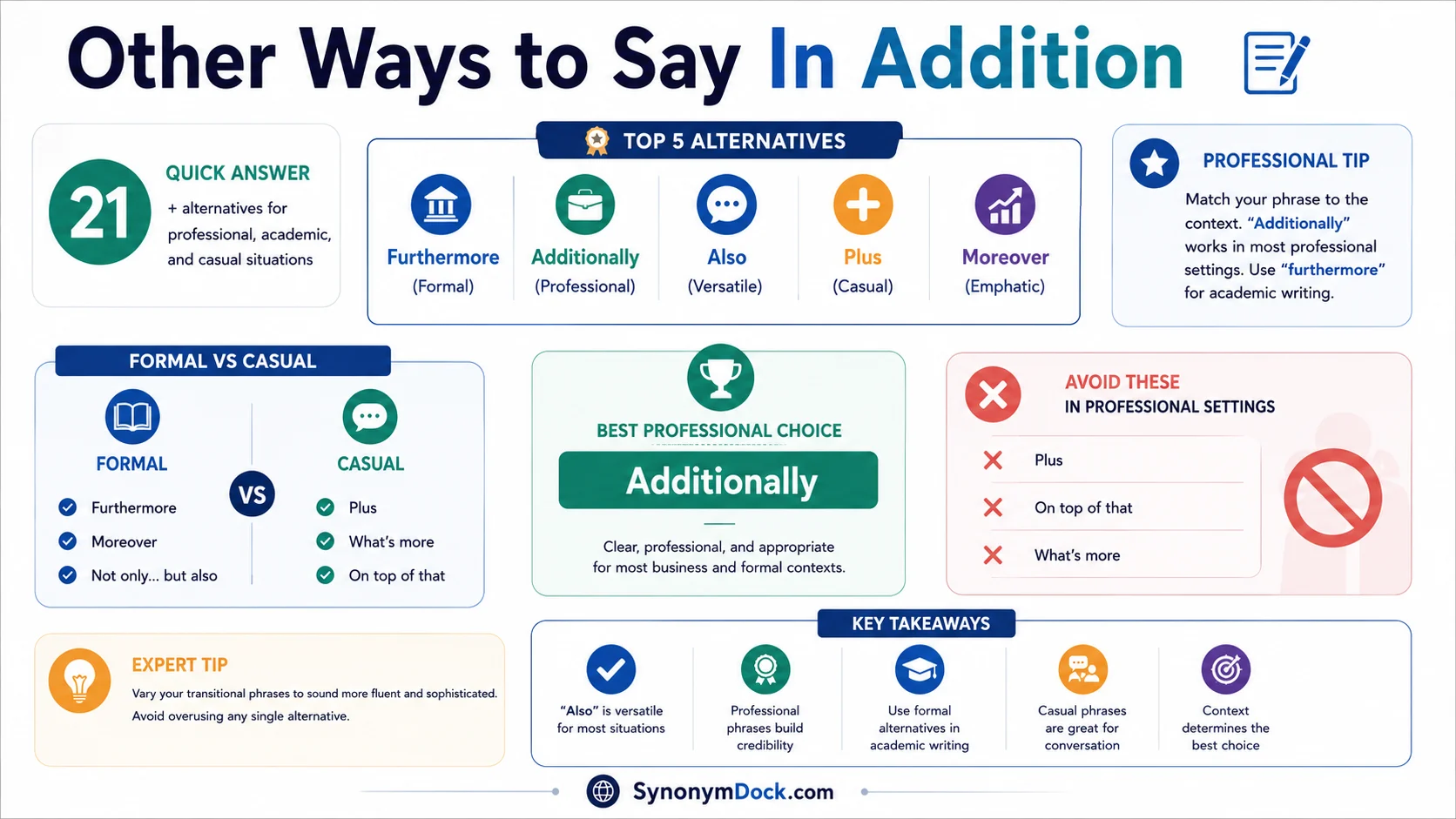
Looking for other ways to say in addition? Try “furthermore” for formal writing, “moreover” for academic work, “also” for everyday use, “additionally” for professional contexts, or “plus” for casual conversation. The best alternatives include: furthermore, moreover, also, additionally, plus, as well as, besides, what’s more, on top of that, and not to mention.
“In addition” is a useful transitional phrase. It helps you connect ideas and add information smoothly. But using it too often makes your writing feel repetitive and robotic.
Whether you’re writing a business report, an academic essay, or a casual email, having other ways to say in addition helps you sound more fluent and sophisticated. The right phrase can elevate your English from basic to impressive. This article explores 15+ powerful alternatives to “in addition” organized by tone and situation, so you can choose the perfect expression with confidence.
Quick Categories
Formal Alternatives
- Furthermore
- Moreover
- In addition to this
- Additionally
- Not only but also
Pro Tip: Use formal alternatives in academic writing, legal documents, and official correspondence. They sound sophisticated and precise.
Professional Alternatives
- Additionally
- As well as
- In addition to
- Along with
- Plus
Pro Tip: Professional alternatives work well in business reports, presentations, and workplace communication. They show your command of professional English.
Business Email Alternatives
- Additionally
- As well as
- In addition to
- Along with
- Furthermore
Pro Tip: These phrases are perfect for adding information in professional correspondence without sounding repetitive.
Academic Alternatives
- Furthermore
- Moreover
- In addition to this
- Additionally
- Not only but also
Pro Tip: Academic alternatives strengthen your essays and research papers by adding variety and sophistication to your writing.
Casual Alternatives
- Also
- Plus
- Besides
- What’s more
- On top of that
Pro Tip: Casual alternatives work well in everyday conversation and informal writing. They sound natural and native-like.
Informal Expressions
- And
- Plus
- Also
- Too
- As well
Pro Tip: Use informal expressions in text messages, social media, and casual conversations. Avoid them in professional or academic writing.
“Varying your transitional phrases shows you’re a confident, fluent English speaker.”
What Does “In Addition” Mean?
“In addition” is a transitional phrase used to add information or introduce another point. It indicates that you’re adding something to what you’ve already said.
Example: “We need to hire more staff. In addition, we should upgrade our equipment.”
Grammar: “In addition” is a prepositional phrase that functions as a conjunctive adverb. It can be used at the beginning of a sentence (followed by a comma) or in the middle.
Is It Professional or Polite?
“In addition” is both professional and polite. However, using it repeatedly can make your writing sound formulaic and uninspired.
Polite? ✅ Yes
Professional? ✅ Yes, but variety matters
Formal? ✅ Yes
Natural? ⚠️ Can feel stiff if overused
Example: “In addition, we need to consider the budget” works professionally. For a more sophisticated tone, try “Furthermore, we need to consider the budget.”
Common Mistakes
Mistake #1: Using “In Addition” Too Frequently
Why it’s incorrect: Repeating “in addition” makes your writing sound robotic and repetitive.
Correct version: Vary your language with different transitional phrases.
Example: “In addition, we need more staff. Furthermore, we should upgrade our equipment.”
Mistake #2: Confusing “In Addition” with “In Addition To”
Why it’s incorrect: “In addition” is used at the beginning of a sentence. “In addition to” is followed by a noun or noun phrase.
Correct version: “In addition, we need more staff” vs. “In addition to staff, we need new equipment.”
Mistake #3: Forgetting the Comma
Why it’s incorrect: When “in addition” starts a sentence, it needs a comma after it.
Correct version: “In addition, we should consider the timeline.”
Incorrect: “In addition we should consider the timeline.”
Mistake #4: Using Too Formal Alternatives in Casual Writing
Why it’s incorrect: “Furthermore” and “moreover” can sound too formal in casual contexts.
Correct version: Use “also,” “plus,” or “as well” in casual writing.
Example: “We had a great time. Also, the food was amazing.” (Casual)
Mistake #5: Using “And” to Start Every Sentence
Why it’s incorrect: Starting sentences with “and” is grammatically acceptable but can feel repetitive.
Correct version: Use a variety of transitional phrases.
Example: “We need more staff. Additionally, we need better equipment.”
When to Use “In Addition”
Common Situations:
- Adding points in writing
- Introducing new information
- Supporting arguments
- Listing items or ideas
- Connecting related thoughts
Business:
- Reports and proposals
- Presentations
- Meeting agendas
- Project updates
- Strategic planning
Academic:
- Essays and research papers
- Thesis statements
- Literature reviews
- Arguments and evidence
- Discussion sections
Daily Conversation:
- Adding thoughts in conversation
- Sharing additional information
- Making suggestions
- Giving opinions
Written English:
- Academic essays
- Business reports
- Professional emails
- Blog posts
“Transitional phrases are the glue that holds your writing together.”
Pros and Cons of “In Addition”
Pros
- Clear and easy to understand
- Works in formal and professional contexts
- Widely accepted
- Safe choice for most writing
Cons
- Overused
- Sounds repetitive
- Can feel formulaic
- Lacks sophistication
- Not memorable
15 Other Ways to Say In Addition
[1]. Furthermore
Meaning: A formal phrase meaning “in addition” or “besides.
Explanation: “Furthermore” is one of the most sophisticated alternatives. It’s commonly used in academic writing, formal reports, and professional presentations. It signals that you’re adding important information to support your argument. Native speakers use it when they want to sound educated and precise.
Example Sentence: “The proposal is well-written. Furthermore, it’s within our budget.”
Best Use: Academic Writing, Formal Reports, Professional Presentations
Avoid Using In: Casual Conversation, Text Messages
Tone: Formal, Sophisticated
Formality Level: ⭐⭐⭐⭐⭐ Very Formal
Usage Frequency: Common (Academic/Formal Contexts)
CEFR Level: B2
Common Collocations:
- furthermore, the data suggests
- furthermore, it’s important to note
- furthermore, we must consider
- furthermore, the evidence shows
- furthermore, this demonstrates
Context Variability:
- Academic English: “Furthermore, the results confirm our hypothesis.”
- Professional English: “Furthermore, we need to address this issue immediately.”
[2]. Moreover
Meaning: A formal phrase meaning “in addition” or “besides.”
Explanation: “Moreover” is very similar to “furthermore” and is equally formal. It’s used to add information that strengthens your argument. Native speakers often choose “moreover” when they want to emphasize that the new information is even more important than what came before.
Example Sentence: “The candidate has excellent qualifications. Moreover, she has relevant experience.”
Best Use: Academic Writing, Formal Arguments, Persuasive Writing
Avoid Using In: Casual Conversation, Everyday Writing
Tone: Formal, Emphatic
Formality Level: ⭐⭐⭐⭐⭐ Very Formal
Usage Frequency: Common (Academic/Formal Contexts)
CEFR Level: B2
Common Collocations:
- moreover, the evidence indicates
- moreover, this suggests
- moreover, we must remember
- moreover, it’s clear that
- moreover, the data confirms
Context Variability:
- Academic English: “Moreover, the study reveals significant patterns.”
- Professional English: “Moreover, we have sufficient resources.”
[3]. Additionally
Meaning: A professional phrase meaning “in addition” or “also.”
Explanation: “Additionally” is a versatile and professional alternative. It’s slightly less formal than “furthermore” but more professional than “also.” Native speakers use it in both business and academic contexts. It’s safe, clear, and widely accepted.
Example Sentence: “We need to review the contract. Additionally, we should check the timeline.”
Best Use: Business Reports, Professional Emails, Academic Writing
Avoid Using In: Very Casual Conversations
Tone: Professional, Neutral
Formality Level: ⭐⭐⭐⭐ Formal
Usage Frequency: Very Common
CEFR Level: B1
Common Collocations:
- additionally, we need to consider
- additionally, we should note
- additionally, this shows
- additionally, the data suggests
- additionally, it’s worth mentioning
Context Variability:
- Spoken English: “Additionally, I’d like to add something.”
- Professional English: “Additionally, we need to address this concern.”
[4]. Also
Meaning: A simple, neutral word meaning “in addition.”
Explanation: “Also” is one of the most common alternatives. It’s simple, natural, and works in almost any context. Native speakers use it constantly in both speech and writing. It’s safe and effective but can become repetitive if overused.
Example Sentence: “I’d like to visit Paris. Also, I want to see Rome.”
Best Use: Everyday Conversation, Informal Writing, Professional Communication
Avoid Using In: Extremely Formal Academic Writing
Tone: Neutral, Natural
Formality Level: ⭐⭐⭐ Neutral
Usage Frequency: Very Common
CEFR Level: A2
Common Collocations:
- also, I think
- also, we need
- also, you should
- also, consider this
- also, remember
Context Variability:
- Spoken English: “I’m hungry. Also, I’m tired.”
- Professional English: “Also, we should consider the budget.”
[5]. As Well As
Meaning: A phrase meaning “in addition to” or “and also.”
Explanation: “As well as” is a very common alternative. It’s used to add information or items to a list. Native speakers use it in both formal and casual contexts. It’s more sophisticated than “and” but less formal than “furthermore.”
Example Sentence: “We need to hire developers as well as designers.”
Best Use: Business Writing, Academic Writing, Everyday Conversation
Avoid Using In: Very Formal Legal Documents
Tone: Professional, Neutral
Formality Level: ⭐⭐⭐⭐ Formal
Usage Frequency: Very Common
CEFR Level: B1
Common Collocations:
- as well as the fact that
- as well as the budget
- as well as the timeline
- as well as the stakeholders
- as well as the resources
Context Variability:
- Spoken English: “I need to buy milk as well as bread.”
- Professional English: “We’ll need to hire staff as well as contractors.”
“Every alternative has its place – knowing when to use each one is the key.”
[6]. Besides
Meaning: A neutral phrase meaning “in addition to” or “apart from.”
Explanation: “Besides” is a versatile alternative. It can mean “in addition” or “apart from” depending on context. Native speakers use it frequently in casual conversation. In professional contexts, use it carefully.
Example Sentence: “Besides the main objective, we have secondary goals.”
Best Use: Casual Conversation, Informal Writing, Business Communication
Avoid Using In: Very Formal Academic Writing
Tone: Neutral, Casual
Formality Level: ⭐⭐⭐ Neutral
Usage Frequency: Very Common
CEFR Level: A2
Common Collocations:
- besides the fact that
- besides this
- besides everything
- besides the point
- besides the budget
Context Variability:
- Spoken English: “Besides, I don’t think it matters.”
- Professional English: “Besides the financial implications, we should consider the timeline.”
[7]. What’s More
Meaning: A casual phrase meaning “in addition” or “more importantly.”
Explanation: “What’s more” is a friendly, conversational alternative. It emphasizes that the following point is especially important. Native speakers use it in speech and informal writing. It adds enthusiasm and engagement.
Example Sentence: “The hotel is affordable. What’s more, it’s in a great location.”
Best Use: Casual Conversation, Blog Posts, Friendly Communication
Avoid Using In: Academic Essays, Formal Reports
Tone: Casual, Enthusiastic
Formality Level: ⭐⭐ Casual
Usage Frequency: Common (Informal Contexts)
CEFR Level: B1
Common Collocations:
- what’s more, it’s free
- what’s more, you’ll love it
- what’s more, we can do it
- what’s more, it’s easy
- what’s more, we have options
Context Variability:
- Spoken English: “The food is great. What’s more, it’s cheap.”
- Blog Writing: “The product is effective. What’s more, it’s eco-friendly.”
[8]. On Top of That
Meaning: A casual phrase meaning “in addition” or “besides that.”
Explanation: “On top of that” is an informal, conversational alternative. It’s vivid and expressive. Native speakers use it to emphasize that they’re adding even more information. It’s excellent for speech but too casual for formal writing.
Example Sentence: “He lost his job. On top of that, his car broke down.”
Best Use: Casual Conversation, Text Messages, Storytelling
Avoid Using In: Formal Writing, Academic Papers
Tone: Casual, Expressive
Formality Level: ⭐⭐ Casual
Usage Frequency: Common (Informal Contexts)
CEFR Level: B1
Common Collocations:
- on top of that, it’s raining
- on top of that, we have deadlines
- on top of that, I’m tired
- on top of that, she’s amazing
- on top of that, we’re out of time
Context Variability:
- Spoken English: “I’m late for work. On top of that, I forgot my keys.”
- Casual Writing: “The restaurant is expensive. On top of that, the service is slow.”
[9]. Plus
Meaning: A casual word meaning “in addition” or “and also.”
Explanation: “Plus” is a very common informal alternative. It’s short, simple, and conversational. Native speakers use it constantly in speech and informal writing. It’s friendly but too casual for professional or academic contexts.
Example Sentence: “I’m excited about the trip. Plus, I’ll see my family.”
Best Use: Casual Conversation, Text Messages, Informal Writing
Avoid Using In: Professional Emails, Academic Essays
Tone: Casual, Friendly
Formality Level: ⭐⭐ Casual
Usage Frequency: Very Common
CEFR Level: A2
Common Collocations:
- plus, it’s cheap
- plus, you’ll like it
- plus, we can do it
- plus, it works
- plus, I can help
Context Variability:
- Spoken English: “I like the job. Plus, the pay is good.”
- Text Message: “Can’t make it. Plus, I’m sick.”
[10]. Not to Mention
Meaning: A casual phrase meaning “in addition” or “and also.”
Explanation: “Not to mention” is a conversational phrase used to add information. It emphasizes that the additional point is obvious or shouldn’t be overlooked. Native speakers use it frequently in casual conversation.
Example Sentence: “The house is beautiful. Not to mention, it’s affordable.”
Best Use: Casual Conversation, Friendly Communication
Avoid Using In: Formal Writing
Tone: Casual, Emphatic
Formality Level: ⭐⭐ Casual
Usage Frequency: Common (Informal Contexts)
CEFR Level: B1
Common Collocations:
- not to mention, it’s cheap
- not to mention, we need it
- not to mention, it’s important
- not to mention, you’re ready
- not to mention, it works
Context Variability:
- Spoken English: “The movie is funny. Not to mention, the acting is great.”
- Informal Writing: “The hotel is nice. Not to mention, the staff is friendly.”
[11]. As Well
Meaning: A neutral phrase meaning “also” or “in addition.”
Explanation: “As well” is a very common and natural alternative. It’s slightly more formal than “too” but still works in most contexts. Native speakers use it in both speech and writing. It’s safe, clear, and versatile.
Example Sentence: “We should buy some bread as well.”
Best Use: Everyday Conversation, Professional Writing, Informal Communication
Avoid Using In: Very Formal Academic Writing
Tone: Neutral, Natural
Formality Level: ⭐⭐⭐ Neutral
Usage Frequency: Very Common
CEFR Level: A2
Common Collocations:
- as well as
- as well as the budget
- as well as the timeline
- I’ll come as well
- we should go as well
Context Variability:
- Spoken English: “I’ll have pizza as well.”
- Professional English: “We’ll need to include this document as well.”
[12]. In Addition To
Meaning: A formal phrase followed by a noun or noun phrase.
Explanation: This is the prepositional version of “in addition.” It must be followed by a noun, noun phrase, or gerund. Native speakers use it to add items to a list or introduce additional points in formal writing.
Example Sentence: “In addition to the main course, we’ll serve dessert.
Best Use: Formal Writing, Business Communication, Academic Papers
Avoid Using In: Casual Conversation (can sound stiff)
Tone: Formal, Professional
Formality Level: ⭐⭐⭐⭐⭐ Very Formal
Usage Frequency: Very Common
CEFR Level: B1
Common Collocations:
- in addition to this
- in addition to the budget
- in addition to our current plan
- in addition to the evidence
- in addition to everything
Context Variability:
- Professional English: “In addition to the report, we need a presentation.”
- Academic English: “In addition to the study, we’ll conduct interviews.”
[13]. Along With
Meaning: A phrase meaning “in addition to” or “together with.”
Explanation: “Along with” is a professional phrase used to add items or people to a list. It’s slightly more formal than “with” and works well in business and academic contexts. Native speakers use it to show inclusion.
Example Sentence: “We invited the CEO along with the board members.”
Best Use: Professional Writing, Academic Papers, Business Communication
Avoid Using In: Very Casual Conversation
Tone: Professional, Neutral
Formality Level: ⭐⭐⭐⭐ Formal
Usage Frequency: Common
CEFR Level: B1
Common Collocations:
- along with the rest
- along with the stakeholders
- along with the budget
- along with our partners
- along with the evidence
Context Variability:
- Professional English: “We’ll need your signature along with the forms.”
- Academic English: “The theory along with supporting evidence is convincing.”
[14]. Not Only But Also
Meaning: A formal structure emphasizing that two things are true.
Explanation: This is a sophisticated structure for adding information. It emphasizes both points equally. Native speakers use it in formal writing and speeches. It’s excellent for essays and persuasive writing.
Example Sentence: “Not only is she qualified, but also she has experience.”
Best Use: Academic Writing, Professional Speeches, Persuasive Writing
Avoid Using In: Casual Conversation (can sound too formal)
Tone: Formal, Emphatic
Formality Level: ⭐⭐⭐⭐⭐ Very Formal
Usage Frequency: Common (Formal Contexts)
CEFR Level: B2
Common Collocations:
- not only but also
- not only that, but also
- not only is it, but also
- not only does it, but also
- not only has he, but also
Context Variability:
- Academic English: “Not only does this support our theory, but also it opens new questions.”
- Professional English: “Not only have we met our targets, but also we’ve exceeded them.”
[15]. Too
Meaning: A simple word meaning “also” or “in addition.”
Explanation: “Too” is one of the simplest alternatives. Native speakers use it constantly in both speech and writing. It’s natural and versatile. However, it’s typically placed at the end of a sentence or clause.
Example Sentence: “I’d like to come too.”
Best Use: Everyday Conversation, Casual Writing, Professional Communication
Avoid Using In: Formal Academic Writing (but acceptable in some contexts)
Tone: Neutral, Natural
Formality Level: ⭐⭐⭐ Neutral
Usage Frequency: Very Common
CEFR Level: A1
Common Collocations:
- me too
- I’d like to come too
- we should go too
- I’m tired too
- can you help too
Context Variability:
- Spoken English: “I’m coming too.”
- Professional English: “The report addresses marketing, and its impact on sales too.”
“The best writers use a variety of transitional phrases to keep their readers engaged.”
Native Speaker Tip
Native speakers often choose “also” and “as well” in everyday conversation. In formal writing, “furthermore” and “moreover” are preferred. “Plus” and “on top of that” are excellent for casual speech but should be avoided in professional contexts. “Not only but also” is used to add emphasis and sounds very polished.
Expert Insight
In workplace communication, varying your transitional phrases demonstrates professionalism and attention to detail. Using “additionally” in business reports shows you can adapt your language to formal contexts. Using “also” or “as well” in emails with colleagues is perfectly acceptable. The key is matching your language to the situation.
Avoid These Expressions in Formal Situations
| Expression | Why to Avoid | Better Alternative |
|---|---|---|
| Plus | Too casual | Additionally |
| On top of that | Too informal | Furthermore |
| What’s more | Too conversational | Moreover |
| Not to mention | Too casual | In addition |
| And | Too basic | Additionally |
Top 10 Alternatives Compared
| Phrase | Tone | Formality | Best Use | Frequency |
|---|---|---|---|---|
| Furthermore | Formal | ⭐⭐⭐⭐⭐ | Academic, Formal | Common |
| Moreover | Formal | ⭐⭐⭐⭐⭐ | Academic, Formal | Common |
| Additionally | Professional | ⭐⭐⭐⭐ | Business, Academic | Very Common |
| Also | Neutral | ⭐⭐⭐ | All contexts | Very Common |
| As well as | Neutral | ⭐⭐⭐⭐ | All contexts | Very Common |
| Plus | Casual | ⭐⭐ | Conversation, Texts | Very Common |
| On top of that | Casual | ⭐⭐ | Conversation | Common |
| Not to mention | Casual | ⭐⭐ | Conversation | Common |
| What’s more | Casual | ⭐⭐ | Conversation | Common |
| Along with | Professional | ⭐⭐⭐⭐ | Business, Academic | Common |
Which One Should You Use?
Best Overall: Also – works in almost every situation
Best Professional: Additionally – polished and widely accepted
Best Academic: Furthermore – sophisticated for essays
Best Business Email: Additionally – professional and clear
Best Everyday Conversation: Also or Plus – natural and friendly
Most Natural: Also – native speakers use it constantly
Most Emphatic: Moreover – emphasizes the added point
Commonly Confused Phrases
“In Addition” vs. “In Addition To”
“In addition” starts a new sentence or clause. “In addition to” is followed by a noun or noun phrase.
“Furthermore” vs. “Moreover”
Both are formal and similar. “Moreover” often introduces an even more important point. “Furthermore” simply adds information.
“Also” vs. “As Well” vs. “Too”
All mean “in addition.” “Also” is usually placed before the verb. “As well” and “too” are usually placed at the end of a sentence.
Scenario Practice
Scenario 1: You’re writing a business report and need to add a point.
Which phrase would you choose?
Correct Answer: “Additionally, the budget allows for expansion.”
Why: Professional and appropriate for business reports.
Scenario 2: You’re telling a friend about your travel plans.
Which phrase would you choose?
Correct Answer: “We’re going to Paris. Plus, we’ll visit Rome.”
Why: Casual and natural for conversation.
Scenario 3: You’re writing an academic essay and need to strengthen your argument.
Which phrase would you choose?
Correct Answer: “Furthermore, the evidence supports this conclusion.”
Why: Formal and sophisticated for academic writing.
Scenario 4: You’re sending a professional email to a client.
Which phrase would you choose?
Correct Answer: “In addition to the report, we’ll provide a presentation.”
Why: Professional and clear for client communication.
Scenario 5: You’re having a casual conversation with a colleague.
Which phrase would you choose?
Correct Answer: “I like the marketing plan. Also, the sales strategy looks good.”
Why: Neutral and natural for professional conversation.
Mini Quiz
1. Which phrase is most appropriate for academic writing?
- A) Plus
- B) Furthermore
- C) On top of that
2. Which alternative is too casual for professional emails?
- A) Additionally
- B) Also
- C) What’s more
3. Which phrase should be followed by a noun or noun phrase?
- A) In addition
- B) In addition to
- C) Moreover
4. Which is the most versatile alternative for most situations?
- A) Furthermore
- B) Also
- C) Not to mention
5. Which phrase is used to add emphasis to a point?
- A) Moreover
- B) Plus
- C) Also
Answer Key
- B) Furthermore – Formal and appropriate for academic writing.
- C) What’s more – Too casual for professional emails.
- B) In addition to – Must be followed by a noun or noun phrase.
- B) Also – Works in almost all contexts.
- A) Moreover – Emphasizes the importance of the added point.
FAQs
What is the most formal way to say “in addition”?
“Furthermore” and “moreover” are among the most formal alternatives. “Not only but also” is also very formal and emphatic. Use these in academic writing, legal documents, and official correspondence.
Which phrase is best for professional emails?
“Additionally” and “in addition to” are excellent for professional emails. They’re clear, professional, and widely accepted. “Also” is also acceptable in many professional contexts.
What is the difference between “furthermore” and “moreover”?
Both are formal and similar. “Furthermore” simply adds information. “Moreover” often introduces a point that’s even more important or significant than previous points.
Which alternative sounds most natural to native speakers?
“Also” sounds the most natural in everyday conversation. “As well” and “too” are also very natural. These are the phrases native speakers use most frequently.
Can I use these expressions in business meetings?
Yes, professional alternatives like “additionally,” “in addition,” and “also” are perfect for business meetings. Avoid casual phrases like “plus,” “on top of that,” and “what’s more” in formal meetings.
Conclusion
Learning other ways to say in addition transforms your writing and speaking. Instead of repeating the same phrase, you now have powerful alternatives for every situation – from formal academic essays to casual conversations.
The key is choosing the right phrase for the right context. “Furthermore” and “moreover” add sophistication to academic writing. “Additionally” works perfectly in professional settings. “Also” is the most versatile choice for everyday communication. With practice, these alternatives will become second nature.
Start today – choose one new alternative and use it in your next email or conversation. Your English will sound more fluent, professional, and natural.

11 thoughts on “Other Ways to Say In Addition |21+ Academic Alternatives For 2026”