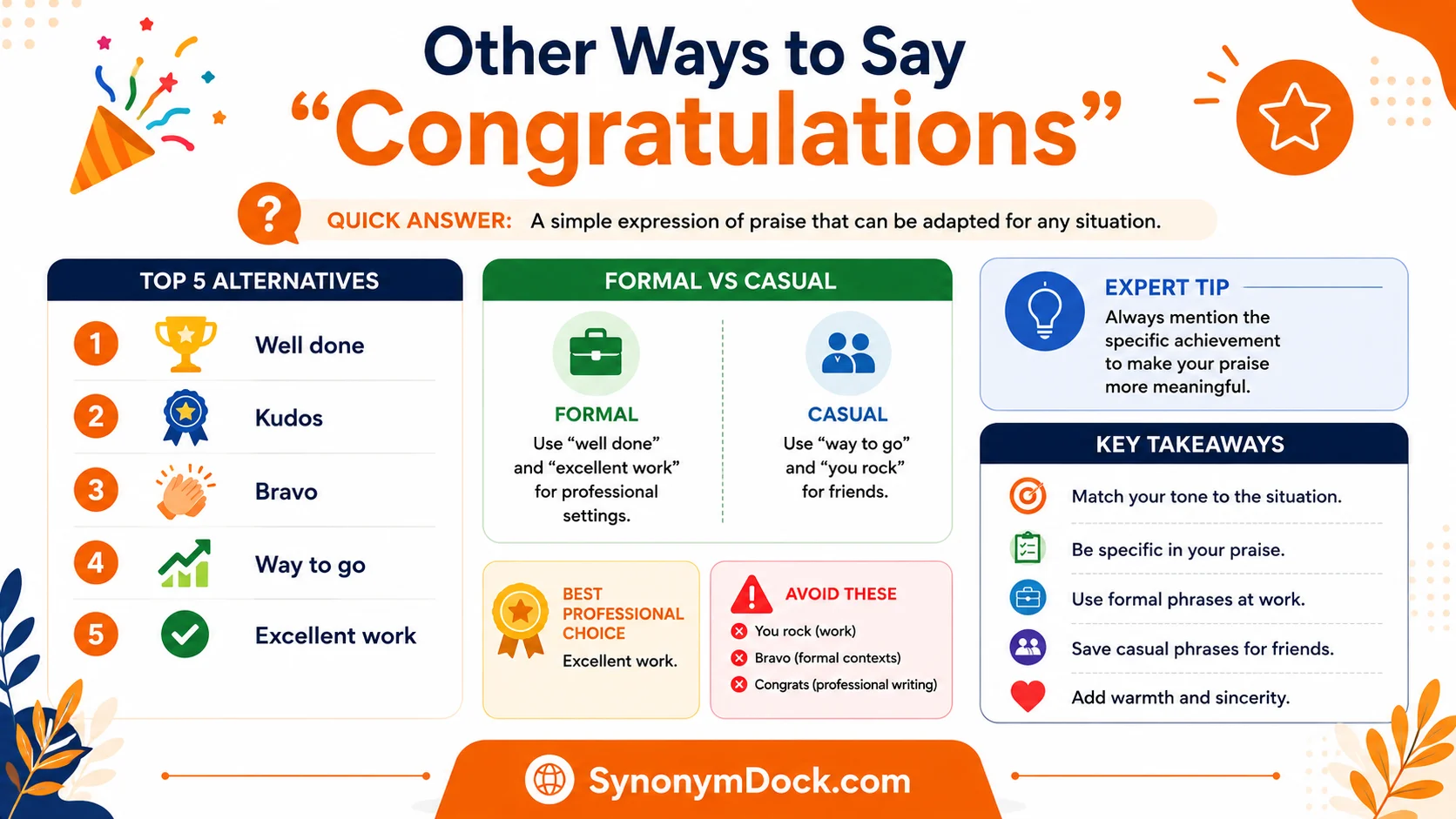
“Congratulations” is an expression of praise or good wishes for someone’s achievement or special occasion. Alternatives include “Well done,” “Kudos,” “Bravo,” “Hats off,” and “Way to go.” The best choice depends on the situation, your relationship with the person, and the level of formality required.
You have just received news that a colleague got a promotion or a friend achieved a personal goal. “Congratulations” is the first word that comes to mind, but using it repeatedly can feel predictable and impersonal.
Learning alternatives to “congratulations” helps you express genuine appreciation and enthusiasm in any situation. Whether you are writing a professional email, sending a text to a friend, or giving a toast at a celebration, having a variety of phrases makes your message more meaningful and memorable.
Quick Categories
Formal Alternatives
- My sincerest congratulations
- Please accept my warmest congratulations
- I offer you my heartfelt congratulations
- Allow me to extend my congratulations
- My best wishes on your achievement
Pro Tip: Use these in formal letters, official emails, or when congratulating someone you do not know well. They show respect and professionalism.
Professional Alternatives
- Well done
- Excellent work
- Outstanding achievement
- Impressive accomplishment
- Great job
Pro Tip: These work perfectly in workplace settings, especially when praising a colleague’s specific accomplishment. They are professional without being stiff.
Business Email Alternatives
- Congratulations on your well-deserved success
- I am delighted to hear about your achievement
- What wonderful news
- That is fantastic news
- You should be very proud
Pro Tip: These phrases sound warm and professional in business emails. They balance enthusiasm with professionalism.
Academic Alternatives
- A well-deserved honor
- Commendable achievement
- Outstanding academic performance
- A remarkable accomplishment
- Your hard work has truly paid off
Pro Tip: Use these when congratulating students, researchers, or academics. They acknowledge both the achievement and the effort behind it.
Casual Alternatives
- Way to go
- Kudos
- Well done
- Nice work
- You rock
Pro Tip: These are perfect for friends, family, and informal settings. They sound natural and genuine.
Informal Expressions
- Bravo
- Hats off to you
- You did it
- That’s awesome
- Amazing work
Pro Tip: Use these in texts, social media comments, or casual conversations. They add energy and enthusiasm.
“The right congratulatory phrase can turn a simple acknowledgement into a meaningful moment.”
Common Mistakes
Mistake 1: Using “Congratulations” Too Often
- Mistake: Repeating “congratulations” multiple times in the same conversation.
- Why it is incorrect: It sounds repetitive and insincere.
- Correct Version: Vary your expressions to show genuine enthusiasm.
- Example: “Congratulations on your promotion. This achievement is truly well deserved.”
Mistake 2: Saying “Congrats” in Formal Settings
- Mistake: Using “congrats” in a professional email to a senior executive.
- Why it is incorrect: “Congrats” is too casual for formal situations.
- Correct Version: Use “congratulations” or “please accept my congratulations.”
- Example: “Congratulations on your recent appointment to the board.”
Mistake 3: Overusing “Well Done” Without Specifics
- Mistake: Saying “well done” without acknowledging what the person actually did.
- Why it is incorrect: It can sound generic and unenthusiastic.
- Correct Version: Mention the specific accomplishment.
- Example: “Well done on completing the project ahead of schedule.”
Mistake 4: Using Sarcastic Tone Unintentionally
- Mistake: Using “bravo” or “well done” in a flat, unenthusiastic tone.
- Why it is incorrect: These phrases can sound sarcastic without proper enthusiasm.
- Correct Version: Match your tone to the occasion.
- Example: “Bravo on that brilliant presentation.”
Mistake 5: Forgetting the Person’s Role
- Mistake: Using casual expressions like “you rock” with a senior colleague.
- Why it is incorrect: It is too informal for professional hierarchy.
- Correct Version: Choose expressions that respect the relationship.
- Example: “Your leadership has been exceptional.”
What Does “Congratulations” Mean?
“Congratulations” is an expression used to acknowledge and celebrate someone’s success, achievement, or special occasion. It comes from the Latin word “congratulari,” meaning “to wish joy or happiness.”
Example: “Congratulations on your wedding. We are so happy for you.”
When to Use “Congratulations”
- Business: Celebrating promotions, project completions, or company milestones
- Academic: Graduations, research publications, or academic awards
- Emails: Professional achievements, work anniversaries, or new roles
- Meetings: Acknowledging team successes or individual accomplishments
- Daily conversation: Personal milestones, achievements, or happy events
- Spoken English: Birthdays, weddings, new babies, or personal goals
- Written English: Cards, emails, social media, or formal letters
- Formal: Official events, ceremonies, or professional announcements
- Informal: Personal celebrations among friends and family
Is It Professional or Polite to Say “Congratulations”?
“Congratulations” is both professional and polite. However, it can sound formal in casual settings and generic if overused.
Business Example: “Congratulations on successfully launching the new product line. Your team’s hard work has truly paid off.”
| Politeness | Professionalism | Formality | Naturalness |
|---|---|---|---|
| ✅ Yes | ✅ Yes | Depends on context | Yes |
Pros and Cons of Using “Congratulations”
Pros
- Widely understood by all English speakers
- Appropriate for almost any achievement
- Formal enough for professional use
- Easy to remember and use correctly
Cons
- Can sound repetitive and unoriginal
- May feel impersonal if overused
- Does not express specific enthusiasm
- Can seem generic in personal situations
Other Ways to Say “Congratulations” (With Examples)
These alternatives will help you express congratulations in any situation. Each phrase has a different tone and level of formality.
[1]. Phrase: Well Done
Meaning: An expression of approval for something accomplished successfully.
Explanation: “Well done” is a straightforward, professional way to acknowledge achievement. It works well in workplaces and is widely recognized by native speakers.
Example Sentence: “Well done on securing that major client account.”
Best Use: Workplace, presentations, projects
Avoid Using In: Formal ceremonies
Tone: Professional, Encouraging
Formality Level: ⭐⭐⭐ Neutral
Usage Frequency: Very Common
CEFR Level: B1
Common Collocations:
- Well done on
- Well done for
- Well done, everyone
- Very well done
Context Variability:
- Spoken English: “Well done on finishing your first marathon.”
- Professional English: “Well done on delivering the quarterly results.”
- Casual Conversation: “Well done, mate. That was brilliant.”
[2]. Phrase: Kudos
Meaning: Praise and honor for a notable achievement.
Explanation: “Kudos” comes from Greek and means “glory” or “fame.” It sounds slightly more sophisticated than “well done” and works well in professional and informal contexts.
Example Sentence: “Kudos to the entire team for their innovative solution.”
Best Use: Team celebrations, workplace achievements
Avoid Using In: Formal letters
Tone: Appreciative, Professional
Formality Level: ⭐⭐⭐ Neutral
Usage Frequency: Common
CEFR Level: B2
Common Collocations:
- Kudos to
- Kudos for
- Full kudos
Context Variability:
- Spoken English: “Kudos to you for speaking up.”
- Professional English: “Kudos to the marketing department for the campaign.”
- Casual Conversation: “Kudos, man. That was impressive.”
[3]. Phrase: Bravo
Meaning: An enthusiastic expression of approval, often used for performances.
Explanation: “Bravo” originally comes from Italian and is used to applaud performers. It works well for creative or public achievements.
Example Sentence: “Bravo on that outstanding presentation!”
Best Use: Performances, speeches, creative work
Avoid Using In: Academic writing
Tone: Enthusiastic, Appreciative
Formality Level: ⭐⭐ Casual
Usage Frequency: Common
CEFR Level: B1
Common Collocations:
- Bravo to
- Bravo for
Context Variability:
- Spoken English: “Bravo on your piano performance tonight.”
- Professional English: “Bravo on closing that deal.”
- Casual Conversation: “Bravo, that was brilliant.”
[4]. Phrase: Way to Go
Meaning: An enthusiastic expression of praise and encouragement.
Explanation: “Way to go” is an American phrase that sounds supportive and encouraging. It is perfect for casual situations where you want to show excitement.
Example Sentence: “Way to go on completing the project ahead of schedule.
Best Use: Team achievements, school, friendly encouragement
Avoid Using In: Formal business writing
Tone: Encouraging, Friendly
Formality Level: ⭐⭐ Casual
Usage Frequency: Very Common
CEFR Level: B1
Common Collocations:
- Way to go on
Context Variability:
- Spoken English: “Way to go on winning the competition.”
- Professional English: “Way to go, team. Great work this quarter.”
- Casual Conversation: “Way to go, you deserve this.
[5]. Phrase: Excellent Work
Meaning: A professional compliment praising the quality of someone’s effort.
Explanation: “Excellent work” is a polished, professional alternative that highlights both the effort and the outcome.
Example Sentence: “Excellent work on the annual report. The data analysis is thorough.”
Best Use: Business emails, performance reviews, workplace feedback
Avoid Using In: Casual text messages
Tone: Professional, Formal
Formality Level: ⭐⭐⭐⭐ Formal
Usage Frequency: Very Common
CEFR Level: B2
Common Collocations:
- Excellent work on
- Truly excellent work
- Excellent work, everyone
Context Variability:
- Spoken English: “Excellent work on that project.”
- Professional English: “Excellent work deserves recognition.”
- Casual Conversation: (less common)
[6]. Phrase: Hats Off
Meaning: An expression of admiration and respect for someone’s achievement.
Explanation: “Hats off” is a classic English idiom originating from the gesture of removing a hat to show respect. It sounds warm and appreciative.
Example Sentence: “Hats off to the entire team for their tireless dedication.”
Best Use: Group achievements, public recognition, speeches
Avoid Using In: Very formal ceremonies
Tone: Admiring, Respectful
Formality Level: ⭐⭐⭐ Neutral
Usage Frequency: Common
CEFR Level: B2
Common Collocations:
- Hats off to
- Hats off for
Context Variability:
- Spoken English: “Hats off to you for finishing this project.”
- Professional English: “Hats off to the sales team.”
- Casual Conversation: “Hats off, that was amazing.”
[7]. Phrase: You Did It
Meaning: A direct and encouraging way to acknowledge someone’s success.
Explanation: “You did it” is simple, personal, and powerful. It works well in one-on-one conversations where you want to be sincere.
Example Sentence: “You did it! All your hard work paid off.”
Best Use: Personal celebrations, one-to-one moments, achievements
Avoid Using In: Formal business announcements
Tone: Excited, Personal
Formality Level: ⭐⭐ Casual
Usage Frequency: Very Common
CEFR Level: A2
Common Collocations:
- You did it again
- You actually did it
Context Variability:
- Spoken English: “You did it. I knew you could.”
- Professional English: “You did it. The client loved the proposal.”
- Casual Conversation: “You did it, friend. So proud of you.”
[8]. Phrase: Great Job
Meaning: A simple, positive expression acknowledging someone’s effort.
Explanation: “Great job” is one of the most versatile alternatives. It works in almost any context and sounds natural and encouraging.
Example Sentence: “Great job on getting the report finished so quickly.”
Best Use: Emails, workplace, everyday use
Avoid Using In: Formal award ceremonies
Tone: Encouraging, Friendly
Formality Level: ⭐⭐⭐ Neutral
Usage Frequency: Very Common
CEFR Level: A2
Common Collocations:
- Great job on
- Really great job
- Absolutely great job
Context Variability:
- Spoken English: “Great job on the presentation.”
- Professional English: “Great job, everyone. Let’s keep up the momentum.”
- Casual Conversation: “Great job, buddy.”
[9]. Phrase: Congratulations on Your Well-Deserved Success
Meaning: A warm, professional expression acknowledging that the achievement was earned through hard work.
Explanation: This longer, more formal phrase emphasizes that the person has earned their success. It is perfect for formal occasions.
Example Sentence: “Congratulations on your well-deserved success in the industry awards.
Best Use: Formal letters, speeches, business announcements
Avoid Using In: Casual conversations
Tone: Formal, Appreciative
Formality Level: ⭐⭐⭐⭐⭐ Very Formal
Usage Frequency: Occasional
CEFR Level: B2
Common Collocations:
- Well-deserved success
- Well-deserved recognition
- Well-deserved promotion
Context Variability:
- Professional English: “Congratulations on your well-deserved promotion.”
- Academic English: “Congratulations on your well-deserved fellowship.”
[10]. Phrase: Commendable Achievement
Meaning: An expression of praise for an achievement worthy of admiration.
Explanation: “Commendable achievement” is a sophisticated, formal alternative often used in academic and professional contexts.
Example Sentence: “This is a commendable achievement that reflects your dedication.”
Best Use: Academic ceremonies, professional awards, formal praise
Avoid Using In: Casual conversations
Tone: Formal, Respectful
Formality Level: ⭐⭐⭐⭐⭐ Very Formal
Usage Frequency: Occasional
CEFR Level: C1
Common Collocations:
- Truly commendable achievement
- Highly commendable achievement
- Commendable effort
Context Variability:
- Academic English: “The research represents a commendable achievement.”
- Professional English: “This is a commendable achievement for the team.”
[11]. Phrase: You Rock
Meaning: An enthusiastic, informal expression of praise and admiration.
Explanation: “You rock” is a modern, American slang phrase that sounds energetic and positive. It is common among friends and in social media.
Example Sentence: “You rock for organizing such an amazing event.”
Best Use: Social media, texts, friends, casual settings
Avoid Using In: Professional emails, formal communication
Tone: Energetic, Friendly
Formality Level: ⭐ Very Casual
Usage Frequency: Common
CEFR Level: B1
Common Collocations:
- You rock for
- You absolutely rock
- You rock, dude
Context Variability:
- Spoken English: “You rock, man. That was awesome.”
- Casual Conversation: “You rock for helping me out.”
[12]. Phrase: That’s Fantastic News
Meaning: A warm expression showing you are genuinely happy for someone.
Explanation: “That’s fantastic news” works well when you are responding to someone’s announcement. It shows genuine enthusiasm.
Example Sentence: “That’s fantastic news about your job promotion.”
Best Use: Responding to announcements, emails, conversations
Avoid Using In: Formal letters
Tone: Enthusiastic, Warm
Formality Level: ⭐⭐⭐ Neutral
Usage Frequency: Very Common
CEFR Level: B1
Common Collocations:
- That’s fantastic news
- What fantastic news
- Absolutely fantastic news
Context Variability:
- Spoken English: “That’s fantastic news. I am so happy for you.”
- Professional English: “That’s fantastic news for the whole department.”
- Casual Conversation: “That’s fantastic news, mate.”
[13]. Phrase: You Should Be Very Proud
Meaning: A thoughtful expression that acknowledges the person’s effort and achievement.
Explanation: “You should be very proud” shifts the focus to the person’s feelings. It is warm, sincere, and works well in personal conversations.
Example Sentence: “You should be very proud of what you have accomplished.”
Best Use: Personal conversations, feedback, mentoring
Avoid Using In: Quick, casual responses
Tone: Warm, Supportive
Formality Level: ⭐⭐⭐ Neutral
Usage Frequency: Very Common
CEFR Level: B1
Common Collocations:
- Very proud of
- So proud of
- Proud of your achievement
Context Variability:
- Spoken English: “You should be very proud of your work.”
- Professional English: “You should be very proud of your team.”
- Casual Conversation: “You should be very proud, honestly.”
[14]. Phrase: My Sincerest Congratulations
Meaning: A formal, heartfelt expression conveying deep respect and admiration.
Explanation: “My sincerest congratulations” is one of the most formal alternatives. It is perfect for official letters, formal emails, and special occasions.
Example Sentence: “Please accept my sincerest congratulations on your appointment.”
Best Use: Formal letters, official announcements, senior colleagues
Avoid Using In: Casual conversations
Tone: Formal, Respectful
Formality Level: ⭐⭐⭐⭐⭐ Very Formal
Usage Frequency: Occasional
CEFR Level: B2
Common Collocations:
- Sincerest congratulations on
- Heartfelt congratulations on
- Warmest congratulations on
Context Variability:
- Professional English: “My sincerest congratulations on your promotion.”
- Academic English: “My sincerest congratulations on your graduation.”
[15]. Phrase: Nice Work
Meaning: A simple, friendly expression acknowledging a job well done.
Explanation: “Nice work” is an easy, casual alternative that works well in workplace settings and among friends.
Example Sentence: “Nice work on getting the proposal submitted early.
Best Use: Emails, workplace, casual conversations
Avoid Using In: Formal ceremonies
Tone: Friendly, Encouraging
Formality Level: ⭐⭐⭐ Neutral
Usage Frequency: Very Common
CEFR Level: A2
Common Collocations:
- Nice work on
- Good work
- Great work
Context Variability:
- Spoken English: “Nice work on the garden.”
- Professional English: “Nice work on the quarterly report.”
- Casual Conversation: “Nice work, mate.”
“A heartfelt congratulations is remembered long after the words have been spoken. Choose words that match your sincerity.”
Native Speaker Tips
Tip 1: Match Your Tone to the Relationship
Native speakers adjust their congratulations based on who they are talking to. “Well done” works for colleagues, “you rock” is for friends, and “my sincerest congratulations” is for formal occasions.
Tip 2: Add Specific Details
Native speakers always make their congratulations more meaningful by adding specific details. Instead of just saying “well done,” mention exactly what impressed you.
Tip 3: Use Non-Verbal Cues
In spoken English, native speakers use tone of voice, facial expressions, and gestures to add warmth. A sincere smile and enthusiastic tone matter as much as the words themselves.
Avoid These in Formal Situations
- You rock – Too casual for professional settings
- Way to go – Informal, better for friends
- Bravo – Best for creative or performance contexts only
- Awesome – Informative but unprofessional in writing
- Congrats – Shortened form is too casual for formal use
Best Phrases by Situation
| Situation | Best Phrase |
|---|---|
| Business Email | Excellent work |
| Client Meeting | Well done |
| Academic Essay | Commendable achievement |
| Presentation | Bravo |
| Workplace Discussion | Kudos |
| Job Interview | You should be very proud |
| Team Collaboration | Hats off |
| Everyday Conversation | Great job |
Comparison Table: Top 10 Alternatives Compared
| Phrase | Tone | Formality | Best Use | Frequency |
|---|---|---|---|---|
| Well done | Professional | Neutral | Workplaces | Very Common |
| Kudos | Appreciative | Neutral | Team recognition | Common |
| Bravo | Enthusiastic | Casual | Performances | Common |
| Way to go | Encouraging | Casual | Friendly praise | Very Common |
| Excellent work | Formal | Formal | Business emails | Very Common |
| Hats off | Admiring | Neutral | Group recognition | Common |
| You did it | Excited | Casual | Personal moments | Very Common |
| Great job | Friendly | Neutral | Daily use | Very Common |
| Commendable achievement | Formal | Very Formal | Academic | Occasional |
| Nice work | Friendly | Neutral | Casual workplaces | Very Common |
Which One Should You Use?
Best Overall: Well done. It works in almost any situation.
Best Professional: Excellent work. It is polished and respectful.
Best Academic: Commendable achievement. It sounds scholarly and precise.
Best Business Email: Great job or well done. Both are professional and warm.
Best Everyday Conversation: Way to go or you did it. They sound natural and friendly.
Most Natural: Well done. It fits seamlessly into any conversation.
Most Polite: Hats off to you. It shows respect and admiration.
Commonly Confused Phrases
“Well Done” vs “Good Job”
“Well done” focuses on the quality of the work, while “good job” focuses on the effort. “Well done” sounds slightly more professional.
“Kudos” vs “Bravo”
“Kudos” is more versatile and works in many professional settings. “Bravo” is best for creative or performance achievements.
“Congratulations” vs “Congrats”
“Congratulations” is formal and complete. “Congrats” is an informal shortened version. Use “congratulations” in professional contexts.
Scenario Practice
Scenario 1: A colleague just completed a major project
Which phrase would you choose? “Well done” or “Excellent work.”
Why? These are professional, specific, and appropriate for workplace praise.
Scenario 2: A friend ran their first marathon
Which phrase would you choose? “Way to go” or “You did it.”
Why? These are enthusiastic, personal, and perfect for friendly encouragement.
Scenario 3: You are writing a formal letter to a senior executive
Which phrase would you choose? “My sincerest congratulations.”
Why? This is formal and respectful, appropriate for senior professionals.
Scenario 4: A team delivered exceptional results
Which phrase would you choose? “Hats off to the team” or “Kudos.”
Why? These phrases acknowledge group effort and teamwork.
Scenario 5: A student graduated with honors
Which phrase would you choose? “Commendable achievement” or “Congratulations on your well-deserved success.”
Why? These are formal, academic, and recognize hard work.
Mini Quiz
Question 1:
Which alternative is best for a formal business letter?
a) You rock
b) Well done
c) Way to go
Question 2:
Which phrase is most appropriate for a friendly text message?
a) My sincerest congratulations
b) You did it
c) Commendable achievement
Question 3:
What is the difference between “congratulations” and “congrats”?
a) There is no difference
b) “Congrats” is more formal
c) “Congrats” is informal and casual
Question 4:
Which alternative is best for a team achievement?
a) Kudos
b) You rock
c) Bravo
Answer Key
- b) Well done – It is professional and appropriate for formal contexts.
- b) You did it – It is personal and friendly for text messages.
- c) “Congrats” is informal – Use “congratulations” in professional settings.
- a) Kudos – It acknowledges team recognition professionally.
FAQs
What is the most formal way to say “congratulations”?
The most formal alternatives include “my sincerest congratulations,” “please accept my warmest congratulations,” and “I offer you my heartfelt congratulations.” These are perfect for official letters, formal emails, and important occasions.
Which phrase is best for professional emails?
“Excellent work” and “well done” are excellent for professional emails. They are professional, clear, and appropriate for praising colleagues. “Great job” also works well in many office contexts.
What is the difference between “well done” and “good job”?
“Well done” focuses more on the quality of the work, while “good job” focuses on the effort. “Well done” is often considered more professional and is preferred in workplace settings.
Which alternative sounds most natural?
Well done” and “great job” are the most natural alternatives. They fit seamlessly into both professional and casual conversations without sounding forced.
Can I use these expressions in business meetings?
Yes, phrases like “well done,” “excellent work,” and “kudos” are perfect for business meetings. They provide specific, professional praise that motivates colleagues.
Conclusion
Learning alternatives to “congratulations” helps you communicate more effectively and sincerely in any situation. Whether you are writing a formal email, celebrating with friends, or recognizing a colleague’s success, choosing the right expression makes your praise more meaningful.
Start using these alternatives in your daily conversations, emails, and social media posts. With practice, you will naturally choose the perfect phrase for every occasion. Your words will sound more genuine, and your congratulations will be remembered long after they are spoken.

2 thoughts on “Other Ways to Say “Congratulations”|13+ Professional Examples”