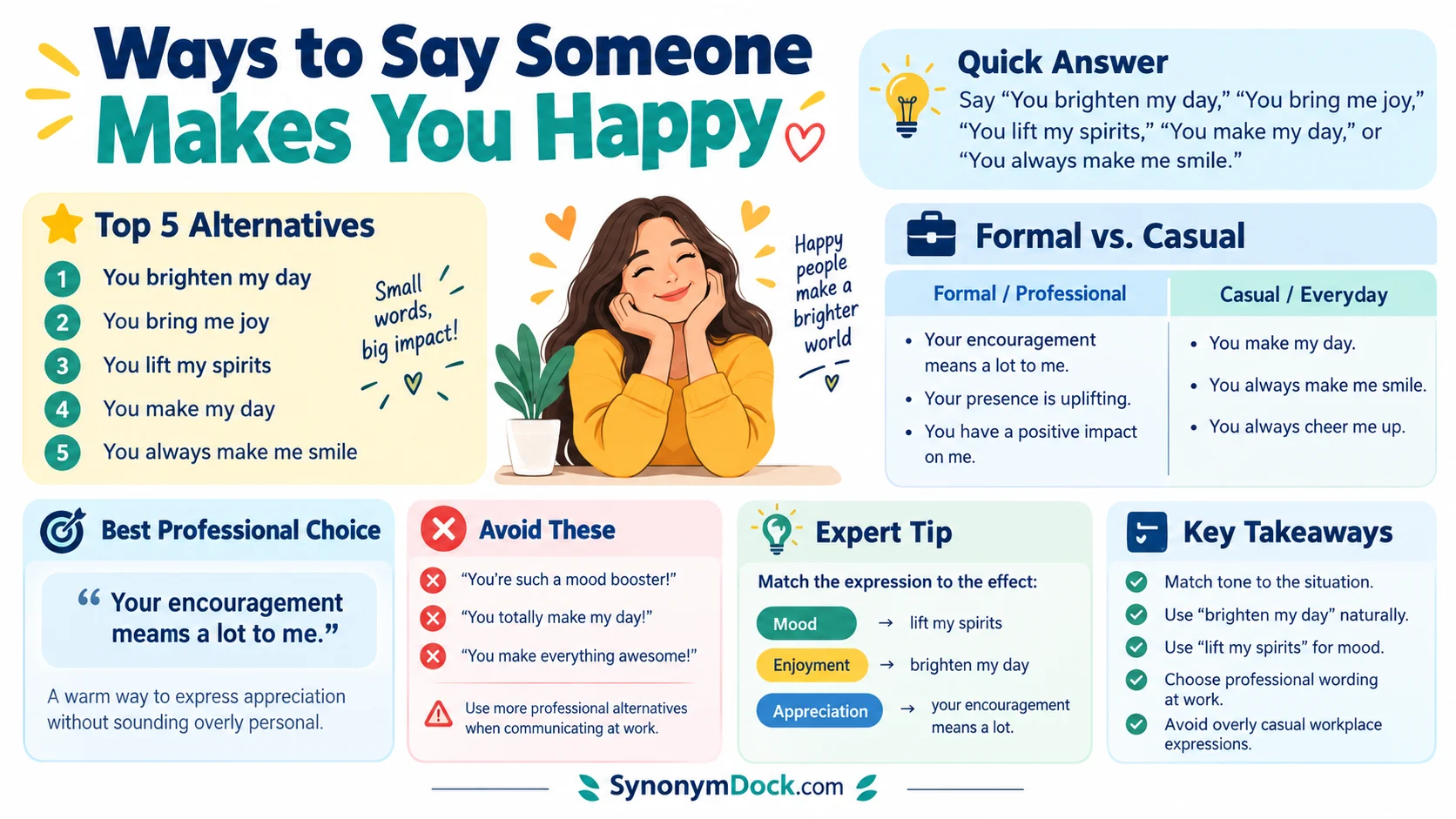
If you want other ways to say someone makes you happy, try “You brighten my day,” “You bring me joy,” “You lift my spirits,” “You make my day,” or “You always cheer me up.” Choose based on tone and context.
Top 5: You brighten my day, You bring me joy, You lift my spirits, You make my day, You always cheer me up.
Saying “You make me happy” is natural and correct, but repeating the same expression can make your English sound less varied. Learning alternatives helps you express positive feelings more precisely.
There are many other ways to say someone makes you happy, from friendly everyday expressions to polished phrases suitable for professional communication. The best choice depends on your relationship, audience, and situation.
These alternatives can help you sound more fluent in spoken English, writing, messages, workplace conversations, and personal communication without making your English sound forced.
“Good vocabulary is not about using complicated words; it is about choosing the right words for the moment.”
Quick Categories
Formal Alternatives
- You bring me great joy.
- Your presence is uplifting.
- You have a positive influence on me.
- You bring a sense of happiness to my life.
Pro Tip
Formal expressions work best when you want to sound respectful, thoughtful, or polished. They are more suitable for formal writing than casual texting.
Professional Alternatives
- You always brighten my day.
- You lift my spirits.
- You have a positive impact on my day.
- You make difficult days easier.
- Your encouragement means a lot to me.
Pro Tip
In professional English, focus on the positive effect someone has rather than using overly emotional language.
Business Email Alternatives
- Your message brightened my day.
- I really appreciate your positive attitude.
- Your encouragement was greatly appreciated.
- Thank you for bringing such positive energy to the discussion.
Pro Tip
Business emails usually benefit from appreciation rather than highly personal emotional language.
Academic Alternatives
- Your encouragement has been very motivating.
- Your support has had a positive effect on me.
- Your feedback always encourages me.
- Your contribution makes the learning experience more enjoyable.
Pro Tip
Academic English usually favors precise descriptions of someone’s positive influence rather than strongly emotional expressions.
Casual Alternatives
- You make my day.
- You always cheer me up.
- You put a smile on my face.
- You make things more fun.
Pro Tip
These expressions sound natural with friends, classmates, teammates, and people you know well.
Informal Expressions
- You always make me smile.
- You brighten my day.
- You make everything better.
- You’re such a mood booster.
Pro Tip
Informal expressions are common in everyday conversation and messages, but some may sound too relaxed for formal workplace communication.
“The same positive feeling can sound completely different when the tone changes.”
What Does “Ways to Say Someone Makes You Happy” Mean?
The phrase “ways to say someone makes you happy” refers to different English expressions used to communicate that another person’s presence, actions, words, or support creates a positive emotional effect.
The basic sentence is:
“You make me happy.”
It follows the structure:
Subject + make + object + adjective
For example:
- You make me happy.
- Your jokes make me laugh.
- Her encouragement makes me confident.
The alternatives do not all have exactly the same meaning. “You brighten my day” suggests that someone makes an ordinary day more pleasant, while “You lift my spirits” suggests that someone improves your mood when you are feeling low.
When to Use These Expressions
You can use these expressions in many situations:
- Daily conversation: “You always make me smile.”
- Messages: “You really made my day.”
- Workplace communication: “Your encouragement really lifted my spirits.”
- Meetings: “Your positive attitude makes the discussion more enjoyable.”
- Academic settings: “Your feedback makes learning more enjoyable.”
- Presentations: “Your support gives me confidence.”
- Professional emails: “Your positive feedback brightened my day.”
- Friendship: “You always cheer me up.”
- Written English: “Your presence brings me great joy.”
- Spoken English: “You always make me smile.”
The key is to match the expression with the relationship and level of formality.
Is It Professional or Polite?
Polite? ✔ Yes
Professional? Depends on context
Formal? Sometimes
Natural? ✔ Yes
“You make me happy” is grammatically correct and perfectly natural. However, in a workplace, saying it directly to a colleague can sometimes sound more personal than intended.
For professional communication, expressions such as “Your encouragement means a lot to me” or “I appreciate your positive influence” are often clearer.
Business example:
“Your constructive feedback always makes the learning process easier.”
This communicates appreciation while keeping the tone professional.
Pros and Cons
Pros
- Easy to understand
- Natural in everyday English
- Friendly and positive
- Works well in spoken conversation
- Expresses appreciation clearly
Cons
- Can become repetitive
- Does not always explain how someone creates happiness
- May sound personal in some professional settings
- Offers less variety than more specific expressions
Transition to the Main List
The best alternative depends on what you actually want to communicate. You may want to say that someone improves your mood, makes your day easier, creates enjoyment, or gives you encouragement.
The following 15 expressions cover formal, professional, neutral, casual, and informal situations.
Expert Tip
Native speakers usually choose an expression based on the specific effect someone has. If someone improves your mood, “You lift my spirits” is more precise than simply saying “You make me happy.”
Other Ways to Say “Someone Makes You Happy” (With Examples)
These alternatives can help you sound more fluent, avoid repetition, and express positive feelings naturally. Notice that some are suitable for professional communication while others belong mainly in friendly conversation.
1. Phrase: You Brighten My Day
Meaning:
You make an ordinary day feel more pleasant or enjoyable.
Explanation:
This is one of the most natural alternatives to “You make me happy.” It is warm without being overly emotional and can be used with friends, classmates, coworkers, teachers, or other people you appreciate.
It sounds neutral, friendly, and positive.
Example Sentence:
“Your cheerful attitude always brightens my day.”
Best Use:
Daily Conversation
Avoid Using In:
Formal Academic Writing
Tone:
Warm, Friendly
Formality Level:
⭐⭐⭐ Neutral
Usage Frequency:
Very Common
CEFR Level:
B1
Common Collocations:
- brighten my day
- really brighten my day
- brighten someone’s day
- brighten a difficult day
Context Variability:
- Spoken: “You really brighten my day.”
- Professional: “Your positive attitude brightens the team’s day.”
- Casual: “Your messages always brighten my day.”
2. Phrase: You Bring Me Joy
Meaning:
You give me a strong feeling of happiness or pleasure.
Explanation:
This expression is more expressive than “You brighten my day.” It can sound thoughtful and sincere, but it may feel slightly more formal or literary in everyday conversation.
It works particularly well in reflective writing or a heartfelt message.
Example Sentence:
“Working with such enthusiastic students brings me great joy.”
Best Use:
Thoughtful Writing
Avoid Using In:
Casual Work Chat
Tone:
Warm, Sincere
Formality Level:
⭐⭐⭐⭐ Formal
Usage Frequency:
Common
CEFR Level:
B2
Common Collocations:
- bring me joy
- bring great joy
- bring someone joy
- bring happiness and joy
Context Variability:
- Spoken: “Your kindness brings me joy.”
- Professional: “Helping new learners brings me great joy.”
- Casual: “Your funny stories always bring me joy.”
3. Phrase: You Lift My Spirits
Meaning:
You improve my mood when I am tired, worried, disappointed, or unhappy.
Explanation:
This phrase is especially useful when someone helps you feel better after a difficult moment. It is more specific than “You make me happy.”
It is natural, polite, and moderately formal.
Example Sentence:
“Your encouraging words really lifted my spirits after the presentation.”
Best Use:
Workplace Support
Avoid Using In:
Very Formal Reports
Tone:
Supportive, Warm
Formality Level:
⭐⭐⭐ Neutral
Usage Frequency:
Common
CEFR Level:
B2
Common Collocations:
- lift my spirits
- really lift my spirits
- lift someone’s spirits
- help lift my spirits
Context Variability:
- Spoken: “You always lift my spirits.”
- Professional: “Your feedback really lifted my spirits.”
- Casual: “That joke definitely lifted my spirits.”
4. Phrase: You Make My Day
Meaning:
You make a particular day much more enjoyable or positive.
Explanation:
This is a very common conversational expression. It does not necessarily mean that the person creates long-term happiness; it usually refers to a specific positive moment.
It is casual, friendly, and natural.
Example Sentence:
“Your kind message really made my day.”
Best Use:
Friendly Messages
Avoid Using In:
Formal Reports
Tone:
Friendly, Positive
Formality Level:
⭐⭐ Casual
Usage Frequency:
Very Common
CEFR Level:
B1
Common Collocations:
- make my day
- really make my day
- completely make my day
- make someone’s day
Context Variability:
- Spoken: “You just made my day.”
- Professional: “Your positive feedback made my day.”
- Casual: “That surprise totally made my day.”
5. Phrase: You Always Make Me Smile
Meaning:
You regularly cause me to smile because of your words, behavior, humor, or presence.
Explanation:
This is a natural expression for friendly relationships. It focuses on a visible reaction smiling rather than happiness in a broad sense.
It sounds warm and informal.
Example Sentence:
“Your sense of humor always makes me smile.”
Best Use:
Friendly Conversation
Avoid Using In:
Formal Business Letters
Tone:
Warm, Friendly
Formality Level:
⭐⭐ Casual
Usage Frequency:
Very Common
CEFR Level:
B1
Common Collocations:
- make me smile
- always make me smile
- put a smile on my face
- make someone smile
Context Variability:
- Spoken: “You always make me smile.”
- Professional: “Your enthusiasm makes everyone smile.”
- Casual: “Your stories always make me smile.”
Native Speaker Tip
“You brighten my day” and “You always make me smile” are among the easiest natural choices. “You bring me joy” is warmer and more expressive, while “You lift my spirits” specifically suggests that someone’s influence improves your mood.
6. Phrase: You Always Cheer Me Up
Meaning:
You help me feel happier when I am sad, stressed, or discouraged.
Explanation:
“Cheer me up” is a common phrasal expression in spoken English. It is especially appropriate when someone’s humor, conversation, or encouragement changes your mood.
It is informal and conversational.
Example Sentence:
“Talking to you after a difficult class always cheers me up.”
Best Use:
Daily Conversation
Avoid Using In:
Academic Essays
Tone:
Friendly, Informal
Formality Level:
⭐⭐ Casual
Usage Frequency:
Very Common
CEFR Level:
B1
Common Collocations:
- cheer me up
- always cheer me up
- cheer someone up
- try to cheer someone up
Context Variability:
- Spoken: “You always cheer me up.”
- Professional: “Your encouragement always cheers me up after a challenging meeting.”
- Casual: “That video really cheered me up.”
7. Phrase: You Put a Smile on My Face
Meaning:
You cause me to smile and feel positive.
Explanation:
This is a friendly idiomatic expression. It focuses on the immediate emotional effect of someone’s actions rather than making a broad statement about happiness.
It is natural but more expressive than simple everyday wording.
Example Sentence:
“Your thoughtful note put a smile on my face this morning.”
Best Use:
Personal Message
Avoid Using In:
Formal Academic Work
Tone:
Warm, Expressive
Formality Level:
⭐⭐ Casual
Usage Frequency:
Common
CEFR Level:
B2
Common Collocations:
- put a smile on my face
- put a big smile on my face
- put a smile on someone’s face
- always put a smile on my face
Context Variability:
- Spoken: “You really put a smile on my face.”
- Professional: “Your positive comment put a smile on my face.”
- Casual: “That picture put a huge smile on my face.”
8. Phrase: You Make Everything More Enjoyable
Meaning:
Your presence or contribution makes an activity more pleasant.
Explanation:
This phrase is useful when you want to focus on an experience rather than personal happiness. It can work well in teamwork, classrooms, group activities, and social situations.
It sounds neutral and positive.
Example Sentence:
“Your enthusiasm makes our group discussions much more enjoyable.”
Best Use:
Team Collaboration
Avoid Using In:
Legal Documents
Tone:
Positive, Appreciative
Formality Level:
⭐⭐⭐ Neutral
Usage Frequency:
Common
CEFR Level:
B2
Common Collocations:
- make something enjoyable
- make work more enjoyable
- make learning more enjoyable
- make the experience more enjoyable
Context Variability:
- Spoken: “You make these activities more enjoyable.”
- Professional: “Your contribution makes the project more enjoyable.”
- Casual: “You make every trip more enjoyable.”
9. Phrase: Your Presence Is Uplifting
Meaning:
Having you around creates a positive or encouraging feeling.
Explanation:
This is more formal than “You make me happy.” It works especially well when expressing appreciation for someone’s attitude or contribution.
It can sound polished in professional or written communication.
Example Sentence:
“Your positive attitude and willingness to help make your presence genuinely uplifting.”
Best Use:
Professional Appreciation
Avoid Using In:
Casual Texting
Tone:
Polished, Warm
Formality Level:
⭐⭐⭐⭐ Formal
Usage Frequency:
Occasional
CEFR Level:
C1
Common Collocations:
- uplifting presence
- positive presence
- genuinely uplifting
- emotionally uplifting
Context Variability:
- Spoken: “Your presence is always uplifting.”
- Professional: “Your presence is uplifting during challenging projects.”
- Casual: “Everyone enjoys having you around.”
10. Phrase: Your Encouragement Means a Lot to Me
Meaning:
Your supportive words or actions are very valuable to me.
Explanation:
This is one of the strongest choices for professional communication because it expresses appreciation without sounding overly personal.
It is suitable for teachers, colleagues, mentors, supervisors, and supportive friends.
Example Sentence:
“Your encouragement means a lot to me as I prepare for the final presentation.”
Best Use:
Professional Email
Avoid Using In:
Formal Research
Tone:
Grateful, Respectful
Formality Level:
⭐⭐⭐⭐ Formal
Usage Frequency:
Very Common
CEFR Level:
B2
Common Collocations:
- encouragement means a lot
- support means a lot
- your words mean a lot
- appreciate your encouragement
Context Variability:
- Spoken: “Your encouragement means a lot to me.”
- Professional: “Your feedback and encouragement mean a lot to me.”
- Casual: “Your support really means a lot.”
Expert Insight
In workplace communication, “Your encouragement means a lot to me” is often safer than directly saying “You make me happy.” It communicates appreciation while keeping the focus on support, feedback, or encouragement.
11. Phrase: You Have a Positive Impact on Me
Meaning:
Your actions, words, or influence affect me in a beneficial way.
Explanation:
This expression is useful when you want to sound professional and thoughtful. It is less emotional than “You bring me joy” and focuses on influence.
It works well in workplace, academic, and professional settings.
Example Sentence:
“Your constructive feedback has had a positive impact on my confidence as a presenter.”
Best Use:
Professional Communication
Avoid Using In:
Casual Text
Tone:
Professional, Thoughtful
Formality Level:
⭐⭐⭐⭐ Formal
Usage Frequency:
Common
CEFR Level:
B2
Common Collocations:
- positive impact
- have an impact on
- positive influence
- lasting impact
Context Variability:
- Spoken: “You have a positive impact on me.”
- Professional: “Your guidance has had a positive impact on my work.”
- Casual: “You’ve had such a positive impact on me.”
12. Phrase: You Bring Out the Best in Me
Meaning:
You encourage qualities, abilities, or behavior that are positive in me.
Explanation:
This expression goes beyond happiness. It suggests that someone’s influence helps you become more confident, motivated, productive, or positive.
It is natural in personal and professional relationships.
Example Sentence:
“Working with an encouraging mentor often brings out the best in me.”
Best Use:
Personal Appreciation
Avoid Using In:
Formal Report
Tone:
Positive, Sincere
Formality Level:
⭐⭐⭐ Neutral
Usage Frequency:
Common
CEFR Level:
B2
Common Collocations:
- bring out the best in me
- bring out the best in someone
- bring out someone’s strengths
- bring out positive qualities
Context Variability:
- Spoken: “You bring out the best in me.”
- Professional: “A supportive team can bring out the best in its members.”
- Casual: “You really bring out the best in me.”
13. Phrase: You Make Me Feel Positive
Meaning:
You cause me to experience more optimistic or encouraging feelings.
Explanation:
This phrase is straightforward and easy for English learners. It is less idiomatic than some alternatives, but its meaning is clear.
It is useful when you want simple, direct English.
Example Sentence:
“Your optimistic approach makes me feel positive about the upcoming project.”
Best Use:
Simple English
Avoid Using In:
Creative Writing
Tone:
Simple, Positive
Formality Level:
⭐⭐⭐ Neutral
Usage Frequency:
Common
CEFR Level:
B1
Common Collocations:
- feel positive
- feel more positive
- positive about the future
- positive about a situation
Context Variability:
- Spoken: “You make me feel positive.”
- Professional: “Your approach makes the team feel positive about the changes.”
- Casual: “Talking to you makes me feel positive.”
14. Phrase: You Make Things Better
Meaning:
Your presence, actions, or help improves a situation.
Explanation:
This is a flexible and natural expression. It does not directly say “happy,” so it can sound less emotional and more practical.
It works well with friends, coworkers, classmates, and team members.
Example Sentence:
“Your calm approach always makes difficult situations better.”
Best Use:
Everyday Communication
Avoid Using In:
Formal Academic Essay
Tone:
Natural, Positive
Formality Level:
⭐⭐⭐ Neutral
Usage Frequency:
Very Common
CEFR Level:
B1
Common Collocations:
- make things better
- make a situation better
- make everything better
- help make things better
Context Variability:
- Spoken: “You always make things better.”
- Professional: “Your practical suggestions make difficult projects better.”
- Casual: “You always make things better.”
15. Phrase: Your Kindness Makes Me Happy
Meaning:
Another person’s kind behavior creates a feeling of happiness.
Explanation:
This expression is direct but more specific than “You make me happy.” It explains why the person creates a positive feeling.
It works particularly well when thanking someone for a helpful or thoughtful action.
Example Sentence:
“Your kindness toward new students genuinely makes me happy.”
Best Use:
Personal Appreciation
Avoid Using In:
Formal Business Writing
Tone:
Warm, Sincere
Formality Level:
⭐⭐⭐ Neutral
Usage Frequency:
Common
CEFR Level:
B1
Common Collocations:
- kindness makes me happy
- appreciate your kindness
- show kindness
- act with kindness
Context Variability:
- Spoken: “Your kindness makes me happy.”
- Professional: “Your kindness toward new team members creates a welcoming environment.”
- Casual: “Your kindness always makes me happy.”
Native Speaker Tip
Among these choices, “You brighten my day” is a particularly flexible expression for everyday English. “Your encouragement means a lot to me” works better when the situation is professional. Phrases such as “Your presence is uplifting” are less common in casual conversation but useful when you want a polished tone.
Avoid These Expressions in Formal Situations
Some expressions are perfectly understandable but may sound too casual for professional communication.
| Casual Expression | Why Avoid It | Better Alternative |
| “You make everything awesome!” | Very casual | “You make the experience more enjoyable.” |
| “You’re such a mood booster!” | Informal slang-like wording | “Your positive attitude is uplifting.” |
| “You totally make my day!” | Too conversational for some formal settings | “Your feedback was greatly appreciated.” |
| “You’re the best!” | Vague and highly informal | “I really appreciate your support.” |
| “You make me so happy!” | Can sound overly personal | “Your encouragement means a lot to me.” |
Best Phrases by Situation
| Situation | Best Phrase |
| Business Email | Your encouragement means a lot to me |
| Client Meeting | Your positive attitude is uplifting |
| Academic Essay | You have a positive impact on me |
| Presentation | Your encouragement means a lot to me |
| Workplace Discussion | You make things better |
| Job Interview | You bring out the best in me |
| Team Collaboration | You make everything more enjoyable |
| Everyday Conversation | You brighten my day |
Top 10 Alternatives Compared
| Phrase | Tone | Formality | Best Use | Frequency |
| You brighten my day | Warm | Neutral | Daily Conversation | Very Common |
| You bring me joy | Sincere | Formal | Thoughtful Writing | Common |
| You lift my spirits | Supportive | Neutral | Workplace Support | Common |
| You make my day | Friendly | Casual | Messages | Very Common |
| You always make me smile | Warm | Casual | Friends | Very Common |
| You always cheer me up | Friendly | Casual | Daily Conversation | Very Common |
| You put a smile on my face | Expressive | Casual | Personal Messages | Common |
| You make everything more enjoyable | Positive | Neutral | Teamwork | Common |
| Your presence is uplifting | Polished | Formal | Professional Appreciation | Occasional |
| Your encouragement means a lot to me | Respectful | Formal | Professional Emails | Very Common |
Which One Should You Use?
Best Overall
You brighten my day is flexible, natural, and positive without sounding too formal or too personal.
Best Professional
Your encouragement means a lot to me works well when thanking a colleague, teacher, mentor, or supervisor.
Best Academic
You have a positive impact on me is useful when discussing influence in a more formal context.
Best Business Email
Your feedback was greatly appreciated keeps the message professional and focuses on appreciation.
Best Everyday Conversation
You always make me smile sounds natural and friendly.
Most Natural
You brighten my day is an easy choice when speaking naturally.
Most Polite
Your encouragement means a lot to me expresses appreciation respectfully.
Commonly Confused Phrases
“You make me happy” vs. “You make my day”
“You make me happy” describes a broader emotional effect. “You make my day” usually refers to a particular moment or day that someone has improved.
“You brighten my day” vs. “You lift my spirits”
“You brighten my day” means someone makes the day more pleasant. “You lift my spirits” specifically suggests that someone improves your mood when you feel discouraged or low.
“You bring me joy” vs. “You make me smile”
“You bring me joy” describes a deeper or broader feeling of happiness. “You make me smile” focuses on a visible reaction and is generally more casual.
“You have a positive impact on me” vs. “You make me happy”
The first emphasizes influence, while the second emphasizes emotion. In professional English, “positive impact” can be more appropriate when discussing someone’s influence.
“Choose the phrase that describes the effect, not just the emotion.”
Scenario Practice
1. Business Meeting
Situation: A colleague gives useful advice that makes a difficult discussion easier.
Which phrase would you choose?
Answer: “Your suggestions make things better.”
Why: It focuses on the practical value of the colleague’s contribution.
2. Job Interview
Situation: You want to explain how a supportive workplace helps you perform well.
Which phrase would you choose?
Answer: “A supportive environment brings out the best in me.”
Why: This sounds professional and focuses on performance rather than personal emotion.
3. Presentation
Situation: Your teacher encourages you before an important presentation.
Which phrase would you choose?
Answer: “Your encouragement means a lot to me.”
Why: It is respectful, natural, and appropriate for a teacher-student context.
4. Class Discussion
Situation: A classmate makes lessons more enjoyable through useful participation.
Which phrase would you choose?
Answer: “You make our discussions more enjoyable.”
Why: It clearly describes the person’s positive contribution.
5. Email Reply
Situation: A colleague sends encouraging feedback after you complete a task.
Which phrase would you choose?
Answer: “Your feedback really brightened my day.”
Why: It is warm while still being suitable for a friendly professional email.
Mini Quiz
1. Which phrase best describes someone improving your mood when you are discouraged?
A. You bring me joy.
B. You lift my spirits.
C. You make everything awesome.
D. You are the best.
Answer: B
2. Which expression is most suitable for thanking a professional mentor?
A. You totally make my day!
B. You’re such a mood booster!
C. Your encouragement means a lot to me.
D. You make everything awesome!
Answer: C
3. Which phrase is most natural in a casual conversation with a friend?
A. Your presence is uplifting.
B. You always make me smile.
C. You have a positive impact on me.
D. Your contribution is appreciated.
Answer: B
4. Which phrase focuses on someone’s influence rather than direct happiness?
A. You make me happy.
B. You make my day.
C. You have a positive impact on me.
D. You put a smile on my face.
Answer: C
5. Which expression is particularly useful when someone improves a difficult day?
A. You brighten my day.
B. You lift my spirits.
C. Your presence is uplifting.
D. All of these can work, depending on context.
Answer: D
Answer Key
- B “Lift my spirits” specifically means improving someone’s mood.
- C It communicates professional appreciation naturally.
- B It is common and friendly in everyday speech.
- C It emphasizes influence rather than happiness.
- D All three can describe a positive emotional effect, with slightly different nuances.
FAQs
What is the most formal way to say someone makes you happy?
For formal communication, “You have a positive impact on me” is a strong choice because it focuses on influence rather than personal emotion. “Your presence is uplifting” can also work when the context is appropriate. In professional writing, however, explaining the specific positive effect is often clearer than simply saying that someone makes you happy.
Which phrase is best for professional emails?
“Your encouragement means a lot to me” is a useful professional alternative when responding to support or positive feedback. You can also say “I really appreciate your positive feedback” or “Your message was greatly appreciated.” These expressions communicate gratitude without making the message sound unnecessarily personal.
What is the difference between “You brighten my day” and “You lift my spirits”?
“You brighten my day” means someone makes your day more pleasant or enjoyable. “You lift my spirits” is more specific: it suggests that someone improves your mood when you are disappointed, stressed, tired, or discouraged. Both are natural, but they describe slightly different emotional effects.
Which alternative sounds most natural?
“You brighten my day” is one of the most flexible natural alternatives. “You make my day” and “You always make me smile” are also extremely common in everyday English. For professional situations, choose a phrase that focuses on encouragement, support, feedback, or positive influence.
Can I use these expressions in business meetings?
Yes, but choose carefully. In a business meeting, phrases such as “Your suggestions make things better,” “Your encouragement means a lot to me,” or “Your positive attitude is uplifting” can work depending on the context. Very personal or highly casual expressions may sound inappropriate in a formal workplace.
Conclusion
Learning different ways to say someone makes you happy gives you more control over your English. Instead of repeating “You make me happy,” you can choose an expression that describes the exact effect, such as improving someone’s mood, making a day more enjoyable, or showing appreciation for encouragement. This makes your communication more precise and natural.
Practice these alternatives in everyday conversations, emails, meetings, classroom discussions, and professional writing. Start with simple expressions such as “You brighten my day,” then experiment with more formal choices as your confidence grows. The goal is not to use complicated English it is to choose the expression that fits the situation naturally.

19 thoughts on “Ways to Say Someone Makes You Happy| 21 Phrases For 2026”