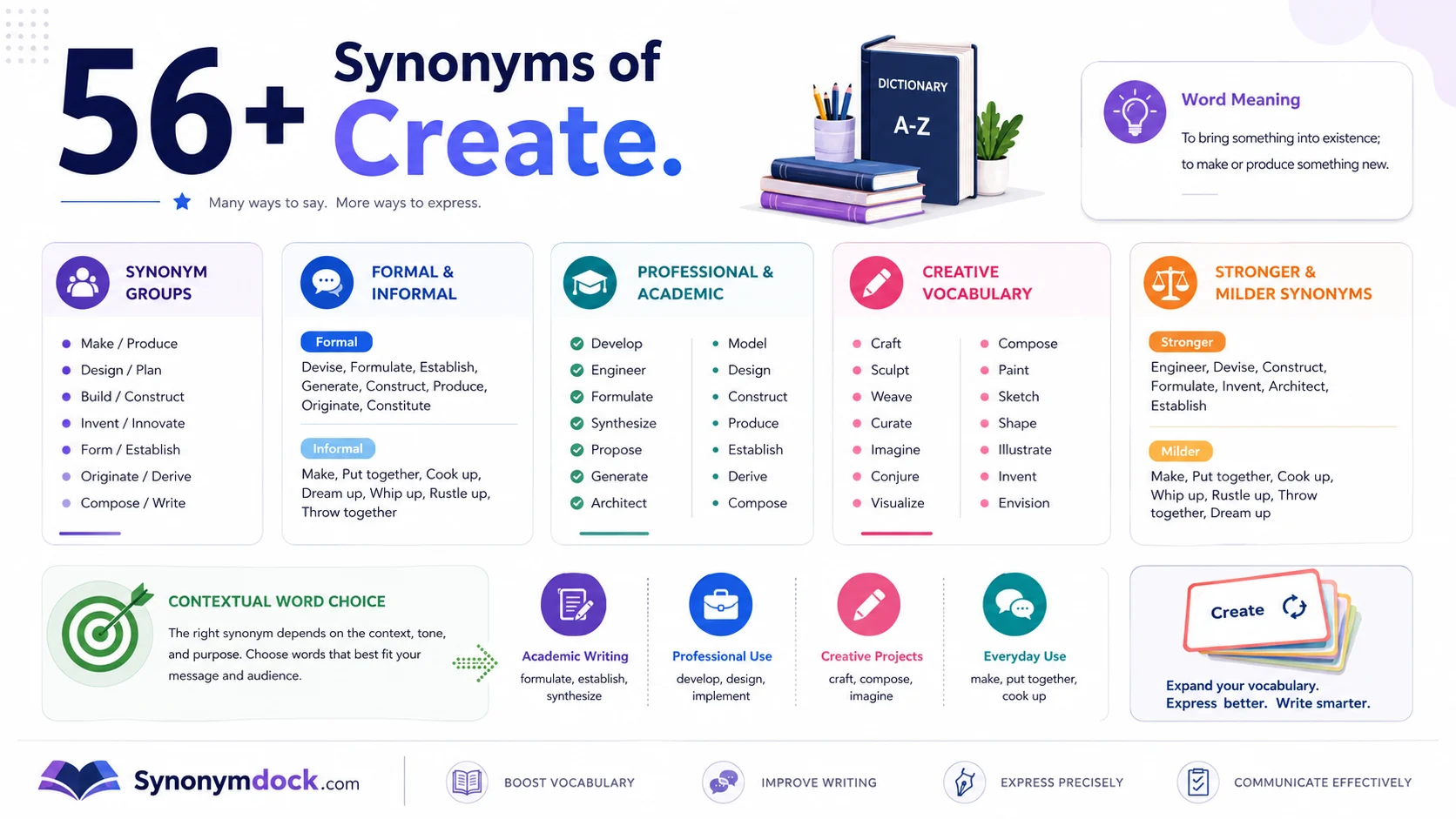
“Create” means to bring something into existence or make something new from nothing. The best formal synonyms include “generate” and “develop.” For casual conversation, choose “make” or “build.” For professional settings, use “produce” or “establish.” Creative writing often benefits from “craft” or “compose.”
Have you ever written an email or an essay and realized you used the word “create” five times in a single paragraph? It happens to everyone. Repeating the same word makes writing feel flat and uninspired. Whether you are drafting a resume, writing a blog post, or composing a social media caption, finding the right synonym of create can transform your message from boring to brilliant.
The word “create” is versatile, but it is not always the best choice. Sometimes you need something more formal, more emotional, or more precise. This guide helps you understand the meaning of “create” and shows you exactly which synonyms to use in every situation.
Meaning, Tone, and Context
Simple Definition
To create means to bring something into existence. It can refer to making physical objects, inventing ideas, causing events, or producing artistic works.
Part of Speech
Verb
Overall Tone
Neutral, with a positive leaning
Formality Level
Neutral. The word fits almost any situation, but it can sometimes feel too general.
Common Uses
You will hear native speakers use “create” in:
- Business settings: “We need to create a new marketing strategy.”
- Artistic contexts: “The painter creates beautiful landscapes.”
- Everyday life: “Can you create more space in the closet?”
- Academic writing: “The study aims to create a framework for analysis.”
- Professional communication: “Let us create a plan for the next quarter.”
Word Forms
| Form | Word |
|---|---|
| Verb | Create |
| Noun | Creation, Creator, Creativity |
| Adjective | Creative |
| Adverb | Creatively |
| Opposite | Destroy |
When and How to Use “Create”
“Create” works well as a default word, but it is often too vague. Use it when you need a general verb that does not require precision.
7 Real-Life Examples
Professional: “Our team will create a new workflow to improve efficiency.”
Academic: “Researchers hope to create a more accurate climate model.”
Workplace: “Please create a spreadsheet for the budget meeting.”
Personal: “I want to create a morning routine that sets up my day for success.”
Email: “I attached the document I created for the client presentation.”
Resume: “Created a new inventory tracking system that reduced waste by 15%.”
Social Media: “Let’s create something beautiful today.”
Best Synonyms of “Create”
No synonym works perfectly in every situation. Each word carries its own tone, intensity, and best use case. Here are the best synonyms for specific contexts.
Professional Writing
Produce is your best choice. It sounds efficient and businesslike. “Produce” emphasizes output and results, making it ideal for workplace communication.
Academic Writing
Generate works well because it suggests systematic creation. Researchers generate data, generate hypotheses, and generate solutions.
Business Communication
Develop implies thoughtful growth. Use it when discussing products, strategies, or projects that require planning and execution.
Casual Conversation
Make is simple and natural. Native speakers use “make” in everyday talk more than any other synonym.
Emotional Writing
Bring forth expresses emotional weight. It works for personal stories, poetry, and inspirational writing.
Creative Writing
Craft implies skill and care. Writers craft sentences, artists craft images, and storytellers craft worlds.
Resume Writing
Established or Founded shows initiative. Use these for resume bullet points describing new systems or organizations you built from scratch.
Workplace Communication
Build suggests collaborative effort. Teams build products, relationships, and momentum.
Stronger Meaning
Invent creates something completely new. Use it only when referring to original ideas or objects that did not exist before.
Softer Meaning
Form suggests gentle creation. You form teams, form opinions, or form habits gradually.
When Not to Use “Create”
The Word Sounds Too General
“I want to create a better life for my family” is true but vague. A stronger sentence communicates specific action.
Better: “I want to build a better life for my family.”
The Word Sounds Too Formal
“A group of friends created a plan for the weekend” sounds stiff for casual talk.
Better: “A group of friends made a plan for the weekend.”
The Word Sounds Too Weak
“The company created a new product” fails to impress. Stronger verbs show more impact.
Better: “The company developed a revolutionary new product.”
The Word Sounds Outdated in Some Contexts
Using “create” when “author” or “compose” would be more precise limits your writing’s sophistication.
Words Commonly Confused With “Create”
Create vs Make
Difference: “Make” is more general and conversational. “Create” suggests originality and effort.
When to use Make: Everyday actions, cooking, building simple things.
Example: “I will make dinner tonight.”
When to use Create: Artistic work, complex projects, bringing something new into existence.
Example: “She creates paintings that sell for thousands of dollars.”
Create vs Produce
Difference: “Produce” focuses on output and manufacturing. “Create” highlights original thought and craftsmanship.
When to use Produce: Factories, content creation, generating results.
Example: “The factory produces 500 units per day.”
When to use Create: Art, innovation, strategic planning.
Example: “The designer created a groundbreaking new look.”
Create vs Design
Difference: “Design” specifically involves planning and intention. “Create” can be more general.
When to use Design: Architecture, graphic work, intentional planning.
Example: “She designed the entire website interface.”
When to use Create: Any act of bringing something into existence.
Example: “He created a new recipe for the competition.”
Create vs Build
Difference: “Build” suggests assembling parts or constructing over time. “Create” is more abstract.
When to use Build: Construction, teams, relationships, systems.
Example: “We built this company from the ground up.”
When to use Create: Ideas, art, concepts, theories.
Example: “She created a powerful argument for the proposal.”
Create vs Form
Difference: “Form” is gentler and suggests gradual development. “Create” is more active.
When to use Form: Habits, opinions, connections.
Example: “They formed a strong friendship over the years.”
When to use Create: Intentional, purposeful acts.
Example: “We created a new department for customer service.”
Create vs Craft
Difference: “Craft” emphasizes skill and care. “Create” can be more impersonal.
When to use Craft: Stories, handmade items, careful work.
Example: “He crafted a beautiful response to her question.”
When to use Create: Any act of making something new.
Example: “The committee created a new policy for the organization.”
Best Synonyms of “Create” by Context
| Context | Best Synonym | Why It Works | Example |
|---|---|---|---|
| Formal writing | Generate | Sounds analytical and precise | “The study will generate new insights into the problem” |
| Academic writing | Develop | Suggests thoughtful progression | “We developed a theoretical framework for analysis” |
| Professional communication | Produce | Emphasizes results and efficiency | “Our team produced impressive results this quarter” |
| Business emails | Establish | Shows authority and permanence | “We established new protocols for client communication” |
| Resume writing | Founded | Demonstrates leadership and initiative | “Founded a mentorship program for new employees” |
| Workplace communication | Build | Suggests collaboration and effort | “We built a culture of transparency and trust” |
| Casual conversation | Make | Natural and effortless | “I will make a reservation for dinner” |
| Everyday speaking | Get together | Informal and friendly | “We got together a plan for the weekend” |
| Creative writing | Craft | Emphasizes artistic skill | “The author crafted a world that felt completely real” |
| Storytelling | Bring forth | Adds emotional weight | “The experience brought forth a newfound sense of purpose” |
| Emotional writing | Compose | Suggests careful arrangement of feelings | “He composed a heartfelt apology” |
| Strong emphasis | Invent | Implies true novelty | “She invented an entirely new approach to the problem” |
| Mild tone | Form | Gentle and gradual | “They formed a close bond over the years” |
| Social media captions | Make | Simple and relatable | “Let’s make today count” |
| American English | Create | Standard across all contexts | Use any synonym naturally |
| British English | Create | Same meaning, same usage | No major differences in common usage |
How to Choose the Best Synonym of “Create”
Choosing the right synonym depends on a few simple questions.
Consider Your Audience
If you are writing for a professor, choose formal vocabulary like “generate” or “develop.” If you are texting a friend, “make” or “build” feels natural.
Check Your Tone
Are you trying to sound professional? Use “produce” or “establish.” Do you want to sound creative? “Craft” or “compose” works better. Need to show strength? “Invent” or “forge” adds power.
Think About Emotional Strength
Emotional writing benefits from words like “bring forth” or “give rise to.” Neutral situations call for “create” or “form.”
Match Your Writing Purpose
Academic essays prefer “generate” and “formulate.” Business writing favors “develop” and “establish.” Creative work shines with “craft” and “compose.
Read Your Sentence Out Loud
If the synonym sounds unnatural, choose a different one. The best word is the one that flows naturally in your sentence.
Real Life Examples of “Create”
School
Original: “The students created dioramas for the history project.”
Improved: “The students constructed detailed dioramas for the history project.”
College
Original: “I need to create a thesis statement for my paper.”
Improved: “I need to formulate a strong thesis statement for my paper.”
Workplace
Original: “We should create a system for tracking orders.”
Improved: “We should establish a system for tracking orders.”
Business
Original: “The company created a new line of products.”
Improved: “The company launched a new line of products.”
Original: “I created a draft of the proposal for your review.”
Improved: “I prepared a draft of the proposal for your review.”
Resume
Original: “Created a new employee onboarding process.”
Improved: “Developed a comprehensive employee onboarding process.”
Conversation
Original: “Let’s create a plan for the road trip.”
Improved: “Let’s make a plan for the road trip.”
Storytelling
Original: “The wizard created a magical shield to protect the kingdom.”
Improved: “The wizard conjured a magical shield to protect the kingdom.”
Blogging
Original: “This recipe creates a delicious chocolate cake.”
Improved: “This recipe yields a delicious chocolate cake.”
Social Media
Original: “Creating memories with my favorite people.”
Improved: “Making memories with my favorite people.”
18 Best Synonyms of “Create”
| Synonym | Simple Meaning | Best Used For | Example Sentence |
|---|---|---|---|
| Make | To produce or form | Everyday situations | “I will make a cup of coffee” |
| Produce | To bring something into existence, often in quantity | Business, manufacturing | “The company produces high-quality furniture” |
| Build | To construct by assembling parts | Teams, systems, relationships | “We built a successful marketing campaign” |
| Develop | To grow or advance gradually | Products, ideas, skills | “They developed a new software program” |
| Generate | To produce or cause to exist | Ideas, energy, solutions | “The brainstorming session generated many new ideas” |
| Design | To plan with intention | Graphics, architecture, plans | “She designed the logo for the company” |
| Invent | To create something entirely new | Innovations, devices, methods | “He invented a machine that cleans itself” |
| Compose | To arrange or create artistically | Music, writing, art | “She composed a symphony for the orchestra” |
| Craft | To make skillfully by hand or care | Handmade items, stories, responses | “He crafted a thoughtful reply” |
| Establish | To set up or create permanently | Organizations, policies, systems | “We established a new department for research” |
| Form | To shape or bring into being gradually | Habits, opinions, relationships | “They formed a partnership that lasted years” |
| Construct | To build or assemble with structure | Buildings, arguments, theories | “The professor constructed a compelling argument” |
| Forge | To create with effort and determination | Alliances, paths, connections | “They forged a strong alliance between the teams” |
| Author | To write or create a work | Books, articles, reports | “She authored three bestselling novels” |
| Conceive | To imagine or develop in the mind | Ideas, plans, concepts | “He conceived a brilliant plan for the project” |
| Initiate | To begin or start | Processes, projects, conversations | “The manager initiated a new feedback system” |
| Fashion | To make or shape skillfully | Objects, responses, solutions | “She fashioned a solution from limited resources” |
| Formulate | To create with careful planning | Strategies, theories, plans | “The committee formulated a new policy” |
Synonyms of “Create” by Usage
Professional vs Personal Synonyms
Professional: produce, develop, establish, generate
These words sound competent and result-oriented. Use them in resumes, meetings, and business communications.
Personal: make, build, form, craft
These words feel warmer and more conversational. Use them with friends, family, and in social settings.
Formal vs Conversational Synonyms
Formal: formulate, originate, establish, generate
Use these for academic papers, professional reports, and formal presentations.
Conversational: make, build, produce, come up with
These words sound natural in everyday talk, text messages, and casual emails.
Academic Synonyms
Generate works well in research contexts.
Formulate fits theoretical discussions.
Develop appears frequently in academic writing.
Conceive works for theoretical frameworks.
Academic settings require precision and authority. Avoid vague synonyms in research papers and essays.
Professional and Business Synonyms
Develop suggests strategic growth.
Establish communicates permanence.
Launch works for products and services.
Found fits organizational work.
Strongest choices for business writing include “develop,” “establish,” and “launch.” These words show initiative and competence.
Creative and Literary Synonyms
Compose works for artistic works.
Craft suggests care and skill.
Fashion adds elegance.
Conjure evokes imagination.
Author works for written works.
Creative writing benefits from vivid synonyms that add imagery and emotion.
Slang or Modern Synonyms
“Whip up” means to create something quickly.
“Throw together” suggests hurried creation.
“Cook up” works for plans and ideas.
These phrases are informal and should be avoided in professional writing.
Strongest to Mildest Synonyms
Mild: form, make
Moderate: produce, generate, build
Strong: establish, forge, invent
Very Strong: bring into being, give rise to, bring forth
Emotional intensity increases as you move up the scale. Choose mild words for everyday talk. Choose strong words for powerful writing.
Emotional vs Neutral Synonyms
Emotional Synonyms: bring forth, give rise to, conceive, forge
These words add feeling and drama. Use them in storytelling, speeches, and persuasive writing.
Neutral Synonyms: make, form, produce, generate
These words simply communicate. Use them in business writing, emails, and factual reporting.
Antonyms of “Create”
| Antonym | Meaning | Example Sentence |
|---|---|---|
| Destroy | To ruin or put an end to | “The storm destroyed the newly built fence” |
| Demolish | To tear down completely | “They demolished the old building to make room for a park” |
| Ruin | To damage beyond repair | “The flood ruined years of hard work” |
| Annihilate | To destroy completely | “The fire annihilated the entire forest” |
| Eliminate | To remove or get rid of | “We eliminated the outdated policies” |
| Erase | To wipe out or remove | “The accident erased years of progress” |
| Obliterate | To wipe out all traces | “The hurricane obliterated the coastal town” |
| Break | To separate into pieces | “He broke the vase by accident” |
| Shatter | To break into many pieces | “The news shattered her confidence” |
| Smash | To break violently | “The truck smashed through the barricade” |
| Wreck | To destroy violently | “The crash wrecked both vehicles” |
| Dissolve | To break down or end | “The organization dissolved after the scandal” |
| Dismantle | To take apart | “They dismantled the old machinery” |
| Terminate | To bring to an end | “The company terminated the project” |
| Abolish | To formally put an end to | “The government abolished the outdated law” |
Comparison: “Create” vs Similar Words
Create vs Generate
Main Difference: “Create” focuses on bringing something into existence. “Generate” emphasizes production from a source.
Which Is Stronger? Both are similar in strength.
Which Is More Formal? “Generate” is slightly more formal, especially in technical contexts.
When to Use Each:
- Create: artistic works, general acts of making
- Generate: energy, data, ideas, reports
Examples:
Create: “The artist created a stunning portrait.”
Generate: “The algorithm generates recommendations based on user behavior.”
Create vs Develop
Main Difference: “Create” happens in a single moment. “Develop” happens gradually over time.
Which Is Stronger? “Develop” often implies more depth and investment.
Which Is More Formal? Both are formal. “Develop” appears more often in academic writing.
When to Use Each:
- Create: bringing something new into existence quickly
- Develop: nurturing something over time
Examples:
Create: “She created a new recipe for the contest.”
Develop: “We developed the product over five years.”
Create vs Invent
Main Difference: “Invent” specifically means creating something that did not exist before. Create” can also mean making something in a new way.
Which Is Stronger? “Invent” is stronger and more specific.
Which Is More Formal? Both are neutral to formal.
When to Use Each:
- Create: making something new or adapted
- Invent: creating something entirely original
Examples:
Create: “The chef created a new twist on a classic dish.”
Invent: “Edison invented the light bulb.”
Create vs Establish
Main Difference: “Establish” focuses on setting up something permanent. “Create” is more general.
Which Is Stronger? “Establish” suggests greater authority.
Which Is More Formal? “Establish” is more formal and authoritative.
When to Use Each:
- Create: making anything new
- Establish: setting up institutions, systems, relationships
Examples:
Create: “He created a document for the meeting.”
Establish: “They established a new branch in the city.”
Create vs Form
Main Difference: “Form” suggests shaping something from existing materials. “Create” can mean making something from nothing.
Which Is Stronger? “Create” is stronger and more active.
Which Is More Formal? Both are versatile.
When to Use Each:
- Create: making something new and original
- Form: shaping or developing gradually
Examples:
Create: “She created a new business model.”
Form: “The students formed a study group.”
Create vs Construct
Main Difference: “Construct” emphasizes building with structure. “Create” is more abstract and general.
Which Is Stronger? “Construct” suggests specific technical effort.
Which Is More Formal? “Construct” is more formal and technical.
When to Use Each:
- Create: ideas, art, concepts
- Construct: buildings, arguments, systems
Examples:
Create: “The writer created a believable character.”
Construct: “The engineers constructed a new bridge.”
Common Phrases and Expressions with “Create”
Create opportunities
Meaning: To make situations available that can lead to advancement.
Example: “The new policy will create opportunities for small businesses.”
Create a stir
Meaning: To cause excitement or controversy.
Example: “His comments created a stir on social media.”
Create a buzz
Meaning: To generate excitement or interest.
Example: “The product launch created a buzz among tech enthusiasts.”
Create a legacy
Meaning: To leave something meaningful for the future.
Example: “She worked hard to create a legacy of compassion.”
Create change
Meaning: To bring about transformation.
Example: “The activists wanted to create real change in the community.”
Create value
Meaning: To add worth or benefit.
Example: “The training program creates value for employees and clients.”
Create a scene
Meaning: To behave dramatically or embarrassingly.
Example: “Please do not create a scene at the wedding.”
Common Mistakes to Avoid
Mistake 1: Using “Make” in Formal Writing
Incorrect: “The researchers made a new theory about climate change.”
Better: “The researchers formulated a new theory about climate change.”
Why: “Make” sounds too casual for academic contexts.
Mistake 2: Using “Create” Too Often
Incorrect: “We need to create a plan. Then we can create a timeline. Finally, we will create the final report.”
Better: “We need to develop a plan. Then we can establish a timeline. Finally, we will produce the final report.”
Why: Variety keeps writing interesting and professional.
Mistake 3: Choosing Overly Dramatic Synonyms
Incorrect: “I want to bring forth a sandwich.”
Better: “I want to make a sandwich.”
Why: “Bring forth” sounds dramatic for everyday actions.
Mistake 4: Confusing “Create” and “Invent”
Incorrect: “She invented a new cupcake recipe.”
Better: “She created a new cupcake recipe.”
Why: “Invent” suggests something completely new, like a device. “Create” fits culinary work better.
Mistake 5: Using Slang in Professional Writing
Incorrect: “The team cooked up a new strategy.”
Better: “The team developed a new strategy.”
Why: Slang phrases sound unprofessional in workplace communication.
Mistake 6: Choosing the Wrong Strength
Incorrect: “The project generated a small improvement in sales.”
Better: “The project created a small improvement in sales.”
Why: “Generate” sounds too strong for a minor improvement.
Mistake 7: Forgetting Audience Context
Incorrect: “I will establish dinner for us tonight.” (Too formal)
Better: “I will make dinner for us tonight.” (Natural)
Why: Your audience determines which word fits best.
Frequently Asked Questions
What are the best synonyms of “create”?
The best synonyms depend on context. For formal writing, use “generate” or “develop.” For casual talk, use “make” or “build.” For creative work, use “craft” or “compose.” Professional settings work well with “produce” and “establish.”
What are the best formal synonyms of “create”?
“Generate,” “develop,” and “formulate” are excellent formal synonyms. “Establish” works for organizational contexts. “Produce” fits business situations. These words sound authoritative and precise in formal writing.
What are common informal synonyms of “create”?
“Make” and “build” are the most common informal synonyms. “Come up with” works for ideas. “Put together” and “whip up” work for casual situations. Use these with friends, family, and in social settings.
What is another word for “create” in professional writing?
Develop,” “produce,” and “establish” are strong professional alternatives. “Generate” works for data and ideas. “Formulate” fits strategic work. These words demonstrate competence and authority.
What is the difference between “create” and “make”?
“Make” is more general and conversational. “Create” suggests originality and effort. You make dinner but create art. “Make” works for everyday actions. “Create” adds weight to artistic or complex work.
What is the opposite of “create”?
The direct opposite of “create” is “destroy.” Other antonyms include demolish, ruin, eliminate, erase, dismantle, and terminate. Each word varies in intensity. “Destroy” is the most direct opposite meaning.
Conclusion
The word “create” brings something into existence. It is a useful verb, but it is not always the best choice. The synonyms you choose shape your message and influence how readers understand your words. In formal writing, choose “generate” or “develop.” In casual conversation, choose “make” or “build.” In creative work, choose “craft or “compose.” No single synonym works for every situation. The best writers match their vocabulary to their audience, their tone, and their purpose. When you need a synonym of create, think about what you want to say and choose the word that communicates that meaning most clearly.

10 thoughts on “56+ Synonyms of Create| Meanings, Uses and Best Alternatives”