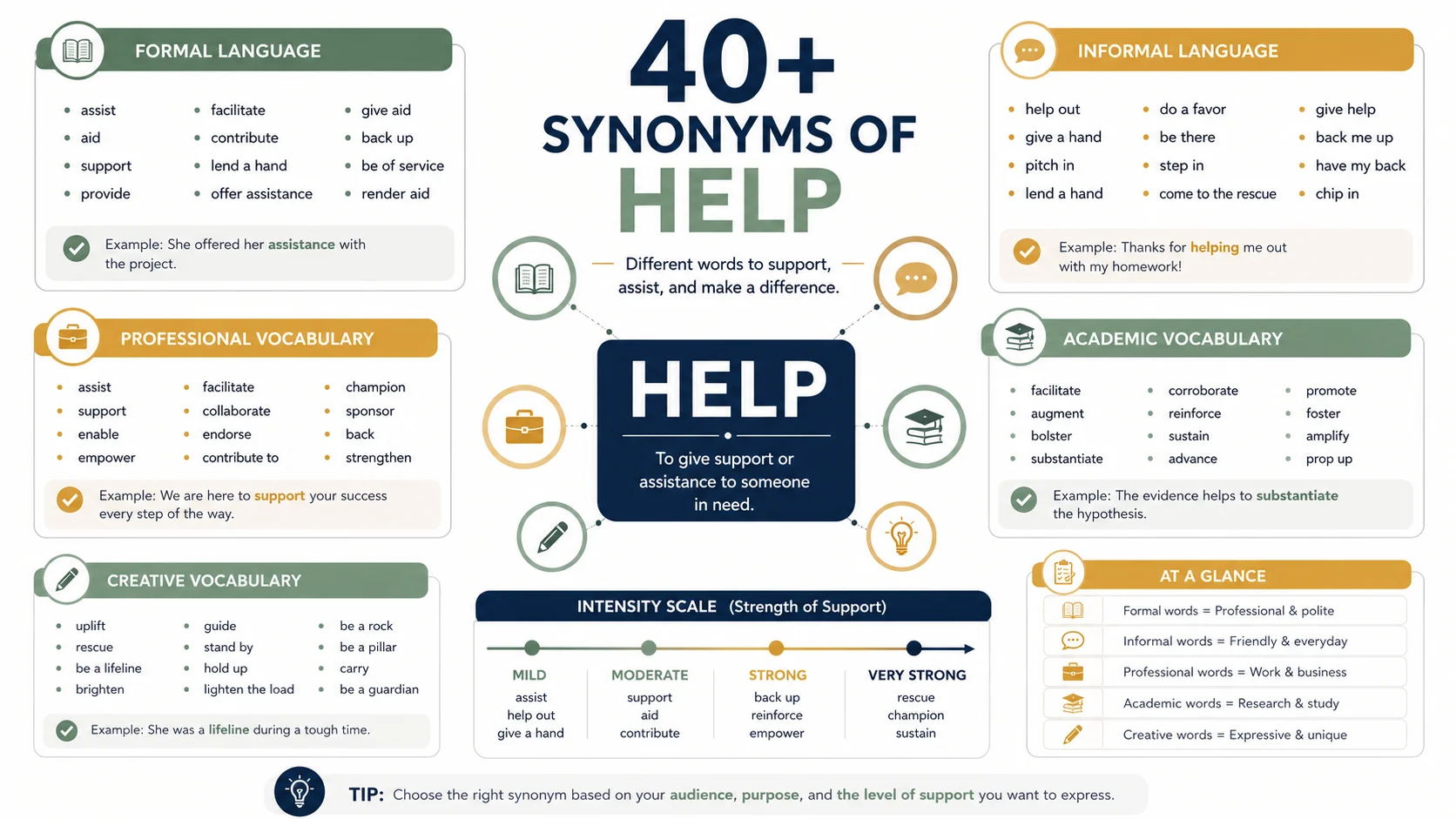
The best synonym of help depends on your context. For professional writing, use “assist.” For academic work, “facilitate” works well. For casual conversation, try “lend a hand.” For emotional support, “support” or “comfort” are excellent choices. No single synonym works perfectly everywhere .
Have you ever caught yourself using the word “help” repeatedly in an email, essay, resume, or social media post? It happens to everyone. Although help is a clear and useful word, choosing a more precise alternative can make your writing sound more natural, professional, and engaging.
If you’re searching for a help synonym, a synonym for help, an other term for help, or simply another word for help, the best choice depends on what you actually mean. Assist may work well in a professional setting, while support, aid, guide, serve, encourage, or facilitate can communicate slightly different ideas.
Understanding the synonyms of help also allows you to match your language to the situation. For example, help synonyms such as assist and aid often suggest practical assistance, while support can emphasize emotional or ongoing encouragement. If you’re looking for synonyms for help in an essay, workplace email, resume, or everyday conversation, selecting the right word can improve both clarity and tone.
You may also be wondering what is another word for help, what is a better word for helping, or whether there are stronger alternatives than simply repeating help. The answer depends on the context, because synonyms help communicate different shades of meaning rather than functioning as perfect replacements in every sentence.
This guide is based on standard English usage, dictionary definitions, and contextual differences in meaning. We’ll explain common help synonyms, their definitions, levels of formality, appropriate situations, and example sentences so you can choose the most accurate alternative with confidence. Whether you’re writing professionally, academically, creatively, or conversationally, you’ll find clear, practical, and trustworthy guidance throughout this article.
Meaning, Tone, and Context
Simple Definition
Help means to give assistance, support, or aid to someone in need. It can also mean making a situation easier or better .
Part of Speech
- Verb (most common)
- Noun
Overall Tone
Neutral. The word “help” does not carry a strong positive or negative emotional charge on its own.
Formality Level
Neutral to Informal. “Help” works in almost any setting. It is neither overly formal nor overly casual.
Common Uses
Native speakers use “help” in virtually every context. You will hear it in workplaces, homes, schools, emails, conversations, and social media. It describes physical assistance, emotional support, professional guidance, and even fixing problems.
Word Forms
- Noun: Help (I need some help.)
- Verb: Help, helps, helping, helped (She helped me.)
- Adjective: Helpful (He gave helpful advice.)
- Adverb: Helpfully (She helpfully explained the rules.)
- Opposite: Hinder, obstruct, harm
When and How to Use “Help”
You should use “help” when you need a simple, clear, and universally understood word. It is the safest choice in most situations. The following examples show how native speakers use it in real life.
Professional
“Can you help me review these financial reports before the meeting?”
Academic
“The study aims to help researchers understand cognitive development in children.”
Workplace
“I asked my colleague to help me with the software installation.”
Personal
“My neighbors helped me move the furniture into my new apartment.”
“Thank you for offering to help with the project deadline.”
Resume
“Helped increase sales by 15 percent through targeted marketing campaigns.”
Social Media
“If anyone can help me find a good plumber, please let me know.”
Best Synonyms of “Help”
No synonym perfectly matches “help” in every situation. The following recommendations explain the best alternative for each context.
Professional Writing: Assist
“Assist” sounds more formal and polished than “help.” It suggests providing support in a professional capacity .
Academic Writing: Facilitate
Facilitate” means making a process easier without doing the work for someone. It sounds precise and authoritative in research papers .
Business Communication: Support
“Support” emphasizes backing someone up and ensuring they are not alone. It works well in emails and meetings .
Casual Conversation: Lend a Hand
This informal phrase sounds warm and friendly in everyday speech .
Emotional Writing: Comfort or Succor
“Comfort” focuses on emotional relief. “Succor” is a literary term for helping someone in distress .
Creative Writing: Befriend or Guide
“Befriend” suggests a personal connection. “Guide” implies leading someone through a process .
Resume Writing: Contribute or Boost
“Contributed to” shows teamwork. “Boosted” implies a noticeable improvement .
Workplace Communication: Back Up or Stand By
These phrases suggest loyalty and readiness to help colleagues.
Stronger Meaning: Rescue or Salvage
Use these when the situation involves danger or serious loss .
Softer Meaning: Ease or Alleviate
Use these when reducing discomfort without complete removal .
When Not to Use “Help”
When It Sounds Too General
If you are describing a specific type of assistance, “help” may be too vague.
Better Alternative: “Facilitate,” “guide,” or “advise” depending on the situation.
When It Sounds Too Formal or Too Informal
In very formal legal documents, “help” can sound weak. In text messages, it can sound stiff.
Better Alternative: For formal: “Aid” or “Assist.” For informal: “Lend a hand.”
When It Sounds Too Weak
If you need to describe a major life-changing intervention, “help” is insufficient.
Better Alternative: “Rescue,” “salvage,” or “remedy” .
When It Sounds Too Strong
If you are just giving simple guidance, “help” can sound overblown.
Better Alternative: “Advise” or “guide” .
Words Commonly Confused With “Help”
Help vs Assist
Difference: “Assist” is more formal and often implies a smaller role. “Help” is broader and more general .
When to Use It: Use “assist” in professional documents. Use “help” in everyday speech.
Example: “The assistant will help you with the paperwork.” (Less formal)
Help vs Aid
Difference: “Aid” is more formal and often used in serious situations like disasters. “Help” is more common .
When to Use It: Use “aid” in news reports or humanitarian contexts.
Example: “The organization provides aid to refugee families.”
Help vs Support
Difference: “Support” suggests a foundation or backing. “Help” is more direct action .
When to Use It: Use “support” for emotional or structural backing.
Example: “My family supports my career choices.”
Help vs Facilitate
Difference: “Facilitate” means making something easier without direct involvement. “Help” often involves direct action .
When to Use It: Use “facilitate” for processes and systems.
Example: “The new software facilitates data analysis.”
Help vs Guide
Difference: “Guide” implies leading someone with expertise. “Help” is more general .
When to Use It: Use “guide” when you have more experience or knowledge.
Example: “The mentor guided me through the project.”
Best Synonyms of “Help” by Context
| Context | Best Synonym | Why It Works | Example |
|---|---|---|---|
| Formal writing | Assist | Polished and professional | “The committee will assist with the investigation.” |
| Academic writing | Facilitate | Precise and authoritative | “The study facilitates understanding of this phenomenon.” |
| Professional communication | Support | Conveys backing and reliability | “I support your proposal.” |
| Business emails | Assist | Direct and appropriate | “Please assist me with the attached file.” |
| Resume writing | Contribute | Shows teamwork and involvement | “Contributed to a 20 percent increase in sales.” |
| Workplace communication | Back up | Casual yet professional | “I will back you up during the meeting.” |
| Casual conversation | Lend a hand | Warm and friendly | “Can you lend a hand with the dishes?” |
| Everyday speaking | Help | Simple and direct | “Could you help me carry this?” |
| Creative writing | Befriend | Adds emotional depth | “The stranger befriended the lost child.” |
| Storytelling | Succor | Literary and dramatic | “The hero offered succor to the villagers.” |
| Emotional writing | Comfort | Focuses on emotional relief | “She comforted her grieving friend.” |
| Strong emphasis | Rescue | Indicates urgent intervention | “They rescued the injured hiker.” |
| Mild tone | Ease | Reduces intensity | “The medication eases the pain.” |
| Social media captions | Boost | Positive and engaging | “Boost your productivity with this tip.” |
| American English | Help | Most common and neutral | “Can I help you?” |
How to Choose the Best Synonym of “Help”
Follow this decision guide to select the perfect word every time.
Consider the audience first.
If you are writing for professionals, choose “assist.” If you are writing for friends, choose “lend a hand.”
Consider the tone.
If you want to sound formal, avoid “help” and use “aid” or “facilitate.” If you want to sound warm, use “support” or “comfort.”
Consider the emotional strength.
If you are describing a life-saving act, use “rescue.” If you are describing simple advice, use “guide.”
Consider the purpose.
If you want to emphasize making a process easier, use “facilitate.” If you want to emphasize being there for someone, use “support.”
Trust natural usage.
If you are unsure, choose “help.” It is never wrong, but you can always upgrade to a more precise synonym.
Real Life Examples of “Help”
School
“The teacher helps students understand difficult math concepts.” (Replace with: “The teacher guides students through difficult math concepts.”)
College
“The tutoring center helps students improve their grades.” (Replace with: “The tutoring center assists students in improving their grades.”)
Workplace
“My manager helps me prioritize my tasks.” (Replace with: “My manager supports me in prioritizing my tasks.”)
Business
“The consultant helps the company expand into new markets.” (Replace with: “The consultant facilitates the company’s expansion into new markets.”)
“I need help with this report.” (Replace with: “I need assistance with this report.”)
Resume
“Helped coordinate the annual conference.” (Replace with: “Contributed to coordinating the annual conference.”)
Conversation
“Thanks for helping me with the move.” (Replace with: “Thanks for lending a hand with the move.”)
Storytelling
“The villagers helped the lost travelers.” (Replace with: “The villagers offered succor to the lost travelers.”)
Blogging
“This tool helps you save time.” (Replace with: “This tool boosts your productivity.”)
Social Media
“How can I help?” (Replace with: “How can I support you?”)
18 Best Synonyms of “Help”
| Synonym | Simple Meaning | Best Used For | Example Sentence |
|---|---|---|---|
| Assist | Provide support in a formal way | Professional writing, business | “Please assist me with this project.” |
| Aid | Provide serious or formal help | Humanitarian, formal contexts | “The organization aids disaster victims.” |
| Support | Provide a foundation or backing | Emotional, professional contexts | “My colleagues support my decision.” |
| Guide | Lead someone with expertise | Mentoring, teaching | “The expert guided us through the process.” |
| Facilitate | Make a process easier | Academic, business contexts | “The new system facilitates communication.” |
| Lend a hand | Offer practical help | Casual conversation, friendly contexts | “Can you lend a hand with the move?” |
| Back up | Provide support and protection | Workplace, team situations | “I will back you up in the meeting.” |
| Contribute | Play a part in a joint effort | Resumes, teamwork | “She contributed to the project’s success.” |
| Boost | Improve or increase something | Social media, marketing | “This strategy boosts our engagement.” |
| Rescue | Save from danger or loss | Emergency, strong situations | “The firefighters rescued the family.” |
| Comfort | Provide emotional relief | Personal, emotional contexts | “She comforted her crying child.” |
| Succor | Give timely help in distress | Literary, formal writing | “The charity offers succor to the needy.” |
| Encourage | Give support and confidence | Motivational, personal contexts | “My friends encourage me to keep going.” |
| Advise | Offer guidance or recommendations | Professional, expert contexts | “I advise you to consider all options.” |
| Befriend | Act as a friend or ally | Creative, personal writing | “He befriended the new student.” |
| Relieve | Reduce pain or discomfort | Medical, emotional contexts | “The medicine relieves the symptoms.” |
| Alleviate | Make less severe | Formal, academic contexts | “The policy alleviates poverty.” |
| Ease | Reduce difficulty or effort | Practical, everyday contexts | “This tool eases the workload.” |
Synonyms of “Help” by Usage
Professional vs Personal Synonyms
Professional: Assist, support, aid, facilitate, guide
These words sound polished and appropriate for emails, reports, and meetings.
Personal: Lend a hand, help out, back up, stand by
These words sound friendly and supportive in everyday life.
Formal vs Conversational Synonyms
Formal: Assist, aid, facilitate, succor, advise
Use these in academic papers, legal documents, and business presentations .
Conversational: Lend a hand, help out, pitch in, give a hand
Use these in text messages, social media, and casual speech.
Academic Synonyms
Research papers and essays demand precise, formal vocabulary. Choose “facilitate” to describe making a process easier. Use “aid” in formal academic writing. Use “elucidate” when helping someone understand a complex idea.
Professional and Business Synonyms
Resumes and interviews require strong, active vocabulary. “Contributed to” demonstrates teamwork. “Boosted” shows measurable improvement. “Assisted” sounds professional without being overly formal .
Creative and Literary Synonyms
Writers need expressive alternatives. “Succor” adds a literary quality. “Befriend” suggests emotional connection. “Comfort” creates warmth. “Rescue” brings drama and tension .
Slang or Modern Synonyms
No widely recognized slang synonyms of “help” exist in standard modern English. Avoid forcing slang where it does not naturally occur.
Strongest to Mildest Synonyms
Mild: Ease, relieve, alleviate (Reducing discomfort)
Moderate: Help, assist, support (General assistance)
Strong: Aid, facilitate, contribute (Active involvement)
Very Strong: Rescue, salvage, succor (Serious or desperate situations)
Emotional vs Neutral Synonyms
Emotional Synonyms
- Comfort: Warmth and care
- Succor: Literary and sympathetic
- Rescue: Urgency and drama
- Befriend: Personal connection
Neutral Synonyms
- Assist: Professional and objective
- Aid: Formal and serious
- Facilitate: Process-oriented
- Support: Stable and dependable
Antonyms of “Help”
| Antonym | Meaning | Example Sentence |
|---|---|---|
| Hinder | Create obstacles | “The storm hindered our progress.” |
| Obstruct | Block or get in the way | “The construction obstructed traffic.” |
| Impede | Slow down or delay | “Bad weather impeded the rescue.” |
| Harm | Cause damage or injury | “The chemicals harmed the environment.” |
| Hurt | Cause physical or emotional pain | “His words hurt her feelings.” |
| Block | Prevent movement or action | “The policy blocks new development.” |
| Oppose | Act against or resist | “The council opposes the new plan.” |
| Thwart | Prevent from achieving a goal | “The security system thwarted the attack.” |
| Hamper | Restrict or limit | “The regulations hampered innovation.” |
| Damage | Cause physical harm | “The fire damaged the building.” |
| Neglect | Fail to care for properly | “He neglected his health.” |
| Ignore | Pay no attention to | “She ignored his advice.” |
| Abandon | Leave without support | “They abandoned the project.” |
| Discourage | Remove confidence | “The criticism discouraged the team.” |
| Withhold | Refuse to give | “They withheld crucial information.” |
Comparison: “Help” vs Similar Words
Help vs Assist
Main Difference: “Assist” is more formal and often implies a supporting role. “Help” is broader.
Which Is Stronger? “Help” feels more direct. “Assist” can seem secondary.
Which Is More Formal? “Assist.”
When to Use Each: Use “help” for everyday situations. Use “assist” for professional writing.
Examples:
- Help: “Can you help me find my keys?”
- Assist: “I will assist the manager with the report.”
Help vs Aid
Main Difference: “Aid” is more formal and serious, often used in emergencies.
Which Is Stronger? “Aid.”
Which Is More Formal? “Aid.”
When to Use Each: Use “help” for general needs. Use “aid” for humanitarian or serious contexts.
Examples:
- Help: “She helped me with my homework.”
- Aid: “The government provided aid to flood victims.”
Help vs Support
Main Difference: “Support” implies a foundation or emotional backing. “Help” is more action-oriented.
Which Is Stronger? “Support” can be more profound.
Which Is More Formal? “Support” is formal and professional.
When to Use Each: Use “help” for specific tasks. Use “support” for ongoing backing.
Examples:
- Help: “He helped me carry the boxes.”
- Support: “My family supports my decisions.”
Help vs Facilitate
Main Difference: “Facilitate” means making a process easier without direct action. “Help” involves direct involvement.
Which Is Stronger? “Help” is more direct. “Facilitate” is more passive.
Which Is More Formal? “Facilitate.”
When to Use Each: Use “help” for personal assistance. Use “facilitate” for processes and systems.
Examples:
- Help: “I helped her start the car.”
- Facilitate: “The new software facilitates data sharing.”
Help vs Guide
Main Difference: “Guide” implies leading with expertise. “Help” is general.
Which Is Stronger? “Guide” indicates more authority.
Which Is More Formal? Both are neutral.
When to Use Each: Use “guide” when you have expertise. Use “help” when you are just assisting.
Examples:
- Help: “He helped me fill out the form.”
- Guide: “The professor guided my research.”
Help vs Advise
Main Difference: “Advise” means giving recommendations. “Help” includes physical or practical assistance.
Which Is Stronger? Neither; they serve different purposes.
Which Is More Formal? “Advise.”
When to Use Each: Use “advise” when offering opinions. Use “help” when taking action.
Examples:
- Help: “I helped him fix the computer.”
- Advise: “I advised him to restart the computer.”
Common Phrases and Expressions with “Help”
Help Yourself
Meaning: Serve yourself or take what you need without waiting for assistance.
Example Sentence: “The food is on the table; help yourself.”
Can’t Help It
Meaning: Unable to avoid or control something.
Example Sentence: “I can’t help it if the weather is bad.”
Help Out
Meaning: Assist someone, especially in a minor or temporary way.
Example Sentence: “Could you help out with the decorations?”
There Is No Help for It
Meaning: The situation cannot be changed.
Example Sentence: “The deadline is tomorrow, and there is no help for it.”
Help Someone Along
Meaning: Assist someone in making progress.
Example Sentence: “The mentor helped him along in his career.”
God Help Us
Meaning: Expressing fear or despair about a situation.
Example Sentence: “God help us if this plan fails.”
Help Me Out Here
Meaning: Request for assistance in a specific situation.
Example Sentence: “Help me out here, I’m confused by these instructions.”
Common Mistakes to Avoid
Choosing a Vague Synonym Instead of a Precise One
Using “assist” when you mean “rescue” weakens the message.
Incorrect: “The paramedics assisted the accident victim.” (Too weak)
Better: “The paramedics rescued the accident victim.” (Accurate)
Confusing “Help” with “Support” in Emotional Contexts
“Support” includes emotional backing. “Help” is more practical.
Incorrect: “I helped my friend emotionally.” (Awkward)
Better: “I supported my friend emotionally.” (Natural)
Using an Informal Synonym in Formal Writing
“Aid” is formal. “Lend a hand” is informal.
Incorrect: “The committee lent a hand to the investigation.” (Too casual)
Better: “The committee aided the investigation.” (Professional)
Selecting an Overly Dramatic Synonym
Using “rescue” for small tasks sounds silly.
Incorrect: “He rescued me from the boring meeting.” (Dramatic)
Better: “He helped me escape the boring meeting.” (Natural)
Repeating the Same Word Too Often
Variety improves writing.
Incorrect: “I help my team. I help my boss. I help my clients.”
Better: “I assist my team. I support my boss. I advise my clients.”
Choosing a Synonym with the Wrong Emotional Tone
“Succor” sounds old-fashioned. “Support” sounds modern.
Incorrect: “I gave succor to my crying friend.” (Literary and awkward)
Better: “I comforted my crying friend.” (Natural and kind)
Using Slang in Academic or Professional Writing
No slang synonyms of “help” are appropriate in formal contexts.
Incorrect: “The researcher helped out with the study.” (Too casual)
Better: “The researcher contributed to the study.” (Professional)
Frequently Asked Questions
What are the best synonyms of “help”?
The best synonyms are “assist” for professional contexts, “aid” for serious situations, “support” for emotional backing, and “facilitate” for making processes easier .
What are the best formal synonyms of “help”?
The most formal synonyms are “aid,” “assist,” “facilitate,” and “succor.” These words sound polished in academic papers, legal documents, and business presentations .
What are common informal synonyms of “help”?
Common informal synonyms include “lend a hand,” “help out,” “pitch in,” and “give someone a hand.” These are best used in casual conversation and text messages .
What is another word for “help” in professional writing?
Assist” and “support” are excellent alternatives in professional writing. “Facilitate” and “guide” work well for specific tasks .
What is the difference between “help” and “assist”?
“Assist” is more formal and can imply a smaller role. “Help” is broader and used in everyday situations. Both mean to provide support .
What is the opposite of “help”?
Common opposites include “hinder,” “obstruct,” “impede,” “harm,” and “hurt.” These words describe creating obstacles or causing damage .
Conclusion
The word “help” is simple, clear, and universally understood. However, choosing the right synonym can transform your writing. “Assist” sounds more polished in professional emails. “Lend a hand” feels warm in casual conversation. “Support” conveys strength and reliability. “Facilitate” adds precision to academic writing. Remember that no synonym works perfectly in every situation. Always consider your audience, tone, and purpose. The next time you reach for the word “help,” pause and consider whether a more precise word would serve you better. Your readers will notice the difference.

1 thought on “Best Synonyms of Help| 40+ Meaningful Alternatives For 2026”