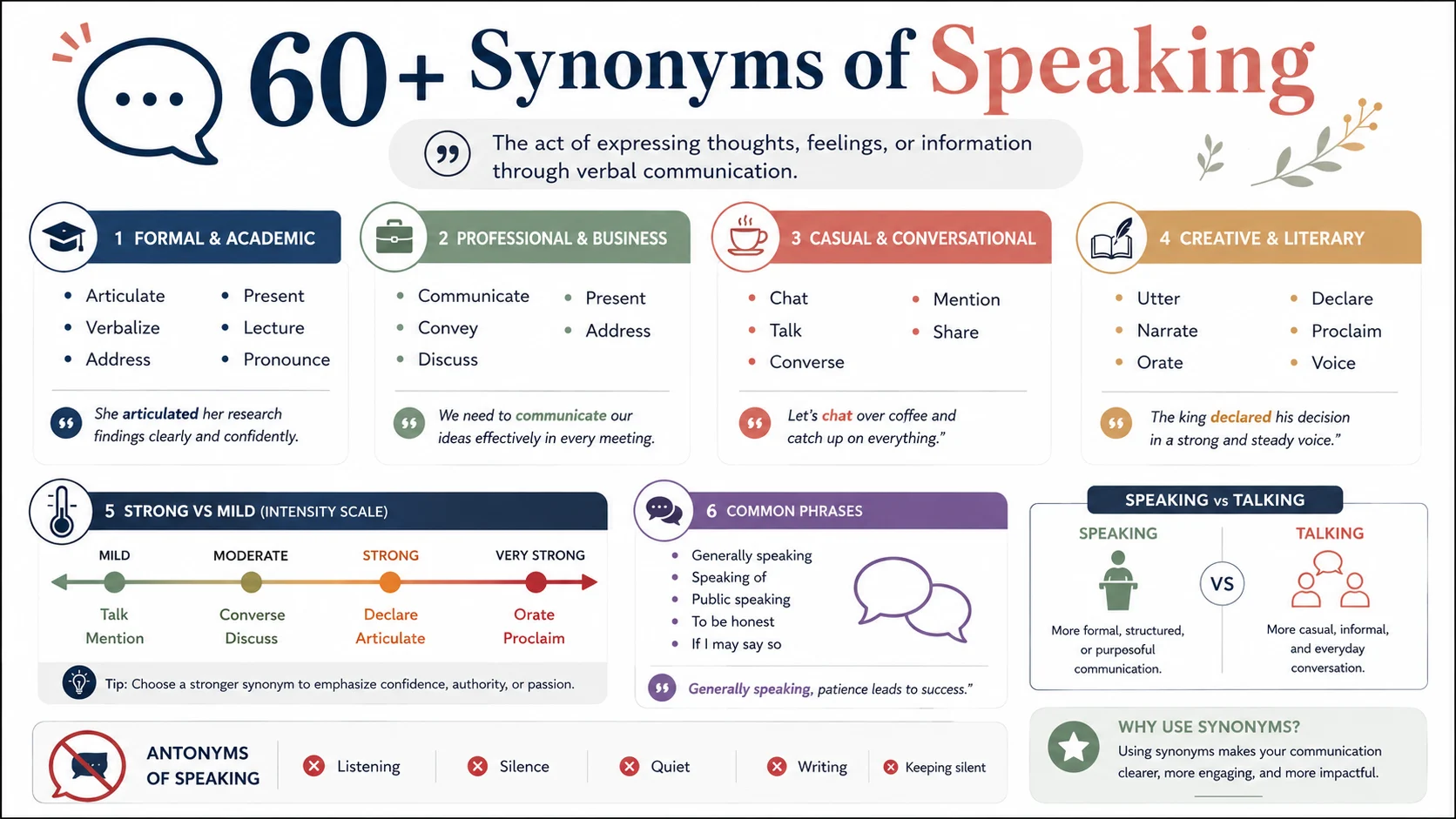
Speaking means the act of expressing thoughts, feelings, or information through verbal communication or delivering an address . The best synonyms depend on context: use “conversing” or “chatting” for casual talk, “articulating” or “verbalizing” for clear expression, “addressing” for public speaking, and “communicating” for professional settings . Match your word choice to your audience and purpose.
Have you ever re-read an email or an essay and noticed you used the word “speaking” or “speak” five times in three sentences? It happens to everyone. Whether you are writing a professional report, crafting a social media caption, or preparing a school assignment, finding the right synonym of speaking can transform your writing from repetitive to refined.
Choosing the exact word matters because communication is about clarity and tone. The right synonym can make you sound more professional, more emotional, or more conversational depending on the situation. This guide explores over fifty ways to say “speaking” so you can choose the perfect word every time.
Meaning, Tone, and Context
Simple Definition
Speaking is the action of conveying information or expressing feelings through oral communication. It includes everything from casual conversation to formal public addresses .
Part of Speech
- Verb: “She is speaking to the audience.”
- Noun: “Public speaking requires confidence.”
- Adjective: “He has a speaking role in the play.”
Overall Tone
Speaking is a neutral word. It simply describes verbal communication without adding emotional weight, formality, or intensity.
Formality Level
Neutral. The word “speaking” works in almost any situation, from casual texting to formal presentations, but more precise synonyms often communicate your meaning better.
Common Uses
Native English speakers use “speaking” for everyday conversation, public addresses, language ability, and telephone communication. It appears in phrases like “speaking of,” “generally speaking,” and “public speaking” .
Word Forms
- Noun: speech, speaker
- Verb: speak, spoke, spoken
- Adjective: spoken, unspeakable (different meaning)
When and How to Use “Speaking”
Choose “speaking” when you need a straightforward, neutral word for verbal communication. It works well as a general term, but more specific synonyms often improve your writing.
Examples by Context
Professional
“The manager is speaking with the client about the contract details.”
Academic
“Speaking clearly is essential for delivering an effective research presentation.”
Workplace
“The team will be speaking about the new project during the morning meeting.”
Personal
“We were speaking for hours about our travel plans.”
Email
“I look forward to speaking with you about the proposal next Tuesday.”
Resume
“Experienced in public speaking and presenting to large audiences.”
Social Media
“Speaking from experience, this book is worth reading.”
Best Synonyms of “Speaking”
No synonym perfectly matches “speaking” in every situation. The best choice depends on your audience, purpose, and the exact meaning you want to convey.
| Context | Best Synonym | Why It Works |
|---|---|---|
| Professional writing | Communicating | Emphasizes clear message exchange in business settings |
| Academic writing | Articulating | Highlights precise, clear expression of complex ideas |
| Business communication | Conveying | Suggests delivering important information effectively |
| Casual conversation | Chatting | Sounds friendly and relaxed for everyday talk |
| Emotional writing | Expressing | Focuses on sharing feelings and personal experiences |
| Creative writing | Uttering | Adds literary quality and vivid imagery |
| Resume writing | Presenting | Emphasizes professional delivery skills |
| Workplace communication | Addressing | Appropriate for formal meetings and group settings |
| Stronger meaning | Declaring | Suggests forceful, confident statement |
| Softer meaning | Mentioning | Implies brief, casual reference without emphasis |
When Not to Use “Speaking”
When It Sounds Too General
If your writing needs precision, “speaking” might be too vague.
Less Effective
“The professor was speaking about the theory.”
Better
“The professor was lecturing about the theory.”
“Lecturing” accurately describes academic teaching, not just casual talk.
When It Sounds Too Informal
In formal legal or official documents, “speaking” may sound casual.
Less Effective
“The witness is speaking about the events.”
Better
“The witness is testifying about the events.”
“Testifying” has precise legal meaning.
When It Sounds Too Weak
If you need to emphasize authority or confidence, “speaking” lacks impact.
Less Effective
“The CEO was speaking about the company’s future.”
Better
“The CEO was outlining the company’s future.”
“Outlining” suggests a planned, authoritative presentation.
Words Commonly Confused With “Speaking”
Speaking vs. Talking
Difference: “Speaking” often implies formal or one-sided communication, while “talking” suggests casual, two-way conversation.
When to Use It: Use “speaking” for presentations or formal contexts. Use “talking” for everyday conversation.
Example (Speaking): “The professor will be speaking at the conference.”
Example (Talking): “We were talking about the movie last night.”
Speaking vs. Conversing
Difference: “Conversing” emphasizes mutual exchange and dialogue. “Speaking” can be one-way.
When to Use It: Use “conversing” when highlighting back-and-forth discussion.
Example: “They were conversing in the corner for hours.”
Speaking vs. Articulating
Difference: “Articulating” focuses on clear, precise expression of thoughts. “Speaking” is more general.
When to Use It: Use “articulating” when clarity and precision matter.
Example: “She articulated her position clearly during the debate.”
Speaking vs. Addressing
Difference: “Addressing” implies speaking to a specific person, group, or topic. “Speaking” is broader.
When to Use It: Use “addressing” for formal speeches or direct communication.
Example: “The mayor addressed the crowd about the new policy.”
Speaking vs. Expressing
Difference: “Expressing” emphasizes conveying feelings, opinions, or ideas. “Speaking” is neutral.
When to Use It: Use “expressing” when communication involves personal emotion.
Example: “He expressed his concerns during the meeting.”
Speaking vs. Uttering
Difference: “Uttering” suggests producing sounds or words briefly. “Speaking” implies continuous communication.
When to Use It: Use “uttering” for short, specific verbalizations.
Example: “She barely uttered a word all evening.”
Best Synonyms of “Speaking” by Context
| Context | Best Synonym | Why It Works | Example |
|---|---|---|---|
| Formal writing | Articulating | Conveys precision and clarity | “The report articulates the key findings effectively.” |
| Academic writing | Verbalizing | Appropriate for research contexts | “Students struggled with verbalizing complex concepts.” |
| Professional communication | Communicating | Emphasizes effective information exchange | “Communicating expectations clearly prevents errors.” |
| Business emails | Conveying | Suggests delivering important messages | “I am conveying our team’s recommendations.” |
| Resume writing | Presenting | Highlights professional delivery skills | “Presented quarterly results to senior leadership.” |
| Workplace communication | Addressing | Suitable for meetings and formal contexts | “She addressed the team about the new policy.” |
| Casual conversation | Chatting | Friendly and relaxed | “We spent the afternoon chatting about old times.” |
| Everyday speaking | Talking | Simple and natural | “We talked for over an hour on the phone.” |
| Creative writing | Uttering | Adds literary quality | “He uttered a quiet prayer before the performance.” |
| Storytelling | Narrating | Emphasizes telling stories | “She narrated the events of her journey.” |
| Emotional writing | Expressing | Focuses on sharing feelings | “He expressed his gratitude to the audience.” |
| Strong emphasis | Declaring | Suggests confident, forceful statement | “She declared her intentions without hesitation.” |
| Mild tone | Mentioning | Brief, casual reference | “He mentioned the plan during the meeting.” |
| Social media captions | Sharing | Engaging and personal | “Sharing my thoughts on this new book.” |
| American English | Speaking | Standard usage | “I will be speaking with them tomorrow.” |
| British English | Chatting (informal) | Common British casual usage | “We were chatting in the pub.” |
How to Choose the Best Synonym of “Speaking”
Consider Your Meaning
Start with exactly what you want to communicate. Are you describing a formal speech, a casual chat, or emotional expression? Choose the word that matches your intended meaning.
Consider Your Audience
Professional and academic audiences expect precise vocabulary. Use “articulate,” “present,” or “communicate.” Friends and family prefer casual words like “talk,” “chat,” or “gossip.”
Consider Your Tone
Do you want to sound formal, friendly, emotional, or neutral? “Addressing” sounds formal. “Chatting” sounds friendly. “Expressing” sounds emotional. “Speaking” sounds neutral.
Consider Emotional Strength
Some synonyms carry more emotional weight. “Declaring” is strong. “Mentioning” is mild. “Uttering” feels literary. Choose the intensity that fits your message.
Consider Your Writing Purpose
Academic papers need precision. Resumes need professionalism. Social media needs engagement. Storytelling needs vividness. Match your word to your purpose.
Real Life Examples of “Speaking”
School Assignment
“During the presentation, Jamie spoke confidently about the historical events.” → “During the presentation, Jamie articulated the historical events clearly.”
College Discussion
“The students spoke about the assigned reading.” → “The students discussed the assigned reading at length.”
Workplace Meeting
“The project manager spoke to the team about the deadline.” → “The project manager addressed the team regarding the deadline.”
Business Email
“I look forward to speaking with you.” → “I look forward to discussing this further with you.”
Resume Entry
“Experienced in speaking with clients” → “Experienced in communicating with diverse clients”
Conversation
“They were speaking for hours.” → “They were conversing for hours.”
Storytelling
“He spoke to the crowd about his journey.” → “He narrated his journey to the captivated crowd.”
Blogging
“I am speaking about my experience with this product.” → “I am sharing my experience with this product.”
Social Media
“Speaking from experience” → “Sharing from personal experience”
18 Best Synonyms of “Speaking”
| Synonym | Simple Meaning | Best Used For | Example Sentence |
|---|---|---|---|
| Talking | Casual verbal exchange | Everyday conversation | “They were talking about the game.” |
| Conversing | Engaging in dialogue | Mutual discussion | “They conversed about world events.” |
| Chatting | Informal, friendly talk | Social situations | “We chatted over coffee.” |
| Discussing | Talking about a topic in detail | Academic and professional | “The committee discussed the budget.” |
| Articulating | Expressing clearly and precisely | Formal and academic | “She articulated her viewpoint perfectly.” |
| Communicating | Exchanging information | All professional contexts | “Effective leaders communicate well.” |
| Addressing | Speaking to an audience or topic | Formal presentations | “He addressed the shareholders.” |
| Presenting | Delivering information to an audience | Public speaking and resumes | “She presented the quarterly report.” |
| Conveying | Transmitting information or ideas | Business communication | “The memo conveyed the new policy.” |
| Expressing | Sharing feelings or opinions | Emotional and personal communication | “He expressed his gratitude.” |
| Verbalizing | Expressing ideas in words | Academic and clinical contexts | “She verbalized her concerns.” |
| Declaring | Stating clearly and firmly | Strong announcements | “He declared his intentions publicly.” |
| Mentioning | Referring briefly | Casual references | “She mentioned the meeting in passing.” |
| Uttering | Saying something briefly | Literary and formal contexts | “He uttered a quiet apology.” |
| Orating | Speaking in a formal, grand style | Formal speeches | “The politician orated for an hour.” |
| Lecturing | Teaching formally | Academic instruction | “She lectured on economic theory.” |
| Narrating | Telling a story | Storytelling and memoirs | “He narrated his wartime experiences.” |
| Pronouncing | Speaking with correct articulation | Language learning and diction | “She pronounced every word carefully.” |
Synonyms of “Speaking” by Usage
Professional vs Personal Synonyms
Professional Settings: “Communicating,” “addressing,” “presenting,” “conveying,” and “articulating” work best in workplaces because they sound confident, clear, and competent.
Personal Settings: “Chatting,” “talking,” “conversing,” and “sharing” sound more relaxed and friendly.
Formal vs Conversational Synonyms
Formal Writing: “Articulating,” “verbalizing,” “addressing,” “presenting,” “declaring,” and “pronouncing” suit reports, essays, and business documents.
Conversational Use: “Chatting,” “talking,” “mentioning,” and “sharing” fit everyday conversations and texting.
Academic Synonyms
“Articulate,” “verbalize,” “discuss,” “lecture,” “present,” and “pronounce” show academic authority. These words suggest precision, expertise, and formal communication.
Example: “The researcher articulated the study’s limitations clearly in the discussion section.”
Professional and Business Synonyms
“Communicate,” “address,” “convey,” “present,” “discuss,” “share information” these are the strongest choices for resumes, interviews, meetings, performance reviews, client communication, and business emails.
Example: “Presented quarterly results to stakeholders and addressed their concerns.”
Creative and Literary Synonyms
“Utter,” “narrate,” “orate,” “declaim,” “proclaim,” “voice,” “murmur,” “mumble,” “whisper” these add emotion and imagery to storytelling, fiction, poetry, descriptive writing, and speeches.
Example: “He uttered a soft promise under the moonlight.”
Slang or Modern Synonyms
“Shoot the breeze”: Very informal for casual conversation. Avoid in professional contexts.
“Chew the fat”: Informal for chatting. Use only with friends.
“Spill”: Modern slang for revealing information. “She spilled all the details.”
Strongest to Mildest Synonyms
| Intensity | Synonym | Usage |
|---|---|---|
| Mild | Mentioning | Brief reference |
| Moderate | Discussing | Detailed exchange |
| Moderate | Articulating | Clear expression |
| Strong | Declaring | Confident statement |
| Very Strong | Proclaiming | Public, forceful announcement |
Emotional vs Neutral Synonyms
Emotional Synonyms: “Expressing,” “sharing,” “declaring,” “proclaiming” these convey feelings, passion, and personal investment.
Neutral Synonyms: “Speaking,” “talking,” “communicating,” “addressing” these simply describe communication without emotional weight.
Antonyms of “Speaking”
| Antonym | Meaning | Example Sentence |
|---|---|---|
| Listening | Receiving spoken communication | “She listened carefully instead of speaking.” |
| Hearing | Perceiving sound | “He heard the announcement but did not respond.” |
| Silence | Complete absence of speech | “The room fell into complete silence.” |
| Quieting | Becoming silent | “The audience quieted during the performance.” |
| Muting | Suppressing speech | “He muted his microphone.” |
| Withholding | Keeping silent about something | “She withheld her opinion during the debate.” |
| Hushing | Making quiet | “The speaker hushed the crowd.” |
| Stopping | Ending speech | “He stopped speaking abruptly.” |
| Refraining | Choosing not to speak | “She refrained from commenting.” |
| Writing | Expressing through written words | “He wrote his response instead of speaking.” |
| Communicating nonverbally | Using gestures instead of words | “She communicated through gestures.” |
| Remaining silent | Staying quiet | “He remained silent throughout the meeting.” |
| Omitting | Leaving out spoken details | “The report omitted verbal references.” |
| Suppressing | Preventing verbal expression | “She suppressed her urge to interrupt.” |
| Concealing | Hiding information | “He concealed his thoughts.” |
Comparison: “Speaking” vs Similar Words
Speaking vs Talking
Main Difference: “Speaking” suggests one-way communication or formal contexts. “Talking” suggests two-way, casual conversation.
Which Is Stronger?: “Speaking” can feel more formal. “Talking” feels more relaxed.
Which Is More Formal?: “Speaking” is more formal. “Talking” is informal and conversational.
When to Use Each: Use “speaking” in professional contexts. Use “talking” with friends and family.
Examples:
- Speaking: “The CEO will be speaking at the conference.”
- Talking: “We were talking about the weekend plans.”
Speaking vs Conversing
Main Difference: “Conversing” emphasizes mutual exchange. “Speaking” can be one-way.
Which Is Stronger?: “Conversing” suggests deeper engagement.
Which Is More Formal?: “Conversing” is slightly more formal and literary.
When to Use Each: Use “conversing” to emphasize dialogue. Use “speaking” for general verbal communication.
Examples:
- Conversing: “They conversed about philosophy for hours.”
- Speaking: “He was speaking to the clerk at the counter.”
Speaking vs Articulating
Main Difference: “Articulating” emphasizes clear, precise expression. “Speaking” just describes verbalization.
Which Is Stronger?: “Articulating” is stronger because it implies careful, accurate expression.
Which Is More Formal?: “Articulating” is more formal and academic.
When to Use Each: Use “articulating” when clarity and precision matter. Use “speaking” for general references.
Examples:
- Articulating: “She articulated her argument perfectly.”
- Speaking: “He was speaking during the meeting.”
Speaking vs Addressing
Main Difference: “Addressing” implies speaking to a specific audience or topic. “Speaking” is broader.
Which Is Stronger?: “Addressing” suggests purposeful, targeted communication.
Which Is More Formal?: “Addressing” is more formal, often used in official contexts.
When to Use Each: Use “addressing” for formal speeches. Use “speaking” for casual communication.
Examples:
- Addressing: “The president addressed the nation.”
- Speaking: “She was speaking to her neighbor.”
Speaking vs Expressing
Main Difference: “Expressing” emphasizes sharing feelings, opinions, or ideas. “Speaking” is neutral.
Which Is Stronger?: “Expressing” suggests emotional or personal investment.
Which Is More Formal?: Neither is necessarily formal, but “expressing” works well in emotional contexts.
When to Use Each: Use “expressing” for personal opinions and emotions. Use “speaking” for neutral information.
Examples:
- Expressing: “He expressed his disappointment with the decision.”
- Speaking: “She spoke about her daily routine.”
Common Phrases and Expressions with “Speaking”
Generally Speaking
Meaning: In general or on the whole.
Example: “Generally speaking, the project was a success.”
Speaking of
Meaning: Mentioning a topic that relates to what was just discussed.
Example: “Speaking of travel, have you been to Italy?”
Public Speaking
Meaning: Giving speeches or presentations to an audience.
Example: “He overcame his fear of public speaking through practice.”
In a Manner of Speaking
Meaning: In some ways, or figuratively speaking.
Example: “She was, in a manner of speaking, the heart of the organization.”
Speaking Terms
Meaning: A relationship where people communicate with each other.
Example: “They are not on speaking terms after the argument.”
Strictly Speaking
Meaning: In a precise or exact sense.
Example: “Strictly speaking, the term applies only to formal agreements.”
So to Speak
Meaning: Used to indicate a figurative expression.
Example: “It was a miracle, so to speak.”
Common Mistakes to Avoid
Using “Speaking” When You Mean “Discussing”
Many people use “speaking about” when “discussing” is more precise.
Incorrect: “They were speaking about the budget.”
Better: “They were discussing the budget.”
“Discussing” suggests a focused exchange of ideas, not just talking.
Using “Speaking” for Emotional Communication
If you are expressing feelings, “speaking” is too neutral.
Incorrect: “He spoke about his gratitude.”
Better: “He expressed his gratitude.”
Using “Speaking” When You Need Formality
“Speaking” can sound too casual for formal writing.
Incorrect: “The report is speaking about economic trends.”
Better: “The report addresses economic trends.”
Using “Speaking” for Strong Announcements
“Speaking” lacks impact for confident statements.
Incorrect: “The CEO spoke that the company is growing.”
Better: “The CEO declared that the company is growing.”
Overusing “Speaking” and “Talking” in Writing
Repeating the same word weakens your writing.
Incorrect: “She is speaking about the plan. He is also speaking about the plan.”
Better: “She is presenting the plan. He is also discussing the plan.”
Using Slang in Professional Contexts
Avoid phrases like “shoot the breeze” or “chew the fat” in formal writing.
Incorrect: “We shot the breeze about the proposal.”
Better: “We discussed the proposal in detail.”
Frequently Asked Questions
What are the best synonyms of “speaking”?
The best synonyms depend on your context. For formal use, try “articulating” or “addressing.” For casual conversation, use “chatting” or “talking.” For professional settings, choose “communicating” or “conveying.”
What are the best formal synonyms of “speaking”?
Formal synonyms include “articulating,” “verbalizing,” “addressing,” “presenting,” “declaring,” “pronouncing,” and “lecturing.” These words convey precision, authority, and appropriate formality for academic, professional, or official contexts.
What are common informal synonyms of “speaking”?
Common informal synonyms include “talking,” “chatting,” “conversing,” “shooting the breeze,” “chewing the fat,” “gossiping,” and “nattering.” These work well with friends and family but should be avoided in professional writing.
What is another word for “speaking” in professional writing?
In professional writing, use “communicating,” “conveying,” “addressing,” “presenting,” “discussing,” or “articulating.” These synonyms sound competent, confident, and appropriate for workplace communication.
What is the difference between “speaking” and “talking”?
“Speaking” is often more formal and can be one-way communication, such as giving a speech. “Talking” is more casual and usually implies a two-way conversation between people.
What is the opposite of “speaking”?
The opposites of “speaking” include listening, silence, writing, and remaining quiet. Antonyms also include muting, withholding, refraining from speech, and communicating nonverbally through gestures or written words.
Conclusion
“Speaking” is a neutral, versatile word that simply describes verbal communication. However, the English language offers dozens of more precise synonyms that can make your writing clearer, more professional, and more engaging. Whether you are choosing “articulate” for academic writing, “chat” for casual conversations, or “address” for professional presentations, matching your word choice to your audience and purpose matters.
No single synonym works perfectly in every situation. The key is to consider your exact meaning, your audience, and your desired tone. Start paying attention to how you use “speaking” in your daily writing. Notice when a more specific word would communicate your message more effectively. Small vocabulary improvements can significantly enhance your communication.

2 thoughts on “60+ Synonyms of Speaking | Meanings, Uses, Examples and Best Alternatives”