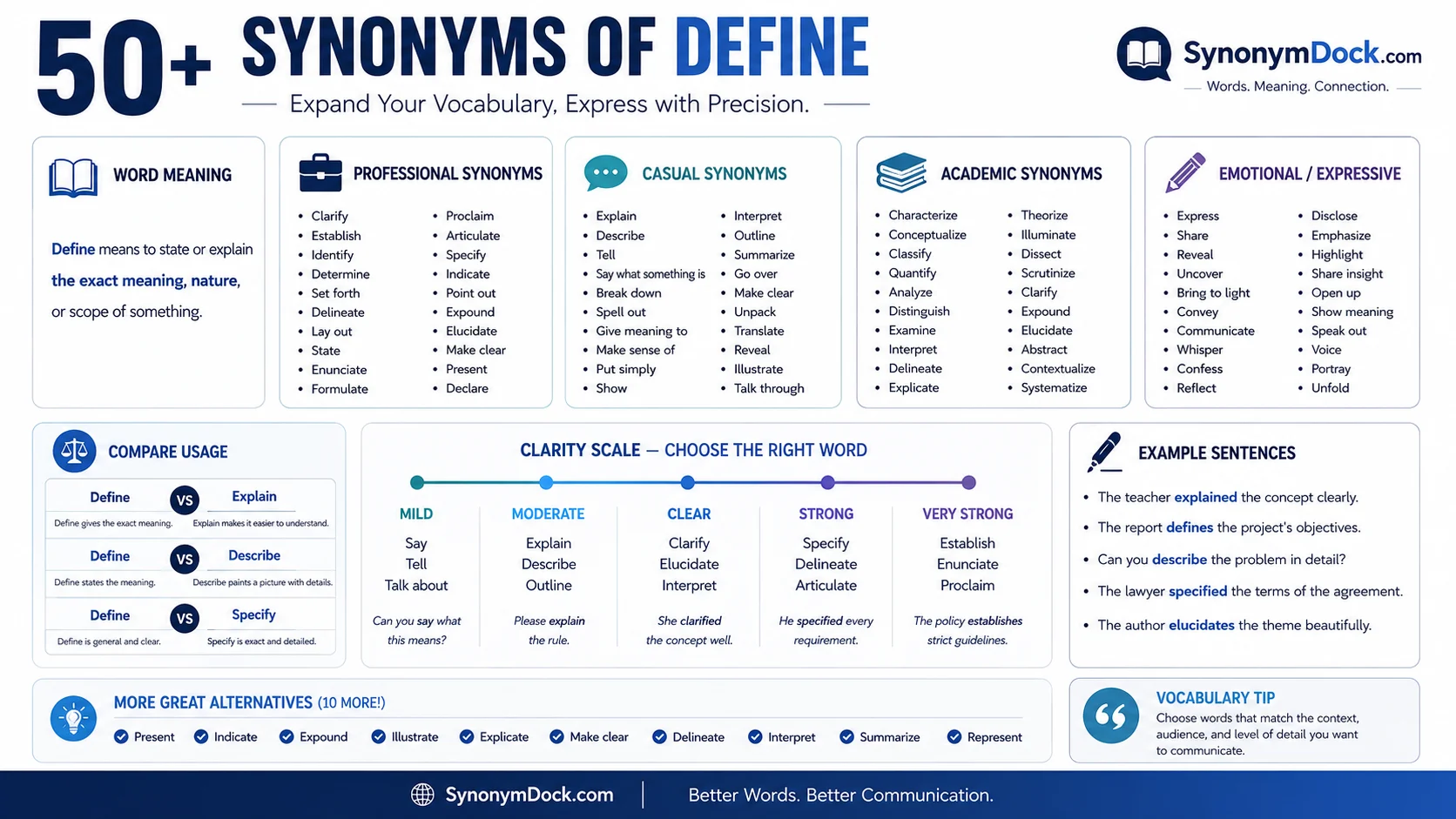
Define means to explain the meaning of a word or concept, or to show the outline of something clearly . The best synonym depends on context. For precise meaning, use specify. For explanation, use clarify. For describing details, use describe. For outlining boundaries, use delineate. Each synonym changes the nuance and formality.
Have you ever written an email, an essay, or a report and realized you used the same word over and over? Many writers rely on “define” repeatedly because it feels safe and familiar. But this repetition makes writing feel dull and less engaging. Whether you are working on a school assignment, a professional email, or a creative project, you need a strong vocabulary to communicate clearly. Finding the right synonym of define can transform your writing from bland to precise.
Choosing a more accurate word helps your reader understand exactly what you mean. A well chosen synonym can clarify whether you are setting boundaries, describing something in detail, or establishing a clear meaning. The best synonym of define also sets the right tone for your audience. This guide will teach you everything you need to know about define synonyms so you can write with confidence and clarity.
Meaning, Tone, and Context
Simple Definition
Define means to explain the meaning of a word, phrase, or concept clearly and precisely . It can also mean to show the outline or shape of something distinctly, or to fix boundaries and limits . When you define something, you establish what it is and what it is not.
Part of Speech
Define is primarily used as a verb. The related noun form is definition. The adjective forms are definable and defined .
Overall Tone
Define is a neutral word. It is precise and authoritative without being emotional. It suggests clarity, accuracy, and purpose.
Formality Level
Define is neutral in formality. It works in almost any context. You can use it in academic papers, professional emails, casual conversations, and formal reports. It sounds slightly more formal than “explain” but less formal than “delineate.”
Common Uses
Native English speakers use define in many situations. Teachers ask students to define terms. Managers define roles and responsibilities. Writers define concepts in their articles. Scientists define variables in their research. People also define relationships and define success in personal conversations. The word appears frequently in dictionaries, textbooks, and legal documents.
Word Forms
- Define (verb): To explain the meaning of something
- Definition (noun): A statement of meaning
- Definable (adjective): Possible to define
- Defined (past tense/past participle): Explained or shown clearly
- Defining (present participle): Explaining or establishing meaning
When and How to Use “Define”
You should choose define when you need to explain something with clarity and precision. It works best when you are establishing meaning, setting boundaries, or describing something completely. Here are examples in different situations.
Professional: “We need to define the project scope before we begin.”
Academic: “The researcher had to define each variable to ensure accurate results.”
Workplace: “Please define your expectations for this role clearly.”
Personal: “It took years for her to define what happiness meant to her.”
Email: “Could you define the key deliverables for this quarter?”
Resume: “Helped define new quality standards for the production department.”
Social Media: “How would you define success in your own words?”
Best Synonyms of “Define”
No synonym perfectly matches define in every situation. Each alternative brings its own nuance. Here is the best synonym for different contexts.
Professional writing: Specify. This word suggests giving precise details and setting exact parameters.
Academic writing: Delineate. This sounds sophisticated and suggests careful, detailed description.
Business communication: Clarify. Use this when you need to remove confusion and make something easy to understand.
Casual conversation: Explain. This is the most natural and accessible synonym for everyday speech.
Emotional writing: Characterize. Use this when you want to describe the nature of someone or something.
Creative writing: Depict. This adds visual imagery and descriptive power.
Resume writing: Established. Use this to show you created or set important standards.
Workplace communication: Outline. This suggests giving a clear structure or framework.
Stronger meaning: Establish. This implies creating something permanent or authoritative.
Softer meaning: Describe. This is gentler and focuses on explaining rather than limiting.
When Not to Use “Define”
Define is a strong word, but it is not always the best choice. Here are situations where you should use a stronger synonym instead.
When Define Sounds Too Technical
If you are writing for a general audience, define can feel too academic or legalistic.
Incorrect: “Let me define how the new system works.”
Better: “Let me explain how the new system works.”
Explain feels more approachable and accessible.
When Define Sounds Too Restrictive
Define originally meant to set boundaries . Sometimes you want to describe without limiting.
Incorrect: “The author defined the character as kind.”
Better: “The author portrayed the character as kind.”
Portrayed suggests the author showed rather than limited the character.
When Define Sounds Too Weak
Some situations call for words that convey stronger commitment.
Incorrect: “The CEO will define new company values.”
Better: “The CEO will establish new company values.”
Establish suggests a more permanent, significant action.
When Define Sounds Too Formal
In casual conversation with friends, define can feel stiff and unnatural.
Incorrect: “Can you define what you mean by that?”
Better: “Can you explain what you mean by that?”
Explain sounds more natural in conversation.
When Define Sounds Too Vague
If you need to emphasize exact details, define might not be specific enough.
Incorrect: “The contract defines the payment schedule.”
Better: “The contract specifies the payment schedule.”
Specify emphasizes exactness and detail.
Words Commonly Confused With “Define”
Several words are similar to define but have important differences. Understanding these distinctions will help you choose the right word.
Define vs Explain
Difference: Define focuses on giving the precise meaning of something. Explain focuses on making something understandable, often by giving reasons or details .
When to Use Each: Use define for dictionary-style meanings. Use explain when you want to make something clear.
Example Define: “Can you define the word ‘democracy’?”
Example Explain: “Can you explain how democracy works?”
Define vs Describe
Difference: Define gives a precise meaning or sets boundaries. Describe provides a detailed account of what something is like . Define is narrower and more exact.
When to Use Each: Use define for specific meanings. Use describe for comprehensive accounts.
Example Define: “Please define the term ‘ecosystem.'”
Example Describe: “Please describe the ecosystem in the Amazon rainforest.”
Define vs Specify
Difference: Specify means to state something clearly and in detail, often with exact requirements . Define is broader and can include general meaning.
When to Use Each: Use specify for exact details and requirements. Use define for general meaning.
Example Define: “How would you define a healthy diet?”
Example Specify: “Please specify which foods are included in a healthy diet.”
Define vs Clarify
Difference: Clarify means to make something clear, often when it was confusing or unclear . Define is more about establishing meaning.
When to Use Each: Use clarify when there is confusion. Use define when establishing meaning from scratch.
Example Define: “The dictionary defines ‘procrastination’ as delaying action.”
Example Clarify: “I need to clarify my earlier point about deadlines.
Define vs Delineate
Difference: Delineate means to describe or portray something very accurately, often outlining details or boundaries . It is more formal and precise than define.
When to Use Each: Use delineate for formal writing where precision matters. Use define for everyday writing.
Example Define: “The policy defines employee conduct.”
Example Delineate: “The policy delineates employee conduct in detail.”
Define vs Establish
Difference: Establish means to set up, create, or bring into existence. Define means to explain meaning or set boundaries . Establish implies creation; define implies explanation.
When to Use Each: Use establish when creating something new. Use define when explaining existing meaning.
Example Define: “The dictionary defines the word.”
Example Establish: “The founder established new company policies.”
Best Synonyms of “Define” by Context
| Context | Best Synonym | Why It Works | Example |
|---|---|---|---|
| Formal writing | Delineate | Suggests careful, precise description | The study delineates the key characteristics of leadership. |
| Academic writing | Characterize | Sounds sophisticated and analytical | The theory characterizes intelligence as multifaceted. |
| Professional communication | Specify | Emphasizes exactness and detail | Please specify your requirements for the project. |
| Business emails | Clarify | Focuses on removing confusion | I want to clarify our position on the new policy. |
| Resume writing | Established | Shows leadership and creation | Established new quality control procedures. |
| Workplace communication | Outline | Suggests clear structure and organization | Let me outline the main points of the proposal. |
| Casual conversation | Explain | Sound natural and approachable | Can you explain what you mean by that? |
| Everyday speaking | Describe | Universal and clear | How would you describe your favorite movie? |
| Creative writing | Depict | Adds visual and descriptive power | The poem depicts the struggles of rural life. |
| Storytelling | Portray | Brings characters and scenes to life | The author portrays the hero as conflicted. |
| Emotional writing | Characterize | Captures nature and essence | The struggle characterized her entire career. |
| Strong emphasis | Establish | Implies permanence and authority | The court established a new legal precedent. |
| Mild tone | Describe | Soft and non-technical | Could you describe what happened? |
| Social media captions | Explain | Relatable and easy to understand | Let me explain why I love this book. |
| American English | Clarify | Common in professional American usage | Let me clarify my earlier statement. |
How to Choose the Best Synonym of “Define”
Use this decision guide to pick the perfect synonym for your situation.
Start with your audience. Professional audiences expect specify, outline, or establish. Casual audiences understand explain, describe, or clarify best.
Consider your tone. If you want to sound precise and authoritative, choose specify or delineate. If you want to sound helpful and accessible, choose explain or clarify. If you want to sound creative, choose depict or portray.
Think about your purpose. Are you explaining meaning? Choose define or clarify. Are you describing something in detail? Choose describe or delineate. Are you setting boundaries? Choose specify or establish.
Consider the complexity. Simple concepts need simple words like explain. Complex concepts may need precise words like delineate.
Match the formality of your writing. Academic papers need academic synonyms like delineate and characterize. Business documents need professional synonyms like specify and establish. Personal writing needs natural synonyms like explain and describe.
Avoid guessing. If you are unsure, define is always acceptable. But choosing a more specific word nearly always improves your writing.
Real Life Examples of “Define”
School Example
Original: My teacher told us to define the term “biodiversity.”
Improved: My teacher told us to explain the term “biodiversity.”
Explain feels more natural for a classroom discussion.
College Example
Original: The professor asked us to define the theory of evolution.
Improved: The professor asked us to characterize the theory of evolution.
Characterize sounds more academic and analytical.
Workplace Example
Original: We need to define the new manager’s responsibilities.
Improved: We need to specify the new manager’s responsibilities.
Specify suggests exact details and clarity.
Business Example
Original: The report defines our five-year strategy.
Improved: The report outlines our five-year strategy.
Outline suggests a clear framework.
Email Example
Original: I want to define what we discussed yesterday.
Improved: I want to clarify what we discussed yesterday.
Clarify suggests removing any confusion.
Resume Example
Original: Defined new procedures for the accounting department.
Improved: Established new procedures for the accounting department.
Establish shows leadership and initiative.
Conversation Example
Original: Can you define why you made that choice?
Improved: Can you explain why you made that choice?
Explain sounds more natural in conversation.
Storytelling Example
Original: The author defined the villain as cruel and greedy.
Improved: The author portrayed the villain as cruel and greedy.
Portrayed brings the character to life.
Blogging Example
Original: This post will define the best way to save money.
Improved: This post will explain the best way to save money.
Explain is more reader-friendly for blogs.
Social Media Example
Original: Trying to define my feelings about this movie.
Improved: Trying to describe my feelings about this movie.
Describe feels more honest and emotional.
18 Best Synonyms of “Define”
| Synonym | Simple Meaning | Best Used For | Example Sentence |
|---|---|---|---|
| Explain | Make something understandable | Everyday communication | Let me explain how the new system works. |
| Describe | Give a detailed account | General writing | She described her experience in vivid detail. |
| Clarify | Make something clear | Removing confusion | I want to clarify the timeline for the project. |
| Specify | State exactly and in detail | Technical and professional writing | The contract specifies the payment terms. |
| Delineate | Describe with precision and detail | Formal and academic writing | The policy delineates employee rights. |
| Outline | Give a general description | Professional presentations | Let me outline the main points of my argument. |
| Establish | Set up or create something | Resumes and leadership contexts | The CEO established new company values. |
| Characterize | Describe the nature of something | Academic and analytical writing | The study characterizes the behavior patterns. |
| Portray | Show or represent something | Creative writing and storytelling | The novel portrays life in the 1920s. |
| Depict | Show or represent visually | Creative and descriptive writing | The painting depicts a rural landscape. |
| Designate | Officially assign or specify | Legal and official contexts | The area is designated as a national park. |
| Determine | Establish firmly and decisively | Professional and authoritative contexts | The court determined the boundary line. |
| Demarcate | Set boundaries or limits | Formal and legal writing | The treaty demarcates the border. |
| Detail | Describe with comprehensive information | Professional and technical contexts | The report details all findings. |
| Interpret | Explain the meaning | Analytical contexts | We need to interpret these results correctly. |
| Limit | Restrict or set boundaries | Legal and formal contexts | The law limits what companies can do. |
| Fix | Set firmly and clearly | Professional and technical contexts | The policy fixes the timeline. |
| Describe | Give a detailed account | General and personal writing | She described her morning routine. |
Synonyms of “Define” by Usage
Professional vs Personal Synonyms
Professional synonyms work best in workplaces: specify, outline, establish, designate, determine.
Personal synonyms sound better at home: explain, describe, clarify, characterize.
Professional Example: “The manager specified the team’s objectives.
Personal Example: “Can you explain how you feel about the decision?”
Formal vs Conversational Synonyms
Formal synonyms for academic and professional writing: delineate, demarcate, designate, establish.
Conversational synonyms for everyday talk: explain, describe, clarify.
Formal Example: “The study delineates the socioeconomic factors.”
Conversational Example: “Just describe what happened in your own words.”
Academic Synonyms
Academic writing benefits from precise vocabulary. Choose delineate for research descriptions. Use characterize for analytical writing. Select establish for theoretical frameworks. Opt for designate for classification work.
Example: “This chapter characterizes the economic trends of the decade.”
Professional and Business Synonyms
In business settings, choose words that show competence and clarity. Use specify for client requirements. Select outline for meeting agendas. Choose establish for company policies. Use designate for role assignments.
Example: “The proposal outlines our approach to the project.”
Creative and Literary Synonyms
Creative writing rewards expressive language. Use depict for visual descriptions. Select portray for character development. Choose illustrate for scene-setting. Use evoke for emotional description.
Example: “The scene depicts a quiet autumn afternoon.”
Slang or Modern Synonyms
Define does not have many established slang synonyms. Some people say “break down” for explaining something, especially in casual contexts. “Lay out” also works for presenting information clearly.
Example: “Let me break down the new policy for you.”
Strongest to Mildest Synonyms
Mild: describe, explain, characterize
Moderate: clarify, specify, outline
Strong: establish, designate, determine
Very Strong: demarcate, delineate, fix
The emotional intensity increases as you move up the scale. Describe feels gentle and open. Demarcate feels firm and decisive. Establish feels permanent and authoritative.
Emotional vs Neutral Synonyms
Emotional Synonyms: portray, characterize, depict, evoke. These words suggest feeling and artistic expression.
Neutral Synonyms: define, explain, describe, specify. These words simply communicate information.
Emotional Example: “The film depicts the struggles of immigrant families.”
Neutral Example: “Can you explain your reasoning for the decision?”
Antonyms of “Define”
| Antonym | Meaning | Example Sentence |
|---|---|---|
| Confuse | Make unclear | The vague explanation only confused everyone. |
| Obscure | Make unclear or hidden | Her response obscured the real issue. |
| Blur | Make indistinct | The boundaries of responsibility began to blur. |
| Complicate | Make more complex | Adding more details only complicated the definition. |
| Muddle | Confuse or mix up | The unclear terms muddled the legal agreement. |
| Misinterpret | Understand incorrectly | People often misinterpret what I mean. |
| Misunderstand | Fail to understand | He completely misunderstood the assignment. |
| Generalize | Speak broadly without specifics | The article generalized rather than specifying details. |
| Vague | Lack clear definition | His explanation was frustratingly vague. |
| Ambiguity | Open to multiple interpretations | The ambiguity in the policy caused problems. |
| Misstate | State incorrectly | The report misstated the key findings. |
| Distort | Twisted out of true meaning | Media coverage sometimes distorts the truth. |
| Obfuscate | Make something unclear | The lawyer tried to obfuscate the main point. |
| Equivocate | Use ambiguous language | Instead of clarifying, he chose to equivocate. |
| Misrepresent | Give false impression | The advertising misrepresented the product. |
Comparison: “Define” vs Similar Words
Define vs Explain
Main Difference: Define gives precise meaning. Explain makes something understandable, often by giving reasons .
Which Is Stronger: Define is stronger in terms of establishing exact meaning.
Which Is More Formal: Define is slightly more formal.
When to Use Each: Use define for dictionary-style meaning. Use explain for making things clear.
Define Example: “The dictionary defines the word ‘biology.'”
Explain Example: “She explained how photosynthesis works.”
Define vs Describe
Main Difference: Define sets exact meaning. Describe gives a detailed account .
Which Is Stronger: Define is stronger for establishing meaning.
Which Is More Formal: Define is more formal.
When to Use Each: Use define for precise meaning. Use describe for comprehensive details.
Define Example: “Please define the term ‘sustainable.'”
Describe Example: “Please describe the sustainable practices in your community.”
Define vs Specify
Main Difference: Specify emphasizes exact details and requirements. Define is broader .
Which Is Stronger: Specify is stronger for exact details.
Which Is More Formal: Both are formal but specify is more technical.
When to Use Each: Use specify for exact requirements. Use define for general meaning.
Define Example: “I need to define the project goals.”
Specify Example: “I need to specify the exact budget for each phase.”
Define vs Clarify
Main Difference: Clarify removes confusion. Define establishes meaning .
Which Is Stronger: Define is stronger for establishing new meaning.
Which Is More Formal: Both are moderately formal.
When to Use Each: Use clarify when there is existing confusion. Use define when starting from scratch.
Define Example: “The Constitution defines the powers of Congress.”
Clarify Example: “Let me clarify what I meant in my earlier statement.”
Define vs Delineate
Main Difference: Delineate suggests more careful, detailed, and precise description. Define is broader .
Which Is Stronger: Delineate is stronger in terms of precision.
Which Is More Formal: Delineate is more formal.
When to Use Each: Use delineate for formal writing requiring exactness. Use define for general use.
Define Example: “The chapter defines the problem.”
Delineate Example: “The chapter delineates the problem in careful detail.”
Define vs Establish
Main Difference: Define explains meaning. Establish creates or sets up something .
Which Is Stronger: Establish is stronger in terms of action.
Which Is More Formal: Both are formal.
When to Use Each: Use define for explaining. Use establish for creating.
Define Example: “The dictionary defines the word.”
Establish Example: “The company established new safety protocols.”
Common Phrases and Expressions with “Define”
Define the Terms
Meaning: To agree on or establish the meaning of key words.
Example Sentence: “Before we sign the contract, we need to define the terms.”
Define a Concept
Meaning: To explain the meaning of an idea clearly.
Example Sentence: “The professor helped us define the concept of social justice.”
Define the Problem
Meaning: To clearly identify what the problem is.
Example Sentence: “The first step in solving any issue is to define the problem.”
Define Your Role
Meaning: To clarify your responsibilities and position.
Example Sentence: “I need to define my role in this project more clearly.”
Define the Scope
Meaning: To set the boundaries of a project or activity.
Example Sentence: “We need to define the scope before assigning tasks.”
Well-Defined
Meaning: Clearly and precisely described.
Example Sentence: “The project had well-defined goals from the start.”
Define Yourself
Meaning: To identify your own identity, values, or purpose.
Example Sentence: “She took time to define herself before entering college.”
Common Mistakes to Avoid
Mistake 1: Using Define When You Should Explain
Define is for precise meaning. Explain is for making something understandable. Using define when you should explain sounds too technical.
Incorrect: “Can you define how to make this recipe?”
Better: “Can you explain how to make this recipe?”
Explain fits instructions better.
Mistake 2: Using Define for Describing Appearance
Define focuses on meaning and boundaries. Describe is better for appearance.
Incorrect: “Can you define what the suspect looked like?”
Better: “Can you describe what the suspect looked like?”
Describe suits visual details.
Mistake 3: Using Define Too Casually
Define sounds formal. In everyday conversation, explain or describe sounds more natural.
Incorrect: “Define why you chose that dress.”
Better: “Explain why you chose that dress.”
Explain is more conversational.
Mistake 4: Using Specify for General Meaning
Specify is for exact details. Define is for general meaning.
Incorrect: “Can you specify what democracy means?”
Better: “Can you define what democracy means?”
Define suits general concepts.
Mistake 5: Repeating Define Too Often
Even the correct word sounds bad when used too frequently. Vary your vocabulary.
Incorrect: “I define the project goals. I define the budget. I define the timeline.”
Better: “I define the project goals. I specify the budget. I outline the timeline.”
Using different synonyms improves readability.
Mistake 6: Using Delineate Informally
Delineate is highly formal. Using it casually sounds pretentious.
Incorrect: “My friend delineated the plot of the movie.”
Better: “My friend described the plot of the movie.”
Describe fits casual conversation.
Mistake 7: Using Establish for Explaining
Establish means to create or set up. It does not mean to explain.
Incorrect: “The book establishes the meaning of success.”
Better: “The book defines the meaning of success.”
Define is correct for explaining meaning.
Frequently Asked Questions
1. What are the best synonyms of define?
The best synonyms depend on context. For precise meaning, use specify. For general explanation, use explain. For formal writing, use delineate. For creative writing, use depict. For making clear, use clarify .
2. What are the best formal synonyms of define?
The best formal synonyms are delineate, specify, designate, and determine. These words sound precise and authoritative. They work well in legal documents, academic papers, and professional reports .
3. What are common informal synonyms of define?
The most common informal synonyms are explain, describe, and clarify. These words sound natural in everyday conversation. They are appropriate for casual settings, talking with friends, and personal writing.
4. What is another word for define in professional writing?
In professional writing, specify is often the best choice. It suggests providing exact details and clear requirements. Outline works well for giving a general framework. Establish suits leadership contexts .
5. What is the difference between define and describe?
Define gives the precise meaning of something. Describe provides a detailed account of what something is like. Define is narrower and more exact. Describe is broader and more comprehensive .
6. What is the opposite of define?
Antonyms of define include confuse, obscure, blur, and complicate. These words mean making something unclear or difficult to understand . The best opposite depends on whether you mean lack of clarity or lack of boundaries.
Conclusion
Define is a powerful verb that means to explain meaning or set boundaries clearly. It fits many situations from academic writing to professional communication. However, using more specific synonyms can dramatically improve your writing. Explain, clarify, specify, describe, delineate, and establish each add distinct meaning and tone.
No single synonym works perfectly in every context. The best choice depends on your audience, your purpose, and the kind of meaning you are conveying. Always consider whether define is precise enough or if a stronger word would communicate your message more clearly.
The next time you write about meaning or boundaries, pause and ask yourself whether define is the right word. Could specify make you sound more exact? Does explain sound more approachable? Would delineate add sophistication to your academic work? Choosing the right word shows thoughtfulness and expertise. It makes your writing more engaging and easier to understand. Build your vocabulary one word at a time. You will become a more confident and effective communicator.

3 thoughts on “50+ Synonyms of Define| Meanings, Uses, Examples, and Best Alternatives”