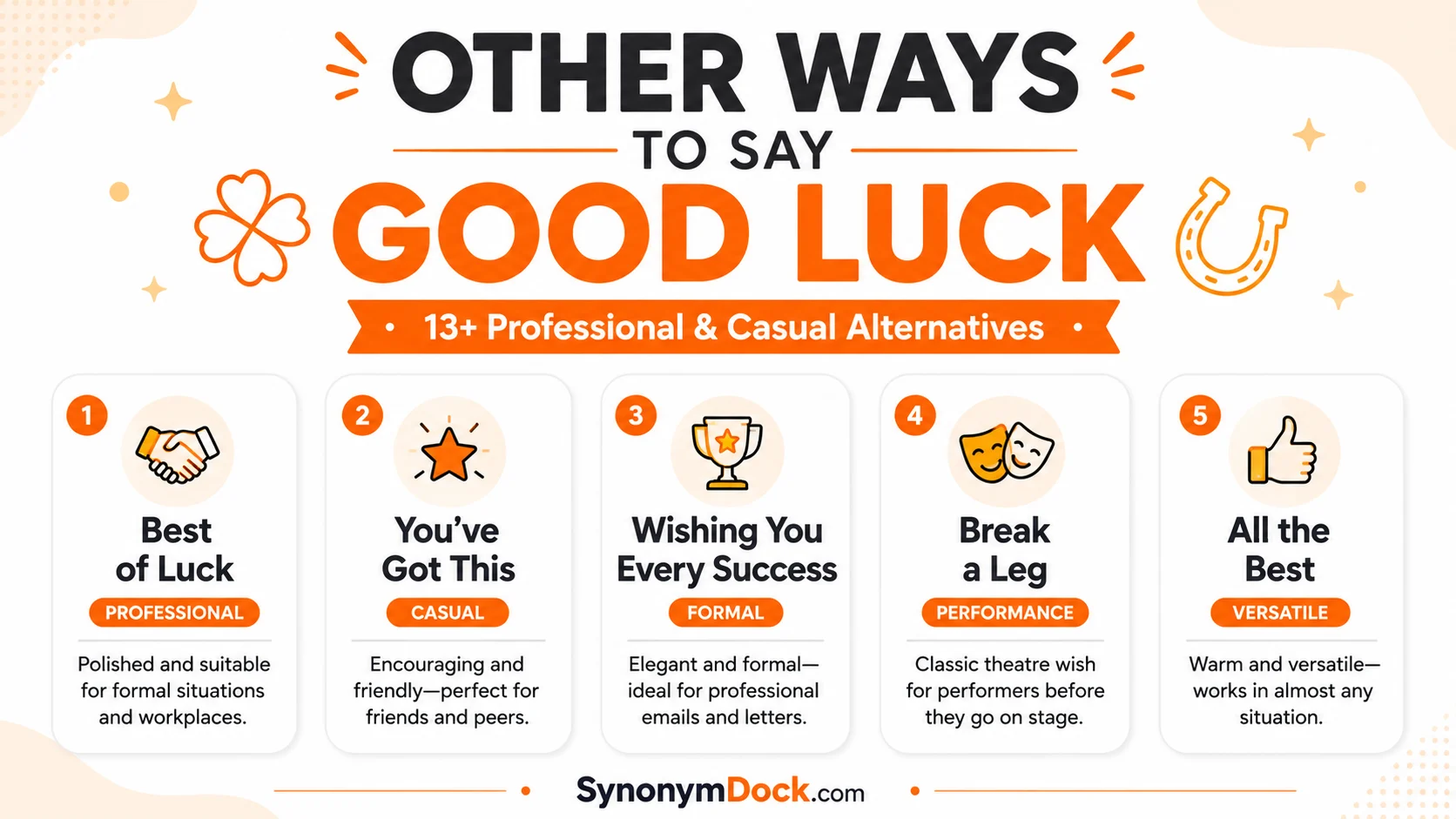
Looking for other ways to say good luck? Try “Best of luck” for professional settings, “You’ve got this” for friends, “Break a leg” for performers, “Wishing you every success” for formal emails, or “Fingers crossed” for casual conversations. The best alternatives include: Best of luck, You’ve got this, Wishing you every success, Break a leg, Fingers crossed, All the best, I’m rooting for you, Go get ’em, May your efforts be rewarded, and Knock ’em dead.
We all say “good luck” dozens of times. But sometimes, this classic phrase feels overused, impersonal, or simply not quite right for the moment.
Whether you’re writing a professional email, cheering on a friend before an interview, or sending a quick text message, having other ways to say good luck helps you communicate more naturally. The right phrase shows you care about the person and understand the situation . This article explores 15+ powerful alternatives to “good luck” organized by tone and situation, so you can choose the perfect expression with confidence.
Quick Categories
Formal Alternatives
- Wishing you every success
- May your efforts be rewarded
- I wish you the best outcome
- Wishing you success in your endeavors
- May everything go smoothly
Pro Tip: Use formal alternatives in business emails, letters of recommendation, or when addressing someone you don’t know well. These phrases sound polished and respectful .
Professional Alternatives
- Best of luck
- I’m confident you’ll do well
- Rooting for your success
- Wishing you success
- Here’s to your continued success
Pro Tip: Professional phrases work well in workplace meetings, project launches, and colleague communications. They show support without being overly personal .
Business Email Alternatives
- Wishing you success with this opportunity
- May your hard work pay off
- I hope everything goes well in your meeting
- Best wishes for your next step
- Looking forward to your achievements
Pro Tip: Start or end emails with these phrases to build rapport while maintaining professionalism. They work especially well for new roles, presentations, or important client meetings.
Academic Alternatives
- Trust your preparation
- You’ve put in the work – now trust it
- May your studies be rewarded
- Wishing you clarity and focus
- All the best with your exams
Pro Tip: Academic alternatives focus on preparation and effort rather than luck. This recognizes the hard work students have invested in their studies.
Casual Alternatives
- You’ve got this
- Fingers crossed for you
- I’m rooting for you
- Go get ’em
- Sending good vibes your way
Pro Tip: Casual phrases are perfect for friends, family, and everyday conversations. They feel warm and supportive without being formal .
Informal Expressions
- Break a leg
- Knock ’em dead
- Crush it
- Smash it
- Nail it
Pro Tip: These phrases work best with people you know well. They’re energetic and confident, but avoid them in professional settings .
“The right tone makes your English sound more confident and builds stronger connections.”
What Does “Good Luck” Mean?
“Good luck” is a common English expression used to wish someone success or a favorable outcome in a future event, task, or endeavor. It conveys hope, support, and positive intentions toward the person receiving the wish.
Example: “Good luck with your presentation today!”
Grammar: “Good luck” functions as a noun phrase and is often followed by the preposition “with” (good luck with your exam) or “in” (good luck in your new role) .
Is It Professional or Polite?
“Good luck” is both polite and versatile, working in many situations. However, its effectiveness depends on context and tone.
Polite? ✅ Yes
Professional? ✅ Generally, but context matters
Formal? ⚠️ Sometimes – it can feel too casual for formal business writing
Natural? ✅ Yes
Example: “Good luck with the client meeting” works in most workplace settings. For a board presentation or formal written communication, consider “Wishing you every success” instead.
Common Mistakes
Mistake #1: Using “Good Luck” Too Casually in Formal Situations
Why it’s incorrect: “Good luck” in a formal email or business letter can sound dismissive or informal.
Correct version: “Wishing you every success”
Example: “Wishing you every success in your new position” sounds more polished than “Good luck in your new position.”
Mistake #2: Using “Break a Leg” Outside Performance Contexts
Why it’s incorrect: While “Break a leg” is a classic theater phrase, using it before a job interview or exam can confuse people.
Correct version: “You’ve got this” or “Best of luck”
Example: “Best of luck with your interview” is clear and appropriate.
Mistake #3: Saying “Fingers Crossed” in Professional Emails
Why it’s incorrect: “Fingers crossed” is too casual for most workplace emails.
Correct version: “I hope everything goes smoothly”
Example: “I hope everything goes smoothly with the project launch” maintains professionalism.
Mistake #4: Overusing “Good Luck” in Text Messages
Why it’s incorrect: Repeating “good luck” in every message feels generic and impersonal.
Correct version: “Rooting for you” or “Can’t wait to hear how it goes” shows more personal investment.
Example: “Rooting for you today!” feels warmer than “Good luck!”
Mistake #5: Using “You Were Made For This” With Someone You Don’t Know Well
Why it’s incorrect: This phrase is intimate and works best with close friends or family.
Correct version: “I’m confident you’ll do well” or “Best of luck”
Example: “I’m confident you’ll do well” is supportive without being overly personal.
15 Other Ways to Say “Good Luck”
[1]. Best of Luck
Meaning: A slightly more formal variation of “good luck” expressing hope for someone’s success.
Explanation: This phrase is widely used in both professional and casual settings. It sounds polished without being stiff, making it a safe choice for most situations. Native speakers often use it when they want to be supportive but maintain a professional distance.
Example Sentence: “Best of luck with your presentation tomorrow.”
Best Use: Business Email, Workplace Meeting, Professional Communication
Avoid Using In: Very Casual Text Messages
Tone: Professional, Warm
Formality Level: ⭐⭐⭐⭐ Formal
Usage Frequency: Very Common
CEFR Level: B1
Common Collocations:
- best of luck with
- wish you the best of luck
- best of luck to you
- best of luck in your future
Context Variability:
- Spoken English: “Best of luck, everyone!”
- Professional English: “Best of luck with the project launch.”
[2]. You’ve Got This
Meaning: A confident, empowering phrase expressing belief in someone’s abilities rather than relying on luck.
Explanation: This alternative shifts focus from chance to capability. It’s encouraging and puts the person in control of their outcome. Native speakers especially use this in casual or supportive conversations.
Example Sentence: “You’ve studied for weeks – you’ve got this!”
Best Use: Daily Conversation, Encouragement, Study/Exam Situations
Avoid Using In: Formal Business Letters
Tone: Encouraging, Confident
Formality Level: ⭐⭐ Casual
Usage Frequency: Very Common
CEFR Level: B1
Common Collocations:
- you’ve got this
- you’ve totally got this
- you’ve got this, I believe in you
Context Variability:
- Spoken English: “Don’t worry, you’ve got this!”
- Casual Conversation: “You’ve got this – go get ’em!”
[3]. Wishing You Every Success
Meaning: A formal, polished phrase expressing hope for someone’s complete success.
Explanation: This is one of the most professional alternatives to “good luck.” It sounds elegant and works perfectly in formal correspondence. Native speakers typically reserve this for important career moments, promotions, or formal announcements.
Example Sentence: “Wishing you every success in your new role as department head.”
Best Use: Formal Business Email, Career Milestones, Promotion Wishes
Avoid Using In: Casual Text Conversations
Tone: Formal, Respectful
Formality Level: ⭐⭐⭐⭐⭐ Very Formal
Usage Frequency: Common (Business Only)
CEFR Level: B2
Common Collocations:
- wishing you every success in
- wishing you every success with
- we wish you every success
Context Variability:
- Professional English: “We’re wishing you every success as you take on this new challenge.”
- Written English: Used in formal letters and emails.
[4]. Break a Leg
Meaning: A traditional theater expression wishing performers good luck – ironically, by saying the opposite.
Explanation: This famous idiom originated in the theater world, where superstition holds that saying “good luck” actually brings bad luck. Today, it’s used for performances, presentations, or any time someone needs to “perform” well.
Example Sentence: “Your band’s first gig – break a leg!”
Best Use: Performance Situations, Theatre, Concerts
Avoid Using In: Sports Contexts, Professional Emails
Tone: Casual, Traditional
Formality Level: ⭐⭐ Casual
Usage Frequency: Common (Performance Contexts)
CEFR Level: B1
Common Collocations:
- break a leg tonight
- break a leg out there
- break a leg, you’ll be amazing
Context Variability:
- Spoken English: “Big audition tomorrow? Break a leg!”
- Performance: “Break a leg, darling – you’ll be fabulous!”
[5]. Fingers Crossed
Meaning: A casual expression showing you’re hoping for a positive outcome.
Explanation: This phrase comes from the common gesture of crossing fingers for good luck. It feels hopeful and lighthearted. It’s common in text messages and casual conversation but too informal for professional writing.
Example Sentence: “I’ve got my fingers crossed for you and your job application.”
Best Use: Text Message, Casual Conversation, Hoping for Good News
Avoid Using In: Formal Business Writing
Tone: Hopeful, Casual
Formality Level: ⭐⭐ Casual
Usage Frequency: Very Common
CEFR Level: B1
Common Collocations:
- fingers crossed for you
- keeping my fingers crossed
- fingers crossed it all works out
Context Variability:
- Spoken English: “I’ve got my fingers crossed for you.”
- Casual Conversation: “Fingers crossed everything works out!”
“Choosing the right phrase matters as much as choosing the right words.”
[6]. All the Best
Meaning: A warm, versatile phrase expressing general good wishes.
Explanation: “All the best” strikes a perfect balance between professional and friendly. It works in almost any situation and is very common among native speakers. It’s particularly good when you won’t see the person again or for new beginnings.
Example Sentence: “All the best for your new job in London.”
Best Use: Farewell Wishes, New Opportunities, General Encouragement
Avoid Using In: Extremely Formal Legal or Official Correspondence
Tone: Warm, Neutral
Formality Level: ⭐⭐⭐ Neutral
Usage Frequency: Very Common
CEFR Level: A2
Common Collocations:
- all the best for
- all the best with
- all the best to you
Context Variability:
- Spoken English: “All the best, mate!”
- Professional English: “All the best with the new venture.”
[7]. I’m Rooting for You
Meaning: A supportive expression showing you’re cheering for someone’s success.
Explanation: “Rooting for” someone means you’re enthusiastically supporting them. This phrase creates a sense of emotional connection and ongoing support. Native speakers use it to show genuine investment in someone’s outcome.
Example Sentence: “I’m rooting for you – you deserve this opportunity.”
Best Use: Encouragement, Supportive Messages, Friends and Family
Avoid Using In: Formal Professional Correspondence
Tone: Warm, Supportive
Formality Level: ⭐⭐ Casual
Usage Frequency: Common
CEFR Level: B1
Common Collocations:
- I’m rooting for you
- we’re all rooting for you
- rooting for your success
Context Variability:
- Spoken English: “We’re all rooting for you – don’t forget that!”
- Professional English: More casual workplaces may accept this phrase.
[8]. Go Get ’Em
Meaning: An energetic, motivational phrase encouraging someone to succeed.
Explanation: This phrase combines encouragement with enthusiasm. It suggests the person should take action and succeed – you believe in them! This phrase is especially popular in sports contexts.
Example Sentence: “It’s your time to shine – go get ’em!”
Best Use: Sports Events, Job Interviews, Friendly Encouragement
Avoid Using In: Formal Situations
Tone: Energetic, Confident
Formality Level: ⭐⭐ Casual
Usage Frequency: Common
CEFR Level: B1
Common Collocations:
- go get ’em today
- go get ’em, tiger
- go get ’em, champ
Context Variability:
- Spoken English: “Go get ’em – I believe in you!”
- Sports/Interviews: Used to fire someone up for a challenge.
[9]. May Your Efforts Be Rewarded
Meaning: A formal, respectful phrase hoping someone’s hard work leads to success.
Explanation: This phrase emphasizes effort rather than luck. It sounds elegant and shows you recognize the person’s dedication. Native speakers use it in formal settings where they want to sound respectful and thoughtful.
Example Sentence: “I know how hard you’ve worked on this – may your efforts be rewarded.”
Best Use: Professional Emails, Formal Occasions, Recognizing Hard Work
Avoid Using In: Casual Text Messages
Tone: Formal, Respectful
Formality Level: ⭐⭐⭐⭐ Formal
Usage Frequency: Occasional (Formal Contexts)
CEFR Level: B2
Common Collocations:
- may your efforts be rewarded
- may your hard work pay off
- may your efforts lead to success
Context Variability:
- Professional English: “May your efforts be rewarded with the outcome you deserve.”
- Written English: Works well in formal letters and emails.
[10]. Knock ’em Dead
Meaning: A casual, confident phrase encouraging someone to impress everyone with their performance.
Explanation: While it sounds violent, this idiom simply means to do amazingly well. It’s common in performance contexts and among friends. It’s not appropriate for formal or sensitive situations.
Example Sentence: “Knock ’em dead at your speech tonight!”
Best Use: Performances, Presentations, Casual Encouragement
Avoid Using In: Professional Emails, Sensitive Situations
Tone: Confident, Informal
Formality Level: ⭐ Casual
Usage Frequency: Common
CEFR Level: B2
Common Collocations:
- knock ’em dead tonight
- go knock ’em dead
- you’ll knock ’em dead
Context Variability:
- Spoken English: “Go knock ’em dead out there!”
- Performance: Used before important speeches, performances, or pitches.
[11]. I Wish You the Best Outcome
Meaning: A formal, neutral expression wishing for a positive result in a situation.
Explanation: This phrase sounds careful and professional. It’s perfect for formal situations where you want to express support without being too familiar.
Example Sentence: “I wish you the best outcome in this matter.”
Best Use: Formal Correspondence, Legal Matters, Business Negotiations
Avoid Using In: Casual Conversations
Tone: Formal, Neutral
Formality Level: ⭐⭐⭐⭐ Formal
Usage Frequency: Occasional (Formal Only)
CEFR Level: B2
Common Collocations:
- wish you the best outcome
- hoping for the best outcome
- best possible outcome for you
Context Variability:
- Professional English: “We wish you the best outcome in your discussions.”
- Written English: Suitable for formal letters.
[12]. Crush It
Meaning: A modern, casual phrase encouraging someone to do extremely well.
Example Sentence: “You’ve been training all year – go crush it!”
Best Use: Sports, Exams, Encouragement
Avoid Using In: Professional Contexts
Tone: Casual, Confident
Formality Level: ⭐ Casual
Usage Frequency: Common
CEFR Level: B2
Common Collocations:
- go crush it
- crush it today
- you’re going to crush it
Context Variability:
- Spoken English: “Crush it out there!”
- Casual Conversation: Popular among younger speakers and in sports.
[13]. Blow Them Away
Meaning: A confident phrase encouraging someone to impress everyone with their skill.
Example Sentence: “Your abilities will blow them away – I’ve never been more sure of anything.”
Best Use: Performances, Presentations, Interviews
Avoid Using In: Formal Situations
Tone: Confident, Informal
Formality Level: ⭐⭐ Casual
Usage Frequency: Common
CEFR Level: B2
Common Collocations:
- blow them away
- you’ll blow them away
- go blow them away
Context Variability:
- Spoken English: “Go blow them away with your presentation.”
- Performance: Shows confidence in someone’s abilities.
[14]. You Were Made for This
Meaning: A warm, encouraging phrase suggesting someone is perfectly suited for their challenge.
Explanation: This phrase is highly personal and works best with close relationships. It builds confidence by reminding the person of their natural abilities.
Example Sentence: “You’ve got the skills and the talent – you were made for this moment.”
Best Use: Close Friends, Family, Personal Encouragement
Avoid Using In: Professional Communication
Tone: Warm, Personal
Formality Level: ⭐⭐ Casual
Usage Frequency: Common
CEFR Level: B1
Common Collocations:
- you were made for this
- made for this moment
- you were born for this
Context Variability:
- Spoken English: “Don’t worry – you were made for this.”
- Close Relationships: Works best with people you know well.
[15]. I’m Confident You’ll Do Well
Meaning: A professional, supportive phrase expressing genuine belief in someone’s ability.
Explanation: This phrase shows you’ve considered the person’s capabilities and genuinely believe they will succeed. It’s reassuring and respectful.
Example Sentence: “I’m confident you’ll do well in the interview tomorrow.”
Best Use: Business Communication, Interviews, Supporting Colleagues
Avoid Using In: Extremely Casual Conversations
Tone: Professional, Supportive
Formality Level: ⭐⭐⭐⭐ Formal
Usage Frequency: Common (Professional Contexts)
CEFR Level: B1
Common Collocations:
- confident you’ll do well
- confident you’ll succeed
- confident in your abilities
Context Variability:
- Professional English: “I’m confident you’ll do well in your new role.”
- Written English: Works well in professional emails.
“Native speakers rarely use ‘good luck’ with performers. They say ‘break a leg’ instead.”
Native Speaker Tip
When encouraging a performer, native speakers rarely say “good luck.” Instead, they use “Break a leg” due to theatrical superstition that saying “good luck” jinxes the performance. Similarly, “Knock ’em dead” sounds more natural than “good luck” before a big speech or presentation .
Expert Insight
In workplace communication, “I’m confident you’ll succeed” builds trust and shows genuine belief in your colleague. This phrase reduces anxiety about luck and focuses on their proven abilities. It’s particularly effective when delivered before a challenging presentation or meeting .
Avoid These Expressions in Formal Situations
| Expression | Why to Avoid | Better Alternative |
|---|---|---|
| Break a leg | Too casual and theatrical | Best of luck |
| Fingers crossed | Too informal | Wishing you success |
| Knock ’em dead | Too aggressive | I’m confident you’ll do well |
| You’ve got this | Too casual | We have full confidence in you |
| Sending good vibes | Too informal | I wish you the best outcome |
Top 10 Alternatives Compared
| Phrase | Tone | Formality | Best Use | Frequency |
|---|---|---|---|---|
| Best of luck | Warm, Professional | ⭐⭐⭐⭐ | Emails, Meetings | Very Common |
| You’ve got this | Encouraging, Confident | ⭐⭐ | Friends, Family | Very Common |
| Wishing you every success | Formal, Respectful | ⭐⭐⭐⭐⭐ | Official Correspondence | Common |
| Break a leg | Traditional, Casual | ⭐⭐ | Performances, Theatre | Common |
| Fingers crossed | Hopeful, Casual | ⭐⭐ | Text Messages | Very Common |
| All the best | Warm, Neutral | ⭐⭐⭐ | Farewells, New Beginnings | Very Common |
| I’m rooting for you | Supportive, Personal | ⭐⭐ | Close Relationships | Common |
| Go get ’em | Energetic, Motivational | ⭐⭐ | Sports, Interviews | Common |
| May your efforts be rewarded | Formal, Respectful | ⭐⭐⭐⭐ | Professional Recognition | Occasional |
| Knock ’em dead | Confident, Casual | ⭐ | Performances, Speeches | Common |
Which One Should You Use?
Best Overall: “Best of luck” – it works in most situations
Best Professional: “I’m confident you’ll do well” – builds trust
Best Academic: “Trust your preparation” – focuses on effort
Best Business Email: “Wishing you success” – sounds polished
Best Everyday Conversation: “All the best” – natural and warm
Most Natural: “All the best” – native speakers use it constantly
Most Polite: “I wish you the best outcome” – respectful and formal
Commonly Confused Phrases
“Best of luck” vs. “Good luck”
These two are very similar. “Best of luck” sounds slightly more formal and sincere, while “good luck” is more direct and casual.
“Break a leg” vs. “Knock ’em dead”
Both are casual performance wishes. “Break a leg” is theatrical and traditional, while “knock ’em dead” is more modern and energetic.
“Fingers crossed” vs. “Sending good vibes”
Both are casual and hopeful. “Fingers crossed” is more common and traditional, while “sending good vibes” is newer and more spiritual in tone .
Scenario Practice
Scenario 1: A colleague is presenting to the board tomorrow.
Which phrase would you choose?
Correct Answer: “Best of luck with your presentation” or “I’m confident you’ll do well”
Why: Professional, encouraging without being too casual.
Scenario 2: Your best friend is going on a first date.
Which phrase would you choose?
Correct Answer: “You’ve got this” or “Rooting for you!”
Why: Warm, supportive, and casual enough for a close friend.
Scenario 3: A family member is having surgery.
Which phrase would you choose?
Correct Answer: “Wishing you all the best” or “I’m thinking of you”
Why: Gentler than “good luck,” shows care and concern.
Scenario 4: A student is taking final exams.
Which phrase would you choose?
Correct Answer: “Trust your preparation – you know this material”
Why: Focuses on effort and knowledge, not luck .
Scenario 5: Someone is starting a new job.
Which phrase would you choose?
Correct Answer: “All the best in your new role” or “Wishing you every success”
Why: Warm yet professional for new beginnings.
Mini Quiz
1. What phrase would you use before a friend’s stage performance?
- A) Best of luck
- B) Break a leg
- C) Fingers crossed
2. Which phrase is most appropriate for a formal business email?
- A) You’ve got this
- B) Wishing you every success
- C) Knock ’em dead
3. Which phrase suggests confidence in someone’s abilities, not luck?
- A) Good luck
- B) I’m confident you’ll do well
- C) Fingers crossed
4. Which phrase is too casual for professional use?
- A) Best of luck
- B) All the best
- C) You’ve got this
5. What’s the most versatile phrase for most situations?
- A) Break a leg
- B) All the best
- C) Sending good vibes
Answer Key
- B) Break a leg – This is the traditional theatrical expression
- B) Wishing you every success – Formal and professional
- B) I’m confident you’ll do well – Focuses on belief in abilities
- C) You’ve got this – Too casual for formal professional contexts
- B) All the best – Works in almost any situation
FAQ Section
What is the most formal way to say “good luck”?
“Wishing you every success” is one of the most formal alternatives. Others include “May your efforts be rewarded” and “I wish you the best outcome.” These phrases are perfect for official correspondence, formal emails, and professional settings where a polished tone is essential .
Which phrase is best for professional emails?
“Best of luck” works well in most professional emails. “Wishing you success” and “I’m confident you’ll do well” are also excellent choices. Avoid casual phrases like “You’ve got this” or “Fingers crossed” in formal workplace correspondence .
What is the difference between “Break a leg” and “Good luck”?
“Break a leg” is a theatrical idiom used for performers. It originated from theater superstition that saying “good luck” brings bad luck. “Good luck” is more general and works in most situations. Use “Break a leg” only for performances, not for exams, interviews, or other situations .
Which alternative sounds most natural to native speakers?
“Best of luck” and “All the best” are among the most natural alternatives native speakers use daily. They feel neither too formal nor too casual and work in many situations. “You’ve got this” is also very common in casual conversation, especially among younger speakers .
Can I use these expressions in business meetings?
Yes, phrases like “Best of luck,” “I’m confident you’ll do well,” and “Wishing you success” are perfect for business meetings. Avoid “Break a leg,” “Fingers crossed,” and “Knock ’em dead” in professional settings unless your workplace is very casual .
Conclusion
Learning other ways to say good luck transforms your communication. Instead of relying on the same phrase, you now have powerful alternatives for every situation – from professional emails to casual text messages.
Remember, the best phrase depends on your relationship with the person and the situation. “Best of luck” and “All the best” work in most circumstances, while “Break a leg” adds theatrical flair. Practice using these alternatives, and your English will sound more fluent, natural, and confident.
Start today – choose one new phrase and use it in your next conversation. You’ve got this!

6 thoughts on “Other Ways to Say “Good Luck” |13+ Professional & Casual Examples 2026”