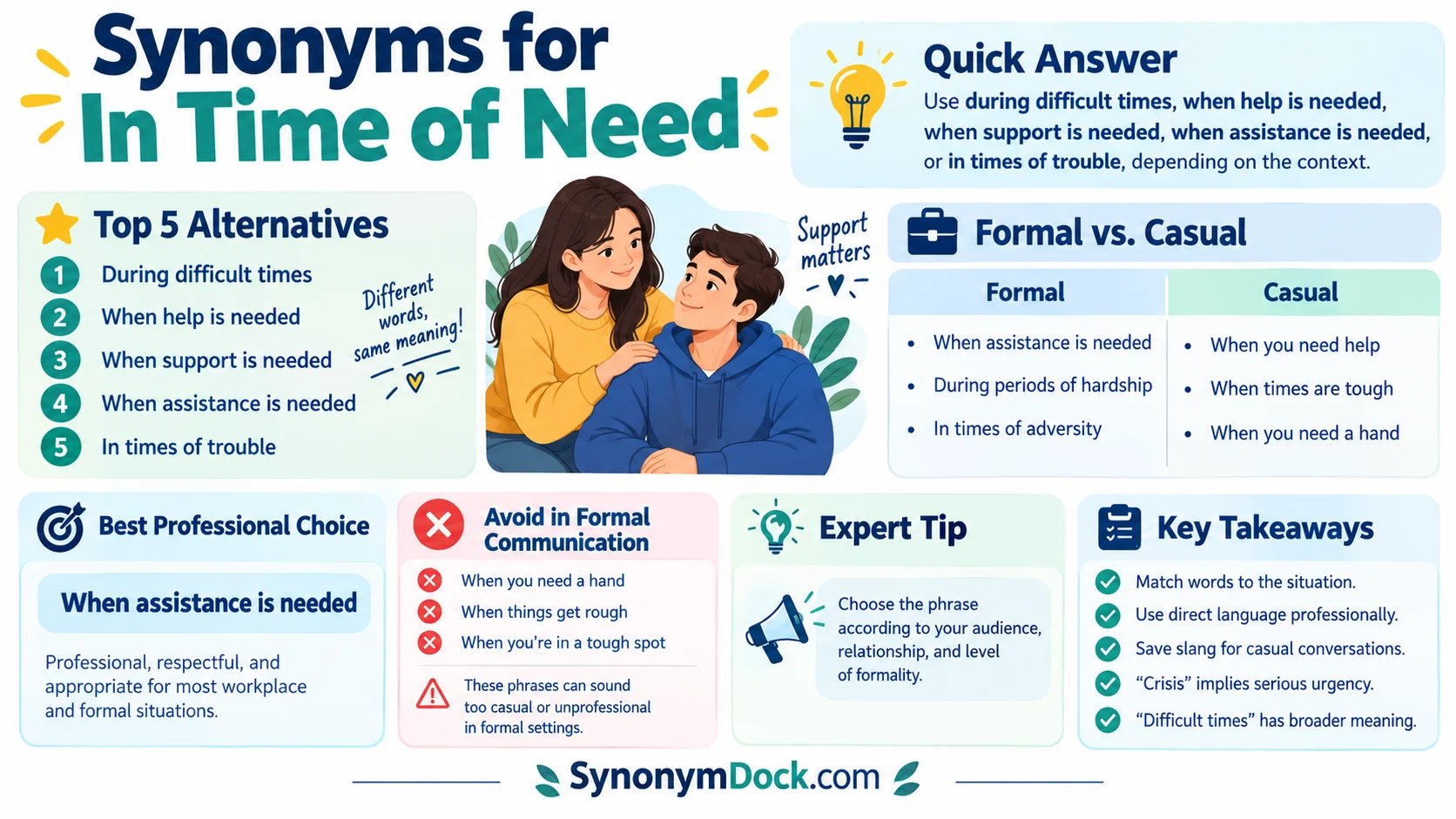
Synonyms for “in time of need” include in times of trouble, during difficult times, when help is needed, in a crisis, and when times are tough. Choose the expression according to the situation and level of formality.
5 best alternatives: in times of trouble, during difficult times, when help is needed, in a crisis, when times are tough
The phrase “in time of need” means when someone is experiencing difficulty and needs help, support, or assistance. It is common in conversations, writing, speeches, and expressions about helping others.
Learning alternatives to “in time of need” can make your English more flexible. Knowing other ways to say “in time of need” also helps you choose a phrase that sounds natural in a business email, academic text, workplace meeting, or everyday conversation.
The best expression depends on context. Some alternatives sound warm and supportive, while others are more formal, professional, or direct.
“Good vocabulary is not about using difficult words. It is about choosing the right words for the situation.”
Quick Categories
Formal Alternatives
- When assistance is required
- During periods of hardship
- In times of adversity
- When support is necessary
- During challenging circumstances
Pro Tip
Use these expressions in formal writing, professional correspondence, reports, and serious discussions. Avoid overly dramatic wording when a simple expression communicates the same idea.
Professional Alternatives
- When support is needed
- During difficult circumstances
- When assistance is needed
- During challenging times
- In challenging situations
Pro Tip
For workplace communication, “when support is needed” and “when assistance is needed” are especially clear because they sound professional without being overly formal.
Business Email Alternatives
- When assistance is needed
- Should support be required
- If you need assistance
- When additional support is necessary
- During challenging circumstances
Pro Tip
Business emails usually benefit from direct language. Instead of writing a dramatic expression, clearly state what support is available and when it can be requested.
Academic Alternatives
- During periods of hardship
- In times of adversity
- During challenging circumstances
- When support is necessary
- In difficult circumstances
Pro Tip
Academic writing favors precise expressions. “During periods of hardship” works well when discussing social, economic, historical, or personal challenges.
Casual Alternatives
- When times are tough
- When things get difficult
- When things get tough
- When you need help
- When things go wrong
Pro Tip
These expressions sound natural in conversations with friends, family, and familiar colleagues. They are generally less suitable for formal reports.
Informal Expressions
- When you’re in a tough spot
- When things get rough
- When you’re having a hard time
- When you need a hand
- When you’re struggling
Pro Tip
Informal expressions can sound warm and friendly, but some may be too casual for professional or academic English.
“The right alternative preserves the meaning while changing the tone.”
Common Mistakes
1. Confusing “in time of need” with “in time”
Mistake: “Please arrive in time of need.”
Why: “In time” can mean before it is too late, while “in time of need” refers to a difficult situation requiring help.
Correct: “She supported her friend in her time of need.”
Example: “The organization provides assistance in times of need.”
2. Using “at time of need” without an article
Mistake: “He helped me at time of need.”
Why: The natural expression normally uses “a” or “the”, depending on the meaning.
Correct: “He helped me in my time of need.”
Example: “They stood by us in our time of need.”
3. Using an overly formal phrase in casual conversation
Mistake: “Please contact me when assistance is required” to a close friend.
Why: The sentence sounds unnecessarily official.
Correct: “Call me when you need help.”
Example: “I’m here whenever you need help.”
4. Treating “in a crisis” as an exact replacement
Mistake: “Call me in a crisis” when you simply mean everyday support.
Why: “Crisis” suggests a serious or urgent situation.
Correct: “Call me when you need help.”
Example: “Our emergency team is available in a crisis.”
5. Using “when times are tough” in formal academic writing
Mistake: “Families save money when times are tough.”
Why: The phrase is natural but conversational.
Correct: “Families often reduce spending during periods of economic hardship.”
Example: “Households may change their spending habits during periods of hardship.”
What Does “In Time of Need” Mean?
“In time of need” means during a situation when someone needs help, support, protection, or assistance.
The phrase commonly appears as “in a time of need” or “in your time of need.” The possessive version is especially natural when talking about helping a particular person.
Example: “A true friend will support you in your time of need.”
Grammatically, “in” introduces the situation or period in which something happens, while “need” refers to a requirement for help or support.
Similar expressions include “during difficult times,” “when help is needed,” and “in times of trouble.”
When to Use “In Time of Need”
You can use the expression when discussing:
- Business: supporting employees during difficult periods
- Academic writing: describing hardship or social challenges
- Emails: offering assistance or support
- Meetings: discussing help available to a team
- Daily conversation: talking about friends or family
- Spoken English: offering emotional or practical support
- Written English: describing support during hardship
- Formal situations: discussing assistance or adversity
- Informal situations: expressing friendship and loyalty
For example:
“Our team is here to support you in your time of need.”
This sounds supportive and professional without being overly complicated.
Is “In Time of Need” Professional or Polite?
Polite? ✔ Yes
Professional? ✔ Yes, depending on context
Formal? ✔ Moderately formal
Natural? ✔ Yes
The phrase is polite and understandable, but it can sometimes sound more traditional or emotionally serious than everyday alternatives.
Business-style example:
“Please remember that our support team is available in your time of need.”
Simpler professional version:
“Please contact our support team whenever you need assistance.”
The second version is often more direct in modern workplace communication.
Pros and Cons
Pros
- Easy for most English speakers to understand
- Communicates support clearly
- Works in both speech and writing
- Can express warmth and loyalty
- Suitable for professional contexts when used carefully
Cons
- Can sound somewhat formal
- May feel emotionally serious
- Less direct than some modern alternatives
- “In a crisis” can imply greater urgency than intended
- Casual alternatives may sound more natural in everyday conversation
“Professional English is often clearer when the level of formality matches the relationship.”
Choosing the Right Alternative
The following alternatives help you expand your vocabulary while keeping your meaning clear. The important difference is context: a phrase suitable for a business email may sound unnatural when speaking to a close friend.
Expert Tip
Native speakers often change the expression according to the relationship, situation, and purpose. In professional communication, “when assistance is needed” is usually clearer than a highly emotional expression.
Other Ways to Say “In Time of Need”
These 15 alternatives cover formal, professional, academic, neutral, casual, and informal English.
1. Phrase: In Times of Trouble
Meaning: During situations that cause difficulty, problems, or distress.
Explanation: This is a natural alternative when someone needs support because something has gone wrong. It is warmer and more conversational than some formal expressions.
Example Sentence: “True friends remain dependable in times of trouble.”
Best Use: Personal Writing
Avoid Using In: Technical Reports
Tone: Warm, Supportive
Formality Level: ⭐⭐⭐ Neutral
Usage Frequency: Common
CEFR Level: B2
Common Collocations:
- help in times of trouble
- friends in times of trouble
- support in times of trouble
- stand together in times of trouble
Context Variability:
- Spoken: “She always helps me in times of trouble.”
- Professional: “The organization provides assistance in times of trouble.”
- Casual: “Good friends stick around in times of trouble.”
2. Phrase: During Difficult Times
Meaning: During a period when life or circumstances are challenging.
Explanation: This is one of the most flexible alternatives. It works naturally in personal, professional, and written English.
Example Sentence: “The company offered extra support to employees during difficult times.”
Best Use: General Communication
Avoid Using In: Legal Definitions
Tone: Neutral, Supportive
Formality Level: ⭐⭐⭐⭐ Formal
Usage Frequency: Very Common
CEFR Level: B1
Common Collocations:
- during difficult times
- support during difficult times
- help during difficult times
- remain strong during difficult times
Context Variability:
- Spoken: “I stayed with her during difficult times.”
- Professional: “Employees may request assistance during difficult times.”
- Casual: “We all need friends during difficult times.”
3. Phrase: When Help Is Needed
Meaning: At a time when someone requires assistance.
Explanation: This phrase is direct and practical. It avoids the emotional weight of “time of need” and works particularly well in professional communication.
Example Sentence: “Our support staff are available when help is needed.”
Best Use: Business Communication
Avoid Using In: Highly Personal Messages
Tone: Clear, Professional
Formality Level: ⭐⭐⭐⭐ Formal
Usage Frequency: Very Common
CEFR Level: B1
Common Collocations:
- provide help when needed
- offer help when needed
- available when help is needed
- receive help when needed
Context Variability:
- Spoken: “I’ll be there when help is needed.”
- Professional: “Our specialists can assist when help is needed.”
- Casual: “Just call me when help is needed.”
4. Phrase: During Challenging Times
Meaning: During a period involving significant difficulty or pressure.
Explanation: This phrase is common in professional communication because it sounds supportive without being overly dramatic.
Example Sentence: “The manager encouraged the team to communicate openly during challenging times.”
Best Use: Workplace Communication
Avoid Using In: Casual Texts
Tone: Professional, Supportive
Formality Level: ⭐⭐⭐⭐ Formal
Usage Frequency: Common
CEFR Level: B2
Common Collocations:
- during challenging times
- support during challenging times
- leadership during challenging times
- remain focused during challenging times
Context Variability:
- Spoken: “We supported each other during challenging times.”
- Professional: “Strong leadership matters during challenging times.”
- Casual: “We stayed close during challenging times.”
5. Phrase: When Support Is Needed
Meaning: At a point when someone requires emotional, practical, or professional support.
Explanation: This is a highly useful workplace expression. It is less emotional than “in your time of need” and works well in emails and meetings.
Example Sentence: “Team members should feel comfortable asking for support when it is needed.”
Best Use: Workplace Meetings
Avoid Using In: Very Casual Chats
Tone: Professional, Reassuring
Formality Level: ⭐⭐⭐⭐ Formal
Usage Frequency: Very Common
CEFR Level: B2
Common Collocations:
- provide support when needed
- offer support when needed
- receive support when needed
- additional support when needed
Context Variability:
- Spoken: “I’ll provide support when it’s needed.”
- Professional: “Managers should offer support when needed.”
- Casual: “I’m here when you need support.”
Native Speaker Tip
“During difficult times” is one of the most natural all-purpose choices. “When support is needed” is more practical and professional, while “in times of adversity” sounds more formal.
6. Phrase: During Difficult Circumstances
Meaning: While dealing with conditions that create problems or hardship.
Explanation: This expression suits formal writing because “circumstances” focuses on the situation rather than the person’s emotions.
Example Sentence: “The scholarship provides financial assistance to students facing difficult circumstances.”
Best Use: Formal Writing
Avoid Using In: Friendly Texts
Tone: Formal, Neutral
Formality Level: ⭐⭐⭐⭐⭐ Very Formal
Usage Frequency: Common
CEFR Level: C1
Common Collocations:
- difficult circumstances
- challenging circumstances
- face difficult circumstances
- assistance during difficult circumstances
Context Variability:
- Spoken: “They helped us during difficult circumstances.”
- Professional: “Additional resources may be provided during difficult circumstances.”
- Casual: “We got through a difficult situation together.”
7. Phrase: During Periods of Hardship
Meaning: During periods of serious difficulty, deprivation, or suffering.
Explanation: This phrase is especially useful in academic, social, economic, and historical writing.
Example Sentence: “Community networks often become stronger during periods of hardship.”
Best Use: Academic Writing
Avoid Using In: Casual Conversation
Tone: Formal, Serious
Formality Level: ⭐⭐⭐⭐⭐ Very Formal
Usage Frequency: Common
CEFR Level: C1
Common Collocations:
- periods of hardship
- economic hardship
- financial hardship
- overcome hardship
Context Variability:
- Spoken: “People need support during periods of hardship.”
- Professional: “The program assists workers experiencing financial hardship.”
- Casual: “Friends can make hard times easier.”
8. Phrase: In Times of Adversity
Meaning: During periods of serious difficulty or hardship.
Explanation: “Adversity” is a formal word meaning difficult circumstances. The phrase is polished but may sound too formal for everyday conversation.
Example Sentence: “Effective leaders remain calm in times of adversity.”
Best Use: Formal Speech
Avoid Using In: Casual Chats
Tone: Formal, Serious
Formality Level: ⭐⭐⭐⭐⭐ Very Formal
Usage Frequency: Occasional
CEFR Level: C1
Common Collocations:
- overcome adversity
- face adversity
- respond to adversity
- strength in adversity
Context Variability:
- Spoken: “They showed courage in times of adversity.”
- Professional: “Strong teams cooperate in times of adversity.”
- Casual: “Good friends help when things get hard.”
9. Phrase: When Assistance Is Needed
Meaning: When someone requires practical or professional help.
Explanation: This is one of the strongest choices for formal and business English. It is direct, polite, and less emotional than “in your time of need.”
Example Sentence: “Please contact the service desk when assistance is needed.”
Best Use: Business Email
Avoid Using In: Friendly Texts
Tone: Professional, Polite
Formality Level: ⭐⭐⭐⭐ Formal
Usage Frequency: Very Common
CEFR Level: B2
Common Collocations:
- provide assistance
- request assistance
- require assistance
- technical assistance
Context Variability:
- Spoken: “Please ask for assistance when needed.”
- Professional: “Employees can request assistance when necessary.”
- Casual: “Let me know if you need help.”
10. Phrase: In a Crisis
Meaning: During an urgent or particularly serious situation.
Explanation: This is not a perfect synonym in every context. It should be used only when the situation is genuinely serious or urgent.
Example Sentence: “The emergency team must communicate clearly in a crisis.”
Best Use: Emergency Context
Avoid Using In: Minor Problems
Tone: Serious, Direct
Formality Level: ⭐⭐⭐⭐ Formal
Usage Frequency: Very Common
CEFR Level: B2
Common Collocations:
- manage a crisis
- respond in a crisis
- crisis management
- remain calm in a crisis
Context Variability:
- Spoken: “Stay calm in a crisis.”
- Professional: “Leaders must make clear decisions in a crisis.”
- Casual: “Call me if you’re ever in a crisis.”
Expert Insight
In workplace English, do not automatically replace “in time of need” with “in a crisis.” A crisis is much more serious. For ordinary support, “when assistance is needed” is more accurate.
11. Phrase: When Times Are Tough
Meaning: During periods when life is difficult or stressful.
Explanation: This is a natural conversational expression. It is friendly and understandable but should generally be avoided in formal academic writing.
Example Sentence: “My family always stays together when times are tough.”
Best Use: Daily Conversation
Avoid Using In: Academic Essays
Tone: Friendly, Natural
Formality Level: ⭐⭐ Casual
Usage Frequency: Very Common
CEFR Level: B1
Common Collocations:
- when times are tough
- stick together when times are tough
- help when times are tough
- stay strong when times are tough
Context Variability:
- Spoken: “Friends matter when times are tough.”
- Professional: “The team remained united during challenging times.”
- Casual: “We help each other when times are tough.”
12. Phrase: When Things Get Difficult
Meaning: When a situation becomes challenging or problematic.
Explanation: This flexible expression works well in everyday speech. It is less formal than “during challenging circumstances.”
Example Sentence: “She knows she can call her sister when things get difficult.”
Best Use: Everyday Speech
Avoid Using In: Formal Reports
Tone: Natural, Supportive
Formality Level: ⭐⭐⭐ Neutral
Usage Frequency: Very Common
CEFR Level: B1
Common Collocations:
- when things get difficult
- know what to do when things get difficult
- help when things get difficult
- stay calm when things get difficult
Context Variability:
- Spoken: “I’m here when things get difficult.”
- Professional: “Employees should communicate early when things get difficult.”
- Casual: “We stick together when things get difficult.”
13. Phrase: When You Need a Hand
Meaning: When you need help with something.
Explanation: “Give someone a hand” and “need a hand” are common informal expressions. They sound friendly and approachable.
Example Sentence: “Give me a call when you need a hand with the project.”
Best Use: Friendly Conversation
Avoid Using In: Formal Emails
Tone: Friendly, Informal
Formality Level: ⭐⭐ Casual
Usage Frequency: Common
CEFR Level: B1
Common Collocations:
- need a hand
- give someone a hand
- lend a hand
- give me a hand
Context Variability:
- Spoken: “Let me know when you need a hand.”
- Professional: “Please contact the support team if you need assistance.”
- Casual: “I can give you a hand.”
14. Phrase: When You’re Having a Hard Time
Meaning: When you are experiencing difficulty or emotional stress.
Explanation: This phrase is personal and empathetic. It works well when speaking about someone’s individual experience.
Example Sentence: “You can always talk to me when you’re having a hard time.”
Best Use: Personal Conversation
Avoid Using In: Formal Reports
Tone: Warm, Empathetic
Formality Level: ⭐⭐ Casual
Usage Frequency: Very Common
CEFR Level: B1
Common Collocations:
- having a hard time
- going through a hard time
- help someone through a hard time
- during a hard time
Context Variability:
- Spoken: “Talk to someone when you’re having a hard time.”
- Professional: “Employees can seek support during difficult periods.”
- Casual: “I’ll be here if you’re having a hard time.”
15. Phrase: When You Need Help
Meaning: At a time when you require assistance.
Explanation: This is the simplest and most natural everyday alternative. It is direct rather than formal, so it works especially well in ordinary conversation.
Example Sentence: “Call me whenever you need help.”
Best Use: Daily Conversation
Avoid Using In: Formal Reports
Tone: Friendly, Direct
Formality Level: ⭐⭐⭐ Neutral
Usage Frequency: Very Common
CEFR Level: A2–B1
Common Collocations:
- need help
- ask for help
- offer help
- get help
Context Variability:
- Spoken: “Just call me when you need help.”
- Professional: “Please contact us whenever you need help.”
- Casual: “I’m here whenever you need help.”
Native Speaker Tip
For everyday English, native speakers commonly use “when you need help” or “when things get difficult.” In professional settings, “when assistance is needed” sounds more polished. “In times of adversity” is correct but noticeably more formal.
Avoid These Expressions in Formal Situations
Some expressions are perfectly understandable but can sound too casual for formal communication.
| Casual Expression | Why Avoid It | Better Alternative |
| When you need a hand | Too conversational | When assistance is needed |
| When things get rough | Informal and vague | During difficult circumstances |
| When you’re in a tough spot | Very conversational | In a difficult situation |
| When things get tough | Casual tone | During challenging times |
| When you’re having a hard time | Personal and conversational | During a period of difficulty |
Best Phrases by Situation
| Situation | Suitable Phrase |
| Business Email | When assistance is needed |
| Client Meeting | When support is needed |
| Academic Essay | During periods of hardship |
| Presentation | During challenging times |
| Workplace Discussion | When support is needed |
| Job Interview | During difficult circumstances |
| Team Collaboration | When help is needed |
| Everyday Conversation | When you need help |
Top 10 Alternatives Compared
| Phrase | Tone | Formality | Best Use | Frequency |
| During difficult times | Supportive | ⭐⭐⭐⭐ | General communication | Very Common |
| When help is needed | Professional | ⭐⭐⭐⭐ | Workplace | Very Common |
| When support is needed | Professional | ⭐⭐⭐⭐ | Business | Very Common |
| When assistance is needed | Formal | ⭐⭐⭐⭐ | Emails | Very Common |
| During challenging times | Professional | ⭐⭐⭐⭐ | Workplace | Common |
| In times of trouble | Warm | ⭐⭐⭐ | Personal writing | Common |
| During difficult circumstances | Formal | ⭐⭐⭐⭐⭐ | Formal writing | Common |
| During periods of hardship | Academic | ⭐⭐⭐⭐⭐ | Academic writing | Common |
| In times of adversity | Formal | ⭐⭐⭐⭐⭐ | Formal speech | Occasional |
| In a crisis | Serious | ⭐⭐⭐⭐ | Emergencies | Very Common |
Which One Should You Use?
Best Overall
During difficult times is versatile, natural, and appropriate in many personal and professional contexts.
Best Professional
When assistance is needed clearly communicates support without sounding overly emotional.
Best Academic
During periods of hardship fits formal discussions of social, economic, or historical difficulties.
Best Business Email
When assistance is needed works well because it is polite, direct, and professional.
Best Everyday Conversation
When you need help is simple and natural.
Most Natural
During difficult times is a flexible choice for many situations.
Most Polite
When support is needed sounds reassuring while maintaining a professional tone.
Commonly Confused Phrases
“In Time of Need” vs. “During Difficult Times”
In time of need focuses on a person’s need for help or support. During difficult times focuses more broadly on a challenging period.
“I’ll support you in your time of need.”
“We stayed together during difficult times.”
“In Time of Need” vs. “In a Crisis”
A crisis is usually more serious and urgent. Someone can be in need without being in a crisis.
“In Time of Need” vs. “When You Need Help”
These have very similar meanings, but “when you need help” is simpler and more conversational.
“In Time of Need” vs. “I’m Here for You”
“I’m here for you” is a supportive personal expression. It emphasizes emotional availability rather than simply describing a difficult situation.
Scenario Practice
1. Business Meeting
Situation: Your colleague needs additional resources to complete an important project.
Which phrase would you choose?
Answer: “When support is needed.”
Why: It sounds professional and works naturally in workplace communication.
2. Job Interview
Situation: You are explaining how you support coworkers.
Which phrase would you choose?
Answer: “During challenging times.”
Why: It sounds professional without being unnecessarily formal.
3. Presentation
Situation: You are discussing how communities respond to major problems.
Which phrase would you choose?
Answer: “In times of adversity.”
Why: The formal tone suits a serious presentation.
4. Class Discussion
Situation: You are discussing the importance of friendship.
Which phrase would you choose?
Answer: “In times of trouble.”
Why: It sounds natural and clearly expresses loyalty and support.
5. Email Reply
Situation: A customer needs assistance with a service.
Which phrase would you choose?
Answer: “When assistance is needed.”
Why: It is polite, direct, and suitable for business communication.
Mini Quiz
1. Which phrase is most suitable for a formal business email?
A. When you need a hand
B. When things get rough
C. When assistance is needed
D. When you’re in a tough spot
2. Which expression sounds most natural in everyday conversation?
A. In times of adversity
B. When you need help
C. During periods of hardship
D. During challenging circumstances
3. Which phrase suggests a particularly serious situation?
A. When you need help
B. During difficult times
C. In a crisis
D. When things get difficult
4. Which expression is especially suitable for academic writing?
A. When you need a hand
B. When times are tough
C. During periods of hardship
D. When you need help
5. Which phrase is informal?
A. When assistance is needed
B. During difficult circumstances
C. In times of adversity
D. When you need a hand
Answer Key
1. C When assistance is needed: It is professional and direct.
2. B When you need help: This is simple and highly natural in everyday speech.
3. C In a crisis: “Crisis” indicates a serious or urgent situation.
4. C During periods of hardship: It suits formal academic discussions.
5. D When you need a hand: “Need a hand” is an informal way to say “need help.”
FAQs
What is the most formal way to say “in time of need”?
“In times of adversity” is one of the more formal alternatives, while “during periods of hardship” also suits formal writing. For business communication, however, “when assistance is needed” is often more practical because it is clear, direct, and professional without sounding overly literary.
Which phrase is best for professional emails?
“When assistance is needed” is a strong choice for professional emails. It clearly communicates that help is available without sounding overly emotional. Depending on the situation, “when support is needed” or “if you need assistance” may sound even more natural because they directly address the reader.
What is the difference between “in time of need” and “during difficult times”?
“In time of need” emphasizes a person’s need for help, support, or assistance. “During difficult times” describes a broader period of hardship. For example, a friend can support you in your time of need, while a community may support families during difficult times.
Which alternative sounds most natural?
“During difficult times” is one of the most flexible choices. In everyday conversation, “when you need help” sounds even simpler and more direct. In professional communication, “when assistance is needed” provides a polished alternative without making the sentence unnecessarily formal.
Can I use these expressions in business meetings?
Yes, but choose according to the situation. “When support is needed,” “during challenging times,” and “when assistance is needed” work well in professional meetings. Avoid very informal expressions such as “when you need a hand” when speaking in a highly formal setting.
Conclusion
Learning different ways to express “in time of need” helps you communicate with greater precision. “During difficult times” works broadly, while “when assistance is needed” fits professional settings and “during periods of hardship” suits formal or academic writing. Casual expressions such as “when you need a hand” are better reserved for relaxed conversations.
The key is to match your vocabulary with your audience and purpose. Practice these alternatives in conversations, emails, meetings, presentations, and professional writing. As you become more comfortable with tone and context, your English will sound more natural, flexible, and confident.

15 thoughts on “Other Ways to Say “In Time of Need” |55+ Examples For 2026”