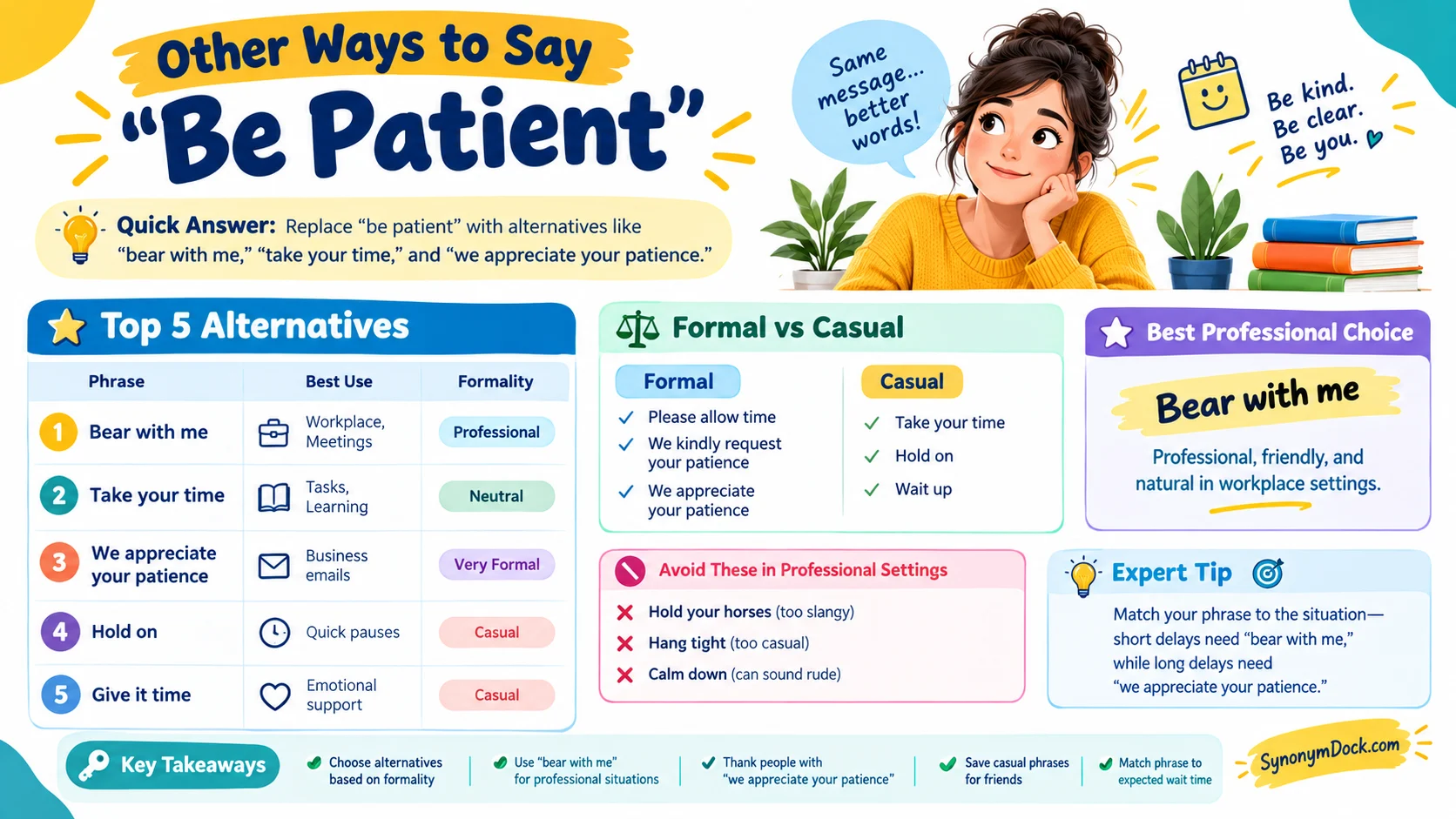
Looking for other ways to say “be patient”? Common alternatives include “bear with me,” “hold on,” “take your time,” “wait a moment,” and “give it time.” The best choice depends on the situation formal settings call for phrases like “please allow time” while casual conversations work better with “hang tight.”
Top 5 Alternatives:
Bear with me, Hold on, Take your time, Wait a moment, Give it time
Patience is a virtue but repeating the same phrase over and over makes you sound like a broken record. Whether you’re managing a busy project, teaching a class, or waiting for important news, knowing other ways to say “be patient” helps you communicate more naturally and professionally.
The phrase “be patient” works perfectly in many situations, but English speakers rarely use it repeatedly. They mix in alternatives that match the tone of the conversation, the formality of the setting, and their relationship with the listener. Learning these alternatives to “be patient” transforms how you sound in both spoken and professional English.
This guide gives you 15 practical alternatives to “be patient” organized by formality and context. You’ll learn exactly when to use each phrase, which ones to avoid in professional settings, and how native speakers choose between them in real conversations. By the end, you’ll feel confident selecting the perfect phrase for any situation.
QUICK CATEGORIES
Formal Alternatives
- Please allow time
- Kindly await
- Please exercise patience
- We respectfully request your patience
- We appreciate your patience
Pro Tip
Use formal alternatives when writing to clients, senior leaders, or external stakeholders. These phrases demonstrate respect and professionalism while maintaining a polished tone.
Professional Alternatives
- Bear with me
- Thank you for your patience
- We kindly ask for your patience
- Please hold on
- Your patience is greatly appreciated
Pro Tip
Professional alternatives work well in workplace emails, team meetings, and client communications. They balance politeness with efficiency showing respect without sounding overly formal.
Business Email Alternatives
- We appreciate your patience
- Thank you for bearing with us
- Please allow us some time
- We kindly request your patience
- We thank you for your patience
Pro Tip
Business emails require phrases that acknowledge the reader’s time while gently requesting more. These alternatives maintain positive client relationships even when delays happen.
Academic Alternatives
- Requires time
- Demands patience
- Necessitates waiting
- Requires careful consideration
- Takes time to develop
Pro Tip
Academic writing benefits from neutral, objective language. These alternatives work well in research papers, academic essays, and scholarly discussions where emotional language is inappropriate.
Casual Alternatives
- Take your time
- Wait up
- Hold your horses
- Patience is a virtue
- Just wait and see
Pro Tip
Casual alternatives suit conversations with friends, family, and close colleagues. They’re warm and friendly but should never appear in formal business correspondence.
Informal Expressions
- Hold on a minute
- Hang tight
- Take a minute
- Give me a moment
- Calm down
Pro Tip
Informal expressions work best in spoken English with people you know well. Use them carefully in professional settings they can sound disrespectful when used with superiors or clients.
“Good communicators don’t just know more words they know which words fit the moment.”
WHAT DOES “BE PATIENT” MEAN?
Definition: To remain calm and not become annoyed when waiting for something or dealing with delays.
Grammar Explanation: “Be patient” is an imperative sentence (a command or request) using the base form of the verb “to be” followed by the adjective “patient.”
Simple Explanation: It’s a gentle way of asking someone to wait without getting frustrated. When you tell someone to “be patient,” you’re acknowledging that waiting isn’t easy while requesting they stay calm.
Example Sentence:
“Please be patient while we resolve this technical issue.”
WHEN TO USE “BE PATIENT”
Common Situations
- Business: Asking clients to wait for project deliverables
- Academic: Encouraging students during complex tasks
- Emails: Requesting patience during delays or processing times
- Meetings: Managing expectations during lengthy discussions
- Daily Conversation: Comforting someone who’s feeling impatient
- Spoken English: Calming someone down in real-time
- Written English: Professional correspondence and official communications
- Formal Settings: Official announcements, public notices
- Informal Settings: Encouraging friends during difficult situations
IS IT PROFESSIONAL OR POLITE?
Polite? ✔ Yes “Be patient” is inherently polite and considerate.
Professional? ✔ Yes It’s appropriate in most professional contexts.
Formal? ⚠ Sometimes It’s neutral, neither extremely formal nor casual.
Natural? ✔ Yes Native speakers use it regularly.
Business-Style Example:
“We kindly ask that you be patient as we process your application.”
Simple Explanation:
“Be patient” strikes the perfect balance polite enough for client emails, natural enough for daily conversation. It’s a safe choice in any situation where you need to request patience without sounding too formal or too casual.
PROS AND CONS
Pros
- Easy to understand
- Universally polite
- Direct and clear
- Appropriate in most contexts
- Native speakers use it regularly
- Neutral enough for any situation
Cons
- Can sound repetitive or boring
- Lacks personality and warmth
- May feel abrupt in casual conversation
- Not ideal in creative or engaging writing
- Can sound like a command rather than a request
- Overused in professional communication
COMMON MISTAKES
Mistake 1: Confusing “patient” with “patience”
- Why it’s incorrect: They’re different parts of speech
- Correct version: “Be patient” (adjective) vs “Have patience” (noun)
- Example: “Please be patient with the new system.”
Mistake 2: Using “patient” to describe objects
- Why it’s incorrect: Only people can be patient
- Correct version: “This process requires patience”
- Example: “The computer needs time to load” (not “The computer is patient”)
Mistake 3: Overusing the exact phrase
- Why it’s incorrect: Repetition makes you sound monotonous
- Correct version: Mix in alternatives
- Example: “Bear with me a moment” instead of “Be patient”
Mistake 4: Forgetting cultural context
- Why it’s incorrect: Some cultures value directness differently
- Correct version: Adjust formality to your audience
- Example: Use “please allow time” with Japanese business partners
Mistake 5: Using it as a scolding phrase
- Why it’s incorrect: It can sound condescending
- Correct version: Make it a request, not a command
- Example: “Thank you for your patience” sounds better than “Be patient!”
“The words you choose shape how people feel about waiting.”
TRANSITION TO THE MAIN LIST
Now that you understand the basics of “be patient,” it’s time to expand your vocabulary with alternatives that make you sound more natural and professional. Here’s what you’ll learn:
- Better vocabulary that replaces repetitive phrases
- Professional communication skills for workplace settings
- Fluent English that matches native speaker patterns
- Tone differences so you choose the right phrase every time
Let’s explore the best alternatives organized by situation and formality.
EXPERT TIP BOX
Expert Tip:
Native English speakers don’t just choose alternatives to “be patient” randomly. They consider three factors: the urgency of the situation (immediate vs long-term), their relationship with the listener (stranger, colleague, friend), and the medium (spoken, email, written). Master these three dimensions, and you’ll always choose the right phrase.
Other Ways to Say “Be Patient” (With Examples)
These 15 alternatives to “be patient” cover every situation from formal business emails to casual conversations with friends. Each alternative includes the meaning, best use, tone, and formality level so you can choose confidently.
[1]. Phrase: Bear With Me
Meaning: A polite request asking someone to wait or be patient while you complete something.
Explanation: “Bear with me” is one of the most common alternatives to “be patient” in both spoken and written English. Native speakers use it constantly in meetings, emails, and customer service interactions. It’s friendly, professional, and sounds more natural than the more direct “be patient.”
Example Sentence:
“Bear with me while I pull up the quarterly sales figures.”
Best Use: Workplace meetings, customer service calls, presentations
Avoid Using In: Formal legal documents, official academic papers
Tone: Professional, Friendly, Warm
Formality Level: ⭐⭐⭐⭐ Formal
Usage Frequency: Very Common
CEFR Level: B2
Common Collocations:
- bear with me a moment
- bear with us
- please bear with me
- bear with me while
- kindly bear with me
Context Variability:
- Spoken English: “Bear with me I’m just checking the details.”
- Professional English: “Please bear with us during this transition period.”
- Casual Conversation: “Bear with me, I’m new to this!”
[2]. Phrase: Hold On
Meaning: A request to wait briefly, usually for a short period.
Explanation: “Hold on” is informal but widely used in everyday English. It’s perfect for quick pauses thinking of a word, checking something quickly, or briefly stopping a conversation. Native speakers use it constantly in spoken English but rarely in professional writing.
Example Sentence:
“Hold on I need to grab my notes before we continue.”
Best Use: Phone calls, quick pauses, informal meetings
Avoid Using In: Professional emails, client correspondence
Tone: Casual, Direct, Friendly
Formality Level: ⭐⭐ Casual
Usage Frequency: Very Common
CEFR Level: B1
Common Collocations:
- hold on a second
- hold on a minute
- hold on just a moment
- hold on tight
- hold on there
Context Variability:
- Spoken English: “Hold on, I’ll be right back.”
- Professional English: Rarely used too casual
- Casual Conversation: “Hold on, that’s not what I meant.”
[3]. Phrase: Take Your Time
Meaning: Encouraging someone to proceed at their own pace without feeling rushed.
Explanation: “Take your time” is actually a gentle reassurance rather than a direct request for patience. You’re telling someone they don’t need to hurry which paradoxically, often speeds things up because people feel less pressured. It’s warm, kind, and widely used in both professional and casual settings.
Example Sentence:
“Take your time with the report accuracy matters more than speed.”
Best Use: Task assignments, learning environments, supportive conversations
Avoid Using In: Urgent situations, emergency contexts
Tone: Warm, Supportive, Encouraging
Formality Level: ⭐⭐⭐ Neutral
Usage Frequency: Very Common
CEFR Level: B1
Common Collocations:
- take your time with it
- take your time and do it right
- no rush, take your time
- take your time to decide
- take all the time you need
Context Variability:
- Spoken English: “Take your time, there’s no rush.”
- Professional English: “Take your time reviewing the contract.”
- Casual Conversation: “Take your time getting ready we’re not in a hurry.”
[4]. Phrase: Wait a Moment
Meaning: A neutral request for a short pause or brief delay.
Explanation: “Wait a moment” is straightforward and clear it tells someone you need them to pause briefly. It’s more neutral than “hold on” and more natural than “be patient” in many contexts. Native speakers use it frequently in service settings and daily interactions.
Example Sentence:
“Wait a moment while I confirm the appointment time.”
Best Use: In-person service, phone calls, quick checks
Avoid Using In: Formal written correspondence
Tone: Neutral, Direct, Clear
Formality Level: ⭐⭐⭐ Neutral
Usage Frequency: Common
CEFR Level: B1
Common Collocations:
- wait a moment please
- just wait a moment
- wait a moment while
- wait one moment
- wait a moment for me
Context Variability:
- Spoken English: “Wait a moment I forgot my keys.”
- Professional English: “Wait a moment while I connect you.”
- Casual Conversation: “Wait a moment, I have something to show you.”
“Great communicators know that a slightly different phrase can completely change the tone of a conversation.”
[5]. Phrase: Give It Time
Meaning: Advising someone that a process or situation requires time to develop or resolve.
Explanation: “Give it time” is excellent when you’re comforting someone who’s impatient about progress. It acknowledges that patience is needed while offering a gentle reminder that some things can’t be rushed like healing, skill development, or complex projects.
Example Sentence:
“Learning a new language takes patience give it time and you’ll improve.”
Best Use: Emotional support, skill development, long-term projects
Avoid Using In: Urgent business situations, time-sensitive matters
Tone: Supportive, Comforting, Gentle
Formality Level: ⭐⭐ Casual
Usage Frequency: Common
CEFR Level: B1
Common Collocations:
- give it time and see
- give it time to heal
- give it time to develop
- give it some time
- just give it time
Context Variability:
- Spoken English: “Give it time you’ll get better with practice.”
- Professional English: “Give it time the new system will improve efficiency.”
- Casual Conversation: “Give it time, things will work out.”
[6]. Phrase: We Appreciate Your Patience
Meaning: A polite, formal way of thanking someone for waiting while acknowledging their patience.
Explanation: This is one of the most professional alternatives to “be patient.” Instead of directly asking for patience, you’re thanking someone in advance for being patient. It’s standard in customer service, business communications, and any situation where you’re managing expectations.
Example Sentence:
“We appreciate your patience as we upgrade our booking system.”
Best Use: Customer service, business emails, formal announcements
Avoid Using In: Casual conversations, text messages
Tone: Professional, Polite, Formal
Formality Level: ⭐⭐⭐⭐⭐ Very Formal
Usage Frequency: Very Common
CEFR Level: B2
Common Collocations:
- we appreciate your patience and understanding
- we appreciate your patience during this time
- thank you for your patience
- we greatly appreciate your patience
- your patience is appreciated
Context Variability:
- Spoken English: Used in announcements and service settings
- Professional English: “We appreciate your patience as we resolve this issue.”
- Casual Conversation: Too formal not typically used
[7]. Phrase: Please Allow Time
Meaning: A formal request acknowledging that a process or task requires sufficient time.
Explanation: This phrase works perfectly in formal writing and professional communications. Instead of telling someone “be patient,” you’re stating objectively that time is needed. It removes the personal element and focuses on the process which often sounds more professional.
Example Sentence:
“Please allow time for the application to be processed.”
Best Use: Formal correspondence, official communications, legal matters
Avoid Using In: Casual conversation, verbal instructions
Tone: Formal, Objective, Professional
Formality Level: ⭐⭐⭐⭐⭐ Very Formal
Usage Frequency: Common
CEFR Level: B2
Common Collocations:
- please allow time for processing
- please allow time for delivery
- please allow sufficient time
- please allow time to review
- please allow extra time
Context Variability:
- Spoken English: Too formal for most spoken contexts
- Professional English: “Please allow time for the review process.”
- Casual Conversation: Rarely used
[8]. Phrase: Just Wait and See
Meaning: Encouraging someone to be patient by suggesting the outcome will be positive or interesting.
Explanation: This friendly phrase turns waiting into something exciting. Native speakers use it when they want to build anticipation or calm someone who’s eager for results. It’s common in casual conversation but should be avoided in formal business contexts.
Example Sentence:
“Just wait and see the results will surprise you.”
Best Use: Motivational conversations, teaser announcements, casual encouragement
Avoid Using In: Professional correspondence, formal meetings
Tone: Exciting, Informal, Encouraging
Formality Level: ⭐⭐ Casual
Usage Frequency: Common
CEFR Level: B1
Common Collocations:
- just wait and see what happens
- wait and see for yourself
- just wait and see the results
- wait and see if it works
- wait and see how it turns out
Context Variability:
- Spoken English: “Just wait and see it’ll be amazing!”
- Professional English: Too casual for most professional settings
- Casual Conversation: “Just wait and see how good the food is.”
[9]. Phrase: Kindly Await
Meaning: A very formal request asking someone to wait with respect and courtesy.
Explanation: “Kindly await” is rarely used in modern English it sounds quite old-fashioned and overly formal. You’ll mainly find it in extremely formal correspondence, government communications, or traditional business letters. For most modern professional contexts, “please await” or “we appreciate your patience” sound more natural.
Example Sentence:
“Kindly await further instructions from our legal department.”
Best Use: Extremely formal correspondence, government communications
Avoid Using In: Modern business emails, daily conversation
Tone: Very Formal, Traditional, Old-Fashioned
Formality Level: ⭐⭐⭐⭐⭐ Very Formal
Usage Frequency: Rare
CEFR Level: C1
Common Collocations:
- kindly await further instructions
- kindly await our response
- kindly await the outcome
- kindly await confirmation
- kindly await notification
Context Variability:
- Spoken English: Rarely used
- Professional English: “Kindly await the committee’s decision.”
- Casual Conversation: Never used
[10]. Phrase: Hold Your Horses
Meaning: An idiomatic, informal way of telling someone to slow down and be patient.
Explanation: “Hold your horses” is a colorful idiom native speakers use when someone is rushing or acting impatiently. It’s playful and friendly not at all serious. Use it with friends, family, or close colleagues, but keep it out of professional emails and formal communications.
Example Sentence:
“Hold your horses we haven’t even started yet!”
Best Use: Casual conversations, friendly warnings, playful situations
Avoid Using In: Professional communication, business meetings, client interactions
Tone: Playful, Informal, Idiomatic
Formality Level: ⭐ Very Casual
Usage Frequency: Occasional
CEFR Level: B2 (idiom)
Common Collocations:
- hold your horses there
- hold your horses a minute
- hold your horses, we’re not ready
- hold your horses and wait
- just hold your horses
Context Variability:
- Spoken English: “Hold your horses I’m coming!”
- Professional English: Never used
- Casual Conversation: “Hold your horses, let me finish first.”
“Native speakers rarely say ‘be patient’ directly they choose expressions that feel more natural and less commanding.”
EXPERT INSIGHT
In workplace communication, the difference between a good alternative and a great one often comes down to whether you’re asking for patience preemptively or responding after a delay. Proactive phrases like “please allow time” work best in project planning and advance notice. Reactive phrases like “we appreciate your patience” are better when you’ve already caused a delay. Understanding this subtle difference makes your professional communication much more effective.
[11]. Phrase: We Kindly Ask for Your Patience
Meaning: A formal, respectful request for patience in business or customer service contexts.
Explanation: This phrase is a slightly more formal version of “we appreciate your patience.” Instead of thanking, you’re asking which can sound humbler and more respectful. It’s standard in professional communications where you need to request patience from clients or stakeholders.
Example Sentence:
“We kindly ask for your patience as we finalize the contract details.”
Best Use: Client communications, formal business letters, stakeholder updates
Avoid Using In: Casual conversation, personal emails
Tone: Formal, Respectful, Professional
Formality Level: ⭐⭐⭐⭐ Formal
Usage Frequency: Common
CEFR Level: B2
Common Collocations:
- we kindly ask for your patience and understanding
- we kindly ask for your patience during this transition
- we kindly ask for your patience while we resolve this
- we kindly ask for your patience and cooperation
- we kindly ask for your patience at this time
Context Variability:
- Spoken English: Used in public announcements
- Professional English: “We kindly ask for your patience as we upgrade our systems.”
- Casual Conversation: Not used
[12]. Phrase: Take a Minute
Meaning: A casual request for a brief pause or short delay.
Explanation: “Take a minute” is less formal than “wait a moment” and feels more like permission than a request. Native speakers use it when they need someone to pause briefly but don’t want to sound demanding. It works well in both spoken English and casual written communication.
Example Sentence:
“Take a minute to review the document before you sign.”
Best Use: Casual workplace settings, informal instructions, friendly requests
Avoid Using In: Formal business correspondence, official communications
Tone: Casual, Friendly, Permissive
Formality Level: ⭐⭐ Casual
Usage Frequency: Common
CEFR Level: B1
Common Collocations:
- take a minute to think
- take a minute and relax
- take a minute to consider
- take a minute for yourself
- take a minute to breathe
Context Variability:
- Spoken English: “Take a minute you’ll figure it out.”
- Professional English: “Take a minute to review the proposal.”
- Casual Conversation: “Take a minute, we’re not in a rush.”
[13]. Phrase: Your Patience Is Greatly Appreciated
Meaning: A very formal, gracious way of thanking someone for being patient.
Explanation: This phrase elevates “we appreciate your patience” to the highest level of formality. Adding “greatly” makes it warmer and more gracious while maintaining professional distance. Use it in formal thank-you letters, client communications, and official acknowledgments.
Example Sentence:
“Your patience is greatly appreciated while we investigate this matter.”
Best Use: Formal thank-you letters, client communications, official correspondence
Avoid Using In: Casual conversations, informal emails
Tone: Very Formal, Gracious, Appreciative
Formality Level: ⭐⭐⭐⭐⭐ Very Formal
Usage Frequency: Common
CEFR Level: B2
Common Collocations:
- your patience is greatly appreciated
- your patience and understanding are greatly appreciated
- your patience is truly appreciated
- your patience is appreciated more than you know
- your continued patience is appreciated
Context Variability:
- Spoken English: Formal announcements only
- Professional English: “Your patience is greatly appreciated during this transition.”
- Casual Conversation: Too formal
[14]. Phrase: Hang Tight
Meaning: A very casual way of asking someone to wait or stay where they are.
Explanation: “Hang tight” is American slang that means “wait” or “stay in place.” It’s friendly and informal perfect for text messages, casual conversations, and group chats. Native speakers often use it when they need someone to wait for a short time while they handle something.
Example Sentence:
“Hang tight I’ll text you when we’re ready to leave.”
Best Use: Text messages, casual conversations, group chats
Avoid Using In: Professional emails, business meetings, client communication
Tone: Very Casual, Slang, Friendly
Formality Level: ⭐ Very Casual
Usage Frequency: Common
CEFR Level: B2
Common Collocations:
- hang tight for a minute
- hang tight and wait
- just hang tight
- hang tight, I’ll be right back
- hang tight for the update
Context Variability:
- Spoken English: “Hang tight I’ll be back in five minutes.”
- Professional English: Rarely used too casual
- Casual Conversation: “Hang tight, we’ll figure it out.”
[15]. Phrase: Wait Up
Meaning: A casual way of asking someone to pause or slow down so you can catch up.
Explanation: “Wait up” is informal and friendly you’re asking someone to wait for you, often literally. Native speakers use it when someone is walking ahead, talking too fast, or moving through a process too quickly. It’s never appropriate in professional writing but works great with friends.
Example Sentence:
“Wait up you’re walking too fast for me!”
Best Use: Physical situations, casual conversations, friendly contexts
Avoid Using In: Professional communication, formal writing
Tone: Casual, Friendly, Direct
Formality Level: ⭐ Very Casual
Usage Frequency: Common
CEFR Level: B1
Common Collocations:
- wait up for me
- wait up a second
- wait up, I’m coming
- wait up, you’re going too fast
- wait up and let me catch my breath
Context Variability:
- Spoken English: “Wait up I need to tie my shoe.”
- Professional English: Never used
- Casual Conversation: “Wait up, what did you just say?”
“Knowing alternatives is one thing knowing when to use them is what makes you fluent.”
NATIVE SPEAKER TIP
Here’s what native speakers actually say:
“Bear with me” is by far the most common alternative in professional situations. It sounds natural, friendly, and professional simultaneously. In everyday conversation, “hold on” and “take your time” dominate. “We appreciate your patience” is the standard for business emails and customer service.
“Kindly await” and “please exercise patience” sound very old-fashioned. Native speakers almost never use them in modern English. If you want to sound current, avoid these phrases entirely.
COMPARISON SECTION
Top 10 Alternatives Compared
| Phrase | Tone | Formality | Best Use | Frequency |
| Bear with me | Professional, Friendly | ⭐⭐⭐⭐ | Workplace, Meetings | Very Common |
| Hold on | Direct, Casual | ⭐⭐ | Phone, Quick Pauses | Very Common |
| Take your time | Warm, Supportive | ⭐⭐⭐ | Task assignments | Very Common |
| Wait a moment | Neutral, Clear | ⭐⭐⭐ | Service, Daily use | Common |
| Give it time | Supportive, Gentle | ⭐⭐ | Emotional support | Common |
| We appreciate your patience | Polite, Formal | ⭐⭐⭐⭐⭐ | Business emails | Very Common |
| Please allow time | Formal, Objective | ⭐⭐⭐⭐⭐ | Official comms | Common |
| Just wait and see | Exciting, Informal | ⭐⭐ | Motivational | Common |
| Kindly await | Very Formal, Old | ⭐⭐⭐⭐⭐ | Extremely formal | Rare |
| We kindly ask for your patience | Formal, Respectful | ⭐⭐⭐⭐ | Client comms | Common |
EXPERT INSIGHT
The most effective professional communicators don’t just rotate through alternatives randomly. They match the phrase to the situation’s urgency. For short delays, “bear with me” works perfectly. For longer delays, “we appreciate your patience” builds goodwill. For indefinite waiting, “please allow time” is safe and professional. Match the phrase to the expected wait time, and you’ll always sound appropriate.
AVOID THESE EXPRESSIONS IN FORMAL SITUATIONS
1. Hold your horses
- Why avoid: It’s an idiom too casual and slangy
- Better alternative: “Please hold on” or “Bear with me”
2. Hang tight
- Why avoid: Slang unprofessional in formal settings
- Better alternative: “Please wait” or “We appreciate your patience”
3. Wait up
- Why avoid: Too casual and physical
- Better alternative: “Please wait a moment” or “Bear with us”
4. Just wait and see
- Why avoid: Sounds flippant not serious enough
- Better alternative: “Please allow time for results” or “Give it time”
5. Calm down
- Why avoid: Can sound condescending and rude
- Better alternative: “Take your time” or “We appreciate your patience”
BEST PHRASES BY SITUATION
| Situation | Best Phrase |
| Business Email | We appreciate your patience |
| Client Meeting | Bear with me |
| Academic Essay | Requires time |
| Presentation | Bear with me |
| Workplace Discussion | Thank you for your patience |
| Job Interview | I appreciate your patience |
| Team Collaboration | Bear with us |
| Everyday Conversation | Take your time |
WHICH ONE SHOULD YOU USE?
Best Overall: Bear with me
The perfect balance of professional and friendly works in almost any situation.
Best Professional: We appreciate your patience
Standard in business emails and client communications.
Best Academic: Please allow time
Neutral, objective, and appropriate for scholarly writing.
Best Business Email: We kindly ask for your patience
Polite and humble great for client relationships.
Best Everyday Conversation: Take your time
Warm, supportive, and encourages relaxed communication.
Most Natural: Bear with me
What native speakers actually use most often.
Most Polite: We appreciate your patience
Thanking rather than asking comes across as more gracious.
COMMONLY CONFUSED PHRASES
“Be patient” vs “Have patience”
“Be patient” is an instruction to stay calm (adjective). Example: “Please be patient with the new system.”
“Have patience” is a suggestion to possess patience (noun). Example: “Have patience good things take time.”
Both are correct and native speakers use both. “Be patient” is slightly more common in spoken English. “Have patience” sounds a bit more formal or old-fashioned.
“Bear with me” vs “Please hold”
“Bear with me” means “wait while I do something.” It’s common in both spoken and written English. Example: “Bear with me while I find the file.”
“Please hold” is a specific request to stay on the phone. Example: “Please hold while I transfer your call.” It’s almost exclusively used in phone conversations.
“Take your time” vs “Give it time”
Take your time” means “don’t rush” the listener controls the pace. Example: “Take your time answering the questions.”
“Give it time” means “let the situation develop” the listener has no control. Example: “Give it time you’ll feel better soon.”
SCENARIO PRACTICE
Scenario 1: Client meeting where you need to find a document
- Which phrase would you choose? “Bear with me while I locate that file.”
- Why? It’s professional, acknowledges the client’s time, and sounds natural.
Scenario 2: Friend who’s frustrated with slow progress
- Which phrase would you choose? “Give it time you’re doing great.”
- Why? It’s supportive and acknowledges their effort while gently requesting patience.
Scenario 3: Formal email to a senior stakeholder
- Which phrase would you choose? “We appreciate your patience as we complete this review.”
- Why? Formal, respectful, and acknowledges the stakeholder’s importance.
Scenario 4: Teacher helping a struggling student
- Which phrase would you choose? “Take your time there’s no rush to finish.”
- Why? Encouraging and removes pressure while maintaining warmth.
Scenario 5: Customer service announcement
- Which phrase would you choose? “We kindly ask for your patience while we resolve this issue.”
- Why? Formal, respectful, and builds goodwill with customers.
MINI QUIZ
1. Which phrase is most appropriate for a formal business email?
- A. Hang tight
- B. We appreciate your patience
- C. Hold your horses
- D. Wait up
2. What does “bear with me” mean?
- A. Be patient with a bear
- B. Wait while I do something
- C. Please leave
- D. Hurry up
3. Which phrase means “don’t rush proceed at your own pace”?
- A. Hold on
- B. Kindly await
- C. Take your time
- D. Wait up
4. Which alternative is best for encouraging someone who’s impatient about results?
- A. Calm down
- B. Give it time
- C. Wait up
- D. Kindly await
5. Which phrase is slang and should never be used in formal writing?
- A. Please allow time
- B. We appreciate your patience
- C. Hang tight
- D. Bear with me
Answer Key
1. B “We appreciate your patience” is the most formal and professional option.
2. B “Bear with me” asks someone to wait while you complete something.
3. C “Take your time” encourages someone to proceed at their own pace.
4. B “Give it time” suggests results will come with patience and is supportive.
5. C “Hang tight” is slang and too casual for professional writing.
FAQ SECTION
What is the most formal way to say “be patient”?
The most formal way to say “be patient” is “please allow time” or “we kindly request your patience.” These phrases appear in official correspondence, legal documents, and formal business communications. They avoid direct commands and sound more gracious and professional.
Which phrase is best for professional emails?
“We appreciate your patience” is the best choice for professional emails. It thanks the reader for their patience while gently requesting more time. This phrase builds goodwill, sounds professional, and maintains a positive relationship with clients, colleagues, and stakeholders.
What is the difference between “bear with me” and “be patient”?
“Bear with me” is a polite request asking someone to wait while you do something. It’s less direct than “be patient” and sounds more friendly and natural. “Be patient” is a more direct instruction that can sometimes sound like a command. Native speakers prefer “bear with me” in most professional situations.
Which alternative sounds most natural?
“Bear with me” sounds most natural to native English speakers in professional situations. For everyday conversation, “take your time” and “hold on” are very common. The most natural choice depends on the situation, but “bear with me” works well across many contexts and relationships.
Can I use these expressions in business meetings?
Yes, many alternatives work well in business meetings. “Bear with me” is perfect when you need to find documents or check information. “We appreciate your patience” works when delays occur. Avoid casual phrases like “hang tight” or “hold your horses” in formal business settings.
CONCLUSION
Expanding your vocabulary around common phrases like “be patient” is one of the fastest ways to sound more fluent and professional in English. The 15 alternatives in this guide give you the flexibility to match your language to any situation from formal business emails to casual conversations with friends.
Start practicing these phrases in your daily communication. Try using “bear with me” in your next meeting, “we appreciate your patience” in your next email, and “take your time” with friends and family. The more you use these alternatives, the more natural they’ll become. With consistent practice, you’ll never need to repeat “be patient” again!

14 thoughts on “Other Ways to Say “Be Patient” |19+ Professional & Alternatives”