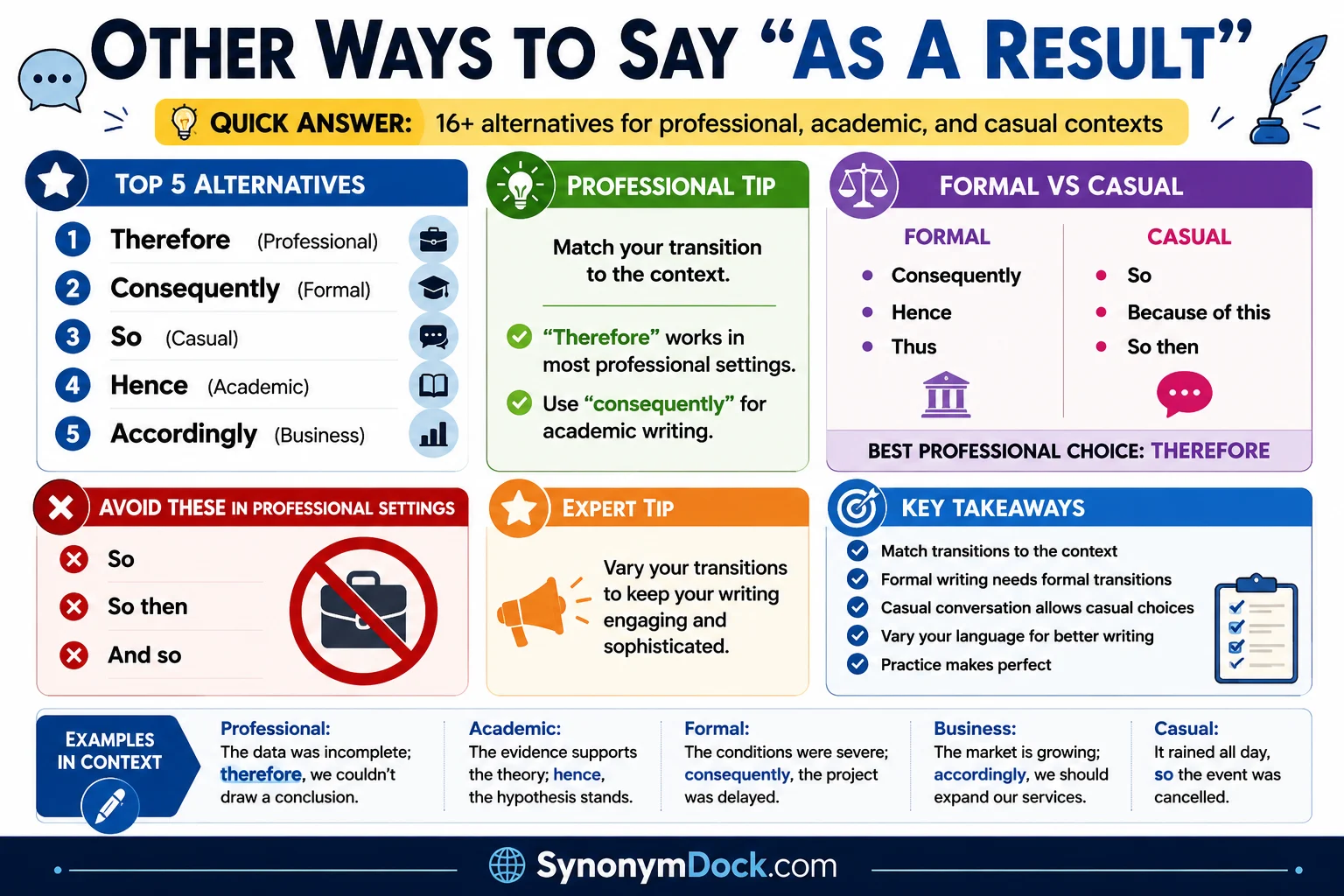
Looking for other ways to say “as a result“? Try “consequently” for formal writing, “therefore” for professional contexts, “hence” for academic work, “thus” for essays, or “so” for casual conversation. The best alternatives include: consequently, therefore, hence, thus, so, accordingly, for this reason, as a consequence, in turn, and because of this.
“As a result” is a useful transitional phrase. It helps connect causes to effects and shows logical relationships. But using it too often makes your writing sound repetitive and basic.
Whether you’re writing a business report, an academic essay, or a simple email, having other ways to say “as a result” helps you sound more sophisticated and fluent. The right phrase can elevate your writing from simple to impressive. This article explores 15+ powerful alternatives to “as a result” organized by tone and situation, so you can choose the perfect expression with confidence.
Quick Categories
Formal Alternatives
- Consequently
- Hence
- Thus
- Accordingly
- For this reason
Pro Tip: Use formal alternatives in academic writing, legal documents, and official correspondence. They sound sophisticated and precise.
Professional Alternatives
- Therefore
- As a consequence
- For that reason
- In consequence
- Subsequently
Pro Tip: Professional alternatives work well in business reports, presentations, and workplace communication. They show your command of professional English.
Business Email Alternatives
- Accordingly
- As a result of this
- In light of this
- Given this
- Following this
Pro Tip: These phrases are perfect for explaining decisions, actions, or changes in professional correspondence.
Academic Alternatives
- Consequently
- Hence
- Thus
- Ergo
- In turn
Pro Tip: Academic alternatives strengthen your essays and research papers by adding variety and sophistication to your causal relationships.
Casual Alternatives
- So
- Because of this
- That’s why
- This is why
- As a result of that
Pro Tip: Casual alternatives work well in everyday conversation and informal writing. They sound natural and native-like.
Informal Expressions
- So then
- And so
- Which means
- Hence why
- That’s how
Pro Tip: Use informal expressions with friends, family, and in text messages. Avoid them in professional or academic writing.
“Good writers connect ideas smoothly without repeating the same transitions.”
What Does “As a Result” Mean?
“As a result” is a transitional phrase used to show the consequence or outcome of an action, event, or situation. It indicates a cause-and-effect relationship between two ideas.
Example: “She studied hard. As a result, she passed the exam with excellent grades.”
Grammar: “As a result” is an adverbial phrase. It typically appears at the beginning of a sentence, followed by a comma, or in the middle of a sentence between the cause and effect.
Is It Professional or Polite?
“As a result” is both professional and polite. However, overusing it can make your writing feel mechanical.
Polite? ✅ Yes
Professional? ✅ Yes, but variety matters
Formal? ✅ Yes
Natural? ✅ Yes
Example: “Sales increased. As a result, we hired more staff.” For a formal report, consider “Consequently, we hired more staff.”
Common Mistakes
Mistake #1: Using “As a Result” Without a Clear Cause
Why it’s incorrect: “As a result” must connect to a specific cause. Without it, the sentence is confusing.
Correct version: Ensure the cause is clearly stated.
Example: “The economy improved. As a result, unemployment fell.” (Clear cause)
Mistake #2: Confusing “As a Result” with “As a Result Of”
Why it’s incorrect: “As a result” starts a sentence, while “as a result of” connects the cause directly.
Correct version: Use the correct structure.
Example: “As a result of the rain, the game was canceled.”
Mistake #3: Overusing “As a Result” in Formal Writing
Why it’s incorrect: Repetitive use makes your writing sound basic and unpolished.
Correct version: Vary your transitions with alternatives.
Example: “Consequently, we revised our strategy. Therefore, we achieved better outcomes.”
Mistake #4: Using “Hence” Incorrectly
Why it’s incorrect: “Hence” can mean “as a result” or “from this time.” Using it incorrectly can confuse readers.
Correct version: Use “hence” for cause-effect relationships, not time.
Example: “He lacked experience; hence, he wasn’t hired.” (Correct)
Mistake #5: Using “So” in Formal Writing
Why it’s incorrect: “So” is too casual for formal business or academic writing.
Correct version: Use “therefore” or “consequently” instead.
Example: “The deadline changed; therefore, we adjusted our schedule.”
When to Use “As a Result”
Common Situations:
- Explaining cause and effect
- Connecting ideas in writing
- Transitioning between paragraphs
- Showing logical conclusions
- Summarizing results
Business:
- Reports
- Meeting minutes
- Project updates
- Strategy documents
- Performance reviews
Academic:
- Essays
- Research papers
- Theses
- Scientific reports
- Academic presentations
Everyday:
- Explaining events
- Telling stories
- Casual conversation
- Text messages
- Social media posts
Written English:
- Formal letters
- Reports
- Emails
- Articles
- Books
“The best writers connect their ideas seamlessly with varied transitional phrases.”
Pros and Cons of “As a Result”
Pros
- Clear and easy to understand
- Works in most contexts
- Professional enough for business
- Academic enough for essays
Cons
- Overused and repetitive
- Can feel wordy
- Limited variety
- Doesn’t show sophisticated vocabulary
15 Other Ways to Say “As a Result”
[1]. Consequently
Meaning: A formal phrase meaning “as a result” or “therefore.”
Explanation: “Consequently” is one of the most professional and formal alternatives. Native speakers use it in academic writing, business reports, and formal speeches. It sounds sophisticated and precise. It’s perfect for showing a logical chain of events.
Example Sentence: “The company invested heavily in research. Consequently, they developed several innovative products.”
Best Use: Academic Writing, Business Reports, Formal Speeches
Avoid Using In: Casual Conversation
Tone: Formal, Logical
Formality Level: ⭐⭐⭐⭐⭐ Very Formal
Usage Frequency: Common
CEFR Level: B2
Common Collocations:
- consequently, we decided
- consequently, there was
- consequently, the results show
- consequently, it became
- consequently, they were
Context Variability:
- Academic English: “The sample was contaminated. Consequently, the results were invalid.”
- Professional English: “Sales declined. Consequently, we reduced production.”
[2]. Therefore
Meaning: A formal phrase meaning “as a result” or “for that reason.”
Explanation: “Therefore” is a classic, formal alternative. Native speakers use it constantly in professional and academic writing. It sounds polished and authoritative. It’s excellent for business reports, academic essays, and professional presentations.
Example Sentence: “The project exceeded its budget. Therefore, we need additional funding.”
Best Use: Business Reports, Academic Writing, Professional Presentations
Avoid Using In: Casual Conversation
Tone: Formal, Logical
Formality Level: ⭐⭐⭐⭐ Formal
Usage Frequency: Very Common
CEFR Level: B2
Common Collocations:
- therefore, we must
- therefore, it is
- therefore, they decided
- therefore, the conclusion is
- therefore, we recommend
Context Variability:
- Written English: “The evidence is clear. Therefore, we must act.”
- Professional English: “The budget was approved. Therefore, we can proceed.”
[3]. Hence
Meaning: A formal, slightly old-fashioned phrase meaning “as a result.”
Explanation: “Hence” is a sophisticated alternative. Native speakers use it in formal writing and academic contexts. It sounds elegant but can feel a bit old-fashioned in everyday conversation. It’s excellent for essays, articles, and formal documents.
Example Sentence: “She forgot to bring her ID. Hence, she couldn’t enter the building.”
Best Use: Academic Writing, Formal Essays, Literature
Avoid Using In: Casual Conversation
Tone: Formal, Sophisticated
Formality Level: ⭐⭐⭐⭐⭐ Very Formal
Usage Frequency: Common (Formal Contexts)
CEFR Level: B2
Common Collocations:
- hence, the need for
- hence, it follows
- hence, the conclusion
- hence, we can see
- hence, the reason
Context Variability:
- Academic English: “The theory is flawed. Hence, it cannot be accepted.”
- Written English: “He was unwell. Hence, he didn’t attend.”
[4]. Thus
Meaning: A formal phrase meaning “as a result” or “in this way.”
Explanation: “Thus” is very similar to “hence” but slightly less old-fashioned. Native speakers use it in academic writing, legal documents, and formal speeches. It sounds careful and precise. It’s perfect for showing logical conclusions.
Example Sentence: “The temperature dropped below freezing. Thus, the roads became icy.”
Best Use: Academic Writing, Formal Reports, Legal Documents
Avoid Using In: Casual Conversation
Tone: Formal, Precise
Formality Level: ⭐⭐⭐⭐⭐ Very Formal
Usage Frequency: Common (Formal Contexts)
CEFR Level: B2
Common Collocations:
- thus, we conclude
- thus, it appears
- thus, the evidence shows
- thus, we can see
- thus, the answer is
Context Variability:
- Academic English: “The data supports the hypothesis. Thus, further research is warranted.”
- Formal Writing: “The contract was breached. Thus, the agreement is void.”
[5]. So
Meaning: A casual, everyday word meaning “as a result.”
Explanation: “So” is the most common and natural alternative in everyday conversation. Native speakers use it constantly. However, it’s too casual for formal writing. Use it with friends, family, and in informal contexts.
Example Sentence: “I was tired, so I went to bed early.”
Best Use: Daily Conversation, Casual Writing, Text Messages
Avoid Using In: Academic Writing, Business Reports
Tone: Casual, Natural
Formality Level: ⭐⭐ Casual
Usage Frequency: Very Common
CEFR Level: A2
Common Collocations:
- so, we decided
- so, I went
- so, they left
- so, we can
- so, here’s the thing
Context Variability:
- Spoken English: “She was hungry, so she made a sandwich.”
- Casual Writing: “It was raining, so we stayed home.”
“Formal writing demands formal transitions. Casual conversations allow casual choices.”
[6]. Accordingly
Meaning: A formal phrase meaning “as a result” or “in a way that is appropriate.”
Explanation: “Accordingly” is a professional, formal alternative. Native speakers use it in business and legal contexts. It suggests that actions were taken because of a situation. It’s perfect for showing that you responded appropriately to circumstances.
Example Sentence: “The weather forecast predicted rain. Accordingly, we postponed the outdoor event.”
Best Use: Business Communication, Legal Documents, Formal Reports
Avoid Using In: Casual Conversation
Tone: Formal, Professional
Formality Level: ⭐⭐⭐⭐ Formal
Usage Frequency: Common (Professional Contexts)
CEFR Level: B2
Common Collocations:
- accordingly, we will
- accordingly, they decided
- accordingly, the policy changed
- accordingly, we recommend
- accordingly, we have
Context Variability:
- Professional English: “The client requested changes. Accordingly, we revised the proposal.”
- Formal Writing: “The situation changed. Accordingly, we adjusted our approach.”
[7]. For This Reason
Meaning: A clear, professional phrase meaning “because of this.”
Explanation: “For this reason” is a straightforward and professional alternative. Native speakers use it in business and academic contexts. It’s explicit and leaves no room for confusion. It works well in presentations, reports, and formal writing.
Example Sentence: “The project was behind schedule. For this reason, we extended the deadline.”
Best Use: Business Presentations, Professional Reports, Formal Writing
Avoid Using In: Casual Conversation
Tone: Professional, Clear
Formality Level: ⭐⭐⭐⭐ Formal
Usage Frequency: Common
CEFR Level: B1
Common Collocations:
- for this reason, we
- for this reason, it is
- for this reason, they
- for this reason, the committee
- for this reason alone
Context Variability:
- Professional English: “The market changed. For this reason, we’ve updated our strategy.”
- Academic English: “The evidence is overwhelming. For this reason, we accept the hypothesis.”
[8]. As a Consequence
Meaning: A formal phrase meaning “as a result” or “therefore.”
Explanation: “As a consequence” is very similar to “as a result.” It’s slightly more formal and often used in serious or negative contexts. Native speakers use it in reports, news, and academic writing. It sounds measured and authoritative.
Example Sentence: “He ignored safety protocols. As a consequence, he was injured.”
Best Use: Formal Reports, News Articles, Academic Writing
Avoid Using In: Casual Conversation
Tone: Formal, Serious
Formality Level: ⭐⭐⭐⭐ Formal
Usage Frequency: Common
CEFR Level: B2
Common Collocations:
- as a consequence, we
- as a consequence, they
- as a consequence, there was
- as a consequence, the company
- as a direct consequence
Context Variability:
- Written English: “The policy changed. As a consequence, many employees left.”
- Formal English: “Emissions increased. As a consequence, air quality declined.”
[9]. In Turn
Meaning: A phrase showing a sequential result or chain of events.
Explanation: “In turn” is excellent for showing chains of cause and effect. Native speakers use it when describing sequences of consequences. It works well in business, academic, and formal writing. It’s particularly useful in complex explanations.
Example Sentence: “The new software improved efficiency, which in turn increased profits.”
Best Use: Business Writing, Academic Essays, Complex Explanations
Avoid Using In: Casual Conversation
Tone: Professional, Sequential
Formality Level: ⭐⭐⭐⭐ Formal
Usage Frequency: Common
CEFR Level: B2
Common Collocations:
- which in turn
- and in turn
- this in turn
- that in turn
- in turn, this led to
Context Variability:
- Professional English: “The marketing campaign raised awareness, which in turn boosted sales.”
- Academic English: “Economic growth increased demand, which in turn drove inflation.”
[10]. Hence
Meaning: A formal, concise way to say “as a result.
Explanation: “Hence” is elegant and succinct. Native speakers use it in academic writing and formal documents. It’s shorter than “as a result” and sounds more sophisticated. However, it can sound old-fashioned in casual contexts.
Example Sentence: “The machine malfunctioned. Hence, production was halted.”
Best Use: Academic Writing, Formal Essays, Legal Documents
Avoid Using In: Casual Conversation
Tone: Formal, Sophisticated
Formality Level: ⭐⭐⭐⭐⭐ Very Formal
Usage Frequency: Common (Formal Contexts)
CEFR Level: B2
Common Collocations:
- hence, we can
- hence, the need
- hence, it follows
- hence, the conclusion
- hence, the result
Context Variability:
- Academic English: “The theory is incomplete. Hence, further study is required.”
- Written English: “He was underqualified. Hence, he wasn’t hired.”
[11]. Because of This
Meaning: A clear, neutral phrase meaning “as a result.”
Explanation: “Because of this” is straightforward and works in many contexts. Native speakers use it in both professional and casual situations. It’s less formal than “consequently” but more formal than “so.” It’s a safe, reliable choice.
Example Sentence: “The company lost its biggest client. Because of this, we need to cut costs.”
Best Use: Professional Communication, Casual Writing, Everyday Use
Avoid Using In: Extremely Formal Documents
Tone: Neutral, Clear
Formality Level: ⭐⭐⭐ Neutral
Usage Frequency: Very Common
CEFR Level: A2
Common Collocations:
- because of this, we
- because of this, they
- because of this, many
- because of this, the team
- because of this situation
Context Variability:
- Spoken English: “The traffic was heavy. Because of this, I was late.”
- Professional English: “The budget was cut. Because of this, we reduced staff.”
[12]. Ergo
Meaning: A very formal, slightly old-fashioned phrase meaning “therefore.”
Explanation: “Ergo” is a Latin-derived word that means “therefore.” It’s very formal and sounds intellectual. Native speakers sometimes use it in academic writing or to sound clever. However, it’s rare in everyday conversation and can sound pretentious.
Example Sentence: “The evidence is conclusive. Ergo, the hypothesis is confirmed.”
Best Use: Academic Writing, Philosophy, Legal Documents
Avoid Using In: Everyday Conversation
Tone: Very Formal, Intellectual
Formality Level: ⭐⭐⭐⭐⭐ Very Formal
Usage Frequency: Rare
CEFR Level: C1
Common Collocations:
- ergo, we must
- ergo, the conclusion
- ergo, it follows
- ergo, the answer is
- ergo, we can assume
Context Variability:
- Academic English: “The data supports the claim. Ergo, we accept it.”
- Philosophical Writing: “All humans are mortal. Socrates is human. Ergo, Socrates is mortal.”
[13]. Subsequently
Meaning: A formal phrase meaning “afterward” or “as a result.”
Explanation: “Subsequently” shows that one event followed another. Native speakers use it in academic and professional writing. It’s similar to “as a result” but emphasizes the order of events. It’s excellent for telling stories or explaining processes.
Example Sentence: “The committee reviewed the proposal and subsequently approved it.”
Best Use: Academic Writing, Business Reports, Narratives
Avoid Using In: Casual Conversation
Tone: Formal, Sequential
Formality Level: ⭐⭐⭐⭐ Formal
Usage Frequency: Common
CEFR Level: B2
Common Collocations:
- subsequently, we
- subsequently, they
- subsequently, the company
- subsequently, the research
- subsequently, it was
Context Variability:
- Professional English: “The CEO stepped down. Subsequently, the company was restructured.”
- Academic English: “The experiment was conducted. Subsequently, the data was analyzed.”
[14]. This Led To
Meaning: A clear phrase showing cause and effect.
Explanation: “This led to” is a straightforward and effective alternative. Native speakers use it in both professional and casual contexts. It’s active and engaging. It works well when you want to emphasize the result.
Example Sentence: “The team worked overtime. This led to a successful product launch.”
Best Use: Professional Writing, Everyday Conversation, Storytelling
Avoid Using In: Extremely Formal Legal Documents
Tone: Neutral, Active
Formality Level: ⭐⭐⭐ Neutral
Usage Frequency: Very Common
CEFR Level: B1
Common Collocations:
- this led to
- which led to
- that led to
- ultimately led to
- eventually led to
Context Variability:
- Spoken English: “We invested in new technology. This led to better results.”
- Professional English: “The marketing strategy was effective. This led to increased sales.”
[15]. In Light of This
Meaning: A formal phrase meaning “considering this” or “as a result.”
Explanation: “In light of this” means you’ve considered the information and are taking appropriate action. Native speakers use it in business, academic, and formal contexts. It sounds professional and thoughtful.
Example Sentence: “The new evidence was compelling. In light of this, we reopened the case.”
Best Use: Business Reports, Academic Writing, Formal Correspondence
Avoid Using In: Casual Conversation
Tone: Formal, Considerate
Formality Level: ⭐⭐⭐⭐ Formal
Usage Frequency: Common
CEFR Level: B2
Common Collocations:
- in light of this, we
- in light of this, they
- in light of this, the committee
- in light of this evidence
- in light of this decision
Context Variability:
- Professional English: “The market has changed. In light of this, we’ve revised our strategy.”
- Academic English: “New data has emerged. In light of this, our conclusions have changed.”
“Using varied transitions shows you’re a sophisticated and thoughtful writer.”
Native Speaker Tip
Native speakers often choose “so” in conversation but switch to “therefore” or “consequently” in formal writing. “Hence” and “thus” are more common in British English than American English. “Ergo” is rarely used in everyday speech – save it for academic or humorous contexts.
Expert Insight
In business writing, vary your transitions to keep your writing engaging. “Therefore” and “consequently” are safe, professional choices. “Accordingly” shows you’ve responded appropriately. “In light of this” shows thoughtful consideration. The key is matching your transition to your message and audience.
Avoid These Expressions in Formal Situations
| Expression | Why to Avoid | Better Alternative |
|---|---|---|
| So | Too casual | Therefore or consequently |
| So then | Too casual | Hence or thus |
| And so | Too casual | Accordingly |
| Which means | Too casual | Consequently |
| That’s how | Too casual | Thus |
Top 10 Alternatives Compared
| Phrase | Tone | Formality | Best Use | Frequency |
|---|---|---|---|---|
| Consequently | Formal | ⭐⭐⭐⭐⭐ | Academic, Reports | Common |
| Therefore | Formal | ⭐⭐⭐⭐ | Business, Academic | Very Common |
| Hence | Formal | ⭐⭐⭐⭐⭐ | Academic, Formal | Common |
| Thus | Formal | ⭐⭐⭐⭐⭐ | Academic, Formal | Common |
| So | Casual | ⭐⭐ | Conversation | Very Common |
| Accordingly | Professional | ⭐⭐⭐⭐ | Business, Legal | Common |
| For this reason | Professional | ⭐⭐⭐⭐ | Presentations | Common |
| As a consequence | Formal | ⭐⭐⭐⭐ | Formal Reports | Common |
| In turn | Professional | ⭐⭐⭐⭐ | Sequential Explanations | Common |
| Because of this | Neutral | ⭐⭐⭐ | All Contexts | Very Common |
Which One Should You Use?
Best Overall: Therefore – works in almost any professional context
Best Professional: Therefore or consequently – both are polished and precise
Best Academic: Consequently or hence – sophisticated for essays
Best Business Email: Accordingly or for this reason – professional and clear
Best Everyday Conversation: So or because of this – natural and native-like
Most Natural: So – native speakers use it constantly
Most Polite: Accordingly – shows appropriate response
Commonly Confused Phrases
“Hence” vs. “Thus”
Both mean “as a result.” “Hence” can also mean “from this time.” “Thus” can also mean “in this way.” In modern usage, they’re often interchangeable.
“Therefore” vs. “Therefor”
“Therefore” means “as a result.” “Therefor” means “for that” and is rarely used. Be careful of this common spelling error.
“Consequently” vs. “Subsequently”
“Consequently” means “as a result.” “Subsequently” means “afterward.” They’re similar but not identical. Use “consequently” for cause-effect and “subsequently” for sequence.
Scenario Practice
Scenario 1: You’re writing an academic essay about climate change.
Which phrase would you choose?
Correct Answer: “Consequently, global temperatures are rising.”
Why: Formal and appropriate for academic writing.
Scenario 2: You’re explaining to a friend why you’re late.
Which phrase would you choose?*
Correct Answer: “I missed the bus, so I was late.”
Why: Casual and natural for conversation.
Scenario 3: You’re presenting a business report.
Which phrase would you choose?
Correct Answer: “Sales increased. Therefore, we recommend expanding.”
Why: Professional and persuasive.
Scenario 4: You’re explaining a chain of events in a report.
Which phrase would you choose?
Correct Answer: “The new policy improved morale, which in turn boosted productivity.”
Why: Shows the sequential cause-effect relationship.
Scenario 5: You’re responding to new information in an email.
Which phrase would you choose?
Correct Answer: “In light of this, we’ve updated our approach.”
Why: Professional and thoughtful.
Mini Quiz
1. Which phrase is most appropriate for formal academic writing?
- A) So
- B) Consequently
- C) So then
2. Which alternative is too casual for business reports?
- A) Therefore
- B) Consequently
- C) So
3. What is the difference between “consequently” and “subsequently”?
- A) They mean the same thing
- B) “Consequently” shows result, “subsequently” shows sequence
- C) “Subsequently” is more formal
4. Which phrase shows you’ve considered new information?
- A) In light of this
- B) So
- C) Consequently
5. Which is the most natural alternative for everyday conversation?
- A) Hence
- B) Thus
- C) So
Answer Key
- B) Consequently – Formal and appropriate for academic writing.
- C) So – Too casual for business reports.
- B) “Consequently” shows result, “subsequently” shows sequence – They’re different in meaning.
- A) In light of this – Shows thoughtful consideration of new information.
- C) So – Most natural and common in conversation.
FAQs
What is the most formal way to say “as a result”?
“Consequently,” “hence,” and “thus” are among the most formal alternatives. “Ergo” is also very formal but rarely used. Use these in academic writing, legal documents, and formal speeches.
Which phrase is best for professional emails?
“Therefore,” “accordingly,” and “for this reason” are excellent choices for professional emails. They’re formal enough for business contexts without being overly stiff.
What is the difference between “consequently” and “therefore”?
They’re very similar. “Consequently” emphasizes the causal relationship. “Therefore” suggests a logical conclusion. In modern usage, they’re often used interchangeably.
Which alternative sounds most natural to native speakers?
“So” sounds most natural in conversation. “Because of this” and “therefore” sound natural in writing. The most natural choice depends on the context.
Can I use these expressions in business meetings?
Yes, professional alternatives like “therefore,” “consequently,” and “accordingly” are perfect for business meetings. Avoid “so” and “so then” in formal presentations.
Conclusion
Learning other ways to say “as a result” transforms your writing and speaking. Instead of repeating the same phrase, you now have powerful alternatives for every situation – from formal academic papers to casual conversations.
The key is choosing the right phrase for the right context. “Therefore” and “consequently” work perfectly in professional and academic settings. “So” and “because of this” are natural choices for everyday conversation. “Accordingly” and “in light of this” add sophistication to business communication.
Start today – choose one new alternative and use it in your next email, essay, or conversation. With practice, these alternatives will become second nature, and your English will sound more fluent, professional, and impressive.

1 thought on “Other Ways to Say “As a Result” |16+ Professional Alternatives For 2026”