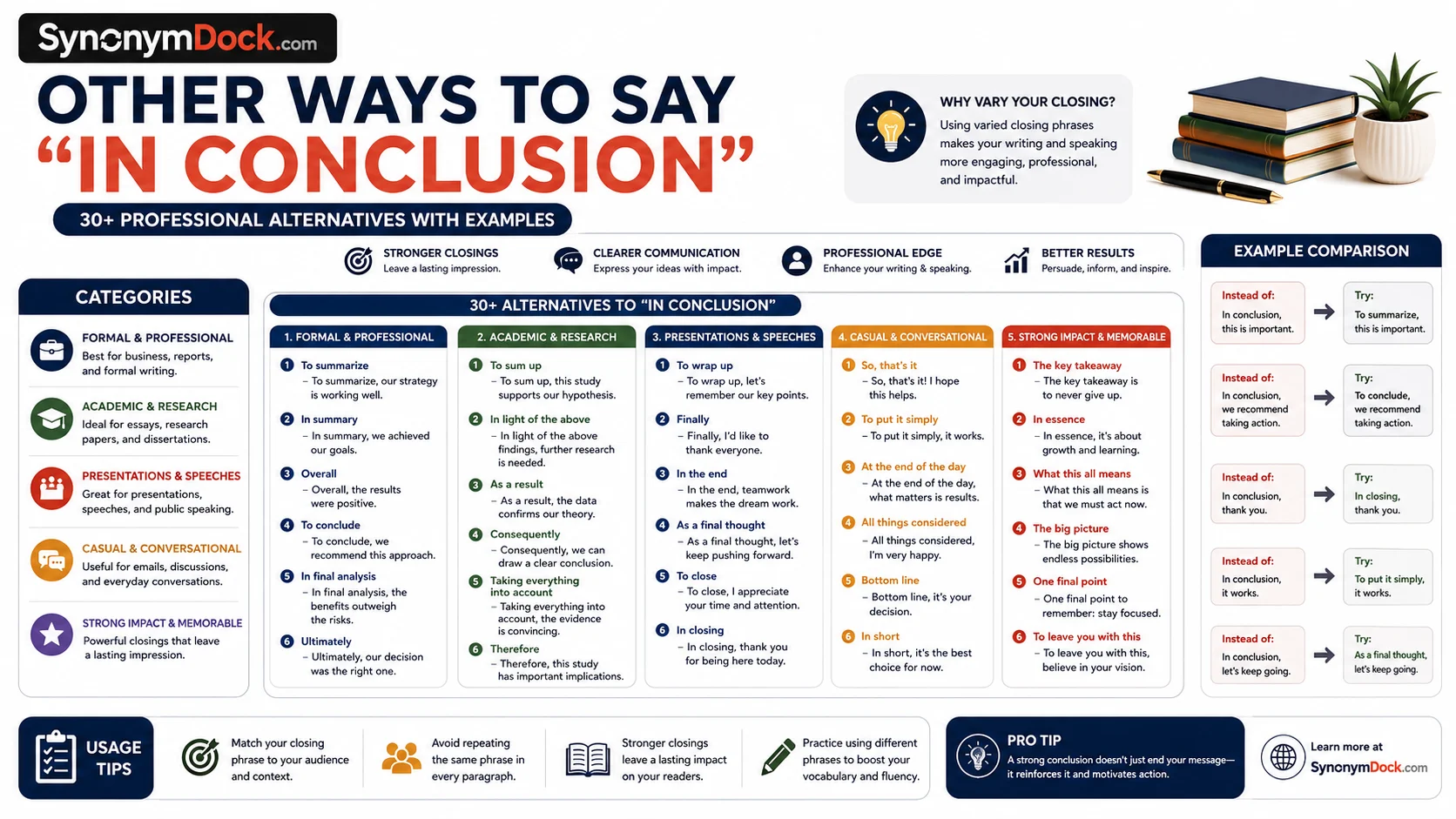
When you’re looking for a stronger alternative to the phrase “in conclusion,” the best choice depends on your audience and the context of your writing .For formal, academic, or professional settings, excellent synonyms include “in summary” to recap key points, “ultimately” to emphasize a final outcome, or “to conclude” to signal the end of a discussion
If you write essays, prepare presentations, or send professional emails, you’ve probably used the phrase “in conclusion” more times than you can count. And that’s okay it works! But using the same expression repeatedly can make your writing feel repetitive and predictable.
Expanding your vocabulary with alternatives makes your communication more engaging and helps you sound more fluent. The right phrase can make your closing remarks memorable, whether you’re finishing a business proposal, an academic paper, or a casual conversation.
This guide covers 30 powerful alternatives to “in conclusion,” organized by tone and situation. You’ll learn exactly when to use each one, see real examples, and avoid common mistakes.
What Does “In Conclusion” Mean?
Meaning: A transition phrase signaling that you are about to finish a discussion, argument, or piece of writing by summarizing your main points.
Grammar: It functions as a prepositional phrase and is typically used to introduce the final paragraph or section.
Simple Explanation: Think of it as a verbal signpost that tells your audience, “I’m wrapping things up now.”
Example Sentence: “In conclusion, regular exercise and a balanced diet are essential for maintaining good health.”
When to Use “In Conclusion”
This phrase is appropriate in many situations, but it works best when you need to:
- Summarize key points at the end of an essay, report, or presentation
- Signal the end of a speech or meeting discussion
- Reinforce your main argument before leaving your audience
- Provide closure to a formal piece of writing
Common Contexts:
- Academic essays
- Business reports
- Formal presentations
- Courtroom closing arguments
- Graduation speeches
Pro Tip: While “in conclusion” is perfectly acceptable, many professional writers avoid it because it’s overused. Your closing words should leave a lasting impression using a fresh alternative can help achieve that.
Quick Categories
Formal Alternatives
- In summary
- Ultimately
- In closing
- To summarize
- In essence
Pro Tip: These work best for academic writing, legal documents, and formal business reports where a polished tone is expected.
Professional Alternatives
- As we have seen
- On the whole
- Taking everything into account
- By way of conclusion
- To put it simply
Pro Tip: Use these in workplace settings when you want to sound competent without being overly stiff.
Business Email Alternatives
- To sum up
- To wrap up
- The bottom line is
- On a final note
- Let’s conclude with this
Pro Tip: These are excellent for client communication and internal memos where clarity matters.
Academic Alternatives
- As has been demonstrated
- In the final analysis
- In summation
- To restate my argument
- This leads to the conclusion that
Pro Tip: These show academic rigor while avoiding the repetition of “in conclusion.”
Casual Alternatives
- All in all
- All things considered
- At the end of the day
- When all is said and done
- In a nutshell
Pro Tip: Great for blog posts, friendly conversations, and informal presentations where you want to sound approachable.
Informal Expressions
- To wrap things up
- To close things off
- Let’s sum it up
- Basically
- The main takeaway is
Pro Tip: Use these with colleagues you know well or in creative writing where a conversational style fits.
“Your conclusion is the last thing your audience hears make every word count.”
30 Alternatives to “In Conclusion” (With Examples)
1. To Sum Up
Meaning: A concise way to summarize the main points before concluding.
Explanation: This phrase is commonly used in both spoken and written English to provide a brief recap without repeating too much information. It works well for team meetings and business updates.
Example Sentence: “To sum up, we need to increase our marketing efforts and improve customer service to meet our quarterly goals.”
- Best Use: Business meetings, presentations
- Avoid Using In: Legal contracts, academic papers
- Tone: Professional, Neutral
- Formality Level: ⭐⭐⭐ Neutral
- Usage Frequency: Very Common
- CEFR Level: B1
- Common Collocations: to sum up the situation, to sum up the main points, to sum up briefly
Context Variability:
- Spoken: “To sum up, we’re on track for next quarter.”
- Professional: “To sum up our findings, the data supports this approach.”
- Casual: “To sum up, it was a great trip!”
2. In Summary
Meaning: Used to introduce a short and concise recap of the discussion.
Explanation: This is slightly more formal than “to sum up” and is ideal for essays, reports, and professional presentations. It signals that you’re about to present the key takeaways from your argument.
Example Sentence: “In summary, our findings suggest that implementing flexible work hours significantly improves employee satisfaction.”
- Best Use: Reports, academic writing, formal speeches
- Avoid Using In: Casual conversations, text messages
- Tone: Formal, Professional
- Formality Level: ⭐⭐⭐⭐ Formal
- Usage Frequency: Very Common
- CEFR Level: B2
- Common Collocations: in summary of findings, brief summary, summary of key points
Context Variability:
- Written: “In summary, the project was a success.”
- Professional: “In summary, our team achieved all major milestones.”
- Academic: “In summary, the results confirm our initial hypothesis.”
“A strong summary provides your audience with a review of your main points and a final appeal.”
3. Ultimately
Meaning: Indicates the final and most important conclusion after considering all factors.
Explanation: This word is particularly useful when you want to emphasize the final outcome or the most critical point. It shows confidence in your conclusion.
Example Sentence: “Ultimately, success depends on how well we adapt to changing market conditions.”
- Best Use: Essays, persuasive writing, business strategy
- Avoid Using In: Casual text messages (unless appropriate)
- Tone: Formal, Confident
- Formality Level: ⭐⭐⭐⭐ Formal
- Usage Frequency: Very Common
- CEFR Level: B2
- Common Collocations: ultimately responsible, ultimately decide, ultimately leads to
Context Variability:
- Professional: “Ultimately, the board will make the final decision.”
- Academic: “Ultimately, this study raises more questions than it answers.”
- Casual: “Ultimately, we just wanted everyone to be happy.”
4. In Closing
Meaning: A formal way to indicate that you are making your final remarks.
Explanation: This phrase is often used in speeches, letters, and reports when signaling the final statement. It’s perfect for endings that include gratitude or a final call to action.
Example Sentence: “In closing, I want to thank everyone for their hard work and dedication to this project.”
- Best Use: Speeches, formal emails, presentations
- Avoid Using In: Academic essays (prefer “in summary”)
- Tone: Formal, Warm
- Formality Level: ⭐⭐⭐⭐ Formal
- Usage Frequency: Common
- CEFR Level: B2
- Common Collocations: in closing remarks, in closing statement, closing thoughts
Context Variability:
- Spoken: “In closing, I’d like to leave you with one final thought.”
- Professional: “In closing, our proposal offers the best value for your investment.”
- Casual: “In closing, it was a pleasure speaking with everyone.”
5. To Conclude
Meaning: A direct and formal way to introduce a conclusion.
Explanation: This phrase is straightforward and works well in essays and academic writing to summarize key arguments. It’s a strong alternative that doesn’t overcomplicate things.
Example Sentence: “To conclude, the study confirms that meditation has significant benefits for mental health.”
- Best Use: Academic writing, formal presentations
- Avoid Using In: Casual conversations
- Tone: Formal, Direct
- Formality Level: ⭐⭐⭐⭐ Formal
- Usage Frequency: Very Common
- CEFR Level: B1
- Common Collocations: to conclude the discussion, conclude that, conclude the analysis
Context Variability:
- Written: “To conclude, we must prioritize sustainability.”
- Professional: “To conclude, this strategy aligns with our long-term vision.”
- Academic: “To conclude, the evidence overwhelmingly supports this theory.”
“When you close with intention, you reinforce your credibility.”
6. All in All
Meaning: Used to present a conclusion by considering all aspects of a situation.
Explanation: This phrase is more conversational and works well for informal writing or speech where a friendly summary is needed.
Example Sentence: “All in all, the conference was a great success despite a few technical issues.”
- Best Use: Personal reflections, speeches, casual writing
- Avoid Using In: Legal documents, formal academic papers
- Tone: Friendly, Reflective
- Formality Level: ⭐⭐ Casual
- Usage Frequency: Very Common
- CEFR Level: B1
- Common Collocations: all in all considered, all in all a good experience
Context Variability:
- Casual: “All in all, it was a fantastic vacation.”
- Professional: “All in all, we met our targets for the quarter.”
- Written: “All in all, the experiment yielded promising results.”
7. As a Result
Meaning: Used to summarize the outcome of a discussion or series of events.
Explanation: This phrase emphasizes the cause-and-effect relationship between your arguments and your conclusion. It’s particularly effective when you’ve been building a case.
Example Sentence: “As a result, we have decided to implement the new training program starting next month.”
- Best Use: Business reports, persuasive essays
- Avoid Using In: When your conclusion doesn’t logically follow your points
- Tone: Formal, Analytical
- Formality Level: ⭐⭐⭐ Neutral
- Usage Frequency: Very Common
- CEFR Level: B1
- Common Collocations: as a result of, resulted in, direct result
Context Variability:
- Professional: “As a result, our profits increased by 20%.”
- Academic: “As a result, the hypothesis was confirmed.”
- Casual: “As a result, we had to cancel the event.”
8. All Things Considered
Meaning: Used to sum up all aspects of a discussion or situation before concluding.
Explanation: This phrase shows that you’ve thoughtfully weighed all factors before reaching your conclusion. It’s suitable for both formal and informal contexts.
Example Sentence: “All things considered, investing in renewable energy is the smartest choice for our company.”
- Best Use: Decision-making discussions, persuasive writing
- Avoid Using In: Scientific papers (prefer “in summary”)
- Tone: Thoughtful, Balanced
- Formality Level: ⭐⭐⭐ Neutral
- Usage Frequency: Common
- CEFR Level: B2
- Common Collocations: all things considered equal, considering all things
Context Variability:
- Professional: “All things considered, we should delay the launch.”
- Casual: “All things considered, it wasn’t a bad day.”
- Written: “All things considered, the evidence supports our position.”
9. In Essence
Meaning: A way to highlight the most crucial point in a concise manner.
Explanation: This phrase helps you remove unnecessary details and focus on the core idea of your discussion. It’s useful when you want to emphasize simplicity.
Example Sentence: “In essence, success is about perseverance and continuous learning.”
- Best Use: Formal writing, academic discussions, reflective pieces
- Avoid Using In: Very casual conversations
- Tone: Intellectual, Neutral
- Formality Level: ⭐⭐⭐⭐ Formal
- Usage Frequency: Common
- CEFR Level: C1
- Common Collocations: in essence means, essence of the argument, essential point
Context Variability:
- Academic: “In essence, this theory challenges traditional assumptions.”
- Professional: “In essence, we need to simplify our processes.”
- Written: “In essence, the book is about human connection.”
10. To Summarize
Meaning: A formal way to introduce a summary of key points.
Explanation: This is widely used in academic, business, and formal writing to wrap up the discussion. It’s one of the most straightforward alternatives to “in conclusion.”
Example Sentence: “To summarize, we need to focus on sustainability, innovation, and employee well-being.”
- Best Use: Academic writing, business reports, formal presentations
- Avoid Using In: Very informal contexts
- Tone: Formal, Professional
- Formality Level: ⭐⭐⭐⭐ Formal
- Usage Frequency: Very Common
- CEFR Level: B2
- Common Collocations: summarize the findings, briefly summarize, summarize key points
Context Variability:
- Written: “To summarize, the main argument is clear.”
- Professional: “To summarize, we recommend proceeding with caution.”
- Academic: “To summarize, the data shows a significant correlation.”
11. On the Whole
Meaning: Used to give an overall view or general summary of a situation.
Explanation: This phrase expresses that you’ve looked at the big picture. It works well when you want to present a balanced final judgment.
Example Sentence: “On the whole, the project was a resounding success despite a few minor setbacks.”
- Best Use: Reviews, evaluations, reflections
- Avoid Using In: Scientific papers with precise conclusions
- Tone: Reflective, Balanced
- Formality Level: ⭐⭐⭐ Neutral
- Usage Frequency: Common
- CEFR Level: B2
- Common Collocations: on the whole review, on the whole opinion
Context Variability:
- Professional: “On the whole, the team performed exceptionally well.”
- Casual: “On the whole, I enjoyed the movie.”
- Written: “On the whole, the evidence supports this interpretation.”
12. In Short
Meaning: A way to summarize concisely and briefly.
Explanation: Use this when you want to restate your main point quickly and clearly. It’s direct and easy to understand.
Example Sentence: “In short, we need to act now or risk falling behind the competition.”
- Best Use: Business discussions, casual writing, brief summaries
- Avoid Using In: Formal academic writing
- Tone: Direct, Efficient
- Formality Level: ⭐⭐⭐ Neutral
- Usage Frequency: Very Common
- CEFR Level: B1
- Common Collocations: in short supply, in short order, in short summary
Context Variability:
- Professional: “In short, we need more resources.”
- Casual: “In short, it was a disaster.”
- Written: “In short, the answer is yes.”
13. At the End of the Day
Meaning: A conversational phrase that emphasizes the most important takeaway.
Explanation: This phrase is informal and commonly used in spoken language to express a final perspective. It’s effective for persuasive or motivational contexts.
Example Sentence: “At the end of the day, what matters most is customer satisfaction.”
- Best Use: Informal discussions, persuasive writing, workplace communication
- Avoid Using In: Formal academic essays, legal writing
- Tone: Conversational, Persuasive
- Formality Level: ⭐⭐ Casual
- Usage Frequency: Very Common
- CEFR Level: B1
- Common Collocations: at the end of the day matters, end of the day takeaway
Context Variability:
- Casual: “At the end of the day, we all want the same thing.”
- Professional: “At the end of the day, our goals are aligned.”
- Written: “At the end of the day, this decision will benefit everyone.”
14. Taking Everything into Account
Meaning: A phrase used to show that all factors have been considered before concluding.
Explanation: This is useful in discussions where multiple perspectives have been analyzed. It demonstrates thoroughness and attention to detail.
Example Sentence: “Taking everything into account, we believe this is the best strategy for the coming year.”
- Best Use: Business presentations, decision-making discussions
- Avoid Using In: Short, informal conversations
- Tone: Analytical, Logical
- Formality Level: ⭐⭐⭐⭐ Formal
- Usage Frequency: Common
- CEFR Level: B2
- Common Collocations: take into account, account for all factors
Context Variability:
- Professional: “Taking everything into account, we recommend option B.”
- Academic: “Taking everything into account, the results are conclusive.”
- Written: “Taking everything into account, I agree with this approach.”
15. The Bottom Line Is
Meaning: A phrase that introduces the most crucial takeaway or undeniable fact.
Explanation: This is often used in business or debates to drive home a final, clear point. It’s direct and confident.
Example Sentence: “The bottom line is that without innovation, we risk losing our market position.”
- Best Use: Business reports, persuasive discussions, meetings
- Avoid Using In: Formal academic writing
- Tone: Strong, Persuasive
- Formality Level: ⭐⭐⭐ Neutral
- Usage Frequency: Very Common
- CEFR Level: B2
- Common Collocations: bottom line result, bottom line impact, bottom line profits
Context Variability:
- Professional: “The bottom line is we need to cut costs.”
- Casual: “The bottom line is, I just don’t trust him.”
- Written: “The bottom line is that this policy benefits everyone.”
16. As Has Been Demonstrated
Meaning: A transition expression that shows confidence that you’ve thoroughly presented enough evidence to prove your point.
Explanation: This phrase is excellent for academic and professional writing where you need to emphasize that your argument is supported by evidence.
Example Sentence: “As has been demonstrated throughout this report, our approach is both cost-effective and sustainable.”
- Best Use: Academic papers, research reports
- Avoid Using In: Casual conversations, short emails
- Tone: Formal, Confident
- Formality Level: ⭐⭐⭐⭐⭐ Very Formal
- Usage Frequency: Occasional
- CEFR Level: C1
- Common Collocations: demonstrated by, evidence demonstrates, study demonstrates
Context Variability:
- Academic: “As has been demonstrated, the hypothesis is correct.”
- Professional: “As has been demonstrated, our methods are effective.”
17. In the Final Analysis
Meaning: A way to introduce a conclusion after thorough consideration.
Explanation: This formal phrase signals that you’ve looked at all the angles and are presenting your definitive judgment.
Example Sentence: “In the final analysis, the benefits of the new policy far outweigh the costs.”
- Best Use: Formal reports, academic conclusions
- Avoid Using In: Casual conversations
- Tone: Formal, Authoritative
- Formality Level: ⭐⭐⭐⭐⭐ Very Formal
- Usage Frequency: Occasional
- CEFR Level: C1
- Common Collocations: final analysis suggests, final analysis shows
Context Variability:
- Academic: “In the final analysis, this study changes our understanding.”
- Professional: “In the final analysis, our decision was correct.”
18. In a Nutshell
Meaning: An informal way to give a brief summary of the main points.
Explanation: This friendly idiom is perfect for casual situations where you want to state your conclusion in a simple and memorable way.
Example Sentence: “In a nutshell, we need to improve our customer service and reduce wait times.”
- Best Use: Casual discussions, blog posts, friendly emails
- Avoid Using In: Formal business reports, academic essays
- Tone: Friendly, Conversational
- Formality Level: ⭐⭐ Casual
- Usage Frequency: Very Common
- CEFR Level: B1
- Common Collocations: in a nutshell summary, nutshell version
Context Variability:
- Casual: “In a nutshell, it was a disaster.”
- Professional (informal): “In a nutshell, we need more staff.”
19. As We Have Seen
Meaning: A phrase that refers back to evidence or points already discussed.
Explanation: This works well when you want to remind your audience of the journey you’ve taken together before presenting your final idea.
Example Sentence: “As we have seen, remote work offers numerous benefits for both employees and employers.”
- Best Use: Presentations, essays, professional discussions
- Avoid Using In: When you haven’t established points to reference
- Tone: Professional, Engaging
- Formality Level: ⭐⭐⭐ Neutral
- Usage Frequency: Common
- CEFR Level: B2
- Common Collocations: as we have seen earlier, as demonstrated previously
Context Variability:
- Professional: “As we have seen, the data supports this conclusion.”
- Academic: “As we have seen, the evidence is overwhelming.”
20. On a Final Note
Meaning: A phrase that introduces one last remark or idea before ending.
Explanation: Use this when you want to add a final, important thought that might be slightly separate from your main summary.
Example Sentence: “On a final note, let’s not forget to celebrate our small wins along the way.”
- Best Use: Speeches, reflections, storytelling
- Avoid Using In: Formal academic conclusions
- Tone: Thoughtful, Engaging
- Formality Level: ⭐⭐⭐ Neutral
- Usage Frequency: Common
- CEFR Level: B2
- Common Collocations: final note of thanks, final note reminder
Context Variability:
- Professional: “On a final note, I want to thank our partners.”
- Casual: “On a final note, don’t forget to call your mom.”
21. Let Me Sum Up
Meaning: A direct and engaging way to introduce your conclusion.
Explanation: This phrase creates a personal connection with your audience and signals that you’re moving to the closing section. It’s especially effective in spoken presentations.
Example Sentence: “Let me sum up the key points we’ve covered today.”
- Best Use: Presentations, speeches, meetings
- Avoid Using In: Formal writing (prefer “in summary”)
- Tone: Engaging, Conversational
- Formality Level: ⭐⭐⭐ Neutral
- Usage Frequency: Common
- CEFR Level: B1
- Common Collocations: sum up the main points, sum up the discussion
Context Variability:
- Spoken: “Let me sum up what we’ve discussed.”
- Professional: “Let me sum up the key takeaways.”
22. This Leads to the Conclusion That
Meaning: A logical transition emphasizing the cause-and-effect relationship between your argument and your conclusion.
Explanation: This phrase makes your reasoning explicit and is great for academic and analytical writing.
Example Sentence: “This leads to the conclusion that early intervention improves student outcomes.”
- Best Use: Academic papers, analytical essays
- Avoid Using In: Casual conversations
- Tone: Formal, Analytical
- Formality Level: ⭐⭐⭐⭐ Formal
- Usage Frequency: Occasional
- CEFR Level: C1
- Common Collocations: leads logically, leads directly, leads to the conclusion
Context Variability:
- Academic: “This leads to the conclusion that the theory is flawed.”
- Professional: “This leads to the conclusion that we must restructure.”
23. When All Is Said and Done
Meaning: Used to highlight the final takeaway after considering everything.
Explanation: This phrase works well when summarizing a discussion that had multiple viewpoints. It has a reflective, thoughtful tone.
Example Sentence: “When all is said and done, our customers’ trust is what truly matters.”
- Best Use: Speeches, reflections, persuasive discussions
- Avoid Using In: Formal academic writing
- Tone: Thoughtful, Reflective
- Formality Level: ⭐⭐⭐ Neutral
- Usage Frequency: Common
- CEFR Level: B2
- Common Collocations: when it’s all said and done, after everything
Context Variability:
- Casual: “When all is said and done, family is what matters.”
- Professional: “When all is said and done, we delivered results.”
24. To Bring Everything Together
Meaning: A way to unify the key points discussed into one conclusion.
Explanation: This phrase signals a structured summary of everything covered, ideal for presentations and formal discussions where you need to connect multiple ideas.
Example Sentence: “To bring everything together, our strategy must focus on innovation, customer service, and operational efficiency.”
- Best Use: Business meetings, presentations, formal discussions
- Avoid Using In: Very short pieces of writing
- Tone: Professional, Structured
- Formality Level: ⭐⭐⭐ Neutral
- Usage Frequency: Occasional
- CEFR Level: B2
- Common Collocations: bring together ideas, bring it together
Context Variability:
- Professional: “To bring everything together, we need a unified approach.”
- Academic: “To bring everything together, the evidence points to one conclusion.”
25. To Wrap Up
Meaning: A casual way to indicate the end of a discussion.
Explanation: This informal phrase is perfect for presentations, meetings, or blog posts where you want a friendly and engaging tone.
Example Sentence: “To wrap up, let’s make sure everyone is clear on their next steps.”
- Best Use: Casual meetings, friendly discussions, blog posts
- Avoid Using In: Formal academic writing, legal documents
- Tone: Relaxed, Conversational
- Formality Level: ⭐⭐ Casual
- Usage Frequency: Very Common
- CEFR Level: B1
- Common Collocations: wrap up the meeting, wrap up the discussion
Context Variability:
- Professional (informal): “To wrap up, great work everyone.”
- Casual: “To wrap up, it’s been a wonderful day.”
- Written: “To wrap up, let’s review the main points.”
26. By Way of Conclusion
Meaning: A very formal way to introduce your closing remarks.
Explanation: This phrase is quite formal and might sound slightly old-fashioned. It’s best reserved for very formal speeches or official documents.
Example Sentence: “By way of conclusion, I would like to thank all participants for their valuable contributions.”
- Best Use: Formal speeches, official statements
- Avoid Using In: Everyday writing, emails
- Tone: Very Formal, Traditional
- Formality Level: ⭐⭐⭐⭐⭐ Very Formal
- Usage Frequency: Occasional
- CEFR Level: C1
- Common Collocations: by way of explanation, by way of introduction
Context Variability:
- Formal: “By way of conclusion, we reaffirm our commitment.”
27. To Put It Simply
Meaning: Used when providing a clear and straightforward summary.
Explanation: This phrase is ideal when you want to make the conclusion easy to understand, especially after a complex discussion.
Example Sentence: “To put it simply, we cannot succeed without teamwork.”
- Best Use: Explaining complex ideas, informal discussions
- Avoid Using In: Where a more formal tone is expected
- Tone: Clear, Direct
- Formality Level: ⭐⭐⭐ Neutral
- Usage Frequency: Common
- CEFR Level: B1
- Common Collocations: simply put, simply stated, put it this way
Context Variability:
- Casual: “To put it simply, I don’t like it.”
- Professional: “To put it simply, we need to change our approach.”
- Written: “To put it simply, the answer is yes.”
28. In Brief
Meaning: A formal way to provide a concise summary.
Explanation: This phrase works well when you need to be brief and to the point. It’s commonly used in executive summaries and short reports.
Example Sentence: “In brief, our strategy focuses on innovation and customer satisfaction.”
- Best Use: Reports, executive summaries, formal writing
- Avoid Using In: Casual conversations
- Tone: Formal, Concise
- Formality Level: ⭐⭐⭐⭐ Formal
- Usage Frequency: Common
- CEFR Level: B2
- Common Collocations: in brief summary, brief overview, brief statement
Context Variability:
- Professional: “In brief, we’ve achieved our targets.”
- Academic: “In brief, this study supports previous findings.”
29. As a Final Point
Meaning: Introduces a concluding thought or key takeaway.
Explanation: This phrase highlights an important final detail before closing the discussion. It signals that this is your last piece of information.
Example Sentence: “As a final point, teamwork is essential for any project’s success.”
- Best Use: Speeches, meetings, presentations
- Avoid Using In: Where a summary is expected rather than a single point
- Tone: Professional, Clear
- Formality Level: ⭐⭐⭐ Neutral
- Usage Frequency: Common
- CEFR Level: B1
- Common Collocations: final point, point to consider, important point
Context Variability:
- Professional: “As a final point, let’s remember our mission.”
- Casual: “As a final point, don’t forget to have fun.”
30. The Key Takeaway Is
Meaning: Highlights the most important lesson or point to remember.
Explanation: Best when you want the audience to focus on one specific conclusion. It’s modern and widely used in business and educational settings.
Example Sentence: “The key takeaway is that consistent effort leads to meaningful results.”
- Best Use: Presentations, workshops, educational content
- Avoid Using In: Traditional academic essays
- Tone: Informative, Engaging
- Formality Level: ⭐⭐⭐ Neutral
- Usage Frequency: Very Common (modern usage)
- CEFR Level: B2
- Common Collocations: key takeaway points, main takeaway, important takeaway
Context Variability:
- Professional: “The key takeaway is that we must adapt.”
- Casual: “The key takeaway is, keep trying.”
- Written: “The key takeaway is that change is inevitable.”
“An audience is forgiving of many things, but not of a speaker who overstays their welcome.”
Native Speaker Tips
Tip 1: “Ultimately” vs. “In Conclusion”
Both signal a conclusion, but “ultimately” emphasizes the final outcome or most important point, while “in conclusion” simply signals the end. Use “ultimately” when you want to stress the decisive factor.
Example: “Ultimately, the decision rests with the board” vs. “In conclusion, we presented our case.”
Tip 2: “In Closing” vs. “To Conclude”
“In closing” often introduces a final remark, sometimes with a personal touch (thanking the audience). “To conclude” is more formal and direct, focusing on summarizing arguments.
Example: “In closing, I thank you for your attention” vs. “To conclude, the evidence is clear.”
Tip 3: Casual Phrases in Professional Settings
Phrases like “at the end of the day” and “in a nutshell” are common in everyday speech but may sound too informal in a formal report or academic paper. Use them in internal meetings or presentations with familiar colleagues, but opt for “in summary” or “ultimately” in written formal documents.
Top 10 Alternatives Compared
| Phrase | Tone | Formality | Best Use | Frequency |
|---|---|---|---|---|
| To sum up | Professional | ⭐⭐⭐ | Business meetings, presentations | Very Common |
| In summary | Formal | ⭐⭐⭐⭐ | Reports, academic writing | Very Common |
| Ultimately | Confident | ⭐⭐⭐⭐ | Essays, persuasive writing | Very Common |
| In closing | Warm, Formal | ⭐⭐⭐⭐ | Speeches, formal emails | Common |
| To conclude | Direct, Formal | ⭐⭐⭐⭐ | Academic, formal writing | Very Common |
| All in all | Friendly | ⭐⭐ | Reflections, casual writing | Very Common |
| In essence | Intellectual | ⭐⭐⭐⭐ | Formal writing, academic | Common |
| To summarize | Formal | ⭐⭐⭐⭐ | Business, academic | Very Common |
| The bottom line is | Strong | ⭐⭐⭐ | Business, meetings | Very Common |
| In a nutshell | Casual | ⭐⭐ | Casual discussions, blogs | Very Common |
Which One Should You Use?
Best Overall: In Summary
“In summary” is the safest, most widely accepted alternative to “in conclusion.” It works in almost any formal context and clearly signals that you’re summarizing your main points.
Best Professional: To Sum Up
For workplace settings especially presentations and meetings “to sum up” is clear, professional, and easy to understand. It’s perfect for team communication.
Best Academic: As Has Been Demonstrated
This phrase shows confidence and intellectual rigor. Use it in research papers when you want to emphasize that your conclusion is supported by evidence.
Best Business Email: On a Final Note
This phrase is polite and professional, making it ideal for wrapping up client communications or internal emails with a positive closing thought.
Best Everyday Conversation: All in All
This is the most natural, conversational alternative. It’s perfect for personal reflections, friendly discussions, and informal writing.
Most Natural: Ultimately
Native speakers frequently use “ultimately” to signal a conclusion in both speech and writing. It sounds confident and authentic.
Most Polite: In Closing
This phrase carries a warm, respectful tone, making it ideal for speeches, presentations, and any situation where you want to express gratitude.
Common Mistakes
1. Using “In Conclusion” Too Often
Mistake: Starting every concluding paragraph with “in conclusion.”
Why It’s Wrong: It becomes repetitive and boring for your readers.
Correct Version: Vary your language using the alternatives from this guide.
Example: Instead of “In conclusion, the project was successful,” try “Ultimately, the project was successful.”
2. Using Formal Phrases Casually
Mistake: Using overly formal alternatives in everyday conversations.
Why It’s Wrong: You might sound stiff or awkward.
Correct Version: Match your language to the situation.
Example: Don’t say “As has been demonstrated, we should get pizza” in a casual group chat. Say “All in all, pizza’s the best choice.”
3. Using Casual Phrases in Academic Writing
Mistake: Writing “At the end of the day, this study proves…” in an academic paper.
Why It’s Wrong: It undermines the seriousness of your work and might affect your grade.
Correct Version: Use “In summary” or “Ultimately” instead.
4. Not Summarizing After the Transition
Mistake: Using a transitional phrase like “to sum up” but then not actually summarizing anything.
Why It’s Wrong: It confuses the reader and wastes the transition.
Correct Version: Always include a brief summary of your main points after the phrase.
5. Mixing Up Tone Inconsistently
Mistake: Using a very formal phrase in a paragraph that’s otherwise casual, or vice versa.
Why It’s Wrong: It creates an inconsistent, jarring reading experience.
Correct Version: Maintain a consistent tone throughout your writing. Choose phrases that match the overall style.
“You’ll get better marks if you learn the art of getting across your point without stating the obvious.” The Student Room
Avoid These in Formal Situations
Certain phrases should be avoided in professional or academic writing because they’re too informal, vague, or clichéd.
| Phrase | Why to Avoid It | Better Alternative |
|---|---|---|
| “In a nutshell” | Too informal for professional contexts | “In summary” |
| “At the end of the day” | Overused cliché; too casual | “Ultimately” |
| “Basically” | Too vague and informal | “In essence” |
| “So yeah” | Not appropriate for formal writing | “To conclude” |
| “That’s it” | Too abrupt, lacks polish | “In closing” |
Best Phrases by Situation
| Situation | Best Phrase |
|---|---|
| Business Email | On a final note |
| Client Meeting | To sum up |
| Academic Essay | In summary |
| Presentation | To conclude |
| Workplace Discussion | Let me sum up |
| Job Interview | Ultimately |
| Team Collaboration | To wrap up |
| Everyday Conversation | All in all |
Expert Insight
The most effective conclusions combine three elements: restating your thesis, reviewing your main points, and ending with a memorable closing device. Your choice of “in conclusion” alternative is just one tool in this process.
Consider using a call to action as your concluding device: motivate your audience to take specific steps based on your argument. Alternatively, end with a powerful quotation or a rhetorical question to provoke thought.
Frequently Asked Questions
What is the most formal way to say “in conclusion”?
“In summary” and “ultimately” are among the most formal alternatives, widely accepted in academic and professional writing. “As has been demonstrated” is also excellent for research-heavy contexts where you need to emphasize evidence.
Which phrase is best for professional emails?
“On a final note” and “to sum up” strike the right balance between professional and approachable for most business emails. “In closing” is also good when you want to express gratitude or end on a warm note.
What is the difference between “in summary” and “to sum up”?
“In summary” is slightly more formal and is the preferred choice for academic writing and formal reports. “To sum up” works well in spoken contexts like meetings and presentations. Both mean essentially the same thing you’re about to present the main points concisely.
Which alternative sounds most natural?
“Ultimately” and “all in all” are very natural-sounding and frequently used by native speakers in daily conversation. “At the end of the day” is also common in spoken English, though it’s quite casual.
Can I use these expressions in business meetings?
Absolutely. “Let me sum up,” “to wrap up,” and “to conclude” are excellent for business meetings. They signal professionalism and clarity. Avoid very casual options like “in a nutshell” in formal client meetings.
Conclusion
Expanding your vocabulary with alternatives to “in conclusion” is a simple but powerful way to improve your English communication. Whether you’re writing an academic essay, preparing a business presentation, or having a conversation with colleagues, choosing the right phrase helps you sound more fluent, professional, and natural.
Start practicing these alternatives today. Use “to sum up” in your next team meeting, write “in summary” in your next report, and try “ultimately” when you want to make a strong final point. The more you use these phrases, the more natural they’ll feel.
Remember great communication is about more than just words. It’s about connecting with your audience and leaving a lasting impression. Choose wisely.

6 thoughts on “30+Other Ways to Say In Conclusion | Examples and Guide 2026”