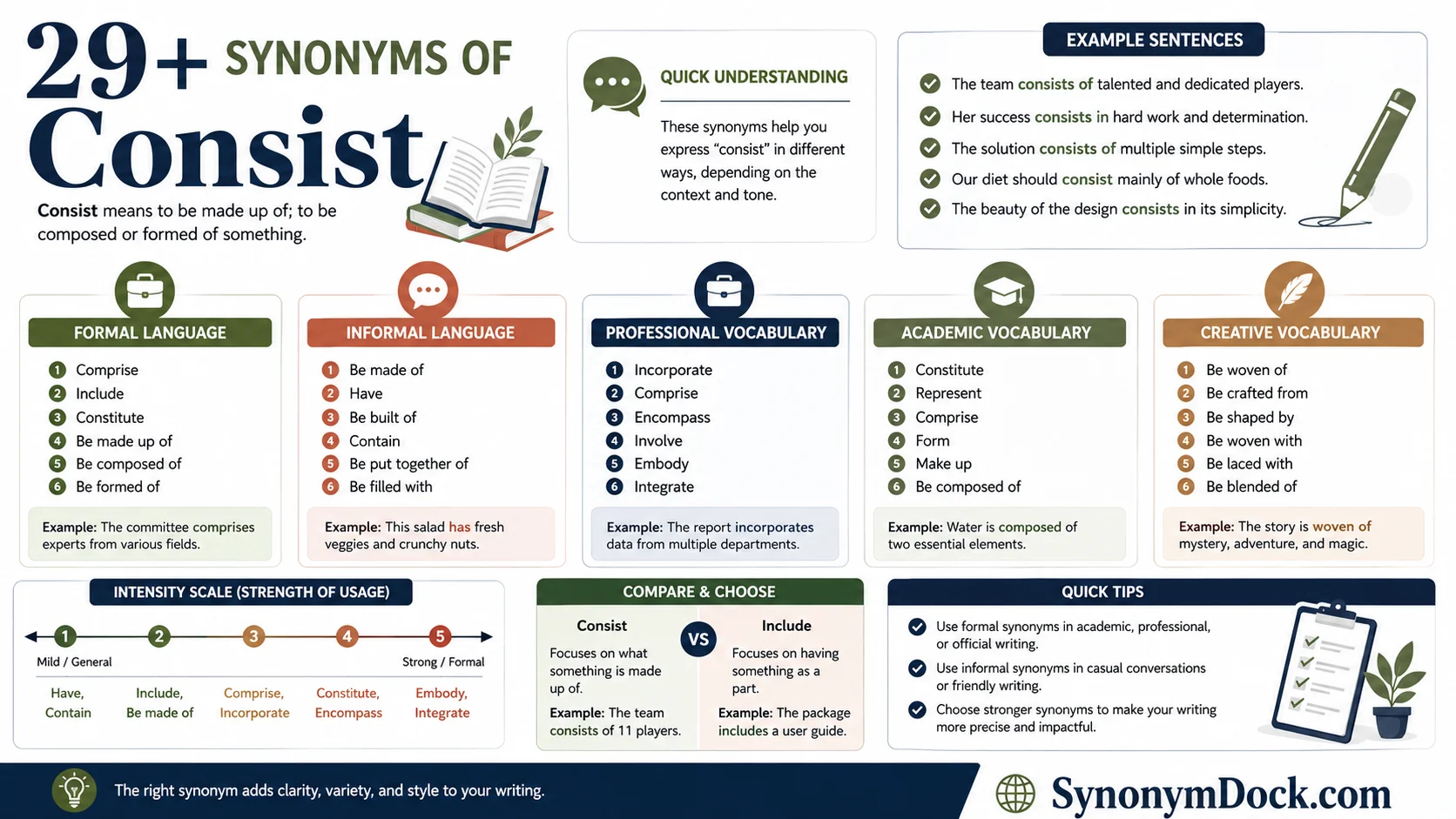
To consist means to be composed or made up of something. The best synonym depends on your context. For formal writing, use “comprise” or “constitute.” For casual conversation, try “include” or “contain.” For professional settings, “encompass” works well. For academic writing, “compose” is appropriate.
Have you ever written a report or an email and found yourself using the word “consist” over and over? You describe what a project consists of, what a team consists of, or what a plan consists of. It happens to many writers. Finding the right synonym of consist can make your writing more precise and engaging. Instead of repeating the same word, you can choose alternatives that add clarity and variety. Whether you are writing a business proposal, an academic paper, or a simple email, having options helps you communicate more effectively.
Meaning, Tone, and Context
Simple Definition
Consist means to have something as a necessary or essential part. It describes what something is made of or what elements form a whole.
Part of Speech
Verb (intransitive, usually followed by “of”)
Overall Tone
Neutral. The word simply describes composition without emotional weight.
Formality Level
Semi-formal. Consist” works in most professional and academic contexts but feels slightly formal for casual conversation.
Common Uses
Native English speakers use “consist” when describing the parts that make up a whole. You might say a team consists of five members, a meal consists of three courses, or a report consists of several sections.
Word Forms
- Consist (verb)
- Consistence (noun, rare)
- Consistent (adjective, related but different meaning)
- Consisting (present participle)
When and How to Use “Consist”
Choose “consist” when you need to clearly explain what elements form a particular whole. It works well in descriptions, definitions, and explanations. Here are seven realistic examples.
Professional
“Our proposal consists of three main phases, each with specific deliverables.”
Academic
“The research methodology consists of both quantitative and qualitative approaches.”
Workplace
“The new training program consists of online modules and in-person workshops.”
Personal
“My morning routine consists of coffee, stretching, and checking emails.”
“The attached document consists of the revised budget and project timeline.”
Resume
“My role consisted of managing client relationships and overseeing project delivery.”
Social Media
“This travel guide consists of my top ten recommendations for first-time visitors.”
Best Synonyms of “Consist”
No synonym is identical in every situation. Here are the best synonyms grouped by context.
Professional writing → Encompass
Why it works: “Encompass” suggests a complete and comprehensive inclusion, which sounds polished and thorough.
Academic writing → Comprise
Why it works: “Comprise” is the standard academic choice for describing composition and is widely recognized in scholarly work.
Business communication → Include
Why it works: “Include” is direct and practical, making it perfect for clear business communication.
Casual conversation → Have
Why it works: “Have” is simple and natural, fitting everyday speech perfectly.
Emotional writing → Embrace
Why it works: “Embrace” adds a sense of warmth and acceptance to the composition.
Creative writing → Be composed of
Why it works: This phrase sounds elegant and slightly formal, adding literary quality.
Resume writing → Involve
Why it works: “Involve” suggests active participation and responsibility, ideal for resume descriptions.
Workplace communication → Contain
Why it works: “Contain” is clear and practical for describing contents or components.
Stronger meaning → Constitute
Why it works: “Constitute” emphasizes that parts actively form or make up the whole.
Softer meaning → Include
Why it works: “Include” is less formal and less rigid, making it feel more approachable.
When Not to Use “Consist”
Sometimes “consist” is not the best choice.
When it sounds too formal
If you are speaking casually, “consist” can feel stiff. Use “have” or “include” instead.
Too formal: “My weekend consists of sleeping and watching movies.”
Better: “My weekend is all about sleeping and watching movies.”
When it sounds too vague
“Consist” does not always specify whether something is fully or partially included. Use “comprise” for full composition.
Vague: “The team consists of experienced professionals.”
Better: “The team comprises experienced professionals from diverse backgrounds.”
When you want to emphasize individual parts
“Consist” focuses on the whole. If you want to highlight specific elements, use “include.”
Less effective: “The course consists of lectures.”
Better: “The course includes interactive workshops and guest lectures.”
When the composition is not essential
If the contents are not the main point, choose a different verb.
Focusing on the wrong thing: “The meeting consists of an agenda review.”
Better: “The meeting begins with an agenda review.”
Words Commonly Confused With “Consist”
Consist vs. Comprise
- Difference: “Comprise” means to include or contain everything. “Consist” means to be made up of something.
- When to Use It: Use “comprise” when you want to emphasize that the parts make up the whole.
- Example: “The committee comprises ten members from different departments.”
Consist vs. Compose
- Difference: “Compose” means to form or make up something. “Consist” focuses on what the whole is made of.
- When to Use It: Use “compose” in passive voice: “is composed of.”
- Example: “The painting is composed of vibrant colors and bold strokes.”
Consist vs. Include
- Difference: “Include” suggests partial listing, while “consist” suggests full composition.
- When to Use It: Use “include” when listing some but not all parts.
- Example: “The package includes a user manual and warranty card.”
Consist vs. Contain
- Difference: “Contain” suggests holding or having within. “Consist” suggests being made of.
- When to Use It: Use “contain” for physical objects holding something.
- Example: “The box contains all the necessary tools.”
Consist vs. Encompass
- Difference: “Encompass” suggests including everything in a comprehensive way.
- When to Use It: Use “encompass” for broad, complete inclusion.
- Example: “The curriculum encompasses a wide range of subjects.”
Consist vs. Constitute
- Difference: “Constitute” means to be the parts that form something.
- When to Use It: Use “constitute” to emphasize the role of individual parts.
- Example: “Individual contributions constitute the final project.”
Best Synonyms of “Consist” by Context
| Context | Best Synonym | Why It Works | Example |
|---|---|---|---|
| Formal writing | Comprise | Standard and widely accepted | “The report comprises five distinct sections.” |
| Academic writing | Be composed of | Clear and scholarly | “The sample was composed of 500 participants.” |
| Professional communication | Encompass | Comprehensive and thorough | “The role encompasses strategic planning and execution.” |
| Business emails | Include | Direct and practical | “The proposal includes a detailed budget breakdown.” |
| Resume writing | Involve | Shows active responsibility | “My position involved managing a team of twelve.” |
| Workplace communication | Contain | Clear and straightforward | “The file contains all necessary documentation.” |
| Casual conversation | Have | Natural and simple | “Dinner has three courses tonight.” |
| Everyday speaking | Be made of | Clear and common | “The sculpture is made of recycled materials.” |
| Creative writing | Be comprised of | Literary and elegant | “The choir was comprised of voices from every continent.” |
| Storytelling | Embrace | Warm and inclusive | “Her story embraces themes of love and loss.” |
| Emotional writing | Incorporate | Integrative and thoughtful | “The design incorporates elements of both styles.” |
| Strong emphasis | Constitute | Shows active formation | “These principles constitute the foundation of our work.” |
| Mild tone | Offer | Gentle and inviting | “The program offers a variety of learning experiences.” |
| Social media captions | Include | Simple and direct | “This video includes my top five travel hacks.” |
| American English | Have | Most common casual choice | “The meal has a salad, soup, and main course.” |
How to Choose the Best Synonym of “Consist”
Choosing the right synonym does not need to be complicated. Follow this simple decision guide.
- What are you describing?
For academic research, use “comprise.” For a product description, use “include.” - Who is your audience?
For a boss or client, use “encompass” or “comprise.” For a friend, use “have.” - Do you want to emphasize completeness?
Use “comprise” or “constitute” for full composition. Use “include” for partial listing. - What tone do you want?
Formal or academic? Use “be composed of.” Casual or conversational? Use “have.” - Does it sound natural?
Read your sentence aloud. If the synonym feels forced, try a different one.
Real Life Examples of “Consist”
School
“The science fair project consists of a research paper, a display board, and an oral presentation. Students must complete each component to qualify.”
College
“The final exam consists of three essays and multiple-choice questions. You will have two hours to complete it.”
Workplace
“My daily responsibilities consist of answering emails, leading team meetings, and reviewing project statuses.”
Business
“Our service package consists of consultation, implementation, and ongoing support. This ensures a complete solution.”
“The attachment consists of the revised contract and the updated timeline. Please review both documents.”
Resume
“My previous role consisted of developing marketing strategies and managing brand partnerships.”
Conversation
“A balanced diet consists of fruits, vegetables, proteins, and whole grains.”
Storytelling
“The ancient city consisted of narrow streets, towering temples, and bustling marketplaces.”
Blogging
“This recipe consists of simple ingredients you likely already have in your kitchen.”
Social Media
“My morning routine consists of meditation, journaling, and a quick workout. It sets the tone for the day.”
25 Best Synonyms of “Consist”
| Synonym | Simple Meaning | Best Used For | Example Sentence |
|---|---|---|---|
| Comprise | Be made up of entirely | Formal and academic writing | “The committee comprises representatives from every department.” |
| Compose | Form or make up something | Academic and formal contexts | “The team is composed of experts in their fields.” |
| Include | Have as part of something | General writing and conversation | “The course includes both theory and practice.” |
| Contain | Hold or have within | Physical and descriptive writing | “The folder contains all the project files.” |
| Encompass | Include comprehensively | Professional and business writing | “The position encompasses many different duties.” |
| Constitute | Be the parts that form something | Academic and formal contexts | “These elements constitute the entire theory.” |
| Involve | Include as a necessary part | Resume and professional writing | “The role involves both analysis and strategy.” |
| Embrace | Include as part of a whole | Creative and emotional writing | “Her philosophy embraces diverse perspectives.” |
| Be formed of | Be created from | Descriptive writing | “The sculpture is formed of clay and wire.” |
| Feature | Include as a notable part | Marketing and descriptions | “The phone features an advanced camera system.” |
Synonyms of “Consist” by Usage
Professional vs Personal Synonyms
Professional: Encompass, Comprise, Constitute, Incorporate
Personal: Have, Include, Be made of, Contain
Formal vs Conversational Synonyms
Formal (Reports, Essays): Comprise, Be composed of, Constitute, Be comprised of
Conversational (Texting, Speech): Have, Include, Be made of, Contain
Academic Synonyms
Use these for research papers and scholarly discussions: Comprise, Compose, Constitute, Be embodied in. They sound more authoritative because they precisely describe composition.
Professional and Business Synonyms
Use these in resumes, meetings, and client communication: Encompass, Involve, Incorporate, Feature. They show polished communication and professional judgment.
Creative and Literary Synonyms
Use these in fiction and descriptive writing: Embrace, Manifest, Be exemplified by. They add depth and imagery to descriptions.
Slang or Modern Synonyms
There are no widely accepted slang synonyms for “consist.” The word is too formal for casual slang usage. Stick with “have” or “include” in informal settings.
Strongest to Mildest Synonyms
| Intensity | Synonym |
|---|---|
| Mild | Include |
| Moderate | Consist, Contain |
| Strong | Comprise, Constitute |
| Very Strong | Encompass |
Emotional vs Neutral Synonyms
Emotional: Embrace, Manifest (these convey warmth or revelation)
Neutral: Comprise, Contain, Include, Constitute (these simply communicate information without added emotion)
Antonyms of “Consist”
| Antonym | Meaning | Example Sentence |
|---|---|---|
| Exclude | Leave out or not include | “The plan excludes any contingency budget.” |
| Omit | Deliberately leave out | “She omitted important details from the report.” |
| Lack | Be without something | “The proposal lacks clear objectives.” |
| Neglect | Fail to include | “The instructions neglect important steps.” |
| Eliminate | Remove from consideration | “The committee eliminated that option.” |
| Remove | Take away from a whole | “Please remove the damaged items from the shipment.” |
| Discard | Throw away or reject | “We discarded the outdated data.” |
| Scatter | Distribute in parts | “The evidence is scattered throughout the report.” |
| Divide | Separate into parts | “We divided the project into manageable sections.” |
| Separate | Keep apart | “Separate the components before assembly.” |
| Disperse | Distribute widely | “The components are dispersed across multiple locations.” |
| Disintegrate | Break into parts | “The organization disintegrated without clear leadership.” |
Comparison: “Consist” vs Similar Words
Consist vs Comprise
- Main Difference: “Consist” focuses on what the whole is made of. “Comprise” focuses on the parts that make up the whole.
- Which Is Stronger? Comprise is more definitive
- Which Is More Formal? Comprise
- When to Use Each: Use “comprise” for full composition. Use “consist” for general composition.
- Examples:
- Consist: “The project consists of three phases.”
- Comprise: “Three phases comprise the project.”
Consist vs Compose
- Main Difference: “Compose” is often used in passive voice (“is composed of”). “Consist” is active.
- Which Is Stronger? Compose suggests deliberate formation
- Which Is More Formal? Compose is slightly more formal
- When to Use Each: Use “compose” when describing creative or intentional formation.
- Examples:
- Consist: “The team consists of five members.”
- Compose: “The team is composed of five members.”
Consist vs Include
- Main Difference: “Include” suggests partial listing. “Consist” suggests complete composition.
- Which Is Stronger? Consist is more definitive
- Which Is More Formal? Consist
- When to Use Each: Use “include” when listing examples. Use “consist” for full composition.
- Examples:
- Consist: “The meal consists of soup, salad, and main course.”
- Include: “The meal includes a soup appetizer.”
Consist vs Encompass
- Main Difference: “Encompass” suggests comprehensive inclusion with a broad scope.
- Which Is Stronger? Encompass is stronger
- Which Is More Formal? Encompass is more formal
- When to Use Each: Use “encompass” for broad, complete coverage.
- Examples:
- Consist: “The job consists of administrative tasks.”
- Encompass: “The job encompasses all aspects of operations.”
Common Phrases and Expressions with “Consist”
Consist of
- Meaning: To be made up of specific elements.
- Example: “The course consists of lectures, labs, and exams.”
Consist in
- Meaning: To have something as a primary feature or essence.
- Example: “True happiness consists in contentment and gratitude.”
To consist with
- Meaning: To be in agreement or harmony with something.
- Example: “This decision does not consist with our company values.”
Be consistent with
- Meaning: To be in agreement or compatible with something.
- Example: “The findings are consistent with previous research.”
Consistently
- Meaning: In a way that does not change; reliably.
- Example: “She consistently delivers high-quality work.”
Consistence
- Meaning: Agreement or harmony between parts.
- Example: “The team works with consistence and precision.”
Common Mistakes to Avoid
Mistake 1: Using “Consist” Without “Of”
Incorrect: “The project consists three phases.”
Better: “The project consists of three phases.”
Why: “Consist” is always followed by “of” when describing composition.
Mistake 2: Confusing “Consist Of” with “Comprise”
Incorrect: “The team is consisted of experts.”
Better: “The team consists of experts.” or “The team is composed of experts.”
Why: “Consist” is not used in passive voice with “of.” Use “compose” for passive construction.
Mistake 3: Using “Consist” for Partial Lists
Incorrect: “The package consists of a manual.” (If there is more)
Better: “The package includes a manual.” or “The package consists of a manual and other items.”
Why: “Consist” suggests full composition, not partial listing.
Mistake 4: Using “Consist” in Casual Conversation
Incorrect: “What does your weekend consist of?”
Better: “What do you have planned for the weekend?”
Why: “Consist” sounds too formal for casual conversation.
Mistake 5: Overusing “Consist”
Incorrect: “The plan consists of steps. Each step consists of tasks. Each task consists of actions.”
Better: “The plan comprises steps, which include tasks and specific actions.”
Why: Variety in word choice keeps writing engaging.
Mistake 6: Using “Consist In” Incorrectly
Incorrect: “The course consists in learning new skills.” (Wrong context)
Better: “The course consists of learning new skills.” or “The course focuses on learning new skills.”
Why: “Consist in” describes essential nature, not composition.
Frequently Asked Questions
What are the best synonyms of “consist”?
The best synonyms depend on your context. For formal writing, use “comprise” or “constitute.” For casual conversation, use “have” or “include.” For professional writing, use “encompass” or “involve.”
What are the best formal synonyms of “consist”?
The best formal synonyms include “comprise,” “constitute,” “be composed of,” and “be comprised of.” These are widely accepted in academic and professional writing.
What are common informal synonyms of “consist”?
Common informal synonyms include “have,” “include,” “contain,” and “be made of.” These are perfect for conversations, text messages, and casual writing.
What is another word for “consist” in professional writing?
In professional writing, use “encompass,” “involve,” or “incorporate.” These words sound polished and demonstrate professional insight.
What is the difference between “consist” and “comprise”?
“Consist” means to be made up of something. “Comprise” means to include or contain everything. “Comprise” suggests full composition with a slightly more formal tone.
What is the opposite of “consist”?
The most direct opposites are “exclude” and “omit.” Other antonyms include “lack,” “miss,” “ignore,” and “eliminate.”
Conclusion
The word “consist” is a useful verb for describing what things are made of or what elements form a whole. It helps you explain composition clearly. But English offers many alternatives to this word. By choosing the right synonym of consist, you can communicate with greater precision and variety.
No single synonym fits every situation. The best word depends on your audience, your tone, and your purpose. For formal writing, choose “comprise.” For casual conversation, choose “have.” For professional writing, choose “encompass” or “involve.” For academic writing, choose “be composed of.”
A practical tip: before you write, ask yourself whether you are describing full composition or partial inclusion. If you mean the entire makeup, use “comprise” or “constitute.” If you mean just some elements, use “include.” With practice, selecting the perfect word becomes second nature.
