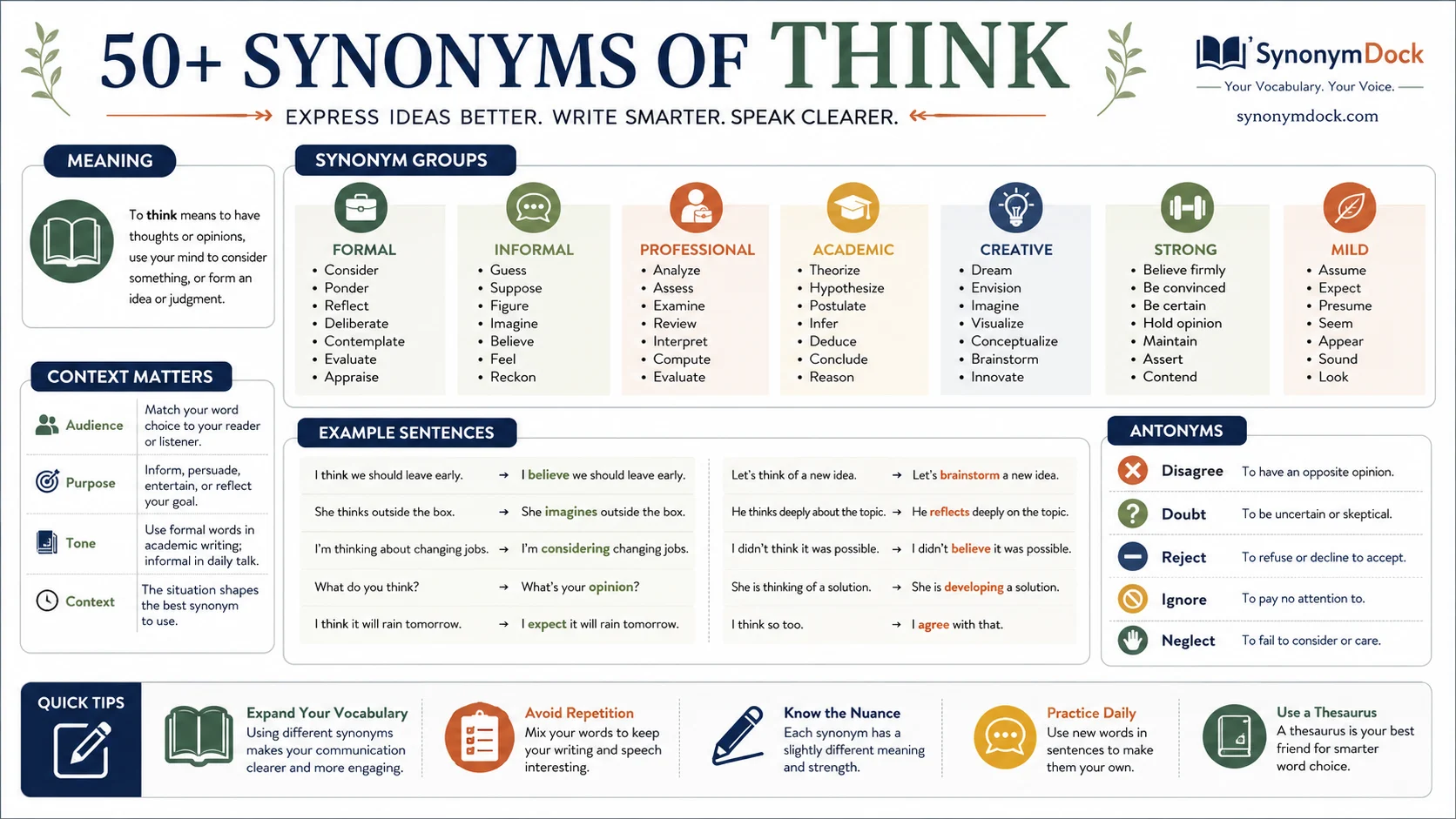
“Think” means to use your mind to consider ideas, form opinions, or make judgments. For professional writing, use “consider” or “analyze.” For casual conversation, use “figure” or “guess.” For academic writing, use “contemplate” or “reflect.” For emotional situations, use “ponder” or “brood.” The best synonym depends on your audience, purpose, and the exact shade of meaning you intend.
Have you ever noticed how often the word “think” appears in your emails, essays, workplace conversations, or everyday writing? Although it is one of the most useful verbs in English, relying on the same word repeatedly can make your communication sound repetitive and less precise. Choosing the right think synonym can make your writing clearer, more natural, and more expressive.
If you’re searching for a synonym for think, synonym think, another word for think, synonyms for think, synonyms of think, or synonym of think, the best choice depends on what you actually mean. For example, believe can express an opinion or conviction, consider can suggest careful thought, suppose can indicate uncertainty, and reflect can emphasize thoughtful consideration. There is no single replacement that works perfectly in every sentence.
Understanding to think synonyms is especially useful for students, professionals, content writers, and anyone who wants to improve their vocabulary. The right alternative can communicate subtle differences in certainty, reasoning, intention, or emotion instead of simply repeating the same verb. Even searches such as thinks synonym and the commonly mistyped think synonyn point to the same need: finding accurate alternatives that fit the intended meaning.
This guide draws on standard English vocabulary and contextual usage to help you choose words accurately rather than simply providing a list of interchangeable terms. Each think synonym is explained with its meaning, tone, and practical examples so you can understand when it works best.
Whether you’re writing an academic essay, professional email, blog post, presentation, or everyday message, this collection of synonyms for think will help you expand your vocabulary, avoid repetition, and express your ideas with greater precision and confidence.
Meaning, Tone, and Context
Simple Definition: Think means to use your mind to reason, remember, evaluate, or form ideas and beliefs.
Part of Speech: Verb (transitive and intransitive), Noun (informal)
Overall Tone: Neutral. It is a general, everyday word.
Formality Level: Neutral. It works in almost any setting.
Common Uses: Native speakers use “think” in virtually every context. You will find it in casual chats, professional meetings, academic writing, and personal reflections. It is the default word for describing mental activity.
Word Forms:
- Verb: think (present), thought (past/past participle), thinking (present participle)
- Noun: think (informal, meaning a period of consideration)
- Adjective: thinkable (possible to imagine), unthinkable (impossible to imagine)
- Adverb: thinkingly (rare)
When and How to Use “Think”
Choose “think” when you need a simple, neutral, and widely understood word. It works well in most situations. However, for more precise communication, consider using a synonym that matches the exact shade of meaning you want.
Professional:
“I think we should schedule a follow-up meeting to discuss the project timeline.”
Academic:
“Many scholars think that economic factors played a significant role in the revolution.”
Workplace:
“My manager thinks I am ready for a promotion.”
Personal:
“I think about my grandmother every time I bake her famous apple pie.”
Email:
“I think the proposal is solid, but I would like your feedback before submitting it.”
Resume/Cover Letter:
“I think strategically and can adapt to changing priorities.” (Better: “I think strategically and adapt to changing priorities.”)
Social Media:
“I think this is the best coffee shop in the city. What do you think?”
Best Synonyms of “Think”
No synonym is identical in every situation. The best choice depends on what you are trying to communicate.
- Professional writing: Consider or Analyze
- Academic writing: Contemplate or Reflect
- Business communication: Evaluate or Assess
- Casual conversation: Figure or Guess
- Emotional writing: Ponder or Brood
- Creative writing: Imagine or Envision
- Resume writing: Strategize or Reason
- Workplace communication: Review or Weigh
- Stronger meaning: Cogitate or Contemplate
- Softer meaning: Suspect or Suppose
When Not to Use “Think”
Sometimes, “think” is not the best choice. It can sound too vague, too weak, or too informal.
General:
- Ineffective: “I think it is important to plan ahead.” (This sounds weak and hesitant.)
- Better: “Planning ahead is important.” (Remove the filter word for stronger writing.)
Vague:
- Ineffective: “I think he might be upset.” (This is unclear.)
- Better: “I suspect he might be upset.” (This implies a specific reason.)
Formal:
- Ineffective: “I think I will have the chicken.” (Sounds stiff in a casual restaurant.)
- Better: “I will have the chicken.” (Direct and clear.)
Informal:
- Ineffective: “I think the study has merit.” (In a formal research paper, this is too weak.)
- Better: “The study has merit.” (Direct and confident.)
Outdated:
- Ineffective: “I think I shall go to the store.” (Sounds overly formal and old-fashioned.)
- Better: “I think I will go to the store.” (Modern and natural.)
Words Commonly Confused With “Think”
Think vs. Believe
Difference: “Think” is broader. It covers any mental activity. “Believe” specifically means accepting something as true or having a conviction .
When to Use Think: Use it for general mental consideration.
When to Use Believe: Use it for convictions, faith, or personal truths.
Example (Think): “I think we should leave early.”
Example (Believe): “I believe she is telling the truth.”
Think vs. Feel
Difference: “Think” involves intellectual judgment. “Feel” involves emotion or intuition.
When to Use Think: Use it for logical conclusions.
When to Use Feel: Use it for personal reactions or gut instincts.
Example (Think): “I think that is the right decision.” (Logical)
Example (Feel): “I feel that is the right decision.” (Emotional)
Think vs. Suppose
Difference: “Think” is a general statement. “Suppose” implies a guess with less evidence .
When to Use Think: Use it for a considered opinion.
When to Use Suppose: Use it for a tentative or hypothetical idea.
Example (Think): “I think it will rain tomorrow.” (Based on weather report)
Example (Suppose): “I suppose it could rain tomorrow.” (Uncertain guess)
Think vs. Reckon
Difference: “Think” is standard English. “Reckon” is more informal and often associated with regional American dialects .
When to Use Think: Use it in most professional and academic settings.
When to Use Reckon: Use it for casual conversation, especially in the American South.
Example (Think): “I think we should start now.”
Example (Reckon): “I reckon we should start now.”
Think vs. Conclude
Difference: “Think” describes a mental process. “Conclude” describes reaching a final decision or logical end point .
When to Use Think: Use it for ongoing consideration.
When to Use Conclude: Use it for a final judgment after analysis.
Example (Think): “I am thinking about the data.”
Example (Conclude): “I conclude that the data is insufficient.”
Think vs. Consider
Difference: “Think” is general. “Consider” means to think about something carefully and deliberately .
When to Use Think: Use it for a quick mental note.
When to Use Consider: Use it for thoughtful evaluation.
Example (Think): “I thought about what you said.”
Example (Consider): “Please consider the consequences before you act.”
Best Synonyms of “Think” by Context
| Context | Best Synonym | Why It Works | Example |
|---|---|---|---|
| Formal writing | Contemplate | Sounds serious and intellectual. | “The committee will contemplate the proposal.” |
| Academic writing | Reflect | Implies deep, thoughtful analysis. | “The study invites us to reflect on our assumptions.” |
| Professional communication | Evaluate | Suggests a careful, objective assessment. | “We need to evaluate all possible solutions.” |
| Business emails | Consider | Clear, professional, and neutral. | “Please consider the attached report.” |
| Resume writing | Strategize | Shows leadership and foresight. | “I strategize marketing campaigns for maximum impact.” |
| Workplace communication | Assess | Indicates thoughtful judgment. | “Let us assess the current situation.” |
| Casual conversation | Figure | Common, relaxed, and friendly. | “I figure we can meet at six.” |
| Everyday speaking | Guess | Quick and informal. | “I guess you are right.” |
| Creative writing | Envision | Creates a vivid mental image. | “She could envision a future full of possibility.” |
| Storytelling | Ponder | Suggests a character’s inner reflection. | “He pondered the meaning of her words.” |
| Emotional writing | Brood | Implies a heavy, troubled, or obsessive kind of thinking . | “He continued to brood over his failure.” |
| Strong emphasis | Cogitate | A formal, strong, and somewhat humorous word for intense thinking . | “He sat in his chair, cogitating on the problem.” |
| Mild tone | Suppose | Gentle and less forceful. | “I suppose that is a possibility.” |
| Social media captions | Wonder | Invites engagement and curiosity. | “Wondering what the future holds…” |
| American English | Reckon | Distinctly informal American usage. | “I reckon it is about time to go.” |
How to Choose the Best Synonym of “Think”
Use this decision guide to select the perfect word.
- What is your audience?
- Professional: Use “consider,” “evaluate,” or “assess.”
- Academic: Use “contemplate,” “reflect,” or “analyze.”
- Casual: Use “figure,” “guess,” or “reckon.”
- What is your purpose?
- Making a decision: Use “determine,” “conclude,” or “decide.”
- Generating ideas: Use “imagine,” “envision,” or “conceive.”
- Analyzing a problem: Use “examine,” “scrutinize,” or “study.”
- What is the emotional tone?
- Neutral: Use “think” or “consider.”
- Positive/Excited: Use “dream” or “imagine.”
- Negative/Troubled: Use “brood” or “agonize.”
- How much certainty do you have?
- High certainty: Use “believe” or “know.”
- Moderate certainty: Use “think” or “consider.”
- Low certainty: Use “suppose” or “guess.”
Real Life Examples of “Think”
School: “Before I started the exam, I took a moment to think about the strategy I would use.” (Replaced with “consider”: “Before I started the exam, I took a moment to consider the strategy I would use.”)
College: “In my philosophy class, we were encouraged to think deeply about the nature of reality.” (Replaced with “contemplate”: “In my philosophy class, we were encouraged to contemplate the nature of reality.”)
Workplace: “We need to think of a solution to this client’s problem.” (Replaced with “devise”: “We need to devise a solution to this client’s problem.”)
Business: “The CEO asked us to think about the long-term vision of the company.” (Replaced with “reflect”: “The CEO asked us to reflect on the long-term vision of the company.”)
Email: “Please think about my proposal and get back to me.” (Replaced with “consider”: “Please consider my proposal and get back to me.”)
Resume: “Proven ability to think quickly in high-pressure situations.” (Replaced with “analyze”: “Proven ability to analyze quickly in high-pressure situations.”)
Conversation: “Give me a minute to think.” (Replaced with “ponder”: “Give me a minute to ponder.”)
Storytelling: “She thought about what he had said.” (Replaced with “mused”: “She mused about what he had said.”)
Blogging: “I think this is the most important issue of our time.” (Replaced with “believe”: “I believe this is the most important issue of our time.”)
Social Media: “Thinking about all the wonderful memories from this year.” (Replaced with “reminiscing”: “Reminiscing about all the wonderful memories from this year.”)
25 Best Synonyms of “Think”
| Synonym | Simple Meaning | Best Used For | Example Sentence |
|---|---|---|---|
| Consider | To think about something carefully | Most situations, professional writing | “Please consider the other options before deciding.” |
| Contemplate | To think about something deeply and for a long time | Philosophical or serious reflection | “He sat by the window to contemplate his future.” |
| Reflect | To think deeply and carefully, often about the past | Personal insights, academic writing | “The essay invites the reader to reflect on loss.” |
| Ponder | To think about something carefully over a period of time | Emotional, serious, or thoughtful situations | “She pondered the meaning of his strange comment.” |
| Deliberate | To think about something very carefully before making a decision | Decision-making, legal contexts | “The jury will deliberate the verdict tomorrow.” |
| Meditate | To think deeply and calmly about a topic | Spiritual, mindful, or focused thought | “He meditated on the nature of happiness.” |
| Cogitate | To think deeply and intensely, often in a formal context | Strong, formal intellectual effort | “The professor cogitated on the problem for days.” |
| Analyze | To examine something carefully and in detail | Logic, science, problem-solving | “We need to analyze the data to find a trend.” |
| Assess | To evaluate or estimate the nature, ability, or quality of something | Workplace, medicine, education | “Doctors will assess the patient’s condition.” |
| Imagine | To form a mental image of something not present | Creativity, daydreaming | “Imagine a perfect world.” |
| Believe | To accept something as true or real | Personal convictions, faith | “I believe you are telling the truth.” |
Synonyms of “Think” by Usage
Professional vs Personal Synonyms: In the workplace, choose words like “assess,” “analyze,” “evaluate,” or “strategize.” They sound competent and objective. In personal conversations, choose “figure,” “guess,” “wonder,” or “imagine.” They sound friendly and approachable.
Formal vs Conversational Synonyms:
- Formal (reports, essays, business writing): Use “consider,” “contemplate,” “reflect,” “analyze,” and “conclude.”
- Conversational (casual chats, texting): Use “guess,” “figure,” “reckon,” “bet,” and “fancy.”
Academic Synonyms: “Contemplate,” “reflect,” “analyze,” “theorize,” “hypothesize,” “deduce,” and “synthesize” all sound authoritative and demonstrate deep thinking. They are ideal for research, essays, and academic discussions.
Professional and Business Synonyms: “Strategize,” “forecast,” “analyze,” “evaluate,” “assess,” and “plan” are powerful choices for resumes, meetings, and client communications. They show leadership and competence.
Creative and Literary Synonyms: “Muse,” “envision,” “dream,” “fantasize,” “imagine,” and “ruminate” add texture and emotion to storytelling, poetry, and descriptive writing.
Slang or Modern Synonyms: “Chew over” (think about) and “mull over” (think about) are slightly informal but widely understood. “Brainstorm” is common in business contexts. “Ponder” is making a comeback in modern self-help language.
Strongest to Mildest Synonyms:
- Mild: Guess, Suppose, Imagine
- Moderate: Think, Consider, Reckon
- Strong: Reflect, Ponder, Deliberate
- Very Strong: Cogitate, Contemplate, Ruminate, Meditate
Emotional vs Neutral Synonyms:
- Emotional Synonyms: “Brood” (sadness), “dream” (happiness), “agonize” (anxiety). These words express a feeling.
- Neutral Synonyms: “Analyze,” “consider,” “evaluate.” These words simply communicate the act of thinking without adding emotion.
Antonyms of “Think”
| Antonym | Meaning | Example Sentence |
|---|---|---|
| Act | To take action instead of thinking | “Stop thinking about it and just act.” |
| Ignore | To pay no attention to | “He chose to ignore the problem.” |
| Disregard | To pay no attention to | “She disregarded the advice.” |
| Neglect | To fail to think about or care for | “He neglected his duties.” |
| Doubt | To be uncertain about something | “I doubt he will come.” |
| Forget | To be unable to think of or remember | “I forgot her name.” |
| Overlook | To fail to think about or notice | “They overlooked an important detail.” |
| Blot out | To completely forget or remove from thought | “He tried to blot out the memory.” |
| Block out | To deliberately try to forget | “She blocked out the traumatic event.” |
| Draw a blank | To be unable to think of or remember | “I drew a blank when asked for his name.” |
| Daydream | To think pleasant thoughts instead of focusing | “He spent the meeting daydreaming.” |
| Distraction | A thing that prevents someone from thinking | “The noise was a major distraction.” |
| Ignorance | Lack of knowledge or information | “His ignorance of the topic was clear.” |
| Misunderstand | To fail to think of the correct meaning | “I think you misunderstand my point.” |
| Reject | To refuse to think about or accept | “She rejected the idea outright.” |
Comparison: “Think” vs Similar Words
Think vs Consider
Main Difference: “Think” is a general term. “Consider” implies a more deliberate, focused attention .
Which Is Stronger? “Consider” implies greater intention.
Which Is More Formal? “Consider” is more formal.
When to Use Each: Use “think” for a quick mental check. Use “consider” when you need to weigh options carefully.
Examples:
- Think: “I think it might rain.”
- Consider: “I need to consider all the factors before I decide.”
Think vs Believe
Main Difference: “Think” refers to the mental process. “Believe” refers to accepting something as true .
Which Is Stronger? “Believe” expresses a stronger conviction.
Which Is More Formal? Both are acceptable, but “believe” is often used in formal testimony and statements of faith.
When to Use Each: Use “think” for everyday reasoning. Use “believe” for your core values or convictions.
Examples:
- Think: “I think we should turn left.”
- Believe: “I believe in helping others.”
Think vs Suppose
Main Difference: “Think” is a straightforward statement. “Suppose” is a guess with less certainty .
Which Is Stronger? “Think” is stronger and more confident.
Which Is More Formal? “Suppose” is often used in academic hypotheticals (“Suppose that X is true…”).
When to Use Each: Use “think” for your actual opinion. Use “suppose” for a hypothetical or a guess.
Examples:
- Think: “I think the answer is four.”
- Suppose: “Suppose the answer is four. What happens next?”
Think vs Ponder
Main Difference: “Think” is quick and broad. “Ponder” is slow, deep, and often emotional .
Which Is Stronger? “Ponder” is much stronger in terms of depth.
Which Is More Formal? “Ponder” is more literary and formal.
When to Use Each: Use “think” for daily decisions. Use “ponder” for philosophical or heavy questions.
Examples:
- Think: “I think I will have coffee.”
- Ponder: “He pondered the meaning of life.”
Think vs Reflect
Main Difference: “Think” is a general mental activity. “Reflect” is thinking about something specific, often to learn from it .
Which Is Stronger? “Reflect” is stronger and implies a more serious purpose.
Which Is More Formal? “Reflect” is more formal.
When to Use Each: Use “think” for general consideration. Use “reflect” when you are looking back on an event or idea to gain insight.
Examples:
- Think: “I am thinking about dinner.”
- Reflect: “I want to reflect on what I learned.”
Think vs Cogitate
Main Difference: “Think” is common. “Cogitate” is a very formal and somewhat humorous word for intense thought .
Which Is Stronger? “Cogitate” is much stronger and more intense.
Which Is More Formal? “Cogitate” is extremely formal and rarely used in everyday speech.
When to Use Each: Use “think” always. Use “cogitate” only for effect, perhaps in writing to sound clever or old-fashioned.
Examples:
- Think: “Let me think about it.”
- Cogitate: “Allow me a moment to cogitate on this weighty matter.”
Common Phrases and Expressions with “Think”
Phrase: “Think twice”
Meaning: To consider something carefully before making a decision .
Example Sentence: “You should think twice before quitting your job.”
Phrase: “Think ahead”
Meaning: To plan for the future .
Example Sentence: “We need to think ahead if we want to avoid problems.
Phrase: “Think outside the box”
Meaning: To think creatively, using new and different ideas .
Example Sentence: “The best solutions come when you think outside the box.”
Phrase: “I don’t think so”
Meaning: A polite way to disagree or say no.
Example Sentence: “Do you think it will work?” “I don’t think so.
Phrase: “Think it over”
Meaning: To consider something carefully before a decision .
Example Sentence: “You have a good offer. Please think it over.”
Phrase: “Think better of it”
Meaning: To change your mind after considering something .
Example Sentence: “He was going to argue but thought better of it.”
Phrase: “Think the world of”
Meaning: To like someone very much or have a very high opinion of them .
Example Sentence: “She thinks the world of her grandchildren.”
Common Mistakes to Avoid
1: Using a vague synonym instead of a precise one.
- Incorrect: “I think about the project.” (Too vague)
- Better: “I am analyzing the project.” (More precise)
- Why: A precise word clearly communicates your mental activity.
2: Confusing “think” with “feel.”
- Incorrect: “I feel that the answer is four.” (Illogical)
- Better: “I think the answer is four.” (Logical)
- Why: “Feel” is for emotions. “Think” is for logic.
3: Using “reckon” or “figure” in formal writing.
- Incorrect: “I reckon the data is conclusive.” (Too informal)
- Better: “I consider the data conclusive.” (Professional)
- Why: Formal settings need formal vocabulary.
4: Using a dramatic synonym like “ruminate” for everyday thoughts.
- Incorrect: “I ruminate about my grocery list.” (Too heavy)
- Better: “I think about my grocery list.” (Appropriate)
- Why: Overly dramatic words sound silly for trivial topics.
5: Repeating the word “think” too often.
- Incorrect: “I think we should start. I think we can do it. I think we will win.”
- Better: “I think we should start. I believe we can do it. I know we will win.”
- Why: Variety keeps your writing interesting.
6: Using a synonym with the wrong emotional tone.
- Incorrect: “He thought about his dead dog.” (Too weak)
- Better: “He brooded over his dead dog.” (Correct tone)
- Why: The right synonym conveys the correct emotional weight.
Mistake 7: Using “suppose” when you mean “believe.”
- Incorrect: “I suppose I can do it.” (Lack of confidence)
- Better: “I believe I can do it.” (Confidence)
- Why: The word you choose signals your level of certainty.
Frequently Asked Questions
1. What are the best synonyms of “think”?
The best synonyms of “think” depend on your context. For professional writing, use “consider.” For academic writing, use “contemplate.” For casual conversation, use “figure” or “guess.” Always choose based on your audience and purpose .
2. What are common informal synonyms of “think”?
Common informal synonyms of “think” include “figure,” “guess,” “reckon,” and “imagine.” Americans often use “figure” and “guess.” “Reckon” is common in the American South and in British English .
3. What is another word for “think” in professional writing?
In professional writing, use “analyze,” “evaluate,” or “assess.” These words demonstrate objectivity and competence. “Strategize” is also excellent for resume writing, as it shows leadership and planning skills .
4. What is the difference between “think” and “believe”?
“Think” is a general term for mental activity. “Believe” specifically means to accept something as true or have a conviction. You think about facts. You believe in ideas, values, or people .
5. What is the opposite of “think”?
The opposite of “think” includes “act,” “ignore,” “forget,” and “doubt.” When you act, you are not thinking. When you ignore or forget, you are not considering something. When you doubt, you are questioning a thought .
Conclusion
“Think” is a fundamental verb that describes the process of using your mind. While it works in almost every situation, using the exact right synonym can transform your communication. Stronger, more precise words like “contemplate,” “analyze,” and “envision” add clarity, authority, and color to your writing . Remember that no synonym works perfectly in every situation. Choose your words based on your audience, tone, and purpose. Start by replacing one overused “think” in your next email, essay, or social post with a more precise synonym. You will notice the difference.
Definitions, meanings, and usage recommendations should be verified with trusted language references before publication. Recommended sources include Cambridge Dictionary, Oxford English Dictionary, Merriam Webster, Collins Dictionary, and Britannica.

5 thoughts on “50+ Synonym of Think| Meanings, Uses and Best Alternatives For 2026”