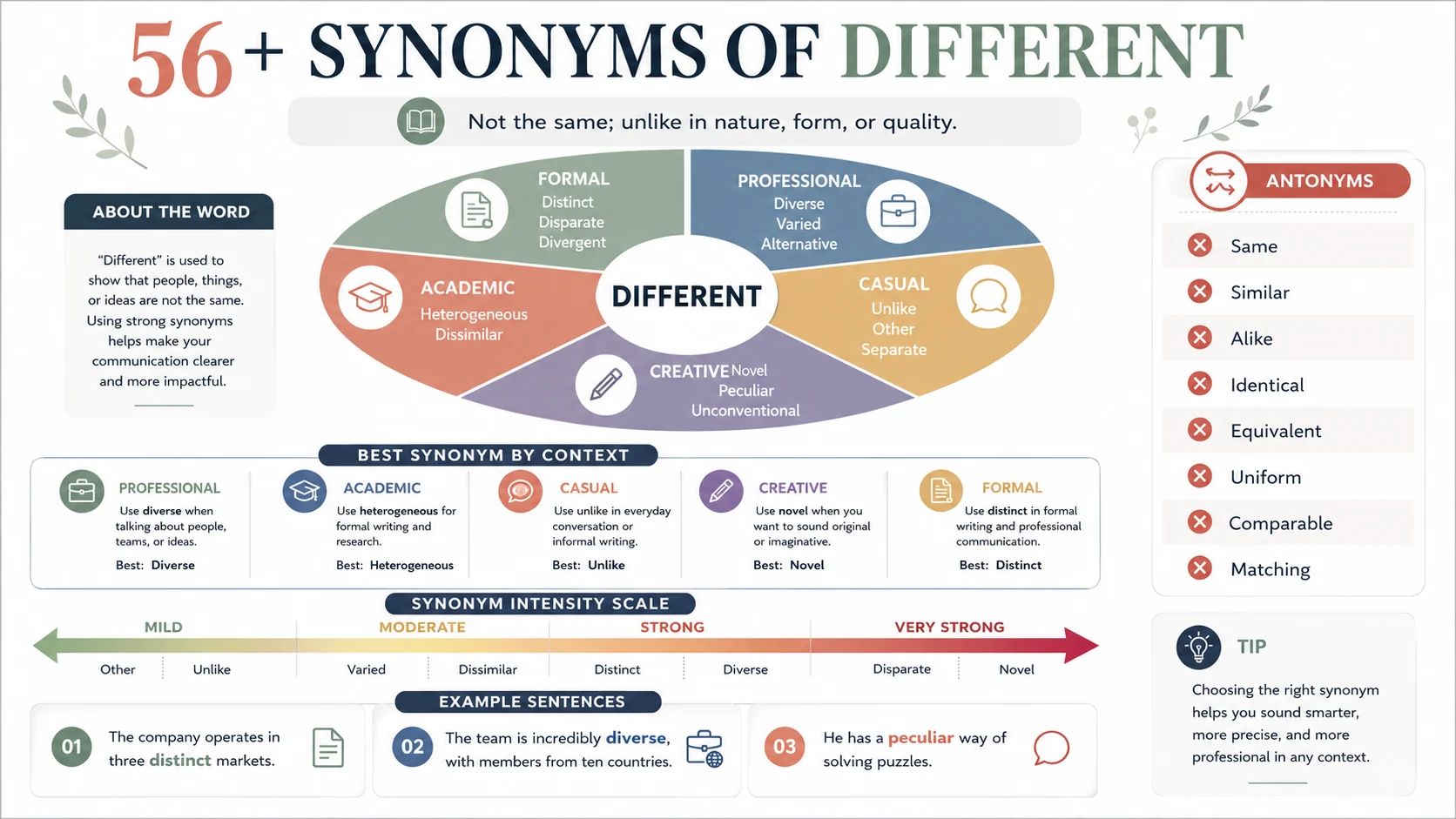
The word “different” means not the same as another or unlike in nature, form, or quality. For formal writing, choose “distinct” or “disparate.” For casual conversation, “other” or “unlike” work well. In academic contexts, “divergent” or “heterogeneous” are strong choices. For professional communication, opt for “diverse” or “varied” to sound precise and inclusive.
Have you ever found yourself writing an email, essay, article, or social media caption and realized you’ve used the word “different” several times in just a few paragraphs? It’s a common writing problem. Although different is useful and grammatically correct, it can sometimes feel repetitive, generic, or too vague when you rely on it too often.
That’s why learning a strong synonym for different can make your writing clearer, more precise, and more engaging. Depending on the context, words such as distinct, diverse, unique, varied, contrasting, dissimilar, alternative, unusual, separate, or individual can communicate a more specific idea than the general word different.
If you’re searching for different synonym, synonym for different, different synonyms, synonyms of different, synonym of different, another word for different, synonyms for different, synonym different, or other words for different, the key is not simply to replace the word mechanically. A good synonym should match the intended meaning, grammatical role, tone, and context of the sentence.
For example, distinct can emphasize that something is clearly separate or recognizable, while diverse usually describes variety within a group. Unique suggests something unusually individual, whereas dissimilar focuses specifically on a lack of similarity. Choosing the right alternative helps your writing sound more natural and avoids subtle changes in meaning.
A different thesaurus can provide a long list of alternatives, but a thesaurus alone doesn’t always explain which word works best in a particular sentence. This guide goes further by considering definitions, usage, tone, context, and example sentences so you can choose an alternative confidently in academic, professional, creative, and everyday writing.
Whether you’re looking for synonyms for different to improve an essay, make an email more professional, strengthen an article, or simply avoid repetition, you’ll find clear explanations and practical examples throughout this guide. The goal is not just to give you more words it’s to help you understand when and why each synonym of different works best.
Meaning, Tone, and Context
Simple Definition
“Different” is an adjective that describes people, things, or ideas that are not alike. It can describe a contrast between two or more items or describe something that stands out as unusual or unique.
Part of Speech
Adjective. The noun form is “difference,” and the adverb form is “differently.”
Overall Tone
The tone of “different” is neutral. It simply states a fact of non-identity. However, it can adopt a positive or negative tone depending on the context. Describing a person as “different” can be a compliment (meaning unique) or an insult (meaning odd or out of place).
Formality Level
“Different” is neutral and can be used in any setting, from formal academic papers to casual text messages. Its neutrality is what makes it so common, but also what makes it less impactful than more specific alternatives.
Common Uses
Native speakers use “different” constantly. It is used to compare objects (“Apples are different from oranges”), to express a change (“Things are different now”), to suggest an alternative (“Let’s try a different approach”), and to describe something unusual (“That movie was certainly different”).
When and How to Use “Different”
Here are realistic examples of how “different” is used in everyday communication.
- Professional: “Our approach to the project is different from what the client initially requested.”
- Academic: “The study examined two different demographic groups to compare the results.”
- Workplace: “I have a different perspective on the quarterly goals.”
- Personal: “My tastes in music are very different from my sister’s.”
- Email: “We are considering a different vendor for the supplies due to the price increase.”
- Resume: “Managed a team of 15 people with different areas of expertise.”
- Social Media: “Trying a different look today. What do you think?”
Best Synonyms of “Different”
No synonym is a perfect match in every situation. The best word depends on your audience, tone, and the specific nuance you want to convey.
- For Professional Writing: “Diverse” is excellent when describing a group with variety. “Disparate” is perfect for highlighting a fundamental lack of connection between things.
- For Academic Writing: “Distinct” is clear and precise for identifying separate features. “Divergent” is ideal for describing opinions or paths that move apart.
- For Business Communication: “Alternative” works well for presenting another option. “Varied” is a neutral term for describing a range of products, services, or methods.
- For Casual Conversation: “Unlike” is simple and direct. Other” is a common and easy way to suggest an alternative without being formal.
- For Emotional Writing: “Unconventional” can carry a proud or defiant tone for those who break rules. “Strange” can express discomfort or unease.
- For Creative Writing: “Peculiar” adds character and a sense of mystery. “Novel” suggests something refreshingly new and original.
When Not to Use “Different”
There are situations where using “different” is less effective.
- When it sounds too general: If you are writing a technical report, saying “the results were different from the hypothesis” is weak. Better: “The results were discrepant from the hypothesis.”
- When it sounds too vague: In a resume, stating you “worked with different people” does not convey much. Better: “Collaborated with diverse stakeholders across multiple departments.”
- When it is too weak: Describing a groundbreaking invention as simply “different” is an understatement. Better: “The invention was truly novel and unprecedented.”
- When it sounds too informal: While “different” is neutral, the phrase “that’s a different story” is highly colloquial and may sound out of place in formal writing. Use a more direct phrase like “that is a separate matter.”
Words Commonly Confused With “Different”
- Alternative: Implies a choice between two or more options. When to use: When presenting a substitute or another possibility. Example: “We need to find an alternative venue for the conference.”
- Distinct: Means clearly separate and identifiable. When to use: When you want to emphasize that things are not the same and are easy to tell apart. Example: “The two species share a habitat but have distinct characteristics.”
- Diverse: Means showing a great variety of different elements. When to use: When describing a group or collection with many different types of people or things. Example: “The company is committed to building a diverse and inclusive workforce.”
- Disparate: Means essentially different in kind and not allowing comparison. When to use: When things are not just different but fundamentally unrelated. Example: “The report tried to combine two disparate data sets.”
- Unusual: Means not common or ordinary. When to use: When describing something that stands out because it is rare or unexpected. Example: “Her approach to the problem was unusual but very effective.”
Best Synonyms of “Different” by Context
| Context | Best Synonym | Why It Works | Example |
|---|---|---|---|
| Formal writing | Distinct | Conveys a clear, unambiguous separation of ideas or items. | “The author raises three distinct issues in the introduction.” |
| Academic writing | Divergent | Suggests ideas or paths that are moving in different, often opposing, directions. | “The two theories offer divergent interpretations of the evidence.” |
| Professional comms | Varied | A neutral and professional way to describe a range of tasks, skills, or items. | “My role involves a varied range of responsibilities.” |
| Business emails | Alternative | Clearly indicates a substitute option or a different plan. | “Let’s look at an alternative approach to the marketing campaign.” |
| Resume writing | Diverse | Strongly implies the ability to work with a wide range of people or concepts. | “Managed a diverse team of engineers and designers.” |
| Workplace | Differing | A standard, polite way to acknowledge disagreement or variation in opinion. | “Team members had differing opinions on the project’s direction.” |
| Casual conversation | Unlike | A simple and natural way to make a comparison between two things. | “Her style is unlike anything I’ve seen before.” |
| Creative writing | Peculiar | Adds a layer of intrigue or mystery to a person, place, or thing. | “The old house had a peculiar smell that I could not place.” |
| Emotional writing | Unconventional | Can evoke admiration for someone who is bold and original. | “Her unconventional approach to life often shocked her family.” |
How to Choose the Best Synonym of “Different”
Choosing the right synonym is a simple decision-making process. First, ask yourself what you are comparing. If you are distinguishing two clear things, use “distinct.” If you are describing a diverse group, use “diverse.” Next, consider your audience. A formal report requires “disparate,” while a friendly email allows for “unlike.” Finally, think about the emotional impact. Do you want to sound critical (“peculiar”) or complimentary (“novel”)? Match your word to the specific message, emotion, and clarity you want to achieve.
Real Life Examples of “Different”
- School: “The two books were about the same time period but offered very different perspectives.”
- College: “Applying to college is a different process than it was for my parents.”
- Workplace: “We need to consider a different strategy if we want to hit our targets.”
- Business: “Our product is distinct from the competitors because of its unique software.”
- Email: “Could we set up a separate meeting to discuss the budget in detail?”
- Resume: “Implemented a novel inventory system that reduced waste by 15%.”
- Conversation: “I like your jacket; it looks really unique.”
- Storytelling: “He had a peculiar habit of collecting old keys.”
- Blogging: “Trying a new and unconventional recipe today.”
- Social Media: “Feeling unlike myself today. Time for a reset.”
18 Best Synonyms of “Different”
| Synonym | Simple Meaning | Best Used For | Example Sentence |
|---|---|---|---|
| Distinct | Clearly separate and different. | Formal writing, academic contexts. | “The company operates in three distinct markets.” |
| Dissimilar | Not alike in appearance or nature. | Neutral comparisons. | “Though twins, their personalities are completely dissimilar.” |
| Diverse | Showing a wide variety of elements. | Describing groups, teams, and cultures. | “The city is known for its diverse culinary scene.” |
| Disparate | Fundamentally different and unrelated. | High-level analysis, technical writing. | “The study combined disparate fields of research.” |
| Divergent | Differing or moving apart from a common point. | Academic writing, discussions of ideas. | “The committee members have divergent views on the issue.” |
| Alternative | A different option or substitute. | Business, decision-making. | We are exploring alternative solutions to the problem.” |
| Unalike | Not similar; not having the same characteristics. | Casual comparisons. | “My two children are very unalike in their interests.” |
| Varying | Showing change or inconsistency. | Describing fluctuating data or conditions. | “Our results were varying depending on the time of day.” |
| Novel | New, original, and unusual in an interesting way. | Creative writing, describing innovations. | “The professor presented a novel theory that challenged everything we knew.” |
| Peculiar | Strange, odd, or distinctive in a way that stands out. | Creative writing, describing quirks. | “He has a peculiar way of solving puzzles.” |
| Unconventional | Not based on or conforming to the usual rules. | Describing unique lifestyles or bold choices. | “She is a designer known for her unconventional style.” |
| Contrasting | Showing a clear difference when compared. | Visual descriptions, analysis of opposites. | “The artist used contrasting colors to create a dramatic effect.” |
| Varied | Including multiple different types. | Professional communication, resumes. | “My career includes a varied range of experiences.” |
Synonyms of “Different” by Usage
Professional vs Personal Synonyms
Professional: In resumes and business reports, “diverse,” “varied,” and “distinct” are highly effective. They are formal and convey competence. Personal: In conversations with friends, “unlike,” “other,” and “different” itself are perfectly fine. You might also use “peculiar” or “unconventional” to affectionately describe a friend’s unique habits.
Formal vs Conversational Synonyms
Formal: “Disparate,” “divergent,” and “heterogeneous” are sophisticated and appropriate for research papers and executive summaries. Conversational: “Different” is the workhorse of everyday speech. “Unalike,” “not the same,” and “dissimilar” are also common, but simpler words are usually better for fast-paced conversation.
Academic Synonyms
Words like “disparate,” “divergent,” and “heterogeneous” demonstrate a high level of vocabulary. Using them in an essay shows a precise understanding of nuance. For instance, using “divergent” suggests a split from a shared starting point, while “heterogeneous” describes a group made up of very different components.
Professional and Business Synonyms
“Diverse” is powerful in a resume because it shows you can work with a broad range of people. “Alternative” is the best word for problem-solving and pitching ideas. “Varied” is a strong, safe option for describing day-to-day responsibilities without exaggeration.
Creative and Literary Synonyms
For writers, “novel” and “unconventional” are essential for describing original ideas. “Peculiar” adds a sense of mystery or intrigue. “Contrasting” is great for visual imagery, and “singular” can be used to describe a character who is one of a kind.
Slang or Modern Synonyms
“Different” itself can be used as slang to mean “good” or “unique” in a positive way (“That new album is different!”). There are no widely recognized slang synonyms for “different” that don’t also sound dated.
Strongest to Mildest Synonyms
- Mild: Other, unlike, separate.
- Moderate: Dissimilar, varied, alternative, contrasting.
- Strong: Distinct, diverse, uncommon, divergent.
- Very Strong: Disparate, novel, unconventional, peculiar.
Emotional vs Neutral Synonyms
Emotional Synonyms: “Peculiar” can suggest suspicion or curiosity. “Unconventional” suggests admiration for someone’s bravery. “Novel” suggests excitement about something new. Neutral Synonyms: “Dissimilar,” “distinct,” and “separate” simply convey information without emotion. Use neutral words in professional documents where objectivity is key.
Antonyms of “Different”
| Antonym | Meaning | Example Sentence |
|---|---|---|
| Similar | Alike in a way that is easy to compare. | “The two brothers have similar tastes in music.” |
| Same | Identical in nature or character. | “We are all working toward the same goal.” |
| Alike | Similar in appearance or nature. | “The two dresses look completely alike.” |
| Identical | Exactly the same in every detail. | “The DNA samples were identical.” |
| Equivalent | Equal in value, amount, or meaning. | “A mile is roughly equivalent to 1.6 kilometers.” |
| Uniform | Not varying or changing; consistent. | “The factory produces products of uniform quality.” |
| Comparable | Similar in a way that allows for comparison. | “The two companies are of comparable size.” |
| Matching | Having the same color, pattern, or style. | “She wore a matching scarf and hat.” |
| Consistent | Acting or done in the same way over time. | “Her results have been consistent all year.” |
| Homogeneous | Composed of parts that are all the same or similar. | “The population was largely homogeneous.” |
| Equal | The same in quantity, size, or degree. | “We split the profits into equal shares.” |
| Parallel | Occurring in a similar way or at the same time. | “The two stories follow parallel plots.” |
| Analogous | Comparable in certain respects. | “The structure of an atom is analogous to a solar system.” |
| Corresponding | Matching or similar. | “Each item has a corresponding code.” |
| Resembling | Having a similar appearance or quality. | “The cloud was resembling a dragon.” |
Comparison: “Different” vs Similar Words
Different vs Distinct
- Main Difference: “Different” means not the same. “Distinct” means clearly separate and identifiable.
- Which Is Stronger? “Distinct” is stronger. It implies a difference that is obvious and undeniable.
- Which Is More Formal? Both are formal, but “distinct” is often favored in academic writing.
- When to Use Each: Use “different” for general contrasts. Use “distinct” to emphasize that items are separate entities.
- Examples:
- Different: “My opinion is different from yours.”
- Distinct: “The proposal has three distinct phases.”
Different vs Diverse
- Main Difference: “Different” can describe two things. “Diverse” describes a group with many different types.
- Which Is Stronger? “Diverse” is more impactful because it implies a rich range.
- Which Is More Formal? “Diverse” is slightly more formal.
- When to Use Each: Use “different” for a simple contrast. Use “diverse” when celebrating variety.
- Examples:
- Different: “I tried a different app for editing photos.”
- Diverse: “The team is incredibly diverse, with members from ten countries.”
Different vs Divergent
- Main Difference: “Different” is a static state. “Divergent” implies moving apart from a common point.
- Which Is Stronger? “Divergent” is stronger and suggests a fundamental split.
- Which Is More Formal? “Divergent” is highly formal and academic.
- When to Use Each: Use “different” to state a fact. Use “divergent” to describe a dynamic process of splitting or disagreement.
- Examples:
- Different: “We have different ideas about the design.”
- Divergent: “Our careers took divergent paths after graduate school.”
Common Phrases and Expressions with “Different”
| Phrase | Meaning | Example Sentence |
|---|---|---|
| “A different kettle of fish” | A completely different matter or situation. | “Being a manager is a different kettle of fish from being an employee.” |
| “To sing a different tune” | To change one’s opinion or behavior. | “After seeing the evidence, he started singing a different tune.” |
| “Different strokes for different folks” | People have different preferences and lifestyles. | “I don’t like modern art, but different strokes for different folks.” |
| “That’s a different story” | Used to indicate that what is being discussed is a separate topic. | “I enjoy traveling, but packing for a trip is a different story.” |
| “To march to the beat of a different drummer” | To act independently and unconventionally. | “He was always a creative child, marching to the beat of a different drummer.” |
Common Mistakes to Avoid
- Mistake 1: Choosing a vague synonym. Using “dissimilar” when you mean “distinct.” “Dissimilar” is just a fancy way of saying not alike, while “distinct” implies a clear, noticeable difference.
- Incorrect: “The two species are dissimilar.”
- Better: “The two species are distinct in their habitat and breeding patterns.”
- Mistake 2: Using a formal synonym in a casual context. Saying “the movies are disparate” to a friend sounds awkward.
- Better: “Those two movies are completely different.”
- Mistake 3: Misusing “diverse.” A single object cannot be diverse; diversity requires a group.
- Incorrect: “I bought a diverse car.”
- Better: “The showroom had a diverse selection of cars.”
- Mistake 4: Using an overly dramatic synonym. Saying a small change is “unprecedented” is an exaggeration.
- Better: “We made a novel adjustment to the process.”
- Mistake 5: Forgetting that “alternative” implies a choice. You should only use “alternative” when there is an option to pick.
- Incorrect: “The two items were alternative to each other.” (Use “different” or “separate” instead).
- Better: “We have two alternative routes to the city.”
Frequently Asked Questions
What are the best synonyms of “different”?
The best synonyms depend on the context. For formal writing, use “distinct” or “disparate.” For casual conversation, use “unlike” or “other.” For creative writing, “peculiar” or “novel” are excellent choices.
What are the best formal synonyms of “different”?
The best formal synonyms include “distinct,” “disparate,” “dissimilar,” and “divergent.” These words are commonly used in academic, professional, and technical writing to convey precision.
What are common informal synonyms of “different”?
Common informal synonyms include “unlike,” “other,” “separate,” and simply using the word “different” itself. In casual conversation, “different” is often the most natural and appropriate word.
What is another word for “different” in professional writing?
In professional writing, words like “diverse,” “varied,” and “alternative” are strong choices. “Diverse” is excellent for describing teams and markets, while “alternative” is perfect for presenting new options.
What is the difference between “different” and “distinct”?
“Different” is a general term meaning not the same. “Distinct” is a stronger term that implies a clear, unmistakable, and often easily recognizable separation or identity.
What is the opposite of “different”?
The primary opposites of “different” are “same,” “similar,” “alike,” and “identical.” Others include “equivalent,” “uniform,” and “comparable.”
Conclusion
The word “different” is a vital part of English vocabulary. It is neutral, clear, and usable in almost any situation. However, mastering a wide range of synonyms of different allows you to communicate with greater precision, express stronger emotions, and adapt your tone to any audience. Remember, the best word is not the most complicated one; it is the one that perfectly conveys your intended message. When you write or speak, think about the context, the audience, and the nuance you want to create. The right synonym will make your language stronger and more effective.
