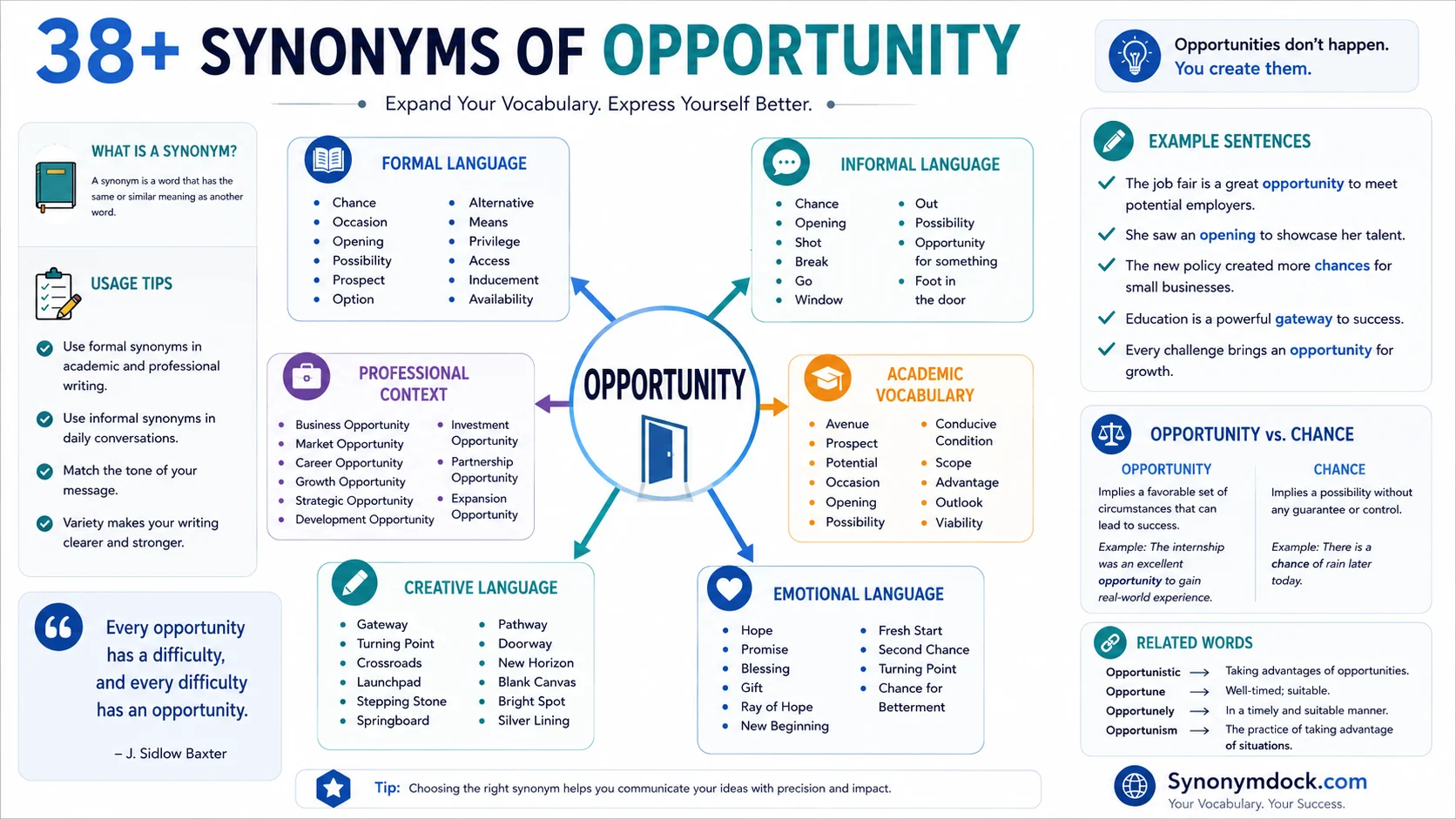
A synonym of “opportunity” is a word that describes a favorable time, chance, or set of circumstances that allows something to be done or achieved . The best alternative depends on context. For professional writing, use “opening” or “prospect.” In casual conversation, “chance” or “break” works well. For academic work, choose “possibility” or “occasion.” In resumes, “scope” and “option” sound strong and professional.
You are writing an important email to a potential employer. You want to say you are excited about the chance to contribute to their team. But you have already used the word “opportunity” three times in the last two paragraphs. Your writing feels repetitive and flat. This is a common struggle for writers, students, and professionals alike. Finding the right synonym of opportunity can instantly improve your clarity and make your message more engaging. The English language offers dozens of alternatives, each with its own tone and ideal use case. Choosing the right one depends on your audience, your purpose, and the emotional weight you want to carry. This guide will help you master the subtle art of selecting the perfect synonym for any situation.
Meaning, Tone, and Context
Simple Definition
“Opportunity” refers to a favorable time, situation, or set of circumstances that makes it possible to do something you want to do .
Part of Speech
Opportunity is a noun. Its plural form is opportunities .
Overall Tone
Neutral. The word itself does not carry a strong emotional charge. It simply describes a situation that allows for action or progress.
Formality Level
Semi-formal. “Opportunity” fits comfortably in professional emails, academic writing, and everyday conversation. It is not overly academic, nor is it casual slang.
Common Uses
Native English speakers use “opportunity” frequently in professional and personal contexts. You will see it in job descriptions (“career opportunity”), business emails (“opportunity to discuss”), and everyday speech (“great opportunity”). It often describes a chance for advancement, learning, or positive change .
Word Forms
Noun: opportunity, opportunities
Adjective: opportune (meaning well-timed or favorable)
Verb form: None. The concept is expressed through phrases like “to have an opportunity” or “to seize an opportunity.”
When and How to Use “Opportunity”
Use “opportunity” when you want to describe a favorable situation without adding strong emotion. It is a safe, reliable choice for most professional and personal contexts. Here are seven realistic examples:
Professional Context
“I would like to take this opportunity to thank everyone who contributed to the project.”
Academic Context
“Studying abroad provides a great opportunity to learn a new language.”
Workplace Context
“New employees have an opportunity to attend the leadership training program next month.”
Personal Context
“We finally have an opportunity to take a vacation together.”
Email Context
“Please let me know when you have an opportunity to review the attached document.”
Resume Context
“Seeking an opportunity to apply my project management skills in a dynamic organization.”
Social Media Context
“Excited about the opportunity to collaborate with such a talented team!”
Best Synonyms of “Opportunity”
No synonym is identical in every situation. Here is the best synonym for different writing contexts.
Professional Writing
Opening. This word suggests a specific chance to enter a new situation or role. It implies timing and readiness. You “wait for an opening” rather than simply hoping for a chance.
Academic Writing
Possibility. This word frames an opportunity as one of several potential outcomes. It sounds analytical and measured, which fits research and scholarly discussion.
Business Communication
Prospect. “Prospect” emphasizes the future potential of an opportunity. It carries a slightly more strategic tone than the basic word.
Casual Conversation
Chance. This is the most natural alternative for everyday speech. It is simple, direct, and familiar.
Emotional Writing
Break. This word suggests that an opportunity arrives through luck or good fortune. It carries an emotional weight of relief or gratitude.
Creative Writing
Occasion. This word sounds more literary and deliberate. It gives the sense that the moment is significant and worth noting.
Resume Writing
Scope. “Scope” suggests room to apply skills and grow. It sounds active and ambitious.
Workplace Communication
Turn. This word emphasizes that the opportunity is part of a natural rotation or sequence. It is less formal than “opening.”
Stronger Meaning
Golden opportunity. This phrase emphasizes that the chance is exceptionally good and rare .
Softer Meaning
Option. “Option” sounds more neutral and less emotionally charged. It simply presents a choice rather than a big moment.
When Not to Use “Opportunity”
Too General
Sometimes “opportunity” is so broad that it does not communicate specific meaning.
Incorrect: “I am looking for new opportunities.”
Better: “I am looking for a new position in digital marketing.”
Why: The original sentence gives no clear direction or purpose.
Too Vague in Job Applications
Employers see hundreds of resumes using the word “opportunity.” It blends in.
Incorrect: “Opportunity to use my skills.”
Better: “Position offering the scope to lead product development projects.”
Why: The revision shows concrete potential and demonstrates ambition.
Too Formal for Casual Situations
Incorrect: “Would you like an opportunity to get coffee?”
Better: “Do you have time to grab coffee?”
Why: The first version sounds stiff and overly businesslike.
Too Weak for Resumes
Incorrect: “I want an opportunity to contribute.”
Better: “I am prepared to step into a challenging leadership role.”
Why: The second version sounds confident and ready.
Too Strong for Simple Choices
Incorrect: “This is a life-changing opportunity to choose a pizza topping.”
Better: “Here is your chance to pick a pizza topping.”
Why: The first version exaggerates a minor situation.
Outdated Usage
“Opportunity” has not changed significantly, but overusing it can make writing sound formulaic. Avoid using it in every sentence.
Words Commonly Confused With “Opportunity”
Opportunity vs. Chance
Difference: “Chance” often implies luck or randomness. “Opportunity” suggests a more favorable and possibly planned situation .
When to Use Each: Use “chance” when luck is involved. Use “opportunity” when the situation seems earned or well-timed.
Example: “Meeting my mentor was pure chance.” / “The internship gave me an opportunity to learn.”
Opportunity vs. Possibility
Difference: “Possibility” is broader. It refers to anything that could happen, whether likely or not. “Opportunity” is narrower and implies a favorable chance .
When to Use Each: Use “possibility” for hypothetical situations. Use “opportunity” when a real, favorable chance exists.
Example: “There is a possibility of rain.” / “The job fair provides an opportunity to network.”
Opportunity vs. Opening
Difference: “Opening” often refers to a specific vacancy or entry point, especially in a job context. “Opportunity” is more general .
When to Use Each: Use “opening” for job positions or specific moments. Use “opportunity” for broader situations.
Example: “There is an opening in the marketing department.” / “The conference gave me an opportunity to meet new clients.”
Opportunity vs. Occasion
Difference: “Occasion” emphasizes the timing or appropriateness of the moment .
When to Use Each: Use “occasion” when the timing is notable. Use “opportunity” when focusing on the action itself.
Example: “The wedding was a special occasion.” / “The team used the occasion as an opportunity to celebrate.”
Opportunity vs. Break
Difference: “Break” suggests good luck or a sudden favorable turn of events .
When to Use Each: Use “break” for unexpected good fortune. Use “opportunity” for more expected or earned chances.
Example: “He got his big break in Hollywood.” / “She was ready when the opportunity came.”
Opportunity vs. Scope
Difference: “Scope” refers to the room or freedom to act. “Opportunity” refers to the chance itself .
When to Use Each: Use “scope” when highlighting freedom and capacity. Use “opportunity” when focusing on the chance itself.
Example: “The new role gives me scope to innovate.” / “The project is a great opportunity to lead.”
Best Synonyms of “Opportunity” by Context
| Context | Best Synonym | Why It Works | Example |
|---|---|---|---|
| Formal Writing | Occasion | Sounds polished and deliberate | “The summit provided an occasion to address global challenges.” |
| Academic Writing | Possibility | Sounds analytical and measured | “This research explores the possibility of alternative energy sources.” |
| Professional Communication | Opening | Suggests a specific, ready-made chance | “The reorganization created an opening for a new team leader.” |
| Business Emails | Prospect | Emphasizes future potential and strategic value | “We see excellent prospects for expanding into new markets.” |
| Resume Writing | Scope | Highlights your capacity and ambition | “Seeking a role that provides scope for creative problem-solving.” |
| Workplace Communication | Turn | Emphasizes rotation and fairness | “Each team member will have a turn to present their ideas.” |
| Casual Conversation | Chance | Simple, natural, and direct | “Do you think we will get a chance to see the presentation?” |
| Everyday Speaking | Shot | Very casual and friendly | “I would love a shot at that project.” |
| Creative Writing | Moment | Emphasizes significance and emotion | “This was the moment she had been waiting for.” |
| Storytelling | Break | Suggests luck and unexpected good fortune | “His break came when he least expected it.” |
| Emotional Writing | Golden Opportunity | Emphasizes rarity and importance | “This is a golden opportunity to make a real difference.” |
| Strong Emphasis | Prime Time | Suggests peak readiness and timing | “This is prime time to launch the new product.” |
| Mild Tone | Option | Neutral and low-pressure | “We have several options for moving forward.” |
| Social Media Captions | Chance | Short, catchy, and relatable | “New chance, new adventure!” |
| American English | Opening | Commonly used in job and business contexts | “We are looking for an opening to enter that market.” |
How to Choose the Best Synonym of “Opportunity”
Choosing the right synonym is about knowing your audience and your purpose.
Consider the tone. Are you writing a formal report or a casual email? A formal tone calls for words like “occasion” or “prospect.” A casual tone works with “chance” or “shot.”
Consider the audience. Professionals expect words like “opening” and “scope.” Friends will find “break” and “shot” more natural.
Consider the emotional weight. Do you want to sound grateful, excited, neutral, or lucky? “Golden opportunity” carries strong positive emotion. “Option” is neutral. “Break” suggests gratitude for unexpected luck.
Consider the writing purpose. Are you trying to persuade, inform, or entertain? Persuasive writing benefits from stronger synonyms like “prime time.” Informative writing works with neutral options like “possibility.
Consider the formality level. Resumes, reports, and business emails are formal. Social media, texting, and conversations are informal. Match your word to the setting.
Most important: choose the word that sounds natural. If a synonym feels forced or awkward, it is probably the wrong choice. Read your sentence aloud. Does it sound like something you would actually say?
Real Life Examples of “Opportunity”
School
“The science fair gave me an opportunity to showcase my experiment.”
Stronger: “The science fair gave me a chance to showcase my experiment.”
College
“College offers an opportunity to explore different career paths.”
Stronger: “College offers the scope to explore different career paths.”
Workplace
“We have an opportunity to increase our market share.”
Stronger: “We have a golden opportunity to increase our market share.”
Business
“The new partnership presents an opportunity for growth.”
Stronger: “The new partnership presents a promising prospect for growth.”
Email
“I would like an opportunity to discuss the proposal with you.”
Stronger: “I would appreciate an opening to discuss the proposal with you.”
Resume
“Seeking an opportunity to contribute to a growing company.”
Stronger: “Seeking a role with scope to contribute to a growing company.”
Conversation
“I finally got an opportunity to travel this summer.”
Natural: “I finally got a chance to travel this summer.”
Storytelling
“This was the opportunity she had dreamed of.”
Stronger: “This was the moment she had been waiting for.”
Blogging
“Starting a blog offers an opportunity to share your ideas.”
Stronger: “Starting a blog offers a great chance to share your ideas.”
Social Media
“New opportunity knocking!”
Natural: “New door opening!”
18 Best Synonyms of “Opportunity”
| Synonym | Simple Meaning | Best Used For | Example Sentence |
|---|---|---|---|
| Chance | A favorable set of circumstances | General, casual, everyday use | “I would love a chance to join the team.” |
| Opening | A specific vacancy or entry point | Professional, job search | “There is an opening for a new project manager.” |
| Occasion | A particular time that is suitable | Formal, literary, speeches | “The meeting provided an occasion to share our vision.” |
| Break | A sudden, lucky turn of events | Casual, emotional, storytelling | “She caught her big break when the producer saw her performance.” |
| Prospect | Future potential for success | Business, strategic planning | “The company sees strong prospects in emerging markets.” |
| Possibility | Something that may happen | Academic, analytical | “We are investigating every possibility for expansion.” |
| Scope | Room for action or thought | Resumes, ambitious writing | “The role offers scope for creative problem-solving.” |
| Option | A choice among alternatives | Neutral, decision-making | “We have several options for the next phase.” |
| Moment | A significant point in time | Creative, emotional, storytelling | “This was the moment they had all been waiting for.” |
| Turn | A chance in a sequence | Workplace, casual | “Each student will have a turn to present.” |
| Shot | An attempt or opportunity | Very casual, sports, informal | “I would like a shot at that job.” |
| Golden Opportunity | A rare, excellent chance | Strong emphasis, motivational | “This is a golden opportunity to start your own business.” |
| Time | A suitable moment | General, everyday | “Is this a good time to discuss the project?” |
| Slice | A chance or portion | Informal, modern | “Everyone deserves a slice of the opportunity.” |
| Field Day | A great chance for enjoyment | Informal, enthusiastic | “The children had a field day at the amusement park.” |
| Leeway | Room to move or act | Professional, creative | “The manager gave us leeway to try new approaches.” |
| Run | A period of opportunity | Casual, sports | “Give me a run at the problem and I will solve it.” |
| Fit | A suitable opportunity | Modern, career | “This position seems like a perfect fit for her skills.” |
Synonyms of “Opportunity” by Usage
Professional vs Personal Synonyms
Professional: “Opening,” “prospect,” “scope,” “leeway,” “option”
Personal: “Chance,” “break,” “shot,” “time,” “turn”
Professional synonyms sound more strategic and formal. They belong in resumes, emails, and meetings. Personal synonyms feel warmer and more natural in conversations.
Formal vs Conversational Synonyms
Formal: “Occasion,” “prospect,” “possibility,” “scope”
Conversational: “Chance,” “break,” “shot,” “time”
Formal synonyms fit reports, essays, and business writing. Conversational synonyms work for emails to friends, social media, and casual meetings.
Academic Synonyms
Academic writing values precision and measured language. “Possibility” and “occasion” are strong choices. They sound analytical and neutral. “Prospect” and “scope” also fit research discussions. Avoid “break” and “shot” in academic work.
Professional and Business Synonyms
Resumes, interviews, and client communication demand strong, ambitious words. “Scope,” “opening,” and “prospect” demonstrate confidence. “Golden opportunity” can be effective when used sparingly in motivational contexts. Match the word to the specific industry and company culture.
Creative and Literary Synonyms
Storytelling and descriptive writing benefit from more expressive alternatives. “Moment,” “occasion,” and “break” add emotional depth. “Golden opportunity” creates a strong image. These words help build atmosphere and convey character emotion.
Slang or Modern Synonyms
Modern English offers several informal options. “Shot” and “slice” are casual and friendly. Field day” suggests enthusiastic enjoyment. Use these in social media, texting, and casual conversation. Avoid them in formal writing.
Strongest to Mildest Synonyms
Mild: option, possibility, time
Moderate: chance, opening, occasion, scope, turn
Strong: prospect, opportunity (the standard), moment
Very Strong: golden opportunity, prime time, break
The intensity changes the emotional impact. A mild word like “option” presents a neutral choice. A strong word like “golden opportunity” suggests that this is a rare and important moment. Choose the level of intensity that matches your message.
Emotional vs Neutral Synonyms
Emotional Synonyms
These words carry strong feelings of excitement, gratitude, or relief.
“Break” suggests luck and thankfulness.
“Golden opportunity” communicates value and excitement.
“Chance” often implies hope.
Neutral Synonyms
These words simply communicate the possibility without added emotion.
“Option” is neutral and practical.
“Possibility” is analytical.
“Scope” is about freedom, not emotion.
Use emotional words when you want to persuade or inspire. Use neutral words when you need to inform clearly.
Antonyms of “Opportunity”
| Antonym | Meaning | Example Sentence |
|---|---|---|
| Obstacle | Something that blocks progress | “The lack of funding was a major obstacle.” |
| Hindrance | Something that causes delay or difficulty | “The broken printer was a hindrance to finishing the report.” |
| Barrier | Something that prevents access or progress | “Language differences can be a barrier to communication.” |
| Blockage | A complete obstruction | “The proposal faced a blockage in the approval process.” |
| Hurdle | A challenge that must be overcome | “Completing the certification was a significant hurdle.” |
| Impediment | Something that slows down or stops | “His injury was an impediment to his athletic career.” |
| Setback | An unexpected delay or reversal | “The project suffered a setback when funding was cut.” |
| Misfortune | Bad luck or unfavorable circumstances | “A series of misfortunes ruined his travel plans.” |
| Missed Chance | A chance that was not taken | “Not applying was a missed chance for him.” |
| Closing | The end of an opportunity | “The closing of the application period disappointed many.” |
| Dead End | A situation with no progress possible | “The negotiations reached a dead end.” |
| Disadvantage | An unfavorable situation | “His lack of experience was a clear disadvantage.” |
| Difficulty | A problem that requires effort to solve | “The difficulty of the task discouraged many applicants.” |
| Block | Something that prevents movement | “The legal block stopped the merger from proceeding.” |
| Loss | A failure to keep or achieve | “The loss of the contract was a huge setback for the company.” |
Comparison: “Opportunity” vs Similar Words
Opportunity vs Chance
Main Difference: “Chance” often implies luck, while “opportunity” suggests a favorable, possibly planned situation .
Which Is Stronger? “Opportunity” is slightly stronger because it implies a more deliberate situation.
Which Is More Formal? “Opportunity” is more formal.
When to Use Each: Use “chance” for casual conversation. Use “opportunity” for professional writing.
Examples:
Opportunity: “The conference gave me an opportunity to network.”
Chance: “I took a chance and applied for the job.”
Opportunity vs Possibility
Main Difference: “Possibility” is broader and more hypothetical. “Opportunity” is a real and favorable chance .
Which Is Stronger? “Opportunity” is stronger because it implies a real opening.
Which Is More Formal? Both are formal, but “possibility” is more analytical.
When to Use Each: Use “possibility” for hypothetical or uncertain situations. Use “opportunity” for real chances.
Examples:
Opportunity: “This role is a great opportunity to grow.”
Possibility: “There is a possibility we will expand next year.”
Opportunity vs Opening
Main Difference: “Opening” often refers to a specific vacancy, while “opportunity” is more general .
Which Is Stronger? “Opening” is more specific and direct.
Which Is More Formal? Both are professional, but “opening” is very common in business.
When to Use Each: Use “opening” for job positions and specific entry points. Use “opportunity” for broader favorable situations.
Examples:
Opportunity: “I have an opportunity to lead a project.”
Opening: “There is an opening for a marketing director.”
Opportunity vs Occasion
Main Difference: “Occasion” emphasizes the appropriateness of the time .
Which Is Stronger? “Occasion” sounds more formal and deliberate.
Which Is More Formal? “Occasion” is more formal.
When to Use Each: Use “occasion” for formal events and speeches. Use “opportunity” for general chances.
Examples:
Opportunity: “I would like to take this opportunity to thank you.”
Occasion: “The holiday was a special occasion for the family.”
Opportunity vs Break
Main Difference: “Break” suggests lucky, sudden good fortune .
Which Is Stronger? “Break” carries stronger emotional weight.
Which Is More Formal? “Break” is much less formal.
When to Use Each: Use “break” for unexpected luck. Use “opportunity” for more expected or earned chances.
Examples:
Opportunity: “The job fair provided a valuable opportunity.”
Break: “Getting that audition was his big break.”
Opportunity vs Scope
Main Difference: “Scope” refers to the room for action. “Opportunity” refers to the chance itself .
Which Is Stronger? “Scope” sounds ambitious and confident.
Which Is More Formal? Both are professional.
When to Use Each: Use “scope” when highlighting freedom and capacity. Use “opportunity” for the chance itself.
Examples:
Opportunity: “This is a great opportunity to innovate.”
Scope: “The position gives me scope to innovate.”
Common Phrases and Expressions with “Opportunity”
Phrase: Golden Opportunity
Meaning: A rare and excellent chance .
Example Sentence: “Investing in that company was a golden opportunity.”
Phrase: Opportunity Knocks
Meaning: A chance presents itself .
Example Sentence: “When opportunity knocks, you have to be ready to answer.”
Phrase: Land of Opportunity
Meaning: A place with many chances for success .
Example Sentence: “The United States has long been called the land of opportunity.”
Phrase: Take the Opportunity
Meaning: Use a chance to do something .
Example Sentence: “I would like to take this opportunity to thank everyone.
Phrase: Missed Opportunity
Meaning: A chance that was not used.
Example Sentence: “Not traveling abroad when I was young was a missed opportunity.”
Phrase: Window of Opportunity
Meaning: A limited time during which a chance exists .
Example Sentence: “We have a two-year window of opportunity to enter this market.”
Phrase: Opportunity Cost
Meaning: The loss of potential gain from other options.
Example Sentence: “The opportunity cost of staying in this job is high.”
Common Mistakes to Avoid
Mistake 1: Choosing a Vague Synonym
Incorrect: “I am looking for opportunities.”
Better: “I am looking for an opening in the marketing field.”
Why: The vague version gives no direction. The specific version shows focus.
Mistake 2: Confusing “Opportunity” with “Possibility”
Incorrect: “We have an opportunity of rain tomorrow.”
Better: “We have a possibility of rain tomorrow.”
Why: Rain is not a favorable circumstance. It is a potential outcome.
Mistake 3: Using an Informal Synonym in Formal Writing
Incorrect: “I would like a shot at that position.”
Better: “I would like an opportunity to apply for that position.”
Why: “Shot” is too casual for professional applications.
Mistake 4: Selecting an Overly Dramatic Word
Incorrect: “This is a golden opportunity to have lunch.”
Better: “This is a good chance to have lunch.”
Why: “Golden opportunity” is too strong for a minor situation.
Mistake 5: Repeating the Same Word Too Often
Incorrect: “This opportunity is great. The opportunity will help my career. I hope to get this opportunity.”
Better: “This opportunity is great. It will help my career. I hope to get this chance.”
Why: Varying word choice keeps writing fresh and engaging.
Mistake 6: Choosing a Synonym with the Wrong Emotional Tone
Incorrect: “The team faces the opportunity of losing the contract.”
Better: “The team faces the prospect of losing the contract.”
Why: “Opportunity” is positive. “Prospect” is neutral and can be negative.
Mistake 7: Using Slang in Professional Writing
Incorrect: “The new role gives me a shot at management.”
Better: “The new role gives me scope to advance into management.”
Why: “Shot” is too casual for a resume or interview.
Frequently Asked Questions
1. What are the best synonyms of “opportunity”?
The best synonyms include “chance,” “opening,” “occasion,” “break,” “prospect,” “possibility,” and “scope.” The right choice depends on your context and audience.
2. What are the best formal synonyms of “opportunity”?
For formal writing, use “occasion,” “prospect,” “possibility,” or “scope.” These words sound polished and appropriate for academic, business, and professional contexts.
3. What are common informal synonyms of “opportunity”?
Common informal synonyms include “chance,” “break,” “shot,” and “time.” These are natural choices for casual conversations, social media, and personal messages.
4. What is another word for “opportunity” in professional writing?
Opening,” “prospect,” and “scope” are excellent alternatives in professional writing. “Opening” suggests a specific vacancy, while “scope” highlights room for growth and action.
5. What is the difference between “opportunity” and “chance”?
“Chance” often implies luck or randomness, while “opportunity” suggests a favorable, possibly planned situation. Use “chance” for casual contexts and “opportunity” for professional ones .
6. What is the opposite of “opportunity”?
Antonyms of “opportunity” include “obstacle,” “hindrance,” “barrier,” “blockage,” “hurdle,” “impediment,” and “setback.” These words describe things that block or hinder progress.
Conclusion
“Opportunity” is a versatile word that describes a favorable chance to do something. But using it too often can make your writing feel flat and repetitive. The English language offers many strong alternatives. From the casual “chance” to the ambitious “scope,” each synonym carries its own tone and purpose. The best writers choose their words based on their audience, their message, and the emotion they want to convey. A professional email might call for “opening” or “prospect.” A heartfelt story benefits from “break” or “moment.” The key is to match the word to the situation and avoid overusing a single term. By expanding your vocabulary, you can communicate with more clarity and confidence. Next time you reach for the word “opportunity,” pause and ask yourself: is there a better synonym for this situation?

3 thoughts on “38+ Synonyms of Opportunity| MeaningsBest Alternatives”