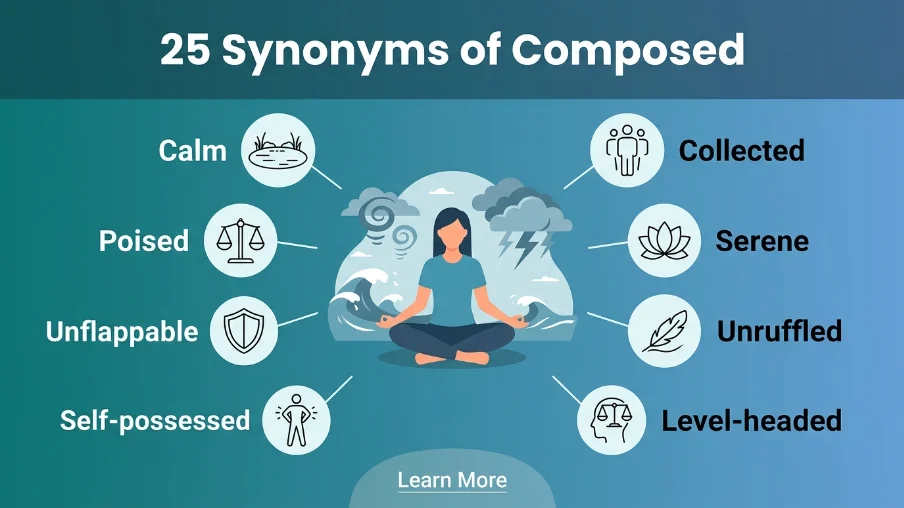
Composed means calm and in control of your emotions, especially during stressful situations. The best synonyms include calm, collected, serene, tranquil, poised, unruffled, self-possessed, cool, unflappable, and imperturbable. But each synonym has a slightly different meaning, tone, or context, so choosing the right one depends on your situation.
Have you ever watched someone stay perfectly calm during a crisis and wondered how they do it? That person is composed. Being composed means keeping your emotions under control when everything around you is chaotic.
But using the word composed over and over can make your writing sound repetitive. That’s where synonyms come in. Learning alternative words for composed will help you speak and write more naturally, just like a native speaker.
In this guide, you’ll discover 25 powerful synonyms for composed, complete with meanings, examples, and practical usage tips. By the end, you’ll know exactly which word to use in any situation whether you’re writing a job application, giving a presentation, or describing someone’s personality.
What Does “Composed” Mean?
Definition
In simple terms, composed describes someone who is calm and shows no nervousness or agitation. You might be very upset on the inside, but your composed face doesn’t give away your feelings. It’s about self-control keeping everything under control during times of stress.
Being composed doesn’t mean you don’t feel anything. It means you don’t show your feelings in a way that disrupts your behavior. You could be angry or nervous inside, but you maintain a composed manner that hides what you’re really feeling.
Pronunciation
| Feature | Value |
|---|---|
| US IPA | /kəmˈpoʊzd/ |
| UK IPA | /kəmˈpəʊzd/ |
| Syllables | 2 |
| Tip | Stress the second syllable: kuhm-POHZD |
Grammar
| Grammar Feature | Information |
|---|---|
| Part of Speech | Adjective |
| Common Position | After a verb (predicative) She remained composed |
| Typical Pattern | composed in/under/despite + noun |
Example Sentences:
- Despite the pressure, she gave a composed presentation.
- He remained perfectly composed throughout the difficult negotiation.
- The witness was composed and sure of her story.
Grammar Note: Composed is usually used after a verb like remain, stay, seem, or appear. It’s less common before a noun, though you might say a composed demeanor.
Word Family
| Word | Part of Speech | Meaning |
|---|---|---|
| Compose | Verb | To create or put together; to calm oneself |
| Composed | Adjective | Calm and in control of emotions |
| Composing | Adjective/Verb | The act of creating or calming |
| Composedly | Adverb | In a calm, controlled manner |
| Composure | Noun | The state of being calm and in control |
| Composedness | Noun | The quality of being composed |
| Discomposed | Adjective | Agitated or disturbed |
| Discomposure | Noun | A state of agitation |
25 Synonyms of “Composed”
1. Calm
Meaning: Free from agitation, excitement, or disturbance; peaceful.
Best Used For: Daily conversation, general descriptions of people or situations.
Formality: Neutral
Tone: Neutral, reassuring
Frequency: ⭐⭐⭐⭐⭐ Very Common
CEFR Level: A2
Example Sentence 1: Try to keep calm and just tell me what happened.
Example Sentence 2: The children were all calm and quiet during story time.
Usage Tip: Calm is the most general synonym. It can describe people, weather, or environments. Use it when you want a simple, everyday word. Unlike composed, calm doesn’t specifically imply effort or self-control it can be a natural state.
2. Collected
Meaning: Self-controlled and not easily upset; having your thoughts and feelings under control.
Best Used For: Professional contexts, describing someone who stays calm under pressure.
Formality: Neutral to formal
Tone: Professional, controlled
Frequency: ⭐⭐⭐⭐ Common
CEFR Level: B1
Example Sentence 1: Police say she was cool and collected during her interrogation.
Example Sentence 2: She was very calm and collected in high-stress meetings.
Usage Tip: Collected emphasizes that a person has gathered their thoughts and emotions together. It’s slightly more formal than calm and works well in professional writing. Native speakers often pair it with calm in the phrase calm and collected.
3. Serene
Meaning: Deeply peaceful and untroubled; having a quiet, calm quality.
Best Used For: Descriptive writing, literary contexts, describing peaceful environments or expressions.
Formality: Formal to literary
Tone: Poetic, peaceful, spiritual
Frequency: ⭐⭐⭐ Moderate
CEFR Level: B2
Example Sentence 1: She looked as calm and serene as always.
Example Sentence 2: The mountain view was absolutely serene at sunset.
Usage Tip: Serene suggests a deep, almost spiritual peace. It’s more poetic than calm and is often used for environments, landscapes, or facial expressions. Don’t use it for temporary calmness it implies lasting peace.
4. Tranquil
Meaning: Free from disturbance; calm and peaceful.
Best Used For: Describing peaceful places, lifestyles, or states of mind.
Formality: Formal
Tone: Peaceful, gentle
Frequency: ⭐⭐⭐ Moderate
CEFR Level: B2
Example Sentence 1: She lived a tranquil life.
Example Sentence 2: The garden provided a tranquil escape from the city noise.
Usage Tip: Tranquil is very similar to serene but often describes environments rather than people. It suggests an absence of disturbance rather than active self-control. Use it when describing peaceful settings or a calm way of life.
5. Poised
Meaning: Composed, balanced, and ready; showing confidence and control.
Best Used For: Professional settings, describing someone who is graceful under pressure.
Formality: Neutral to formal
Tone: Confident, graceful
Frequency: ⭐⭐⭐⭐ Common
CEFR Level: B2
Example Sentence 1: Rachel appeared poised and calm.
Example Sentence 2: Her poised demeanor impressed everyone at the meeting.
Usage Tip: Poised goes beyond just being calm it implies confidence, balance, and readiness. It’s an excellent word for professional contexts. A poised person doesn’t just stay calm; they look graceful and in control while doing it.
6. Self-possessed
Meaning: In full control of your feelings, behavior, and faculties.
Best Used For: Formal writing, character descriptions, professional contexts.
Formality: Formal
Tone: Controlled, dignified
Frequency: ⭐⭐⭐ Moderate
CEFR Level: B2
Example Sentence 1: She is the most articulate and self-possessed member of her family.
Example Sentence 2: The young lawyer was remarkably self-possessed during her first trial.
Usage Tip: Self-possessed emphasizes internal control and ownership of one’s emotions. It suggests a person who is fully aware of and in charge of themselves. It’s quite formal, so use it in professional or literary writing rather than casual conversation.
7. Unruffled
Meaning: Not agitated or disturbed; remaining calm despite provocation.
Best Used For: Describing someone who stays calm when others are upset or when things go wrong.
Formality: Neutral to formal
Tone: Controlled, steady
Frequency: ⭐⭐⭐ Moderate
CEFR Level: B2
Example Sentence 1: Anne had remained unruffled, very cool and controlled.
Example Sentence 2: He seemed remarkably unruffled for a man who was about to lose his job.
Usage Tip: Unruffled literally means “not ruffled” like feathers that haven’t been disturbed. It’s a vivid way to say someone stayed calm when they had every reason to be upset. Use it when you want to emphasize that someone wasn’t bothered by a difficult situation.
8. Unflappable
Meaning: Not easily perturbed or excited; marked by extreme calm and composure.
Best Used For: Describing professionals who handle crises well doctors, pilots, emergency responders.
Formality: Informal to neutral
Tone: Admiring, practical
Frequency: ⭐⭐⭐ Moderate
CEFR Level: B2
Example Sentence 1: Professional life-savers need to be calm and unflappable.
Example Sentence 2: As an A&E doctor, she’s got to be unflappable.
Usage Tip: Unflappable is a wonderful, slightly informal word for someone who never gets rattled. It’s more colorful than composed and suggests a natural, almost effortless ability to stay calm. Use it when you want to praise someone’s ability to handle pressure.
9. Imperturbable
Meaning: Not easily upset or excited; extremely calm and steady.
Best Used For: Formal writing, leadership descriptions, character portraits.
Formality: Very formal
Tone: Dignified, steady
Frequency: ⭐ Rare
CEFR Level: C1
Example Sentence 1: His imperturbable nature made him an excellent leader.
Example Sentence 2: He was cool and aloof, and imperturbable.
Usage Tip: Imperturbable is the most formal synonym on this list. It suggests a person who is literally impossible to perturb or disturb. It’s a powerful word but can sound stiff in everyday conversation. Reserve it for formal writing or when you want to make a strong impression.
10. Cool
Meaning: Not showing or feeling nervousness, anger, or other strong emotions.
Best Used For: Everyday conversation, informal writing, describing someone who stays calm.
Formality: Informal
Tone: Casual, approving
Frequency: ⭐⭐⭐⭐⭐ Very Common
CEFR Level: A2
Example Sentence 1: He was marvellously cool, smiling as if nothing had happened.
Example Sentence 2: He was very cool about the problem and didn’t shout or lose his temper.
Usage Tip: Cool is very common in informal English. It can mean “calm” or “not upset,” but it can also mean “fashionable” or “impressive,” so be careful with context. In the sense of being composed, it’s often used in phrases like keep your cool or cool under pressure.
11. Unperturbed
Meaning: Not worried or disturbed by something; remaining calm.
Best Used For: Describing someone who isn’t affected by negative comments or difficult situations.
Formality: Formal
Tone: Neutral, steady
Frequency: ⭐⭐⭐ Moderate
CEFR Level: B2
Example Sentence 1: He was completely unperturbed by her nasty remark.
Example Sentence 2: Ruiz seemed totally unperturbed by the events unfolding around him.
Usage Tip: Unperturbed focuses on not being disturbed by external events. It’s similar to unruffled but slightly more formal. Use it when you want to emphasize that someone wasn’t affected by something that would typically upset people.
12. Placid
Meaning: Calm and not easily excited, angry, or upset.
Best Used For: Describing gentle, easygoing people or calm waters.
Formality: Neutral to formal
Tone: Gentle, peaceful
Frequency: ⭐⭐⭐ Moderate
CEFR Level: B2
Example Sentence 1: She was a placid child who rarely cried.
Example Sentence 2: The placid lake reflected the mountains perfectly.
Usage Tip: Placid describes a naturally calm temperament someone who is not easily excited or angered. It’s gentler than composed and suggests a peaceful nature rather than active self-control. It can also describe calm water or weather.
13. Sedate
Meaning: Quiet, calm, and rather slow; sometimes suggesting dullness.
Best Used For: Describing calm, unhurried people, places, or lifestyles.
Formality: Formal
Tone: Calm, unhurried, sometimes dull
Frequency: ⭐⭐ Rare
CEFR Level: B2
Example Sentence 1: She took them to visit her sedate, elderly cousins.
Example Sentence 2: The town had a sedate, old-fashioned charm.
Usage Tip: Sedate suggests calmness that is almost slow or dull. It can be positive (peaceful, unhurried) or slightly negative (boring, lacking excitement). Use it carefully it often implies a lack of energy rather than admirable self-control.
14. Even-tempered
Meaning: Not easily upset or angered; consistently calm and balanced.
Best Used For: Describing someone’s personality, especially in professional or personal contexts.
Formality: Neutral
Tone: Approving, steady
Frequency: ⭐⭐⭐ Moderate
CEFR Level: B2
Example Sentence 1: He’s so even-tempered he’ll make an excellent teacher.
Example Sentence 2: Her even-tempered nature made her popular with colleagues.
Usage Tip: Even-tempered describes a personality trait someone who is consistently calm and not prone to mood swings. It’s a warm, approving word. Unlike composed, which can be a temporary state, even-tempered suggests a permanent characteristic.
15. Level-headed
Meaning: Calm and sensible; able to make good decisions even in difficult situations.
Best Used For: Describing leaders, decision-makers, and people who stay rational under pressure.
Formality: Neutral
Tone: Practical, sensible
Frequency: ⭐⭐⭐ Moderate
CEFR Level: B2
Example Sentence 1: She is level-headed and practical.
Example Sentence 2: She’s very level-headed and unlikely to get upset by what has happened.
Usage Tip: Level-headed combines calmness with good judgment. It’s not just about staying calm it’s about staying sensible and making good decisions. It’s an excellent word for describing leaders, managers, or anyone who needs to think clearly under pressure.
16. Unfazed
Meaning: Not worried or surprised by something; unaffected.
Best Used For: Informal conversation, describing someone who takes things in stride.
Formality: Informal
Tone: Casual, relaxed
Frequency: ⭐⭐⭐ Moderate
CEFR Level: B2
Example Sentence 1: She was unfazed by the news that he was leaving her.
Example Sentence 2: Despite the chaos around her, she remained completely unfazed.
Usage Tip: Unfazed is an informal, modern word. It suggests that someone wasn’t bothered or surprised by something that would typically affect people. It’s great for casual conversation but might be too informal for academic or business writing.
17. Cool-headed
Meaning: Not easily excited or panicked; calm and controlled.
Best Used For: Describing people who stay rational in emergencies or high-pressure situations.
Formality: Neutral
Tone: Practical, controlled
Frequency: ⭐⭐⭐ Moderate
CEFR Level: B2
Example Sentence 1: The cool-headed pilot landed the plane safely during the storm.
Example Sentence 2: We need a cool-headed manager to handle this crisis.
Usage Tip: Cool-headed emphasizes rationality and lack of panic. It’s similar to level-headed but focuses more on emotional control than good judgment. It’s a useful, practical word for everyday use.
18. Equanimous
Meaning: Having or showing equanimity; calm and balanced in difficult situations.
Best Used For: Formal writing, psychological contexts, describing emotional balance.
Formality: Very formal
Tone: Intellectual, balanced
Frequency: ⭐ Very Rare
CEFR Level: C1
Example Sentence 1: The monk remained equanimous despite the chaos around him.
Example Sentence 2: Her equanimous response to criticism impressed her colleagues.
Usage Tip: Equanimous is a rare, formal word related to equanimity (mental calmness). It’s more common to use the noun equanimity than the adjective. Unless you’re writing very formally, calm or composed are better choices.
19. Together
Meaning: Well-organized, calm, and in control.
Best Used For: Informal conversation, describing someone who has their life organized.
Formality: Informal
Tone: Casual, approving
Frequency: ⭐⭐⭐⭐ Common
CEFR Level: B1
Example Sentence 1: She was very headstrong, and very together.
Example Sentence 2: Despite the chaos, she seemed completely together.
Usage Tip: Together is an informal way to say someone is composed and organized. It’s often used to describe someone who appears to have everything under control their emotions, their life, their work. It’s friendly and conversational but not suitable for formal writing.
20. Peaceful
Meaning: Free from disturbance; calm and quiet.
Best Used For: Describing environments, people, or situations that are calm and quiet.
Formality: Neutral
Tone: Gentle, soothing
Frequency: ⭐⭐⭐⭐ Common
CEFR Level: A2
Example Sentence 1: The peaceful garden was a perfect place to relax.
Example Sentence 2: She felt peaceful after her meditation session.
Usage Tip: Peaceful describes a state of calm and quiet. It can describe both external environments and internal states. Unlike composed, it doesn’t imply active self-control it suggests a gentle, natural calm.
21. Dispassionate
Meaning: Not influenced by strong emotion; objective and calm.
Best Used For: Academic writing, legal contexts, describing objective analysis.
Formality: Formal
Tone: Objective, analytical
Frequency: ⭐⭐ Rare
CEFR Level: C1
Example Sentence 1: The judge gave a dispassionate assessment of the evidence.
Example Sentence 2: We need a dispassionate analysis of the situation.
Usage Tip: Dispassionate emphasizes lack of emotion rather than control of emotion. It’s often used in academic, legal, or analytical contexts where objectivity is valued. It’s not about staying calm under pressure it’s about being free from emotional bias.
22. Unagitated
Meaning: Not agitated or disturbed emotionally.
Best Used For: Describing someone who remains calm when others are upset.
Formality: Neutral to formal
Tone: Neutral, controlled
Frequency: ⭐ Rare
CEFR Level: B2
Example Sentence 1: She remained unagitated despite the shouting around her.
Example Sentence 2: His unagitated response defused the tense situation.
Usage Tip: Unagitated is a straightforward word that simply means “not agitated”. It’s less common than calm or composed but can be useful when you want to be precise. It emphasizes the absence of agitation rather than the presence of control.
23. At ease
Meaning: Relaxed and comfortable; not worried or tense.
Best Used For: Describing someone who is comfortable in a situation, not nervous.
Formality: Neutral
Tone: Relaxed, comfortable
Frequency: ⭐⭐⭐ Moderate
CEFR Level: B1
Example Sentence 1: She seemed completely at ease during the interview.
Example Sentence 2: He put his guests at ease with his warm welcome.
Usage Tip: At ease is a phrase rather than a single word, but it’s a common alternative to composed. It suggests relaxation and comfort rather than active self-control. Use it when you want to emphasize that someone feels comfortable, not just controlled.
24. Controlled
Meaning: Restrained and deliberate; not showing strong emotions.
Best Used For: Describing someone who deliberately restrains their emotions.
Formality: Neutral to formal
Tone: Deliberate, restrained
Frequency: ⭐⭐⭐⭐ Common
CEFR Level: B1
Example Sentence 1: She spoke in a controlled, measured voice.
Example Sentence 2: His controlled reaction surprised everyone.
Usage Tip: Controlled emphasizes deliberate restraint. A controlled person is actively holding back their emotions. It’s a useful word but can sometimes sound negative like someone is too controlled or repressed. Use it carefully.
Synonyms Comparison Table
| Synonym | Best Context | Formality | Tone | Frequency |
|---|---|---|---|---|
| Calm | General, everyday | Neutral | Neutral | ⭐⭐⭐⭐⭐ |
| Cool | Informal conversation | Informal | Casual | ⭐⭐⭐⭐⭐ |
| Collected | Professional settings | Neutral | Controlled | ⭐⭐⭐⭐ |
| Poised | Professional, confident | Neutral | Confident | ⭐⭐⭐⭐ |
| Serene | Literary, descriptive | Formal | Poetic | ⭐⭐⭐ |
| Tranquil | Environments, lifestyles | Formal | Peaceful | ⭐⭐⭐ |
| Unruffled | Staying calm under provocation | Neutral | Steady | ⭐⭐⭐ |
| Self-possessed | Formal, dignified | Formal | Dignified | ⭐⭐⭐ |
| Unflappable | Crisis professionals | Informal | Admiring | ⭐⭐⭐ |
| Level-headed | Leaders, decision-makers | Neutral | Sensible | ⭐⭐⭐ |
| Even-tempered | Personality descriptions | Neutral | Approving | ⭐⭐⭐ |
| Placid | Gentle, easygoing people | Neutral | Gentle | ⭐⭐⭐ |
| Unperturbed | Not affected by events | Formal | Steady | ⭐⭐⭐ |
| Imperturbable | Very formal writing | Very formal | Dignified | ⭐ |
| Together | Casual conversation | Informal | Casual | ⭐⭐⭐⭐ |
Best Synonyms by Situation
| Situation | Best Synonym | Why It Works |
|---|---|---|
| Daily Conversation | Calm or Cool | Natural and easy to understand |
| Business Email | Collected or Poised | Professional and clear |
| Academic Writing | Imperturbable or Dispassionate | Formal and precise |
| School Assignment | Calm or Composed | Simple and appropriate |
| Professional Meeting | Poised or Level-headed | Confident and business-like |
| Presentation | Composed or Poised | Clear and professional |
| Creative Writing | Serene or Tranquil | Imagery-rich and descriptive |
| Social Media | Cool or Unfazed | Modern and relatable |
| Job Interview | Composed or Poised | Professional and confident |
| Emergency Situation | Unflappable or Cool-headed | Practical and appropriate |
Formal vs Informal Synonyms
Formal Alternatives
| Synonym | Best Used For |
|---|---|
| Imperturbable | Formal writing, leadership descriptions |
| Serene | Literary, descriptive, poetic contexts |
| Tranquil | Describing peaceful environments |
| Self-possessed | Dignified character descriptions |
| Dispassionate | Academic, legal, analytical writing |
| Equanimous | Psychological or philosophical contexts |
Neutral Alternatives
| Synonym | Best Used For |
|---|---|
| Calm | Almost any context |
| Composed | Professional and everyday use |
| Collected | Professional contexts |
| Poised | Professional, confident situations |
| Level-headed | Decision-making contexts |
| Even-tempered | Personality descriptions |
| Unruffled | Staying calm under pressure |
Informal Alternatives
| Synonym | Best Used For |
|---|---|
| Cool | Friends, casual conversation |
| Together | Describing someone organized |
| Unfazed | Casual, modern contexts |
| Laid-back | Describing relaxed personalities |
When to Choose Each Level of Formality: Use formal synonyms in academic papers, legal documents, and formal speeches. Use neutral synonyms in business writing, emails, and most professional contexts. Use informal synonyms with friends, on social media, and in casual conversation. The key is matching your word to your audience and situation.
Strong vs Mild Synonyms
Mild
- Calm — A general state of peace
- Peaceful — Gentle calmness
- Placid — Naturally easygoing
- At ease — Comfortable and relaxed
These words suggest calmness without emphasizing effort or intensity.
Moderate
- Composed — Active self-control
- Collected — Gathered thoughts and emotions
- Poised — Confident and balanced
- Unruffled — Not disturbed by events
- Level-headed — Calm and sensible
These words suggest deliberate control and are suitable for most professional contexts.
Strong
- Imperturbable — Impossible to disturb
- Unflappable — Never rattled
- Self-possessed — Complete internal control
- Stoic — Enduring without complaint
Use these words carefully. They convey exceptional calmness and should be reserved for situations where someone demonstrates remarkable self-control. Overusing them can make your writing sound exaggerated.
Real-Life Examples
In the Workplace:
- “Despite the angry client on the phone, she remained composed and professional.”
- “His poised presentation impressed the entire board of directors.”
In Academic Writing:
- “The researcher maintained a dispassionate analysis of the controversial data.”
- “Her imperturbable demeanor during the exam reassured her anxious classmates.”
In Everyday Conversation:
- “Just stay calm everything will be fine.”
- “He was so cool about it, like nothing had happened.”
In Creative Writing:
- “Her serene expression belied the chaos in her heart.”
- “The tranquil lake reflected the peaceful sky above.”
In Business Emails:
- “Thank you for your collected and professional response to the issue.
- “We need a level-headed approach to this challenging situation.”
In Social Media:
- “Staying unfazed despite everything that’s the goal!”
- “She’s so together, I don’t know how she does it.”
Common Collocations
| Common Phrase | Better Alternative |
|---|---|
| Stay calm | Remain composed, stay collected |
| Calm down | Regain composure, collect yourself |
| Keep calm | Stay unruffled, remain level-headed |
| Calm voice | Composed voice, measured tone |
| Calm response | Poised response, unruffled reaction |
| Calm personality | Even-tempered nature, placid disposition |
| Calm environment | Serene setting, tranquil atmosphere |
| Calm waters | Placid waters, tranquil seas |
Common Phrases
| Phrase | Meaning | Stronger Alternative |
|---|---|---|
| Keep your cool | Stay calm | Remain composed |
| Lose your cool | Become angry or upset | Become agitated |
| Calm and collected | Very calm and in control | (Already strong) |
| Stay calm and carry on | Remain calm despite difficulty | Remain unruffled |
| Composed demeanor | Calm appearance | Poised bearing |
| Maintain composure | Stay calm | Keep your equilibrium |
| Cool under pressure | Calm in difficult situations | Unflappable under pressure |
Context Guide
| Situation | Best Synonym | Reason |
|---|---|---|
| Essay | Composed or Dispassionate | Academic and precise |
| Speech | Composed or Poised | Clear and impactful |
| Business Email | Collected or Level-headed | Professional and clear |
| Novel | Serene or Tranquil | Imagery-rich and emotional |
| Presentation | Poised or Composed | Confident and audience-friendly |
| Conversation | Calm or Cool | Natural and easy |
| Academic Writing | Imperturbable or Dispassionate | Formal and precise |
| Marketing Copy | Composed or Poised | Professional and engaging |
Related Words
Near Synonyms
- Calm — Free from agitation
- Collected — Self-controlled
- Serene — Deeply peaceful
- Tranquil — Free from disturbance
- Poised — Confident and balanced
Antonyms
- Agitated — Upset and nervous
- Anxious — Worried and uneasy
- Nervous — Easily worried or frightened
- Flustered — Confused and agitated
- Discomposed — Disturbed or agitated
- Excitable — Easily excited
Related Adjectives
- Calm — Peaceful and untroubled
- Collected — In control of emotions
- Serene — Deeply peaceful
- Poised — Balanced and confident
- Even-tempered — Consistently calm
- Level-headed — Calm and sensible
Related Nouns
- Composure — The state of being calm
- Calmness — The quality of being calm
- Serenity — Deep peacefulness
- Equanimity — Mental calmness
- Self-possession — Control over one’s emotions
- Poise — Graceful balance and composure
Related Verbs
- Compose — To calm oneself; to create
- Calm — To make someone calm
- Collect — To gather one’s thoughts
- Steady — To make steady or calm
Frequently Asked Questions
What is another word for composed?
The most common synonyms for composed are calm, collected, serene, and poised. The best choice depends on your context. For everyday use, calm works well. For professional contexts, use collected or poised. For literary writing, try serene or tranquil.
Which synonym sounds the most professional?
Collected, poised, and composed itself sound the most professional. These words are common in business writing and professional contexts. Imperturbable is also professional but very formal use it sparingly.
What is the strongest synonym for composed?
Imperturbable is the strongest formal synonym it means impossible to disturb. Unflappable is the strongest informal synonym. Both suggest an almost superhuman ability to stay calm. Use them when you want to emphasize exceptional self-control.
Which synonym is best for essays?
Composed, dispassionate, and imperturbable work well in essays. Composed is versatile, dispassionate is great for objective analysis, and imperturbable works for character descriptions. All are formal enough for academic writing.
What’s the difference between composed and calm?
Calm is general it can describe people, weather, or situations. Composed specifically means maintaining control over your emotions, especially under pressure. A calm person might naturally be peaceful, but a composed person actively controls their emotions in stressful situations.
What’s the difference between composed and serene?
Composed is about self-control under pressure staying calm when you have reason not to be. Serene is about deep, lasting peace a state of tranquility that isn’t easily disturbed. You can be composed during a crisis, but serene suggests a more permanent peacefulness.
Which synonym is most common in everyday English?
Calm is the most common synonym, followed by cool. Native speakers use these words daily. Composed itself is also common but slightly more formal. For everyday conversation, calm is usually your best choice.
What is the opposite of composed?
The main opposites are agitated, anxious, nervous, flustered, and discomposed. Agitated means upset and nervous. Anxious means worried. Nervous means easily frightened or worried. Choose based on the specific type of distress you mean.
Conclusion
Composed is a valuable word that describes one of the most admired qualities staying calm and in control when things get difficult. Whether you’re writing about a leader, describing a friend, or talking about yourself, having the right word makes all the difference.
Now you have 25 powerful synonyms to choose from. Remember:
- Use calm for everyday, general situations
- Use collected or poised for professional contexts
- Use serene or tranquil for peaceful, descriptive writing
- Use unflappable or imperturbable for exceptional self-control
- Use level-headed or even-tempered for personality descriptions
The key to choosing the right synonym is understanding your context, tone, and audience. A word that works perfectly in a business email might sound odd in casual conversation. Practice using these synonyms in your daily writing and speaking, and soon they’ll feel completely natural.
Start small try replacing calm with composed or collected in your next professional email. Then experiment with more descriptive words like serene or unruffled when the situation is right. Your vocabulary will grow, and your English will sound more fluent and natural.

2 thoughts on “25 Synonyms of Composed | Meaning, Examples & Usage For 2026”